AI Investor Update Deck: Monthly Metrics Narrative Template
Updated August 17, 2026 · Sarah Jenkins
An AI investor update deck monthly metrics narrative workflow helps founders turn raw KPIs, wins, misses, risks, and asks into a concise update that explains not only what changed, but why it changed and what happens next.
This guide covers target users, the recommended monthly structure, what each slide should contain, a copyable prompt, example narrative, risk checks, FAQ, and the PopAi presentation workflow.
AI Investor Update Deck Monthly Metrics Narrative: Lead with Signal
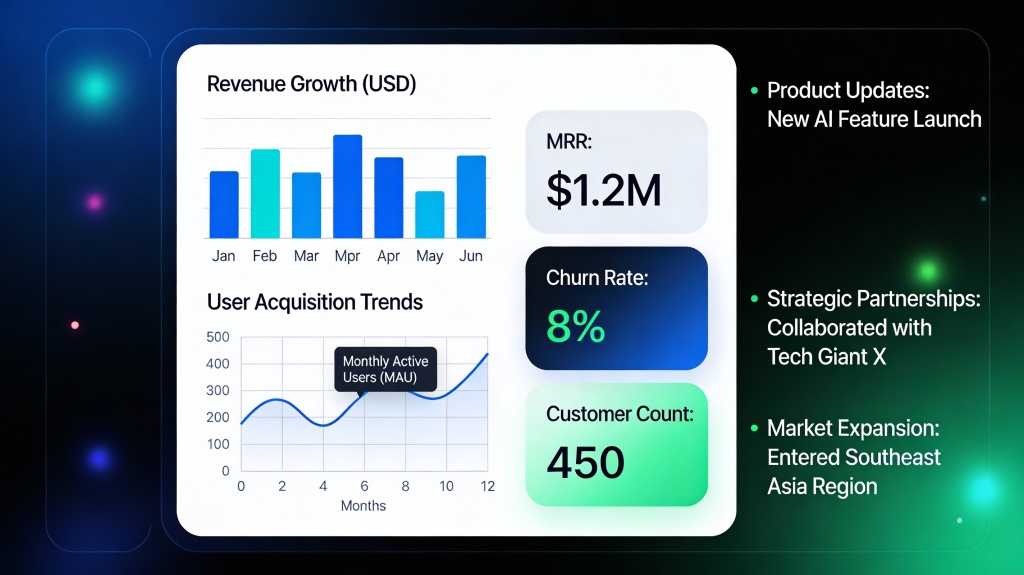
Investors do not need a spreadsheet disguised as slides. They need a consistent view of progress, context behind the numbers, founder judgment, clear risks, and specific ways to help.
Target Users and Investor Update Scenarios
- Pre-seed and seed founders sending a consistent monthly update.
- Series A teams combining finance, product, and go-to-market reporting.
- CEOs preparing a short board pre-read before a deeper meeting.
- Investor relations teams standardizing portfolio communication.
Recommended Monthly Investor Update Template
| Slide | Investor question | What to include |
|---|---|---|
| 1. Executive summary | What changed? | Three wins, one concern, one ask |
| 2. North-star KPI | Is the company progressing? | Current value, target, trend, and cause |
| 3. Revenue | Is growth durable? | MRR/ARR, MoM growth, and revenue drivers |
| 4. Retention | Do customers stay? | Churn, NRR, cohort signal, and action |
| 5. Product | Is execution improving? | Usage, launches, adoption, and evidence |
| 6. Go-to-market | Is demand efficient? | Pipeline, conversion, CAC, and learning |
| 7. Cash | How much time remains? | Burn, runway, forecast, and variance |
| 8. Risks | What could break the plan? | Issue, impact, owner, and mitigation |
| 9. Next month | What happens next? | Priorities, milestones, and owners |
| 10. Asks | How can investors help? | Introductions, hiring, advice, or decision |
AI Prompt and Monthly Narrative Examples
Example: growth with a retention warning
MRR grew 12% month over month after the enterprise launch, but SMB logo churn rose from 3.1% to 4.4%. Next action: run onboarding calls for the 20 lowest-adoption accounts and report the result next month.
Example: a useful investor ask
We are hiring a founding customer success lead before October. We need introductions to operators who have built onboarding for a $1M to $10M ARR B2B SaaS company.
Review the Metrics, Narrative, and Asks
- Verify metric definitions and use the same reporting period every month.
- Explain the driver behind a change instead of repeating the chart.
- Show misses and risks with an owner and mitigation plan.
- Keep technical detail and full financials in an appendix.
- Make each investor ask specific enough to act on immediately.
For quarterly leadership reporting, use the AI QBR deck generator. For fundraising, use the startup investor pitch deck structure.
Frequently Asked Questions
What is an AI investor update deck monthly metrics narrative?
It is a structured monthly report that connects verified startup KPIs to business context, actions, risks, next milestones, and investor asks.
How often should founders send investor updates?
Most early-stage founders benefit from a consistent monthly update, while larger companies may pair a short monthly summary with quarterly reviews.
Which metrics should the deck include?
Use the metrics that explain progress and risk, such as MRR or ARR, growth, retention, product adoption, pipeline, burn, runway, and forecast variance.
Can AI explain why a metric changed?
It can draft an explanation from your notes, but founders must verify the cause and distinguish evidence from assumptions.