Presentation Summary
An in-depth analysis of the 2026-2027 TV industry's strategic shifts in renewals and cancellations across broadcast and streaming platforms, impacting viewer habits and industry trends.
Full Presentation Transcript
Slide 1: The 2026-2027 TV Industry Reckoning: Renewals, Cancellations, and the Reshaping of Television
A comprehensive analysis of broadcast, cable, and streaming platform decisions that define the next phase of television
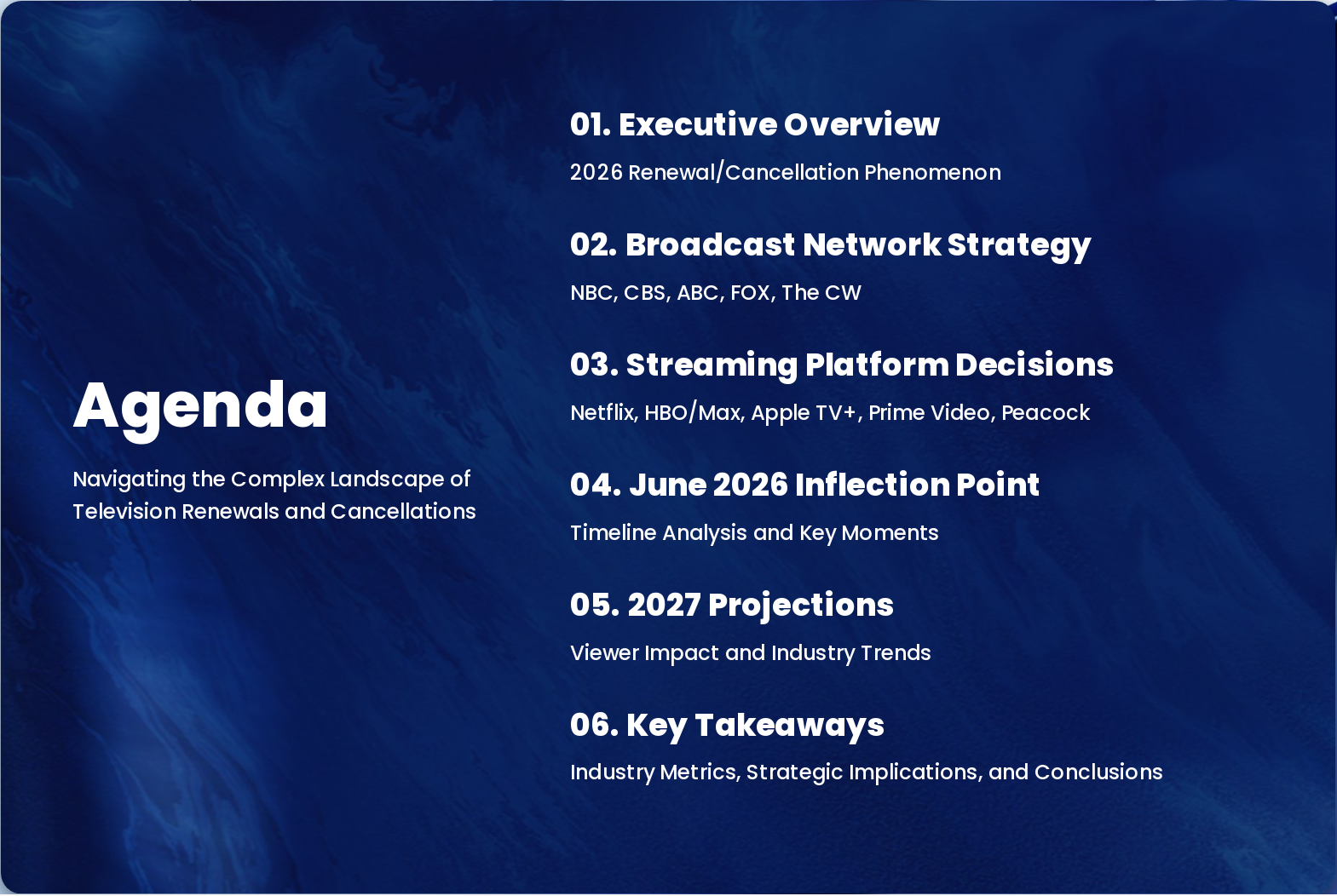
Slide 2: Agenda
- Executive Overview: 2026 Renewal/Cancellation Phenomenon
- Broadcast Network Strategy: NBC, CBS, ABC, FOX, The CW
- Streaming Platform Decisions: Netflix, HBO/Max, Apple TV+, Prime Video, Peacock
- June 2026 Inflection Point: Timeline Analysis and Key Moments
- 2027 Projections: Viewer Impact and Industry Trends
- Key Takeaways: Industry Metrics, Strategic Implications, and Conclusions
Navigating the Complex Landscape of Television Renewals and Cancellations
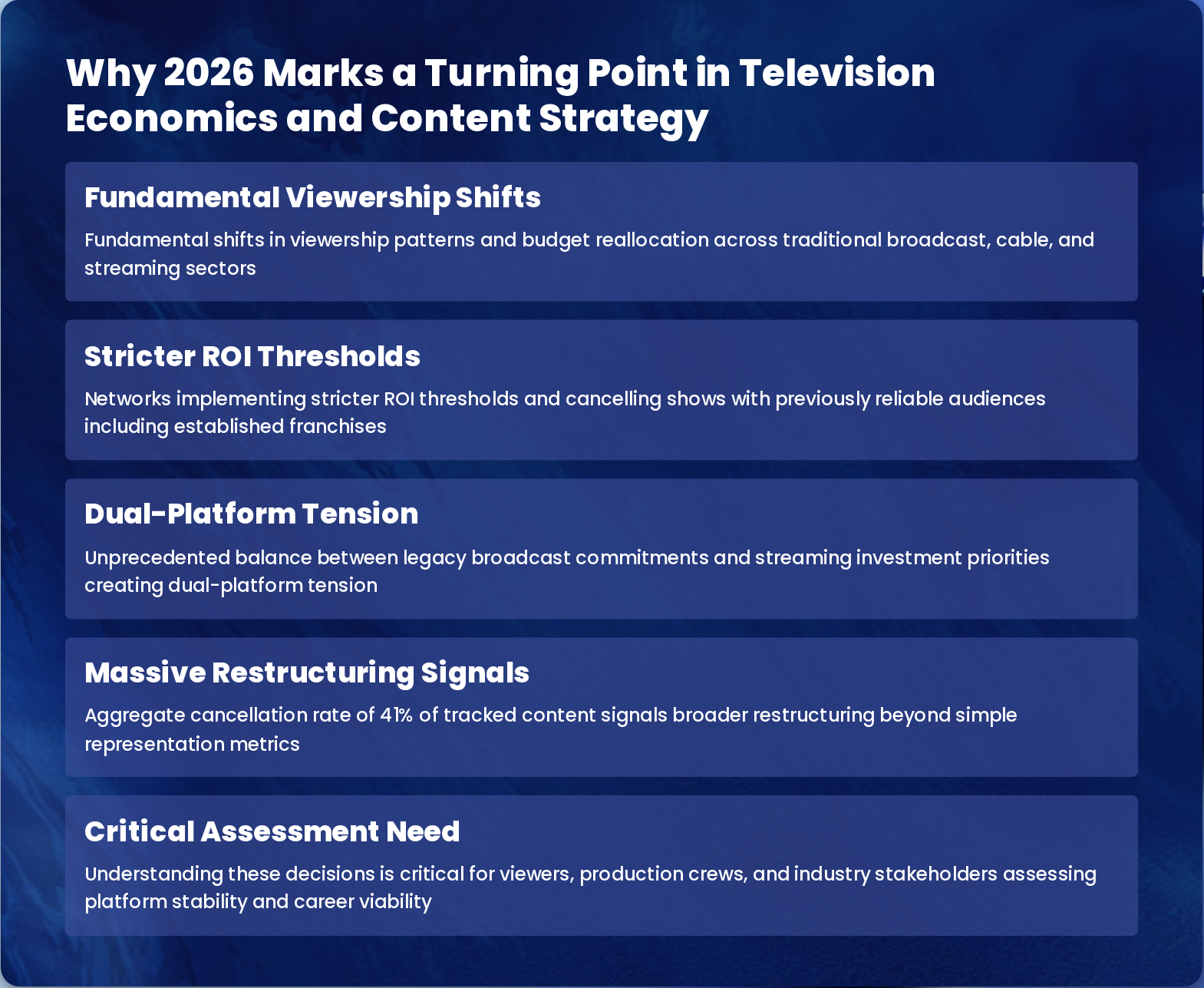
Slide 3: Why 2026 Marks a Turning Point in Television Economics and Content Strategy
- Fundamental Viewership Shifts: Fundamental shifts in viewership patterns and budget reallocation across traditional broadcast, cable, and streaming sectors
- Stricter ROI Thresholds: Networks implementing stricter ROI thresholds and cancelling shows with previously reliable audiences including established franchises
- Dual-Platform Tension: Unprecedented balance between legacy broadcast commitments and streaming investment priorities creating dual-platform tension
- Massive Restructuring Signals: Aggregate cancellation rate of 41% of tracked content signals broader restructuring beyond simple representation metrics
- Critical Assessment Need: Understanding these decisions is critical for viewers, production crews, and industry stakeholders assessing platform stability and career viability
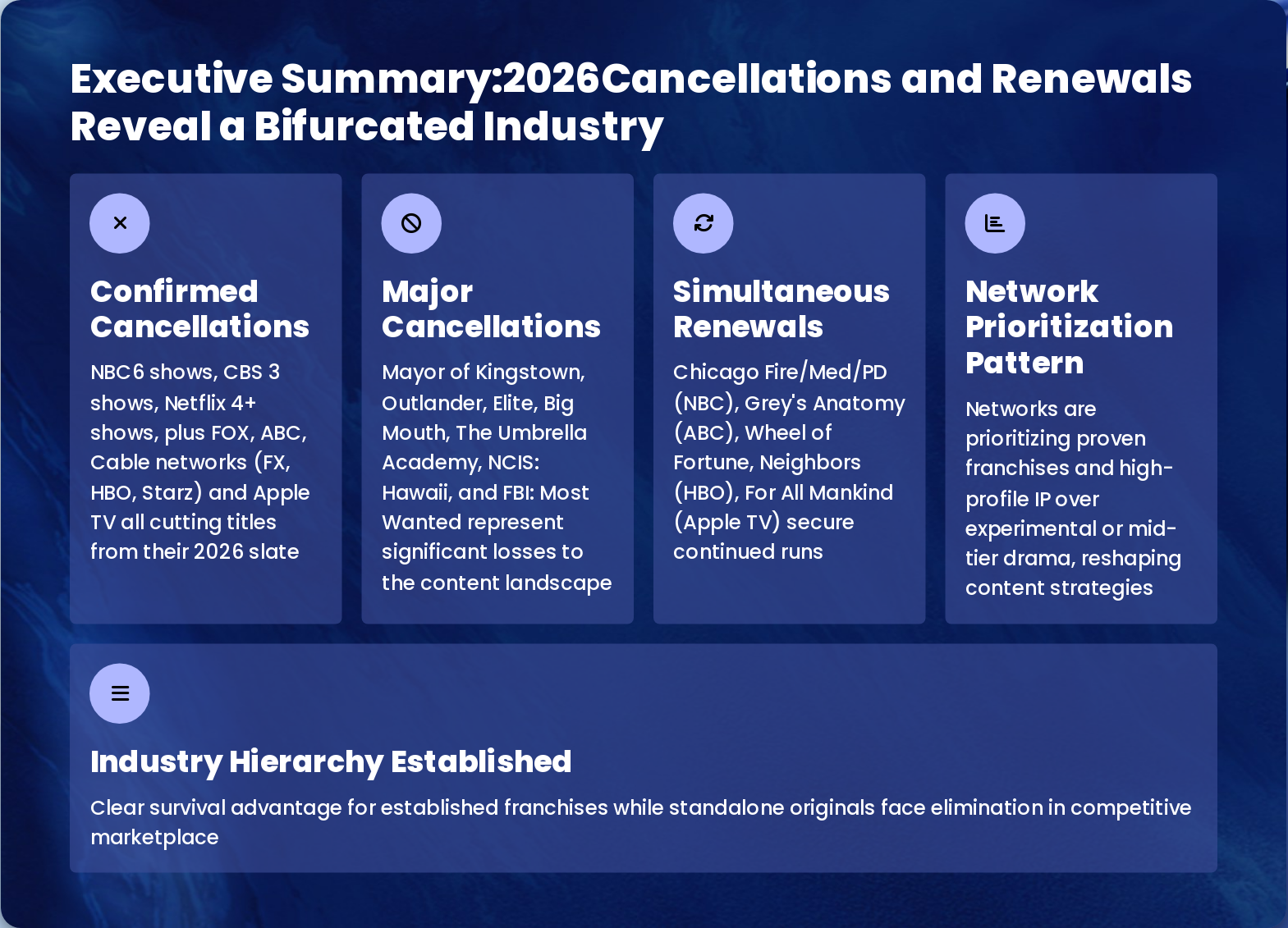
Slide 4: Executive Summary:2026Cancellations and Renewals Reveal a Bifurcated Industry
- Confirmed Cancellations: NBC6 shows, CBS 3 shows, Netflix 4+ shows, plus FOX, ABC, Cable networks (FX, HBO, Starz) and Apple TV all cutting titles from their 2026 slate
- Major Cancellations: Mayor of Kingstown, Outlander, Elite, Big Mouth, The Umbrella Academy, NCIS: Hawaii, and FBI: Most Wanted represent significant losses to the content landscape
- Simultaneous Renewals: Chicago Fire/Med/PD (NBC), Grey's Anatomy (ABC), Wheel of Fortune, Neighbors (HBO), For All Mankind (Apple TV) secure continued runs
- Network Prioritization Pattern: Networks are prioritizing proven franchises and high-profile IP over experimental or mid-tier drama, reshaping content strategies
- Industry Hierarchy Established: Clear survival advantage for established franchises while standalone originals face elimination in competitive marketplace
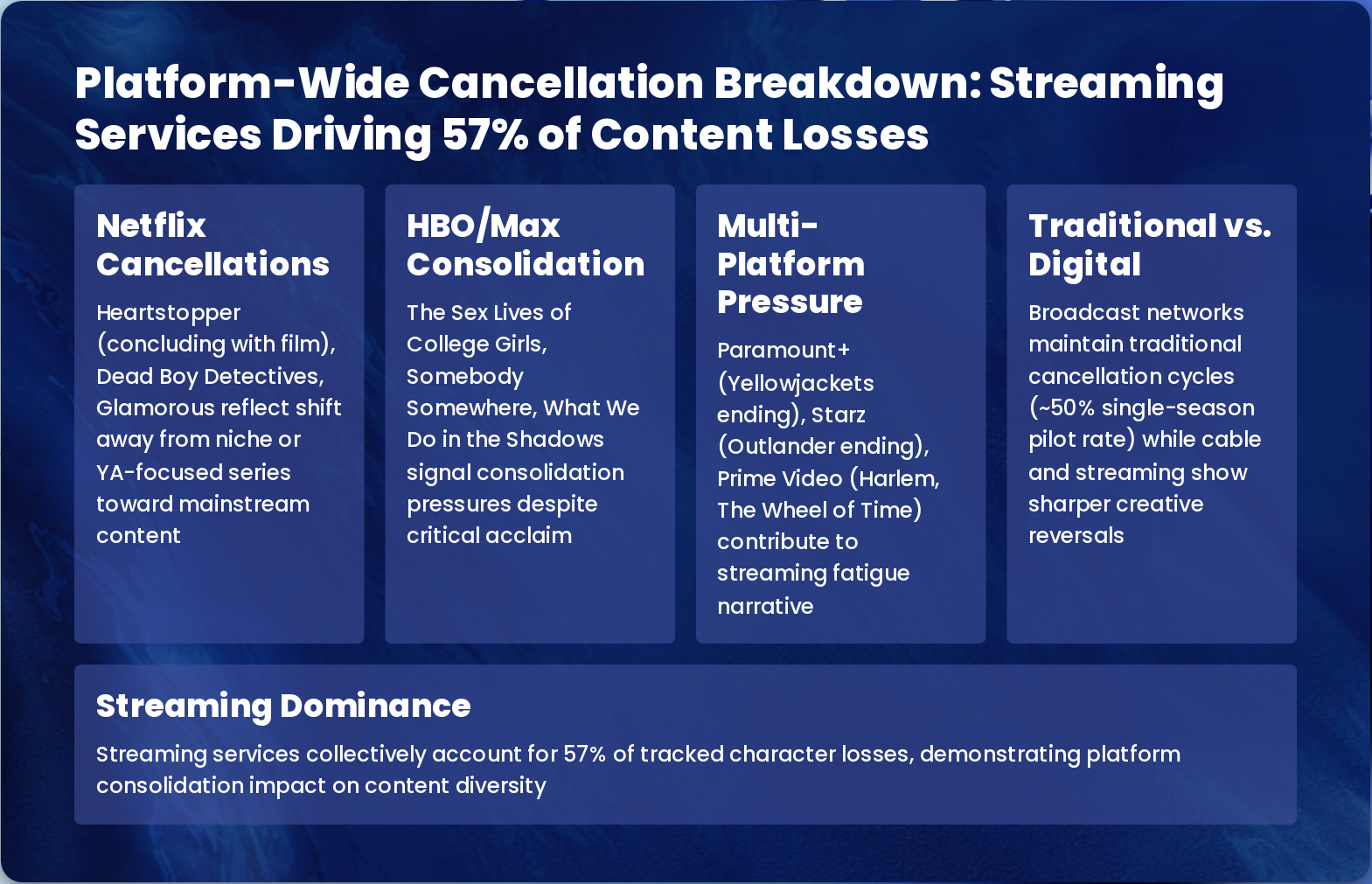
Slide 5: Platform-Wide Cancellation Breakdown: Streaming Services Driving 57% of Content Losses
- Netflix Cancellations: Heartstopper (concluding with film), Dead Boy Detectives, Glamorous reflect shift away from niche or YA-focused series toward mainstream content
- HBO/Max Consolidation: The Sex Lives of College Girls, Somebody Somewhere, What We Do in the Shadows signal consolidation pressures despite critical acclaim
- Multi-Platform Pressure: Paramount+ (Yellowjackets ending), Starz (Outlander ending), Prime Video (Harlem, The Wheel of Time) contribute to streaming fatigue narrative
- Traditional vs. Digital: Broadcast networks maintain traditional cancellation cycles (~50% single-season pilot rate) while cable and streaming show sharper creative reversals
- Streaming Dominance: Streaming services collectively account for 57% of tracked character losses, demonstrating platform consolidation impact on content diversity
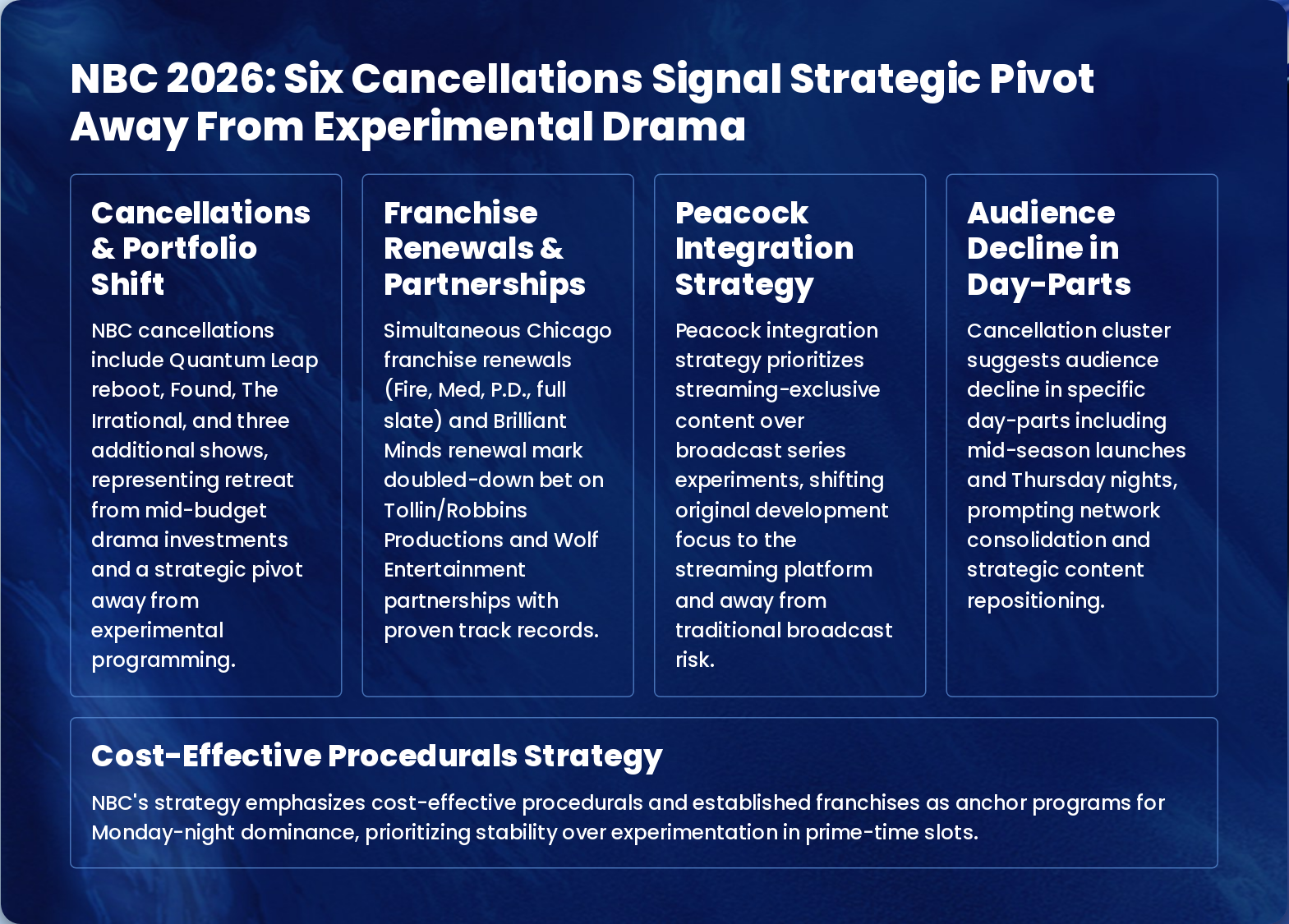
Slide 6: NBC 2026: Six Cancellations Signal Strategic Pivot Away From Experimental Drama
- Cancellations & Portfolio Shift: NBC cancellations include Quantum Leap reboot, Found, The Irrational, and three additional shows, representing retreat from mid-budget drama investments and a strategic pivot away from experimental programming.
- Franchise Renewals & Partnerships: Simultaneous Chicago franchise renewals (Fire, Med, P.D., full slate) and Brilliant Minds renewal mark doubled-down bet on Tollin/Robbins Productions and Wolf Entertainment partnerships with proven track records.
- Peacock Integration Strategy: Peacock integration strategy prioritizes streaming-exclusive content over broadcast series experiments, shifting original development focus to the streaming platform and away from traditional broadcast risk.
- Audience Decline in Day-Parts: Cancellation cluster suggests audience decline in specific day-parts including mid-season launches and Thursday nights, prompting network consolidation and strategic content repositioning.
- Cost-Effective Procedurals Strategy: NBC's strategy emphasizes cost-effective procedurals and established franchises as anchor programs for Monday-night dominance, prioritizing stability over experimentation in prime-time slots.
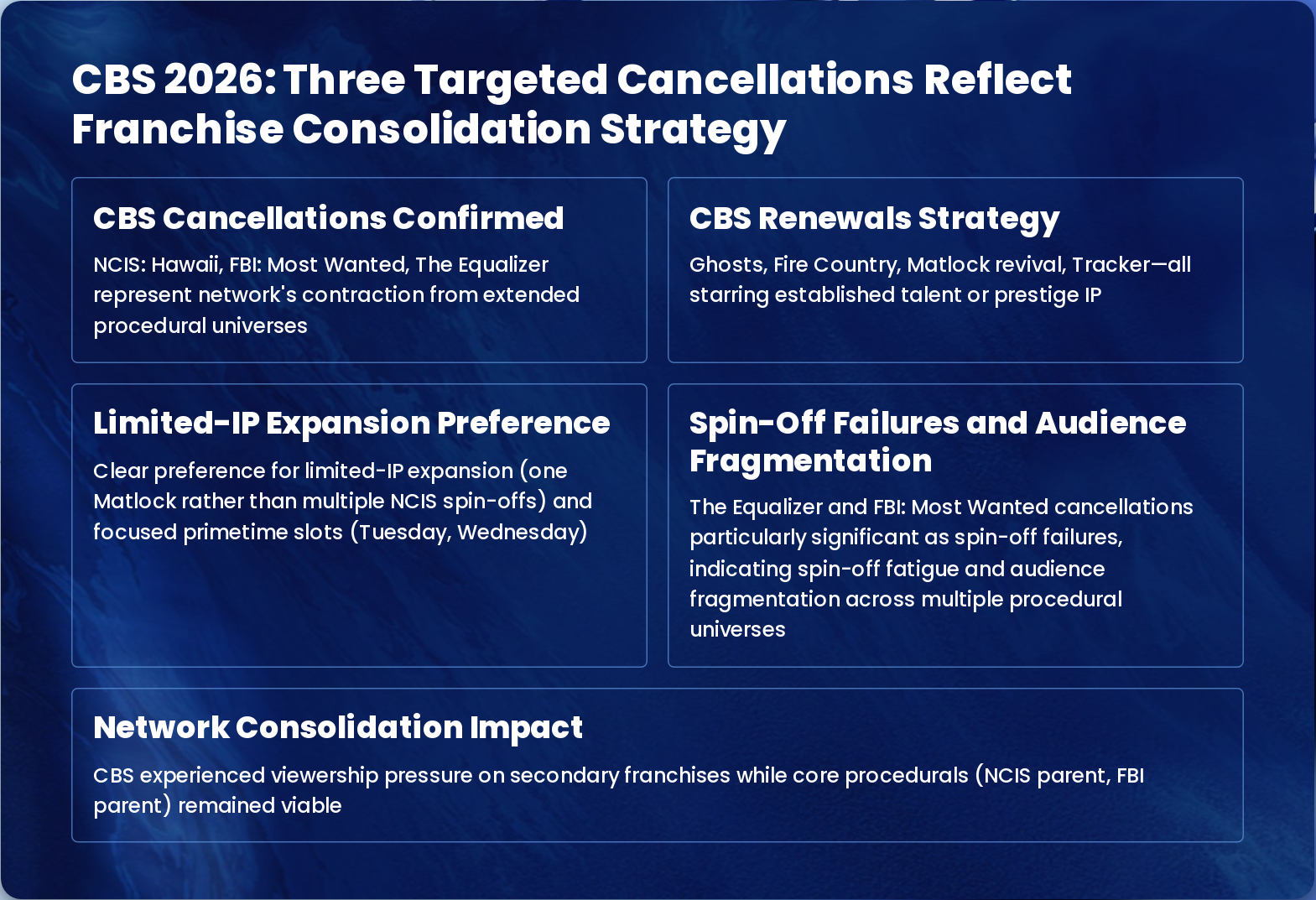
Slide 7: CBS 2026: Three Targeted Cancellations Reflect Franchise Consolidation Strategy
- CBS Cancellations Confirmed: NCIS: Hawaii, FBI: Most Wanted, The Equalizer represent network's contraction from extended procedural universes
- CBS Renewals Strategy: Ghosts, Fire Country, Matlock revival, Tracker—all starring established talent or prestige IP
- Limited-IP Expansion Preference: Clear preference for limited-IP expansion (one Matlock rather than multiple NCIS spin-offs) and focused primetime slots (Tuesday, Wednesday)
- Spin-Off Failures and Audience Fragmentation: The Equalizer and FBI: Most Wanted cancellations particularly significant as spin-off failures, indicating spin-off fatigue and audience fragmentation across multiple procedural universes
- Network Consolidation Impact: CBS experienced viewership pressure on secondary franchises while core procedurals (NCIS parent, FBI parent) remained viable
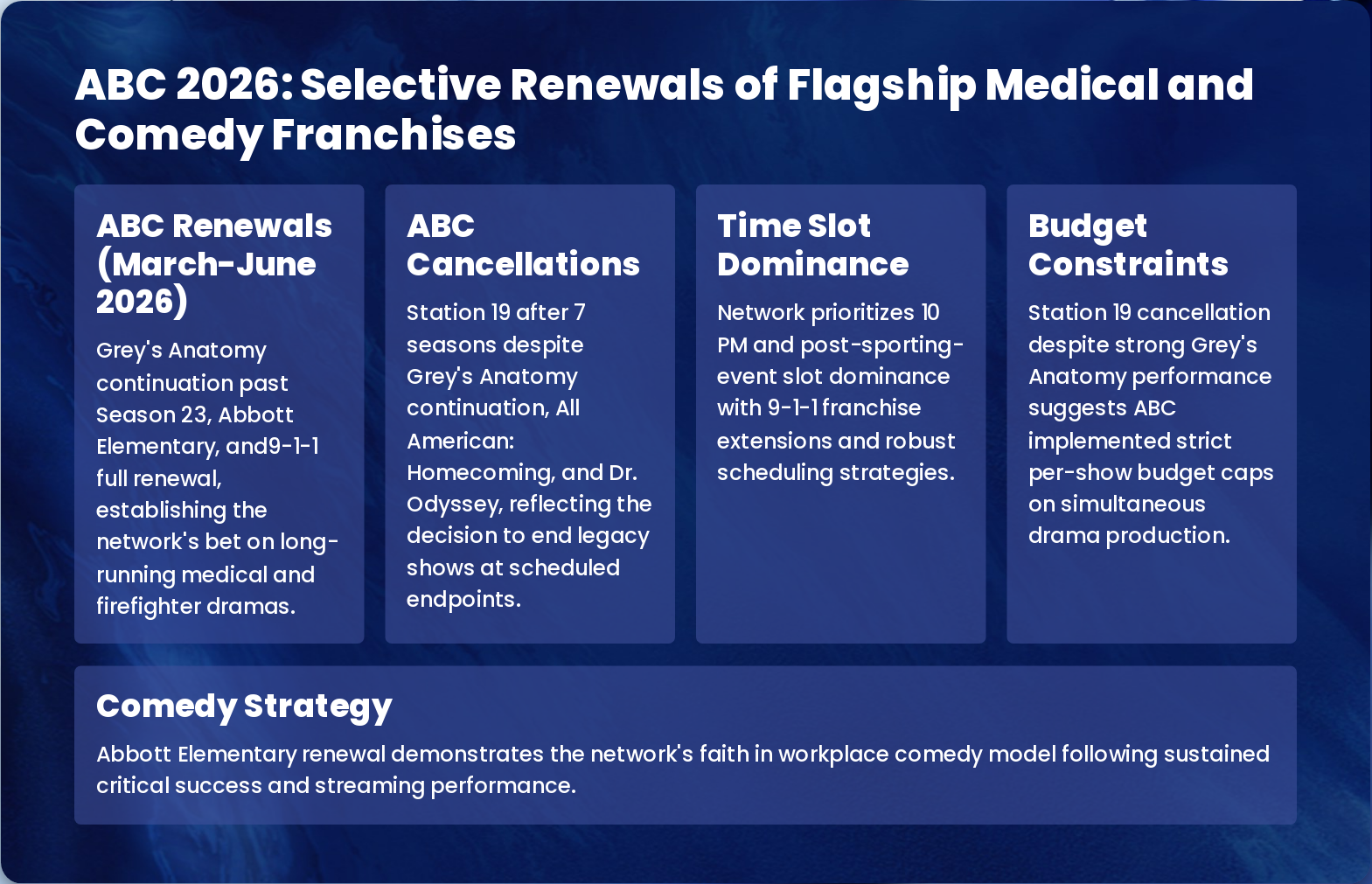
Slide 8: ABC 2026: Selective Renewals of Flagship Medical and Comedy Franchises
- ABC Renewals (March-June 2026): Grey's Anatomy continuation past Season 23, Abbott Elementary, and9-1-1 full renewal, establishing the network's bet on long-running medical and firefighter dramas.
- ABC Cancellations: Station 19 after 7 seasons despite Grey's Anatomy continuation, All American: Homecoming, and Dr. Odyssey, reflecting the decision to end legacy shows at scheduled endpoints.
- Time Slot Dominance: Network prioritizes 10 PM and post-sporting-event slot dominance with 9-1-1 franchise extensions and robust scheduling strategies.
- Budget Constraints: Station 19 cancellation despite strong Grey's Anatomy performance suggests ABC implemented strict per-show budget caps on simultaneous drama production.
- Comedy Strategy: Abbott Elementary renewal demonstrates the network's faith in workplace comedy model following sustained critical success and streaming performance.
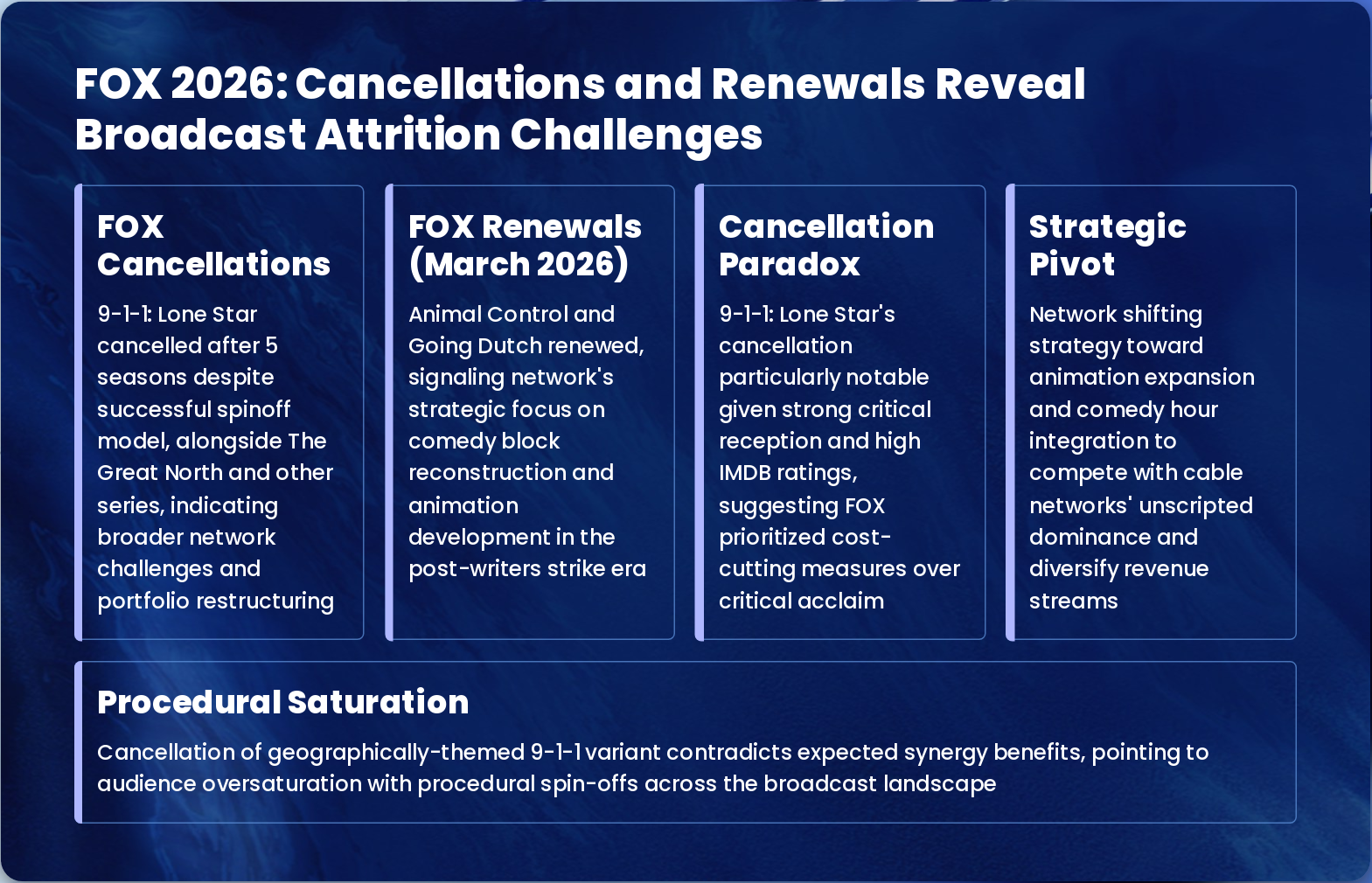
Slide 9: FOX 2026: Cancellations and Renewals Reveal Broadcast Attrition Challenges
- FOX Cancellations: 9-1-1: Lone Star cancelled after 5 seasons despite successful spinoff model, alongside The Great North and other series, indicating broader network challenges and portfolio restructuring
- FOX Renewals (March 2026): Animal Control and Going Dutch renewed, signaling network's strategic focus on comedy block reconstruction and animation development in the post-writers strike era
- Cancellation Paradox: 9-1-1: Lone Star's cancellation particularly notable given strong critical reception and high IMDB ratings, suggesting FOX prioritized cost-cutting measures over critical acclaim
- Strategic Pivot: Network shifting strategy toward animation expansion and comedy hour integration to compete with cable networks' unscripted dominance and diversify revenue streams
- Procedural Saturation: Cancellation of geographically-themed 9-1-1 variant contradicts expected synergy benefits, pointing to audience oversaturation with procedural spin-offs across the broadcast landscape
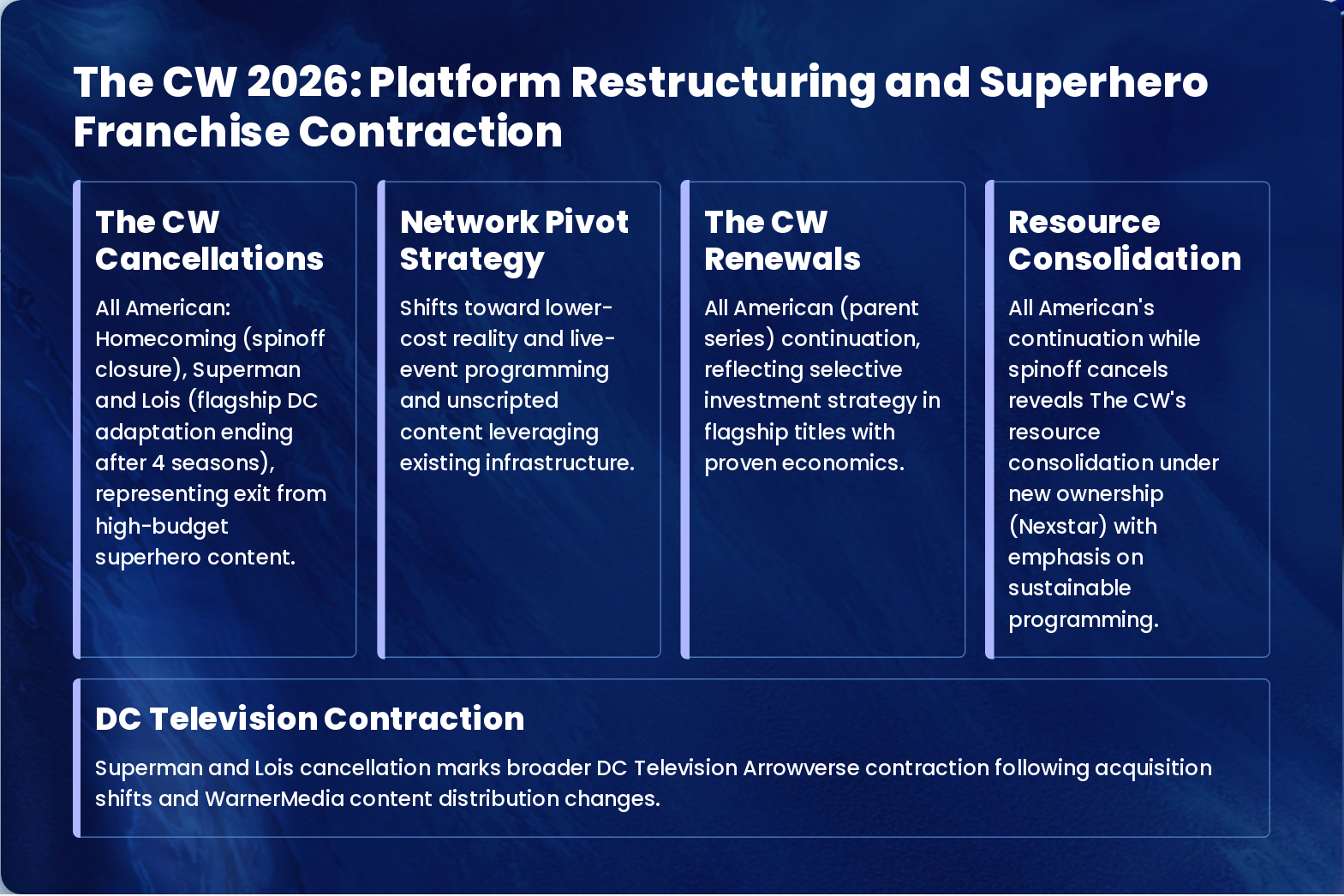
Slide 10: The CW 2026: Platform Restructuring and Superhero Franchise Contraction
- The CW Cancellations: All American: Homecoming (spinoff closure), Superman and Lois (flagship DC adaptation ending after 4 seasons), representing exit from high-budget superhero content.
- Network Pivot Strategy: Shifts toward lower-cost reality and live-event programming and unscripted content leveraging existing infrastructure.
- The CW Renewals: All American (parent series) continuation, reflecting selective investment strategy in flagship titles with proven economics.
- Resource Consolidation: All American's continuation while spinoff cancels reveals The CW's resource consolidation under new ownership (Nexstar) with emphasis on sustainable programming.
- DC Television Contraction: Superman and Lois cancellation marks broader DC Television Arrowverse contraction following acquisition shifts and WarnerMedia content distribution changes.
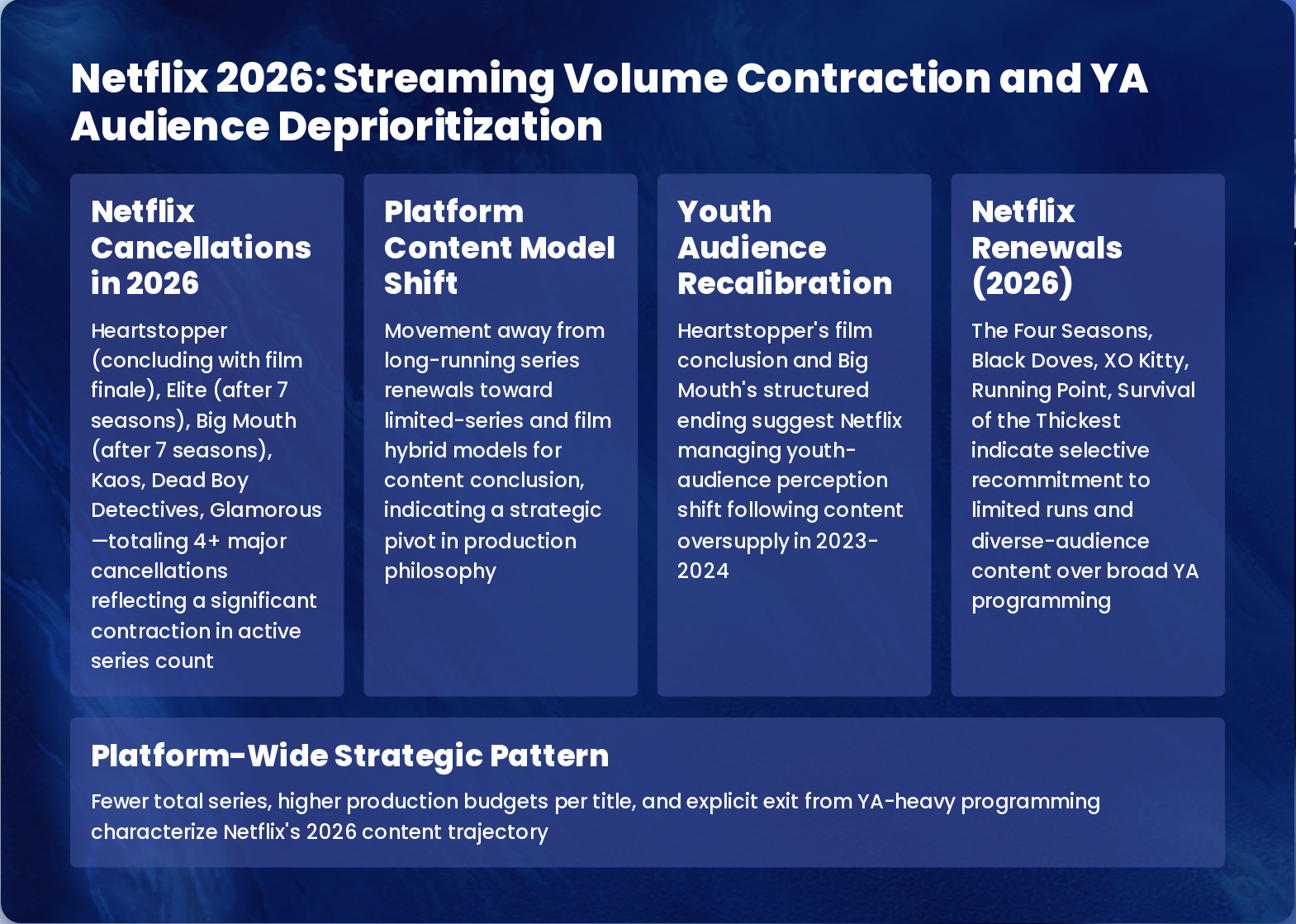
Slide 11: Netflix 2026: Streaming Volume Contraction and YA Audience Deprioritization
- Netflix Cancellations in 2026: Heartstopper (concluding with film finale), Elite (after 7 seasons), Big Mouth (after 7 seasons), Kaos, Dead Boy Detectives, Glamorous—totaling 4+ major cancellations reflecting a significant contraction in active series count
- Platform Content Model Shift: Movement away from long-running series renewals toward limited-series and film hybrid models for content conclusion, indicating a strategic pivot in production philosophy
- Youth Audience Recalibration: Heartstopper's film conclusion and Big Mouth's structured ending suggest Netflix managing youth-audience perception shift following content oversupply in 2023-2024
- Netflix Renewals (2026): The Four Seasons, Black Doves, XO Kitty, Running Point, Survival of the Thickest indicate selective recommitment to limited runs and diverse-audience content over broad YA programming
- Platform-Wide Strategic Pattern: Fewer total series, higher production budgets per title, and explicit exit from YA-heavy programming characterize Netflix's 2026 content trajectory
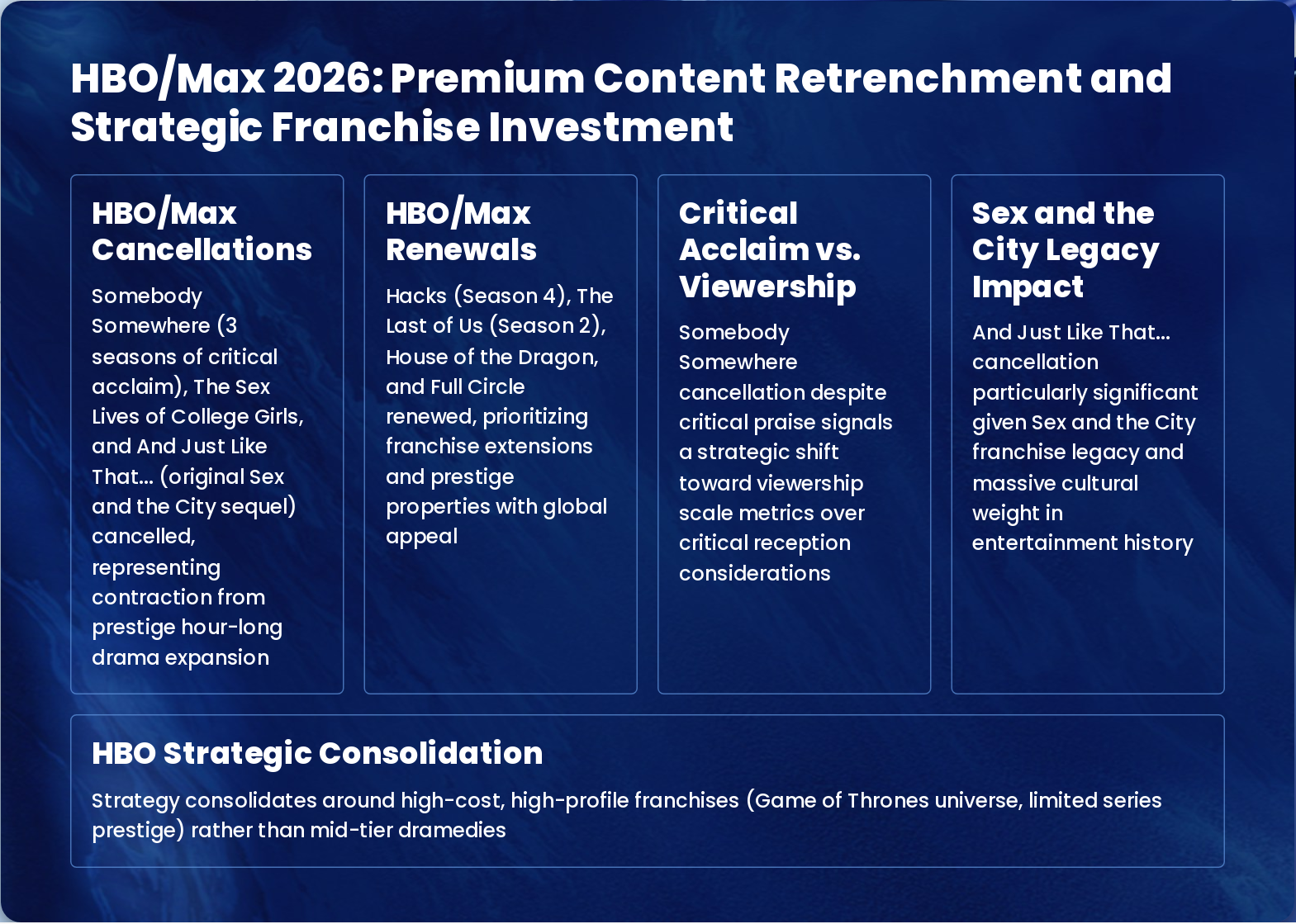
Slide 12: HBO/Max 2026: Premium Content Retrenchment and Strategic Franchise Investment
- HBO/Max Cancellations: Somebody Somewhere (3 seasons of critical acclaim), The Sex Lives of College Girls, and And Just Like That... (original Sex and the City sequel) cancelled, representing contraction from prestige hour-long drama expansion
- HBO/Max Renewals: Hacks (Season 4), The Last of Us (Season 2), House of the Dragon, and Full Circle renewed, prioritizing franchise extensions and prestige properties with global appeal
- Critical Acclaim vs. Viewership: Somebody Somewhere cancellation despite critical praise signals a strategic shift toward viewership scale metrics over critical reception considerations
- Sex and the City Legacy Impact: And Just Like That... cancellation particularly significant given Sex and the City franchise legacy and massive cultural weight in entertainment history
- HBO Strategic Consolidation: Strategy consolidates around high-cost, high-profile franchises (Game of Thrones universe, limited series prestige) rather than mid-tier dramedies
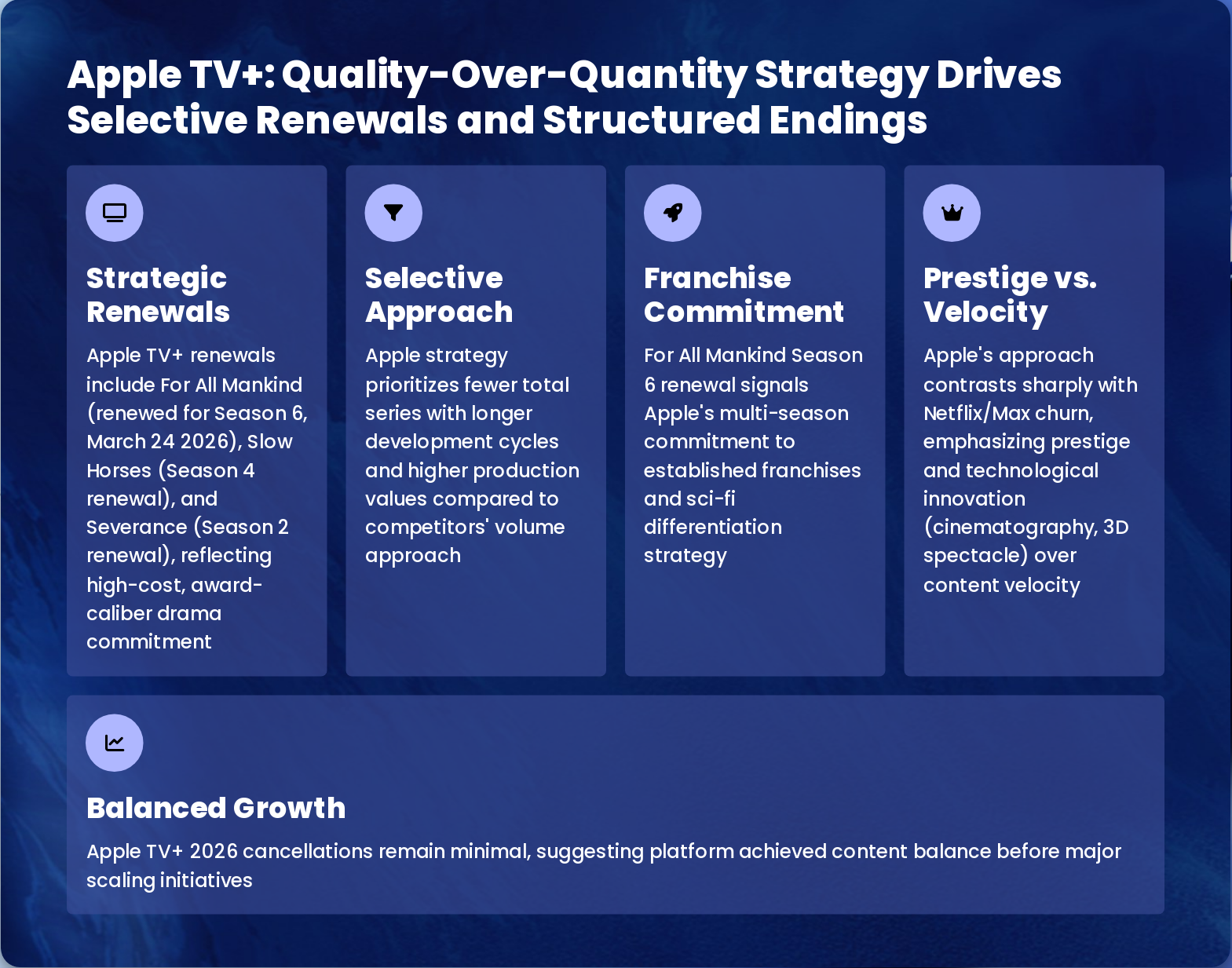
Slide 13: Apple TV+: Quality-Over-Quantity Strategy Drives Selective Renewals and Structured Endings
- Strategic Renewals: Apple TV+ renewals include For All Mankind (renewed for Season 6, March 24 2026), Slow Horses (Season 4 renewal), and Severance (Season 2 renewal), reflecting high-cost, award-caliber drama commitment
- Selective Approach: Apple strategy prioritizes fewer total series with longer development cycles and higher production values compared to competitors' volume approach
- Franchise Commitment: For All Mankind Season 6 renewal signals Apple's multi-season commitment to established franchises and sci-fi differentiation strategy
- Prestige vs. Velocity: Apple's approach contrasts sharply with Netflix/Max churn, emphasizing prestige and technological innovation (cinematography, 3D spectacle) over content velocity
- Balanced Growth: Apple TV+ 2026 cancellations remain minimal, suggesting platform achieved content balance before major scaling initiatives
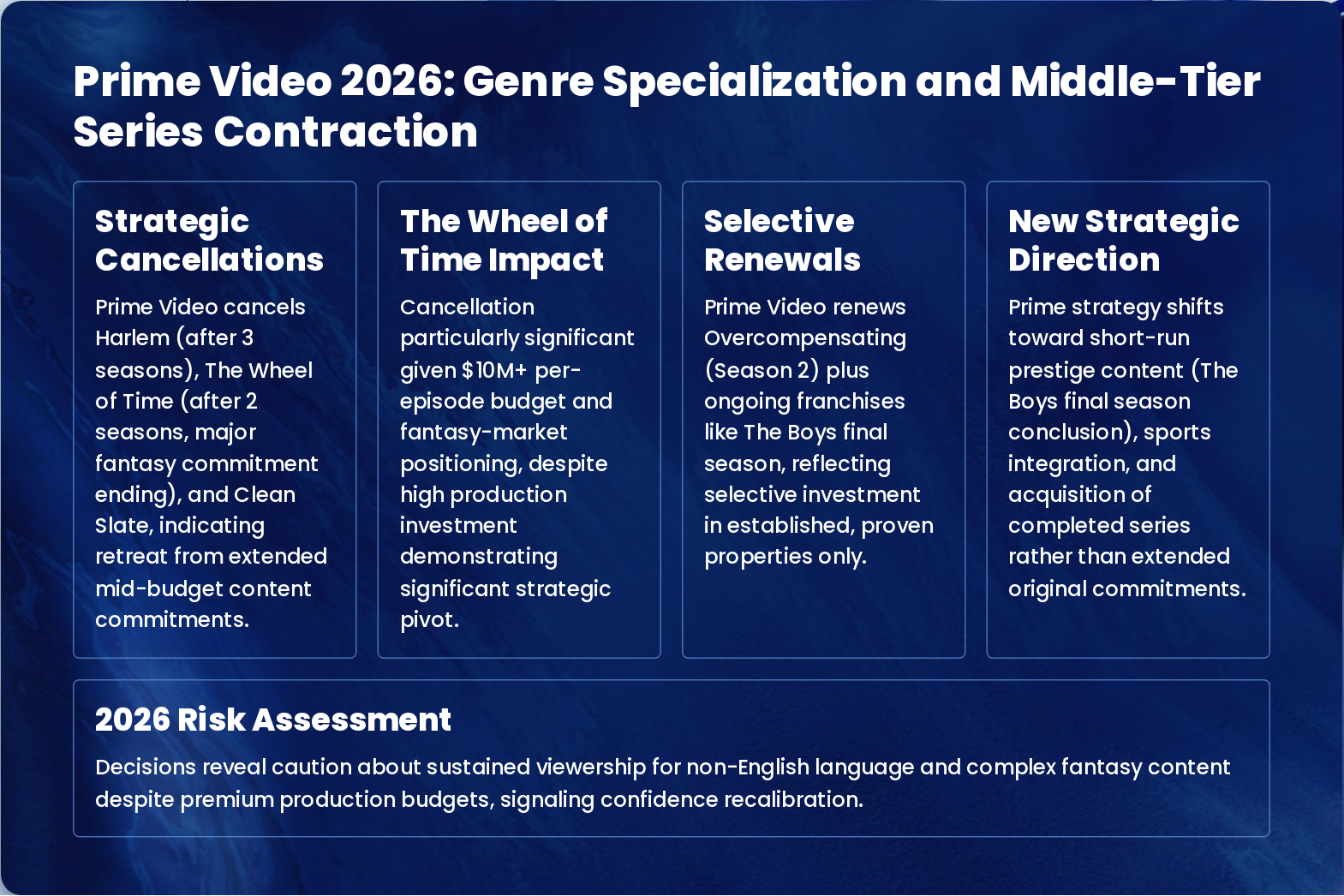
Slide 14: Prime Video 2026: Genre Specialization and Middle-Tier Series Contraction
- Strategic Cancellations: Prime Video cancels Harlem (after 3 seasons), The Wheel of Time (after 2 seasons, major fantasy commitment ending), and Clean Slate, indicating retreat from extended mid-budget content commitments.
- The Wheel of Time Impact: Cancellation particularly significant given $10M+ per-episode budget and fantasy-market positioning, despite high production investment demonstrating significant strategic pivot.
- Selective Renewals: Prime Video renews Overcompensating (Season 2) plus ongoing franchises like The Boys final season, reflecting selective investment in established, proven properties only.
- New Strategic Direction: Prime strategy shifts toward short-run prestige content (The Boys final season conclusion), sports integration, and acquisition of completed series rather than extended original commitments.
- 2026 Risk Assessment: Decisions reveal caution about sustained viewership for non-English language and complex fantasy content despite premium production budgets, signaling confidence recalibration.
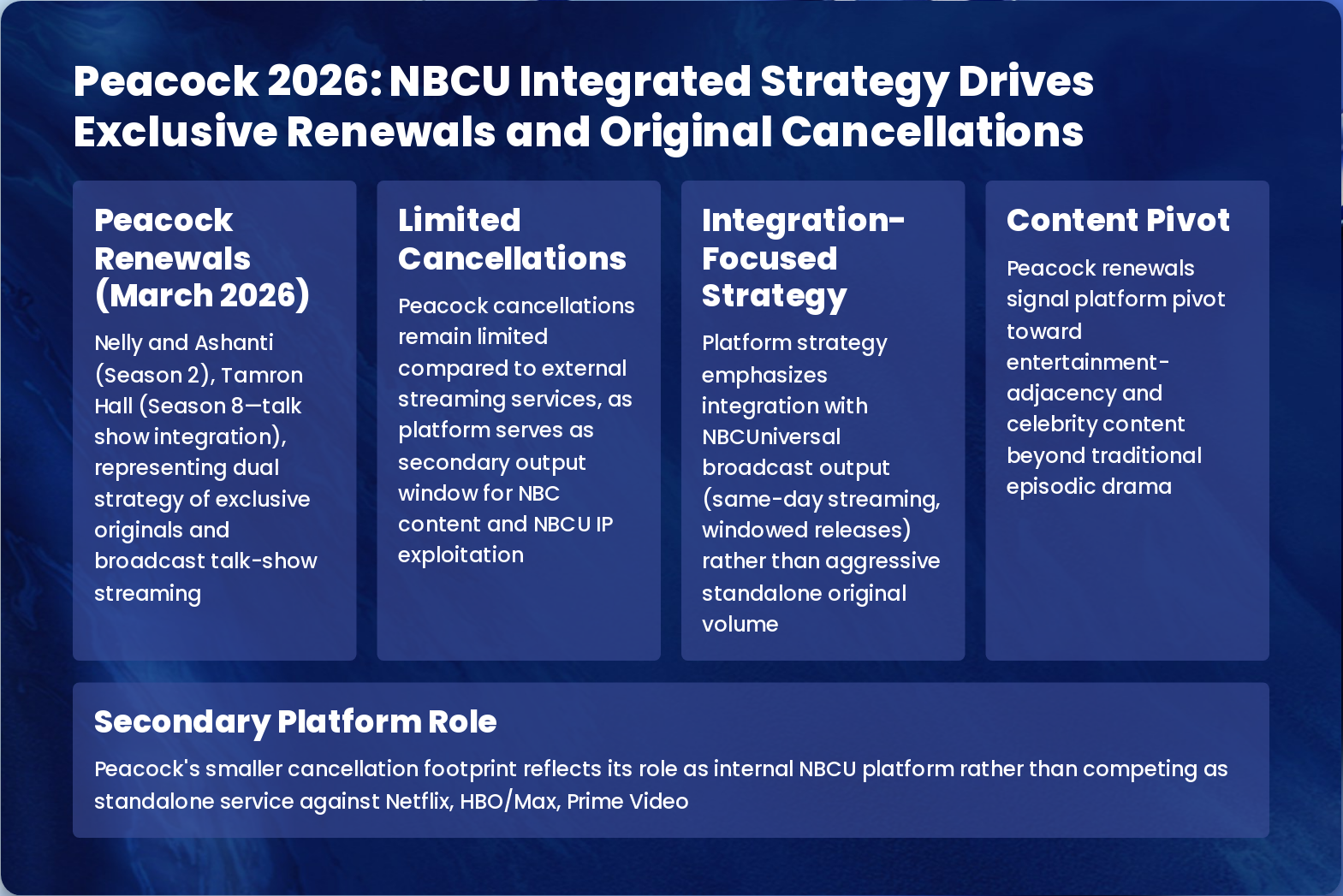
Slide 15: Peacock 2026: NBCU Integrated Strategy Drives Exclusive Renewals and Original Cancellations
- Peacock Renewals (March 2026): Nelly and Ashanti (Season 2), Tamron Hall (Season 8—talk show integration), representing dual strategy of exclusive originals and broadcast talk-show streaming
- Limited Cancellations: Peacock cancellations remain limited compared to external streaming services, as platform serves as secondary output window for NBC content and NBCU IP exploitation
- Integration-Focused Strategy: Platform strategy emphasizes integration with NBCUniversal broadcast output (same-day streaming, windowed releases) rather than aggressive standalone original volume
- Content Pivot: Peacock renewals signal platform pivot toward entertainment-adjacency and celebrity content beyond traditional episodic drama
- Secondary Platform Role: Peacock's smaller cancellation footprint reflects its role as internal NBCU platform rather than competing as standalone service against Netflix, HBO/Max, Prime Video
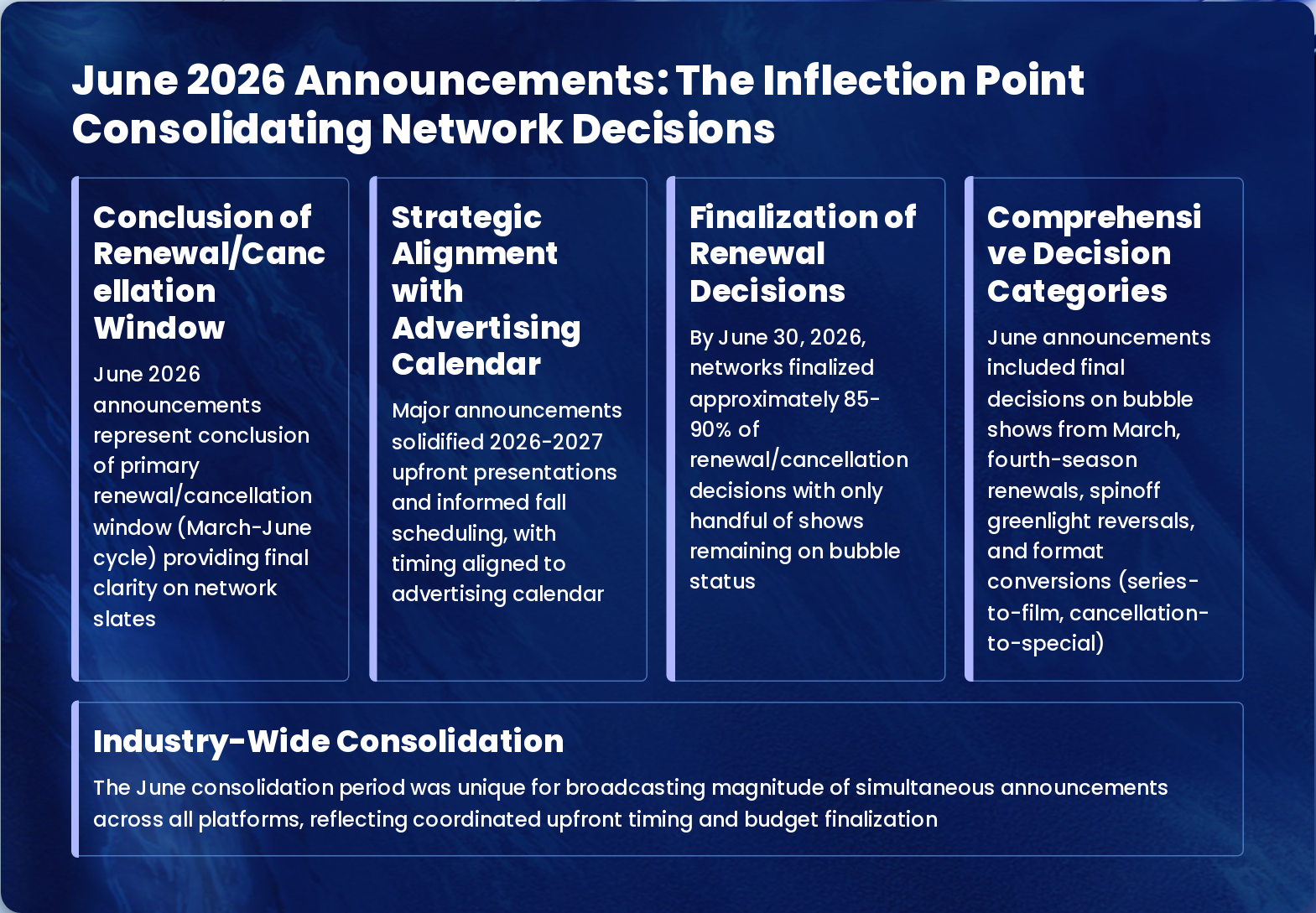
Slide 16: June 2026 Announcements: The Inflection Point Consolidating Network Decisions
- Conclusion of Renewal/Cancellation Window: June 2026 announcements represent conclusion of primary renewal/cancellation window (March-June cycle) providing final clarity on network slates
- Strategic Alignment with Advertising Calendar: Major announcements solidified 2026-2027 upfront presentations and informed fall scheduling, with timing aligned to advertising calendar
- Finalization of Renewal Decisions: By June 30, 2026, networks finalized approximately 85-90% of renewal/cancellation decisions with only handful of shows remaining on bubble status
- Comprehensive Decision Categories: June announcements included final decisions on bubble shows from March, fourth-season renewals, spinoff greenlight reversals, and format conversions (series-to-film, cancellation-to-special)
- Industry-Wide Consolidation: The June consolidation period was unique for broadcasting magnitude of simultaneous announcements across all platforms, reflecting coordinated upfront timing and budget finalization
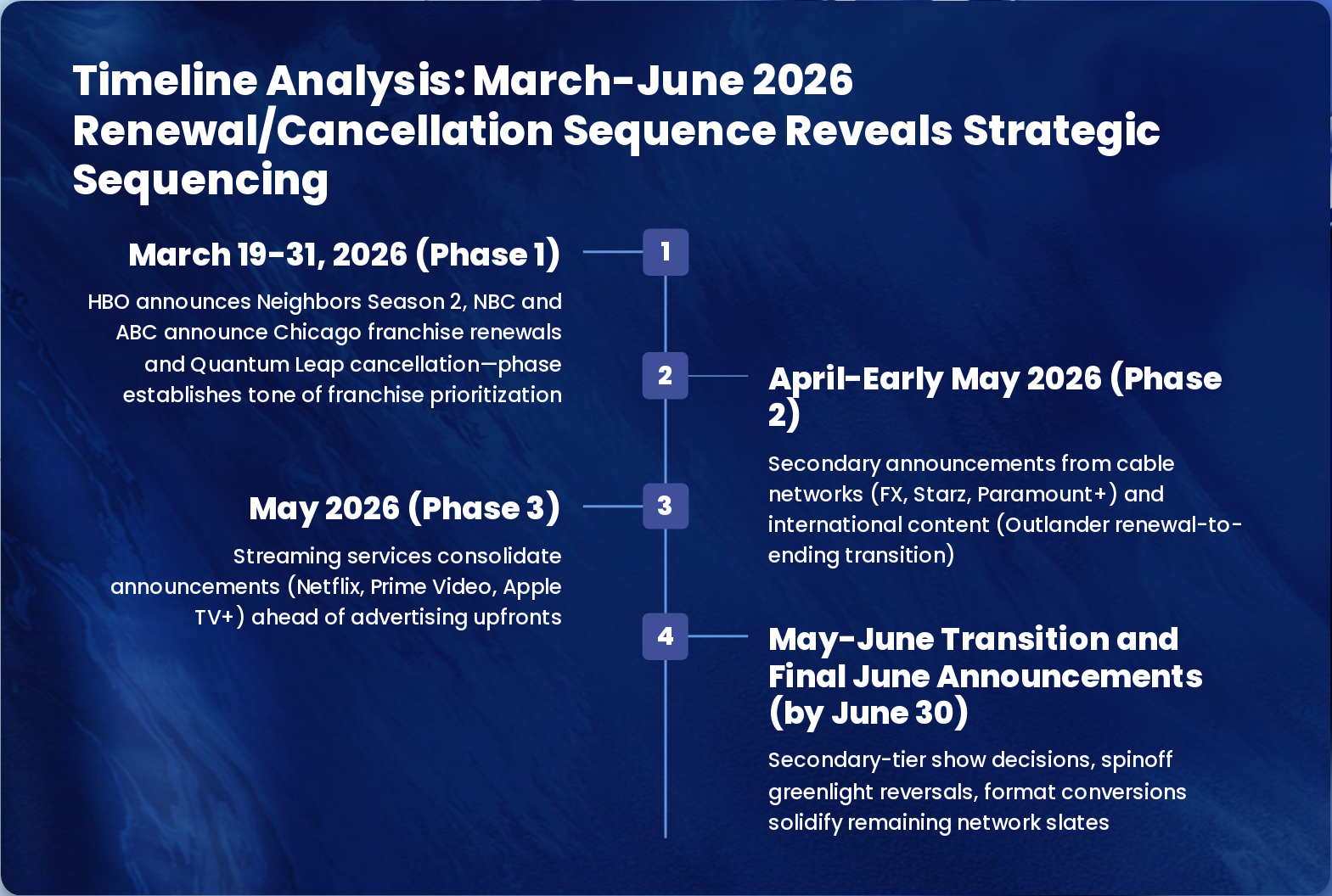
Slide 17: Timeline Analysis: March-June 2026 Renewal/Cancellation Sequence Reveals Strategic Sequencing
- March 19-31, 2026 (Phase 1): HBO announces Neighbors Season 2, NBC and ABC announce Chicago franchise renewals and Quantum Leap cancellation—phase establishes tone of franchise prioritization
- April-Early May 2026 (Phase 2): Secondary announcements from cable networks (FX, Starz, Paramount+) and international content (Outlander renewal-to-ending transition)
- May 2026 (Phase 3): Streaming services consolidate announcements (Netflix, Prime Video, Apple TV+) ahead of advertising upfronts
- May-June Transition and Final June Announcements (by June 30): Secondary-tier show decisions, spinoff greenlight reversals, format conversions solidify remaining network slates
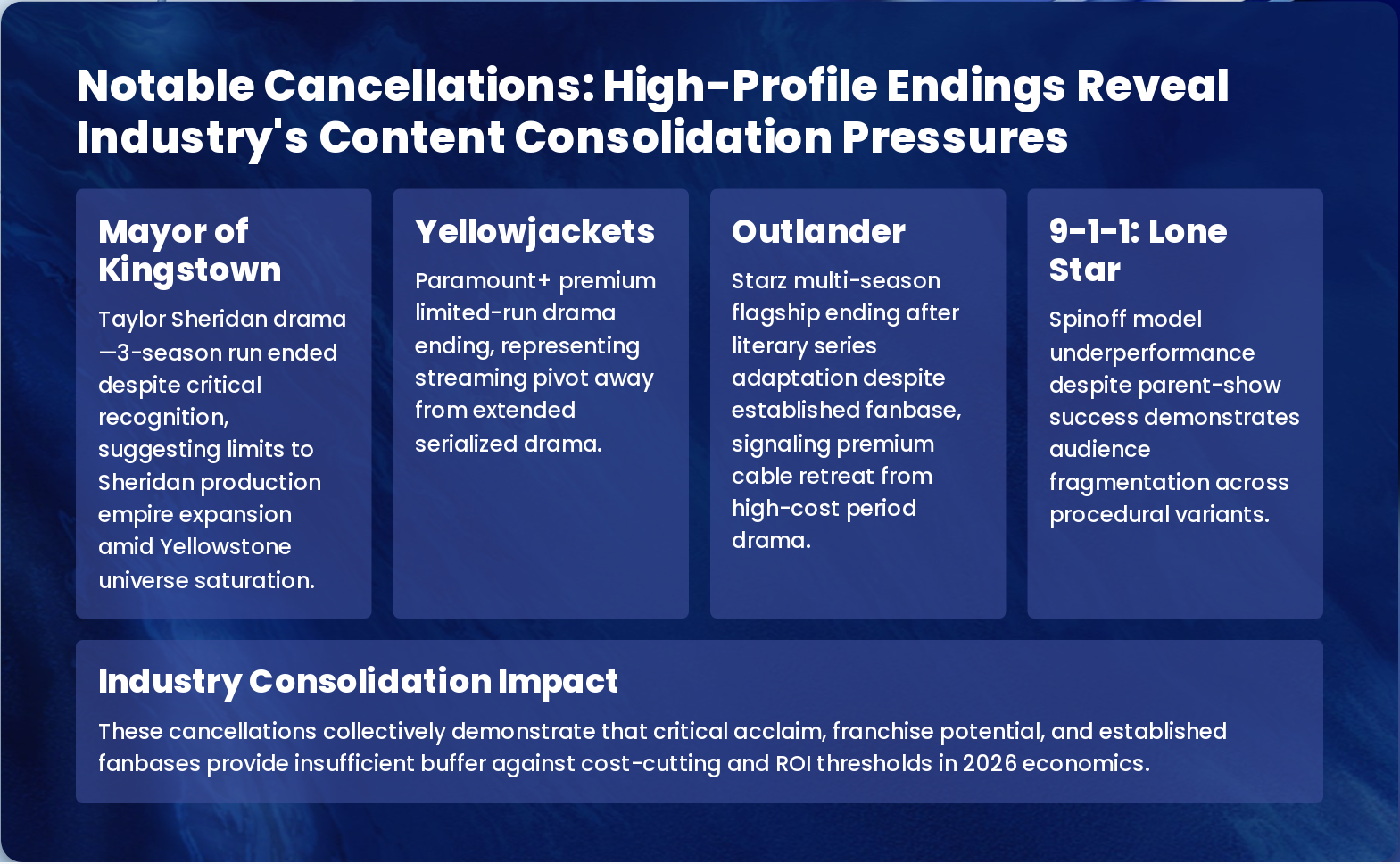
Slide 18: Notable Cancellations: High-Profile Endings Reveal Industry's Content Consolidation Pressures
- Mayor of Kingstown: Taylor Sheridan drama—3-season run ended despite critical recognition, suggesting limits to Sheridan production empire expansion amid Yellowstone universe saturation.
- Yellowjackets: Paramount+ premium limited-run drama ending, representing streaming pivot away from extended serialized drama.
- Outlander: Starz multi-season flagship ending after literary series adaptation despite established fanbase, signaling premium cable retreat from high-cost period drama.
- 9-1-1: Lone Star: Spinoff model underperformance despite parent-show success demonstrates audience fragmentation across procedural variants.
- Industry Consolidation Impact: These cancellations collectively demonstrate that critical acclaim, franchise potential, and established fanbases provide insufficient buffer against cost-cutting and ROI thresholds in 2026 economics.
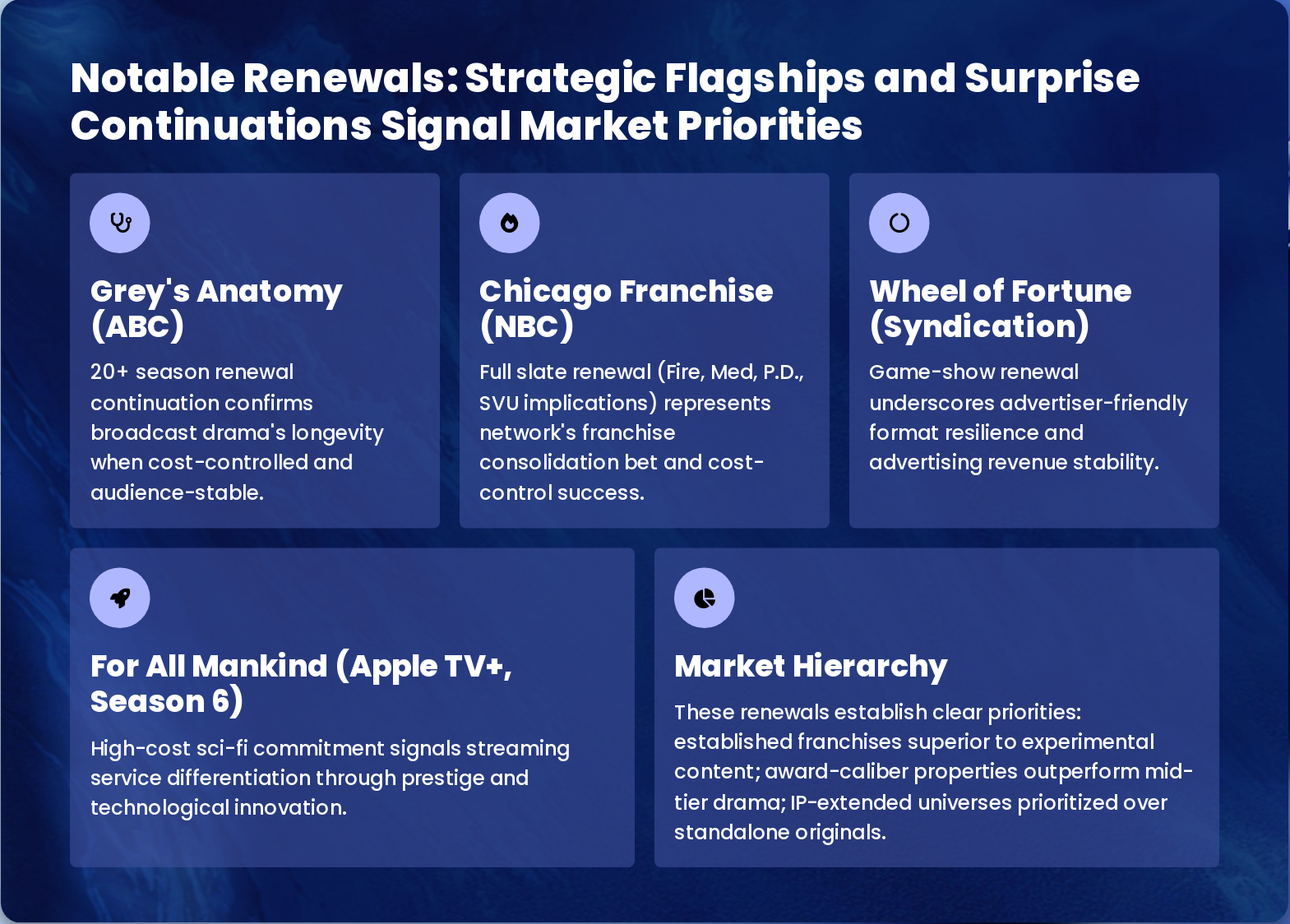
Slide 19: Notable Renewals: Strategic Flagships and Surprise Continuations Signal Market Priorities
- Grey's Anatomy (ABC): 20+ season renewal continuation confirms broadcast drama's longevity when cost-controlled and audience-stable.
- Chicago Franchise (NBC): Full slate renewal (Fire, Med, P.D., SVU implications) represents network's franchise consolidation bet and cost-control success.
- Wheel of Fortune (Syndication): Game-show renewal underscores advertiser-friendly format resilience and advertising revenue stability.
- For All Mankind (Apple TV+, Season 6): High-cost sci-fi commitment signals streaming service differentiation through prestige and technological innovation.
- Market Hierarchy: These renewals establish clear priorities: established franchises superior to experimental content; award-caliber properties outperform mid-tier drama; IP-extended universes prioritized over standalone originals.
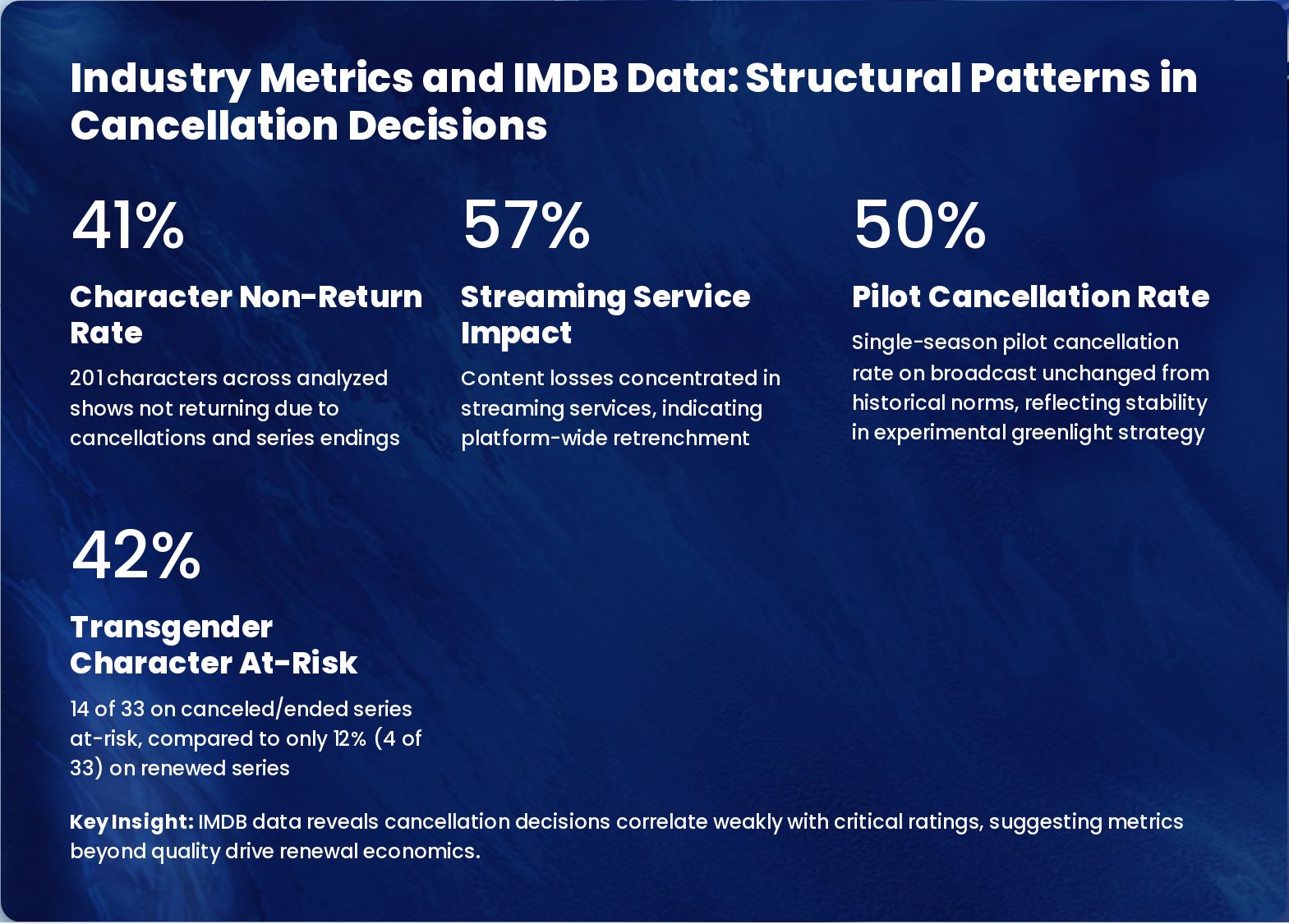
Slide 20: Industry Metrics and IMDB Data: Structural Patterns in Cancellation Decisions
- 41% — Character Non-Return Rate
- 57% — Streaming Service Impact
- 50% — Pilot Cancellation Rate
- 42% — Transgender Character At-Risk
Key Insight: IMDB data reveals cancellation decisions correlate weakly with critical ratings, suggesting metrics beyond quality drive renewal economics.
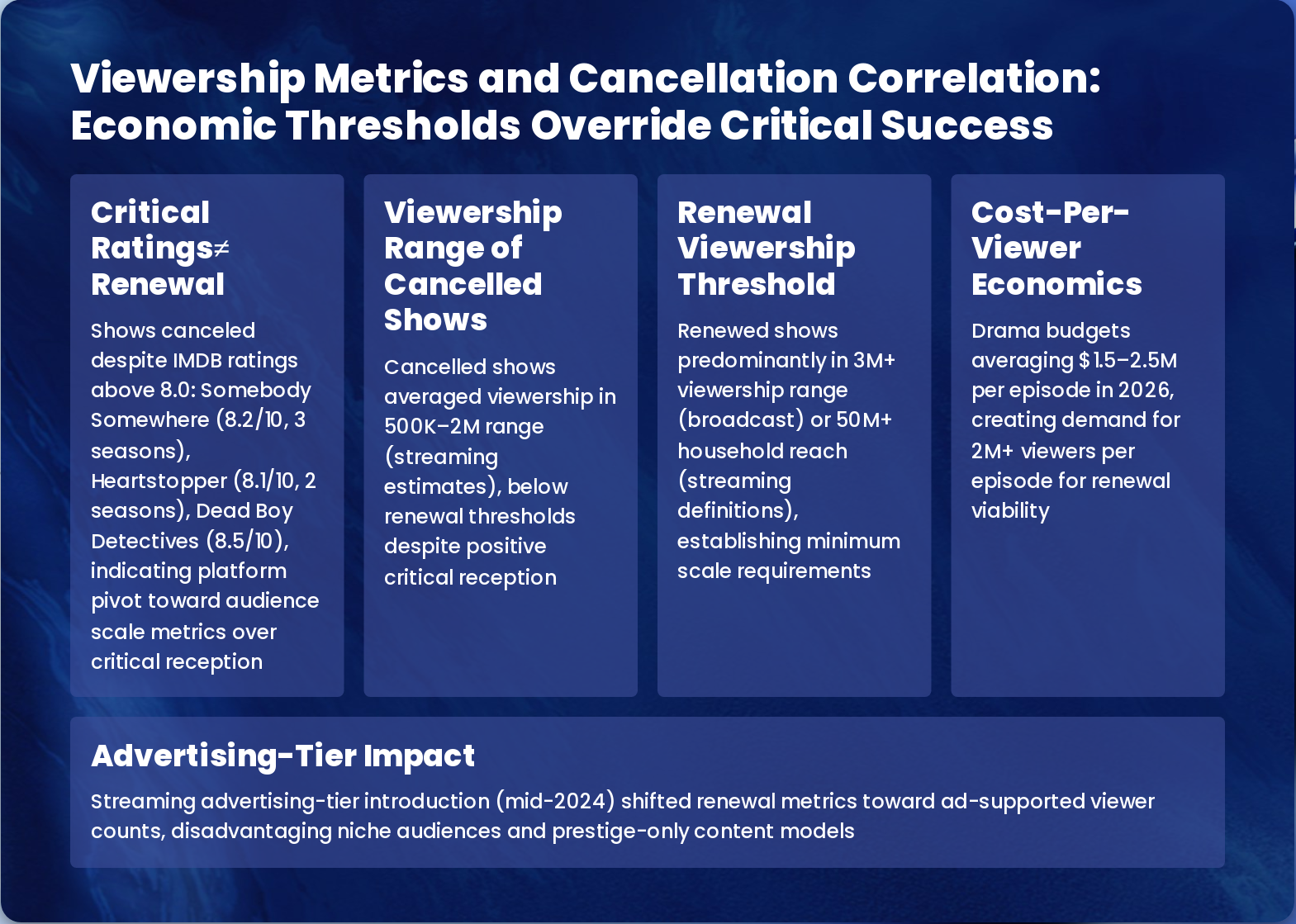
Slide 21: Viewership Metrics and Cancellation Correlation: Economic Thresholds Override Critical Success
- Critical Ratings≠ Renewal: Shows canceled despite IMDB ratings above 8.0: Somebody Somewhere (8.2/10, 3 seasons), Heartstopper (8.1/10, 2 seasons), Dead Boy Detectives (8.5/10), indicating platform pivot toward audience scale metrics over critical reception
- Viewership Range of Cancelled Shows: Cancelled shows averaged viewership in 500K–2M range (streaming estimates), below renewal thresholds despite positive critical reception
- Renewal Viewership Threshold: Renewed shows predominantly in 3M+ viewership range (broadcast) or 50M+ household reach (streaming definitions), establishing minimum scale requirements
- Cost-Per-Viewer Economics: Drama budgets averaging $1.5–2.5M per episode in 2026, creating demand for 2M+ viewers per episode for renewal viability
- Advertising-Tier Impact: Streaming advertising-tier introduction (mid-2024) shifted renewal metrics toward ad-supported viewer counts, disadvantaging niche audiences and prestige-only content models
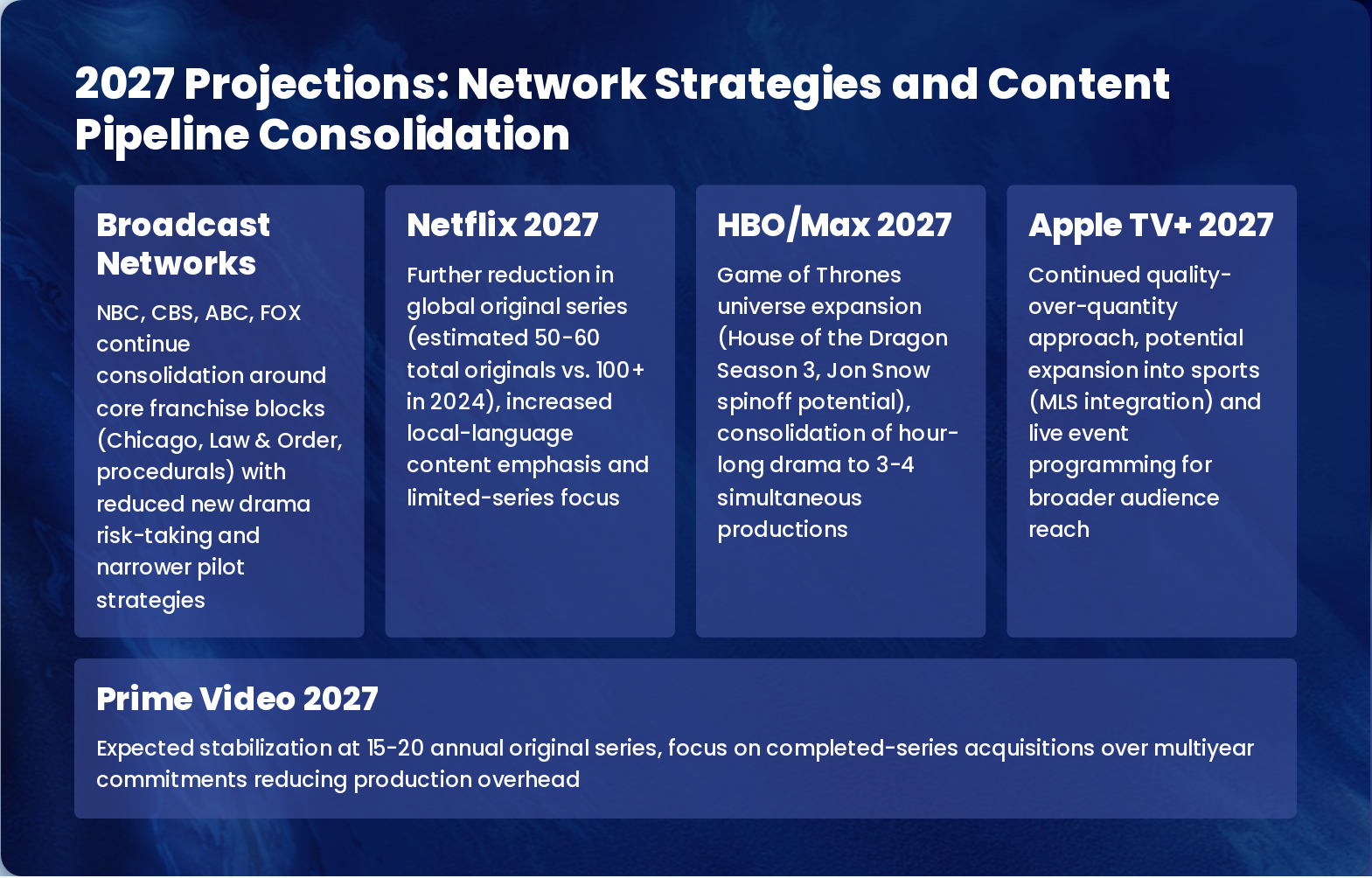
Slide 22: 2027 Projections: Network Strategies and Content Pipeline Consolidation
- Broadcast Networks: NBC, CBS, ABC, FOX continue consolidation around core franchise blocks (Chicago, Law & Order, procedurals) with reduced new drama risk-taking and narrower pilot strategies
- Netflix 2027: Further reduction in global original series (estimated 50-60 total originals vs. 100+ in 2024), increased local-language content emphasis and limited-series focus
- HBO/Max 2027: Game of Thrones universe expansion (House of the Dragon Season 3, Jon Snow spinoff potential), consolidation of hour-long drama to 3-4 simultaneous productions
- Apple TV+ 2027: Continued quality-over-quantity approach, potential expansion into sports (MLS integration) and live event programming for broader audience reach
- Prime Video 2027: Expected stabilization at 15-20 annual original series, focus on completed-series acquisitions over multiyear commitments reducing production overhead
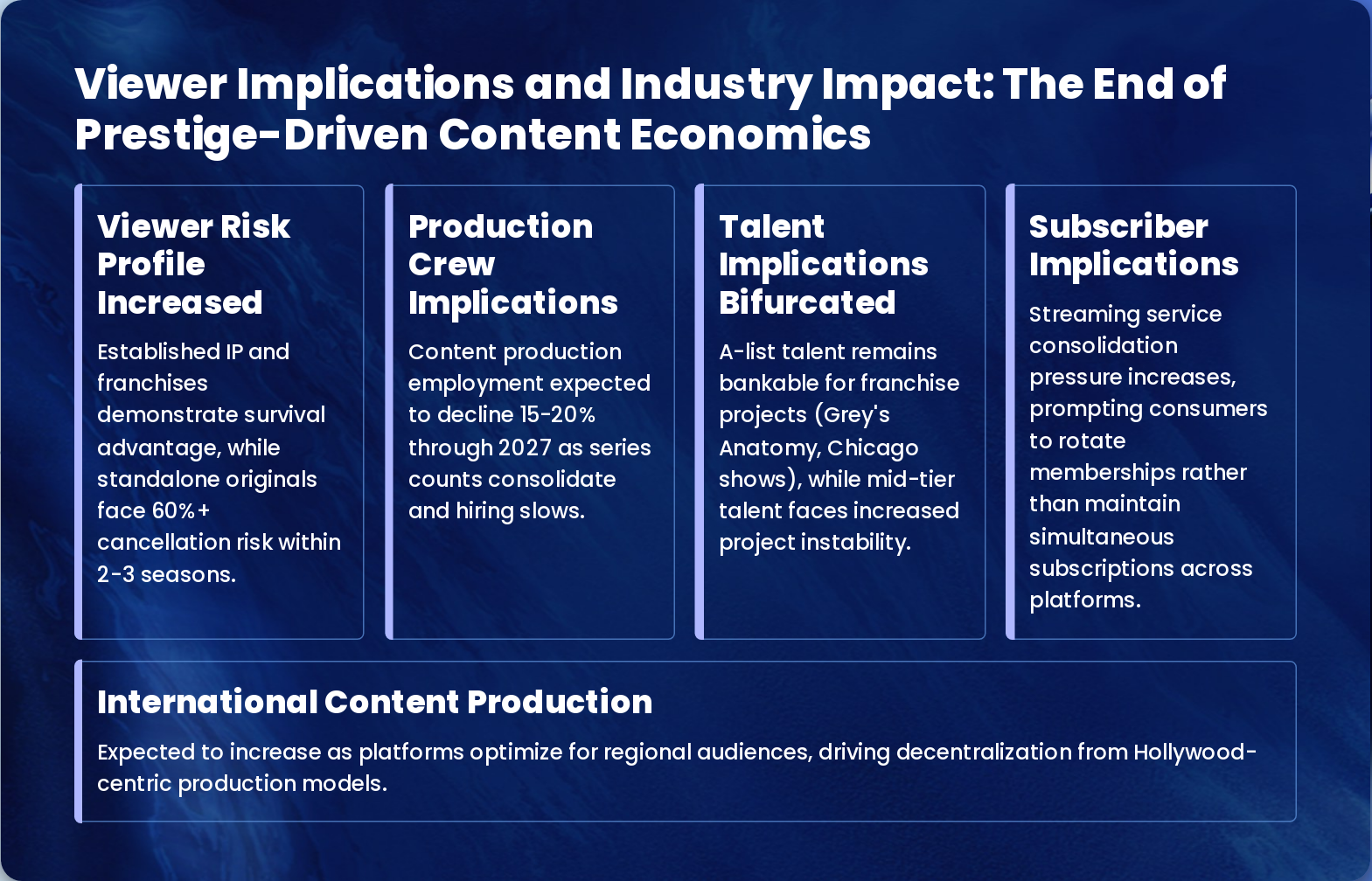
Slide 23: Viewer Implications and Industry Impact: The End of Prestige-Driven Content Economics
- Viewer Risk Profile Increased: Established IP and franchises demonstrate survival advantage, while standalone originals face 60%+ cancellation risk within 2-3 seasons.
- Production Crew Implications: Content production employment expected to decline 15-20% through 2027 as series counts consolidate and hiring slows.
- Talent Implications Bifurcated: A-list talent remains bankable for franchise projects (Grey's Anatomy, Chicago shows), while mid-tier talent faces increased project instability.
- Subscriber Implications: Streaming service consolidation pressure increases, prompting consumers to rotate memberships rather than maintain simultaneous subscriptions across platforms.
- International Content Production: Expected to increase as platforms optimize for regional audiences, driving decentralization from Hollywood-centric production models.
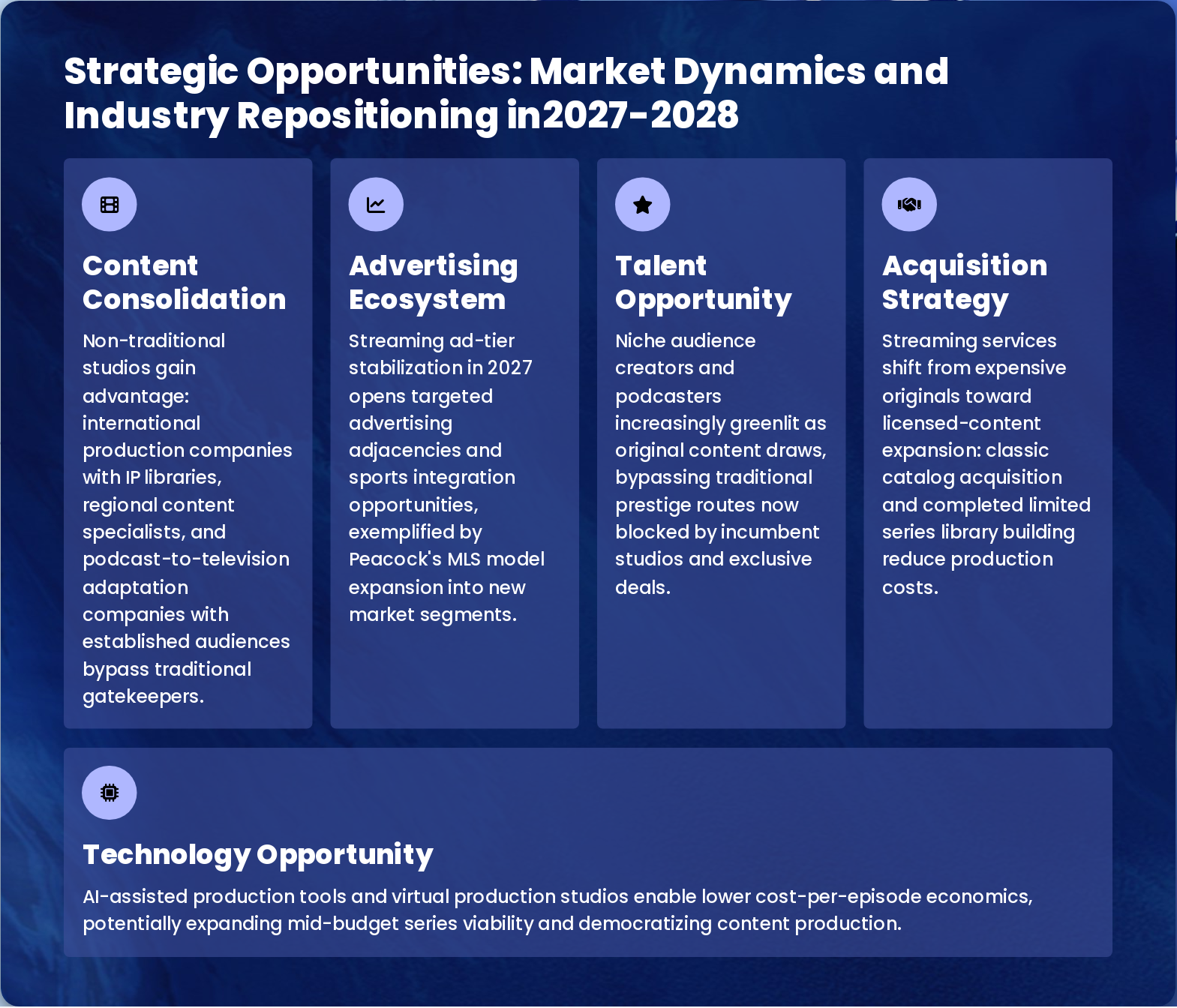
Slide 24: Strategic Opportunities: Market Dynamics and Industry Repositioning in2027-2028
- Content Consolidation: Non-traditional studios gain advantage: international production companies with IP libraries, regional content specialists, and podcast-to-television adaptation companies with established audiences bypass traditional gatekeepers.
- Advertising Ecosystem: Streaming ad-tier stabilization in 2027 opens targeted advertising adjacencies and sports integration opportunities, exemplified by Peacock's MLS model expansion into new market segments.
- Talent Opportunity: Niche audience creators and podcasters increasingly greenlit as original content draws, bypassing traditional prestige routes now blocked by incumbent studios and exclusive deals.
- Acquisition Strategy: Streaming services shift from expensive originals toward licensed-content expansion: classic catalog acquisition and completed limited series library building reduce production costs.
- Technology Opportunity: AI-assisted production tools and virtual production studios enable lower cost-per-episode economics, potentially expanding mid-budget series viability and democratizing content production.
Slide 25: 2026 Marks the Inflection From Prestige Expansion to Economic Consolidation
Television economics fundamentally restructured from prestige-driven volume (2015-2023 era) toward scale-driven franchise consolidation (2026+ era)
Network strategies converged on core pillars: broadcast (legacy franchise extension), streaming (advertising integration), cable (selective prestige preservation)
41% aggregate cancellation rate across tracked shows and 57% losses in streaming represent unprecedented content contraction
Stakeholders should expect continued consolidation through 2027-2028, employment pressure, and franchise clustering dependency
2026-2027 represents television's transition from peak-production-era toward sustainable-economics-era with implications through 2030
- Television economics fundamentally restructured from prestige-driven volume (2015-2023 era) toward scale-driven franchise consolidation (2026+ era)
- Network strategies converged on core pillars: broadcast (legacy franchise extension), streaming (advertising integration), cable (selective prestige preservation)
- 41% aggregate cancellation rate across tracked shows and 57% losses in streaming represent unprecedented content contraction
- Stakeholders should expect continued consolidation through 2027-2028, employment pressure, and franchise clustering dependency
- 2026-2027 represents television's transition from peak-production-era toward sustainable-economics-era with implications through 2030