Presentation Summary
Dive into the rich legacy of Apollo, from Greek mythology to space missions, finance, and hospitality, exploring its influence and pursuit of excellence across cultures and time.
Full Presentation Transcript
Slide 1: APOLLO: A Journey Through Mythology, Space Exploration, and Modern Enterprise
Comprehensive exploration of the multifaceted legacy of Apollo spanning ancient mythology, groundbreaking space missions, global financial management, and contemporary culinary ventures
Slide 2: Contents
- Apollo in Greek Mythology: Divine origins and cultural influence (Slides 3-6)
- NASA's Apollo Program: Human spaceflight revolution (Slides 7-13)
- Apollo in Modern Business: Global finance and hospitality (Slides 14-19)
- Cross-Domain Legacy and Significance: Slides 20-23
- Conclusion and Key Takeaways: Slide 24
Slide 3: Introduction: The Enduring Power of the Name 'Apollo'
- Timeless Span: Apollo represents one of the most versatile names in human civilization, spanning 3,000+ years from ancient Greek religion to 21st-century commerce
- Universal Excellence: The name embodies excellence, ambition, and reaching beyond limits across mythology (Olympian deity), science (moon landing missions 1969-1972), finance ($696+ billion AUM), and hospitality
- Common Thread: Common thread across all domains: pursuit of the extraordinary and transcendence of conventional boundaries
- Timeless Inspiration: Demonstrates how ancient cultural symbols continue to inspire modern enterprises and achievements
- Interconnected Themes: This exploration reveals interconnected themes of human aspiration across five distinct Apollo domains
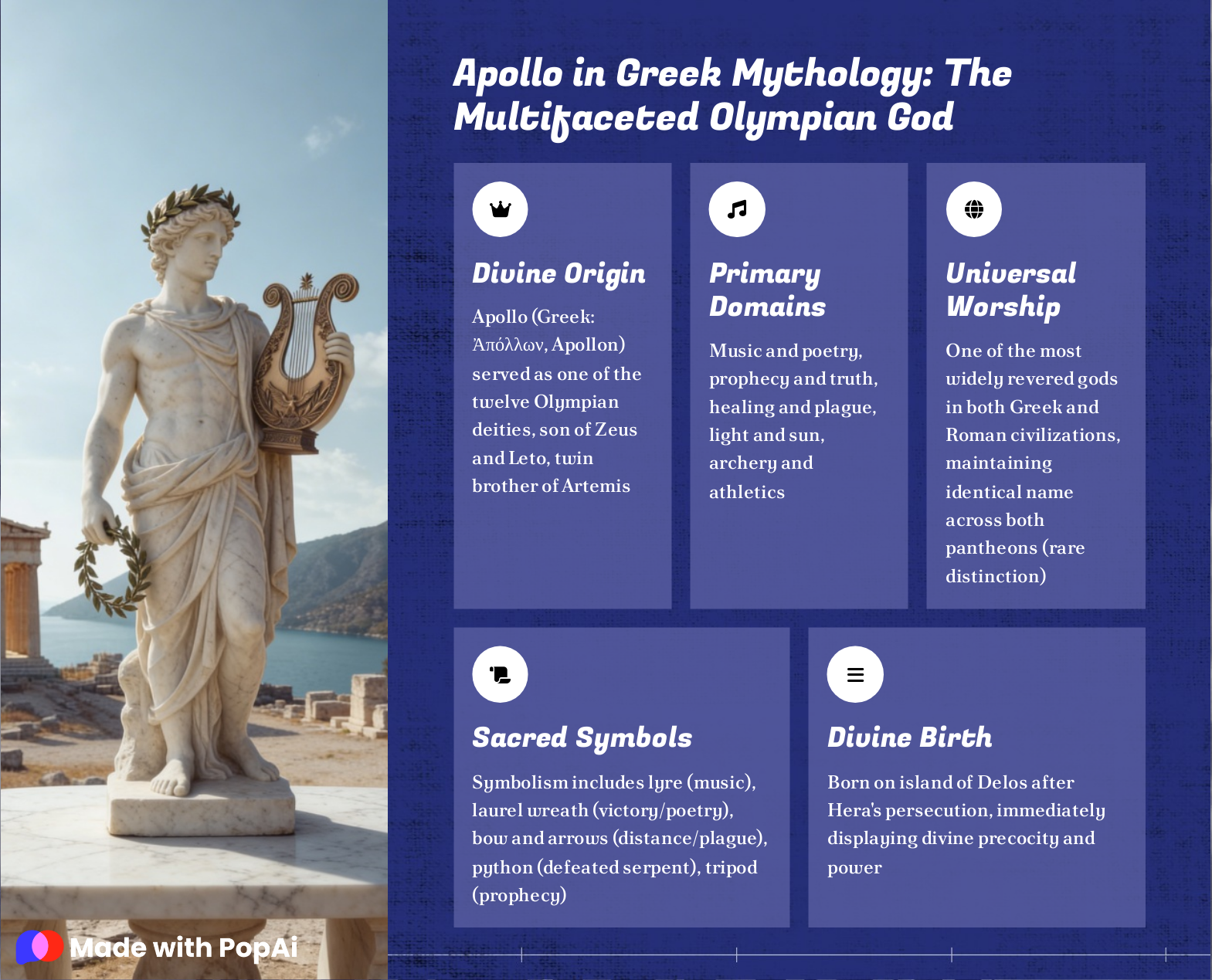
Slide 4: Apollo in Greek Mythology: The Multifaceted Olympian God
- Divine Origin: Apollo (Greek: Ἀπόλλων, Apollon) served as one of the twelve Olympian deities, son of Zeus and Leto, twin brother of Artemis
- Primary Domains: Music and poetry, prophecy and truth, healing and plague, light and sun, archery and athletics
- Universal Worship: One of the most widely revered gods in both Greek and Roman civilizations, maintaining identical name across both pantheons (rare distinction)
- Sacred Symbols: Symbolism includes lyre (music), laurel wreath (victory/poetry), bow and arrows (distance/plague), python (defeated serpent), tripod (prophecy)
- Divine Birth: Born on island of Delos after Hera's persecution, immediately displaying divine precocity and power
Slide 5: Apollo's Sacred Domains: Light, Music, and Prophecy
- God of Light and Order: Associated with rational thinking, civilization, and intellectual pursuits. Apollo epitomized balance between emotional Dionysus, representing order, reason, and enlightenment as guiding forces of civilization.
- Master of Music: Invented the lyre and served as patron of poets and musicians. Led the nine Muses on Mount Parnassus. Musical competitions symbolized civilized discourse and the triumph of harmony over chaos.
- Oracle of Delphi: Most important prophetic site in the ancient world. The Pythia priestess channeled Apollo's prophecies, guiding kings and commoners for over 1,000 years. Seekers traveled vast distances for divine guidance.
- Healing and Medicine: Father of Asclepius, god of medicine. Apollo's temples served as healing sanctuaries. Paradoxically could bring plague as divine punishment. Protector of Youth overseeing education and athletic competitions.
Slide 6: Key Myths and Cultural Influence of Apollo
- Slaying of Python (Early): Young Apollo killed serpent Python at Delphi, establishing his oracle. Represents triumph of order over chaos and civilization over primordial forces.
- Daphne and Unrequited Love: Pursued nymph Daphne who transformed into laurel tree to escape. Laurel became Apollo's sacred plant. Illustrates theme of unattainable desire.
- Musical Contest with Marsyas: Defeated satyr Marsyas in competition. Represents superiority of civilized (lyre) over wild (flute) music. Demonstrates consequences of hubris.
- Trojan War and Roman Adoption (Modern Era): Supported Trojans, guided Paris's arrow to kill Achilles. Became Augustus Caesar's patron deity. Influenced Western art, architecture, and political imagery for 2,000+ years.
Slide 7: NASA's Apollo Program: Overview and Cold War Context
- Program Duration and Scale: 1961-1972 US human spaceflight program achieving first crewed lunar landings. 17 major missions (Apollo 1-17); $25.4 billion contemporary cost ($280+ billion in 2025 dollars); employed 400,000+ workers across aerospace industry.
- Political Genesis: President Kennedy's May 1961 commitment to land humans on Moon before decade's end. Response to Soviet space supremacy (Sputnik 1957, Gagarin 1961). Cold War race for technological and political dominance.
- Scientific Goals: Establish US preeminence in space. Develop human capability in lunar environment. Conduct scientific exploration of Moon. Advance technology for national interests.
- Hardware Systems: Saturn IB and Saturn V rockets. Command Module (crew quarters), Service Module (propulsion/support), Lunar Module (surface operations). Six successful lunar landings delivered 12 astronauts to surface.
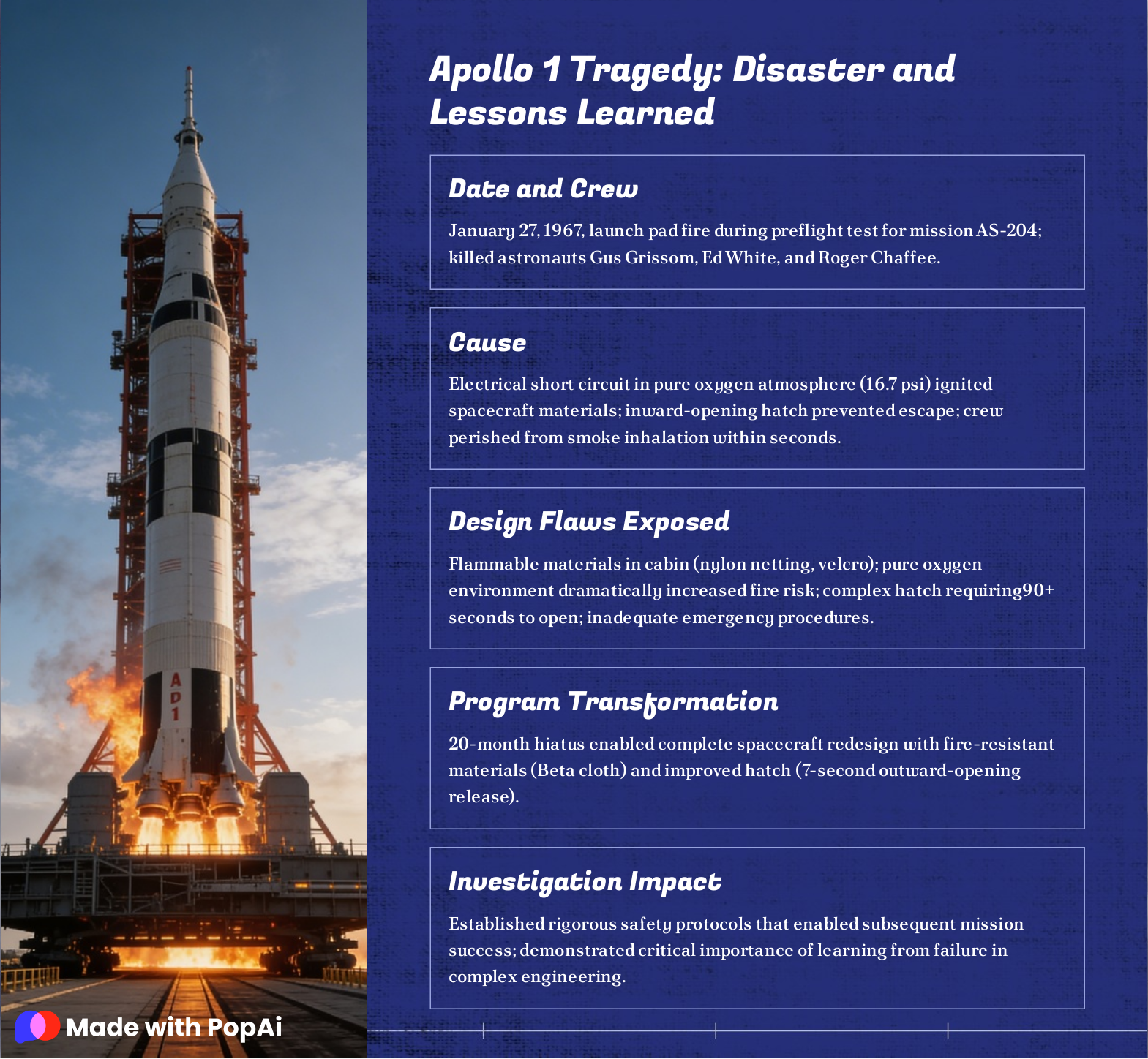
Slide 8: Apollo 1 Tragedy: Disaster and Lessons Learned
- Date and Crew: January 27, 1967, launch pad fire during preflight test for mission AS-204; killed astronauts Gus Grissom, Ed White, and Roger Chaffee.
- Cause: Electrical short circuit in pure oxygen atmosphere (16.7 psi) ignited spacecraft materials; inward-opening hatch prevented escape; crew perished from smoke inhalation within seconds.
- Design Flaws Exposed: Flammable materials in cabin (nylon netting, velcro); pure oxygen environment dramatically increased fire risk; complex hatch requiring90+ seconds to open; inadequate emergency procedures.
- Program Transformation: 20-month hiatus enabled complete spacecraft redesign with fire-resistant materials (Beta cloth) and improved hatch (7-second outward-opening release).
- Investigation Impact: Established rigorous safety protocols that enabled subsequent mission success; demonstrated critical importance of learning from failure in complex engineering.
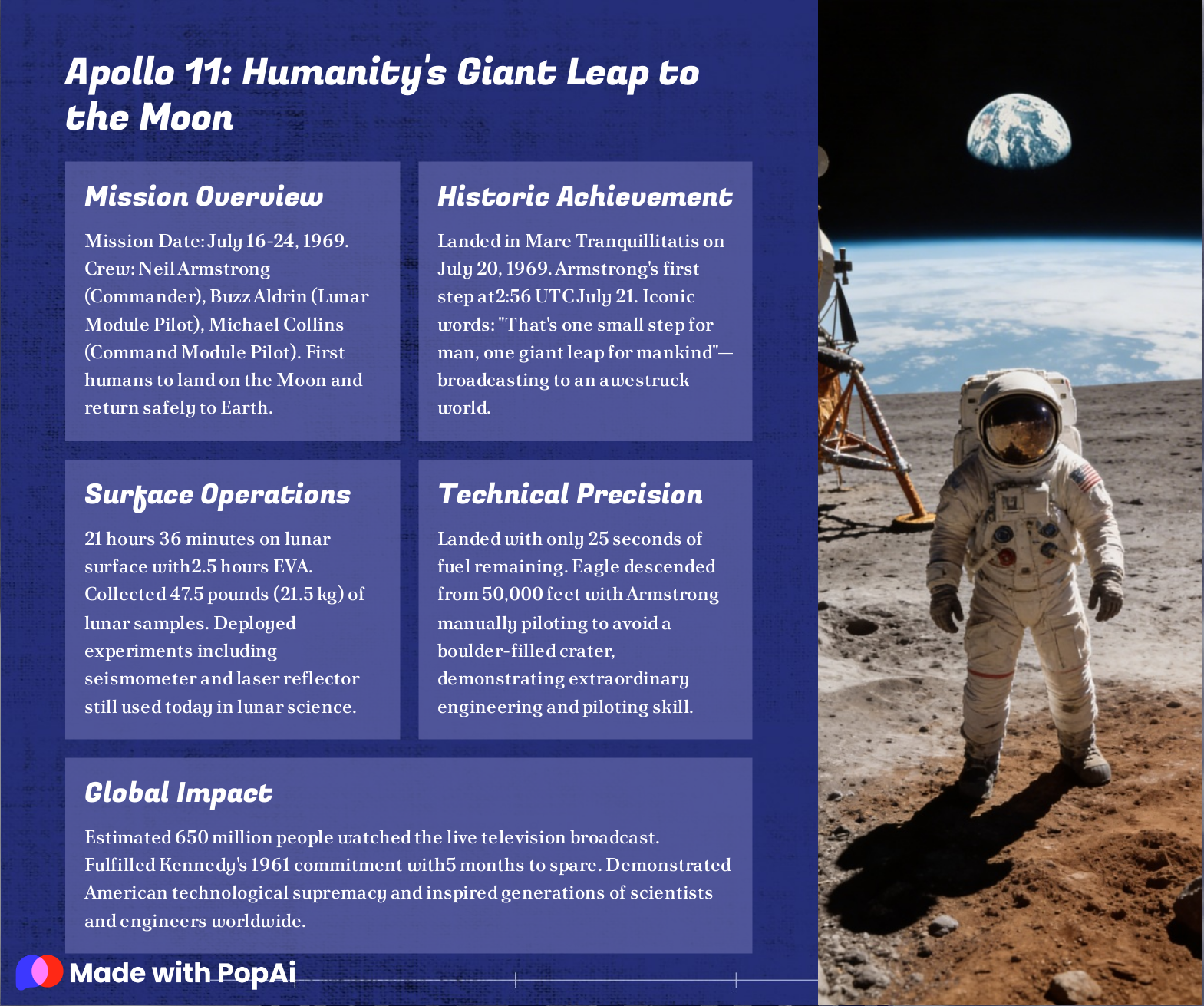
Slide 9: Apollo 11: Humanity's Giant Leap to the Moon
- Mission Overview: Mission Date: July 16-24, 1969. Crew: Neil Armstrong (Commander), Buzz Aldrin (Lunar Module Pilot), Michael Collins (Command Module Pilot). First humans to land on the Moon and return safely to Earth.
- Historic Achievement: Landed in Mare Tranquillitatis on July 20, 1969. Armstrong's first step at2:56 UTC July 21. Iconic words: "That's one small step for man, one giant leap for mankind"—broadcasting to an awestruck world.
- Surface Operations: 21 hours 36 minutes on lunar surface with2.5 hours EVA. Collected 47.5 pounds (21.5 kg) of lunar samples. Deployed experiments including seismometer and laser reflector still used today in lunar science.
- Technical Precision: Landed with only 25 seconds of fuel remaining. Eagle descended from 50,000 feet with Armstrong manually piloting to avoid a boulder-filled crater, demonstrating extraordinary engineering and piloting skill.
- Global Impact: Estimated 650 million people watched the live television broadcast. Fulfilled Kennedy's 1961 commitment with5 months to spare. Demonstrated American technological supremacy and inspired generations of scientists and engineers worldwide.
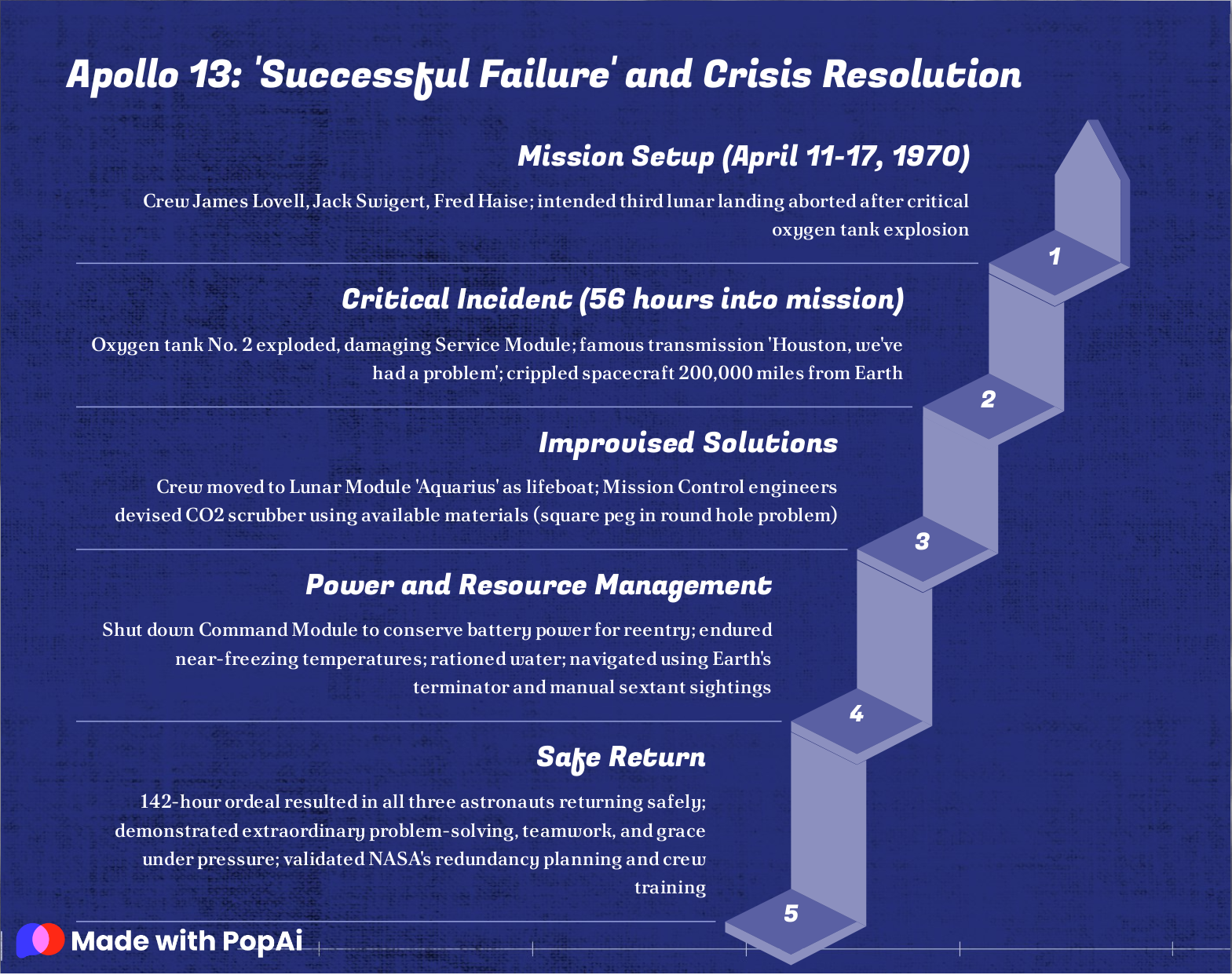
Slide 10: Apollo 13: 'Successful Failure' and Crisis Resolution
- Mission Setup (April 11-17, 1970): Crew James Lovell, Jack Swigert, Fred Haise; intended third lunar landing aborted after critical oxygen tank explosion
- Critical Incident (56 hours into mission): Oxygen tank No. 2 exploded, damaging Service Module; famous transmission 'Houston, we've had a problem'; crippled spacecraft 200,000 miles from Earth
- Improvised Solutions: Crew moved to Lunar Module 'Aquarius' as lifeboat; Mission Control engineers devised CO2 scrubber using available materials (square peg in round hole problem)
- Power and Resource Management: Shut down Command Module to conserve battery power for reentry; endured near-freezing temperatures; rationed water; navigated using Earth's terminator and manual sextant sightings
- Safe Return: 142-hour ordeal resulted in all three astronauts returning safely; demonstrated extraordinary problem-solving, teamwork, and grace under pressure; validated NASA's redundancy planning and crew training
Slide 11: Apollo 17: The Final Lunar Mission and Scientific Peak
- Mission Date and Crew: December 7-19, 1972. Eugene Cernan commanded as Mission Commander, Harrison Schmitt served as Lunar Module Pilot (the only scientist-astronaut to walk on the Moon), and Ronald Evans piloted the Command Module.
- Duration Records: Longest lunar landing mission at 12 days 14 hours. Longest total EVAs spanning 22 hours 4 minutes. Largest sample return of243.4 pounds (110.5 kg), demonstrating the scientific focus of the mission.
- Taurus-Littrow Valley Location: Selected for geological diversity between highlands and lowlands. Evidence of volcanic activity was discovered. Schmitt's geology expertise enabled sophisticated field analysis and unprecedented scientific investigation.
- Scientific Achievements: Discovered orange volcanic glass indicating recent volcanism (3billion years ago). Deployed Advanced ALSEP experiments measuring moonquakes, heat flow, and cosmic rays. The Lunar Roving Vehicle traveled 22.3 miles across the lunar surface.
- Final Words and Legacy: Cernan's historic departure: "We leave as we came and, God willing, as we shall return, with peace and hope for all mankind." Ended human lunar exploration for over 50 years. The final three planned missions (18-20) were cancelled due to budget constraints.
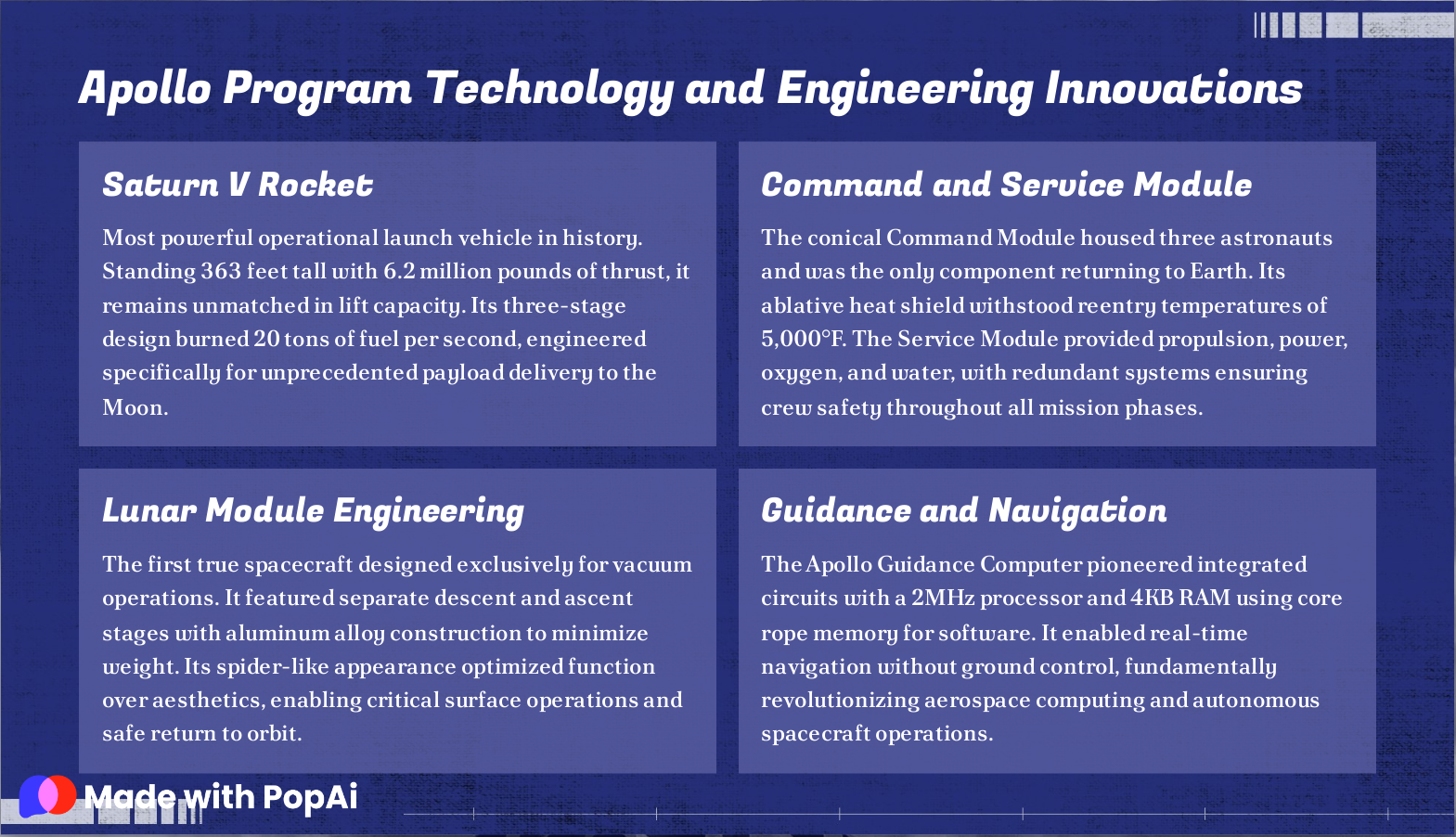
Slide 12: Apollo Program Technology and Engineering Innovations
- Saturn V Rocket: Most powerful operational launch vehicle in history. Standing 363 feet tall with 6.2 million pounds of thrust, it remains unmatched in lift capacity. Its three-stage design burned 20 tons of fuel per second, engineered specifically for unprecedented payload delivery to the Moon.
- Command and Service Module: The conical Command Module housed three astronauts and was the only component returning to Earth. Its ablative heat shield withstood reentry temperatures of 5,000°F. The Service Module provided propulsion, power, oxygen, and water, with redundant systems ensuring crew safety throughout all mission phases.
- Lunar Module Engineering: The first true spacecraft designed exclusively for vacuum operations. It featured separate descent and ascent stages with aluminum alloy construction to minimize weight. Its spider-like appearance optimized function over aesthetics, enabling critical surface operations and safe return to orbit.
- Guidance and Navigation: The Apollo Guidance Computer pioneered integrated circuits with a 2MHz processor and 4KB RAM using core rope memory for software. It enabled real-time navigation without ground control, fundamentally revolutionizing aerospace computing and autonomous spacecraft operations.
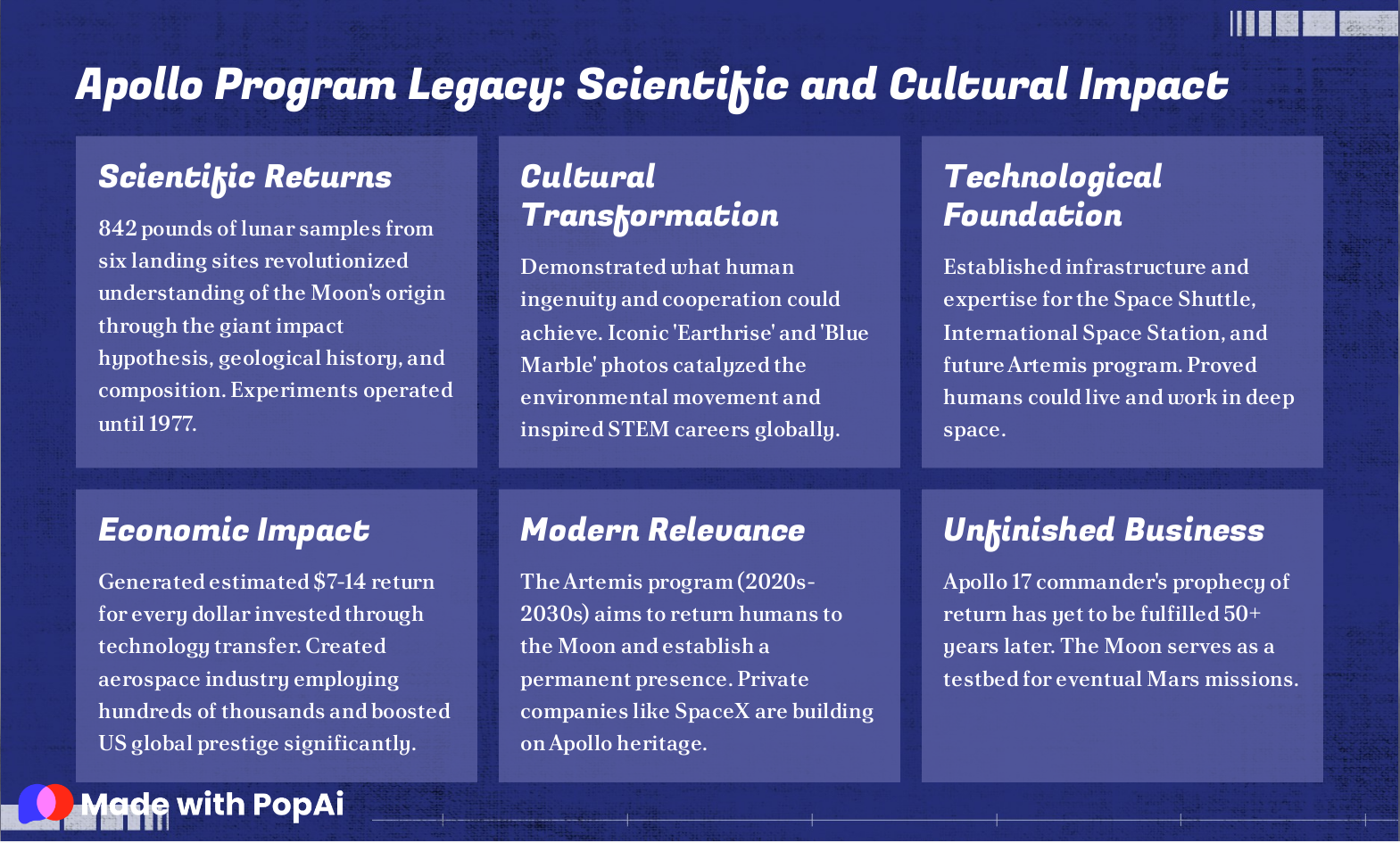
Slide 13: Apollo Program Legacy: Scientific and Cultural Impact
- Scientific Returns: 842 pounds of lunar samples from six landing sites revolutionized understanding of the Moon's origin through the giant impact hypothesis, geological history, and composition. Experiments operated until 1977.
- Cultural Transformation: Demonstrated what human ingenuity and cooperation could achieve. Iconic 'Earthrise' and 'Blue Marble' photos catalyzed the environmental movement and inspired STEM careers globally.
- Technological Foundation: Established infrastructure and expertise for the Space Shuttle, International Space Station, and future Artemis program. Proved humans could live and work in deep space.
- Economic Impact: Generated estimated $7-14 return for every dollar invested through technology transfer. Created aerospace industry employing hundreds of thousands and boosted US global prestige significantly.
- Modern Relevance: The Artemis program (2020s-2030s) aims to return humans to the Moon and establish a permanent presence. Private companies like SpaceX are building on Apollo heritage.
- Unfinished Business: Apollo 17 commander's prophecy of return has yet to be fulfilled 50+ years later. The Moon serves as a testbed for eventual Mars missions.
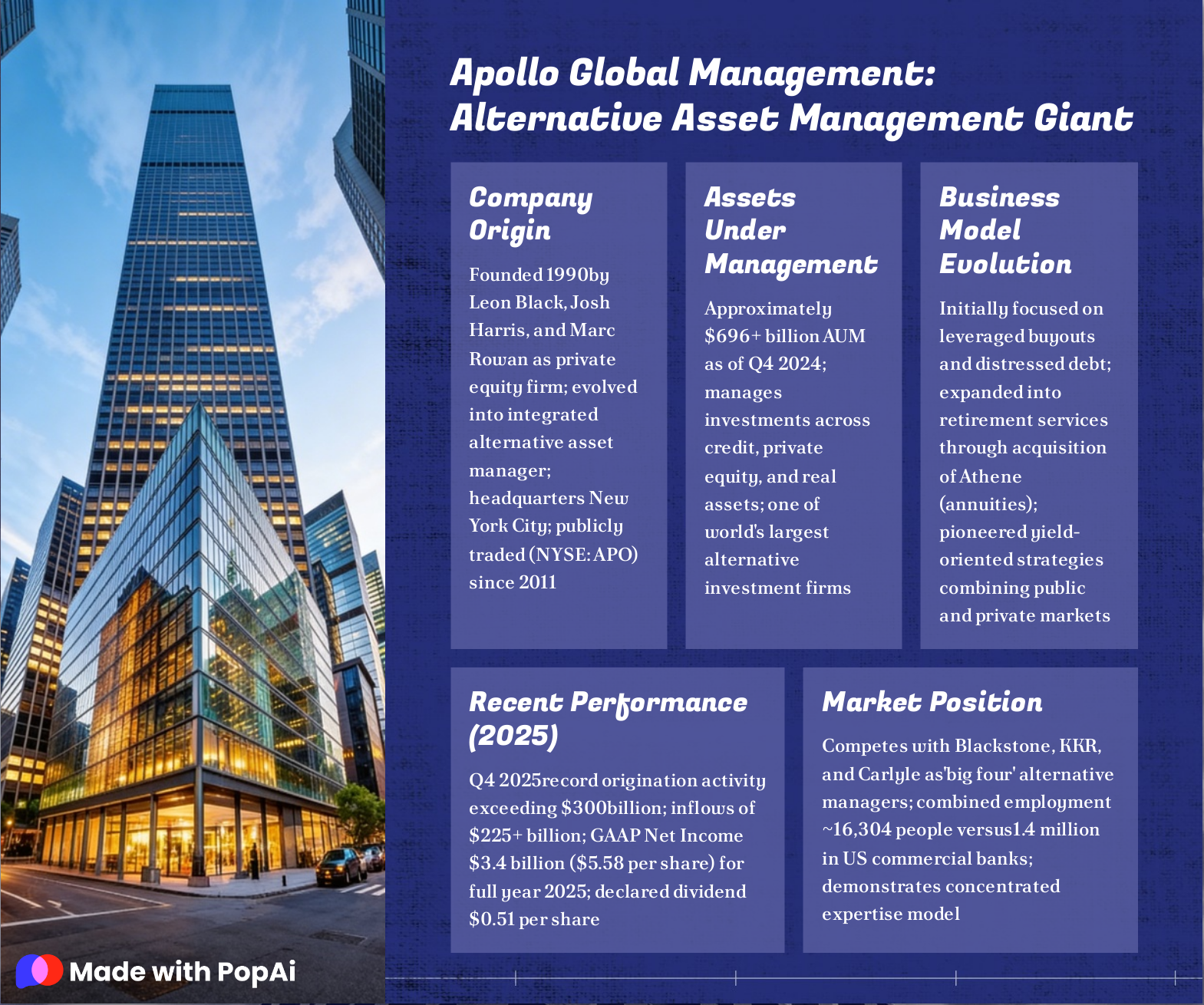
Slide 14: Apollo Global Management: Alternative Asset Management Giant
- Company Origin: Founded 1990by Leon Black, Josh Harris, and Marc Rowan as private equity firm; evolved into integrated alternative asset manager; headquarters New York City; publicly traded (NYSE: APO) since 2011
- Assets Under Management: Approximately $696+ billion AUM as of Q4 2024; manages investments across credit, private equity, and real assets; one of world's largest alternative investment firms
- Business Model Evolution: Initially focused on leveraged buyouts and distressed debt; expanded into retirement services through acquisition of Athene (annuities); pioneered yield-oriented strategies combining public and private markets
- Recent Performance (2025): Q4 2025record origination activity exceeding $300billion; inflows of $225+ billion; GAAP Net Income $3.4 billion ($5.58 per share) for full year 2025; declared dividend $0.51 per share
- Market Position: Competes with Blackstone, KKR, and Carlyle as'big four' alternative managers; combined employment ~16,304 people versus1.4 million in US commercial banks; demonstrates concentrated expertise model
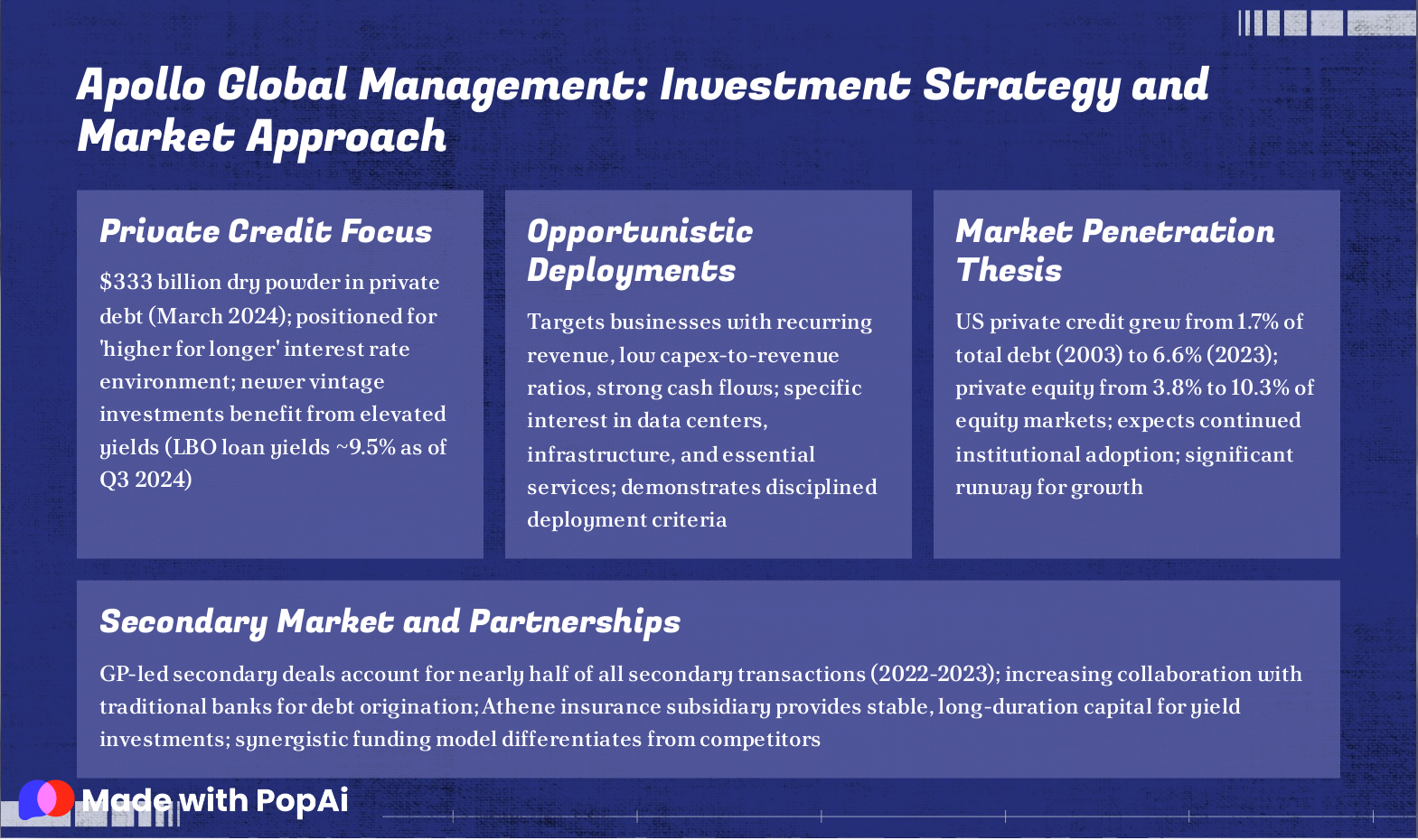
Slide 15: Apollo Global Management: Investment Strategy and Market Approach
- Private Credit Focus: $333 billion dry powder in private debt (March 2024); positioned for 'higher for longer' interest rate environment; newer vintage investments benefit from elevated yields (LBO loan yields ~9.5% as of Q3 2024)
- Opportunistic Deployments: Targets businesses with recurring revenue, low capex-to-revenue ratios, strong cash flows; specific interest in data centers, infrastructure, and essential services; demonstrates disciplined deployment criteria
- Market Penetration Thesis: US private credit grew from 1.7% of total debt (2003) to 6.6% (2023); private equity from 3.8% to 10.3% of equity markets; expects continued institutional adoption; significant runway for growth
- Secondary Market and Partnerships: GP-led secondary deals account for nearly half of all secondary transactions (2022-2023); increasing collaboration with traditional banks for debt origination; Athene insurance subsidiary provides stable, long-duration capital for yield investments; synergistic funding model differentiates from competitors
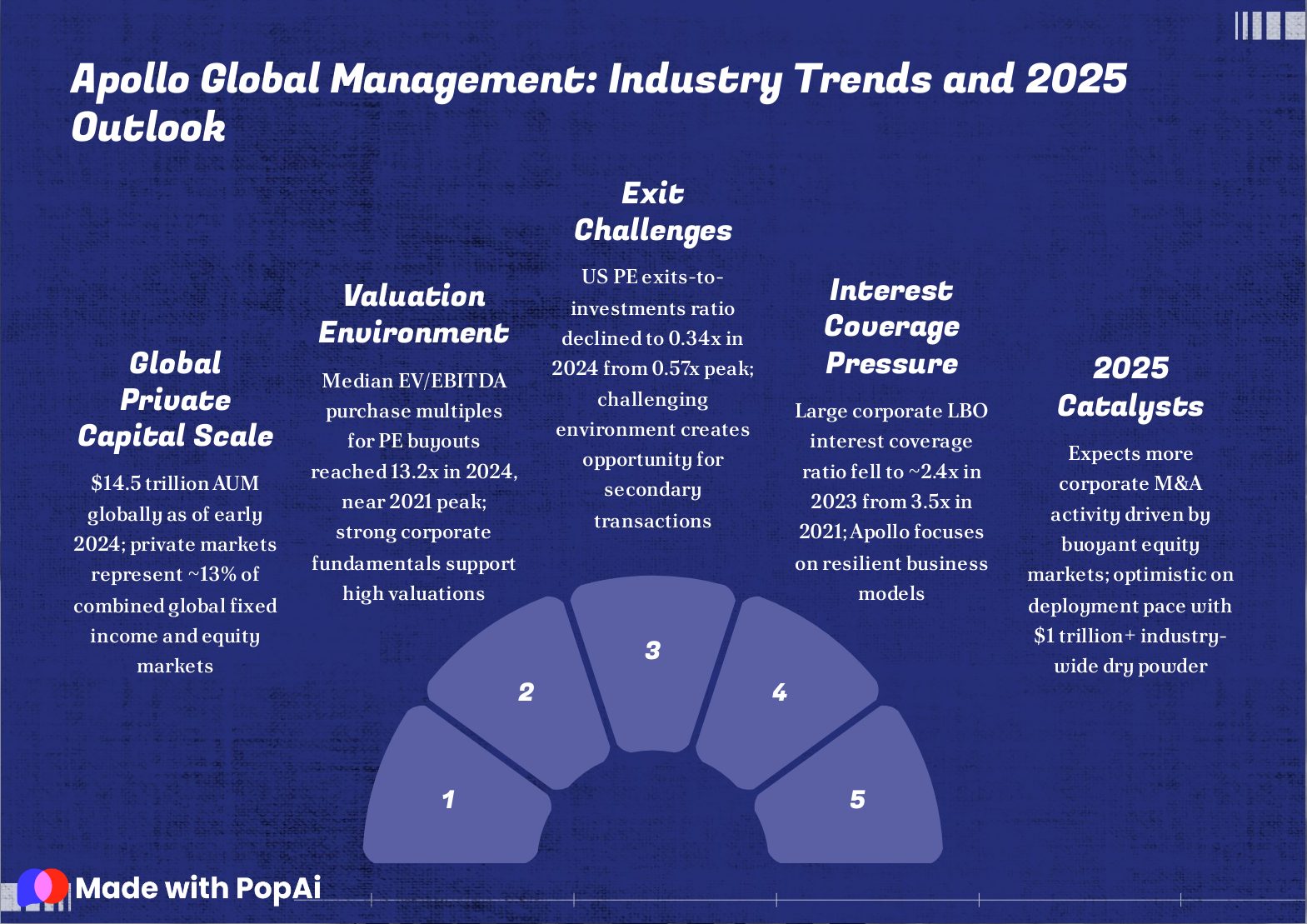
Slide 16: Apollo Global Management: Industry Trends and 2025 Outlook
- Global Private Capital Scale: $14.5 trillion AUM globally as of early 2024; private markets represent ~13% of combined global fixed income and equity markets
- Valuation Environment: Median EV/EBITDA purchase multiples for PE buyouts reached 13.2x in 2024, near 2021 peak; strong corporate fundamentals support high valuations
- Exit Challenges: US PE exits-to-investments ratio declined to 0.34x in 2024 from 0.57x peak; challenging environment creates opportunity for secondary transactions
- Interest Coverage Pressure: Large corporate LBO interest coverage ratio fell to ~2.4x in 2023 from 3.5x in 2021; Apollo focuses on resilient business models
- 2025 Catalysts: Expects more corporate M&A activity driven by buoyant equity markets; optimistic on deployment pace with $1 trillion+ industry-wide dry powder
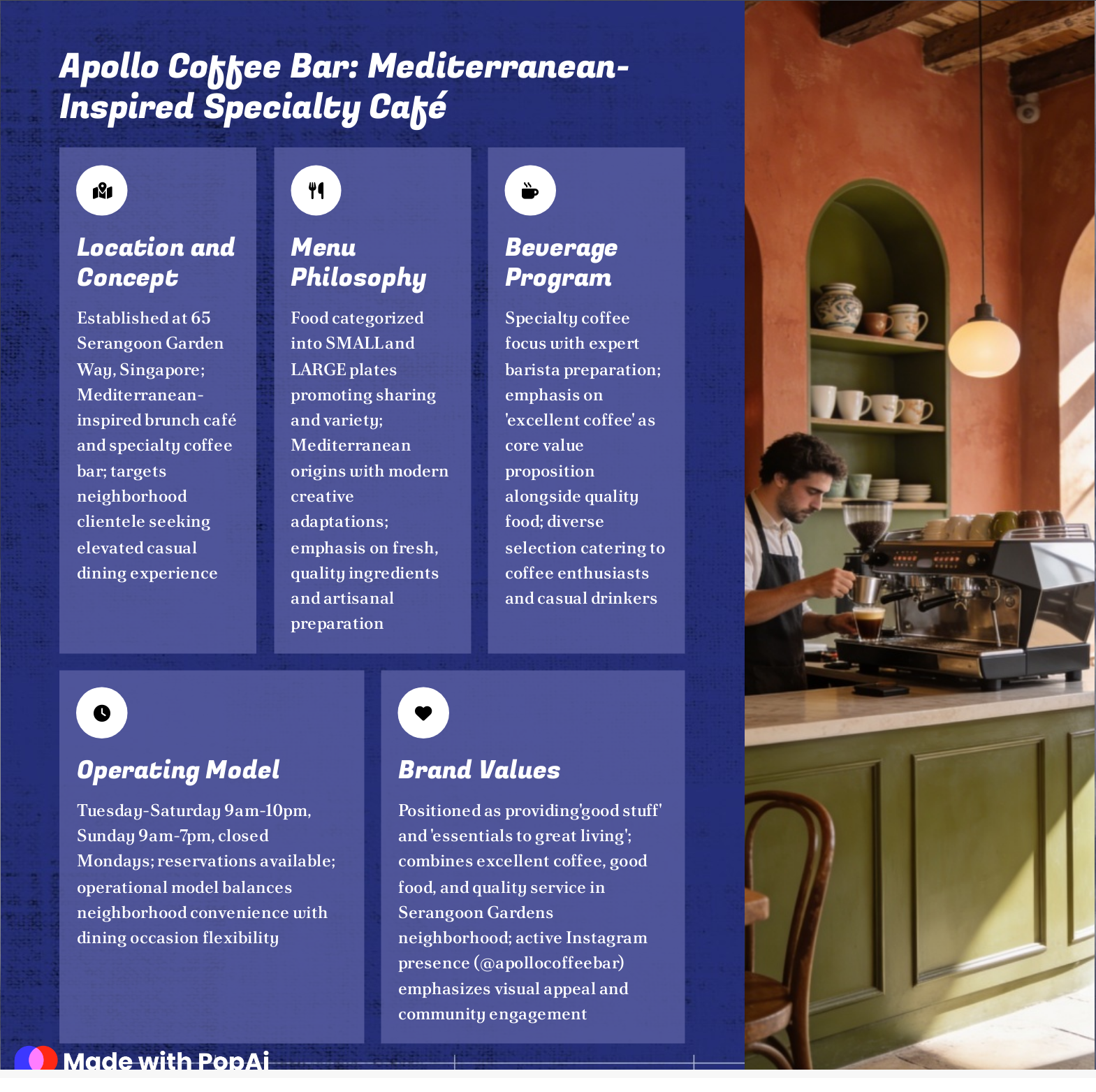
Slide 17: Apollo Coffee Bar: Mediterranean-Inspired Specialty Café
- Location and Concept: Established at 65 Serangoon Garden Way, Singapore; Mediterranean-inspired brunch café and specialty coffee bar; targets neighborhood clientele seeking elevated casual dining experience
- Menu Philosophy: Food categorized into SMALL and LARGE plates promoting sharing and variety; Mediterranean origins with modern creative adaptations; emphasis on fresh, quality ingredients and artisanal preparation
- Beverage Program: Specialty coffee focus with expert barista preparation; emphasis on 'excellent coffee' as core value proposition alongside quality food; diverse selection catering to coffee enthusiasts and casual drinkers
- Operating Model: Tuesday-Saturday 9am-10pm, Sunday 9am-7pm, closed Mondays; reservations available; operational model balances neighborhood convenience with dining occasion flexibility
- Brand Values: Positioned as providing'good stuff' and 'essentials to great living'; combines excellent coffee, good food, and quality service in Serangoon Gardens neighborhood; active Instagram presence (@apollocoffeebar) emphasizes visual appeal and community engagement
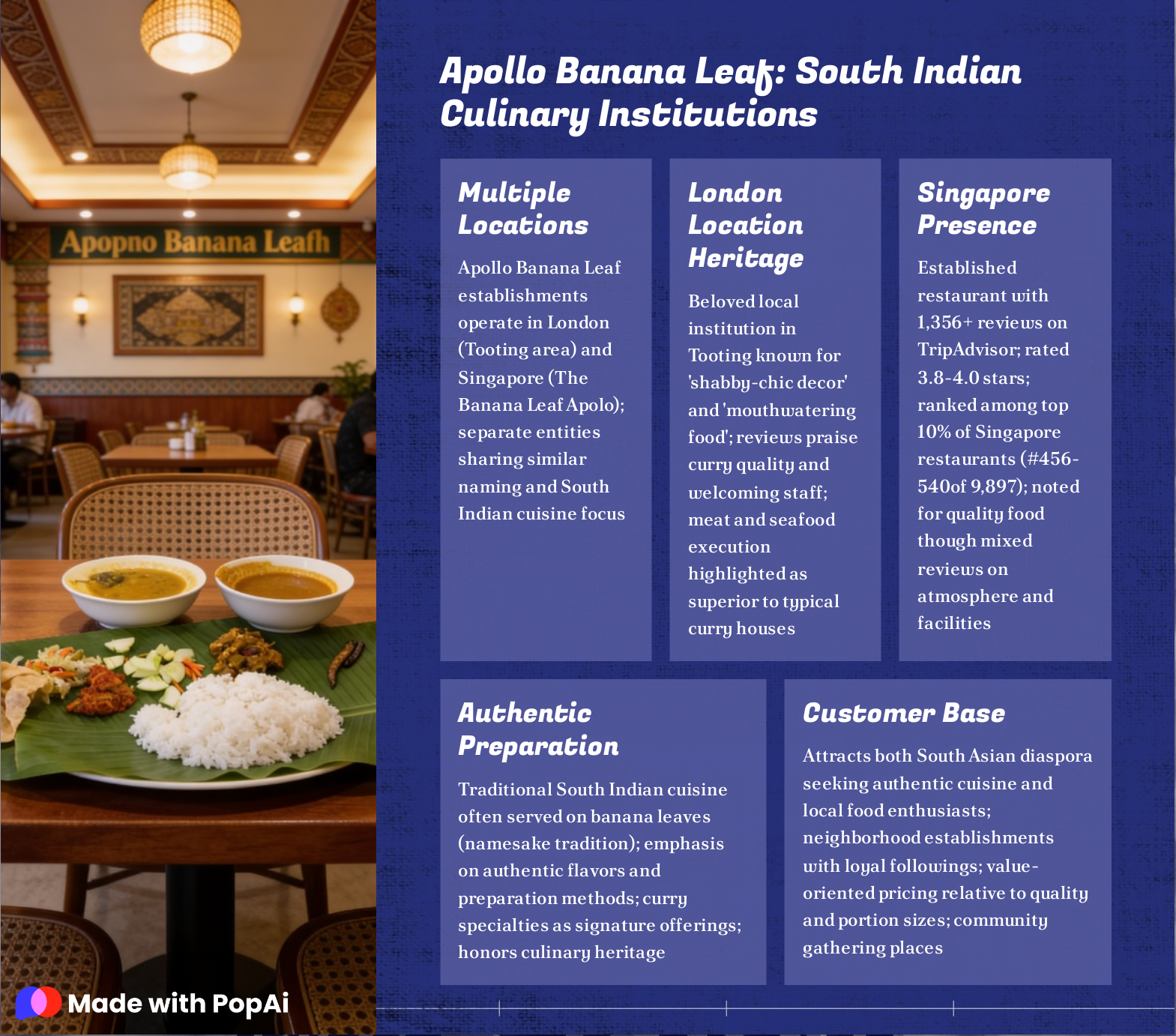
Slide 18: Apollo Banana Leaf: South Indian Culinary Institutions
- Multiple Locations: Apollo Banana Leaf establishments operate in London (Tooting area) and Singapore (The Banana Leaf Apolo); separate entities sharing similar naming and South Indian cuisine focus
- London Location Heritage: Beloved local institution in Tooting known for 'shabby-chic decor' and 'mouthwatering food'; reviews praise curry quality and welcoming staff; meat and seafood execution highlighted as superior to typical curry houses
- Singapore Presence: Established restaurant with 1,356+ reviews on TripAdvisor; rated 3.8-4.0 stars; ranked among top 10% of Singapore restaurants (#456-540of 9,897); noted for quality food though mixed reviews on atmosphere and facilities
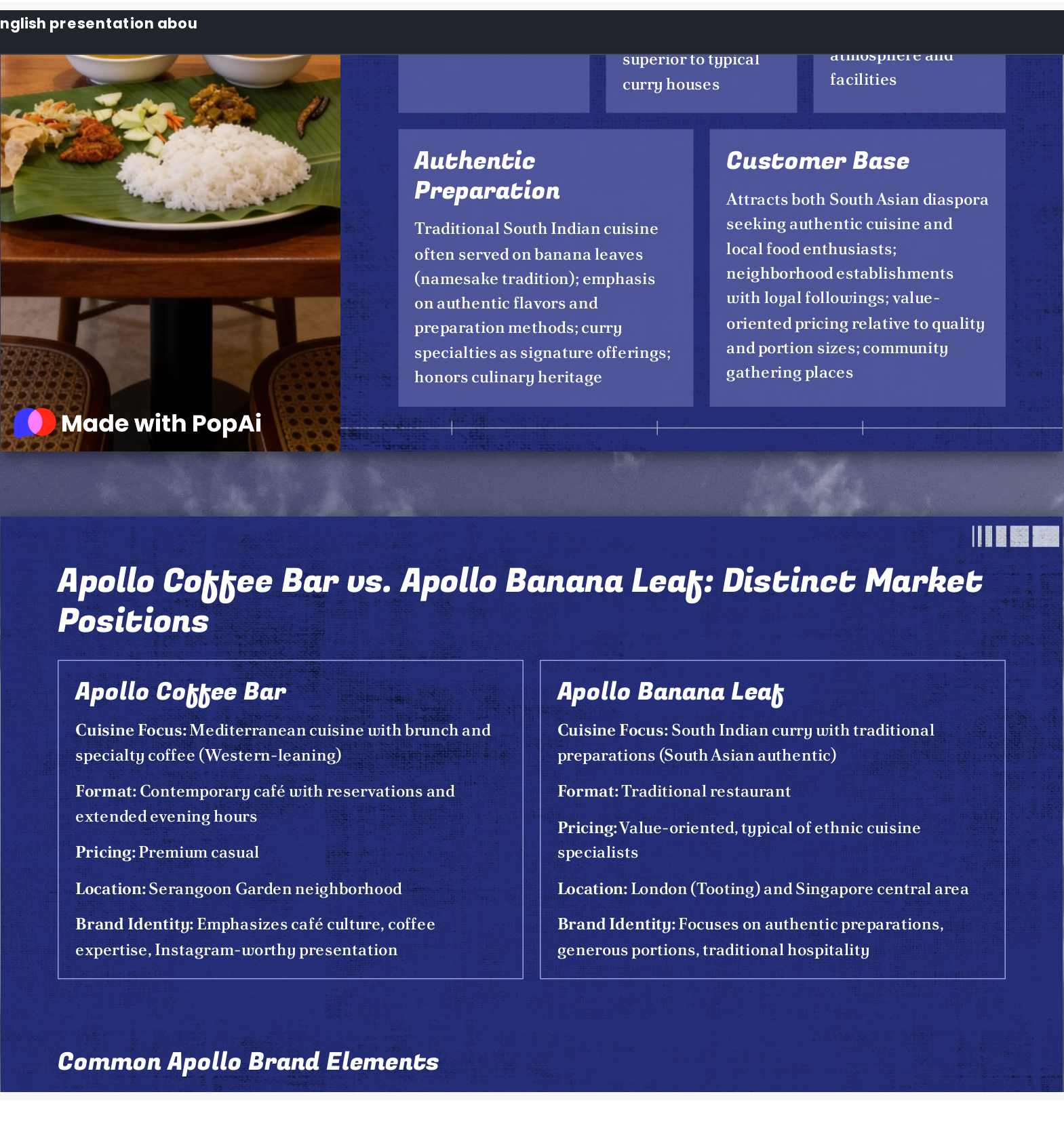
- Authentic Preparation: Traditional South Indian cuisine often served on banana leaves (namesake tradition); emphasis on authentic flavors and preparation methods; curry specialties as signature offerings; honors culinary heritage
- Customer Base: Attracts both South Asian diaspora seeking authentic cuisine and local food enthusiasts; neighborhood establishments with loyal followings; value-oriented pricing relative to quality and portion sizes; community gathering places
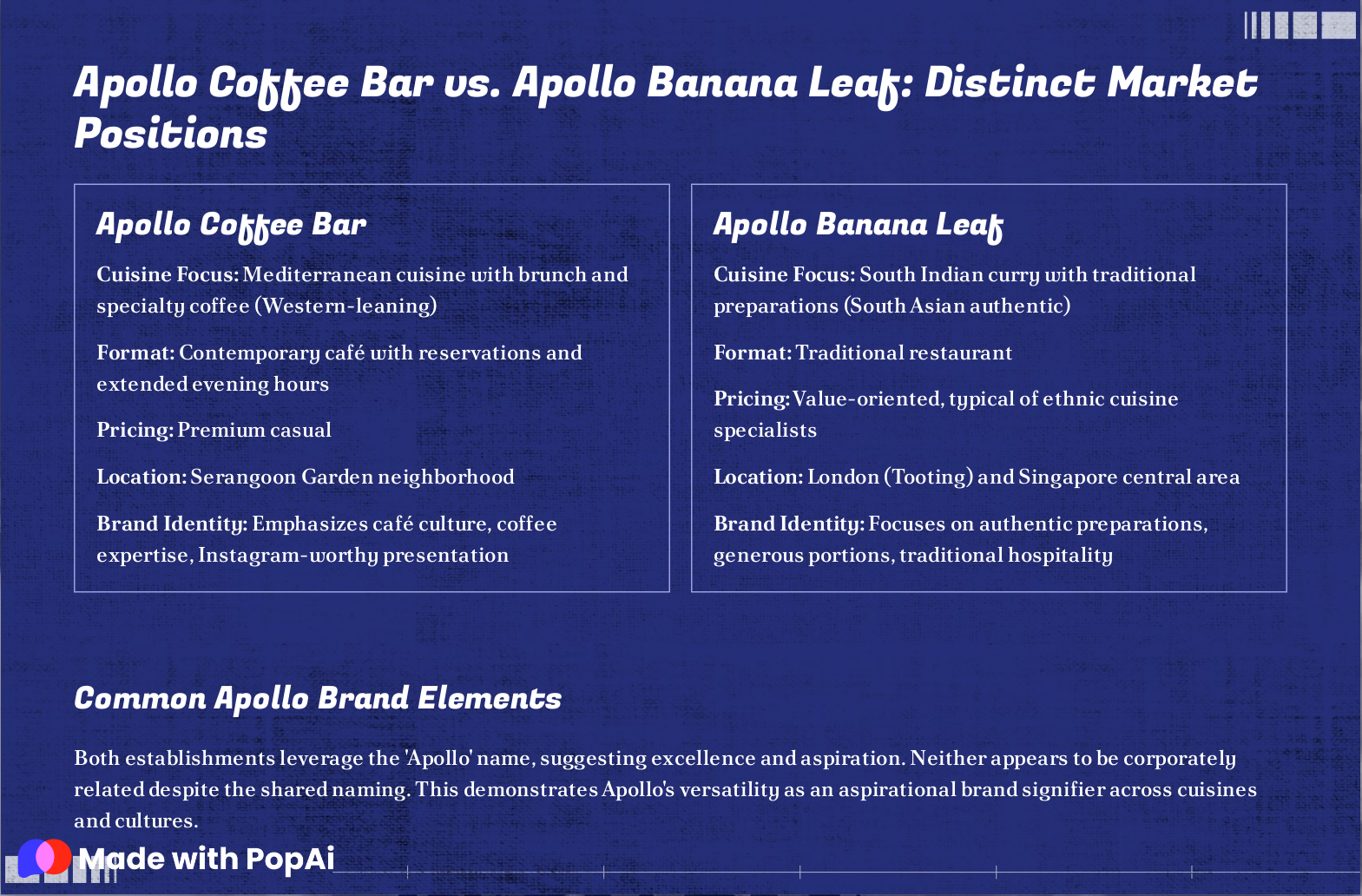
Slide 19: Apollo Coffee Bar vs. Apollo Banana Leaf: Distinct Market Positions
- Apollo Coffee Bar: Cuisine Focus: Mediterranean cuisine with brunch and specialty coffee (Western-leaning)
- Apollo Banana Leaf: Cuisine Focus: South Indian curry with traditional preparations (South Asian authentic)
Both establishments leverage the 'Apollo' name, suggesting excellence and aspiration. Neither appears to be corporately related despite the shared naming. This demonstrates Apollo's versatility as an aspirational brand signifier across cuisines and cultures.
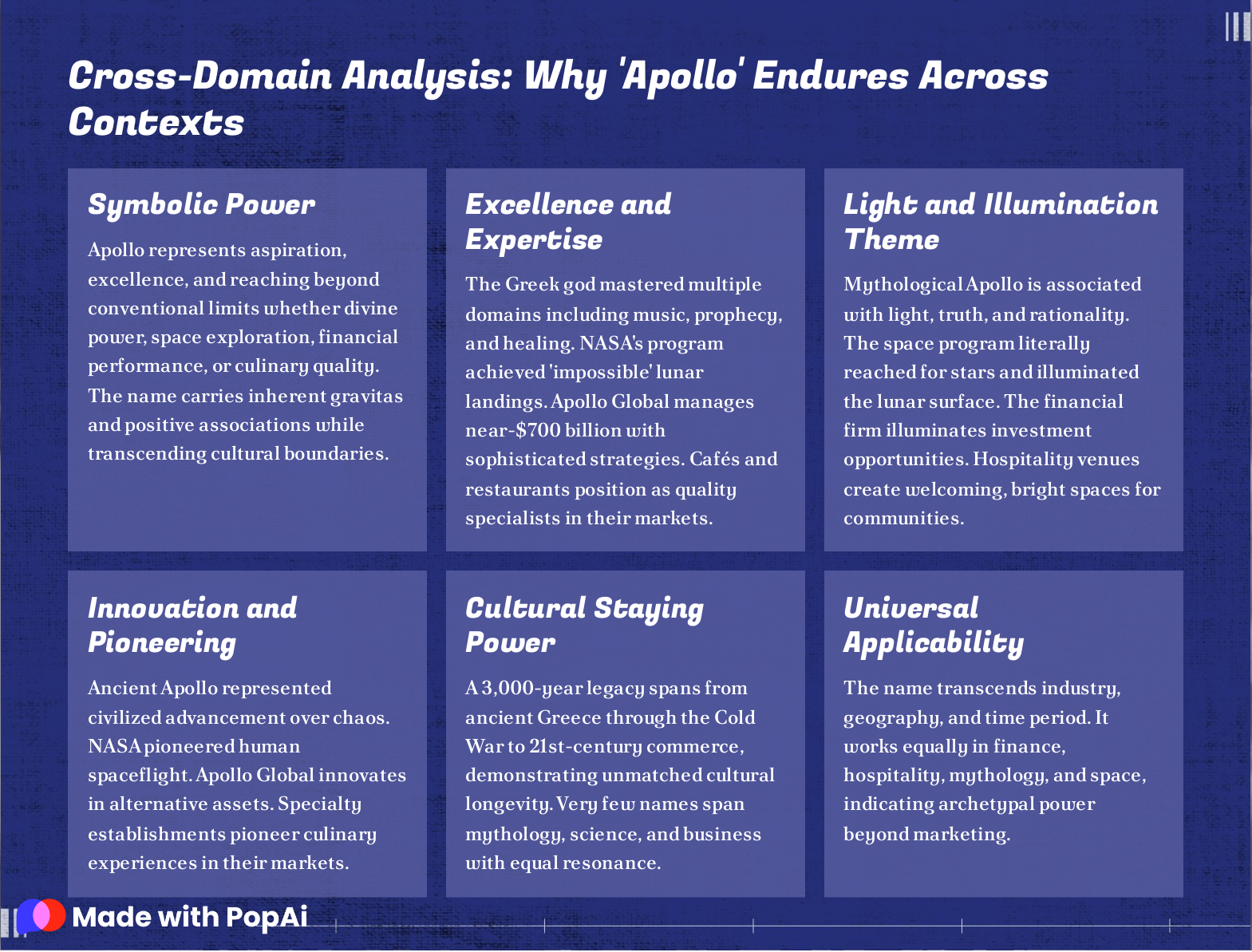
Slide 20: Cross-Domain Analysis: Why 'Apollo' Endures Across Contexts
- Symbolic Power: Apollo represents aspiration, excellence, and reaching beyond conventional limits whether divine power, space exploration, financial performance, or culinary quality. The name carries inherent gravitas and positive associations while transcending cultural boundaries.
- Excellence and Expertise: The Greek god mastered multiple domains including music, prophecy, and healing. NASA's program achieved 'impossible' lunar landings. Apollo Global manages near-$700 billion with sophisticated strategies. Cafés and restaurants position as quality specialists in their markets.
- Light and Illumination Theme: Mythological Apollo is associated with light, truth, and rationality. The space program literally reached for stars and illuminated the lunar surface. The financial firm illuminates investment opportunities. Hospitality venues create welcoming, bright spaces for communities.
- Innovation and Pioneering: Ancient Apollo represented civilized advancement over chaos. NASA pioneered human spaceflight. Apollo Global innovates in alternative assets. Specialty establishments pioneer culinary experiences in their markets.
- Cultural Staying Power: A 3,000-year legacy spans from ancient Greece through the Cold War to 21st-century commerce, demonstrating unmatched cultural longevity. Very few names span mythology, science, and business with equal resonance.
- Universal Applicability: The name transcends industry, geography, and time period. It works equally in finance, hospitality, mythology, and space, indicating archetypal power beyond marketing.
Slide 21: The Apollo Archetype: Characteristics Across Domains
- Pursuit of Knowledge: Mythological prophecy and truth-seeking; NASA's scientific exploration of lunar geology; Apollo Global's market intelligence and sophisticated analysis; culinary craftsmanship and expertise in coffee preparation and curry authenticity
- Technical Mastery: Divine skill with lyre and bow; engineering precision of Saturn V and lunar modules achieving impossible objectives; sophisticated financial modeling and risk management; culinary technique excellence in both coffee and curry preparation
- Calculated Risk-Taking: Apollo's decisive action in myths without hesitation; astronauts accepting mortality risk for exploration; private equity's leveraged investments in market downturns; entrepreneurs launching premium establishments in competitive markets
- Transformative Impact: Apollo's myths shaped Western civilization for millennia; moon landings transformed human self-perception and global cooperation; alternative assets revolutionized investment landscape; quality establishments elevate neighborhood dining culture and community gathering
- Balance and Harmony: God of order and civilization versus Dionysian chaos; NASA's precise orbital mechanics balancing risk and safety; Apollo Global's risk-adjusted returns seeking sustainable performance; cafés and restaurants balancing quality, ambiance, and value proposition
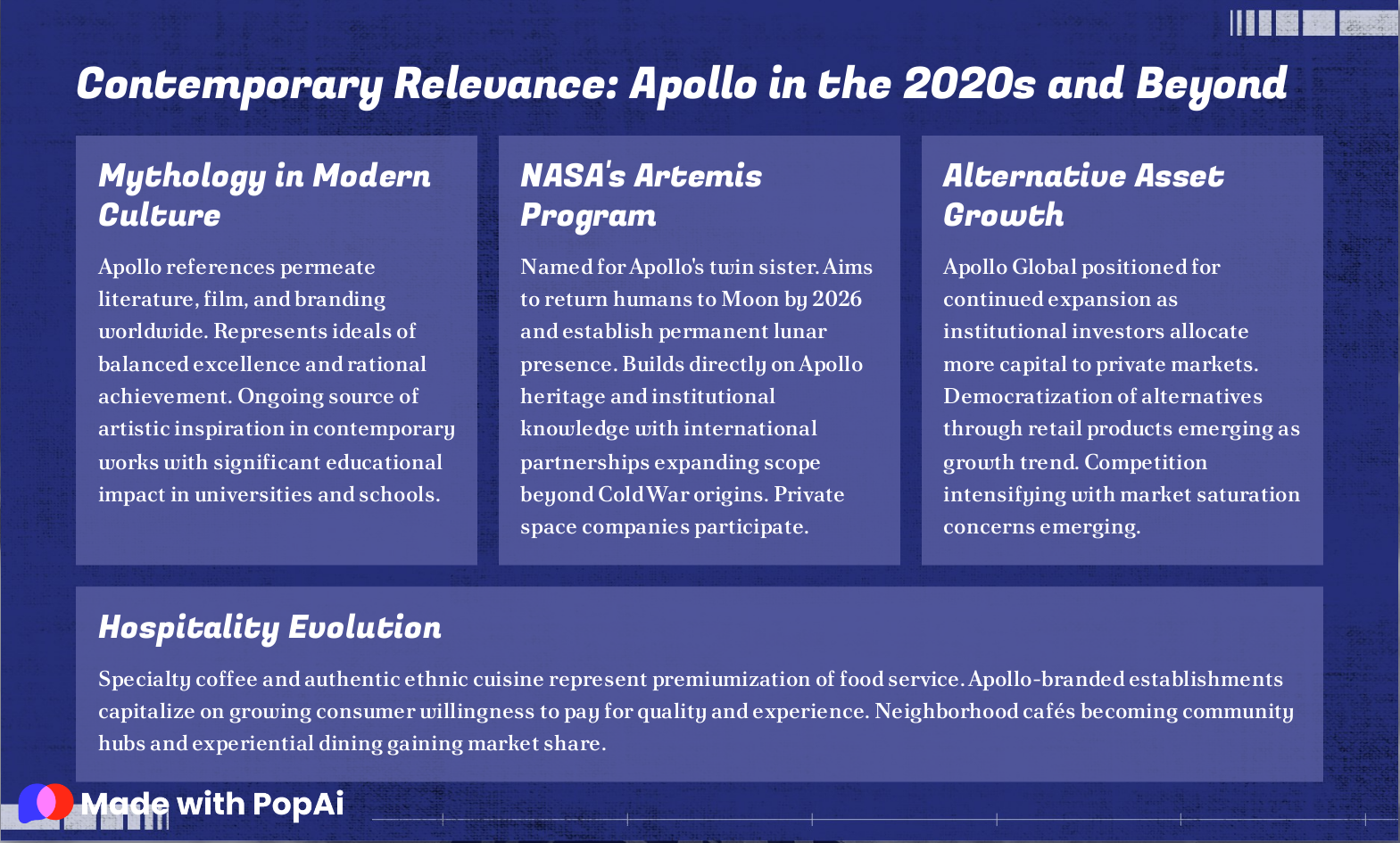
Slide 22: Contemporary Relevance: Apollo in the 2020s and Beyond
- Mythology in Modern Culture: Apollo references permeate literature, film, and branding worldwide. Represents ideals of balanced excellence and rational achievement. Ongoing source of artistic inspiration in contemporary works with significant educational impact in universities and schools.
- NASA's Artemis Program: Named for Apollo's twin sister. Aims to return humans to Moon by 2026 and establish permanent lunar presence. Builds directly on Apollo heritage and institutional knowledge with international partnerships expanding scope beyond Cold War origins. Private space companies participate.
- Alternative Asset Growth: Apollo Global positioned for continued expansion as institutional investors allocate more capital to private markets. Democratization of alternatives through retail products emerging as growth trend. Competition intensifying with market saturation concerns emerging.
- Hospitality Evolution: Specialty coffee and authentic ethnic cuisine represent premiumization of food service. Apollo-branded establishments capitalize on growing consumer willingness to pay for quality and experience. Neighborhood cafés becoming community hubs and experiential dining gaining market share.
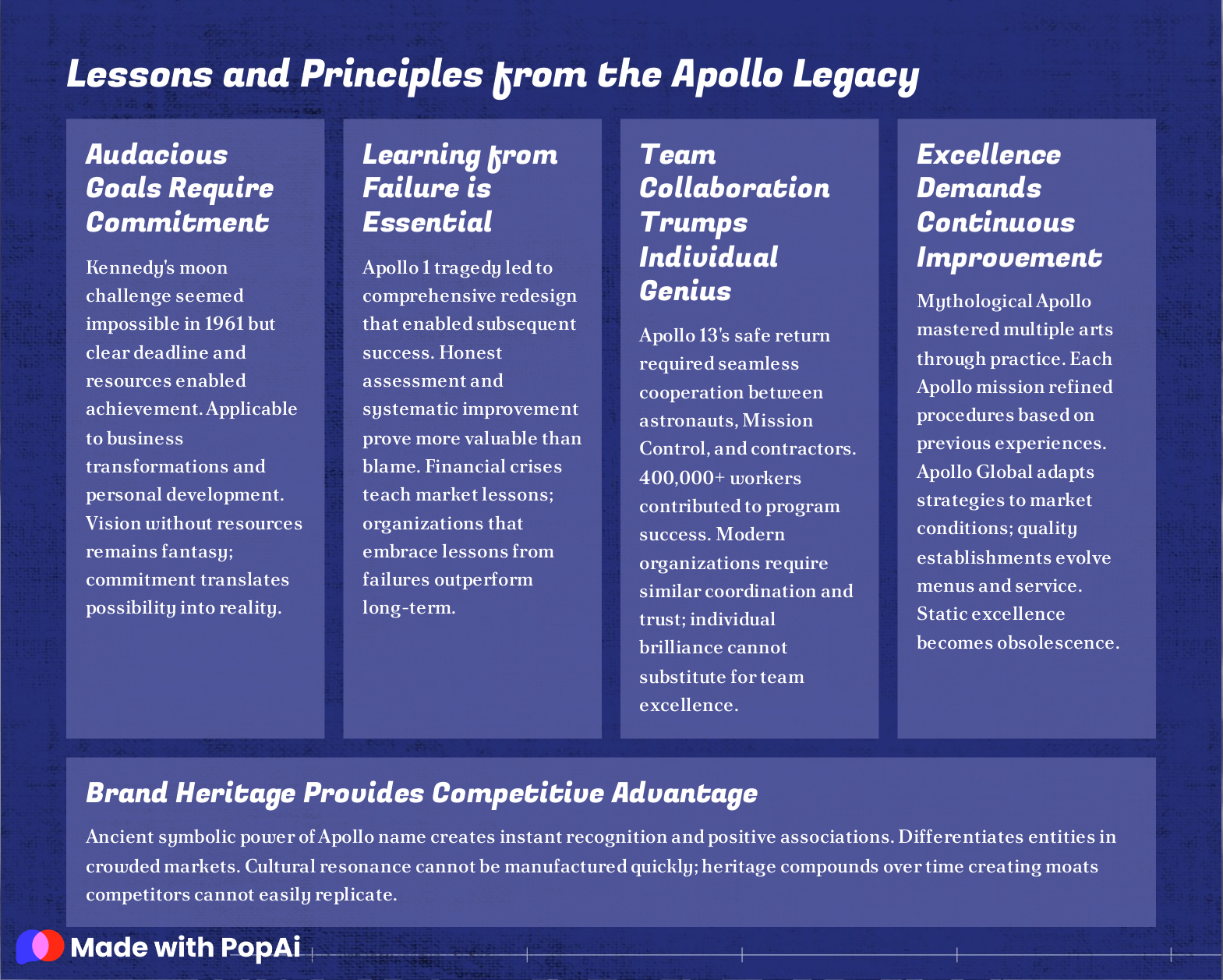
Slide 23: Lessons and Principles from the Apollo Legacy
- Audacious Goals Require Commitment: Kennedy's moon challenge seemed impossible in 1961 but clear deadline and resources enabled achievement. Applicable to business transformations and personal development. Vision without resources remains fantasy; commitment translates possibility into reality.
- Learning from Failure is Essential: Apollo 1 tragedy led to comprehensive redesign that enabled subsequent success. Honest assessment and systematic improvement prove more valuable than blame. Financial crises teach market lessons; organizations that embrace lessons from failures outperform long-term.
- Team Collaboration Trumps Individual Genius: Apollo 13's safe return required seamless cooperation between astronauts, Mission Control, and contractors. 400,000+ workers contributed to program success. Modern organizations require similar coordination and trust; individual brilliance cannot substitute for team excellence.
- Excellence Demands Continuous Improvement: Mythological Apollo mastered multiple arts through practice. Each Apollo mission refined procedures based on previous experiences. Apollo Global adapts strategies to market conditions; quality establishments evolve menus and service. Static excellence becomes obsolescence.
- Brand Heritage Provides Competitive Advantage: Ancient symbolic power of Apollo name creates instant recognition and positive associations. Differentiates entities in crowded markets. Cultural resonance cannot be manufactured quickly; heritage compounds over time creating moats competitors cannot easily replicate.
Slide 24: Conclusion: The Multidimensional Apollo Legacy
Apollo represents rare cultural phenomenon spanning mythology, history, science, business, and daily life across 3,000+ years; demonstrates enduring power of excellence, innovation, and aspiration as universal human values.
Names and symbols carrying deep cultural resonance provide lasting competitive advantages
Ambitious goals require commitment, resources, and willingness to learn from failures
Technical mastery and calculated risk-taking enable transformative achievements
Balance between rational excellence and inspirational vision creates enduring impact
NASA's Artemis program continues space exploration legacy; Apollo Global navigates evolving financial markets; hospitality establishments carry naming tradition into neighborhood communities; new 'Apollos' will emerge as humans pursue next frontiers.
Whether seeking truth like the ancient god, reaching for the Moon like 1960s astronauts, generating returns like modern investors, or crafting perfect espresso like contemporary baristas, the Apollo spirit of striving for excellence beyond conventional limits remains timeless and universal.
- Names and symbols carrying deep cultural resonance provide lasting competitive advantages
- Ambitious goals require commitment, resources, and willingness to learn from failures
- Technical mastery and calculated risk-taking enable transformative achievements
- Balance between rational excellence and inspirational vision creates enduring impact