Presentation Summary
Explore the 2026 FIFA World Cup Intercontinental Playoff, featuring six teams battling for two spots in the expanded 48-team tournament. Learn about the unique format, participating nations, and the implications for global football.
Full Presentation Transcript
Slide 1: 2026 FIFA World Cup Intercontinental Playoff: Road to Global Glory
Comprehensive Analysis of Repechaje Mundial – Tournament Format, Teams, Venues, and World Cup Implications
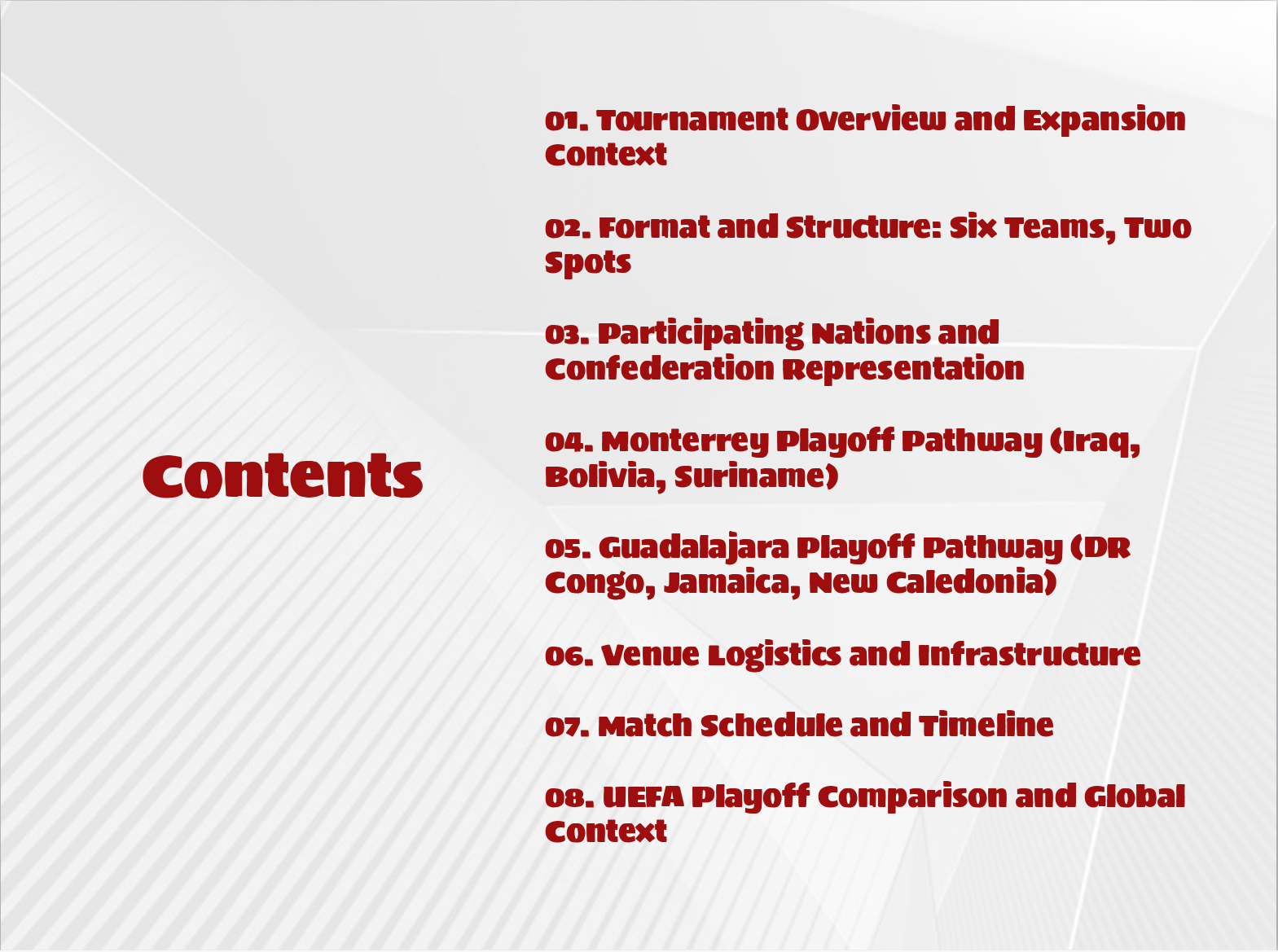
Slide 2: Contents
- Tournament Overview and Expansion Context
- Format and Structure: Six Teams, Two Spots
- Participating Nations and Confederation Representation
- Monterrey Playoff Pathway (Iraq, Bolivia, Suriname)
- Guadalajara Playoff Pathway (DR Congo, Jamaica, New Caledonia)
- Venue Logistics and Infrastructure
- Match Schedule and Timeline
- UEFA Playoff Comparison and Global Context
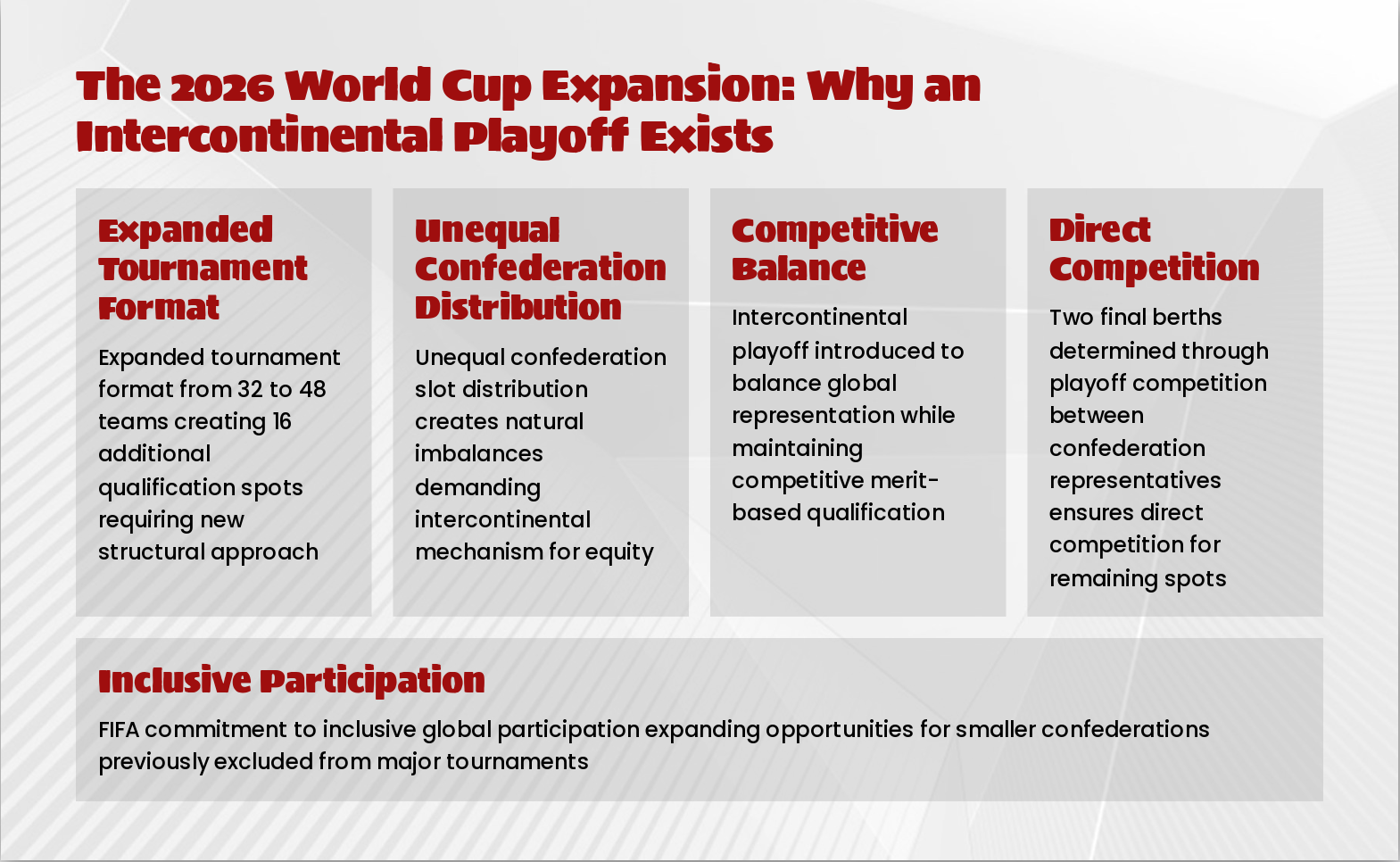
Slide 3: The 2026 World Cup Expansion: Why an Intercontinental Playoff Exists
- Expanded Tournament Format: Expanded tournament format from 32 to 48 teams creating 16 additional qualification spots requiring new structural approach
- Unequal Confederation Distribution: Unequal confederation slot distribution creates natural imbalances demanding intercontinental mechanism for equity
- Competitive Balance: Intercontinental playoff introduced to balance global representation while maintaining competitive merit-based qualification
- Direct Competition: Two final berths determined through playoff competition between confederation representatives ensures direct competition for remaining spots
- Inclusive Participation: FIFA commitment to inclusive global participation expanding opportunities for smaller confederations previously excluded from major tournaments
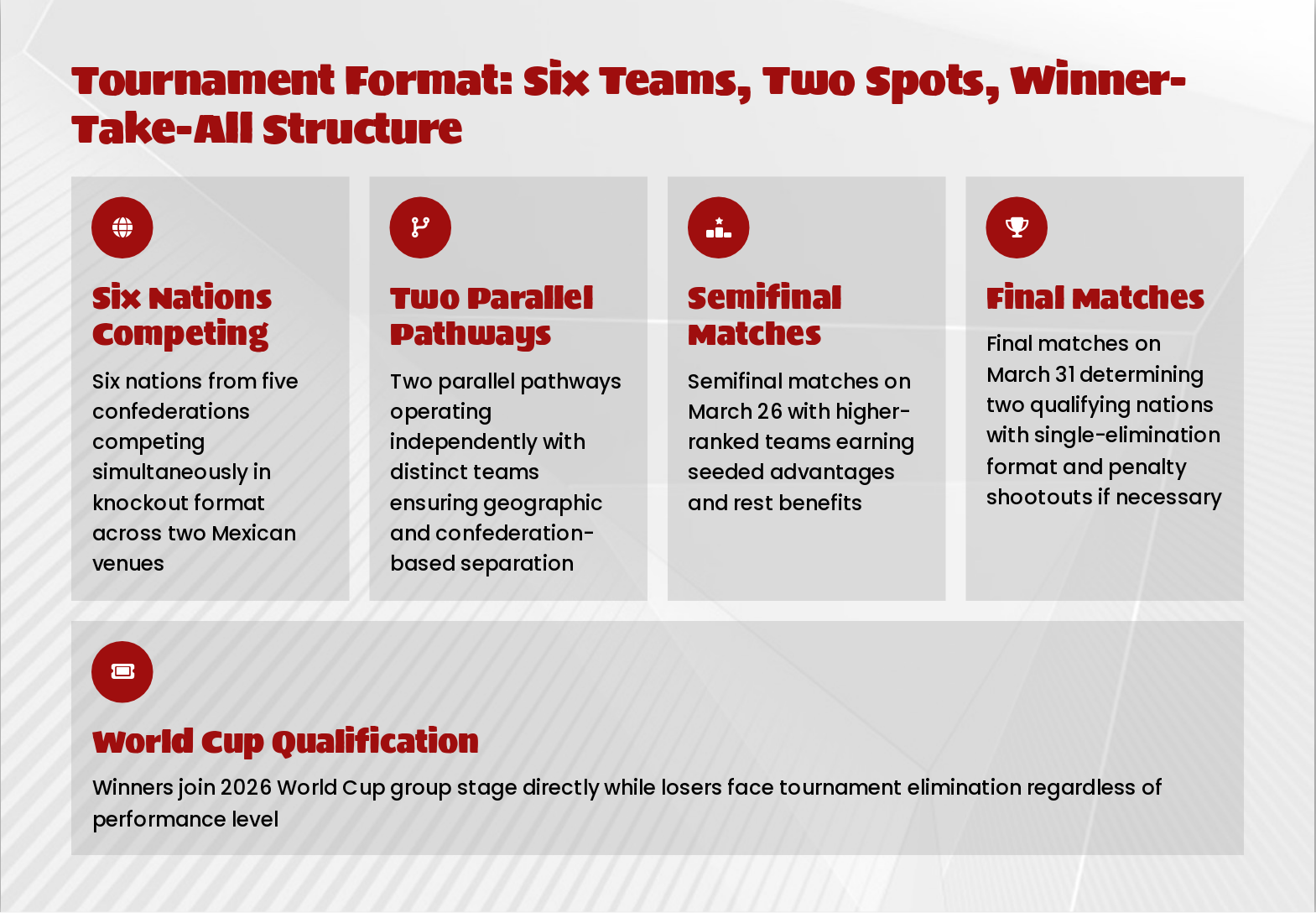
Slide 4: Tournament Format: Six Teams, Two Spots, Winner-Take-All Structure
- Six Nations Competing: Six nations from five confederations competing simultaneously in knockout format across two Mexican venues
- Two Parallel Pathways: Two parallel pathways operating independently with distinct teams ensuring geographic and confederation-based separation
- Semifinal Matches: Semifinal matches on March 26 with higher-ranked teams earning seeded advantages and rest benefits
- Final Matches: Final matches on March 31 determining two qualifying nations with single-elimination format and penalty shootouts if necessary
- World Cup Qualification: Winners join 2026 World Cup group stage directly while losers face tournament elimination regardless of performance level
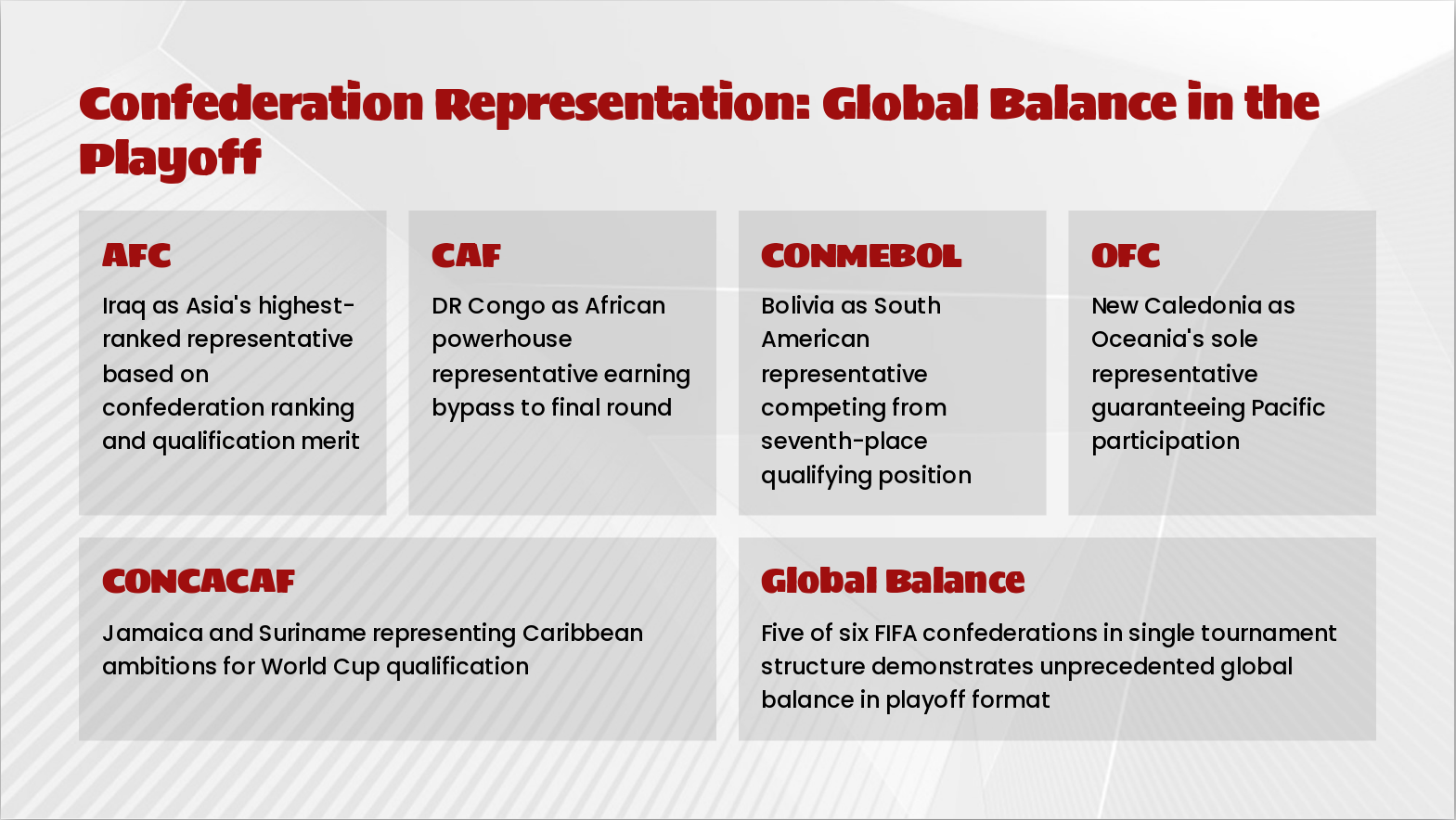
Slide 5: Confederation Representation: Global Balance in the Playoff
- AFC: Iraq as Asia's highest-ranked representative based on confederation ranking and qualification merit
- CAF: DR Congo as African powerhouse representative earning bypass to final round
- CONMEBOL: Bolivia as South American representative competing from seventh-place qualifying position
- OFC: New Caledonia as Oceania's sole representative guaranteeing Pacific participation
- CONCACAF: Jamaica and Suriname representing Caribbean ambitions for World Cup qualification
- Global Balance: Five of six FIFA confederations in single tournament structure demonstrates unprecedented global balance in playoff format
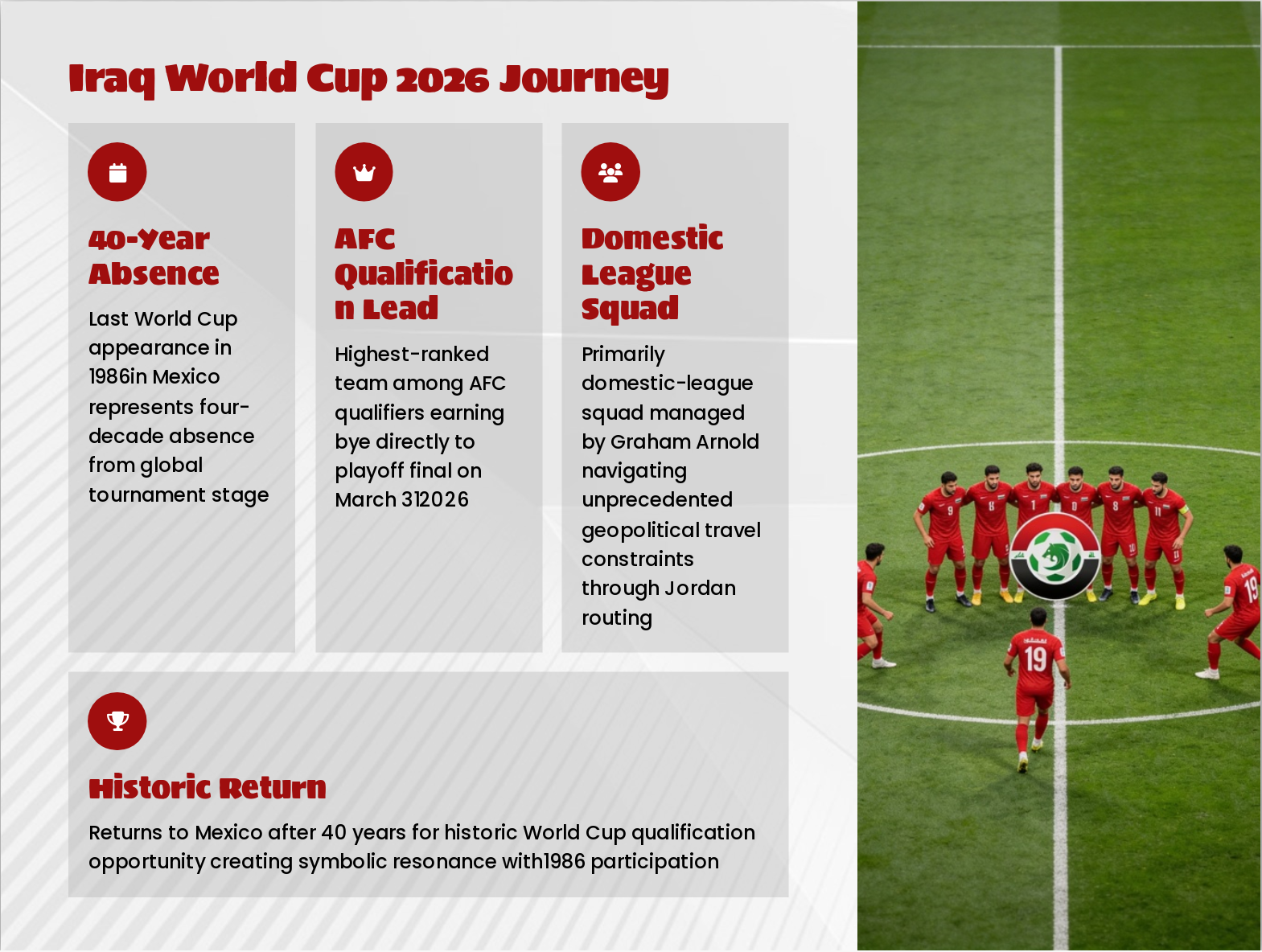
Slide 6: Iraq World Cup 2026 Journey
- 40-Year Absence: Last World Cup appearance in 1986in Mexico represents four-decade absence from global tournament stage
- AFC Qualification Lead: Highest-ranked team among AFC qualifiers earning bye directly to playoff final on March 312026
- Domestic League Squad: Primarily domestic-league squad managed by Graham Arnold navigating unprecedented geopolitical travel constraints through Jordan routing
- Historic Return: Returns to Mexico after 40 years for historic World Cup qualification opportunity creating symbolic resonance with1986 participation
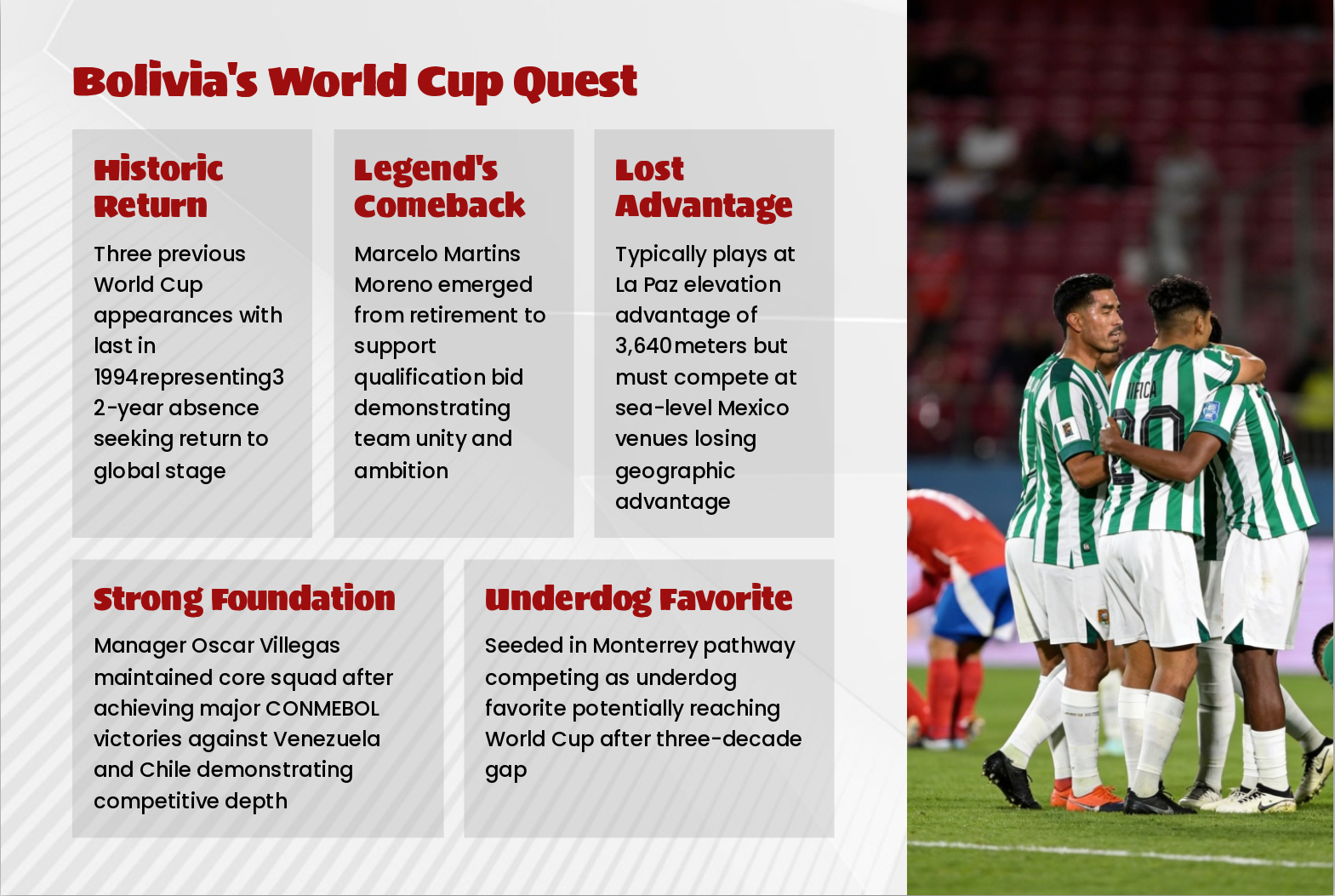
Slide 7: Bolivia's World Cup Quest
- Historic Return: Three previous World Cup appearances with last in 1994representing32-year absence seeking return to global stage
- Legend's Comeback: Marcelo Martins Moreno emerged from retirement to support qualification bid demonstrating team unity and ambition
- Lost Advantage: Typically plays at La Paz elevation advantage of 3,640meters but must compete at sea-level Mexico venues losing geographic advantage
- Strong Foundation: Manager Oscar Villegas maintained core squad after achieving major CONMEBOL victories against Venezuela and Chile demonstrating competitive depth
- Underdog Favorite: Seeded in Monterrey pathway competing as underdog favorite potentially reaching World Cup after three-decade gap
Slide 8: Participating Team #3: DR Congo – African Powerhouse Qualifier
- CAF Highest-Ranked Nation: CAF highest-ranked African nation in playoff based on confederation ranking earning direct bypass to final round
- Semifinal Advantage: Semifinal advantage of bye provides additional preparation and recovery time before March 31 championship match
- Continental Representation: Second African nation alongside Jamaica competing in intercontinental playoff structure representing continental ambition
- Squad Strength: Squad strength includes African league stars and European-based professionals providing tactical depth and international experience
- Unknown Challenger Dynamic: Final opponent determined by New Caledonia vs Jamaica winner creating unknown challenger dynamic before championship showdown
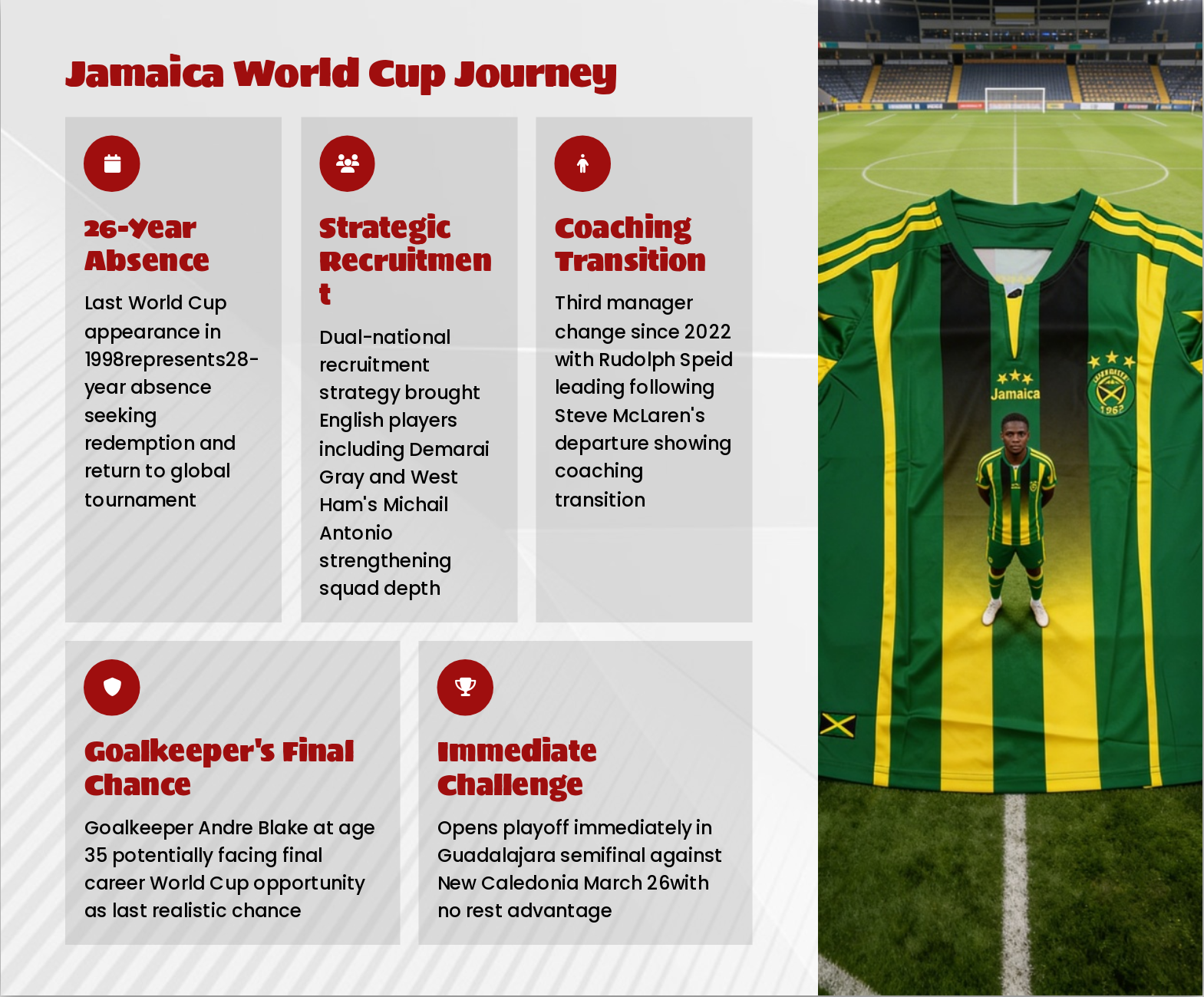
Slide 9: Jamaica World Cup Journey
- 26-Year Absence: Last World Cup appearance in 1998represents28-year absence seeking redemption and return to global tournament
- Strategic Recruitment: Dual-national recruitment strategy brought English players including Demarai Gray and West Ham's Michail Antonio strengthening squad depth
- Coaching Transition: Third manager change since 2022 with Rudolph Speid leading following Steve McLaren's departure showing coaching transition
- Goalkeeper's Final Chance: Goalkeeper Andre Blake at age 35 potentially facing final career World Cup opportunity as last realistic chance
- Immediate Challenge: Opens playoff immediately in Guadalajara semifinal against New Caledonia March 26with no rest advantage
Slide 10: Participating Teams #5 and #6: Suriname and New Caledonia – Underdogs in Global Competition
- Suriname CONCACAF Path: Suriname confederation representative competing in Monterrey pathway against Bolivia semifinal
- New Caledonia OFC Path: New Caledonia OFC Oceania representative facing Jamaica in Guadalajara ensuring Pacific island representation
- Smaller Infrastructure: Both nations represent smaller football infrastructure facing established confederation competitors in single-elimination format
- Disadvantaged Format: Suriname and New Caledonia forced into elimination semifinals while AFC and CAF teams earn byes to final
- Historic Opportunity: Historic opportunity for small nations to reach World Cup platform demonstrating expanded tournament philosophy
- Elimination Stakes: Loss on March 26 eliminates participation regardless of competitive performance remaining—no secondary chance mechanism
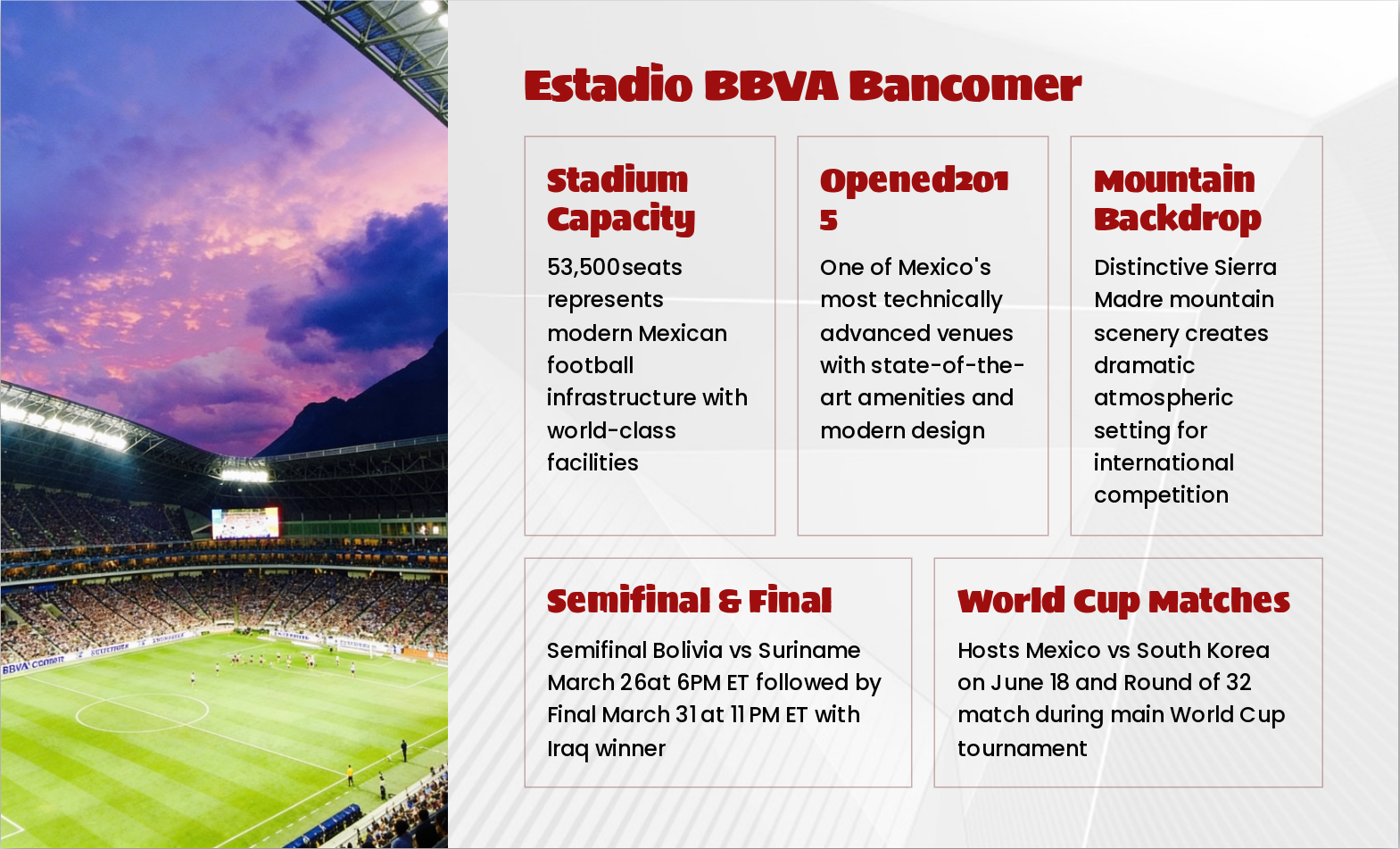
Slide 11: Estadio BBVA Bancomer
- Stadium Capacity: 53,500seats represents modern Mexican football infrastructure with world-class facilities
- Opened2015: One of Mexico's most technically advanced venues with state-of-the-art amenities and modern design
- Mountain Backdrop: Distinctive Sierra Madre mountain scenery creates dramatic atmospheric setting for international competition
- Semifinal & Final: Semifinal Bolivia vs Suriname March 26at 6PM ET followed by Final March 31 at 11 PM ET with Iraq winner
- World Cup Matches: Hosts Mexico vs South Korea on June 18 and Round of 32 match during main World Cup tournament
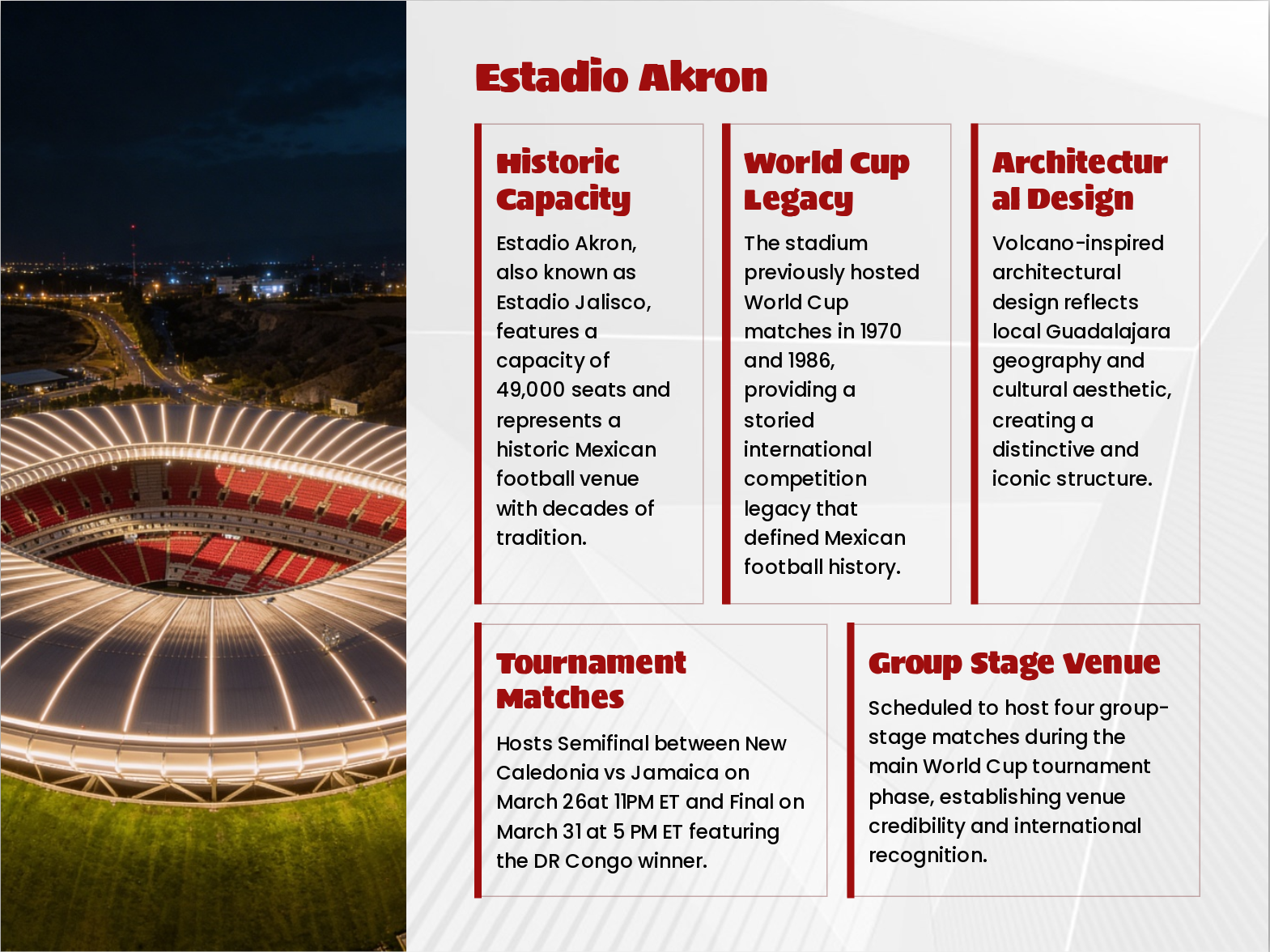
Slide 12: Estadio Akron
- Historic Capacity: Estadio Akron, also known as Estadio Jalisco, features a capacity of 49,000 seats and represents a historic Mexican football venue with decades of tradition.
- World Cup Legacy: The stadium previously hosted World Cup matches in 1970 and 1986, providing a storied international competition legacy that defined Mexican football history.
- Architectural Design: Volcano-inspired architectural design reflects local Guadalajara geography and cultural aesthetic, creating a distinctive and iconic structure.
- Tournament Matches: Hosts Semifinal between New Caledonia vs Jamaica on March 26at 11PM ET and Final on March 31 at 5 PM ET featuring the DR Congo winner.
- Group Stage Venue: Scheduled to host four group-stage matches during the main World Cup tournament phase, establishing venue credibility and international recognition.
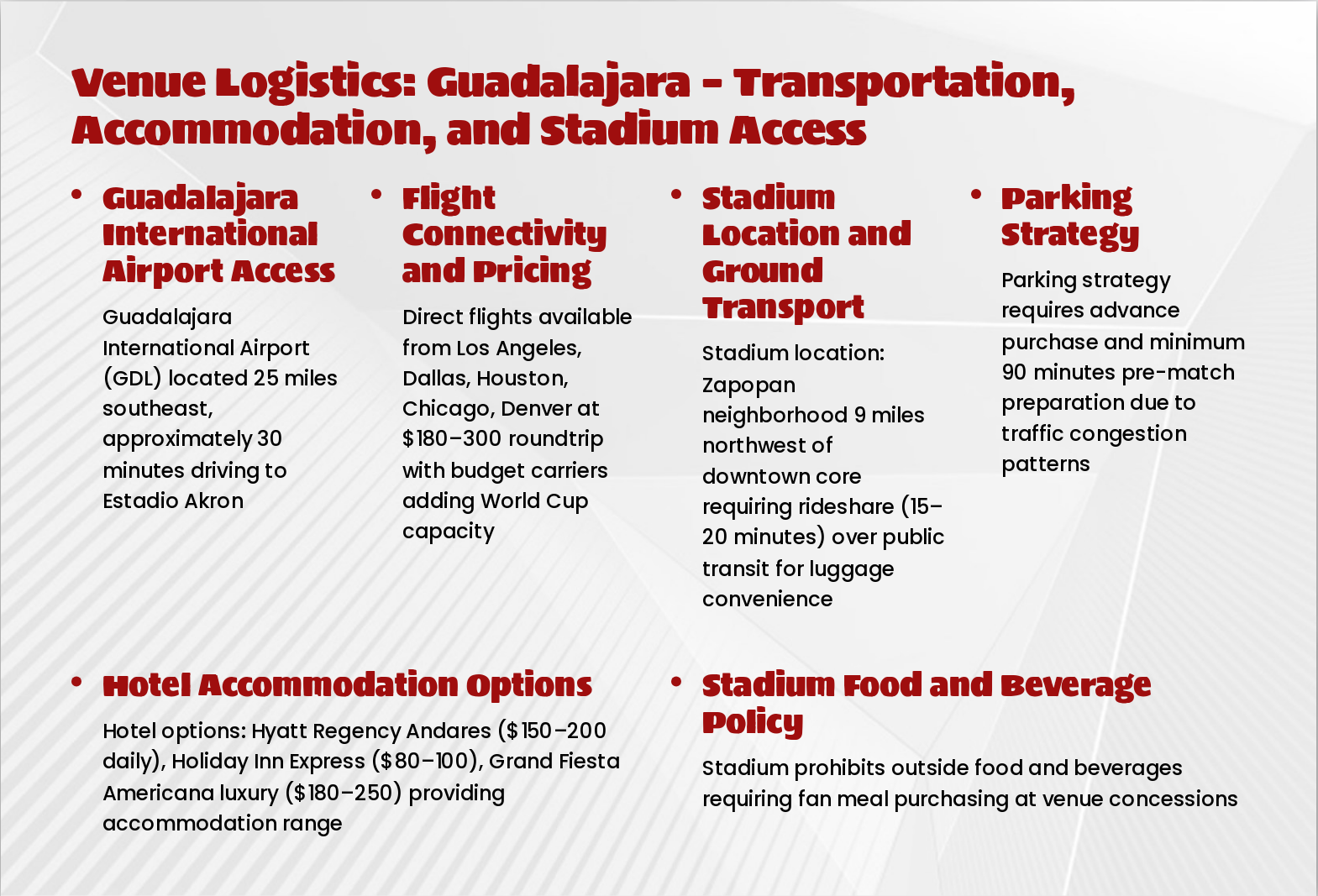
Slide 13: Venue Logistics: Guadalajara – Transportation, Accommodation, and Stadium Access
- Guadalajara International Airport Access: Guadalajara International Airport (GDL) located 25 miles southeast, approximately 30 minutes driving to Estadio Akron
- Flight Connectivity and Pricing: Direct flights available from Los Angeles, Dallas, Houston, Chicago, Denver at $180–300 roundtrip with budget carriers adding World Cup capacity
- Stadium Location and Ground Transport: Stadium location: Zapopan neighborhood 9 miles northwest of downtown core requiring rideshare (15–20 minutes) over public transit for luggage convenience
- Parking Strategy: Parking strategy requires advance purchase and minimum 90 minutes pre-match preparation due to traffic congestion patterns
- Hotel Accommodation Options: Hotel options: Hyatt Regency Andares ($150–200 daily), Holiday Inn Express ($80–100), Grand Fiesta Americana luxury ($180–250) providing accommodation range
- Stadium Food and Beverage Policy: Stadium prohibits outside food and beverages requiring fan meal purchasing at venue concessions
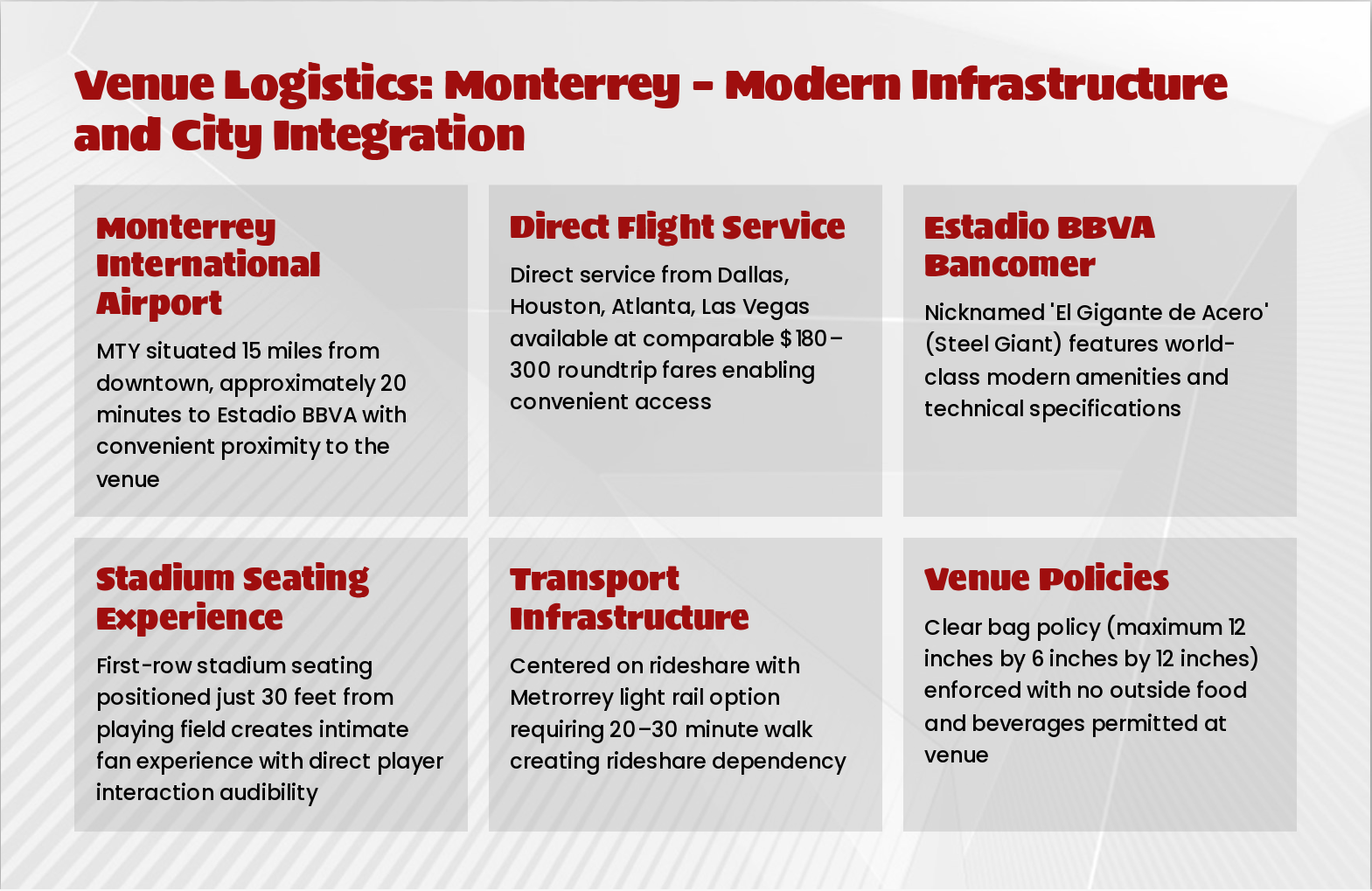
Slide 14: Venue Logistics: Monterrey – Modern Infrastructure and City Integration
- Monterrey International Airport: MTY situated 15 miles from downtown, approximately 20 minutes to Estadio BBVA with convenient proximity to the venue
- Direct Flight Service: Direct service from Dallas, Houston, Atlanta, Las Vegas available at comparable $180–300 roundtrip fares enabling convenient access
- Estadio BBVA Bancomer: Nicknamed 'El Gigante de Acero' (Steel Giant) features world-class modern amenities and technical specifications
- Stadium Seating Experience: First-row stadium seating positioned just 30 feet from playing field creates intimate fan experience with direct player interaction audibility
- Transport Infrastructure: Centered on rideshare with Metrorrey light rail option requiring 20–30 minute walk creating rideshare dependency
- Venue Policies: Clear bag policy (maximum 12 inches by 6 inches by 12 inches) enforced with no outside food and beverages permitted at venue
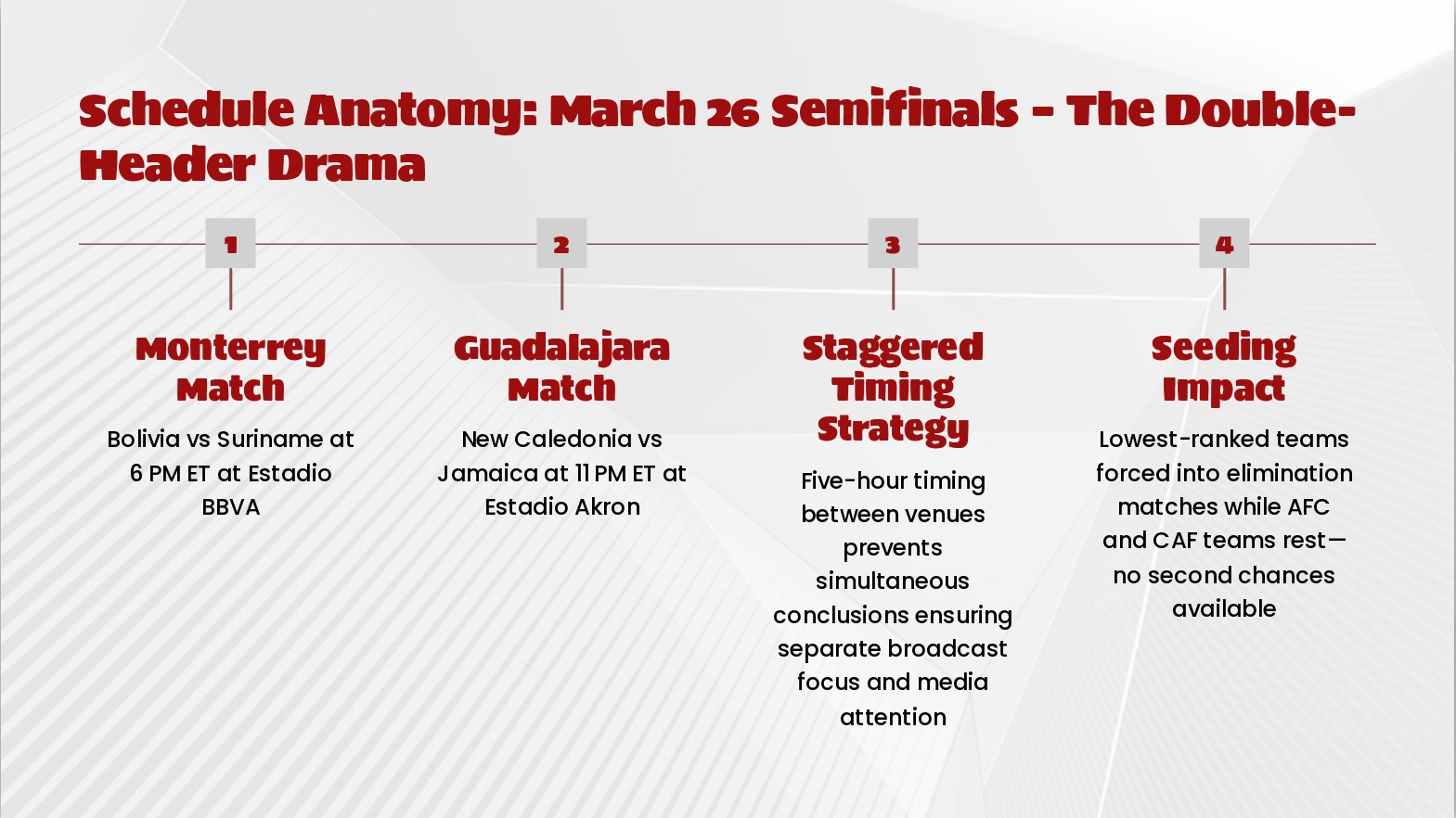
Slide 15: Schedule Anatomy: March 26 Semifinals – The Double-Header Drama
- Monterrey Match: Bolivia vs Suriname at 6 PM ET at Estadio BBVA
- Guadalajara Match: New Caledonia vs Jamaica at 11 PM ET at Estadio Akron
- Staggered Timing Strategy: Five-hour timing between venues prevents simultaneous conclusions ensuring separate broadcast focus and media attention
- Seeding Impact: Lowest-ranked teams forced into elimination matches while AFC and CAF teams rest—no second chances available
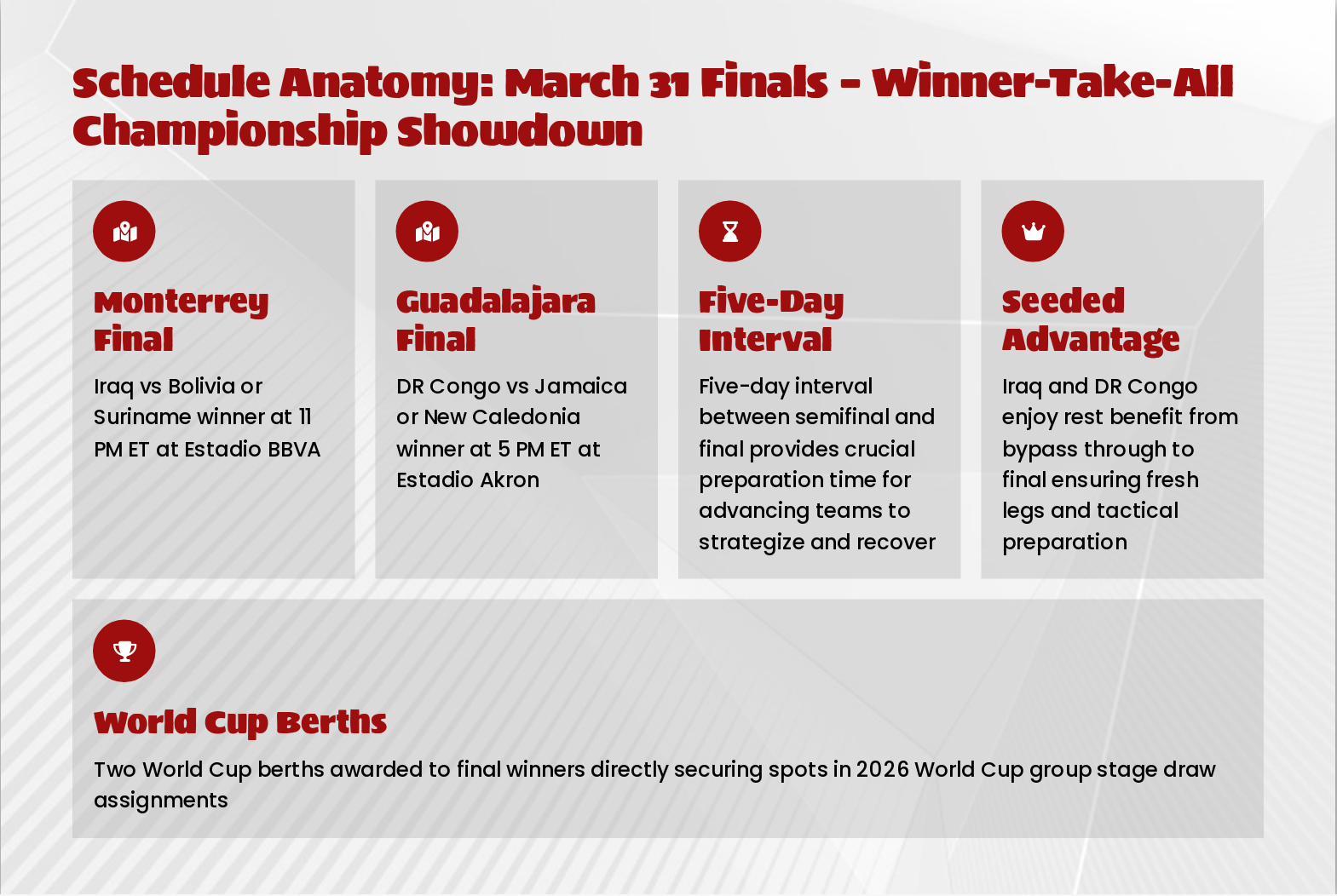
Slide 16: Schedule Anatomy: March 31 Finals – Winner-Take-All Championship Showdown
- Monterrey Final: Iraq vs Bolivia or Suriname winner at 11 PM ET at Estadio BBVA
- Guadalajara Final: DR Congo vs Jamaica or New Caledonia winner at 5 PM ET at Estadio Akron
- Five-Day Interval: Five-day interval between semifinal and final provides crucial preparation time for advancing teams to strategize and recover
- Seeded Advantage: Iraq and DR Congo enjoy rest benefit from bypass through to final ensuring fresh legs and tactical preparation
- World Cup Berths: Two World Cup berths awarded to final winners directly securing spots in 2026 World Cup group stage draw assignments
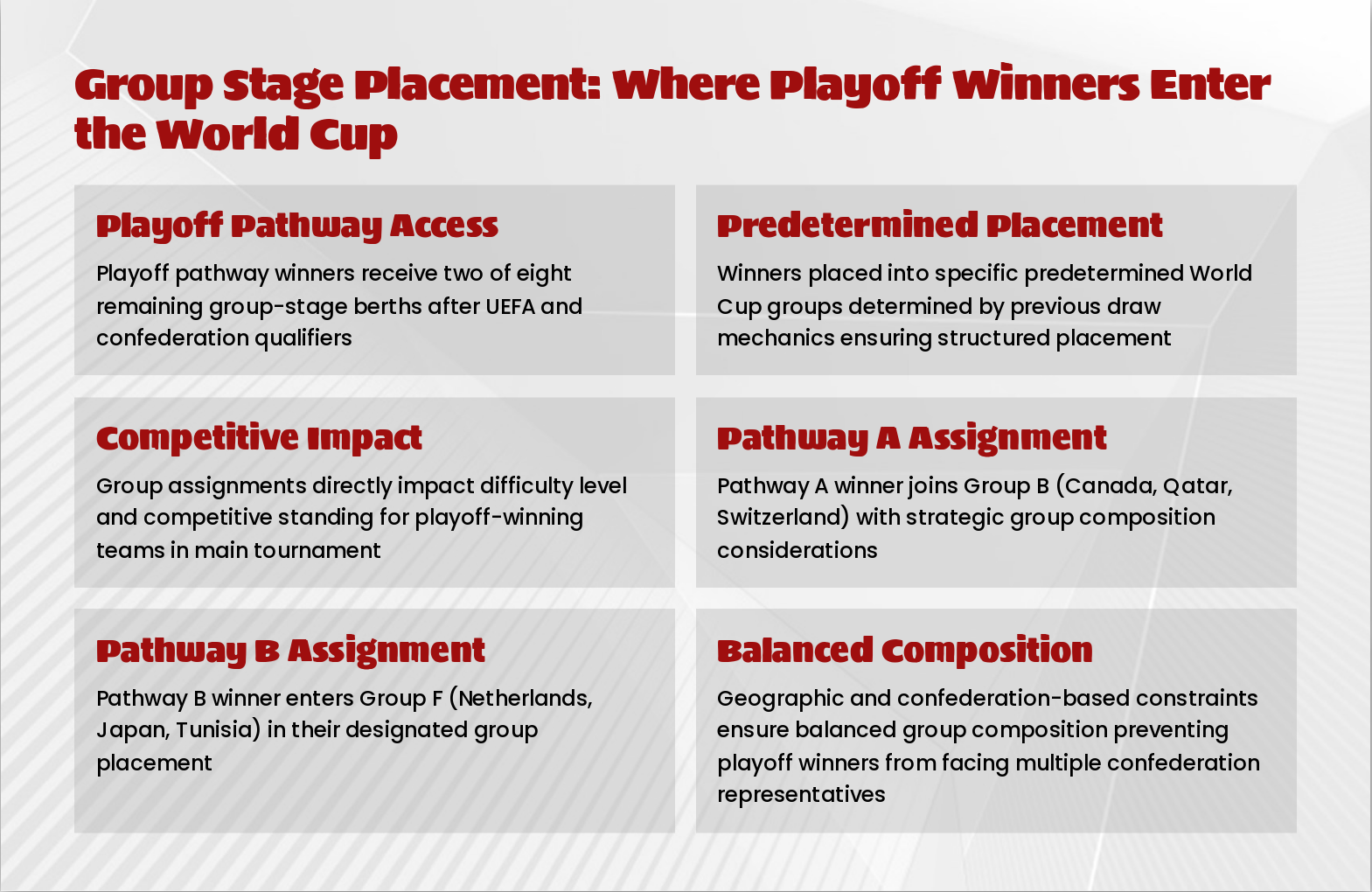
Slide 17: Group Stage Placement: Where Playoff Winners Enter the World Cup
- Playoff Pathway Access: Playoff pathway winners receive two of eight remaining group-stage berths after UEFA and confederation qualifiers
- Predetermined Placement: Winners placed into specific predetermined World Cup groups determined by previous draw mechanics ensuring structured placement
- Competitive Impact: Group assignments directly impact difficulty level and competitive standing for playoff-winning teams in main tournament
- Pathway A Assignment: Pathway A winner joins Group B (Canada, Qatar, Switzerland) with strategic group composition considerations
- Pathway B Assignment: Pathway B winner enters Group F (Netherlands, Japan, Tunisia) in their designated group placement
- Balanced Composition: Geographic and confederation-based constraints ensure balanced group composition preventing playoff winners from facing multiple confederation representatives
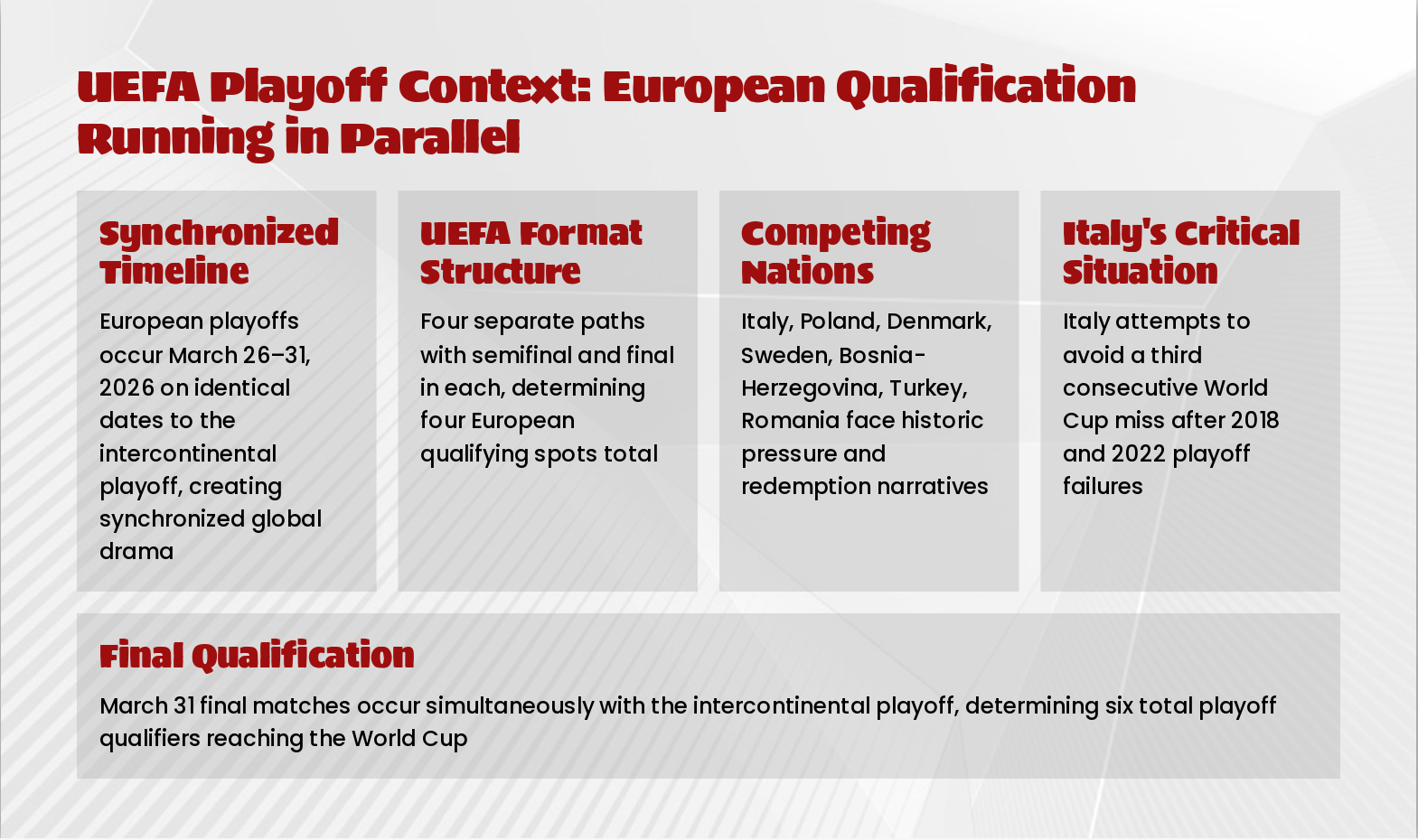
Slide 18: UEFA Playoff Context: European Qualification Running in Parallel
- Synchronized Timeline: European playoffs occur March 26–31, 2026 on identical dates to the intercontinental playoff, creating synchronized global drama
- UEFA Format Structure: Four separate paths with semifinal and final in each, determining four European qualifying spots total
- Competing Nations: Italy, Poland, Denmark, Sweden, Bosnia-Herzegovina, Turkey, Romania face historic pressure and redemption narratives
- Italy's Critical Situation: Italy attempts to avoid a third consecutive World Cup miss after 2018 and 2022 playoff failures
- Final Qualification: March 31 final matches occur simultaneously with the intercontinental playoff, determining six total playoff qualifiers reaching the World Cup
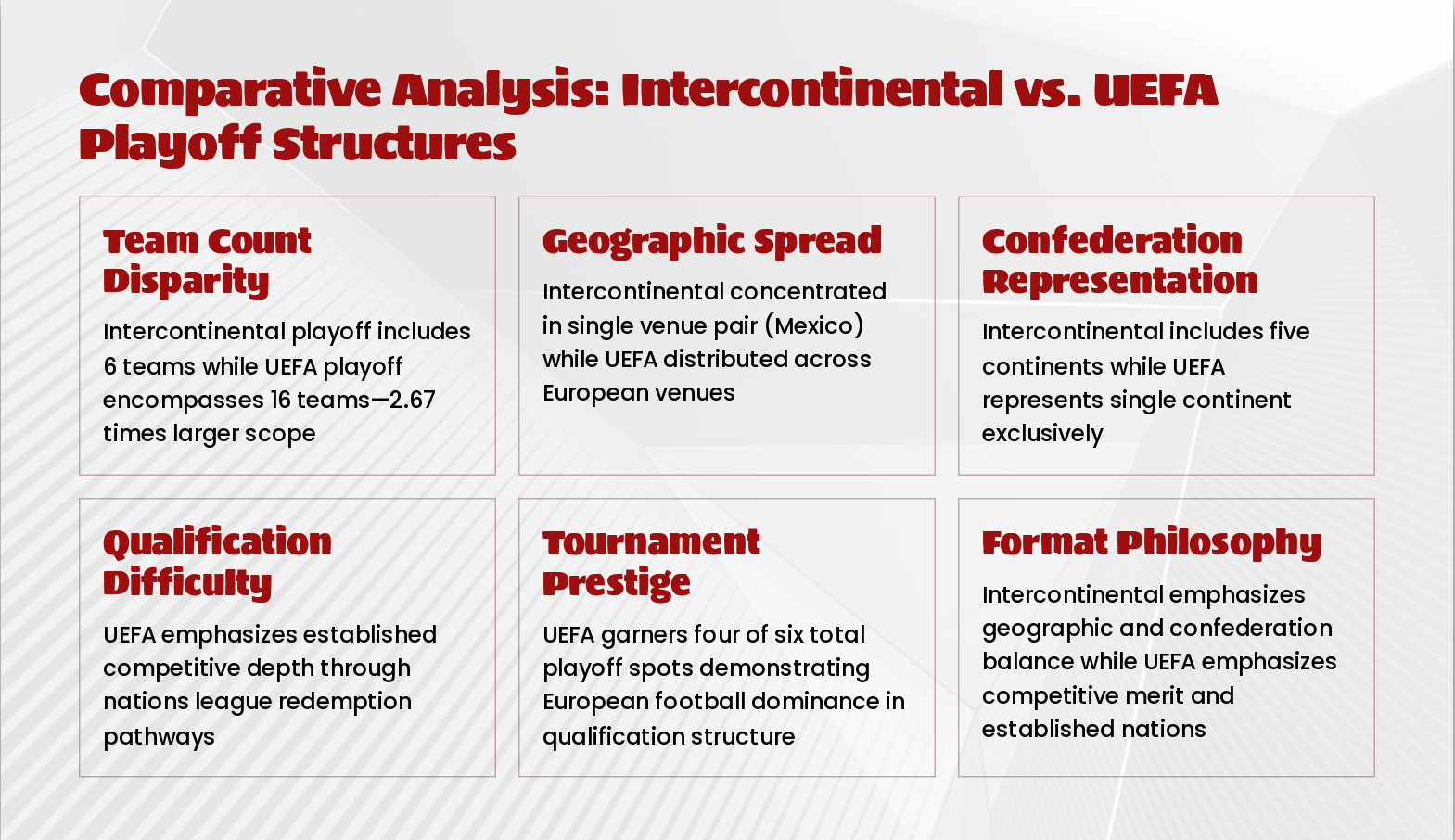
Slide 19: Comparative Analysis: Intercontinental vs. UEFA Playoff Structures
- Team Count Disparity: Intercontinental playoff includes 6 teams while UEFA playoff encompasses 16 teams—2.67 times larger scope
- Geographic Spread: Intercontinental concentrated in single venue pair (Mexico) while UEFA distributed across European venues
- Confederation Representation: Intercontinental includes five continents while UEFA represents single continent exclusively
- Qualification Difficulty: UEFA emphasizes established competitive depth through nations league redemption pathways
- Tournament Prestige: UEFA garners four of six total playoff spots demonstrating European football dominance in qualification structure
- Format Philosophy: Intercontinental emphasizes geographic and confederation balance while UEFA emphasizes competitive merit and established nations
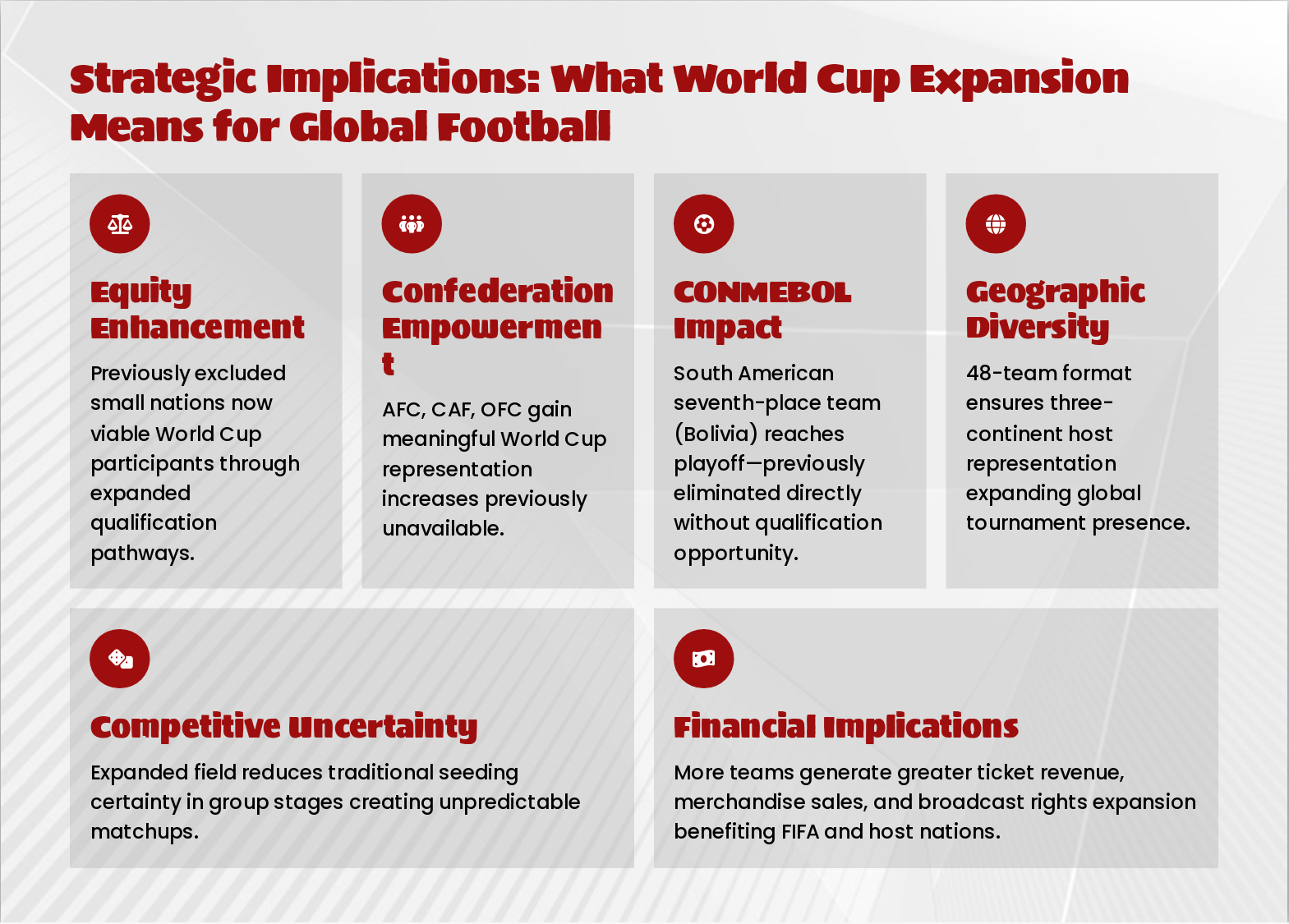
Slide 20: Strategic Implications: What World Cup Expansion Means for Global Football
- Equity Enhancement: Previously excluded small nations now viable World Cup participants through expanded qualification pathways.
- Confederation Empowerment: AFC, CAF, OFC gain meaningful World Cup representation increases previously unavailable.
- CONMEBOL Impact: South American seventh-place team (Bolivia) reaches playoff—previously eliminated directly without qualification opportunity.
- Geographic Diversity: 48-team format ensures three-continent host representation expanding global tournament presence.
- Competitive Uncertainty: Expanded field reduces traditional seeding certainty in group stages creating unpredictable matchups.
- Financial Implications: More teams generate greater ticket revenue, merchandise sales, and broadcast rights expansion benefiting FIFA and host nations.
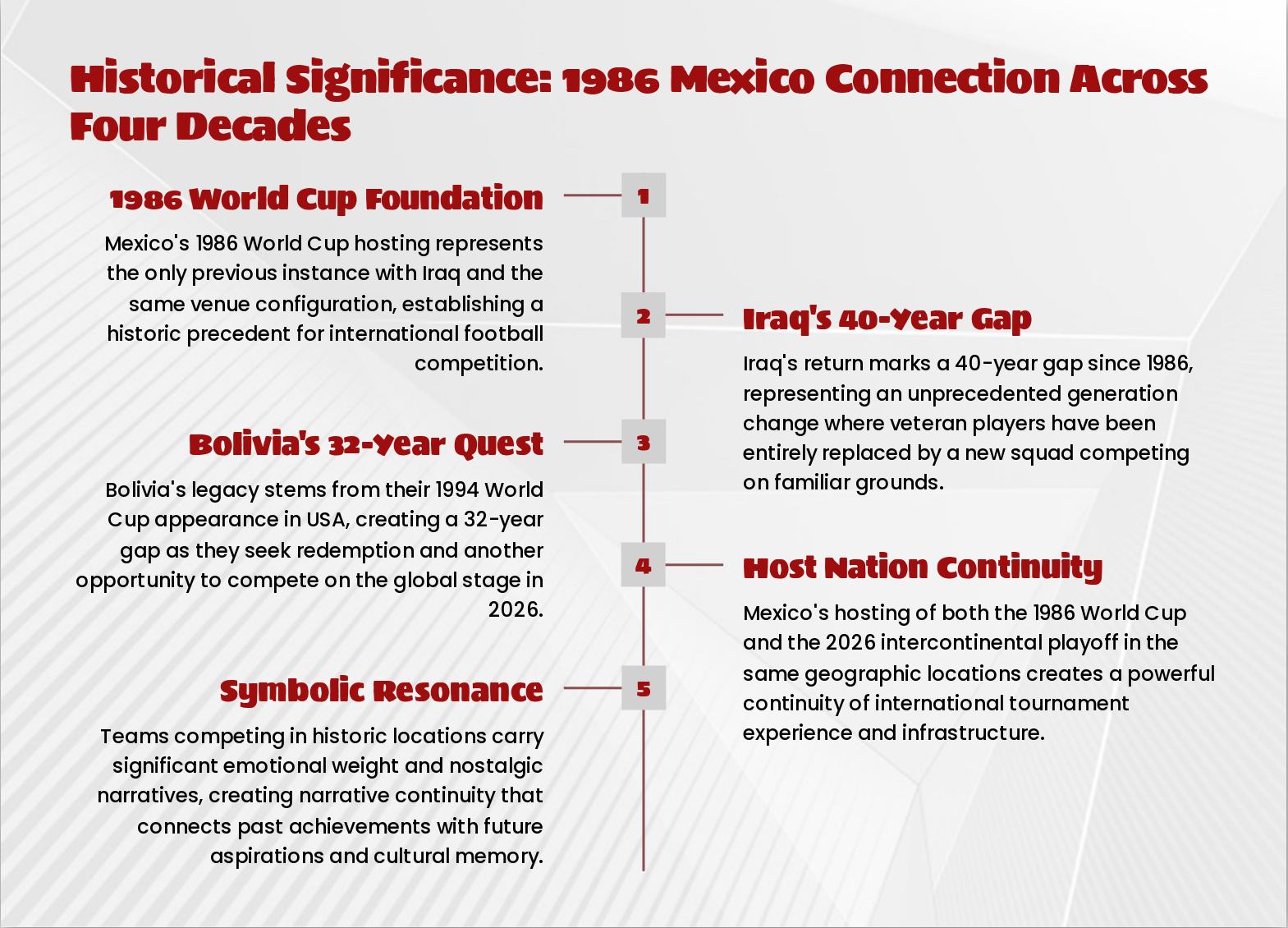
Slide 21: Historical Significance: 1986 Mexico Connection Across Four Decades
- 1986 World Cup Foundation: Mexico's 1986 World Cup hosting represents the only previous instance with Iraq and the same venue configuration, establishing a historic precedent for international football competition.
- Iraq's 40-Year Gap: Iraq's return marks a 40-year gap since 1986, representing an unprecedented generation change where veteran players have been entirely replaced by a new squad competing on familiar grounds.
- Bolivia's 32-Year Quest: Bolivia's legacy stems from their 1994 World Cup appearance in USA, creating a 32-year gap as they seek redemption and another opportunity to compete on the global stage in 2026.
- Host Nation Continuity: Mexico's hosting of both the 1986 World Cup and the 2026 intercontinental playoff in the same geographic locations creates a powerful continuity of international tournament experience and infrastructure.
- Symbolic Resonance: Teams competing in historic locations carry significant emotional weight and nostalgic narratives, creating narrative continuity that connects past achievements with future aspirations and cultural memory.
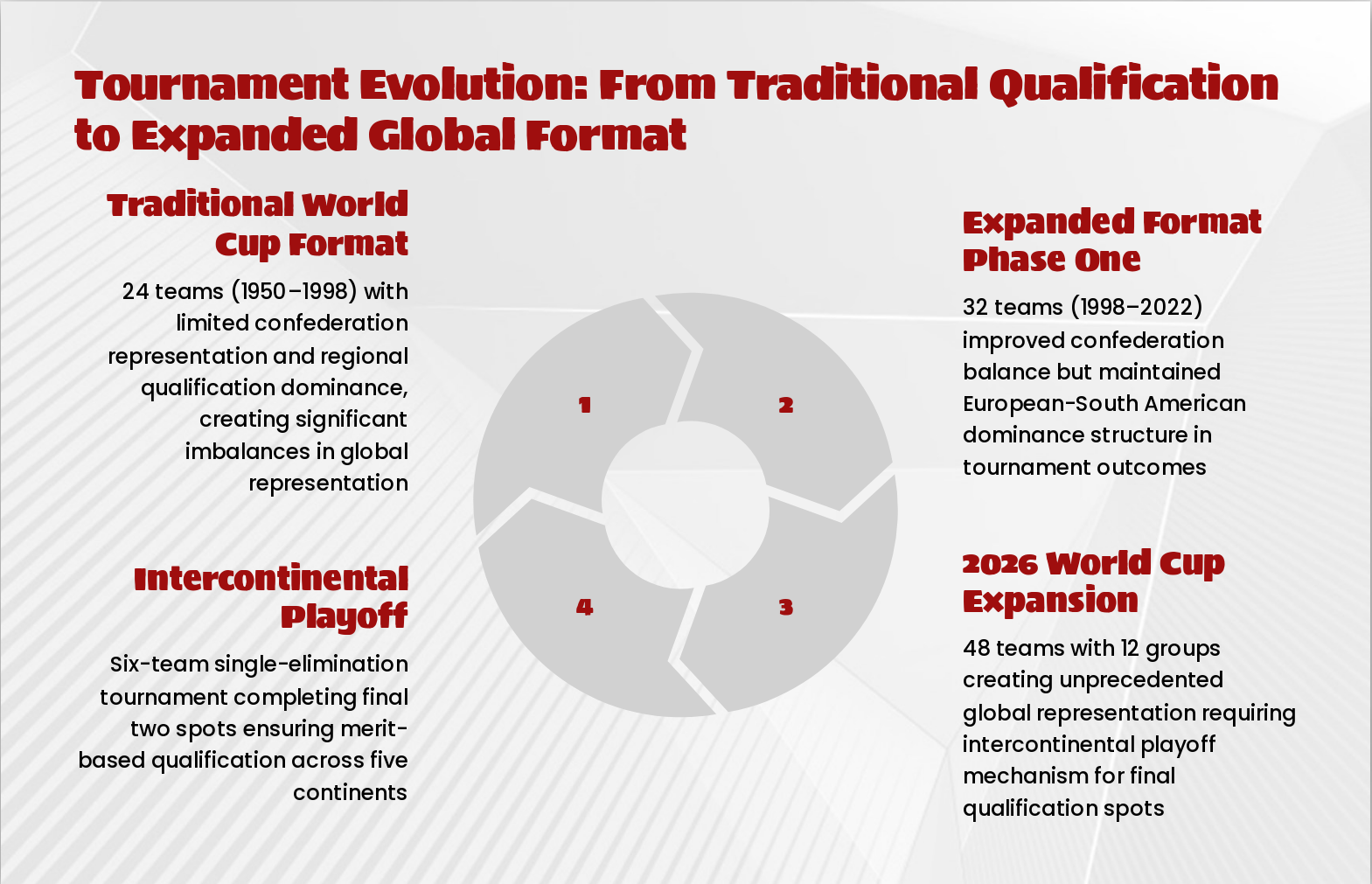
Slide 22: Tournament Evolution: From Traditional Qualification to Expanded Global Format
- Traditional World Cup Format: 24 teams (1950–1998) with limited confederation representation and regional qualification dominance, creating significant imbalances in global representation
- Expanded Format Phase One: 32 teams (1998–2022) improved confederation balance but maintained European-South American dominance structure in tournament outcomes
- 2026 World Cup Expansion: 48 teams with 12 groups creating unprecedented global representation requiring intercontinental playoff mechanism for final qualification spots
- Intercontinental Playoff: Six-team single-elimination tournament completing final two spots ensuring merit-based qualification across five continents
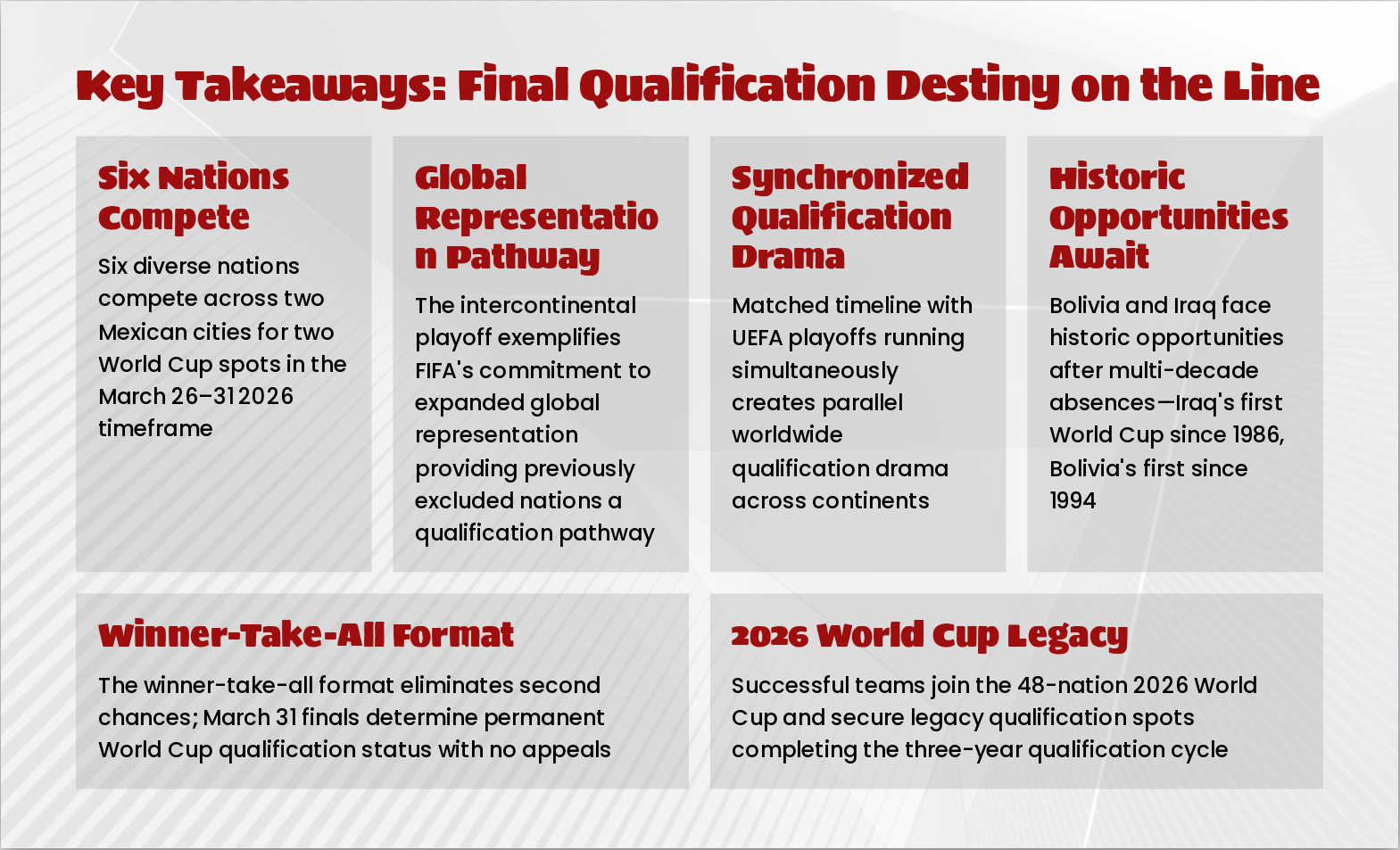
Slide 23: Key Takeaways: Final Qualification Destiny on the Line
- Six Nations Compete: Six diverse nations compete across two Mexican cities for two World Cup spots in the March 26–31 2026 timeframe
- Global Representation Pathway: The intercontinental playoff exemplifies FIFA's commitment to expanded global representation providing previously excluded nations a qualification pathway
- Synchronized Qualification Drama: Matched timeline with UEFA playoffs running simultaneously creates parallel worldwide qualification drama across continents
- Historic Opportunities Await: Bolivia and Iraq face historic opportunities after multi-decade absences—Iraq's first World Cup since 1986, Bolivia's first since 1994
- Winner-Take-All Format: The winner-take-all format eliminates second chances; March 31 finals determine permanent World Cup qualification status with no appeals
- 2026 World Cup Legacy: Successful teams join the 48-nation 2026 World Cup and secure legacy qualification spots completing the three-year qualification cycle