Create a Thesis Defense Presentation with AI: Practical Guide
June 23, 2026
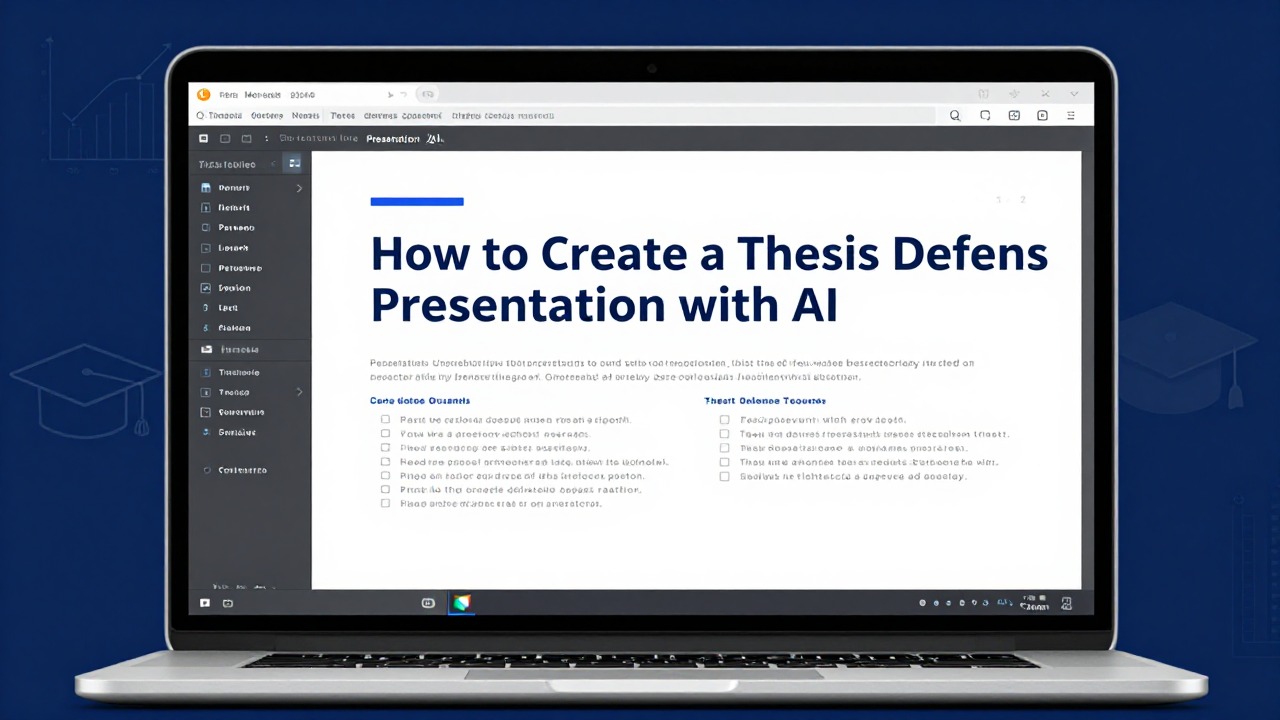
Can AI make your thesis defense presentation? Yes, if you use it to draft the structure, summarize dense sections, create editable slide outlines, improve speaker notes, and prepare likely committee questions. No, if you expect it to verify your research, invent missing results, decide what your committee values, or replace your academic judgment.
The safest and most useful workflow is to treat AI as a presentation assistant, not as a co-author of your research. Start with your thesis abstract, chapter summaries, research questions, methods, key findings, figures, limitations, and department requirements. Then use a tool such as PopAi AI Presentation to turn that source pack into a first editable deck structure.
This guide shows how to build a thesis-defense-specific AI workflow: decide the defense story, prompt section by section, verify every claim, design slides around committee evaluation, prepare speaker notes, and rehearse Q&A without losing academic rigor.
When you are ready to turn the workflow into slides, PopAi AI Presentation can help transform rough notes, documents, or prompts into an editable deck structure.
Quick Answer: Use AI to Draft the Defense Structure, Not to Defend the Research for You
This section clarifies what AI can safely help with and where your responsibility as the researcher begins.
If your immediate question is, can AI make my thesis defense presentation, the practical answer is yes for the first draft and no for the intellectual defense itself. AI can help you move from a long document to a usable slide sequence. It can also turn dense paragraphs into short slide bullets, suggest clearer slide titles, draft speaker notes, and generate practice questions.
AI should not make unverified claims, create citations, invent statistical results, approve your argument, or decide what your supervisor will accept. A thesis defense is an academic evaluation. The committee is judging your research design, evidence, interpretation, contribution, limitations, and ability to answer questions. Those parts must stay under your control.
- Good AI use: convert your abstract and chapter summaries into a defense outline.
- Good AI use: simplify a methods explanation for a mixed committee audience.
- Good AI use: create speaker notes from slide bullets so your talk sounds organized.
- Good AI use: list possible committee questions about methods, findings, limitations, and contribution.
- Bad AI use: ask the tool to create missing results or fill a literature gap you have not written.
- Bad AI use: accept generated citations, statistical interpretations, or novelty claims without checking them.
- Bad AI use: upload confidential, restricted, unpublished, or identifiable data if your program or ethics approval prohibits it.
PopAi AI Presentation fits the early and middle stages of this workflow because it can turn prompts, documents, notes, and rough ideas into a structured deck draft. For example, a student can paste a thesis abstract plus five chapter summaries and ask for a 20-minute defense outline with editable slide titles, section transitions, and speaker-note guidance.
Before using any AI tool, check your university, department, supervisor, funder, and ethics-board rules. If your thesis includes confidential participants, proprietary data, unpublished patentable work, clinical records, or restricted field notes, summarize or anonymize the material first, or do not upload it at all.
Use AI to reduce blank-page time, not to outsource the scholarly judgment your committee is there to evaluate.
What a Strong Thesis Defense Deck Needs Before AI Touches It
Before generating slides, you need a defense storyline and a clean source pack that tells AI what matters.
A strong defense deck is not a compressed version of every thesis chapter. It is a guided argument. Your slides should help the committee understand why the research matters, what gap you addressed, how you investigated it, what evidence you found, how you interpret that evidence, what contribution you claim, and what limitations remain.
The core defense narrative usually follows this path: research problem, literature or practice gap, research question or hypothesis, method, evidence, findings, discussion, contribution, limitations, and next steps. The order may vary by discipline, but the logic should be visible. If a committee member joins your defense from a neighboring field, they should still be able to follow why each slide exists.
- Title and thesis statement: your topic, degree, department, supervisor, and date.
- Research problem: what issue, puzzle, contradiction, or need motivated the study.
- Gap: what the existing literature, practice, or design field had not resolved.
- Research questions or hypotheses: the questions your thesis actually answered.
- Methodology: design, data, participants or materials, procedure, instruments, analysis, and rationale.
- Findings: the few results or arguments that carry the defense, not every detail.
- Discussion: how the findings answer the research questions and relate to prior work.
- Contribution: what your thesis adds conceptually, empirically, methodologically, practically, or theoretically.
- Limitations: boundaries of your evidence and interpretation.
- Conclusion and Q&A: final takeaway, next research steps, and backup material.
Different defense types need different emphasis. A master's thesis defense often needs a clear explanation of scope, method, key findings, and learning contribution. A PhD dissertation defense usually requires more space for theoretical positioning, methodological justification, originality, and contribution to the field. A proposal defense focuses on the problem, gap, planned method, feasibility, and risks. A final defense focuses on evidence, interpretation, and why the completed work is defensible.
Presentation length affects slide count, but there is no universal number that works for every program. Many programs expect a short defense presentation to use fewer slides than a full dissertation defense. A 10-minute talk needs a tight argument and selective visuals. A 30-minute defense can support more methodological detail, more findings, and backup slides. Always check department instructions and rehearse with a timer instead of relying on a fixed slide-count rule.
- For a short defense, prioritize the research question, method at a glance, two or three key findings, contribution, and limitations.
- For a longer dissertation defense, add more background, theoretical framing, validation, robustness checks, and future research.
- For a mixed committee, define specialized terms earlier and reduce jargon on main slides.
- For a highly technical committee, keep conceptual framing short and use backup slides for detailed equations, protocols, coding schemes, or data tables.
Before using a thesis presentation generator, prepare a clean source pack. Do not paste your entire thesis blindly and hope the tool finds the defense story. A long document contains literature details, repeated definitions, procedural explanation, appendices, and citations that may not belong in the talk. A curated source pack gives AI better boundaries.
- Thesis title and one-sentence thesis claim.
- Abstract or executive summary.
- Research questions, aims, or hypotheses.
- One short summary for each chapter.
- Methodology summary with design, data, sample or corpus, procedure, analysis method, and rationale.
- Key findings grouped by research question.
- Main figures, tables, models, diagrams, screenshots, or conceptual frameworks.
- Limitations exactly as stated in your thesis.
- Contribution statement approved or discussed with your supervisor.
- Department defense format, required slides, time limit, and citation style expectations.
- Known committee concerns or likely questions from prior feedback.
If you cannot explain your thesis in one paragraph, AI will probably create a generic deck. Write a one-page defense brief first: problem, gap, question, method, three findings, contribution, limitations, and final takeaway.
Step-by-Step Workflow: From Thesis Document to AI Thesis Slides
This workflow moves from your thesis material to a verified, rehearsed, editable defense deck.
The best AI workflow is iterative. You should not generate a full deck once and treat it as finished. Instead, narrow the purpose, create a defense brief, generate an outline, refine the structure, draft slides, add original visuals, verify details, and rehearse. Each pass should make the deck more accurate and more defensible.
- Define the defense goal. Write the time limit, degree level, audience, required slides, and the one message your committee should remember.
- Summarize the thesis into a one-page defense brief. Include problem, gap, research questions, method, evidence, findings, contribution, limitations, and next steps.
- Use PopAi AI Presentation or another AI presentation tool to generate a first slide outline from the defense brief, abstract, or document summary.
- Refine the outline into defense sections: title, problem, literature gap, research questions, methodology, findings, discussion, contribution, limitations, conclusion, and Q&A.
- Generate slide drafts and speaker notes. Replace vague AI wording with precise terms from your thesis.
- Add original charts, tables, conceptual diagrams, images, framework visuals, equations, models, or screenshots where they clarify the research logic.
- Verify every method detail, result, term, citation, data label, statistical phrase, and limitation against the thesis.
- Rehearse with a timer. If you overrun, ask AI to identify cuts, simplify transitions, or shorten speaker notes while preserving the core argument.
- Review the deck with your supervisor, lab peer, writing center, or trusted colleague and revise again.
Workflow example 1: a master's student in education has a 70-page thesis on formative feedback in online writing courses and a 15-minute defense. Instead of uploading participant comments, the student prepares anonymized chapter summaries and a findings table. In PopAi AI Presentation, they request a 12- to 15-slide outline with sections for problem, literature gap, research questions, method, three findings, implications for instructors, limitations, and Q&A. The generated deck gives them a usable structure. They then replace generic phrases such as student engagement improved with their actual coded theme labels and evidence from the thesis.
Workflow example 2: a PhD candidate in mechanical engineering has a dissertation on thermal management for battery modules and a 30-minute final defense. They do not ask AI to interpret raw experimental data. Instead, they provide a defense brief, experiment summary, figure captions, model validation notes, and approved contribution statement. PopAi AI Presentation drafts a sectioned deck with problem context, design constraints, experimental setup, simulation model, validation results, key findings, limitations, and future work. The candidate then inserts original plots, checks all axis labels and units, and adds backup slides for boundary conditions and sensitivity analysis.
A common turning point is converting dense thesis prose into a slide that can be spoken. A thesis paragraph often includes background, method, caveats, and interpretation in one block. A slide needs a sharper title and fewer points.
Dense thesis paragraph: This study examined how first-generation undergraduate students described their use of institutional advising services during the first academic year, with particular attention to the mismatch between formal advising availability and students' perceived ability to ask for help. Interview data suggested that students often interpreted advising as a remedial service rather than a developmental resource, which limited early engagement even when appointments were technically accessible.
- Clear slide title: Advising was available, but students hesitated to use it early.
- Bullet 1: Interviewees often viewed advising as help for students who were already struggling.
- Bullet 2: This perception reduced proactive appointment use in the first year.
- Bullet 3: Accessibility was not only logistical; it was also social and interpretive.
- Bullet 4: The finding reframes advising uptake as a communication and trust issue.
Notice that the improved slide does not add new findings. It clarifies the claim, separates evidence from interpretation, and makes the argument easier to present. That is the kind of transformation AI can help with when you provide accurate source text and verify the output.
After AI creates a slide, ask: Would I be comfortable defending this exact sentence if a committee member asked where it appears in my thesis?
Prompt Templates for Better AI Thesis Defense Slides
Good prompts tell AI the audience, degree level, source limits, academic tone, and what not to invent.
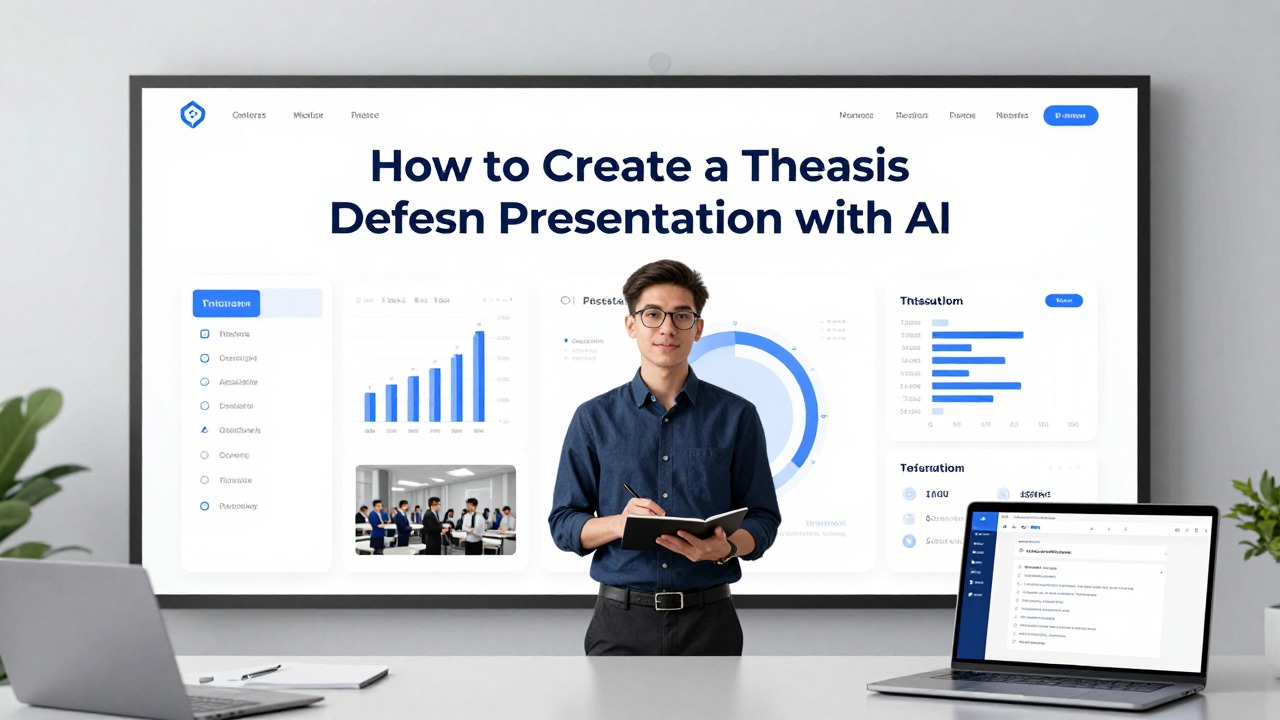
Generic prompts create generic slides. A prompt such as make a thesis presentation usually produces broad sections and polished but empty phrasing. A better prompt gives the tool your defense length, discipline, degree level, committee audience, source material, tone, and strict limits on invention.
The prompt should act like a defense brief, not a vague request for slides.
Use the following templates as starting points. Replace bracketed fields with your actual information. If your research contains sensitive data, summarize or anonymize the material before using any AI tool, and follow your university policy.
- PopAi outline prompt: Create a thesis defense presentation outline from the following abstract and chapter summaries. Degree level: [master's/PhD]. Discipline: [field]. Defense length: [minutes]. Audience: committee members with [specialist/mixed] knowledge. Use only the information provided. Do not invent citations, results, methods, or claims. Mark missing details as [placeholder]. Include slides for title, problem, gap, research questions, methodology, findings, discussion, contribution, limitations, conclusion, and Q&A.
- Abstract-to-slide prompt: Convert this abstract into a defense slide sequence for a [minutes]-minute presentation. Keep the academic tone clear but not inflated. Separate background, gap, method, findings, and contribution. Suggest slide titles that make claims only when supported by the text.
- Methodology simplification prompt: Rewrite this methodology section for two defense slides: one slide called Method at a glance and one slide called Why this method fits the question. Keep key terms accurate. Do not remove necessary constraints, sample details, instruments, analysis procedures, or limitations.
- Speaker notes prompt: Create natural speaker notes for these slide bullets. The notes should sound like a graduate student explaining their own work, not a scripted advertisement. Keep each slide within approximately [time per slide] when spoken. Preserve technical terms from the thesis.
- Slide title improvement prompt: Improve these slide titles so each title states the main point of the slide. Avoid hype, vague claims, and unsupported novelty. Use concise academic language suitable for a thesis defense.
- Committee questions prompt: Based only on the research question, methodology, findings, and limitations below, generate likely committee questions. Group them into methods, theory, evidence, limitations, contribution, and future research. Do not assume information not provided.
- Context Action Result prompt for applied research: For each applied finding, frame the slide as Context, Action, Result. Context means the stakeholder problem. Action means the intervention, model, design, curriculum, or analysis conducted. Result means what the thesis evidence supports. Do not turn recommendations into proven outcomes unless the thesis measured them.
For applied research, the Context -> Action -> Result pattern can make a defense easier to follow. A business analytics thesis might use Context for the forecasting problem, Action for the model comparison, and Result for the performance pattern actually observed. An education thesis might use Context for classroom constraints, Action for the instructional intervention, and Result for coded themes or measured learning outcomes. A medical research thesis might use Context for clinical uncertainty, Action for the study design or analysis, and Result for the supported association or observation.
The key is to prevent the AI from turning a limited finding into an overbroad recommendation. If your thesis found an association, do not let the deck say you proved causation. If your sample was exploratory, do not let the deck imply generalizability. If your model performed well under specific conditions, keep those conditions visible.
Add this sentence to almost every thesis prompt: Use only the information provided, mark missing details as placeholders, and do not create fake citations, results, sample sizes, quotations, equations, or claims.
Defense Slide Examples by Research Scenario
AI-generated thesis slides should look different across humanities, STEM, and applied research because committees evaluate different kinds of evidence.
A good thesis presentation generator should not force every discipline into the same template. Humanities and social science defenses often need argument structure, literature positioning, evidence interpretation, and conceptual contribution. STEM and engineering defenses need problem definition, design or experiment, data, model, validation, error, and limitations. Business, education, and applied research defenses need stakeholders, intervention, findings, recommendations, and practical implications.
Scenario 1: humanities or social science thesis. The persona is a master's student defending a thesis on how migration narratives are represented in contemporary documentary film. The source material includes an abstract, theoretical framework summary, corpus description, coding categories, three interpreted findings, and limitations. The student's pain point is that the thesis argument is subtle and the slides risk becoming long text blocks.
- AI intervention: ask PopAi AI Presentation for an outline that separates research problem, literature gap, theoretical lens, corpus, analytic method, findings by theme, contribution, and limitations.
- Likely slide output: Why these films matter, Gap in existing scholarship, Analytical framework, Corpus and selection criteria, Finding 1 with evidence, Finding 2 with evidence, Finding 3 with evidence, Contribution to documentary studies, Limitations and future research.
- Manual refinement: replace generic theme labels with the exact concepts used in the thesis, add short textual or visual evidence where permitted, and keep interpretation tied to the analyzed corpus.
- Reusable structure: Claim, evidence, interpretation, link to research question.
For this scenario, AI is most useful for reducing prose density. A slide titled Finding 2: Narrative voice shifts responsibility to institutions is stronger than a vague title such as Results. The student should still decide which evidence is appropriate to show and whether image permissions or quotation limits apply.
Scenario 2: STEM or engineering thesis. The persona is a PhD candidate defending a dissertation on a sensor calibration method for environmental monitoring. The source material includes the problem statement, system architecture diagram, experimental protocol, validation dataset description, performance plots, error analysis, and limitations. The pain point is explaining technical detail without losing the committee members who are not specialists in the exact model.
- AI intervention: provide a technical defense brief and ask for slides grouped into Problem, Design, Experiment, Validation, Findings, Error sources, Contribution, Limitations, and Backup.
- Likely slide output: Monitoring problem and constraints, Calibration challenge, Proposed method at a glance, Experimental setup, Validation approach, Key performance result, Error analysis, Comparison to baseline, Contribution to measurement reliability, Limitations and future tests.
- Manual refinement: insert original plots from the dissertation, verify units and axis labels, check baseline descriptions, and avoid unsupported performance claims.
- Reusable structure: Problem statement, method diagram, validation evidence, boundary conditions.
For STEM work, the main slide should often show the research logic, while backup slides hold extra equations, parameter tables, robustness checks, or alternative analysis. AI can suggest which material belongs in backup, but the researcher must decide what is essential for the defense.
Scenario 3: business, education, or applied research thesis. The persona is an MBA or education master's student presenting an applied project on improving onboarding for remote employees. The source material includes organizational context, literature summary, survey design, interview themes, intervention proposal, findings, recommendations, and implementation constraints. The pain point is avoiding a consulting-style pitch that overstates what the thesis evidence proves.
- AI intervention: ask for a Context -> Action -> Result slide sequence that distinguishes observed findings from recommendations.
- Likely slide output: Organizational context, Stakeholder problem, Research question, Data sources, Method at a glance, Finding 1: onboarding ambiguity, Finding 2: manager touchpoints, Recommendation logic, Practical implications, Limitations, Next steps.
- Manual refinement: label recommendations as recommendations, not proven outcomes, and make sample limitations visible.
- Reusable structure: Context, stakeholder pain point, evidence, implication, implementation caveat.
This scenario shows why ethical prompting matters. If the thesis studied one organization, AI might write a broad statement such as remote employees require a redesigned onboarding model. A defensible slide would say in this case, participants reported uncertainty around early role expectations, which supports clearer manager touchpoints during the first onboarding phase.
Across disciplines, useful defense slides include Method at a glance, Key finding and evidence, Contribution to the field, Limitations and future work, and Backup: details for committee questions.
What to Edit After AI Generates the Deck
The editing stage protects your credibility by checking accuracy, academic tone, visual clarity, and compliance.
The first AI-generated deck is a draft, not a submission-ready defense. It will probably contain useful structure and some weak language. Your job is to turn it into a precise academic presentation that matches your thesis and your committee's expectations.
- Factual accuracy: confirm that every claim appears in your thesis or approved defense notes.
- Terminology: replace broad AI wording with the exact constructs, variables, models, theories, materials, or procedures used in your field.
- Citation placement: add citations where your program expects them, especially on literature, theory, instruments, datasets, and adapted figures.
- Data labels: check axis titles, units, sample descriptions, figure numbers, table labels, and legends.
- Statistical wording: distinguish correlation from causation, significance from practical importance, and exploratory results from confirmatory findings.
- Methods description: verify sample, corpus, instruments, recruitment, procedure, analysis method, software, assumptions, and exclusion criteria.
- Consistency with the written thesis: do not add findings, claims, definitions, or recommendations that are absent from the document.
- Limitations: keep scope boundaries visible instead of hiding them at the end.
- Figure permissions: confirm that images, screenshots, participant materials, clinical visuals, copyrighted diagrams, or proprietary materials can be shown.
- Confidentiality: remove identifying details, restricted data, or sensitive field notes if they are not approved for presentation.
Be especially careful with contribution language. AI often writes phrases such as this research proves, establishes a new framework, or demonstrates broad applicability. Those phrases may be too strong. A more defensible contribution statement might say this thesis extends, provides evidence for, proposes, evaluates, compares, documents, or offers a framework for, depending on what your study actually did.
Also watch for over-designed slides. A visually impressive deck can still fail if the research logic is hidden. Thesis defense slides should be readable, but the design should serve the argument. A clean diagram that shows method flow is better than a decorative graphic that makes the slide look modern but adds no meaning.
- Use clear section transitions so the committee knows when you move from background to method, findings, discussion, and contribution.
- Replace dense paragraphs with short claim-and-evidence bullets.
- Keep visuals large enough to read from a screen share or room projector.
- Define specialized terms the first time they appear.
- Use consistent names for research questions, variables, themes, models, and datasets.
- Create backup slides for detailed methods, extra data, definitions, robustness checks, ethics details, or alternative explanations.
Academic integrity rules vary. Some universities require disclosure of AI assistance. Some supervisors allow AI for editing and organization but not content generation. Some programs restrict uploading unpublished research to external tools. Follow your actual rules. If disclosure is required, be specific and calm: for example, you might state that AI was used to assist with slide organization and language refinement, while all research content, analysis, citations, and final wording were verified by you.
- Final review checklist: the deck follows department format and time limit.
- Final review checklist: the title, committee, degree, and date are correct.
- Final review checklist: each finding maps to a research question or aim.
- Final review checklist: all figures are readable and correctly labeled.
- Final review checklist: all citations and acknowledgments required by your program are included.
- Final review checklist: limitations are honest and not minimized.
- Final review checklist: speaker notes sound like you, not like generic AI output.
- Final review checklist: backup slides cover likely committee questions.
- Final review checklist: your supervisor or peer has reviewed the main argument.
- Final review checklist: you have rehearsed aloud with a timer.
If a slide cannot answer one of these questions, revise it: Why does this matter, what did I do, what did I find, how do I know, and what does it contribute?
How to Use AI for Speaker Notes, Rehearsal, and Q&A Preparation
AI can help you practice the defense by turning bullets into natural notes and generating realistic questions to prepare for.
Many students finish the slides and then realize they do not know how to speak them within the time limit. AI can help here, but again the output needs editing. Good speaker notes should sound like a prepared researcher, not a memorized script. They should help you explain transitions, evidence, and emphasis while leaving room for natural delivery.
- Ask AI to turn each slide into three speaking beats: context, main point, transition.
- Ask for shorter notes if rehearsal runs long.
- Ask for plain-language explanations of technical terms for mixed committees.
- Ask for alternative phrasing when a sentence sounds too promotional or vague.
- Ask for a one-sentence bridge between each section of the deck.
A practical speaker-note prompt is: Create speaker notes for this thesis defense slide. Keep the tone scholarly and natural. Do not add new claims. Explain the slide in a way that fits a [master's/PhD] defense in [discipline]. Include a final transition sentence to the next slide. Keep the notes concise enough for a total presentation length of [minutes].
AI can also help you prepare for Q&A. A committee may ask why you chose a method, how your sample limits interpretation, why you did not use an alternative framework, how your findings relate to prior work, whether contradictory evidence exists, what your contribution really is, and what you would do next. You should not memorize AI-generated answers. Use them to find weak spots and rehearse concise responses.
- Methods question prompt: Generate difficult but fair committee questions about my methodology. Focus on design choice, sampling, validity, reliability, assumptions, and alternatives. Use only the method summary provided.
- Limitations question prompt: Based on these limitations, ask what a skeptical examiner might challenge. Then help me draft honest answers that acknowledge boundaries without undermining the thesis.
- Contradictory findings prompt: Create questions about findings that may appear inconsistent with prior literature. Help me answer by distinguishing my context, data, method, and interpretation.
- Contribution prompt: Ask five questions that test whether my contribution is theoretical, empirical, methodological, practical, or conceptual. Help me answer without overstating novelty.
- Future research prompt: Suggest possible future research questions that logically follow from my limitations and findings. Do not invent new results or claim these extensions are proven.
Backup slides are another strong use of AI. After you generate likely committee questions, identify which questions need visual support. A complex method might need a process diagram. A statistical question might need an additional model table. A qualitative coding question might need a coding tree or example excerpt, if permitted. A theoretical question might need a slide comparing definitions.
- List the ten questions you most expect from the committee.
- Mark which questions can be answered verbally and which need a backup visual.
- Ask AI to suggest backup slide titles only, using your actual thesis content.
- Create the backup slides manually or with PopAi AI Presentation, then insert verified figures, tables, or definitions.
- Place backup slides after the Q&A slide so they do not interrupt the main presentation.
PopAi AI Presentation is useful after rehearsal too, not only at the first-draft stage. If a peer says your method section is too long, you can ask PopAi to restructure that section into Method at a glance, Why this method fits the question, and Key limitations. If your advisor says the contribution is unclear, you can revise the outline around research questions and contribution claims, then update speaker notes accordingly.
Gather your thesis source pack, generate a first AI deck draft, verify every slide against the thesis, rehearse aloud, and revise with advisor or peer feedback before defense day.
FAQ
Can I use AI to create my thesis defense presentation?
Yes, you can use AI to draft, organize, summarize, and polish your defense slides, speaker notes, and Q&A preparation. You remain responsible for accuracy, academic integrity, supervisor expectations, citation checks, and compliance with university rules.
What is the best AI thesis presentation generator?
Choose by criteria rather than rankings. Look for document-to-slides capability, editable outlines, speaker notes, design flexibility, and clear ways to control accuracy. PopAi AI Presentation is a strong fit for turning thesis abstracts, notes, chapter summaries, or documents into structured editable decks.
How many slides should a thesis defense presentation have?
It depends on your defense length, department rules, degree level, and research complexity. A short master's defense may need fewer slides than a full dissertation defense. Check your program requirements and rehearse with a timer instead of relying on a universal slide count.
What should I include in a thesis defense presentation?
Include the title, research problem, literature or practice gap, research questions or hypotheses, methodology, key findings, discussion, contribution, limitations, conclusion, and Q&A or backup slides. Adjust emphasis based on your discipline and committee expectations.
How do I stop AI from making up citations or results?
Tell AI to use only the material you provide, mark missing details as placeholders, and avoid invented references, sample sizes, results, quotations, or claims. Then manually verify every slide against your thesis before using the deck.
Create your presentation with one click now
Turn your thesis notes into an editable defense deck draft, then refine, verify, and rehearse with confidence.
Try PopAi AI Presentation