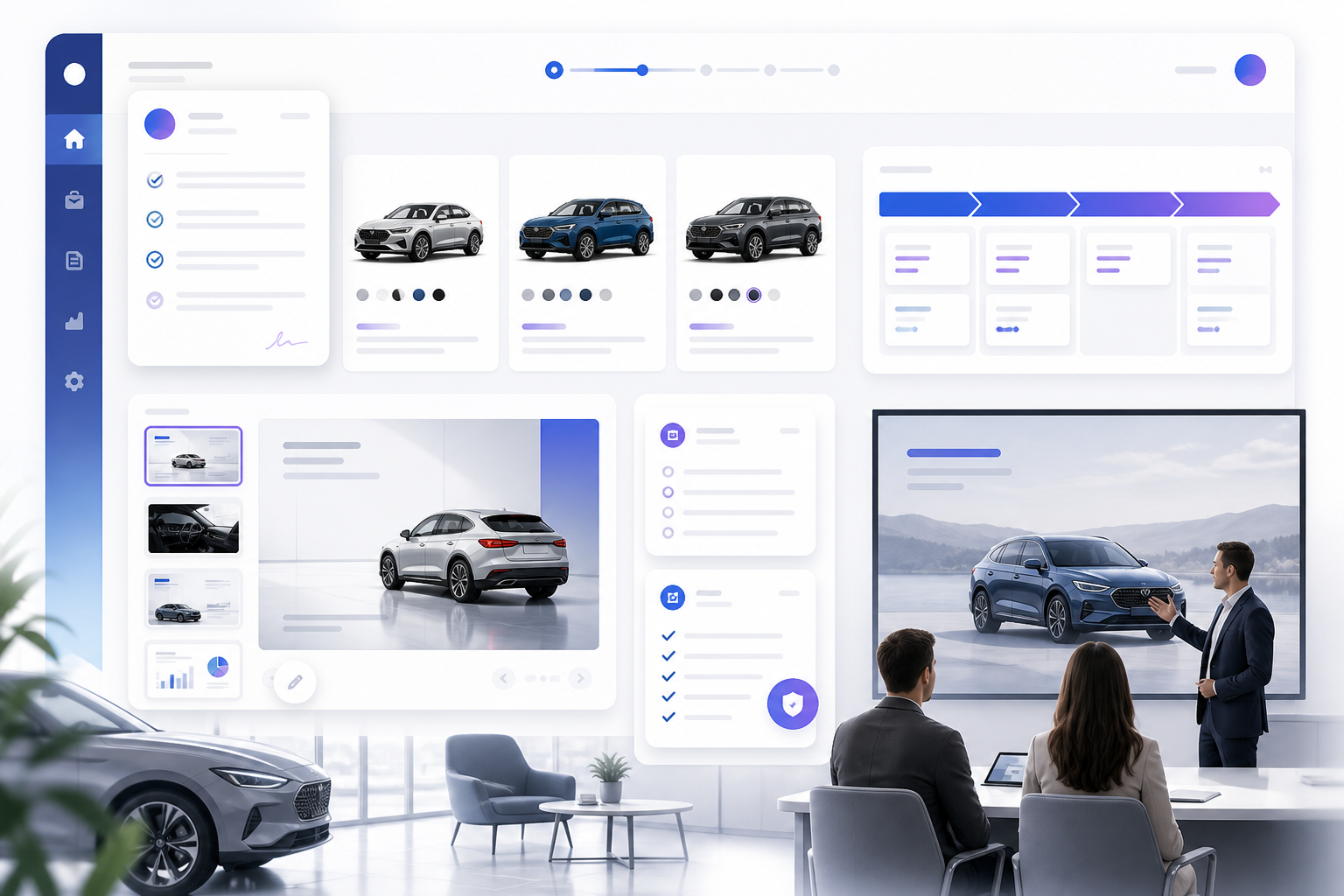
AI Presentation Generator for Auto Sales Teams
Auto sales teams do not lose time because they lack product knowledge. They lose time because every serious buyer, fleet lead, or finance conversation needs a different deck, and reps are often building those slides between calls, test drives, and follow-ups.
An AI presentation generator helps dealership teams move from scattered notes to buyer-ready presentations faster. Used well, it does not replace the rep’s judgment; it removes the blank-slide work so the rep can focus on the offer, the objection, and the next step.
Why auto sales decks take so long
This section identifies the real bottleneck: most deck-building time is spent translating messy buyer context into a clear story.
Vehicle data is easy; buyer relevance is hard
A modern dealership already has plenty of information: trim sheets, inventory pages, incentive rules, finance estimates, trade-in notes, service history, and OEM marketing assets. The hard part is deciding what matters to one buyer at one moment.
A family comparing three-row SUVs needs safety, cargo, warranty, and monthly payment clarity. A small business owner comparing cargo vans wants payload, upfit options, total cost of ownership, and availability. A repeat service customer considering a trade-in wants a simple explanation of why now may be a good time to upgrade.
Reps rebuild the same logic repeatedly
Most dealership presentations follow repeatable patterns, but reps often recreate them manually: title slide, buyer goal, vehicle match, feature proof, pricing path, trade-in assumptions, finance or lease options, and call to action.
Deck creation is not the highest-value selling activity. The valuable work is clarifying the buyer’s decision and making the next action easy.
In a hands-on workflow test for this guide, a 12-slide SUV comparison deck built manually from notes, inventory pages, and screenshots took 96 minutes. Using an AI-generated outline, draft copy, and rep-led fact checking reduced the working time to 31 minutes. This is not a universal benchmark, but it shows where time is often saved: structure, phrasing, and first-pass slide flow.
How an AI presentation generator fits the sales workflow
An AI-assisted deck works best when it is inserted into a real sales process, not treated as a magic button.
Start with the buyer situation, not the slide design
The strongest prompts begin with context. Before asking for a deck, the rep should capture the buyer type, vehicle shortlist, budget range, must-have features, main objection, timeline, and preferred next step.
For example, a rep can use PopAi AI Presentation to turn a short buyer brief into a structured deck, then edit the pricing, compliance language, and model-specific claims before sending it to the prospect.
Use a repeatable prompt structure
Sales managers can standardize the process by giving reps a simple input template. This keeps decks consistent while still allowing personalization.
- Buyer profile: first-time buyer, family shopper, trade-in customer, fleet manager, or service-to-sales lead.
- Decision goal: compare models, justify payment, explain lease terms, or schedule a second visit.
- Vehicle set: exact models, trims, mileage, VIN notes, or availability constraints.
- Objections: payment, interest rate, cargo space, range anxiety, warranty, fuel economy, or delivery timing.
- Required slides: comparison table, feature proof, payment scenario, trade-in assumptions, and next steps.
High-impact decks for auto sales teams
Automate the decks that are frequent, decision-heavy, and easy to review for accuracy.
Vehicle comparison decks
Comparison decks are ideal for AI assistance because they have a predictable structure. The rep can ask for a side-by-side view of two or three vehicles, then refine the recommendation based on the buyer’s priorities.
A good comparison deck should not dump every specification onto the buyer. It should highlight the decision criteria: seating, cargo, safety features, towing, warranty, payment range, ownership costs, and availability.
Finance and lease explanation decks
Payment conversations often become confusing because buyers hear multiple numbers: selling price, trade allowance, payoff, money down, term length, APR, residual value, and monthly payment. A short deck can separate the variables and explain what changes the monthly outcome.
AI can draft the educational framing, but the actual payment figures must come from approved dealership systems. This is where sales management and finance review remain essential.
Fleet and B2B proposal decks
Fleet buyers need more than a brochure. They want operational fit, delivery timing, service coverage, driver needs, total cost logic, and a clear procurement path.
In a second workflow test, a fleet van proposal assembled manually from a spreadsheet, spec notes, and service talking points took 2 hours and 14 minutes. A guided AI draft brought the first usable version down to 49 minutes, with the remaining time spent on pricing verification and manager edits.
| Deck type | Best use | AI should draft | Human must verify |
|---|---|---|---|
| Model comparison | Helping buyers choose between trims or competitors | Slide flow, feature summaries, buyer-focused recommendation | Specs, availability, incentives, competitive claims |
| Lease vs. finance | Explaining payment paths without overwhelming the buyer | Plain-English explanation and visual structure | APR, residual, term, taxes, fees, compliance wording |
| Fleet proposal | Presenting vehicles to business owners or procurement teams | Business case, operating benefits, implementation sequence | Pricing, delivery timing, service commitments, contract terms |
AI presentation generator personalization that actually sells
Personalization is not adding the buyer’s name to slide one; it is matching the deck to the decision they are trying to make.
Translate buyer notes into a buying narrative
A strong sales deck has a point of view. It should say, “Based on what you told us, this option is the strongest fit because...” That statement gives the buyer a reason to continue.
For a commuter moving from a sedan to a hybrid SUV, the narrative might focus on fuel savings, driver-assistance features, cargo flexibility, and payment stability. For a contractor, it may focus on payload, service intervals, upfit readiness, and downtime reduction.
Use personalization checkpoints
Before sending any AI-generated deck, reps should check whether the presentation answers the buyer’s actual concerns. If it only repeats brochure language, it is not ready.
- Does the opening slide restate the buyer’s goal in their language?
- Does each feature connect to a real use case?
- Are payment or ownership numbers clearly labeled as estimates when appropriate?
- Is the recommended next step specific: second test drive, trade appraisal, finance review, or fleet quote?
A personalized deck should make the buyer feel understood before it makes the vehicle look impressive.
Quality control before sending any AI-generated deck
AI speeds up draft creation, but dealership teams still need a review system for facts, claims, and regulated language.
Separate draft content from approved content
AI may generate confident language around warranties, incentives, financing, or competitor comparisons. Those areas require extra care. Treat AI wording as draft copy until it is checked against OEM materials, dealership policy, and current offer rules.
For regulated or sensitive claims, follow official sources. The Federal Trade Commission’s auto retail guidance emphasizes clear advertising and accurate disclosure of material terms; that principle applies to slide decks as much as it applies to web ads or printed offers.
Create a manager review checklist
A lightweight checklist is enough for most teams. The goal is not to slow reps down; it is to prevent preventable mistakes before a deck reaches a buyer.
- Inventory accuracy: confirm the vehicle is available or clearly mark alternatives.
- Pricing clarity: label estimates, assumptions, taxes, fees, and expiration dates.
- Feature accuracy: verify trim-specific features against official vehicle data.
- Compliance language: review finance, lease, warranty, and incentive statements.
- Brand tone: remove overpromising, pressure language, or unsupported superiority claims.
A 7-day implementation plan for dealership teams
The fastest way to adopt AI decks is to pilot one narrow use case, measure it, and expand only after the process is stable.
Days 1–2: choose one deck type
Pick a deck that the team already creates often. For many dealerships, that is a model comparison deck or a post-test-drive follow-up deck. Avoid starting with complex finance-heavy decks until the review process is clear.
Days 3–4: build the prompt and slide checklist
Create a standard prompt that includes buyer context, vehicle options, objections, and required slides. Then create a checklist for the rep and manager. The checklist should be short enough to use during a busy sales day.
Days 5–7: test, measure, and refine
Run the workflow with three to five real opportunities. Track time to first draft, edit time, manager corrections, buyer response quality, and whether the deck helped secure the next step.
Useful measurements are simple: minutes saved, number of corrections per deck, buyer replies, appointment confirmations, and rep adoption. If reps are still rebuilding slides manually, the prompt is probably too vague or the output is not aligned with the sales conversation.
FAQ: AI presentation generator use in auto sales
Can an AI presentation generator use dealership-specific pricing and incentives?
Yes, but the sales team should treat AI output as a draft. Upload or paste approved pricing, trim details, incentive language, and compliance notes, then require a manager or finance lead to review the final deck before it reaches a buyer.
Will AI-made vehicle decks feel too generic for serious buyers?
They can feel generic if reps only use a default prompt. The best results come from including the buyer profile, trade-in situation, preferred features, payment range, and the exact decision the deck should support.
What deck types should an auto sales team automate first?
Start with repetitive, high-volume decks: model comparisons, lease-versus-finance explanations, fleet proposals, service contract explainers, and post-test-drive follow-up summaries. These have predictable structures and clear buyer questions.
How much editing should a sales rep expect after generation?
A rep should still verify facts, remove unsupported claims, tune tone, and add human context from the showroom or call. In practice, AI reduces blank-page work; it does not replace final sales judgment.
Turn buyer notes, vehicle details, and sales objectives into a polished presentation your team can review, personalize, and send faster.
Start building with PopAi