AI Pitch Deck for Startups: MVP to Seed Round Structure
July 2, 2026
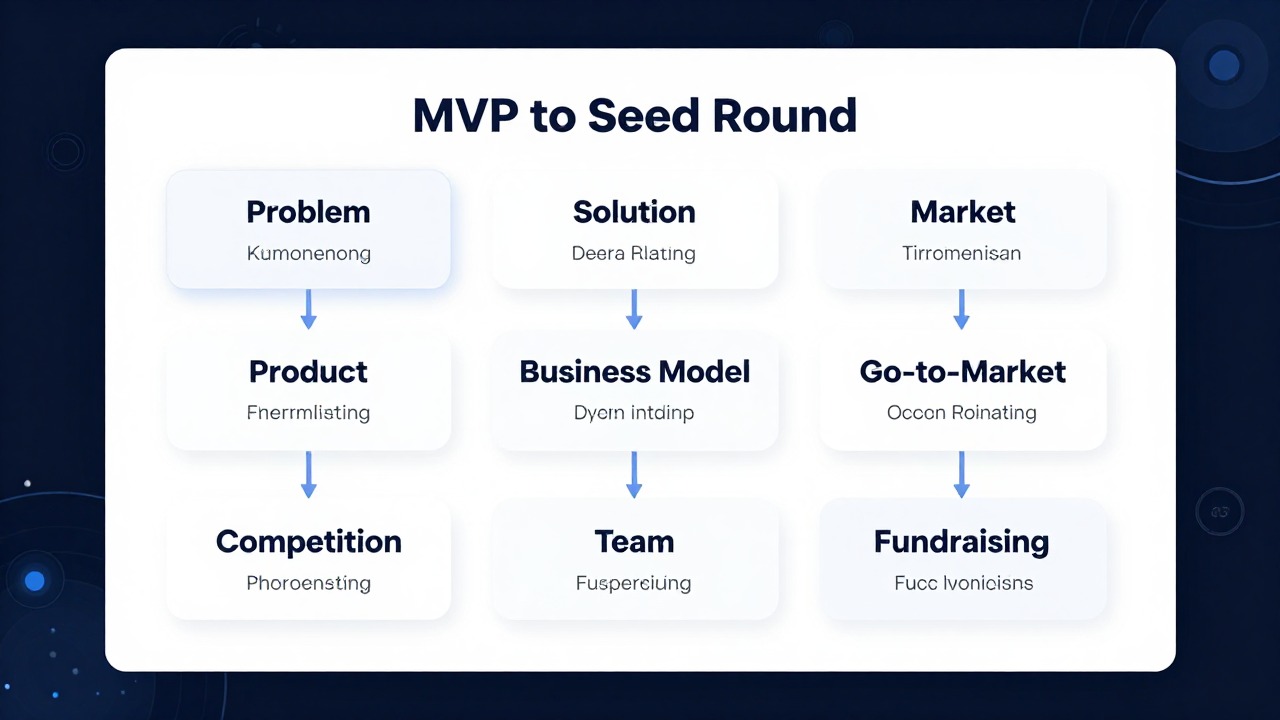
An AI pitch deck startup workflow should help you turn scattered MVP notes, customer feedback, product screenshots, market research, and fundraising thoughts into a clear first draft of a seed round deck. It should not decide your fundraising strategy for you. Use AI for structure, slide sequencing, summarization, wording, and visual organization; keep founder judgment in charge of the numbers, competitive claims, market assumptions, traction, and fundraising ask.
For an MVP-to-seed deck, a practical flow is: Problem, Customer, Solution, Product or MVP, Market, Business Model, Traction, Go-to-Market, Competition, Team, Financials or Use of Funds, and Ask. That structure gives investors enough context to understand what you are building, why now, who needs it, how early evidence supports it, and what the round is meant to unlock.
This guide shows how to prepare inputs, prompt AI without producing a generic deck, use AI presentation software in a practical drafting workflow, and manually review the slides that investors will scrutinize most.
When you are ready to turn the workflow into slides, PopAi AI Presentation can help transform rough notes, documents, or prompts into an editable deck structure.
Quick Answer: What an AI Pitch Deck for a Startup Should Produce
This section explains what AI can realistically create for a startup pitch deck and what founders must still decide themselves.
An AI pitch deck for a startup is best understood as an AI-assisted first draft, not an automatic fundraising strategy. The useful output is a structured deck outline, slide-by-slide message, cleaner wording, and a design direction that helps you move faster from raw material to a presentation you can edit.
For MVP-stage founders, AI is especially helpful because the source material is usually messy. You may have a product demo, customer notes, a few usage signals, founder hypotheses, screenshots, and an evolving business model. AI can help organize those pieces into a narrative investors can follow.
- Use AI to turn rough notes into a logical slide sequence.
- Use AI to summarize long product or business-plan documents into presentation-ready points.
- Use AI to draft slide objectives, headlines, and speaker notes.
- Use AI to reduce blank-page friction and formatting work.
- Do not use AI to invent market size, financial forecasts, partnerships, customer quotes, traction, or competitive advantages.
A strong MVP-to-seed deck usually follows this core flow: Problem, Customer, Solution, Product or MVP, Market, Business Model, Traction or Validation, Go-to-Market, Competition, Team, Financials or Use of Funds, and Ask. The order can shift depending on your company, but the deck should answer the same investor questions: who cares, why the problem matters, why your product is credible, why the business can grow, and why this funding round is the next logical step.
Let AI organize the story, but manually validate every number, customer claim, market assumption, competitor comparison, timeline, and fundraising use before sharing the deck.
MVP Deck vs. Seed Round Deck: What Changes in the Story
This section compares the expectations of an MVP demo deck and a seed round fundraising deck so you choose the right narrative depth.
An MVP deck is often built to explain what you have learned so far. It may be used for early conversations with advisors, pilot customers, accelerators, angel investors, or internal stakeholders. The story can lean heavily on problem discovery, user insight, prototype decisions, and learning speed.
A seed round deck usually needs a stronger business case. Investors still want to see product insight, but they also need to understand the market opportunity, early validation, go-to-market path, team credibility, business model, use of funds, and the risks you already recognize.
- Audience: an MVP deck may speak to testers, mentors, accelerators, or early believers; a seed deck usually speaks to investors evaluating whether the company can become a fundable business.
- Goal: an MVP deck explains what is being built and what has been learned; a seed deck explains why funding now can help the company reach the next meaningful milestone.
- Evidence: an MVP deck may rely on interviews, prototypes, waitlists, pilots, or qualitative feedback; a seed deck should organize any available usage, revenue, retention, pipeline, pilot, or engagement signals without exaggeration.
- Slide emphasis: an MVP deck may spend more space on product discovery and demo flow; a seed deck usually needs more space on market, go-to-market, business model, team, financials, and use of funds.
- Risk level: an MVP deck can admit that many assumptions are still being tested; a seed deck should show which assumptions have been reduced and which remain open.
The difference is not that seed decks must look more polished. The difference is that the seed narrative must connect product progress to company-building logic. A working MVP is useful, but investors also want to know who will buy, why adoption can grow, how the company might make money, and what the founding team can execute.
A seed deck should not simply say, “We built an MVP.” It should say, “Here is the customer problem we validated, the product response we built, the early signal we observed, and the next milestone this round funds.”
Deck expectations vary by industry, investor type, geography, and business model. A biotech, deep-tech, or hardware company may need more technical validation and milestone planning. A SaaS company may need stronger buyer, workflow, pricing, and retention logic. A consumer app may need more evidence of behavior, frequency, and distribution.
Prepare the Inputs: What to Give Startup Presentation AI Before Drafting
This section shows what to collect before using startup presentation AI so the output is specific rather than generic.
AI-generated pitch decks become generic when the inputs are generic. Before asking any tool to draft your deck, gather the raw material that makes your company specific: the customer, the problem, the evidence, the product, the business model, and the reason the round matters now.
- One-sentence company description: what you build, for whom, and what outcome it improves.
- Target customer: buyer, user, industry, role, segment, or community.
- Problem evidence: customer interviews, repeated complaints, workflow observations, support tickets, manual workarounds, or market research notes.
- MVP material: screenshots, demo notes, feature list, prototype flow, product roadmap, or technical architecture summary.
- Customer feedback: direct notes from conversations, survey summaries, pilot feedback, early testimonials you have permission to use, or objections you heard repeatedly.
- Traction signals: usage, waitlist, pilots, revenue, letters of intent, retention signals, qualified pipeline, community growth, or qualitative validation if metrics are still limited.
- Business model: pricing hypothesis, revenue model, buyer path, sales motion, or monetization assumptions.
- Competitors and alternatives: direct competitors, spreadsheets, manual processes, agencies, incumbents, or “do nothing” behavior.
- Founder background: relevant domain expertise, technical ability, operator experience, network advantage, or personal connection to the problem.
- Fundraising goal: target round size if you are ready to state it, stage of raise, investor audience, and intended use of funds.
- Use of funds: product development, hiring, customer acquisition, regulatory work, pilots, infrastructure, or other milestones.
Separate confirmed facts from assumptions before giving information to AI. Confirmed facts might include a shipped MVP, five pilot conversations, a signed design partner, existing revenue, or a founder’s previous role. Assumptions might include market expansion, future pricing, conversion rates, hiring plans, and customer acquisition efficiency.
- Label confirmed facts as “verified” or “known.”
- Label assumptions as “hypothesis,” “planned,” “estimated,” or “to validate.”
- Use cautious wording when evidence is incomplete, such as “early customer conversations suggest” instead of unsupported claims like “customers are demanding this product.”
- If a number is not verified, do not ask AI to make it sound certain.
- If you do not have traction yet, ask AI to create a validation-focused slide instead of a traction slide.
AI presentation software can fit naturally at this point because it can help turn prompts, documents, notes, and rough ideas into a structured presentation draft. The better your input packet, the more useful the first deck structure becomes. Instead of typing “make me a startup pitch deck,” you can give AI presentation software a concise company description, product notes, customer feedback, and fundraising context so the draft reflects your actual story.
Prepare one page with your company description, customer persona, top three customer pains, MVP feature notes, three to five customer insights, any traction or validation signals, competitors, business model hypothesis, team background, fundraising goal, and intended milestones for the next 12 to 18 months.
Step-by-Step Workflow: From Rough Startup Notes to Seed Round Pitch Deck AI Draft
This section gives a practical workflow for using seed round pitch deck AI without losing control of the fundraising story.
The best workflow is not a single prompt. It is a controlled drafting process: organize your materials, define the investor context, generate an outline, create slide-by-slide content, review the facts, sharpen the story, and polish the deck for readability.
- Collect materials: gather business-plan notes, MVP screenshots, customer feedback, traction details, competitor notes, financial assumptions, and fundraising-use notes.
- Define the investor audience: specify whether the deck is for angel investors, seed funds, accelerator partners, strategic investors, or internal advisors.
- Generate the outline: ask AI for a 10 to 12 slide seed deck structure and require each slide to include a clear objective, not just a title.
- Create the slide-by-slide draft: convert each slide objective into a headline, three to five key points, and suggested visual direction.
- Review for accuracy: check every number, market claim, customer statement, competitor comparison, and milestone.
- Improve narrative flow: make sure the problem leads naturally to the solution, the MVP supports the insight, and the traction supports the fundraising ask.
- Polish visual hierarchy: shorten text, use sharper headlines, group related content, and make each slide easy to scan.
- Export or prepare for edits: move the deck into your preferred editing environment, add screenshots or charts, and prepare speaker notes.
A useful prompt should provide context, constraints, and the expected output format. For example: “Create a seed round pitch deck outline for a B2B SaaS startup that helps operations teams schedule field technicians. We have an MVP, three pilot conversations, early workflow feedback, no revenue yet, and a founder with logistics experience. Produce 12 slides. For each slide, include the slide objective, suggested headline, three key points, what evidence belongs there, and what not to overclaim.”
That prompt is stronger than “make a pitch deck” because it prevents the AI from filling gaps with generic startup language. It also asks for slide objectives, which is important. A slide title says what the slide is about; a slide objective says what the slide must prove.
- Ask for a sharper problem slide if the output sounds broad or abstract.
- Ask for a more investor-focused traction slide if the draft lists activity but does not explain signal quality.
- Ask for a clearer use-of-funds slide if the draft names budget categories without linking them to milestones.
- Ask for a less promotional tone if the deck uses phrases like “massive opportunity” without evidence.
- Ask for a validation-focused version if you do not yet have revenue or usage metrics.
AI presentation software is useful in this workflow because it can help founders move from prompts, documents, and rough ideas into an editable deck structure. A founder can start with a business-plan document, customer notes, and a product description, then use AI presentation software to draft the first presentation outline and slide content. The founder should then rewrite the most strategic slides manually: problem, traction, market, competition, financials, and ask.
A founder with a 12-page business plan and scattered customer interview notes can use AI presentation software to summarize the material into a seed deck draft, then edit the problem slide around the strongest repeated customer pain and replace generic traction wording with verified validation signals.
Recommended Seed Round Deck Structure Slide by Slide
This section provides a reusable 10 to 12 slide blueprint for founders building an MVP-to-seed pitch deck.
A seed deck should be short enough to read quickly and complete enough to support a serious investor conversation. The structure below is a practical starting point. You can merge or reorder slides depending on your startup type, but each slide should have one job.
- Title slide: include company name, one-line description, founder names, and contact details. Do not overload it with slogans. AI can help refine the one-liner, but you should make sure it accurately describes the product and customer.
- Problem slide: define the painful, frequent, or expensive problem. Include customer language or observed workflow friction when available. Do not make the problem so broad that every company in the world seems like a customer. AI can help group interview notes into problem themes.
- Customer or persona slide: show who has the problem, who buys, who uses, and when the pain appears. Do not describe the customer as “everyone.” AI can help convert scattered persona notes into a clear buyer-user distinction.
- Solution slide: explain your product’s core promise in plain language. Do not list every feature. AI can help turn technical product notes into a benefit-led explanation.
- MVP or product slide: show what exists today through screenshots, workflow diagrams, demo steps, or feature highlights. Do not imply a fully mature platform if you only have a prototype. AI can help write concise captions for screenshots and demo flow.
- Market slide: explain the market context, customer segment, and expansion logic. Do not let AI invent market size numbers. If you use external market data, verify the source and define your assumptions clearly.
- Business model slide: state how the company expects to make money. Include pricing model, buyer path, sales motion, or monetization hypothesis. Do not pretend pricing is validated if it is still being tested. AI can help compare possible model narratives, but you choose the credible one.
- Traction or validation slide: show the strongest evidence you have. This may be pilots, revenue, usage, retention, waitlist, qualified pipeline, design partners, customer interviews, or repeated feedback. Do not inflate traction. AI can help rank signals from strongest to weakest.
- Go-to-market slide: explain how you will reach the first meaningful customer segment. Include channels, sales motion, partnerships, community strategy, or founder-led sales. Do not list every possible marketing channel. AI can help turn a scattered plan into a focused sequence.
- Competition slide: show alternatives and your differentiation. Include direct competitors, manual workarounds, incumbents, and the status quo. Do not claim “no competitors.” AI can help map competitive categories, but founders must verify accuracy.
- Team slide: explain why this team can solve this problem. Include relevant experience, domain knowledge, technical ability, or unfair insight. Do not pad the slide with unrelated credentials. AI can help make bios concise and investor-relevant.
- Financials, use of funds, and ask slide: show the funding request, intended use, and milestones. Include hiring, product, go-to-market, regulatory, infrastructure, or pilot goals as relevant. Do not present unsupported projections as certainty. AI can help organize categories, but the assumptions must come from you.
Some startups should adjust the order. A technical product may need to bring the product or architecture slide earlier because technical credibility is central. A marketplace may need separate slides for supply, demand, liquidity, and sequencing. A SaaS startup may emphasize buyer pain, workflow integration, pricing, and retention logic. A consumer app may lead with user behavior, growth loop, community, or engagement evidence. A deep-tech startup may need more space for science, defensibility, regulatory path, and milestone-based financing.
- Move traction earlier if your traction is the strongest part of the story.
- Move team earlier if founder-market fit is unusually important to the opportunity.
- Move product earlier if investors must understand a technical breakthrough before the market case makes sense.
- Add a regulatory or technical-risk slide if those risks are central to the business.
- Add an appendix for deeper market sizing, financial model assumptions, product roadmap, or customer evidence.
The slide order is less important than the logic: each slide should reduce one investor question and prepare the next one.
The biggest risk with AI in this slide-by-slide process is false confidence. Do not allow the tool to invent metrics, customer logos, signed partnerships, market-size claims, financial assumptions, press mentions, or customer quotes. If you do not have evidence yet, say so clearly and frame the slide around what you are testing next.
Realistic Example Workflow: Turning an MVP App Idea into an Investor Deck
This section shows a realistic sample workflow for using AI to turn an MVP concept into a seed deck draft without pretending it is a verified case study.
The following is a realistic sample workflow, not a verified company case study. Imagine a first-time founder building a scheduling app for independent tutors. The MVP allows tutors to manage lesson availability, student rescheduling, reminder messages, and simple payment-status tracking.
The founder has a demo in two weeks with several angel investors. The source materials include a product-notes document, six screenshots, notes from 15 tutor conversations, a rough competitor list, a pricing hypothesis, and a short fundraising memo. There is limited traction: a small group of tutors has tested the prototype, but there is no meaningful revenue yet.
- Context: MVP exists, but the fundraising story is scattered across notes and screenshots.
- Audience: angel investors familiar with education and small-business software.
- Constraint: founder needs a clean seed-style narrative quickly without exaggerating traction.
- Source materials: interview notes, MVP screenshots, competitor notes, pricing hypothesis, and fundraising-use draft.
- Risk: AI could turn the idea into a generic “productivity platform” story unless the founder supplies specific tutor workflow details.
- The founder gathers the raw material and labels facts separately from assumptions.
- The founder uses AI presentation software to turn the product notes, customer pain points, and fundraising memo into a first seed deck outline.
- The founder asks the AI to create slide objectives for Problem, Customer, Solution, MVP, Validation, Business Model, Go-to-Market, Competition, Team, Use of Funds, and Ask.
- The founder reviews the draft and removes generic claims such as “huge education market” unless supported by specific market framing.
- The founder rewrites the problem slide around repeated tutor pain: schedule changes, missed reminders, and fragmented payment tracking.
- The founder replaces a generic traction slide with a validation slide: prototype tested by a small tutor group, repeated pain themes, product usage observations, and open assumptions.
- The founder adds screenshots manually and writes speaker notes explaining what is verified and what is still being tested.
The expected result is not a magic investor-ready deck. The useful result is a cleaner structure, clearer narrative, and fewer blank-page decisions. The founder now has a deck that shows the problem, the specific customer, the MVP workflow, early validation, and the next milestone without pretending the business is more mature than it is.
If your startup has an MVP but limited traction, ask AI to build a validation narrative rather than a growth narrative. Show what you learned, what evidence exists, what remains uncertain, and what the seed round will help prove.
A second realistic AI presentation software workflow might involve a B2B workflow tool. A founder has a long internal memo describing warehouse inventory handoffs, several customer discovery notes, and a prototype built in a no-code tool. By using AI presentation software to summarize the memo into slides, the founder can quickly separate the operational pain, buyer persona, MVP flow, and go-to-market plan. The founder should still manually verify any claims about warehouse budgets, software adoption, and return on investment before the deck is sent.
Common Mistakes to Avoid When Using AI for a Startup Pitch Deck
This section highlights the errors that make AI-generated startup decks look polished but weak to investors.
AI-generated language can sound confident even when the strategy underneath is thin. That is the main danger. A deck can look clean, use polished headlines, and still fail to answer basic investor questions about customer urgency, evidence, differentiation, business model, and use of funds.
- Generic market claims: phrases like “massive market opportunity” without a defined customer segment or verified sizing logic.
- Inflated traction: presenting conversations, waitlists, or prototype tests as stronger evidence than they are.
- Vague problem statements: describing a broad inconvenience instead of a painful, repeated, high-priority problem.
- Too many features: using the product slide as a feature dump instead of explaining the core workflow and value.
- Unclear buyer: failing to distinguish user, buyer, decision-maker, and budget owner.
- Unsupported financials: including forecasts without explaining assumptions, pricing logic, or milestone connection.
- Inconsistent fundraising ask: asking for capital without linking it to hires, product milestones, pilots, sales motion, or runway logic.
- Overdesigned slides: using visuals that look impressive but bury the message.
- Invented credibility: adding logos, partnerships, quotes, or advisor names that are not real or not approved for use.
The solution is not to avoid AI. The solution is to use AI as a drafting partner and then apply founder review. A strong startup deck should sound specific enough that it could not belong to any other company.
- Fact-check every number, including market size, traction, usage, revenue, pricing, and financial projections.
- Remove unsupported claims, especially claims about market leadership, customer demand, defensibility, or partnerships.
- Align the fundraising ask with the use of funds and the milestones the round is meant to unlock.
- Simplify slide text so each slide has one main message and a clear visual hierarchy.
- Prepare speaker notes for nuance that does not belong on the slide itself.
- Ask advisors, operators, or founder peers to review the deck for strategy, not just grammar.
- Customize the deck for investor context instead of sending the same draft to every audience.
A practical next step is to prepare your source notes, generate the first AI pitch deck startup draft, then rewrite it around investor questions. What problem is painful enough? Who buys? What evidence exists? Why is the timing right? Why this team? What does the seed round unlock?
AI presentation software can help with drafting, summarizing, organizing, and moving from a blank page to an editable deck structure. It is especially useful when your materials are scattered across notes, documents, and rough ideas. But the final deck still needs founder judgment, verified evidence, and feedback from people who understand your market and fundraising stage.
Before sending a deck, read every slide as if an investor will ask, “How do you know this?” If the answer is weak, revise the slide or move the claim into an assumption.
FAQ
Can AI create a complete pitch deck for a startup?
AI can create a strong first draft, outline, slide sequence, and wording for a startup pitch deck. Founders still need to verify facts, refine the strategy, adjust the narrative for the investor audience, and make sure the fundraising ask is realistic.
What should I include in a seed round pitch deck created with AI?
Include the core slides: title, problem, customer, solution, MVP or product, market, business model, traction or validation, go-to-market, competition, team, financials or use of funds, and ask. The deck should show problem clarity, early evidence, business logic, team credibility, and what the funding round will unlock.
Is an AI pitch deck good enough to send to investors?
Usually not without review. An AI-generated deck should be edited and customized before sending, especially for traction, market size, competition, financial assumptions, customer claims, and fundraising details.
How do I stop startup presentation AI from making my deck sound generic?
Provide specific source materials: customer persona details, interview notes, MVP screenshots, product constraints, traction evidence, competitor context, founder insight, and positioning rules. Ask AI for slide objectives and evidence requirements, not just slide titles.
Can AI presentation software turn a business plan or notes into a pitch deck?
Yes. AI presentation software can help transform prompts, documents, notes, and rough ideas into a structured editable presentation, which is useful for founders starting from scattered materials. Founders should still review all facts, assumptions, and fundraising claims manually.
Build slides faster from your source material
Turn notes, prompts, documents, or rough outlines into a clearer presentation draft, then edit the story, facts, and visual details before presenting.
Try PopAi AI Presentation