Investor Update Deck AI: Monthly Metrics & Narrative
July 2, 2026
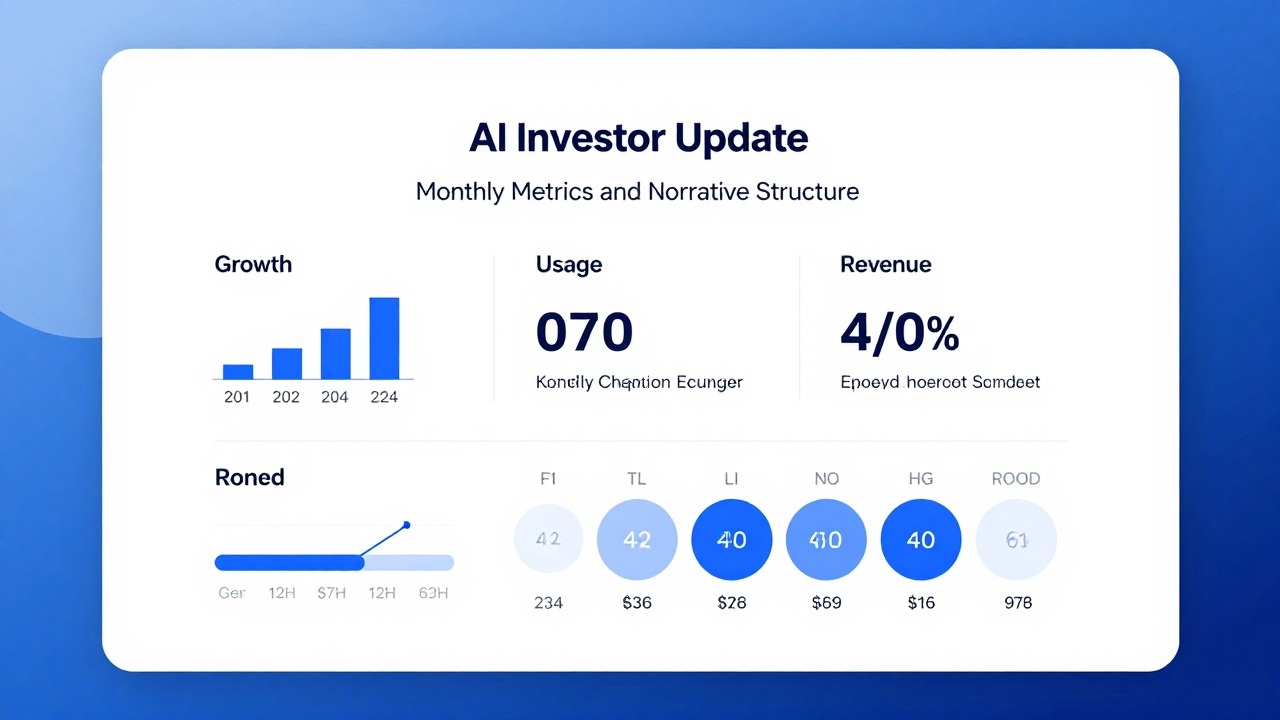
A monthly investor update deck should help existing investors understand what changed, why it matters, what the team is doing next, and where help is needed. It is not a fundraising pitch deck. It is a recurring operating communication built around progress, metrics, risks, priorities, and specific asks.
AI can help you move from scattered notes to a structured first draft faster, especially when you already have CRM updates, finance bullets, product notes, hiring changes, and customer feedback. The useful workflow is not “ask AI to make a deck” and accept the output. It is: gather accurate inputs, define the month’s narrative, generate AI monthly update slides, then review every number, disclosure, and tone choice before sending.
This guide shows how to use an investor update deck AI workflow without making the update generic, vague, or unsafe. You will see what to include, which metrics to prepare, how to frame bad news, where AI presentation software fits, and how to build a concise deck investors can scan quickly.
When you are ready to turn the workflow into slides, PopAi AI Presentation can help transform rough notes, documents, or prompts into an editable deck structure.
What an AI Investor Update Deck Should Do Each Month
This section defines the monthly investor update as a recurring communication tool and explains the core information investors need.
An investor update deck is a short recurring deck sent to existing investors, advisors, and sometimes close prospective investors. Its job is to communicate operating progress, not to sell the entire company from scratch. A strong monthly update gives investors a fast answer to five questions: What happened this month? What changed in the metrics? What is working? What is not working? Where can investors help?
The best use of investor update deck AI is to turn messy source material into a clear first draft. AI can summarize notes, group metrics by theme, suggest slide titles, and create a logical flow. It cannot validate your financial model, decide whether a risk is material, or know how a specific investor will interpret a sensitive statement. Those remain founder-level judgment calls.
- Headline summary: one slide that states the month, the overall status, and the most important change.
- KPI snapshot: a concise view of the metrics that matter for your current stage and business model.
- Wins: meaningful customer, product, revenue, hiring, partnership, or operational progress.
- Challenges: missed targets, blockers, churn drivers, product delays, pipeline weakness, or cost pressure.
- Product or customer progress: what shipped, what customers used, what was learned, and what changed in the roadmap.
- Runway or financial context: burn, runway direction, revenue context, fundraising timing, or cash discipline when relevant.
- Priorities: the three to five actions the team is focused on next month.
- Investor asks: specific introductions, hiring help, customer leads, fundraising support, advice, or decision requests.
- Appendix: detailed charts, customer notes, metric definitions, or supporting context that would slow down the main deck.
A monthly deck does not need to be beautiful in the way a polished fundraising deck does. It does need to be consistent, readable, accurate, and honest. Investors usually value a clear update with specific asks more than a heavily designed deck that hides the real operating picture.
Before generating slides, write a one-sentence monthly headline such as: “Pipeline quality improved, activation remains the bottleneck, and we need investor help with two enterprise design partners.” That headline will keep the deck from becoming a random list of updates.
Investor Update Deck vs. Startup Investor Presentation: What Changes
This section compares a monthly investor update with a fundraising deck so founders do not reuse the wrong structure.
A startup investor presentation for fundraising is designed to build conviction in an opportunity. It usually explains the market, problem, solution, product, traction, business model, team, competition, go-to-market plan, financial outlook, and round narrative. It assumes the audience may be new to the company and needs context before they can believe the story.
A monthly investor update deck is different. Existing investors already know the company’s origin story, vision, and broad market thesis. They want movement. They want to know whether the team is learning fast, whether risks are being handled directly, whether the company is using capital responsibly, and whether their network can help.
- Fundraising deck audience: new or prospective investors who need conviction and context.
- Monthly update audience: existing investors, advisors, and close insiders who need transparency and action items.
- Fundraising deck emphasis: opportunity size, product promise, differentiation, traction, and why now.
- Monthly update emphasis: recent performance, operating priorities, risks, asks, and next steps.
- Fundraising deck tone: persuasive, selective, and narrative-led.
- Monthly update tone: direct, balanced, accountable, and concise.
The most common mistake is copying a fundraising deck template into a monthly update. Long market slides, company origin stories, repeated vision statements, and broad problem-solution framing usually waste space unless there is a specific reason to remind investors of context. A monthly update should spend more time on what changed than on why the company exists.
If one deck must serve both existing investors and warm prospective investors, use a hybrid structure. Keep the main monthly update short, then add two or three appendix slides that explain the company, market, and product for people who are less familiar. Do not force existing investors to reread the full pitch every month.
- Start with the monthly operating update for existing investors.
- Add a short “company context” appendix for warm prospects.
- Label the appendix clearly so insiders can skip it.
- Keep sensitive investor-only information out of versions shared with prospects.
- Create separate exports if disclosure levels differ by audience.
A pitch deck asks investors to believe. A monthly update asks investors to stay informed, trust the team, and help with the next set of constraints.
The Monthly Metrics to Prepare Before Using AI
This section helps you choose the right source metrics before asking AI to build slides.
AI slide tools are only as useful as the inputs you provide. If you paste vague notes such as “growth was good, churn needs work, product shipped features,” you will get generic slides. If you provide the month, business model, stage, operating priorities, metric labels, qualitative context, and specific asks, the output becomes much more useful.
Not every metric belongs in every monthly update. The right metrics are the ones tied to current operating priorities. A SaaS company focused on retention should not bury churn and expansion under a large list of acquisition activity. A pre-revenue company should not force artificial revenue slides when milestone progress, pilot activity, and product learning are more honest.
- SaaS: monthly recurring revenue or revenue trend, new bookings, expansion, churn, retention, activation, product usage, pipeline quality, customer concentration, and implementation status.
- Marketplace: supply growth, demand growth, liquidity signals, completed transactions, repeat behavior, take rate, geographic density, and quality or trust issues.
- Consumer app: active users, retention cohorts, engagement frequency, acquisition channels, conversion, monetization tests, community growth, and product usage patterns.
- Ecommerce: revenue, order volume, average order value, gross margin, contribution margin direction, repeat purchase behavior, inventory constraints, conversion, and paid channel efficiency.
- AI product: active teams or users, usage frequency, workflow completion, model or product reliability themes, enterprise pilots, integration progress, compute or cost considerations, and security review status.
- Services-led startup: booked revenue, delivery capacity, gross margin direction, repeat customers, pipeline, customer concentration, hiring needs, and the path from services to scalable product.
- Pre-revenue company: product milestones, prototype progress, user research, pilot conversations, waitlist quality, design partners, technical risk reduction, hiring, runway context, and next-month learning goals.
When exact numbers are not final or should not be shared broadly, use careful qualitative language. For example, “pipeline increased due to stronger enterprise interest” is better than inventing a precise number. If a number is directional, estimated, unaudited, or preliminary, label it clearly. Investor trust erodes when the deck mixes different levels of certainty without explanation.
- Revenue and bookings: actuals, trends, new wins, expansion, downgrades, and context for movement.
- Customer and user activity: active users, engagement, retention, churn, pilots, renewals, and customer feedback themes.
- Sales pipeline: qualified opportunities, stage movement, close risks, customer segments, and investor-introduction targets.
- Product progress: shipped features, adoption, reliability issues, roadmap changes, and customer learning.
- Financial context: burn, runway direction, hiring plan, cost changes, gross margin direction, and fundraising timing where appropriate.
- Team and operations: key hires, open roles, delivery constraints, process improvements, and cross-functional blockers.
- Milestones: commitments from the prior update, what was completed, what slipped, and what changed.
- Source material checklist: previous investor update, finance summary, CRM notes, sales pipeline export or summary, product analytics summary, customer feedback themes, support or success notes, hiring updates, roadmap notes, cash runway context, and board-style operating bullets.
- Narrative checklist: top three wins, top three concerns, one key learning, one major decision or tradeoff, and two to five investor asks.
- Quality checklist: metric definitions, reporting period, preliminary versus final labels, owner for each number, and any exclusions or caveats.
Use the same metric names month to month unless your business model changes. Consistency helps investors understand trend lines and reduces unnecessary follow-up questions.
How to Build AI Monthly Update Slides From Notes and Documents
This section gives a practical step-by-step workflow for turning monthly materials into editable AI-generated slides.
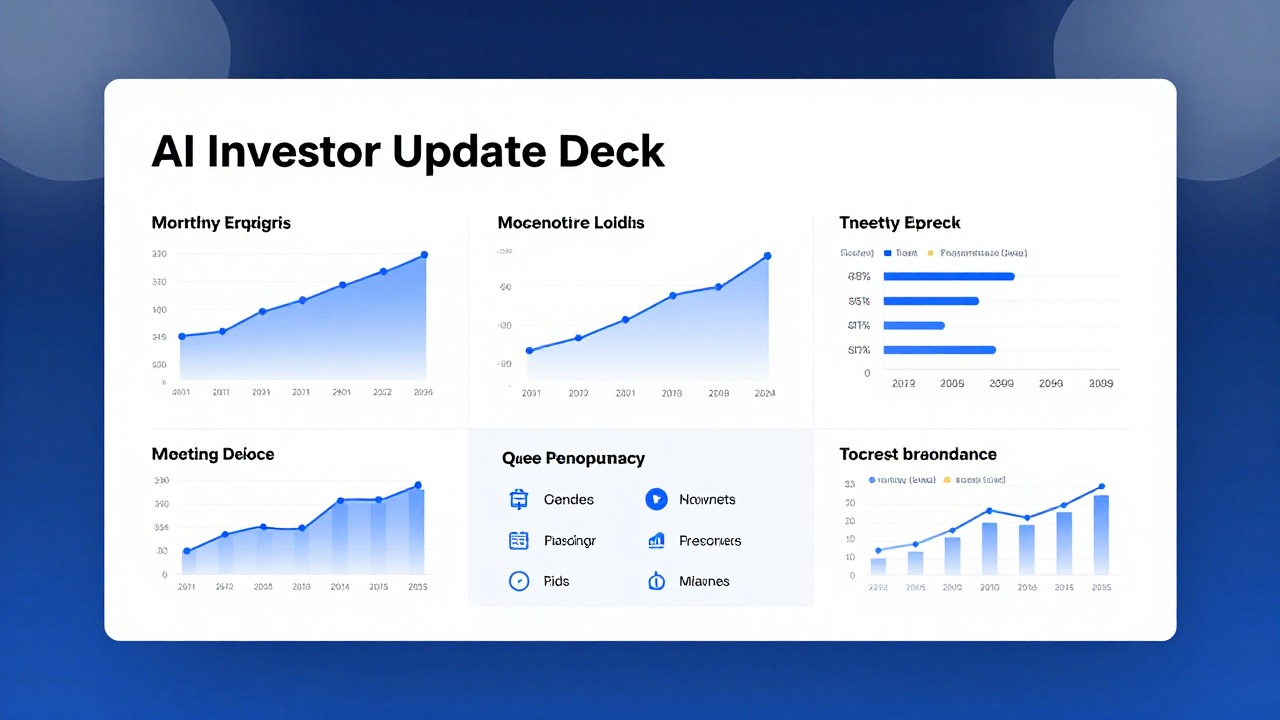
The fastest workflow is to separate thinking from slide production. First, decide what the month means. Then use AI to organize and draft. If you ask AI to create the narrative before you know the narrative yourself, the deck may sound polished but empty.
- Collect inputs: gather finance bullets, CRM notes, product updates, customer feedback, hiring changes, roadmap notes, and the prior investor update.
- Write a one-paragraph monthly summary: state the month’s headline, the strongest proof point, the biggest risk, and the main investor asks.
- Prepare metric notes: label actual, estimated, preliminary, directional, or confidential numbers before using them in any tool.
- Paste notes or upload source material into an AI presentation workflow, depending on your company’s privacy and security policies.
- Ask for a deck outline first: request slide titles, sequence, main message for each slide, and suggested appendix items.
- Generate the first deck: create concise slides that group metrics by theme rather than spreading every note across separate slides.
- Review the storyline: check whether the deck answers what changed, why it changed, what happens next, and where investors can help.
- Verify numbers: reconcile the slides against finance, CRM, product analytics, and prior updates.
- Refine tone: make bad news clear, remove hype, and make investor asks specific.
- Export or edit: prepare a send-ready version and, if needed, a separate version for prospective investors with different disclosure levels.
AI presentation tools fit this workflow because it can help turn prompts, documents, notes, and rough ideas into a structured presentation deck. For a founder or chief of staff, the most useful part is getting from scattered materials to an editable first draft without spending the first hour choosing layouts and slide titles.
Realistic AI-Assisted Workflow Example 1: an early-stage founder has a finance summary, a CRM note export, and a product update written by the engineering lead. The founder writes a short monthly headline, pastes the cleaned notes into AI presentation software, and asks for a 9-slide investor update with KPI snapshot, wins, challenges, next-month priorities, and investor asks. AI presentation software helps organize the material into investor-friendly sections. The founder then checks the pipeline numbers against the CRM, rewrites the risk slide in a more direct voice, and moves detailed customer notes to the appendix.
Realistic AI-Assisted Workflow Example 2: a finance lead supports a CEO who sends monthly investor emails but wants a deck format for more complex updates. The finance lead prepares a short document with revenue movement, burn context, hiring plan changes, and a few customer notes. In AI presentation software, they generate an initial deck from the document, using the tool to create concise titles and structure the flow. The CEO reviews the output, adjusts the investor asks, removes one sensitive customer detail, and adds a short note explaining why a hiring delay is intentional rather than purely negative.
- Prompt for structure: “Create a concise monthly investor update deck for an early-stage B2B SaaS company. Use the following notes. Include title, executive summary, KPI snapshot, revenue and pipeline, customer and product progress, risks, next-month priorities, investor asks, and appendix.”
- Prompt for tone: “Use direct, investor-friendly language. Do not overstate progress. Separate facts from interpretation. Make bad news clear and include the response plan.”
- Prompt for metrics: “Group metrics by theme. Keep exact numbers only where provided. Label estimated or directional metrics. Do not invent benchmarks or missing values.”
- Prompt for asks: “Create a dedicated investor asks slide with specific asks for introductions, hiring help, customer leads, and strategic feedback. Do not bury asks inside general update slides.”
- Prompt for appendix: “Move detailed notes, long customer feedback, and secondary metrics into an appendix so the main deck stays concise.”
To keep the AI output useful, include the reporting month, audience, company stage, business model, top three metrics, biggest challenge, next-month priorities, and specific investor asks. If those details are missing, the AI will often compensate with generic startup language that sounds reasonable but does not communicate your actual operating situation.
Do not paste highly confidential customer names, unreleased financials, employee information, legal issues, security details, or fundraising terms into any AI tool unless the tool and workflow comply with your company’s privacy, legal, and security policies.
A Practical Investor Update Narrative Structure Founders Can Reuse
This section gives a reusable slide-by-slide structure for a monthly investor update deck.
A strong monthly investor update follows a simple narrative arc: status, evidence, explanation, response, and asks. Investors should not have to infer whether a metric is good or bad. They should see what changed, why it changed, what the team believes, what the team is doing next, and how they can help.
- Title and reporting period: include company name, month, reporting period, and audience version. Keep legal or confidential labels consistent with your company’s policy.
- Executive summary: use three to five bullets covering the month’s headline, key win, key challenge, and primary asks. Avoid long paragraphs.
- KPI dashboard: show the core metrics tied to current priorities. Include definitions or caveats when necessary. Move secondary metrics to the appendix.
- Revenue or traction movement: explain what changed in revenue, pipeline, users, retention, pilots, or marketplace activity. Do not present numbers without context.
- Customer or product progress: show shipped work, adoption, customer learning, design partner feedback, or product usage patterns. Keep raw feedback excerpts short.
- Team or operations update: include hiring, delivery capacity, process changes, or operational constraints only when they affect execution.
- Risks and blockers: state the risk, why it matters, what is being done, and whether investor help is needed.
- Next-month priorities: list the few priorities that matter most. Tie them to the risks and opportunities described earlier.
- Investor asks: make requests specific, named, and easy to act on. Include the type of introduction, target profile, role, customer segment, or advice needed.
- Appendix: include detailed charts, metric definitions, customer notes, prior-month comparisons, or context for less familiar readers.
Each slide should have one job. The executive summary is not the place for a detailed funnel analysis. The KPI dashboard is not the place for a long explanation of every product decision. The risks slide is not the place to hide the fact that a target was missed. When the slide has one job, AI-generated drafts become easier to review and edit.
- On the slide: the headline, the key metric or conclusion, and the action implication.
- In speaker notes or email body: nuance, longer explanation, and background context.
- In the appendix: detailed metric tables, definitions, cohort notes, long customer quotes, and secondary analysis.
- In a separate investor call: sensitive decisions, personnel matters, legal issues, or strategic topics that need discussion rather than broad distribution.
To connect metrics to narrative, use a four-part sentence pattern: what changed, why it changed, what the team is doing next, and where help is needed. For example: “Enterprise pipeline improved after narrowing our ICP to compliance-heavy teams; the main constraint is now security review speed; next month we are standardizing the procurement packet; introductions to security leaders at design partners would help validate the process.”
Sample use case: an early-stage B2B SaaS founder is preparing a monthly update from CRM notes, product usage notes, and finance bullets. This is a realistic workflow example, not a verified company case study. The company has a small set of pilots, a growing pipeline, and one product activation issue that affects conversion.
- The founder gathers CRM notes showing which opportunities moved forward, stalled, or requested security review.
- The product lead adds usage notes showing that users who complete onboarding are engaged, but too many accounts stall before setup.
- The finance lead adds burn and runway context, plus a note that a planned hire is being delayed by one month.
- The founder writes the monthly headline: “Pipeline quality is improving, activation is the main bottleneck, and investor help is needed for enterprise security feedback.”
- In AI presentation software, the founder generates a first draft deck from the combined notes and requests a concise investor update structure.
- The AI draft creates a logical flow: summary, KPI snapshot, pipeline, activation challenge, product response, runway context, priorities, asks, and appendix.
- The founder edits the KPI slide to ensure metric definitions are correct, changes the challenge slide to sound more direct, and adds two specific investor asks.
- The final deck is sent with a short email summary and an offer to discuss the activation plan with investors who have relevant enterprise software experience.
The narrative should not make every month look perfect. It should make the team’s thinking visible.
Common Mistakes When Using AI for Investor Updates
This section covers the errors that can make AI-generated investor updates less trustworthy or less useful.
The biggest risk with AI-generated investor updates is not ugly slide design. It is misplaced confidence. A deck can look organized while containing soft claims, missing caveats, inconsistent metrics, or vague explanations of real problems. Investor communication depends on trust, and trust is damaged when the deck sounds smoother than the operating reality.
- Over-polishing bad news: AI may turn “we missed the activation target because onboarding is too complex” into “we are optimizing the onboarding experience.” The second version sounds safer but communicates less.
- Mixing number types: audited, unaudited, preliminary, estimated, and directional numbers should not appear side by side without labels.
- Creating too many slides: busy investors are more likely to read a concise deck with an appendix than a long deck where every update has its own slide.
- Forgetting investor asks: generic AI slides often summarize activity but fail to say what help is needed.
- Using pitch-deck language: phrases that sound persuasive in fundraising can feel evasive in an operating update.
- Ignoring prior communications: if this month’s definitions or claims conflict with previous updates, investors will notice.
- Including sensitive details too broadly: customer names, employee matters, legal topics, and fundraising strategy may require limited distribution or direct conversation.
Bad news should not be hidden, but it should be framed responsibly. A useful risk slide says what happened, why it matters, what the team is doing, what the timeline looks like, and whether investors can help. Avoid emotional language, blame, and unsupported reassurance. The goal is to show control and learning, not to make every issue disappear.
- Check financial accuracy against the source of record.
- Confirm metric definitions match prior updates.
- Label estimates, preliminary data, and directional statements.
- Remove or anonymize confidential customer, employee, legal, or security information where needed.
- Review tone for honesty, specificity, and accountability.
- Confirm that investor asks are concrete and actionable.
- Make sure the deck matches what the CEO, finance lead, and functional owners are prepared to discuss.
Another common mistake is treating the AI output as the final narrative. AI can propose a structure, but it does not know the emotional temperature of your investor base, the history of prior promises, or the sensitivity around missed milestones. A founder must decide how much context to provide and which topics should move from the deck to a call.
Before sending, review the deck for four things AI cannot reliably own: financial accuracy, confidentiality, investor relations tone, and consistency with previous commitments.
When an AI Presentation Tool Fits This Workflow
Use AI for structure, drafting, and slide clarity; keep strategy, facts, and final approval human-owned.
PopAi can be useful when you already have notes, documents, or a rough outline and need to turn them into an editable presentation draft. The strongest use is speeding up the first version, not replacing review.
- Good fit: outline generation, slide titles, summary slides, speaker-note drafts, and alternative wording.
- Needs review: facts, claims, data, customer examples, legal language, and final storyline.
- Not a substitute for: audience judgment, business strategy, source verification, and rehearsal.
FAQ
How long should a monthly investor update deck be?
Keep the main deck short enough for quick scanning, often around the core slides needed to explain summary, metrics, progress, risks, priorities, and asks. Move detailed metric tables, long customer notes, and extra context into an appendix.
Can AI create the whole investor update deck for me?
AI can create a strong first draft, organize scattered notes, suggest slide structure, and improve wording. The founder or team still needs to verify numbers, adjust tone, decide what to disclose, and make sure the update matches prior investor communications.
What metrics should I include if my startup is pre-revenue?
Focus on milestone progress, product development, user research, waitlist or pilot activity, pipeline quality, hiring progress, runway context, and next-month priorities. Do not force revenue metrics before they are meaningful.
Should I include bad news in an investor update deck?
Yes. Present bad news honestly and with context: state what happened, why it matters, what the team is doing, what the expected next step is, and whether investor help is needed. Avoid hiding missed targets behind vague positive language.
Is an investor update deck the same as a board deck?
They can overlap, but they are not the same. A board deck is usually deeper, more detailed, and more decision-oriented. A monthly investor update is shorter, easier to scan, and focused on progress, risks, priorities, and specific asks.
Build slides faster from your source material
Turn notes, prompts, documents, or rough outlines into a clearer presentation draft, then edit the story, facts, and visual details before presenting.
Try PopAi AI Presentation