Presentation Summary
Discover how to build a strong culture in remote teams through virtual escape rooms, coffee chats, and gamified engagement with our comprehensive guide.
Full Presentation Transcript
Slide 1: Remote Team Building Activities Guide
Building Strong Culture in Distributed Teams through Virtual Escape Rooms, Coffee Chats, and Gamified Engagement
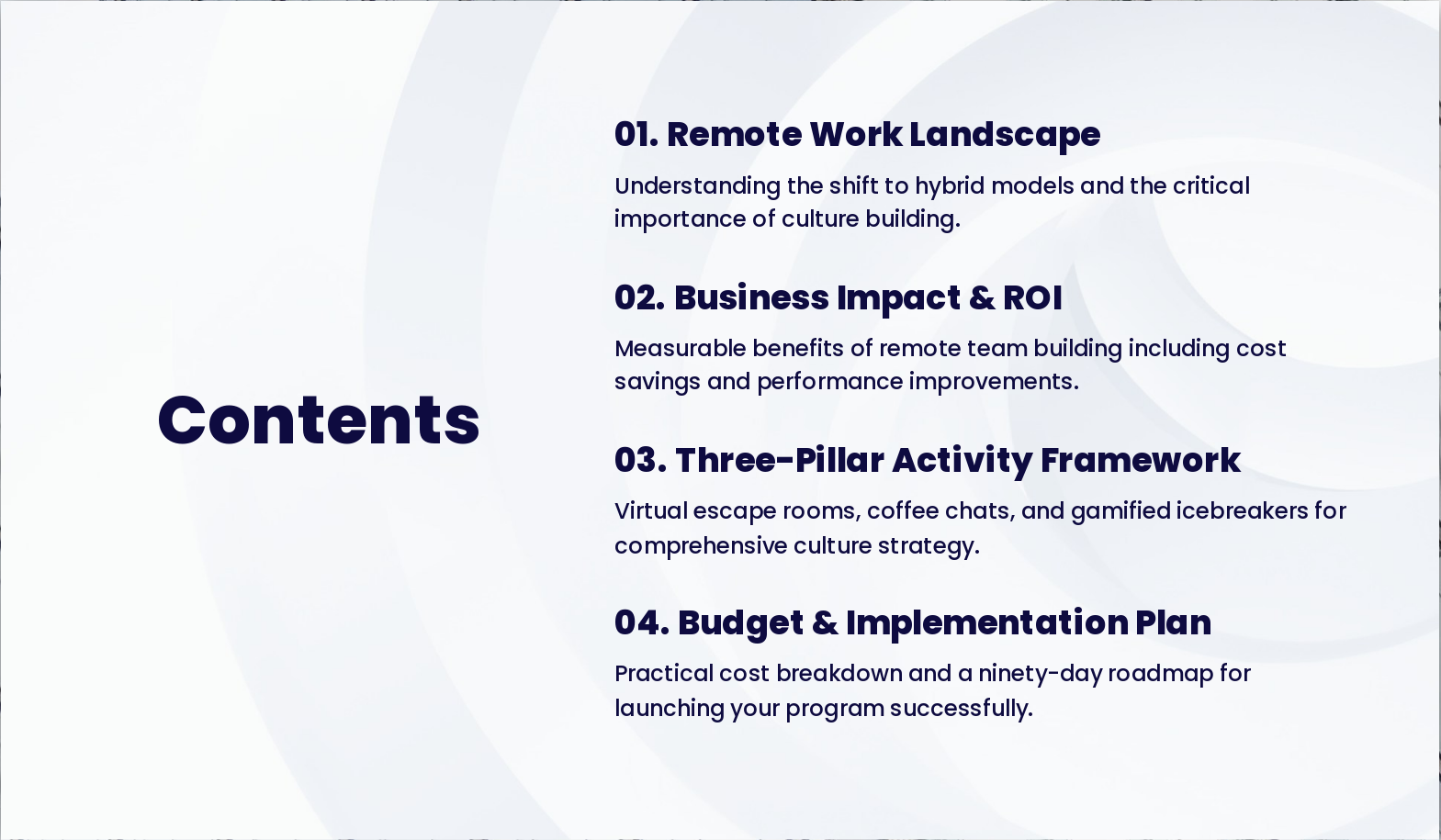
Slide 2: Contents
- Remote Work Landscape: Understanding the shift to hybrid models and the critical importance of culture building.
- Business Impact & ROI: Measurable benefits of remote team building including cost savings and performance improvements.
- Three-Pillar Activity Framework: Virtual escape rooms, coffee chats, and gamified icebreakers for comprehensive culture strategy.
- Budget & Implementation Plan: Practical cost breakdown and a ninety-day roadmap for launching your program successfully.
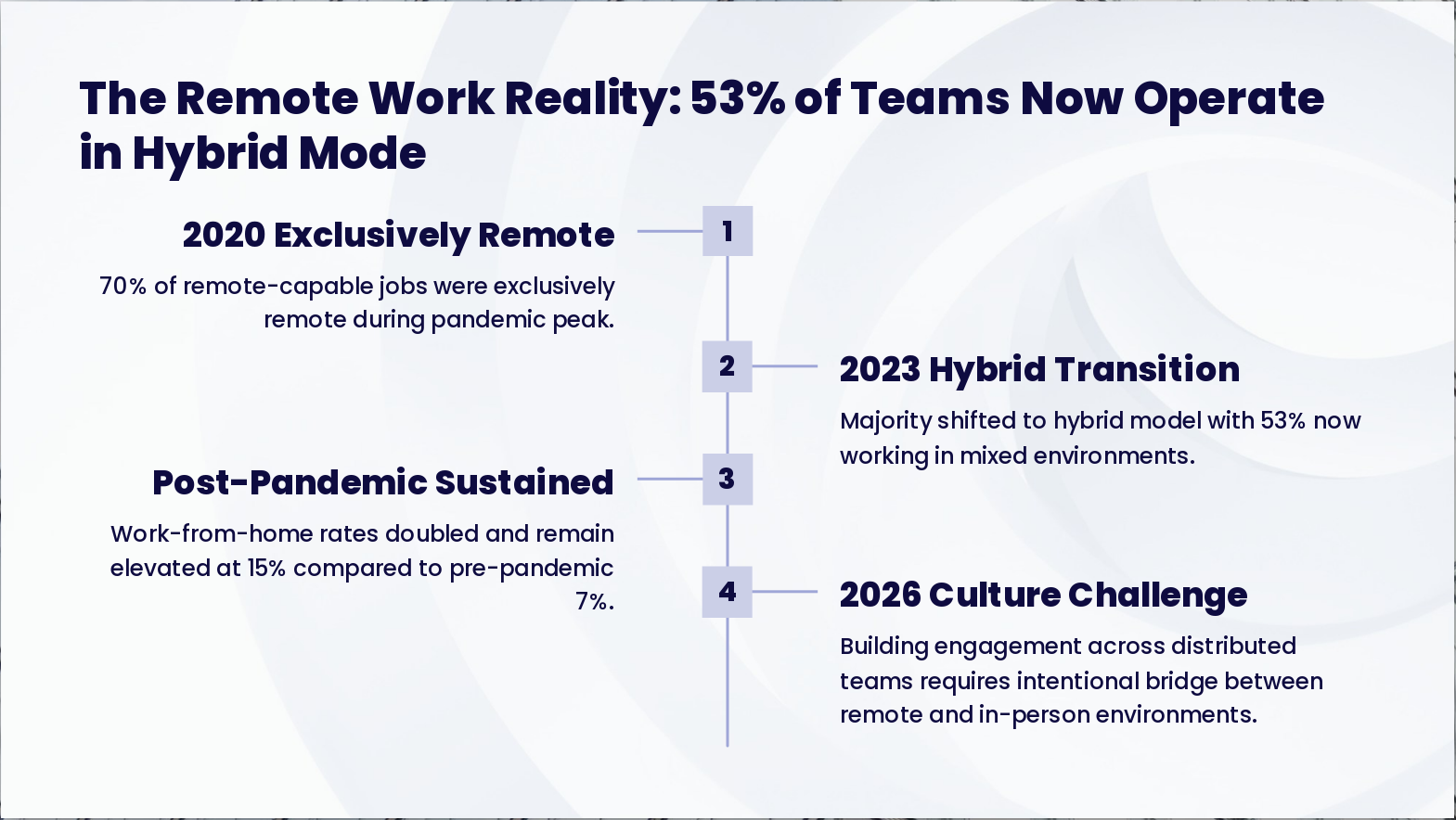
Slide 3: The Remote Work Reality: 53% of Teams Now Operate in Hybrid Mode
- 2020 Exclusively Remote: 70% of remote-capable jobs were exclusively remote during pandemic peak.
- 2023 Hybrid Transition: Majority shifted to hybrid model with 53% now working in mixed environments.
- Post-Pandemic Sustained: Work-from-home rates doubled and remain elevated at 15% compared to pre-pandemic 7%.
- 2026 Culture Challenge: Building engagement across distributed teams requires intentional bridge between remote and in-person environments.
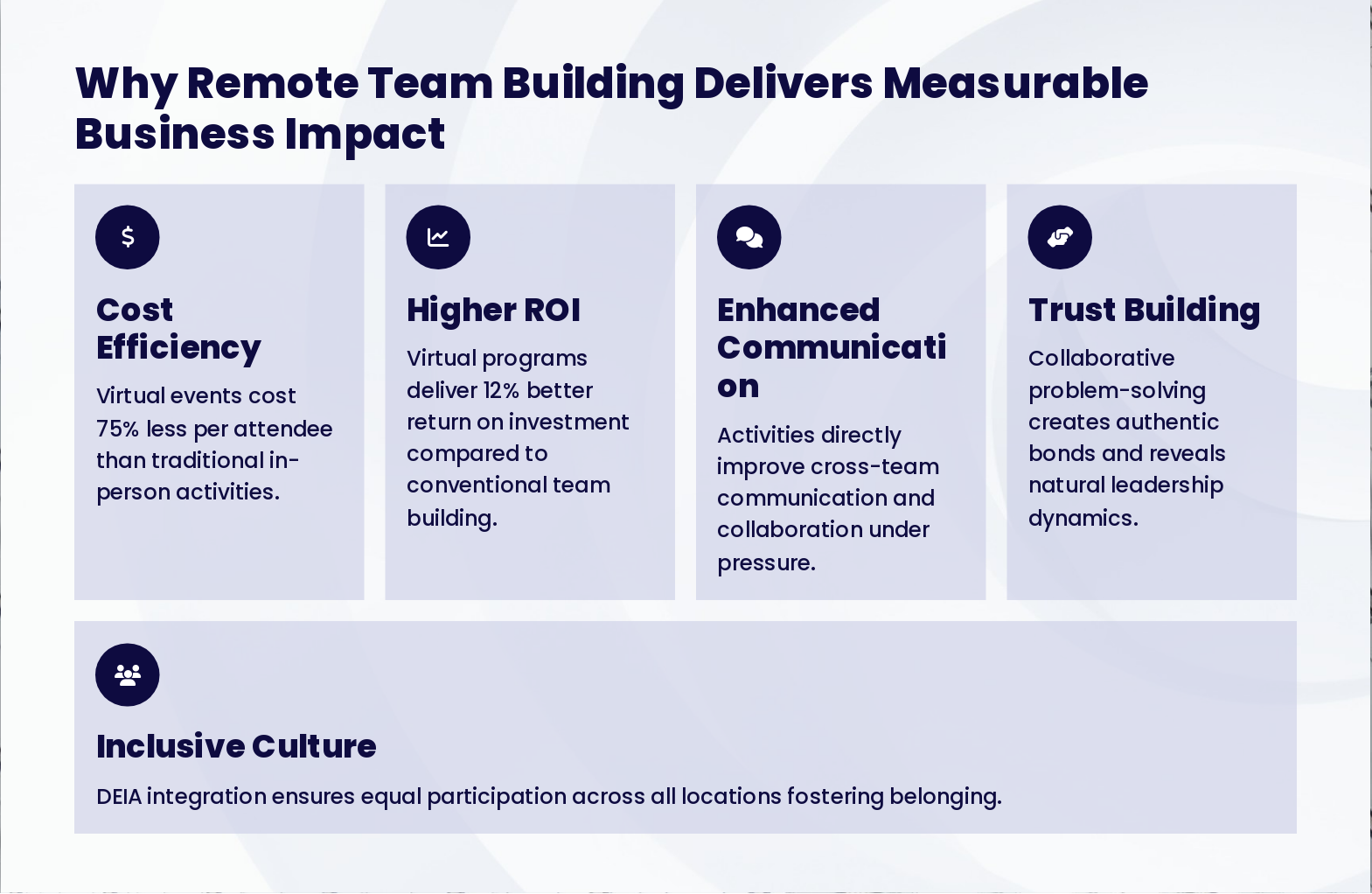
Slide 4: Why Remote Team Building Delivers Measurable Business Impact
- Cost Efficiency: Virtual events cost 75% less per attendee than traditional in-person activities.
- Higher ROI: Virtual programs deliver 12% better return on investment compared to conventional team building.
- Enhanced Communication: Activities directly improve cross-team communication and collaboration under pressure.
- Trust Building: Collaborative problem-solving creates authentic bonds and reveals natural leadership dynamics.
- Inclusive Culture: DEIA integration ensures equal participation across all locations fostering belonging.
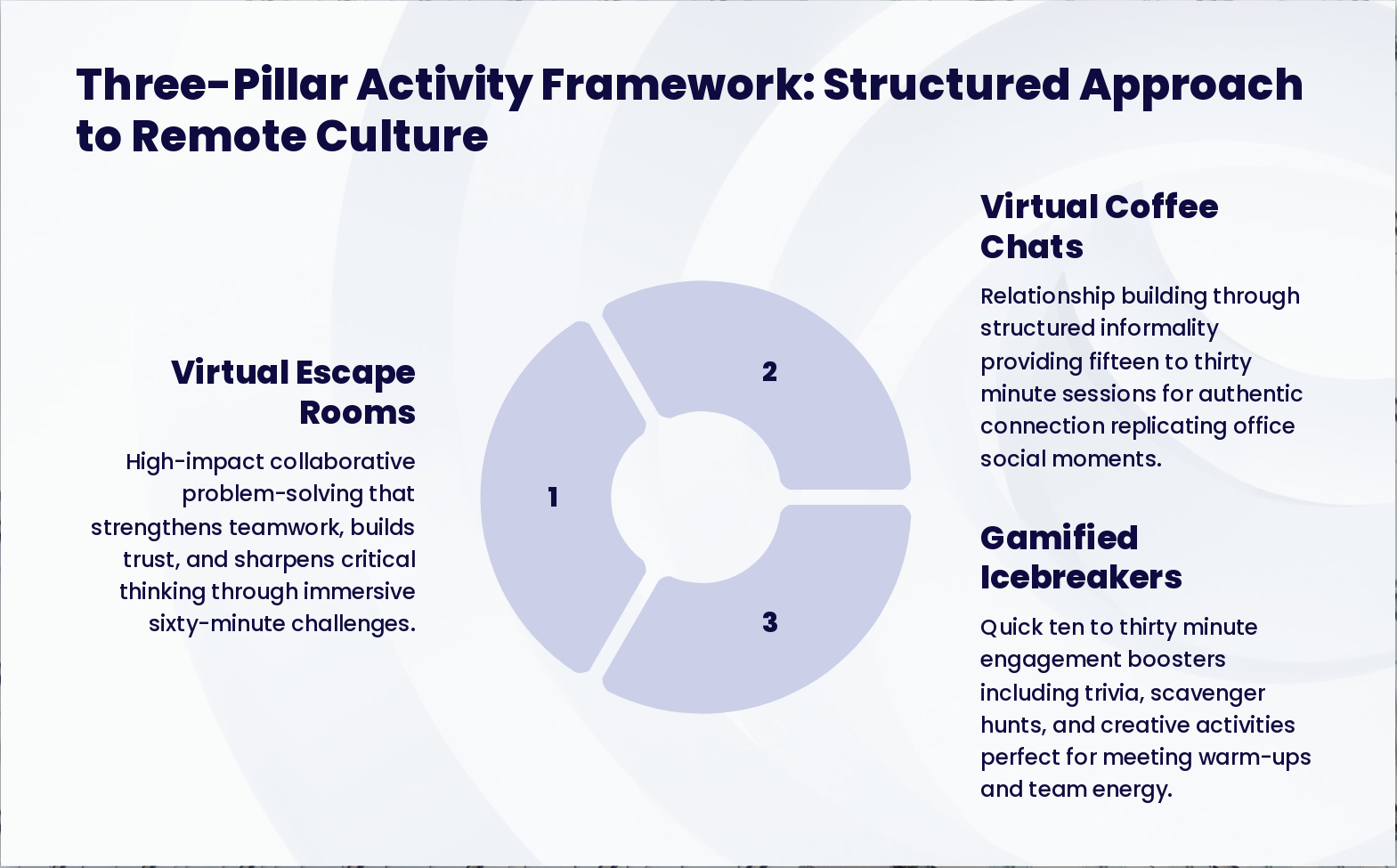
Slide 5: Three-Pillar Activity Framework: Structured Approach to Remote Culture
- Virtual Escape Rooms: High-impact collaborative problem-solving that strengthens teamwork, builds trust, and sharpens critical thinking through immersive sixty-minute challenges.
- Virtual Coffee Chats: Relationship building through structured informality providing fifteen to thirty minute sessions for authentic connection replicating office social moments.
- Gamified Icebreakers: Quick ten to thirty minute engagement boosters including trivia, scavenger hunts, and creative activities perfect for meeting warm-ups and team energy.
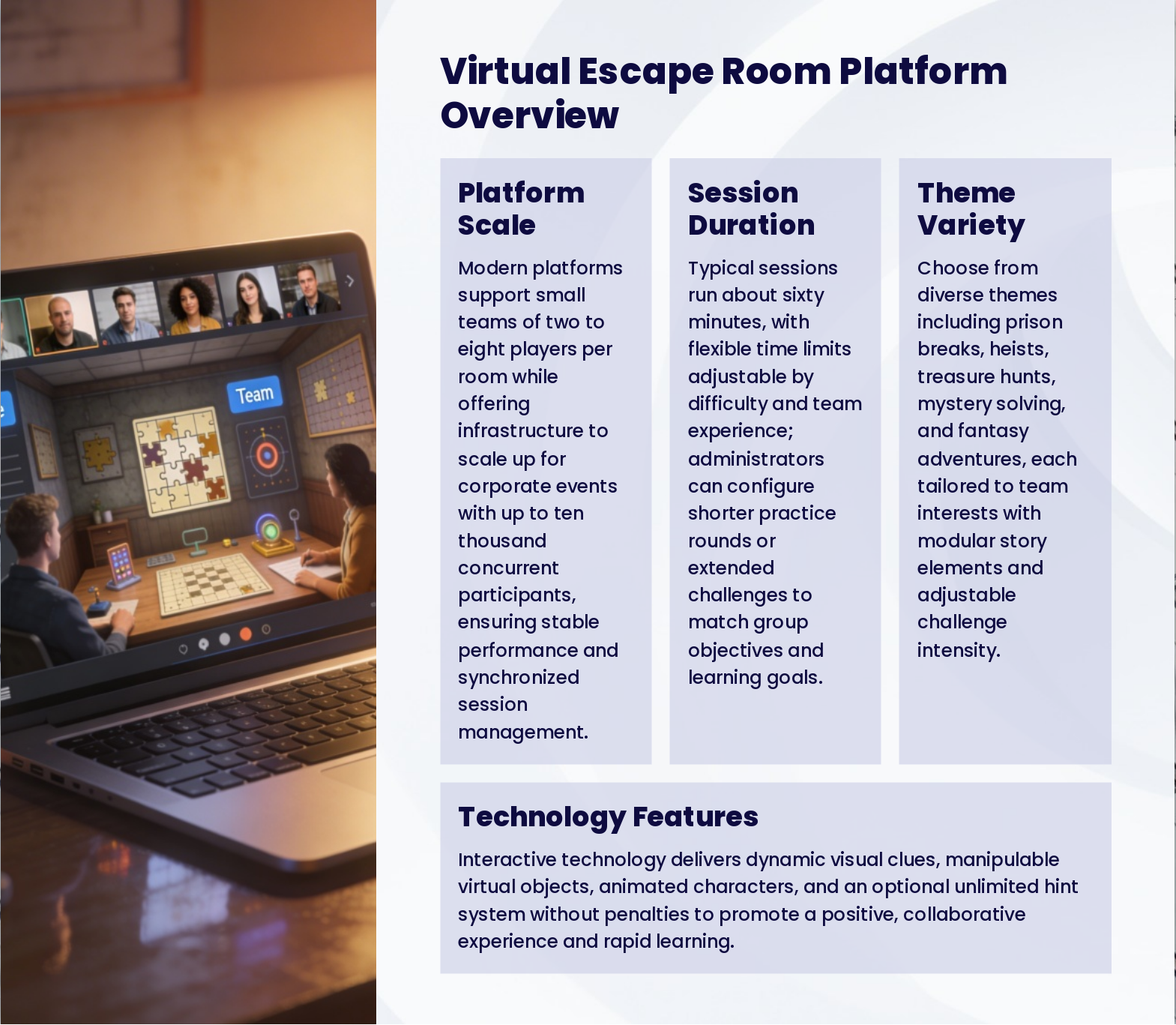
Slide 6: Virtual Escape Room Platform Overview
- Platform Scale: Modern platforms support small teams of two to eight players per room while offering infrastructure to scale up for corporate events with up to ten thousand concurrent participants, ensuring stable performance and synchronized session management.
- Session Duration: Typical sessions run about sixty minutes, with flexible time limits adjustable by difficulty and team experience; administrators can configure shorter practice rounds or extended challenges to match group objectives and learning goals.
- Theme Variety: Choose from diverse themes including prison breaks, heists, treasure hunts, mystery solving, and fantasy adventures, each tailored to team interests with modular story elements and adjustable challenge intensity.
- Technology Features: Interactive technology delivers dynamic visual clues, manipulable virtual objects, animated characters, and an optional unlimited hint system without penalties to promote a positive, collaborative experience and rapid learning.
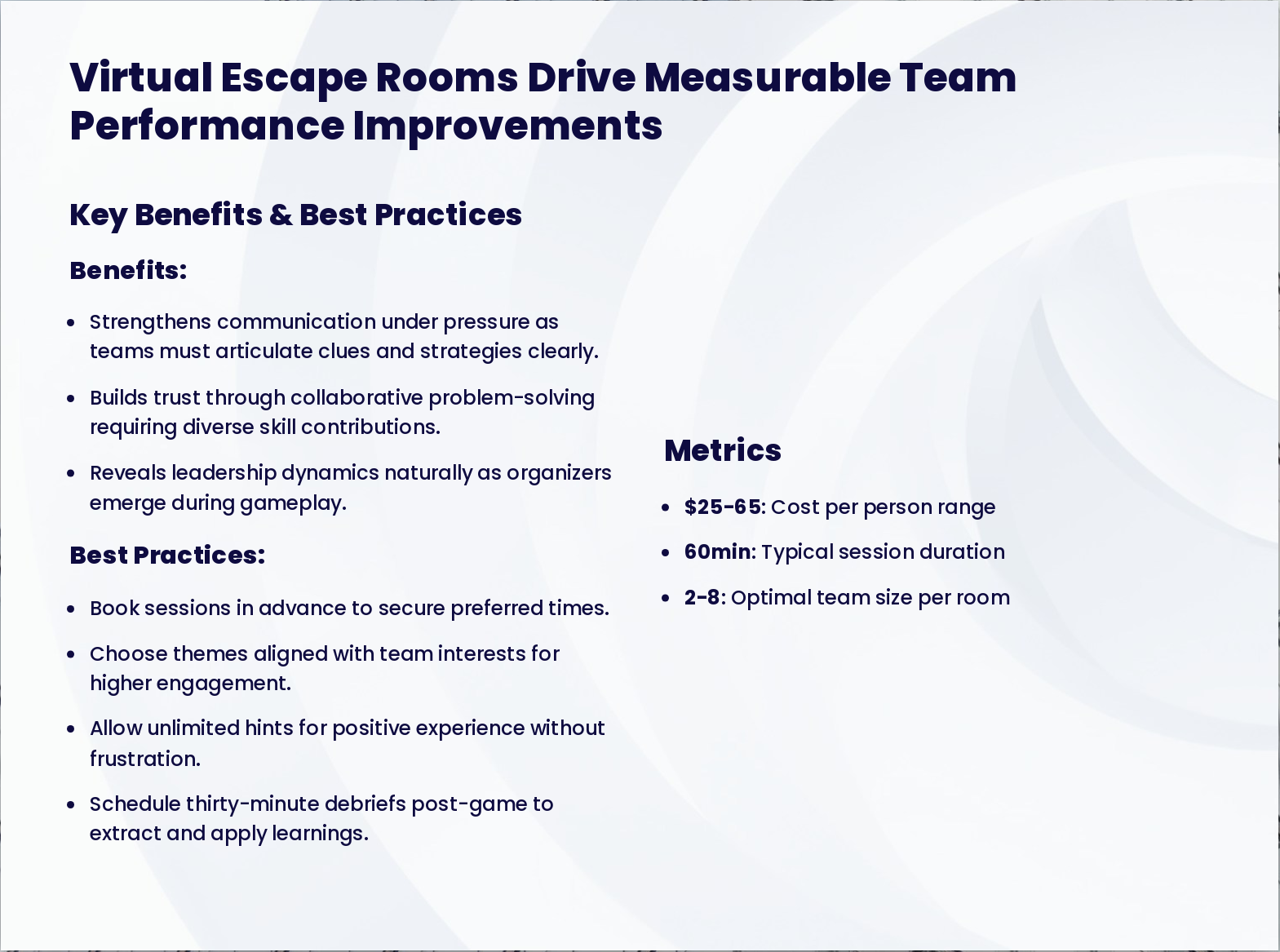
Slide 7: Virtual Escape Rooms Drive Measurable Team Performance Improvements
Strengthens communication under pressure as teams must articulate clues and strategies clearly.
Builds trust through collaborative problem-solving requiring diverse skill contributions.
Reveals leadership dynamics naturally as organizers emerge during gameplay.
Book sessions in advance to secure preferred times.
Choose themes aligned with team interests for higher engagement.
Allow unlimited hints for positive experience without frustration.
Schedule thirty-minute debriefs post-game to extract and apply learnings.
$25-65 : Cost per person range
60min : Typical session duration
2-8 : Optimal team size per room
- Strengthens communication under pressure as teams must articulate clues and strategies clearly.
- Builds trust through collaborative problem-solving requiring diverse skill contributions.
- Reveals leadership dynamics naturally as organizers emerge during gameplay.
- Book sessions in advance to secure preferred times.
- Choose themes aligned with team interests for higher engagement.
- Allow unlimited hints for positive experience without frustration.
- Schedule thirty-minute debriefs post-game to extract and apply learnings.
- $25-65 : Cost per person range
- 60min : Typical session duration
- 2-8 : Optimal team size per room
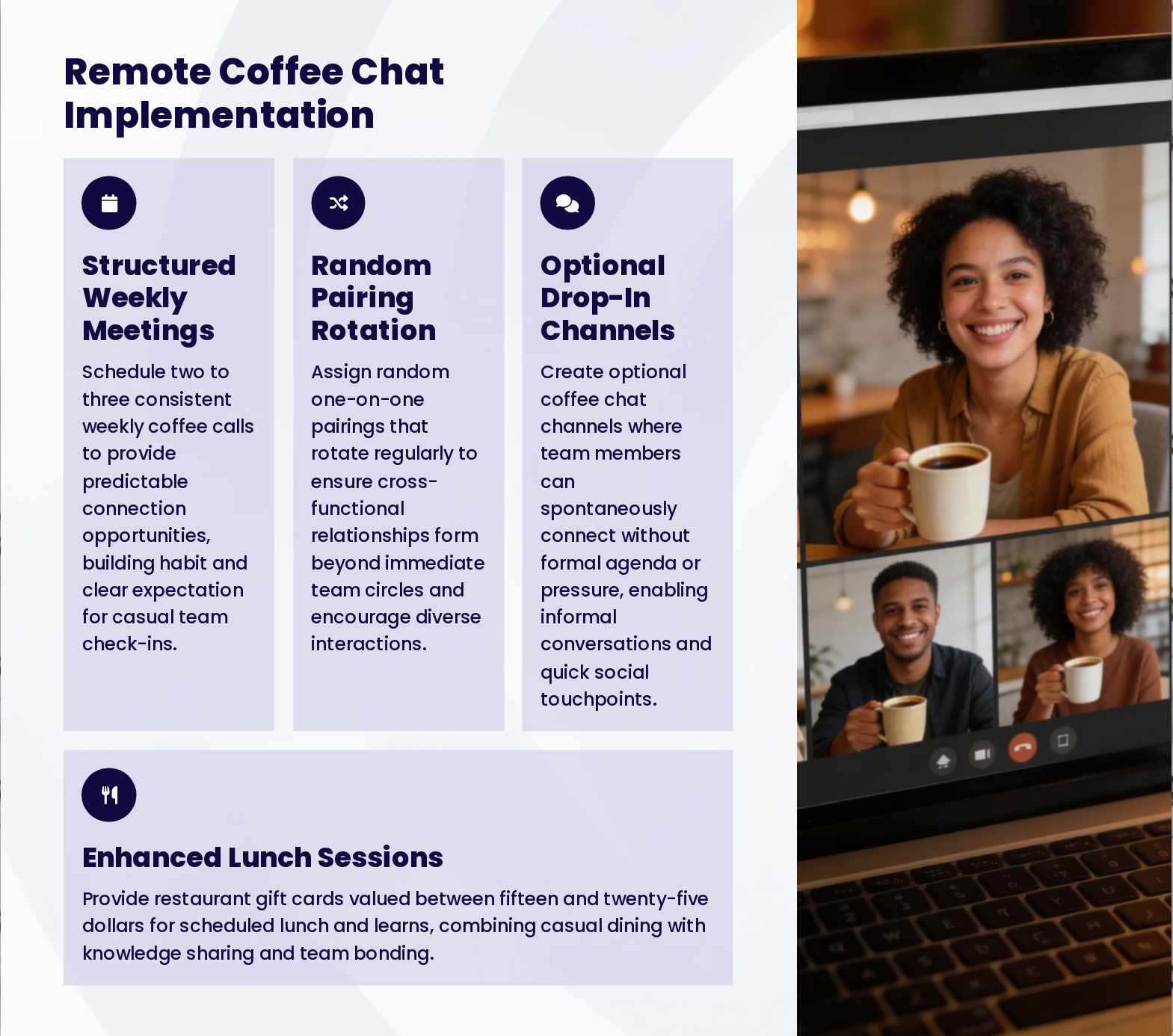
Slide 8: Remote Coffee Chat Implementation
- Structured Weekly Meetings: Schedule two to three consistent weekly coffee calls to provide predictable connection opportunities, building habit and clear expectation for casual team check-ins.
- Random Pairing Rotation: Assign random one-on-one pairings that rotate regularly to ensure cross-functional relationships form beyond immediate team circles and encourage diverse interactions.
- Optional Drop-In Channels: Create optional coffee chat channels where team members can spontaneously connect without formal agenda or pressure, enabling informal conversations and quick social touchpoints.
- Enhanced Lunch Sessions: Provide restaurant gift cards valued between fifteen and twenty-five dollars for scheduled lunch and learns, combining casual dining with knowledge sharing and team bonding.
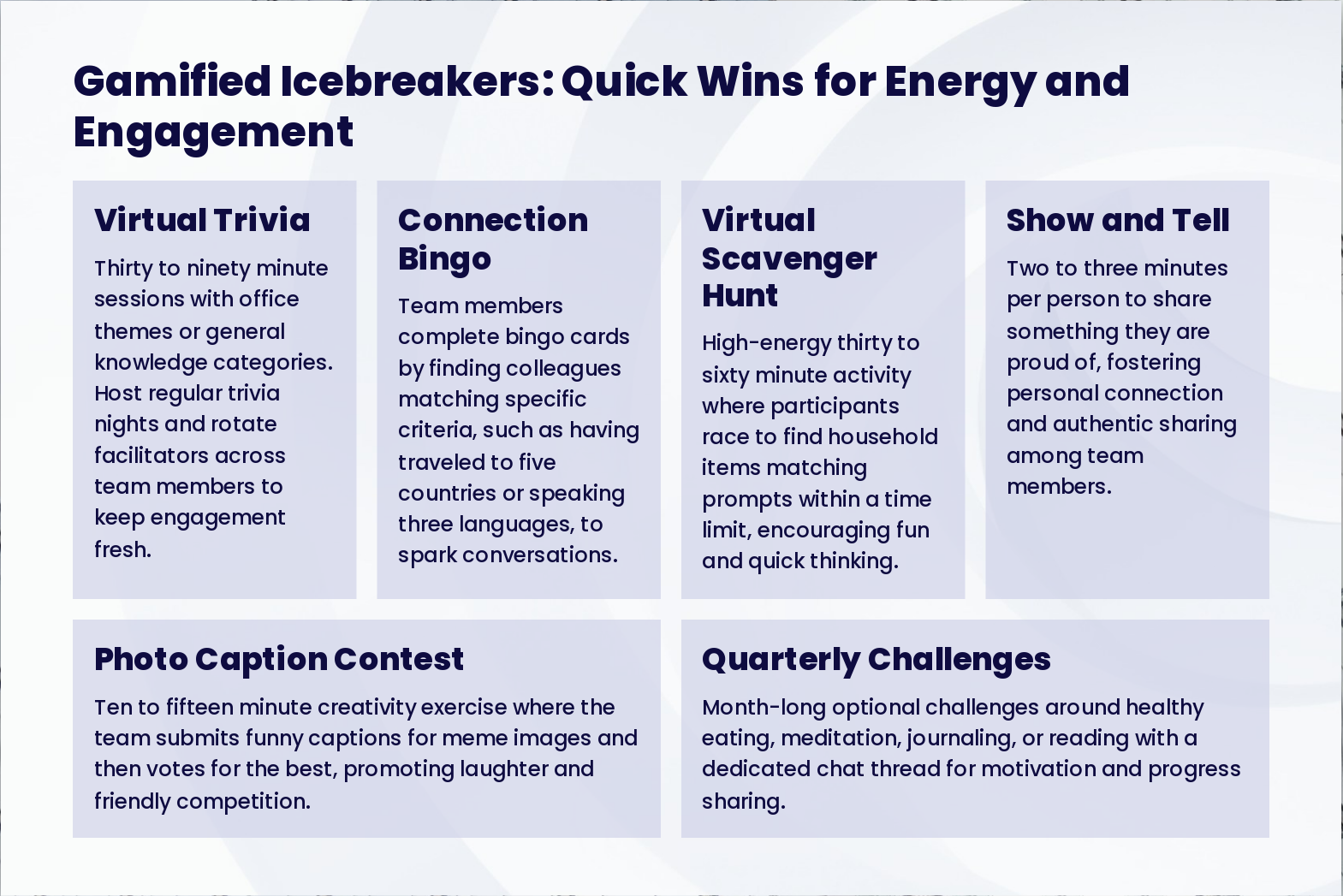
Slide 9: Gamified Icebreakers: Quick Wins for Energy and Engagement
- Virtual Trivia: Thirty to ninety minute sessions with office themes or general knowledge categories. Host regular trivia nights and rotate facilitators across team members to keep engagement fresh.
- Connection Bingo: Team members complete bingo cards by finding colleagues matching specific criteria, such as having traveled to five countries or speaking three languages, to spark conversations.
- Virtual Scavenger Hunt: High-energy thirty to sixty minute activity where participants race to find household items matching prompts within a time limit, encouraging fun and quick thinking.
- Show and Tell: Two to three minutes per person to share something they are proud of, fostering personal connection and authentic sharing among team members.
- Photo Caption Contest: Ten to fifteen minute creativity exercise where the team submits funny captions for meme images and then votes for the best, promoting laughter and friendly competition.
- Quarterly Challenges: Month-long optional challenges around healthy eating, meditation, journaling, or reading with a dedicated chat thread for motivation and progress sharing.
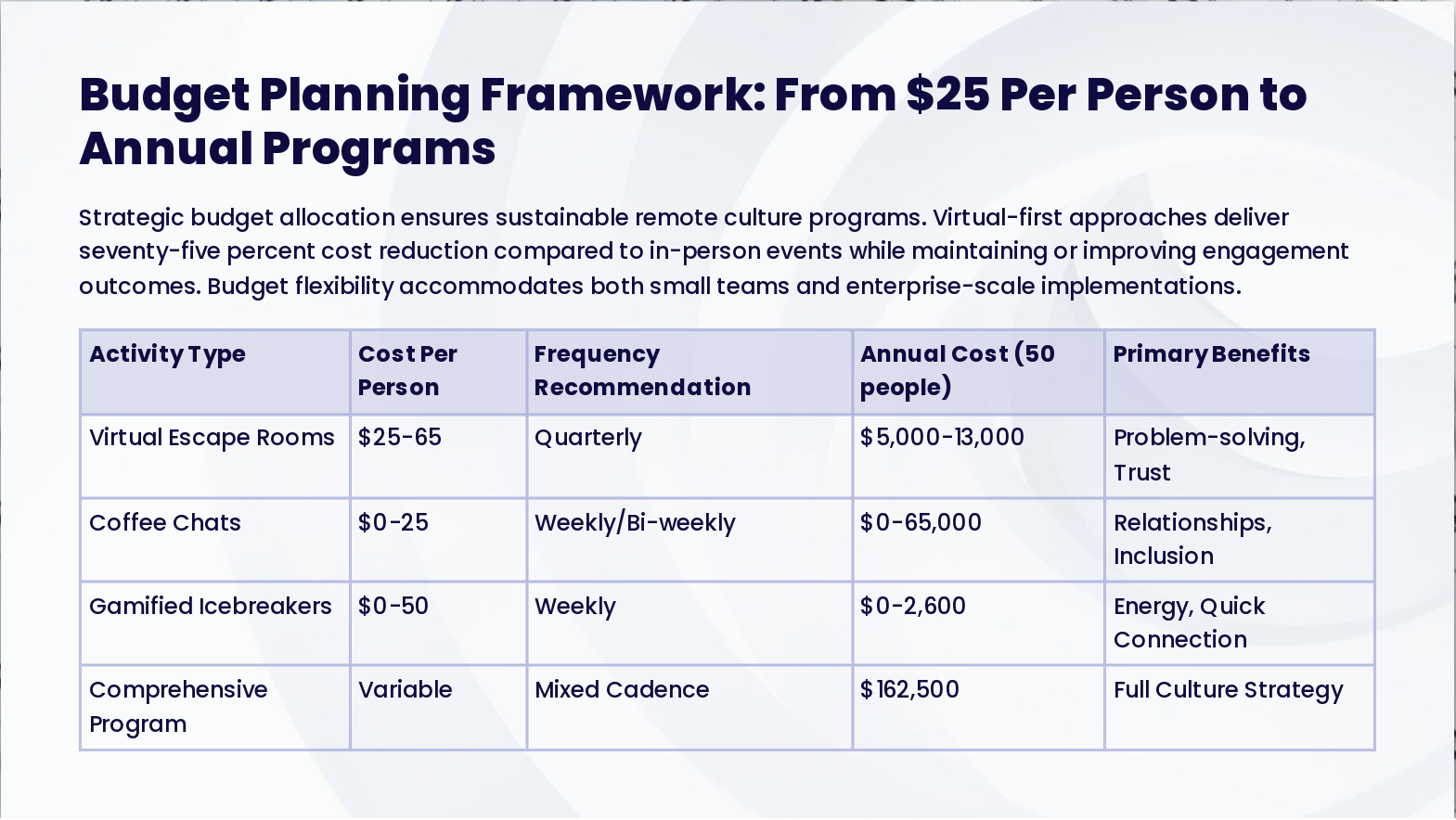
Slide 10: Budget Planning Framework: From $25 Per Person to Annual Programs
Strategic budget allocation ensures sustainable remote culture programs. Virtual-first approaches deliver seventy-five percent cost reduction compared to in-person events while maintaining or improving engagement outcomes. Budget flexibility accommodates both small teams and enterprise-scale implementations.
- Activity Type: Virtual Escape Rooms, Cost Per Person: $25-65, Frequency Recommendation: Quarterly, Annual Cost (50 people): $5,000-13,000, Primary Benefits: Problem-solving, Trust
- Activity Type: Coffee Chats, Cost Per Person: $0-25, Frequency Recommendation: Weekly/Bi-weekly, Annual Cost (50 people): $0-65,000, Primary Benefits: Relationships, Inclusion
- Activity Type: Gamified Icebreakers, Cost Per Person: $0-50, Frequency Recommendation: Weekly, Annual Cost (50 people): $0-2,600, Primary Benefits: Energy, Quick Connection
- Activity Type: Comprehensive Program, Cost Per Person: Variable, Frequency Recommendation: Mixed Cadence, Annual Cost (50 people): $162,500, Primary Benefits: Full Culture Strategy
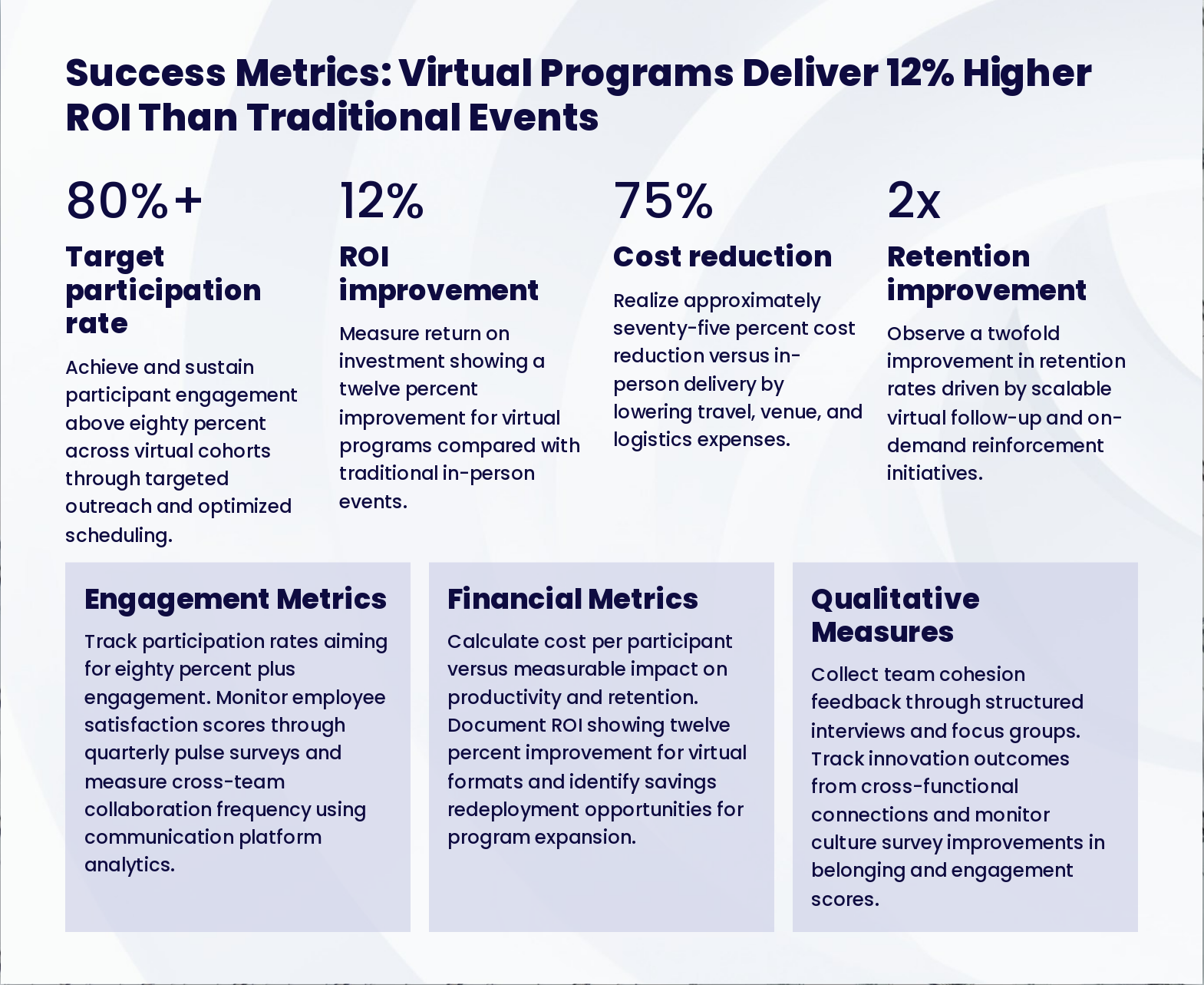
Slide 11: Success Metrics: Virtual Programs Deliver 12% Higher ROI Than Traditional Events
- 80%+ — Target participation rate
- 12% — ROI improvement
- 75% — Cost reduction
- 2x — Retention improvement
- Engagement Metrics: Track participation rates aiming for eighty percent plus engagement. Monitor employee satisfaction scores through quarterly pulse surveys and measure cross-team collaboration frequency using communication platform analytics.
- Financial Metrics: Calculate cost per participant versus measurable impact on productivity and retention. Document ROI showing twelve percent improvement for virtual formats and identify savings redeployment opportunities for program expansion.
- Qualitative Measures: Collect team cohesion feedback through structured interviews and focus groups. Track innovation outcomes from cross-functional connections and monitor culture survey improvements in belonging and engagement scores.
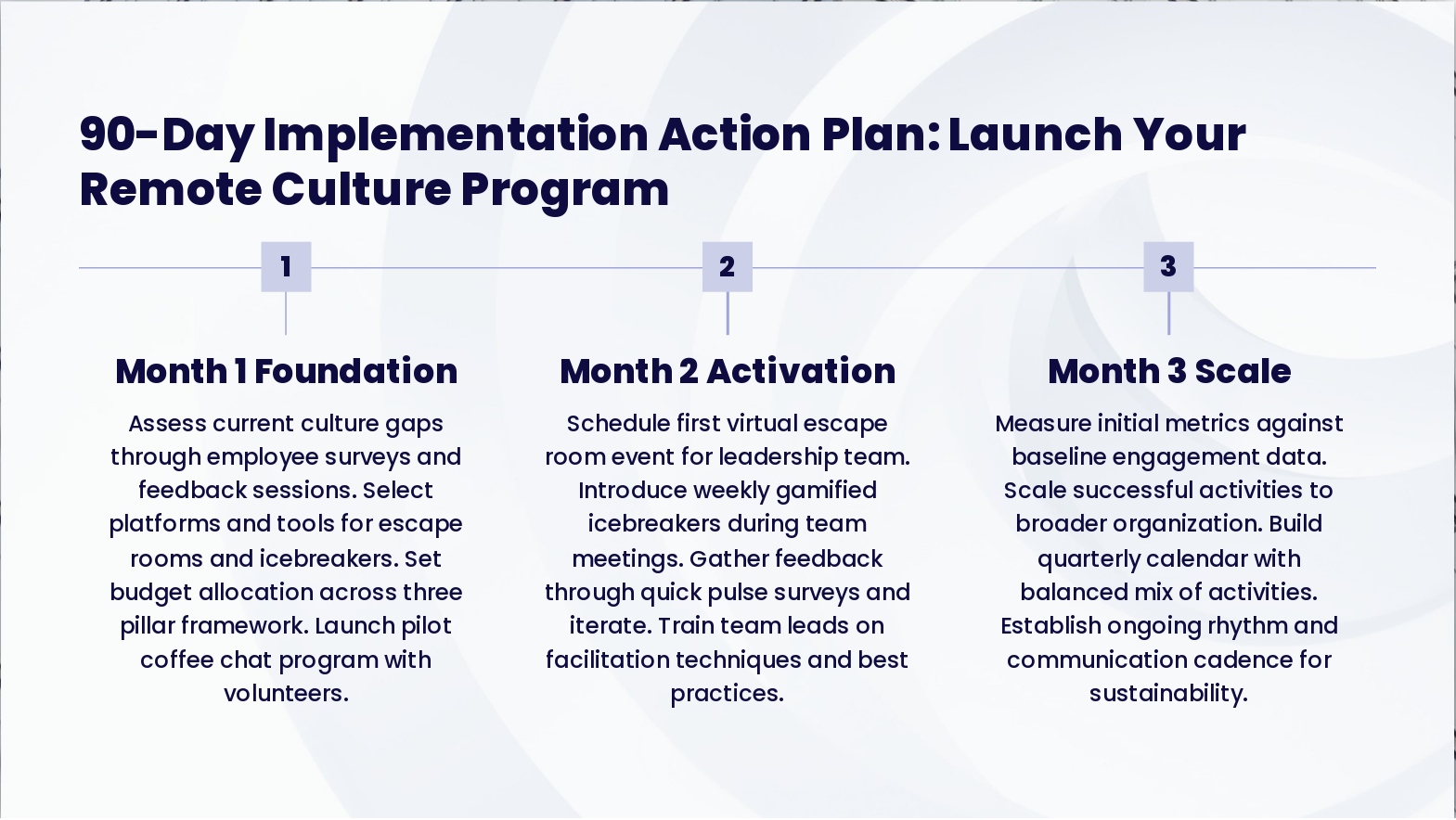
Slide 12: 90-Day Implementation Action Plan: Launch Your Remote Culture Program
- Month 1 Foundation: Assess current culture gaps through employee surveys and feedback sessions. Select platforms and tools for escape rooms and icebreakers. Set budget allocation across three pillar framework. Launch pilot coffee chat program with volunteers.
- Month 2 Activation: Schedule first virtual escape room event for leadership team. Introduce weekly gamified icebreakers during team meetings. Gather feedback through quick pulse surveys and iterate. Train team leads on facilitation techniques and best practices.
- Month 3 Scale: Measure initial metrics against baseline engagement data. Scale successful activities to broader organization. Build quarterly calendar with balanced mix of activities. Establish ongoing rhythm and communication cadence for sustainability.