
Presentation Summary
A Strategic Framework for Analyzing Competitive Dynamics and Industry Attractiveness in Business Strategy Introduction to Porter's Five Forces model and its strategic significance for industry analysis. Analysis of competition intensity among existing firms and its impact on profitability dynamics. Examination of entry barriers and how they protect incumbent market positions and margins. Understanding how supplier concentration and bargaining power influence costs and strategic flexibility constraints. Exploring customer bargaining leverage and its effects on pricing power and value capture.
Full Presentation Transcript
Slide 1: Porter's Five Forces Industry Analysis
A Strategic Framework for Analyzing Competitive Dynamics and Industry Attractiveness in Business Strategy
Slide 2: Contents
- Framework Foundation: Introduction to Porter's Five Forces model and its strategic significance for industry analysis.
- Competitive Rivalry: Analysis of competition intensity among existing firms and its impact on profitability dynamics.
- Threat of New Entrants: Examination of entry barriers and how they protect incumbent market positions and margins.
- Supplier Power: Understanding how supplier concentration and bargaining power influence costs and strategic flexibility constraints.
- Buyer Power: Exploring customer bargaining leverage and its effects on pricing power and value capture.
- Threat of Substitutes & Application: Analysis of alternative solutions and practical framework integration for strategic decision making success.
Slide 3: Foundation: Industry Structure Determines Profitability
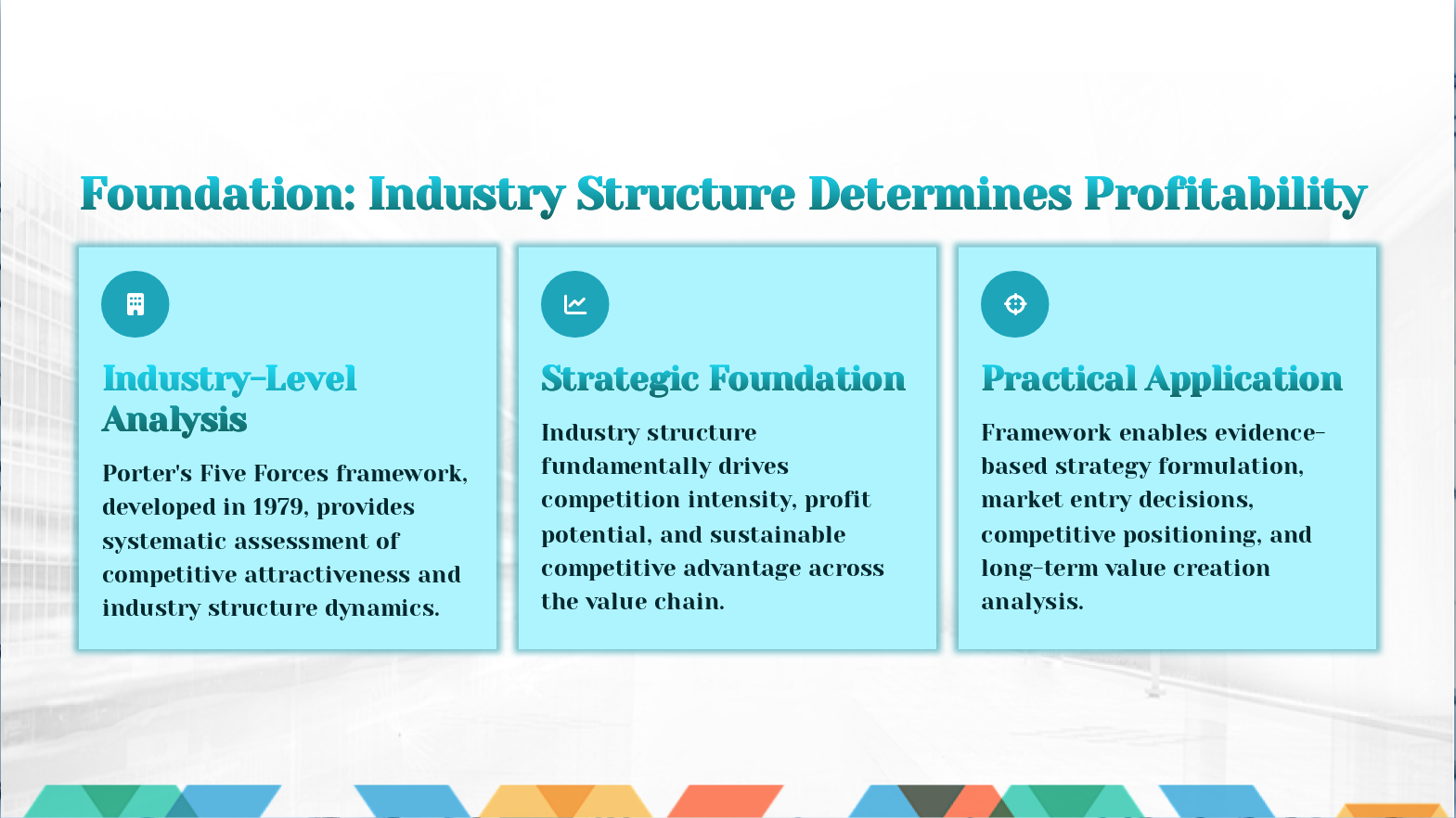
- Industry-Level Analysis: Porter's Five Forces framework, developed in 1979, provides systematic assessment of competitive attractiveness and industry structure dynamics.
- Strategic Foundation: Industry structure fundamentally drives competition intensity, profit potential, and sustainable competitive advantage across the value chain.
- Practical Application: Framework enables evidence-based strategy formulation, market entry decisions, competitive positioning, and long-term value creation analysis.
Slide 4: Force 1: Competitive Rivalry Among Existing Firms
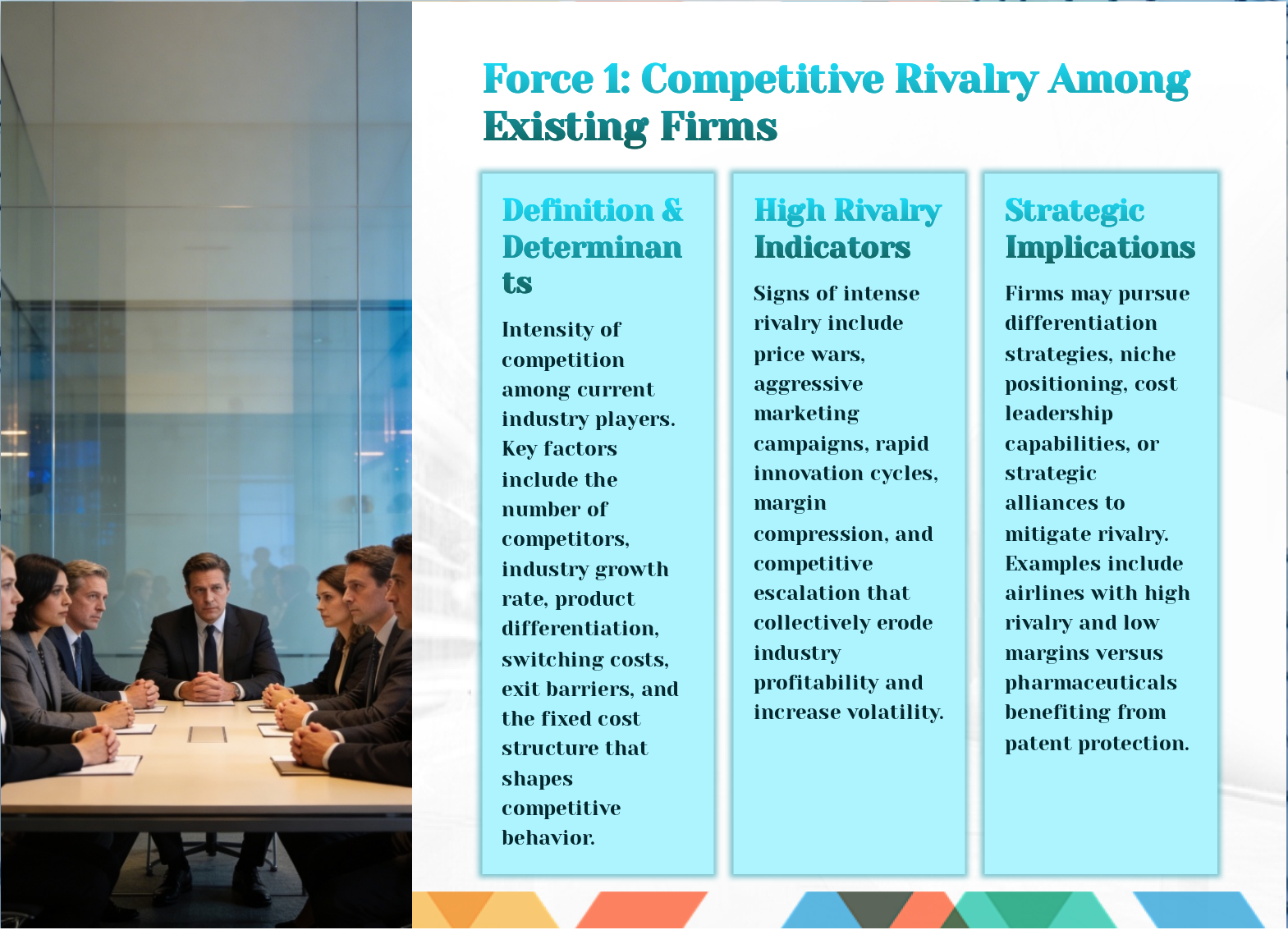
- Definition & Determinants: Intensity of competition among current industry players. Key factors include the number of competitors, industry growth rate, product differentiation, switching costs, exit barriers, and the fixed cost structure that shapes competitive behavior.
- High Rivalry Indicators: Signs of intense rivalry include price wars, aggressive marketing campaigns, rapid innovation cycles, margin compression, and competitive escalation that collectively erode industry profitability and increase volatility.
- Strategic Implications: Firms may pursue differentiation strategies, niche positioning, cost leadership capabilities, or strategic alliances to mitigate rivalry. Examples include airlines with high rivalry and low margins versus pharmaceuticals benefiting from patent protection.
Slide 5: Force 2: Threat of New Entrants and Entry Barriers
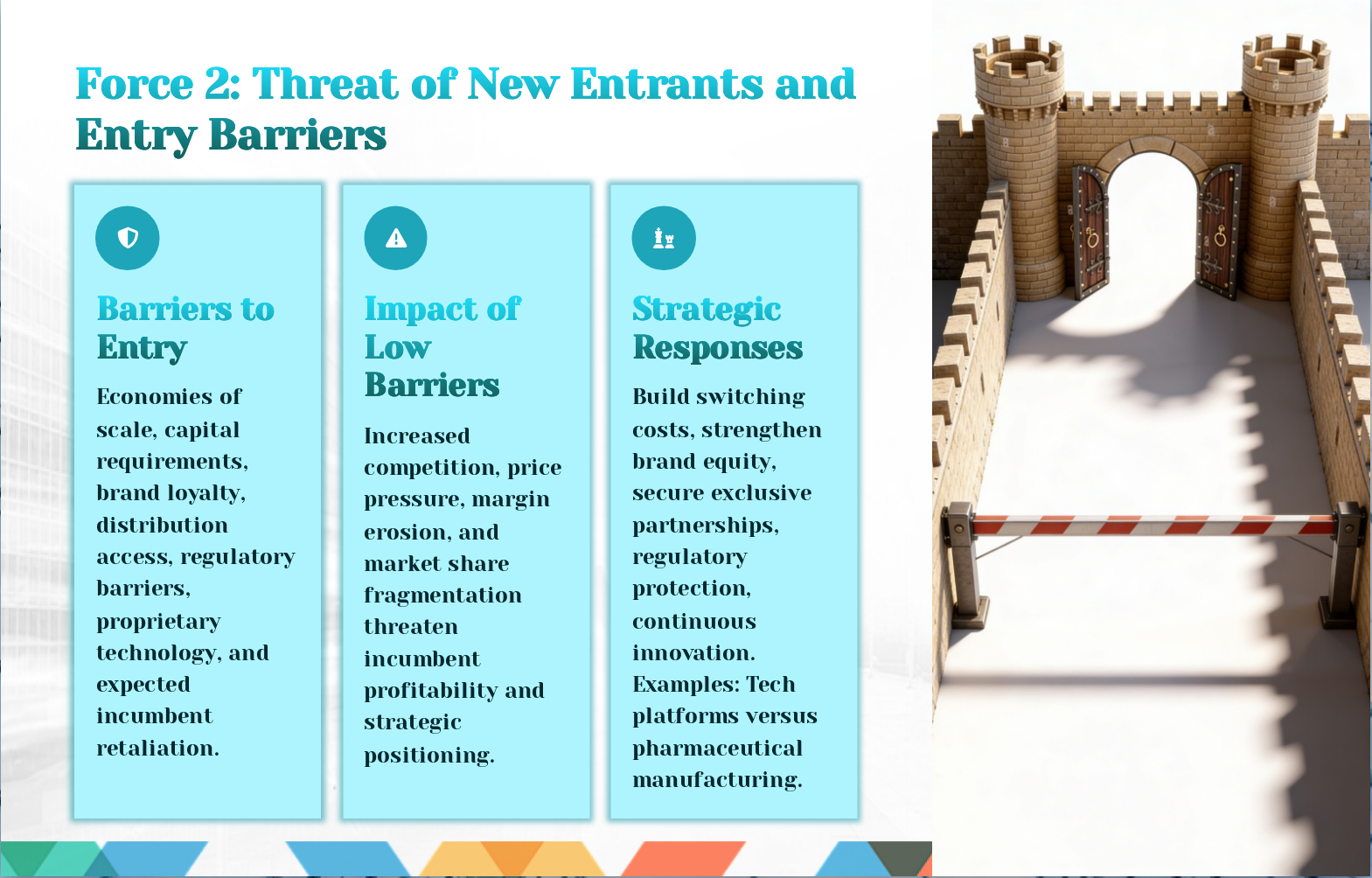
- Barriers to Entry: Economies of scale, capital requirements, brand loyalty, distribution access, regulatory barriers, proprietary technology, and expected incumbent retaliation.
- Impact of Low Barriers: Increased competition, price pressure, margin erosion, and market share fragmentation threaten incumbent profitability and strategic positioning.
- Strategic Responses: Build switching costs, strengthen brand equity, secure exclusive partnerships, regulatory protection, continuous innovation. Examples: Tech platforms versus pharmaceutical manufacturing.
Slide 6: Force 3: Bargaining Power of Suppliers
- High Supplier Power Factors: Supplier concentration versus buyer fragmentation, uniqueness of inputs, high switching costs, threat of forward integration, volume importance, and limited substitute inputs availability.
- Strategic Impact: Input cost pressure, reduced margin flexibility, supply chain vulnerability, constrained product innovation, and value extraction by concentrated suppliers along the chain.
- Mitigation Strategies: Vertical or backward integration, multi-sourcing, supplier diversification, long-term partnerships, substitute input development, volume leverage. Examples: Smartphone chip suppliers, auto industry steel suppliers.
Slide 7: Force 4: Bargaining Power of Buyers
- High Buyer Power Determinants: Buyer concentration, large purchase volumes, product standardization, low switching costs, buyer price sensitivity, threat of backward integration, and information transparency.
- Strategic Consequences: Price pressure, margin compression, demand for customization, value-added service requirements, high relationship management costs, and customer retention challenges.
- Counter-Strategies: Differentiation and value creation, increase switching costs through integration, target less price-sensitive segments, build brand loyalty, offer bundled solutions. Examples: Walmart's supplier power, enterprise SaaS negotiations.
Slide 8: Force 5: Threat of Substitute Products or Services
- Substitute Threat Factors: Relative price-performance, customer switching propensity, emerging technologies, business model innovation, changing preferences, and indirect competition from alternative solutions.
- High Substitution Impact: Price ceiling constraints, value proposition erosion, market share migration, accelerated product lifecycle obsolescence, and competitive positioning vulnerability.
- Strategic Responses: Continuous innovation, superior customer experience, ecosystem lock-in, price monitoring, value redefinition. Examples: Streaming vs cable TV, video conferencing vs business travel, EVs vs combustion engines.
Slide 9: Framework Integration: Holistic Industry Analysis
- Combined Force Assessment: Evaluate all five forces simultaneously for comprehensive industry attractiveness. Analyze force interaction effects and how they reinforce or counterbalance each other in specific contexts.
- Strategic Group Mapping: Map industries from unattractive (all forces strong) to attractive (all forces weak). Identify positioning opportunities within strategic groups and competitive white spaces.
- Dynamic Evolution Analysis: Track how forces evolve across industry lifecycle stages: emerging, growth, maturity, and decline. Integrate with PESTEL analysis, Value Chain, and Resource-Based View for comprehensive strategic planning.
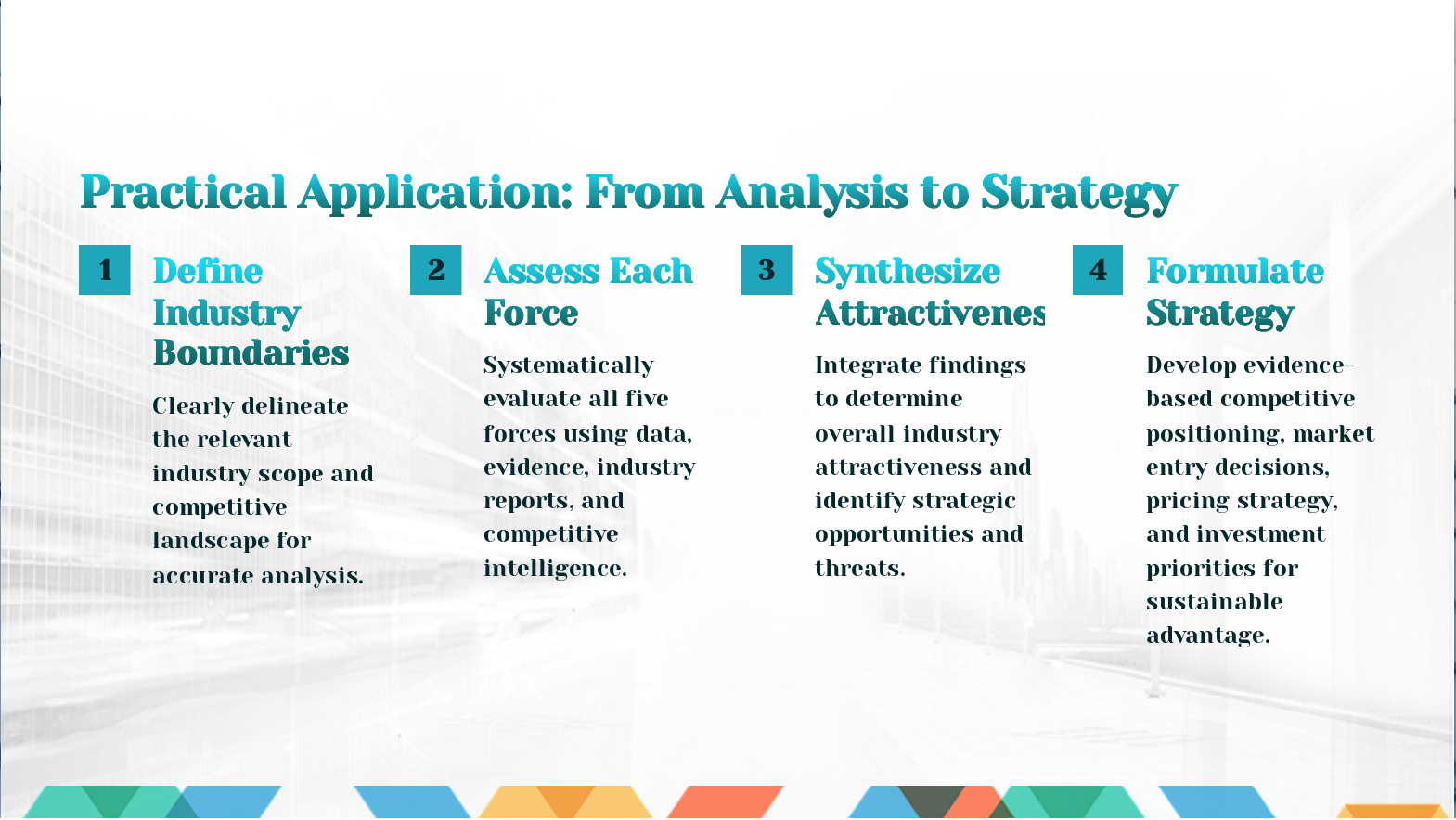
Slide 10: Practical Application: From Analysis to Strategy
- Define Industry Boundaries: Clearly delineate the relevant industry scope and competitive landscape for accurate analysis.
- Assess Each Force: Systematically evaluate all five forces using data, evidence, industry reports, and competitive intelligence.
- Synthesize Attractiveness: Integrate findings to determine overall industry attractiveness and identify strategic opportunities and threats.
- Formulate Strategy: Develop evidence-based competitive positioning, market entry decisions, pricing strategy, and investment priorities for sustainable advantage.
Slide 11: Thank You
Thank You Porter's Five Forces: Essential Framework for Strategic Industry Analysis and Competitive Success