
Presentation Summary
Dive into the NBA Mock Draft ecosystem, exploring its evolution from casual predictions to data-driven forecasts. Understand scouting methods, aggregation techniques, and how mock drafts impact franchise building strategies.
Full Presentation Transcript
Slide 1: Comprehensive Guide to NBA Mock Draft: From Analysis to Franchise Building Strategy
Exploring Mock Draft Ecosystems, Simulators, Evaluation Methodologies, and Strategic Implications
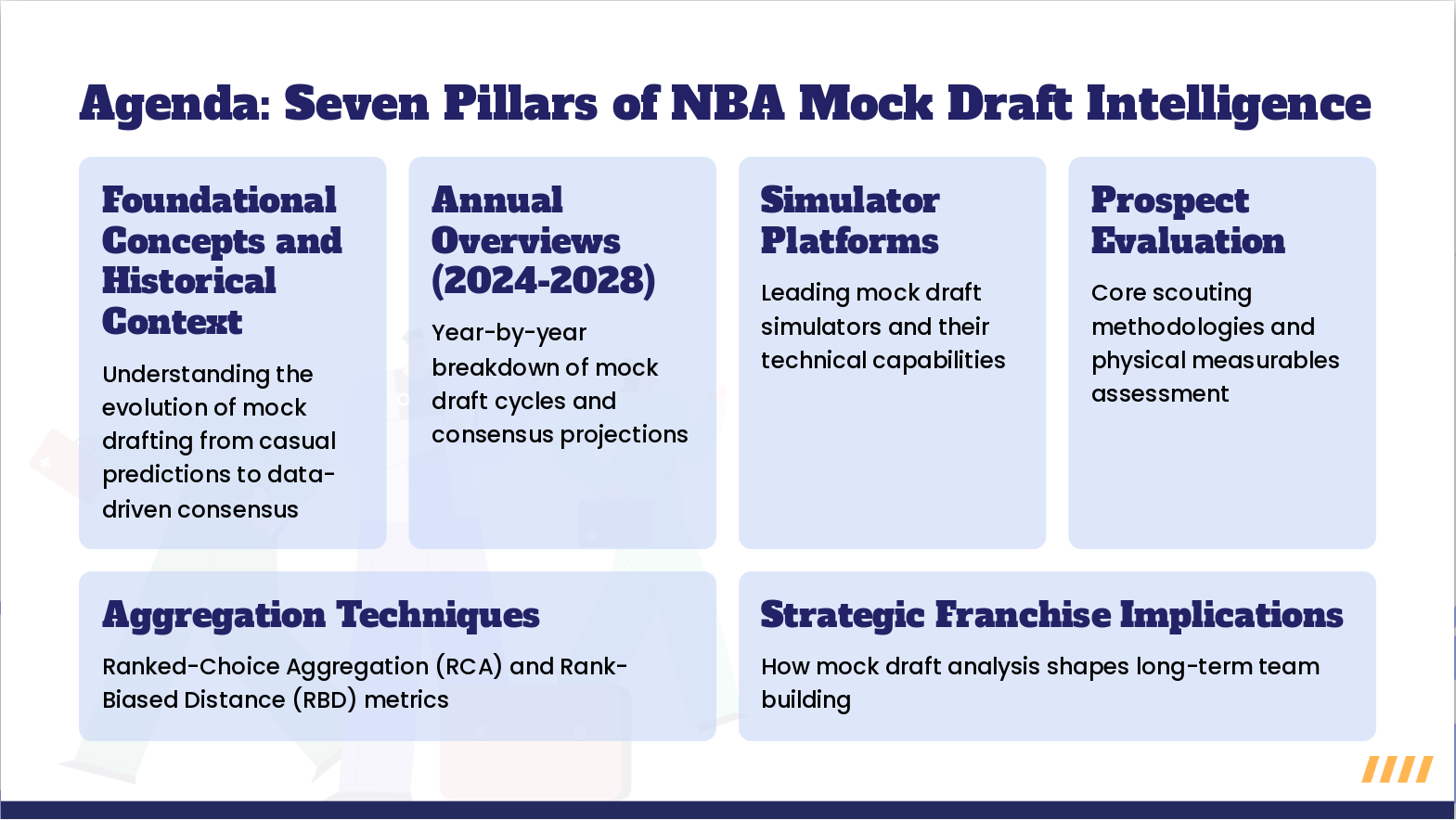
Slide 2: Agenda: Seven Pillars of NBA Mock Draft Intelligence
- Foundational Concepts and Historical Context: Understanding the evolution of mock drafting from casual predictions to data-driven consensus
- Annual Overviews (2024-2028): Year-by-year breakdown of mock draft cycles and consensus projections
- Simulator Platforms: Leading mock draft simulators and their technical capabilities
- Prospect Evaluation: Core scouting methodologies and physical measurables assessment
- Aggregation Techniques: Ranked-Choice Aggregation (RCA) and Rank-Biased Distance (RBD) metrics
- Strategic Franchise Implications: How mock draft analysis shapes long-term team building
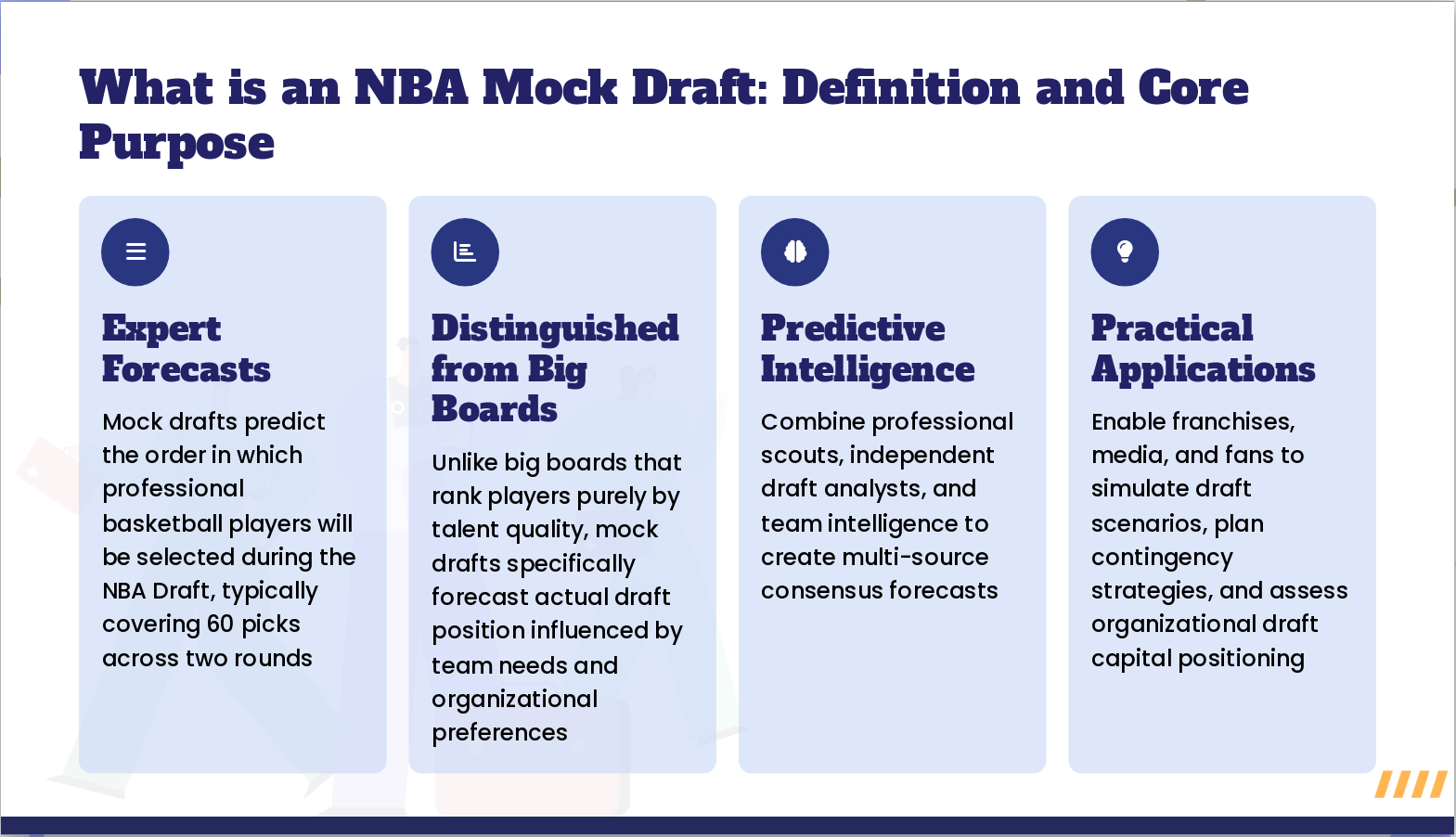
Slide 3: What is an NBA Mock Draft: Definition and Core Purpose
- Expert Forecasts: Mock drafts predict the order in which professional basketball players will be selected during the NBA Draft, typically covering 60 picks across two rounds
- Distinguished from Big Boards: Unlike big boards that rank players purely by talent quality, mock drafts specifically forecast actual draft position influenced by team needs and organizational preferences
- Predictive Intelligence: Combine professional scouts, independent draft analysts, and team intelligence to create multi-source consensus forecasts
- Practical Applications: Enable franchises, media, and fans to simulate draft scenarios, plan contingency strategies, and assess organizational draft capital positioning
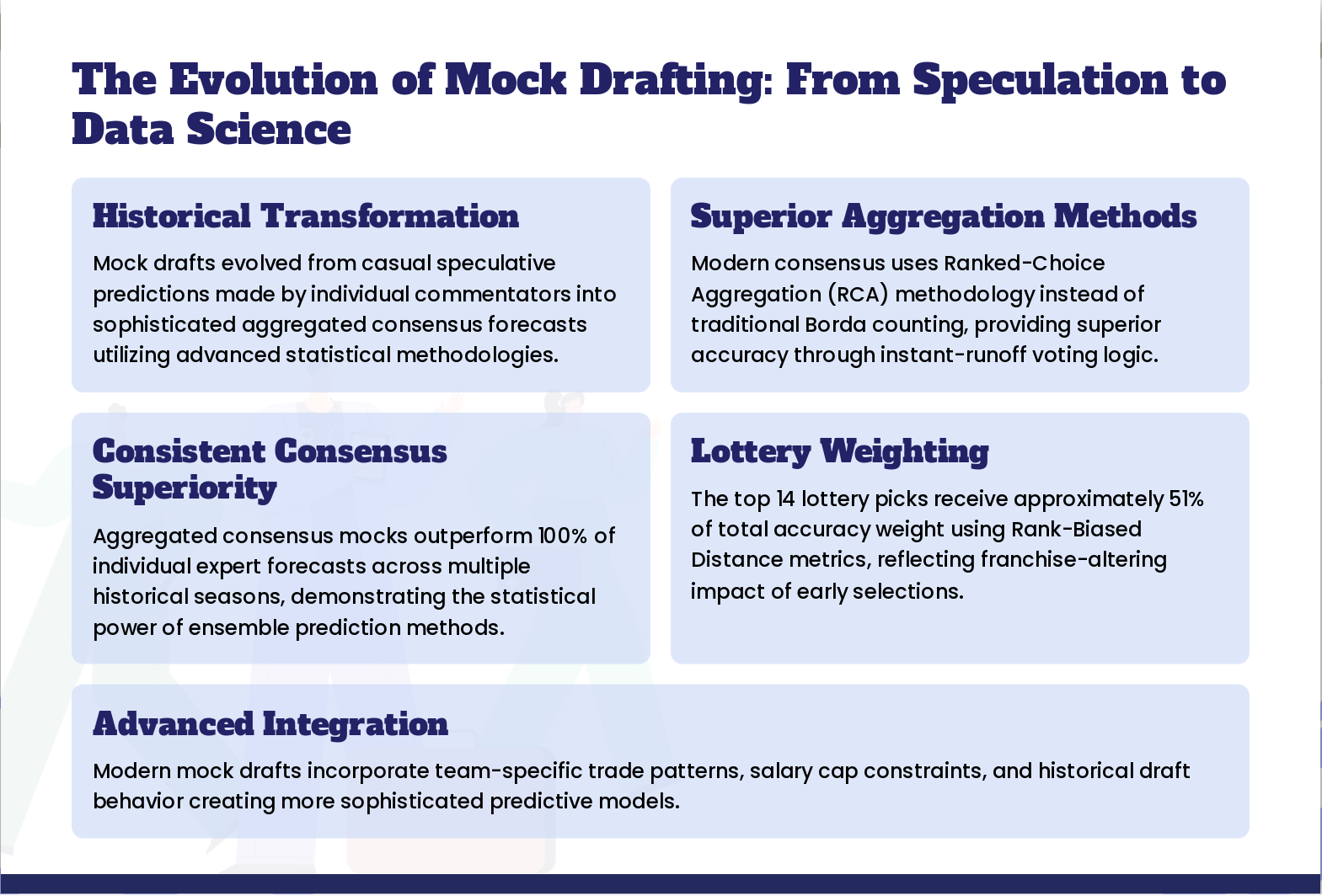
Slide 4: The Evolution of Mock Drafting: From Speculation to Data Science
- Historical Transformation: Mock drafts evolved from casual speculative predictions made by individual commentators into sophisticated aggregated consensus forecasts utilizing advanced statistical methodologies.
- Superior Aggregation Methods: Modern consensus uses Ranked-Choice Aggregation (RCA) methodology instead of traditional Borda counting, providing superior accuracy through instant-runoff voting logic.
- Consistent Consensus Superiority: Aggregated consensus mocks outperform 100% of individual expert forecasts across multiple historical seasons, demonstrating the statistical power of ensemble prediction methods.
- Lottery Weighting: The top 14 lottery picks receive approximately 51% of total accuracy weight using Rank-Biased Distance metrics, reflecting franchise-altering impact of early selections.
- Advanced Integration: Modern mock drafts incorporate team-specific trade patterns, salary cap constraints, and historical draft behavior creating more sophisticated predictive models.
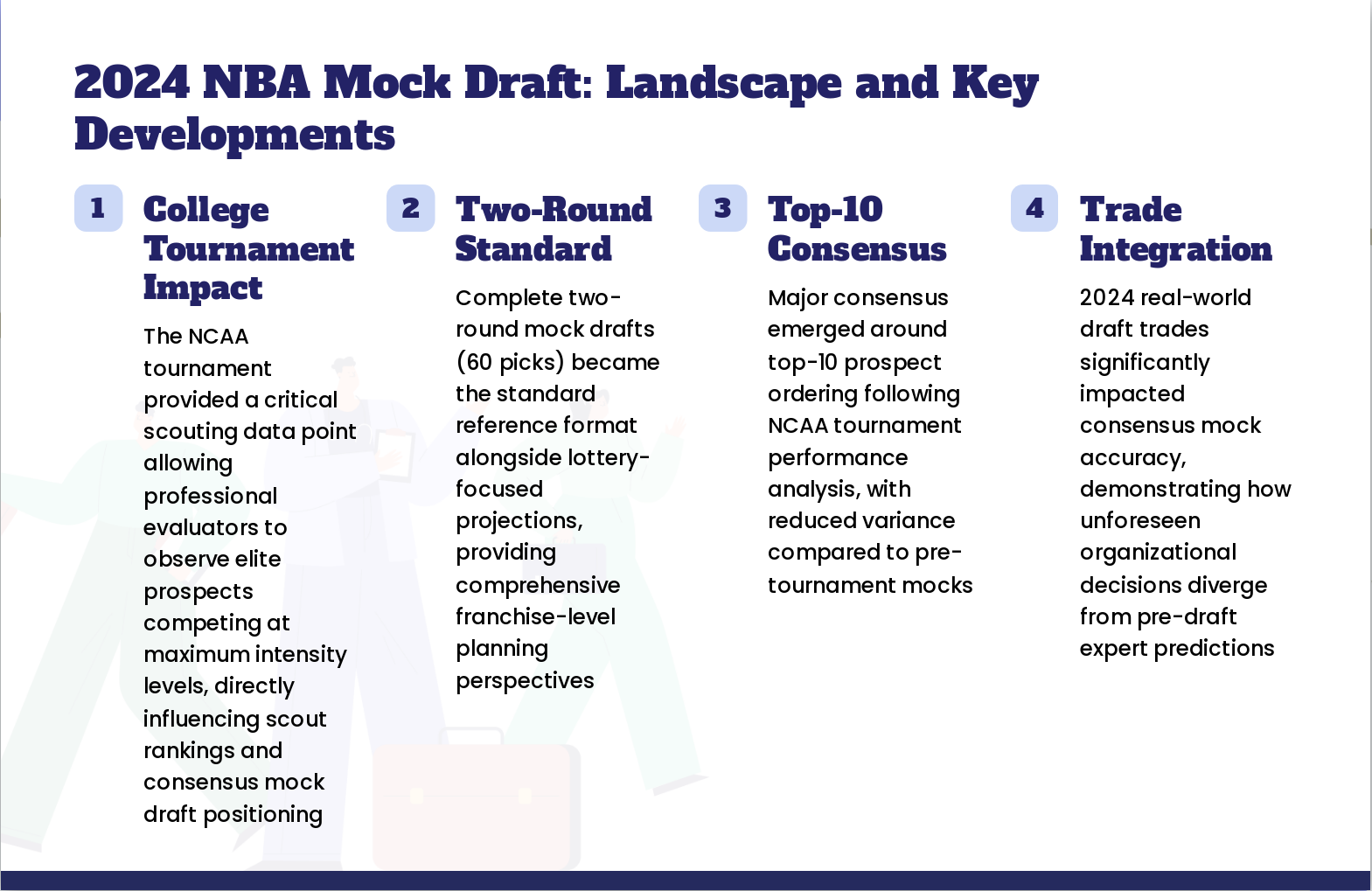
Slide 5: 2024 NBA Mock Draft: Landscape and Key Developments
- College Tournament Impact: The NCAA tournament provided a critical scouting data point allowing professional evaluators to observe elite prospects competing at maximum intensity levels, directly influencing scout rankings and consensus mock draft positioning
- Two-Round Standard: Complete two-round mock drafts (60 picks) became the standard reference format alongside lottery-focused projections, providing comprehensive franchise-level planning perspectives
- Top-10 Consensus: Major consensus emerged around top-10 prospect ordering following NCAA tournament performance analysis, with reduced variance compared to pre-tournament mocks
- Trade Integration: 2024 real-world draft trades significantly impacted consensus mock accuracy, demonstrating how unforeseen organizational decisions diverge from pre-draft expert predictions
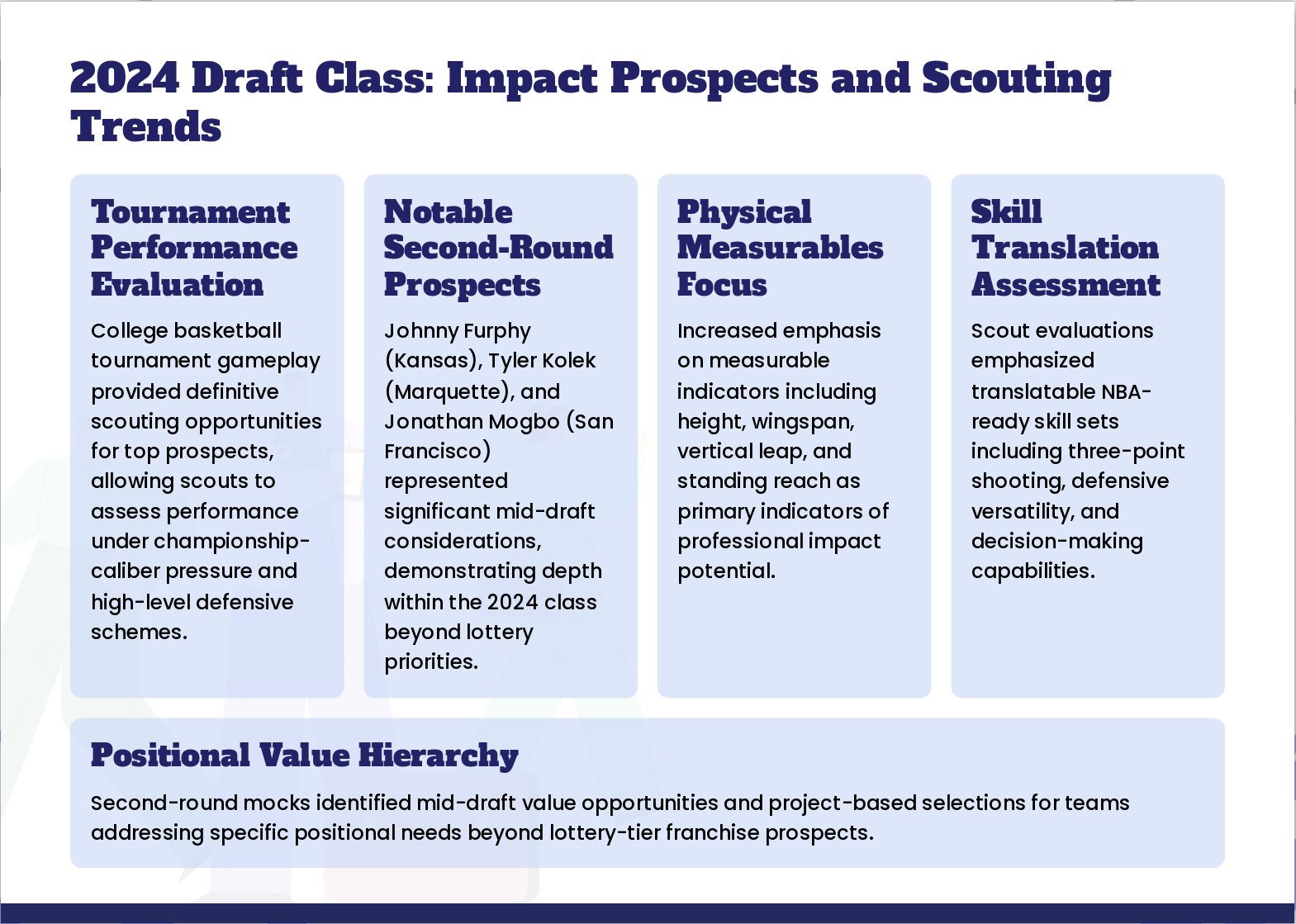
Slide 6: 2024 Draft Class: Impact Prospects and Scouting Trends
- Tournament Performance Evaluation: College basketball tournament gameplay provided definitive scouting opportunities for top prospects, allowing scouts to assess performance under championship-caliber pressure and high-level defensive schemes.
- Notable Second-Round Prospects: Johnny Furphy (Kansas), Tyler Kolek (Marquette), and Jonathan Mogbo (San Francisco) represented significant mid-draft considerations, demonstrating depth within the 2024 class beyond lottery priorities.
- Physical Measurables Focus: Increased emphasis on measurable indicators including height, wingspan, vertical leap, and standing reach as primary indicators of professional impact potential.
- Skill Translation Assessment: Scout evaluations emphasized translatable NBA-ready skill sets including three-point shooting, defensive versatility, and decision-making capabilities.
- Positional Value Hierarchy: Second-round mocks identified mid-draft value opportunities and project-based selections for teams addressing specific positional needs beyond lottery-tier franchise prospects.
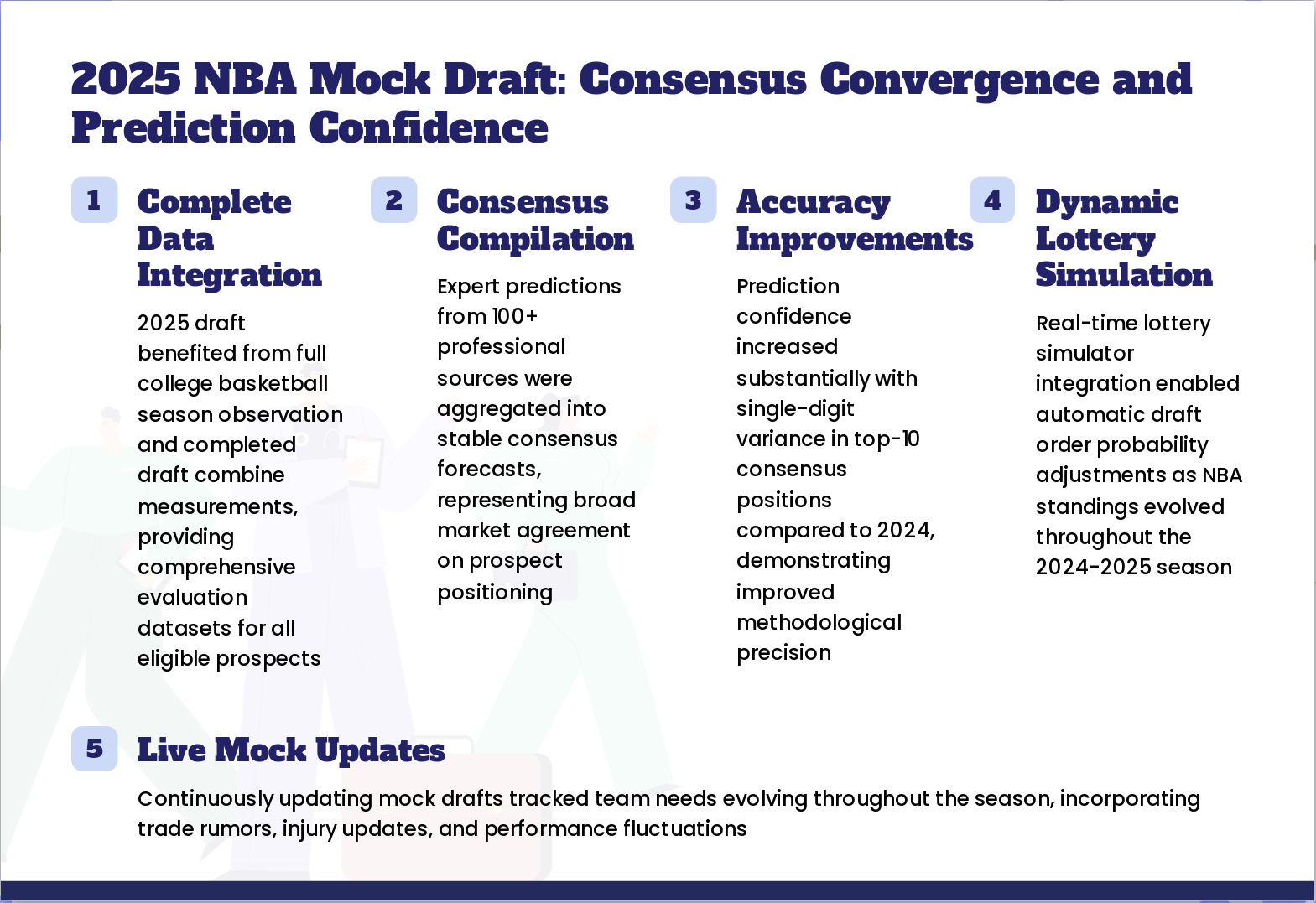
Slide 7: 2025 NBA Mock Draft: Consensus Convergence and Prediction Confidence
- Complete Data Integration: 2025 draft benefited from full college basketball season observation and completed draft combine measurements, providing comprehensive evaluation datasets for all eligible prospects
- Consensus Compilation: Expert predictions from 100+ professional sources were aggregated into stable consensus forecasts, representing broad market agreement on prospect positioning
- Accuracy Improvements: Prediction confidence increased substantially with single-digit variance in top-10 consensus positions compared to 2024, demonstrating improved methodological precision
- Dynamic Lottery Simulation: Real-time lottery simulator integration enabled automatic draft order probability adjustments as NBA standings evolved throughout the 2024-2025 season
- Live Mock Updates: Continuously updating mock drafts tracked team needs evolving throughout the season, incorporating trade rumors, injury updates, and performance fluctuations
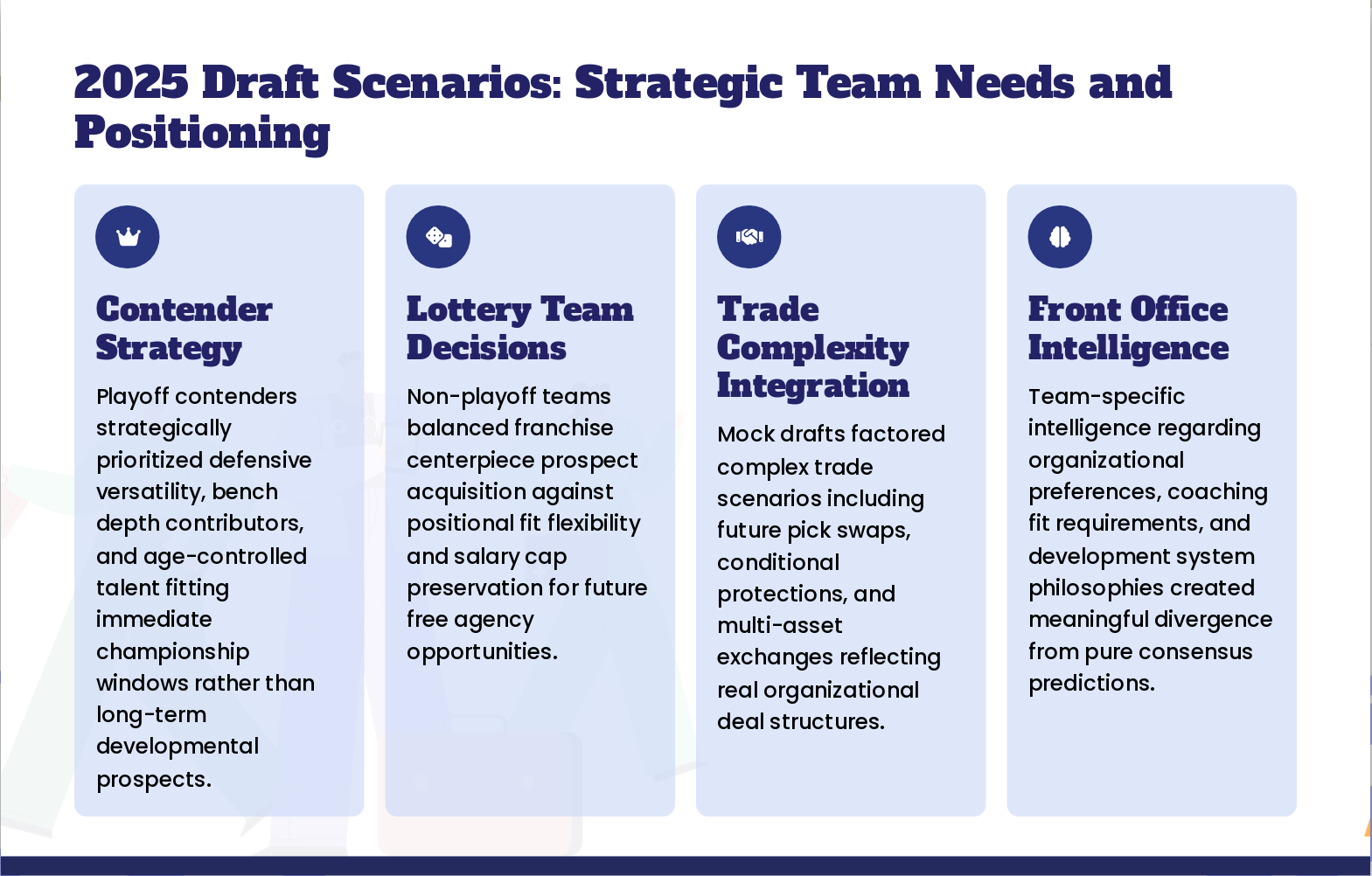
Slide 8: 2025 Draft Scenarios: Strategic Team Needs and Positioning
- Contender Strategy: Playoff contenders strategically prioritized defensive versatility, bench depth contributors, and age-controlled talent fitting immediate championship windows rather than long-term developmental prospects.
- Lottery Team Decisions: Non-playoff teams balanced franchise centerpiece prospect acquisition against positional fit flexibility and salary cap preservation for future free agency opportunities.
- Trade Complexity Integration: Mock drafts factored complex trade scenarios including future pick swaps, conditional protections, and multi-asset exchanges reflecting real organizational deal structures.
- Front Office Intelligence: Team-specific intelligence regarding organizational preferences, coaching fit requirements, and development system philosophies created meaningful divergence from pure consensus predictions.
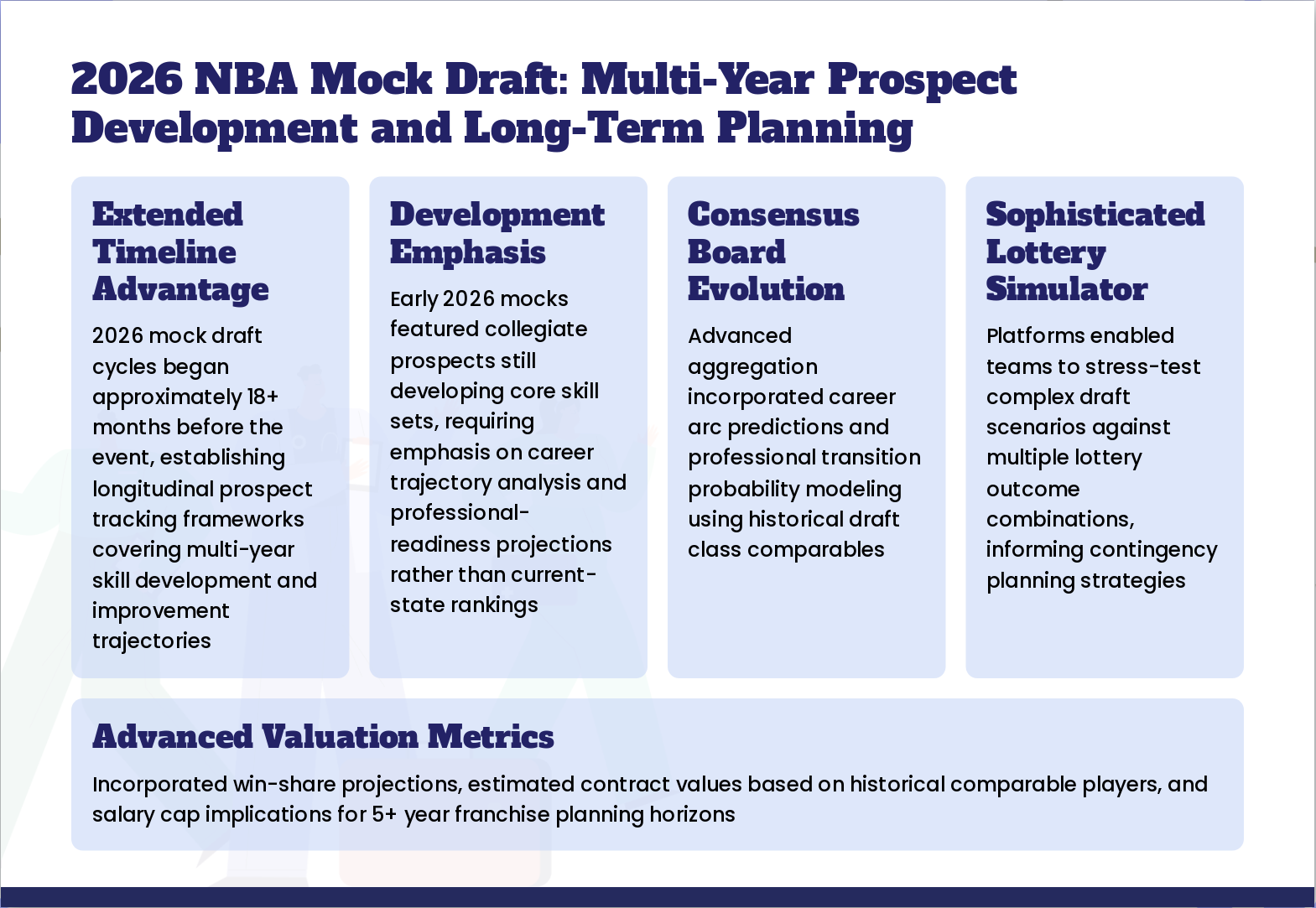
Slide 9: 2026 NBA Mock Draft: Multi-Year Prospect Development and Long-Term Planning
- Extended Timeline Advantage: 2026 mock draft cycles began approximately 18+ months before the event, establishing longitudinal prospect tracking frameworks covering multi-year skill development and improvement trajectories
- Development Emphasis: Early 2026 mocks featured collegiate prospects still developing core skill sets, requiring emphasis on career trajectory analysis and professional-readiness projections rather than current-state rankings
- Consensus Board Evolution: Advanced aggregation incorporated career arc predictions and professional transition probability modeling using historical draft class comparables
- Sophisticated Lottery Simulator: Platforms enabled teams to stress-test complex draft scenarios against multiple lottery outcome combinations, informing contingency planning strategies
- Advanced Valuation Metrics: Incorporated win-share projections, estimated contract values based on historical comparable players, and salary cap implications for 5+ year franchise planning horizons
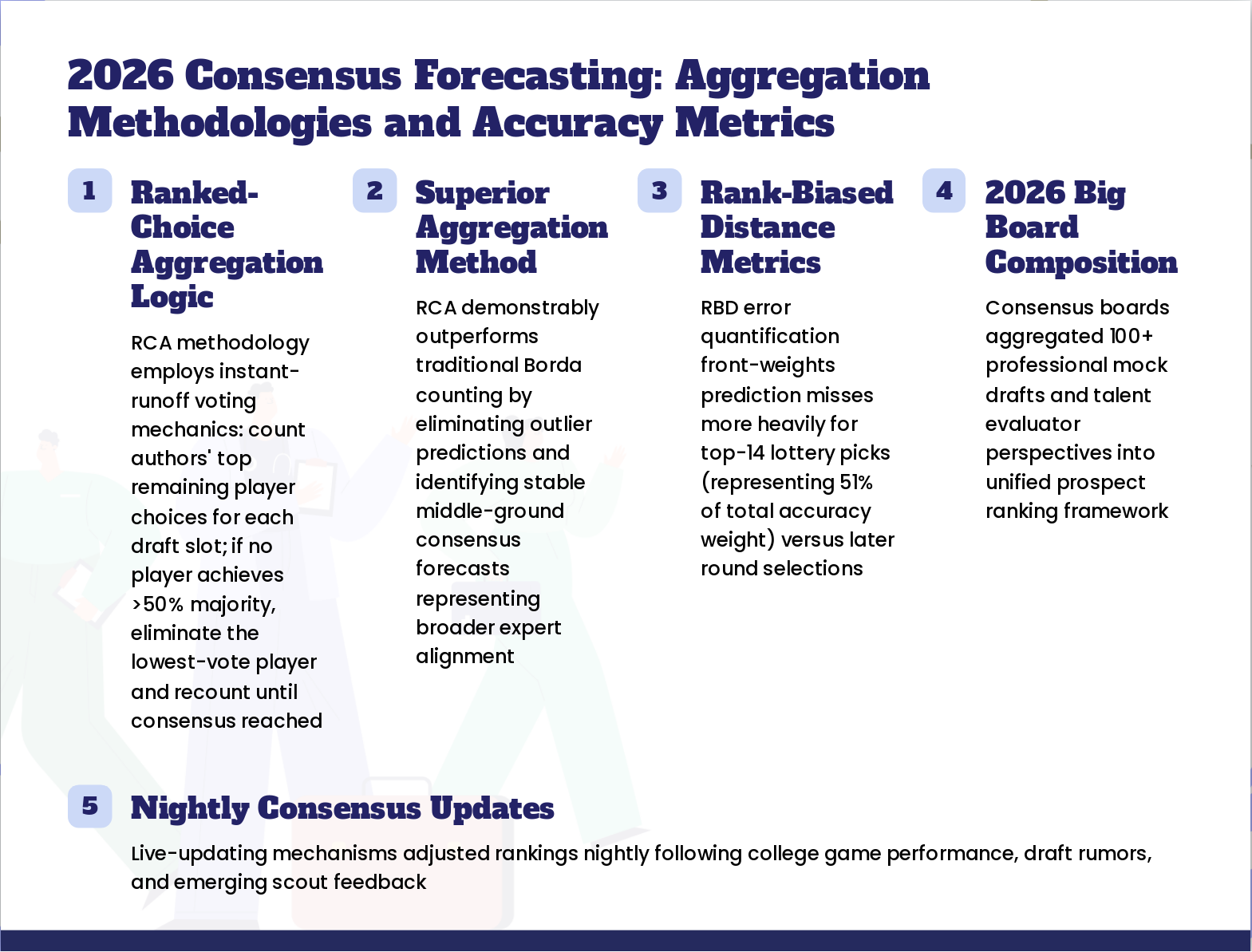
Slide 10: 2026 Consensus Forecasting: Aggregation Methodologies and Accuracy Metrics
- Ranked-Choice Aggregation Logic: RCA methodology employs instant-runoff voting mechanics: count authors' top remaining player choices for each draft slot; if no player achieves >50% majority, eliminate the lowest-vote player and recount until consensus reached
- Superior Aggregation Method: RCA demonstrably outperforms traditional Borda counting by eliminating outlier predictions and identifying stable middle-ground consensus forecasts representing broader expert alignment
- Rank-Biased Distance Metrics: RBD error quantification front-weights prediction misses more heavily for top-14 lottery picks (representing 51% of total accuracy weight) versus later round selections
- 2026 Big Board Composition: Consensus boards aggregated 100+ professional mock drafts and talent evaluator perspectives into unified prospect ranking framework
- Nightly Consensus Updates: Live-updating mechanisms adjusted rankings nightly following college game performance, draft rumors, and emerging scout feedback
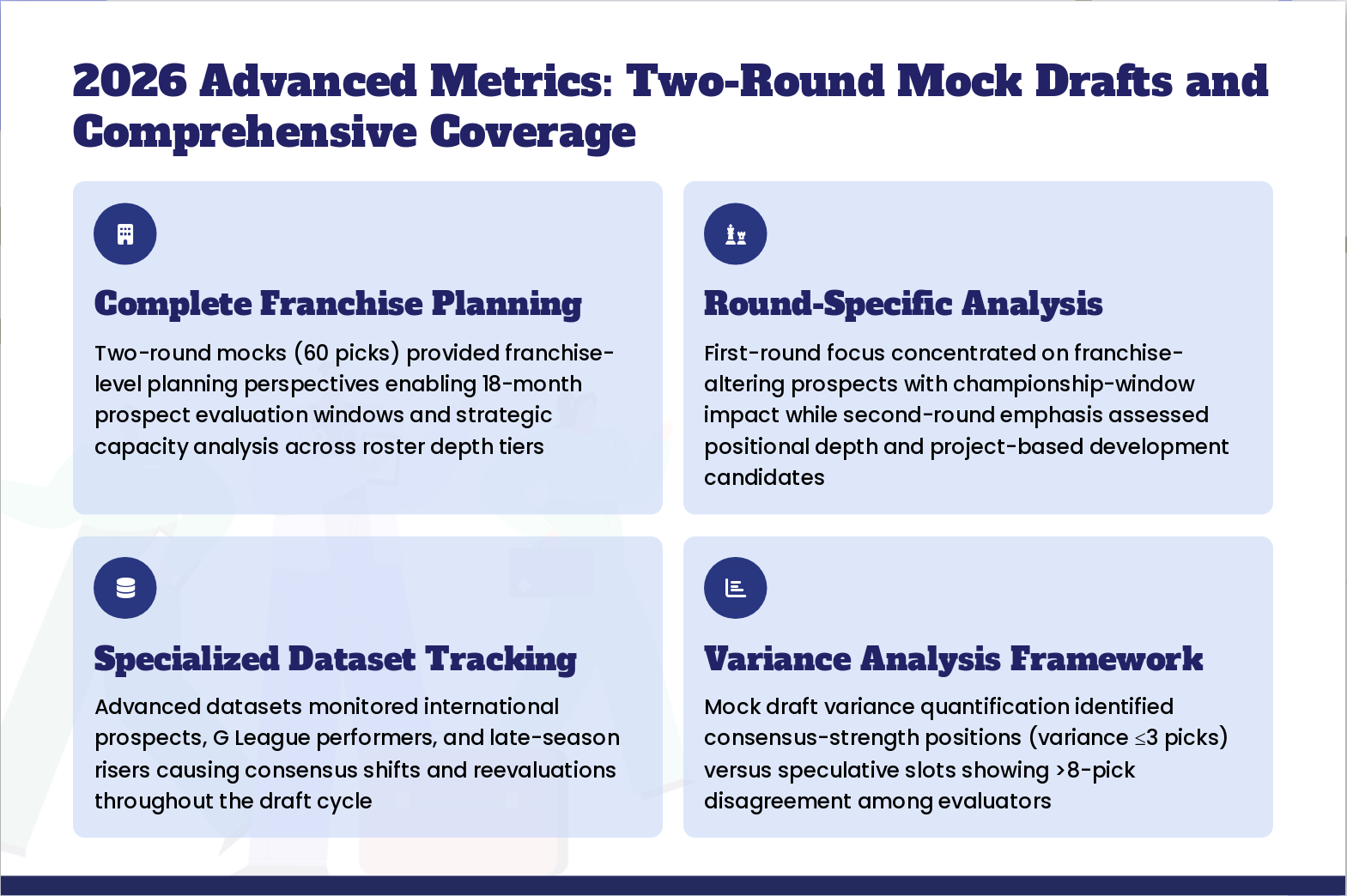
Slide 11: 2026 Advanced Metrics: Two-Round Mock Drafts and Comprehensive Coverage
- Complete Franchise Planning: Two-round mocks (60 picks) provided franchise-level planning perspectives enabling 18-month prospect evaluation windows and strategic capacity analysis across roster depth tiers
- Round-Specific Analysis: First-round focus concentrated on franchise-altering prospects with championship-window impact while second-round emphasis assessed positional depth and project-based development candidates
- Specialized Dataset Tracking: Advanced datasets monitored international prospects, G League performers, and late-season risers causing consensus shifts and reevaluations throughout the draft cycle
- Variance Analysis Framework: Mock draft variance quantification identified consensus-strength positions (variance ≤3 picks) versus speculative slots showing >8-pick disagreement among evaluators
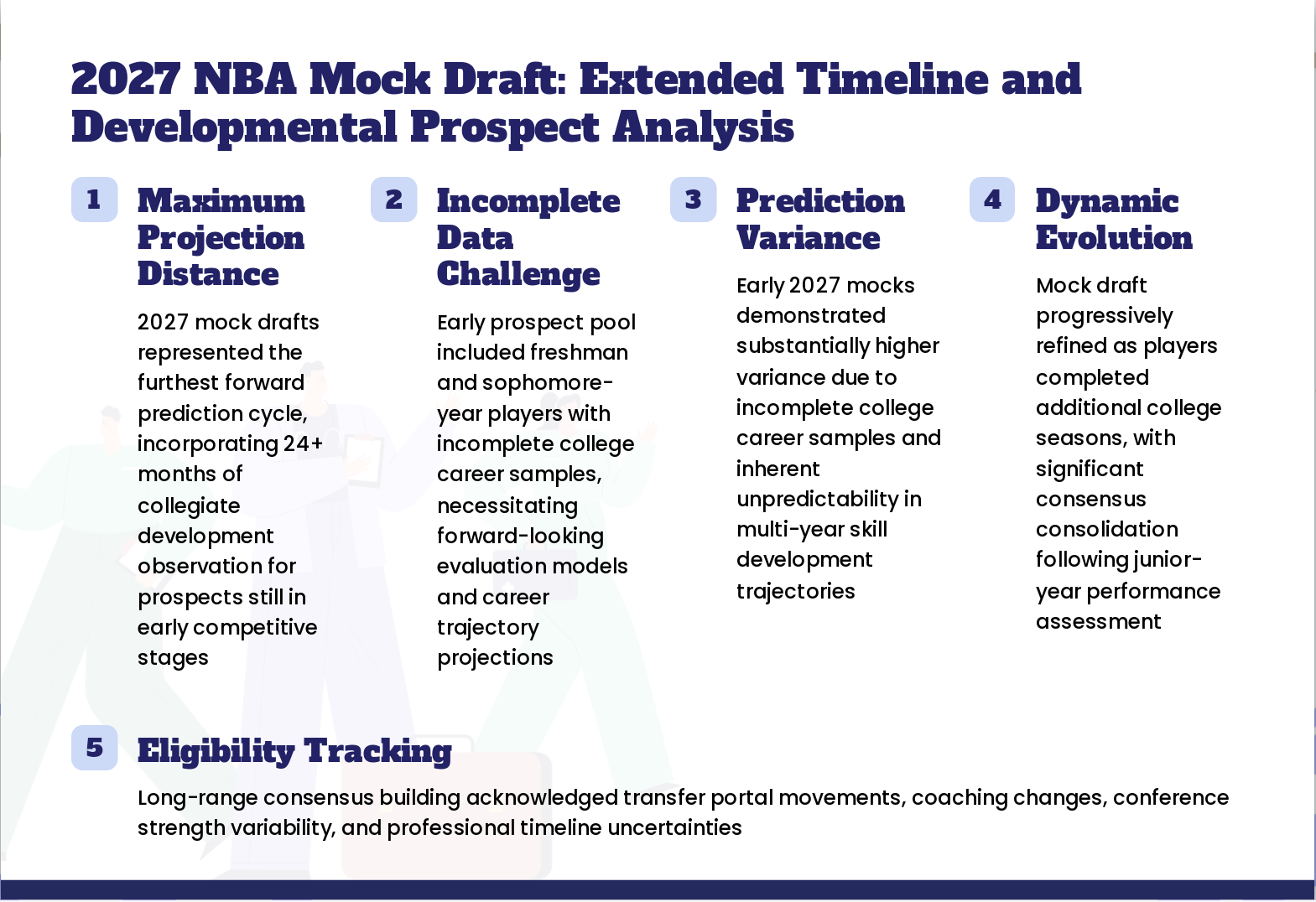
Slide 12: 2027 NBA Mock Draft: Extended Timeline and Developmental Prospect Analysis
- Maximum Projection Distance: 2027 mock drafts represented the furthest forward prediction cycle, incorporating 24+ months of collegiate development observation for prospects still in early competitive stages
- Incomplete Data Challenge: Early prospect pool included freshman and sophomore-year players with incomplete college career samples, necessitating forward-looking evaluation models and career trajectory projections
- Prediction Variance: Early 2027 mocks demonstrated substantially higher variance due to incomplete college career samples and inherent unpredictability in multi-year skill development trajectories
- Dynamic Evolution: Mock draft progressively refined as players completed additional college seasons, with significant consensus consolidation following junior-year performance assessment
- Eligibility Tracking: Long-range consensus building acknowledged transfer portal movements, coaching changes, conference strength variability, and professional timeline uncertainties
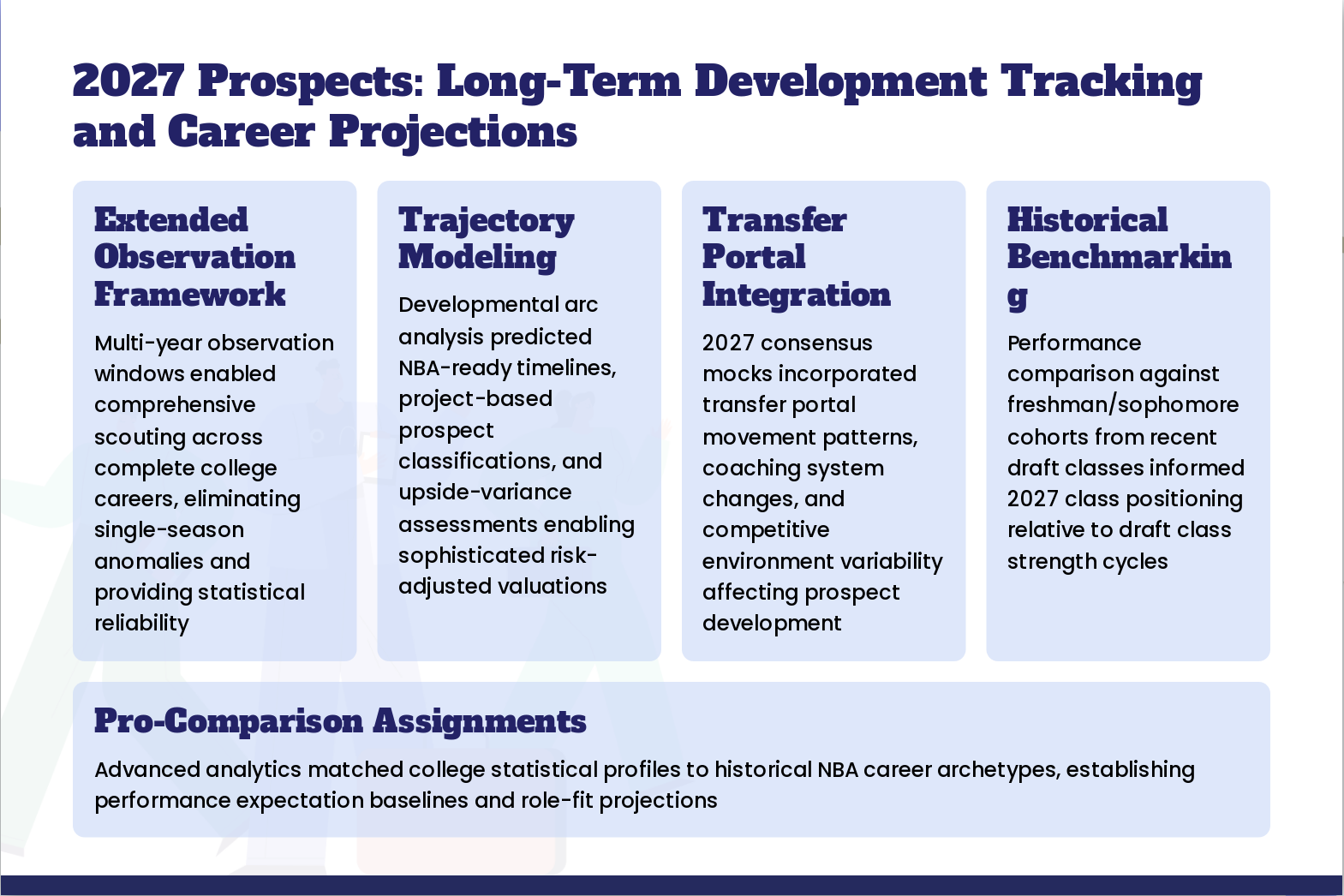
Slide 13: 2027 Prospects: Long-Term Development Tracking and Career Projections
- Extended Observation Framework: Multi-year observation windows enabled comprehensive scouting across complete college careers, eliminating single-season anomalies and providing statistical reliability
- Trajectory Modeling: Developmental arc analysis predicted NBA-ready timelines, project-based prospect classifications, and upside-variance assessments enabling sophisticated risk-adjusted valuations
- Transfer Portal Integration: 2027 consensus mocks incorporated transfer portal movement patterns, coaching system changes, and competitive environment variability affecting prospect development
- Historical Benchmarking: Performance comparison against freshman/sophomore cohorts from recent draft classes informed 2027 class positioning relative to draft class strength cycles
- Pro-Comparison Assignments: Advanced analytics matched college statistical profiles to historical NBA career archetypes, establishing performance expectation baselines and role-fit projections
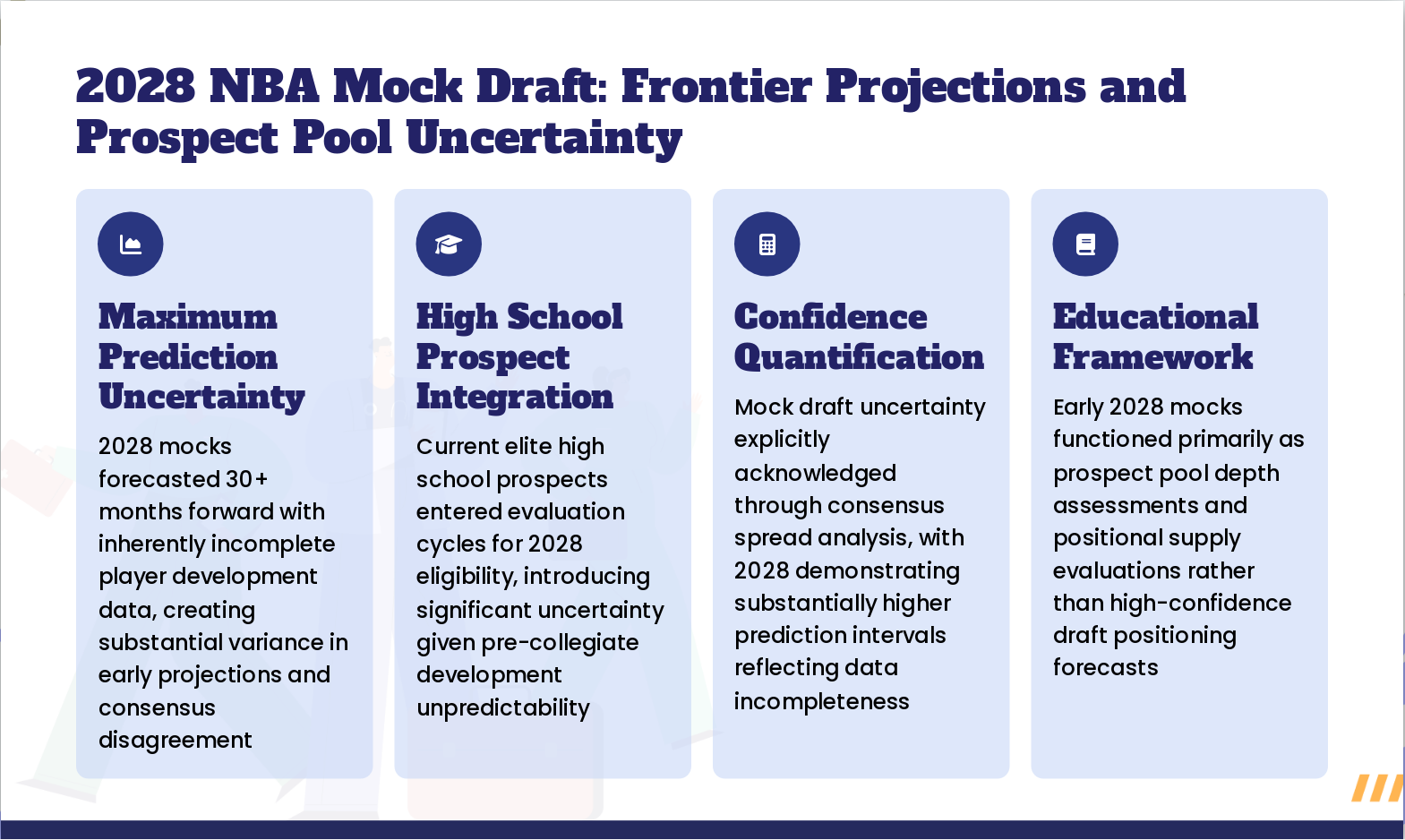
Slide 14: 2028 NBA Mock Draft: Frontier Projections and Prospect Pool Uncertainty
- Maximum Prediction Uncertainty: 2028 mocks forecasted 30+ months forward with inherently incomplete player development data, creating substantial variance in early projections and consensus disagreement
- High School Prospect Integration: Current elite high school prospects entered evaluation cycles for 2028 eligibility, introducing significant uncertainty given pre-collegiate development unpredictability
- Confidence Quantification: Mock draft uncertainty explicitly acknowledged through consensus spread analysis, with 2028 demonstrating substantially higher prediction intervals reflecting data incompleteness
- Educational Framework: Early 2028 mocks functioned primarily as prospect pool depth assessments and positional supply evaluations rather than high-confidence draft positioning forecasts
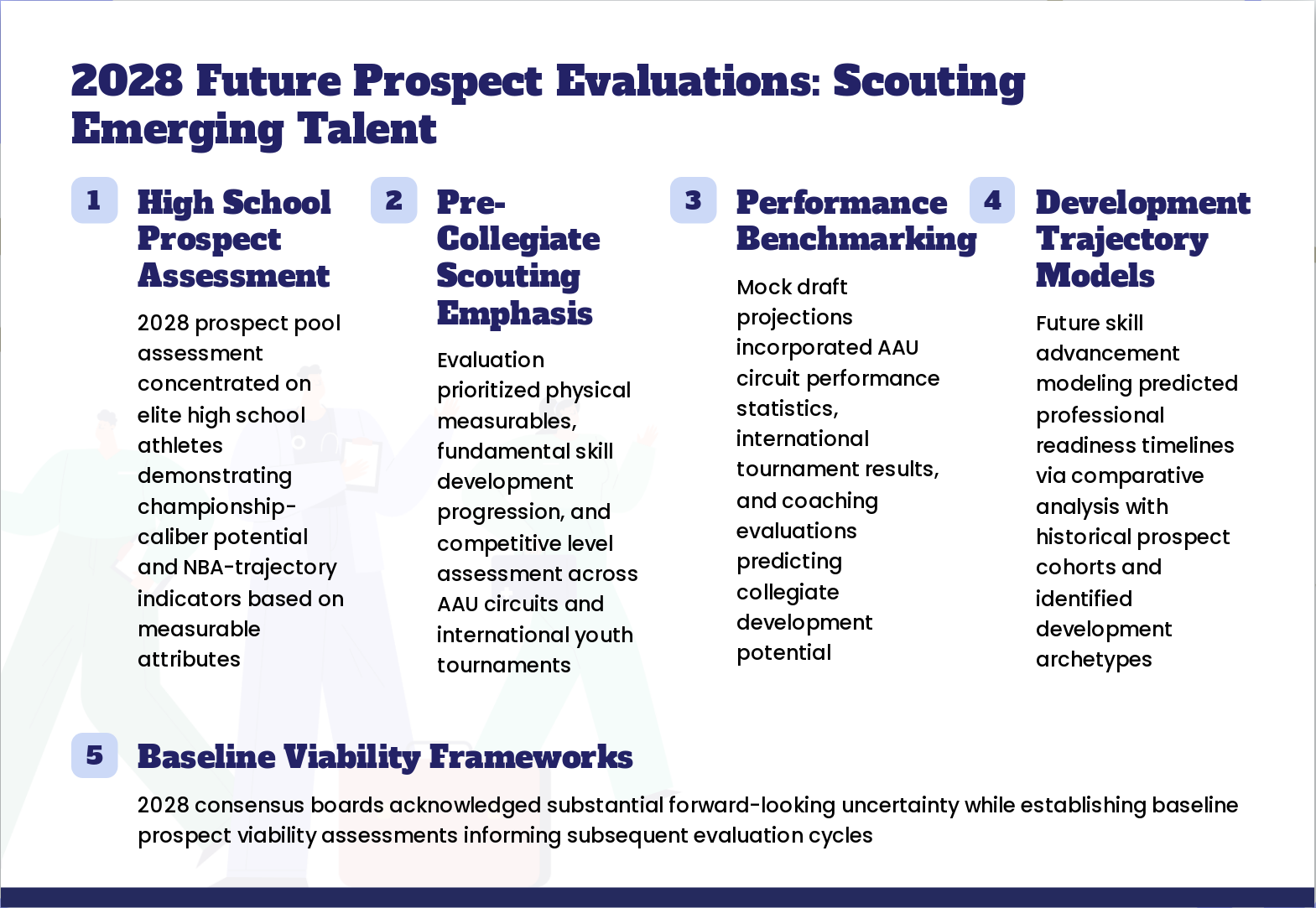
Slide 15: 2028 Future Prospect Evaluations: Scouting Emerging Talent
- High School Prospect Assessment: 2028 prospect pool assessment concentrated on elite high school athletes demonstrating championship-caliber potential and NBA-trajectory indicators based on measurable attributes
- Pre-Collegiate Scouting Emphasis: Evaluation prioritized physical measurables, fundamental skill development progression, and competitive level assessment across AAU circuits and international youth tournaments
- Performance Benchmarking: Mock draft projections incorporated AAU circuit performance statistics, international tournament results, and coaching evaluations predicting collegiate development potential
- Development Trajectory Models: Future skill advancement modeling predicted professional readiness timelines via comparative analysis with historical prospect cohorts and identified development archetypes
- Baseline Viability Frameworks: 2028 consensus boards acknowledged substantial forward-looking uncertainty while establishing baseline prospect viability assessments informing subsequent evaluation cycles
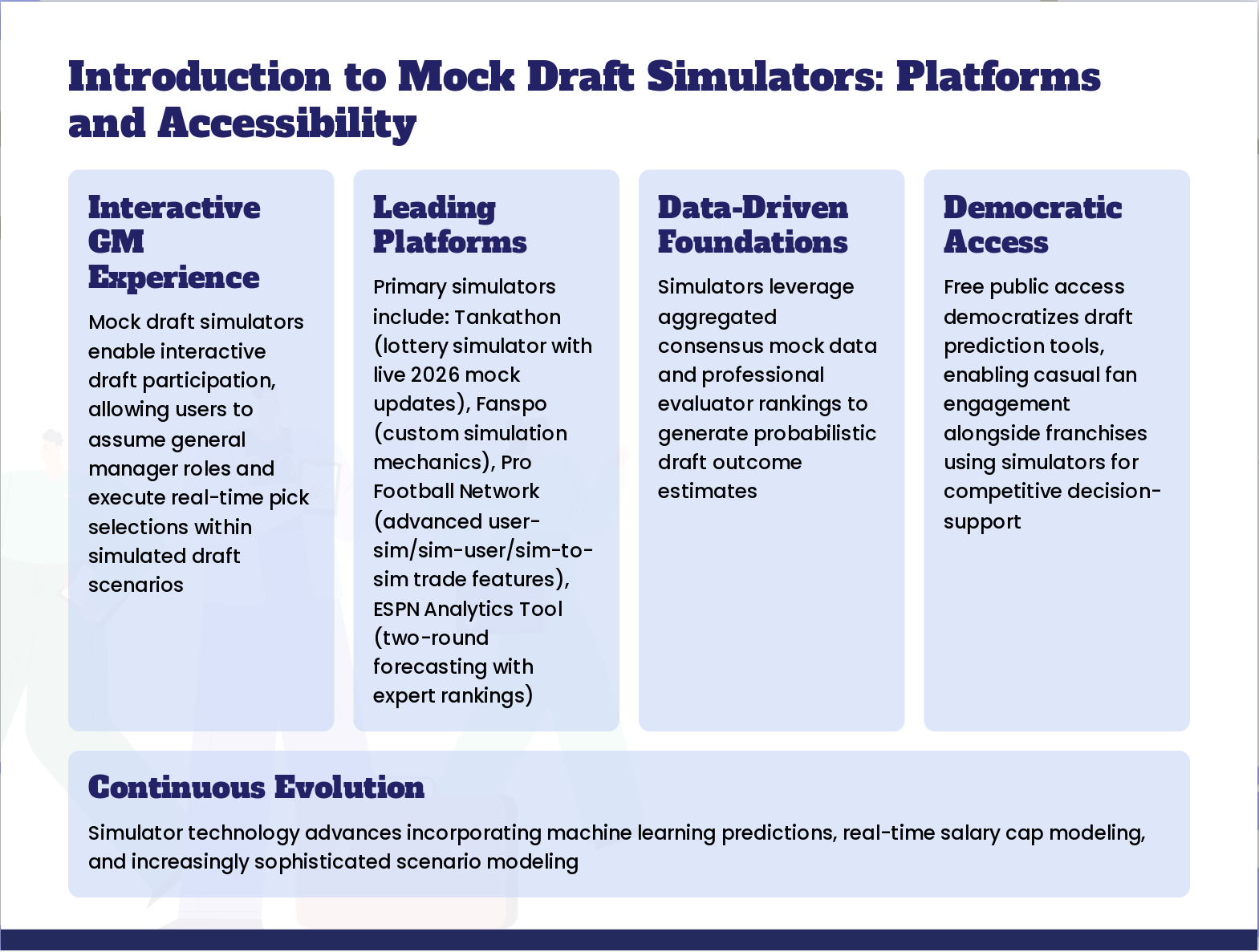
Slide 16: Introduction to Mock Draft Simulators: Platforms and Accessibility
- Interactive GM Experience: Mock draft simulators enable interactive draft participation, allowing users to assume general manager roles and execute real-time pick selections within simulated draft scenarios
- Leading Platforms: Primary simulators include: Tankathon (lottery simulator with live 2026 mock updates), Fanspo (custom simulation mechanics), Pro Football Network (advanced user-sim/sim-user/sim-to-sim trade features), ESPN Analytics Tool (two-round forecasting with expert rankings)
- Data-Driven Foundations: Simulators leverage aggregated consensus mock data and professional evaluator rankings to generate probabilistic draft outcome estimates
- Democratic Access: Free public access democratizes draft prediction tools, enabling casual fan engagement alongside franchises using simulators for competitive decision-support
- Continuous Evolution: Simulator technology advances incorporating machine learning predictions, real-time salary cap modeling, and increasingly sophisticated scenario modeling
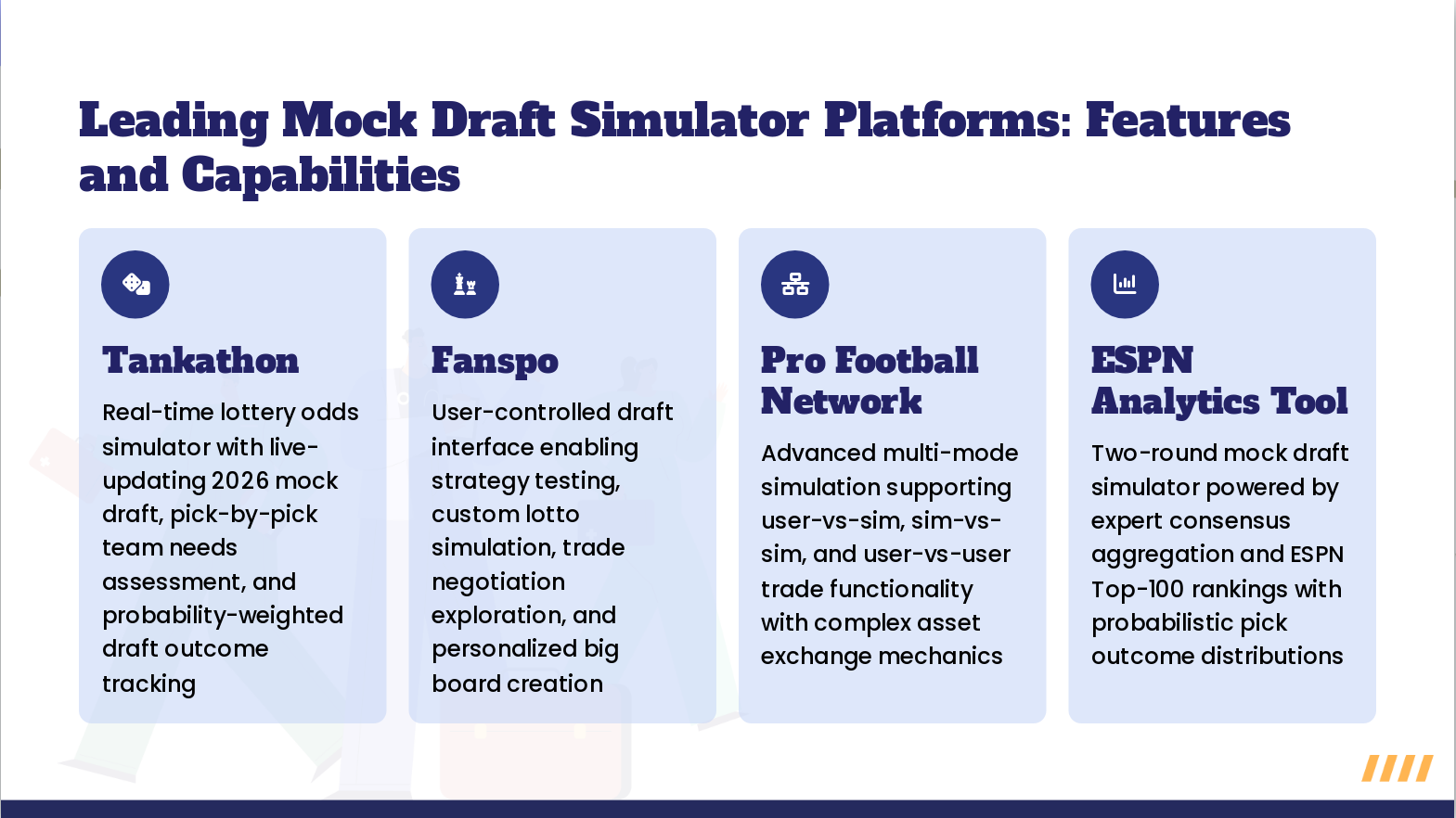
Slide 17: Leading Mock Draft Simulator Platforms: Features and Capabilities
- Tankathon: Real-time lottery odds simulator with live-updating 2026 mock draft, pick-by-pick team needs assessment, and probability-weighted draft outcome tracking
- Fanspo: User-controlled draft interface enabling strategy testing, custom lotto simulation, trade negotiation exploration, and personalized big board creation
- Pro Football Network: Advanced multi-mode simulation supporting user-vs-sim, sim-vs-sim, and user-vs-user trade functionality with complex asset exchange mechanics
- ESPN Analytics Tool: Two-round mock draft simulator powered by expert consensus aggregation and ESPN Top-100 rankings with probabilistic pick outcome distributions
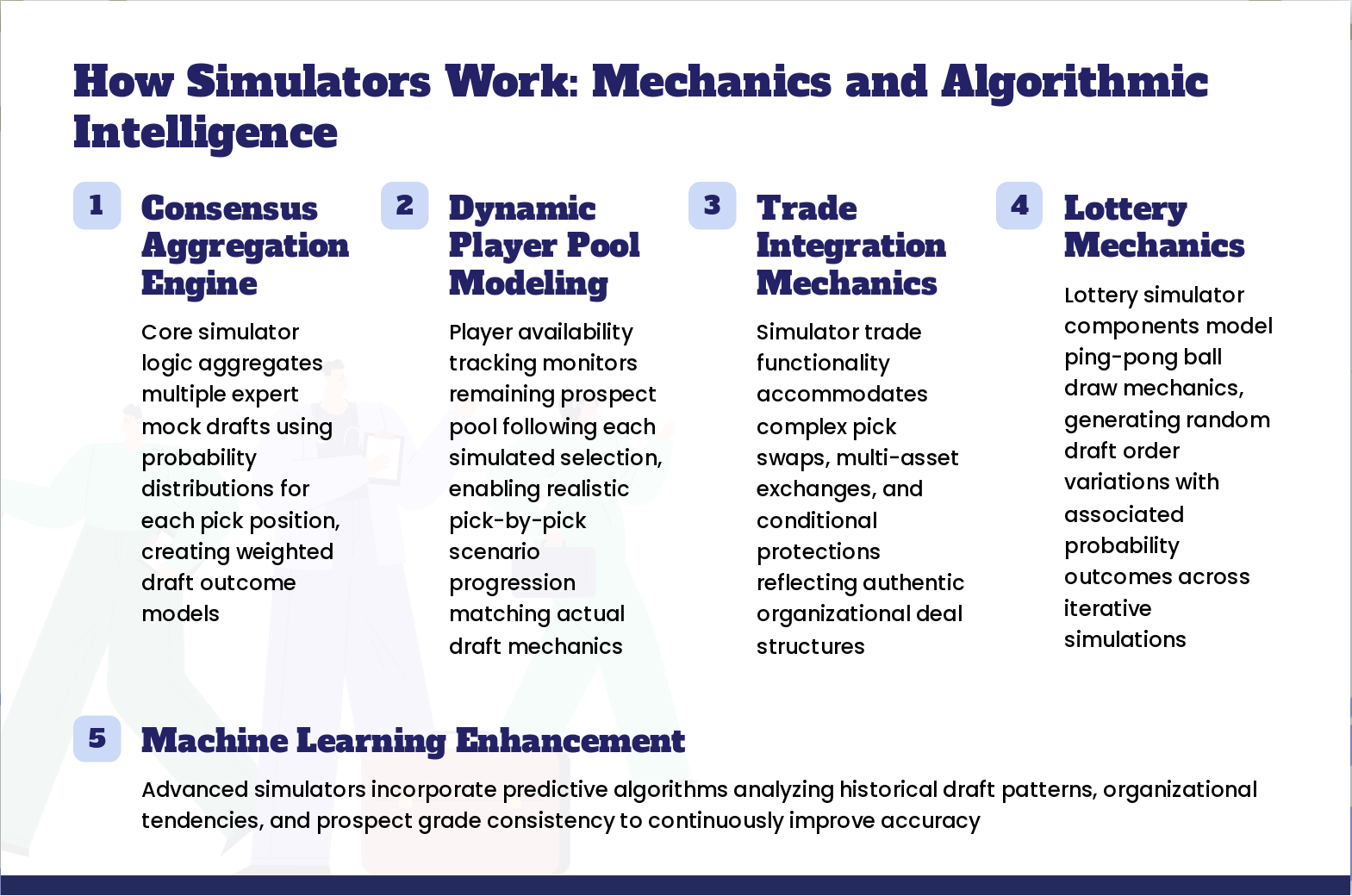
Slide 18: How Simulators Work: Mechanics and Algorithmic Intelligence
- Consensus Aggregation Engine: Core simulator logic aggregates multiple expert mock drafts using probability distributions for each pick position, creating weighted draft outcome models
- Dynamic Player Pool Modeling: Player availability tracking monitors remaining prospect pool following each simulated selection, enabling realistic pick-by-pick scenario progression matching actual draft mechanics
- Trade Integration Mechanics: Simulator trade functionality accommodates complex pick swaps, multi-asset exchanges, and conditional protections reflecting authentic organizational deal structures
- Lottery Mechanics: Lottery simulator components model ping-pong ball draw mechanics, generating random draft order variations with associated probability outcomes across iterative simulations
- Machine Learning Enhancement: Advanced simulators incorporate predictive algorithms analyzing historical draft patterns, organizational tendencies, and prospect grade consistency to continuously improve accuracy
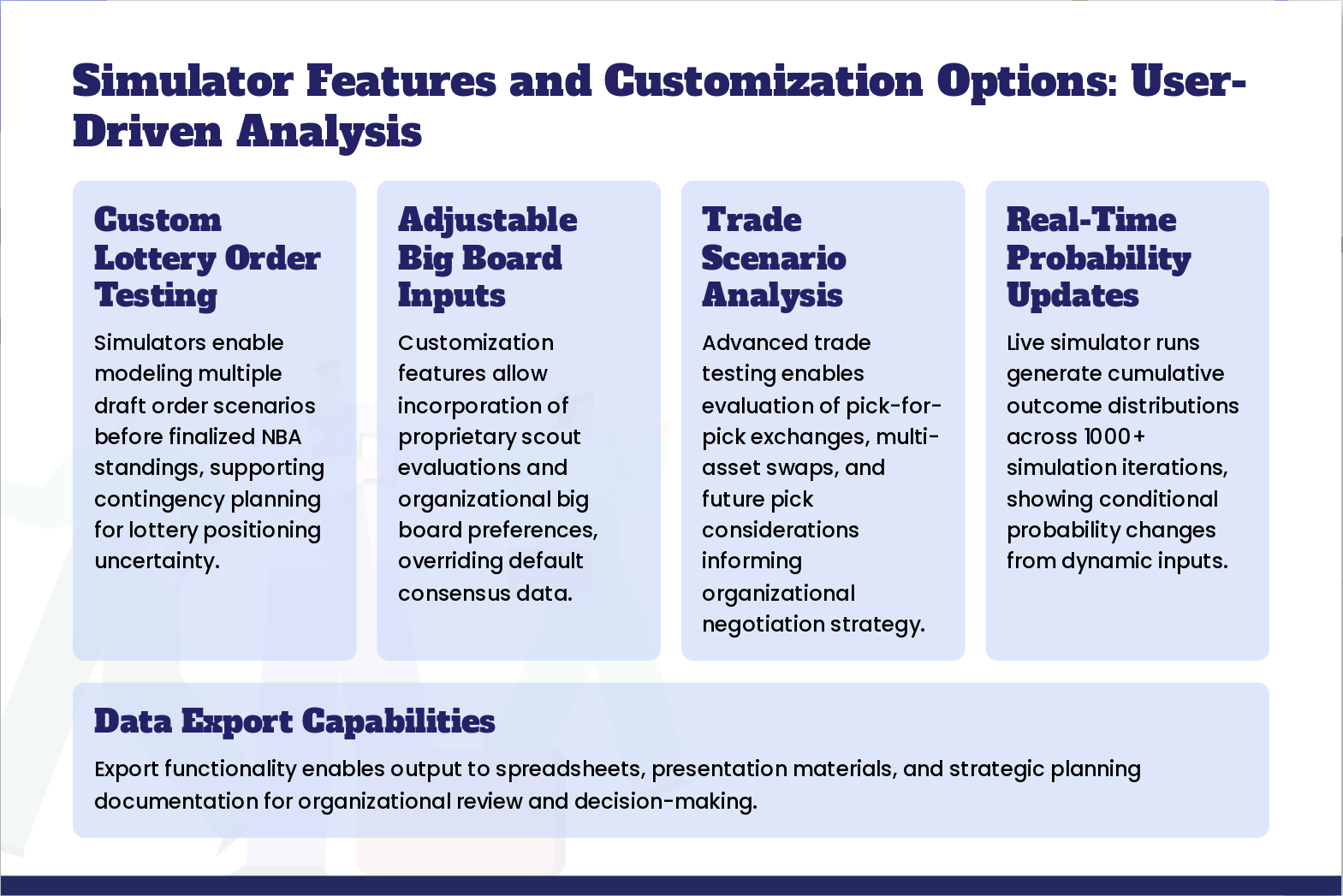
Slide 19: Simulator Features and Customization Options: User-Driven Analysis
- Custom Lottery Order Testing: Simulators enable modeling multiple draft order scenarios before finalized NBA standings, supporting contingency planning for lottery positioning uncertainty.
- Adjustable Big Board Inputs: Customization features allow incorporation of proprietary scout evaluations and organizational big board preferences, overriding default consensus data.
- Trade Scenario Analysis: Advanced trade testing enables evaluation of pick-for-pick exchanges, multi-asset swaps, and future pick considerations informing organizational negotiation strategy.
- Real-Time Probability Updates: Live simulator runs generate cumulative outcome distributions across 1000+ simulation iterations, showing conditional probability changes from dynamic inputs.
- Data Export Capabilities: Export functionality enables output to spreadsheets, presentation materials, and strategic planning documentation for organizational review and decision-making.
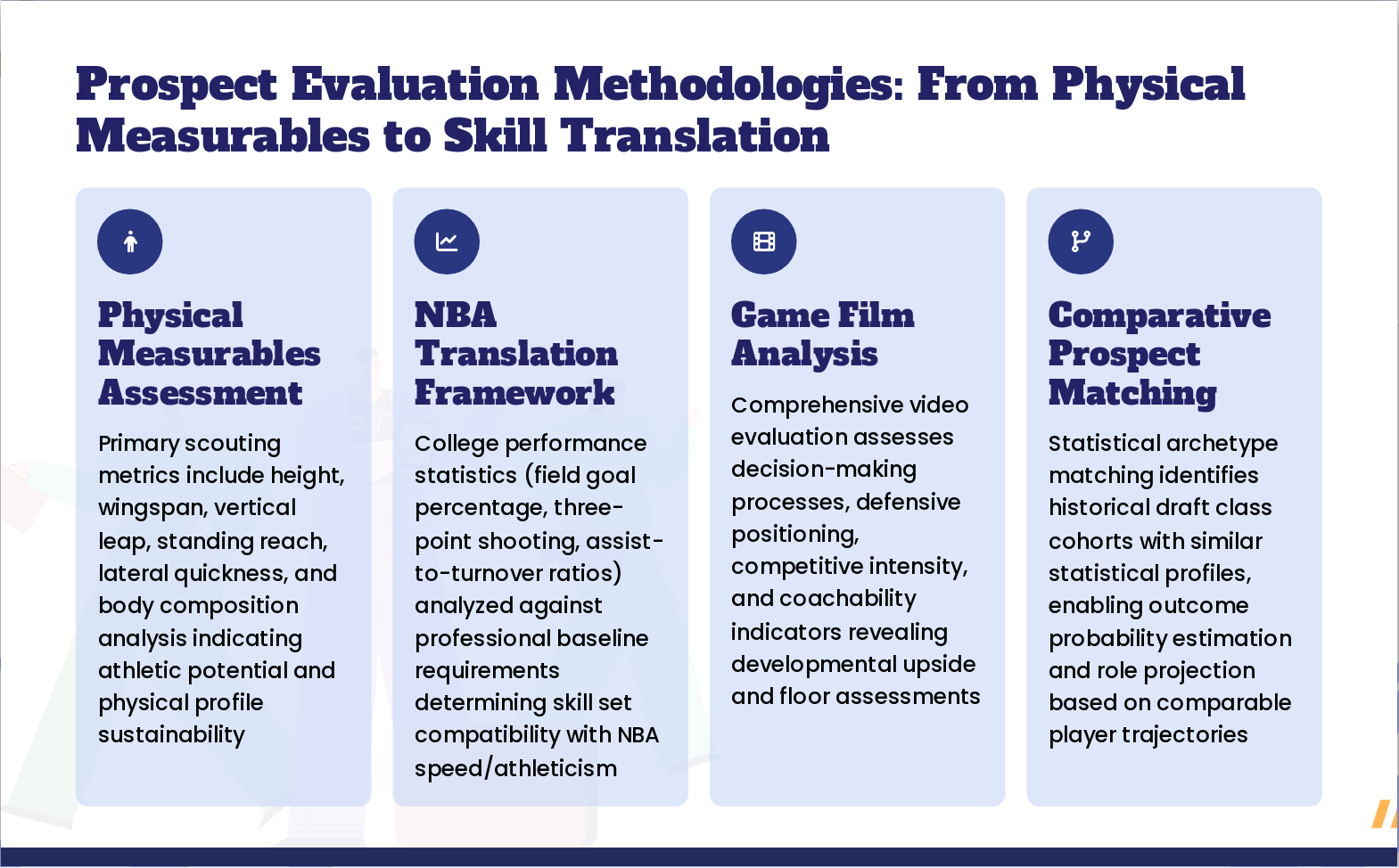
Slide 20: Prospect Evaluation Methodologies: From Physical Measurables to Skill Translation
- Physical Measurables Assessment: Primary scouting metrics include height, wingspan, vertical leap, standing reach, lateral quickness, and body composition analysis indicating athletic potential and physical profile sustainability
- NBA Translation Framework: College performance statistics (field goal percentage, three-point shooting, assist-to-turnover ratios) analyzed against professional baseline requirements determining skill set compatibility with NBA speed/athleticism
- Game Film Analysis: Comprehensive video evaluation assesses decision-making processes, defensive positioning, competitive intensity, and coachability indicators revealing developmental upside and floor assessments
- Comparative Prospect Matching: Statistical archetype matching identifies historical draft class cohorts with similar statistical profiles, enabling outcome probability estimation and role projection based on comparable player trajectories
Slide 21: Consensus Mock Aggregation: Ranked-Choice Aggregation and Advanced Metrics
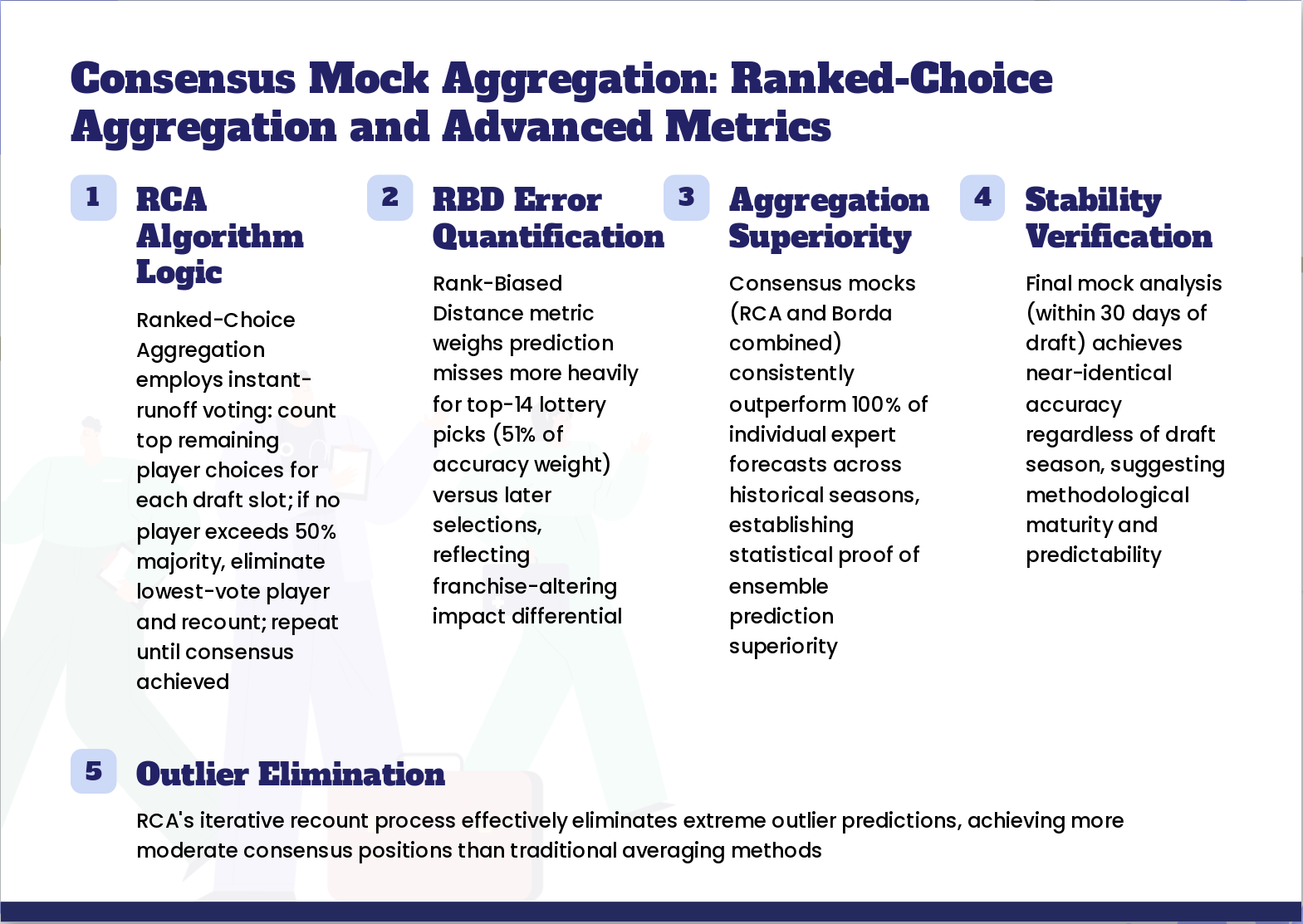
- RCA Algorithm Logic: Ranked-Choice Aggregation employs instant-runoff voting: count top remaining player choices for each draft slot; if no player exceeds 50% majority, eliminate lowest-vote player and recount; repeat until consensus achieved
- RBD Error Quantification: Rank-Biased Distance metric weighs prediction misses more heavily for top-14 lottery picks (51% of accuracy weight) versus later selections, reflecting franchise-altering impact differential
- Aggregation Superiority: Consensus mocks (RCA and Borda combined) consistently outperform 100% of individual expert forecasts across historical seasons, establishing statistical proof of ensemble prediction superiority
- Stability Verification: Final mock analysis (within 30 days of draft) achieves near-identical accuracy regardless of draft season, suggesting methodological maturity and predictability
- Outlier Elimination: RCA's iterative recount process effectively eliminates extreme outlier predictions, achieving more moderate consensus positions than traditional averaging methods
Slide 22: Team Needs Analysis and Strategic Draft Positioning
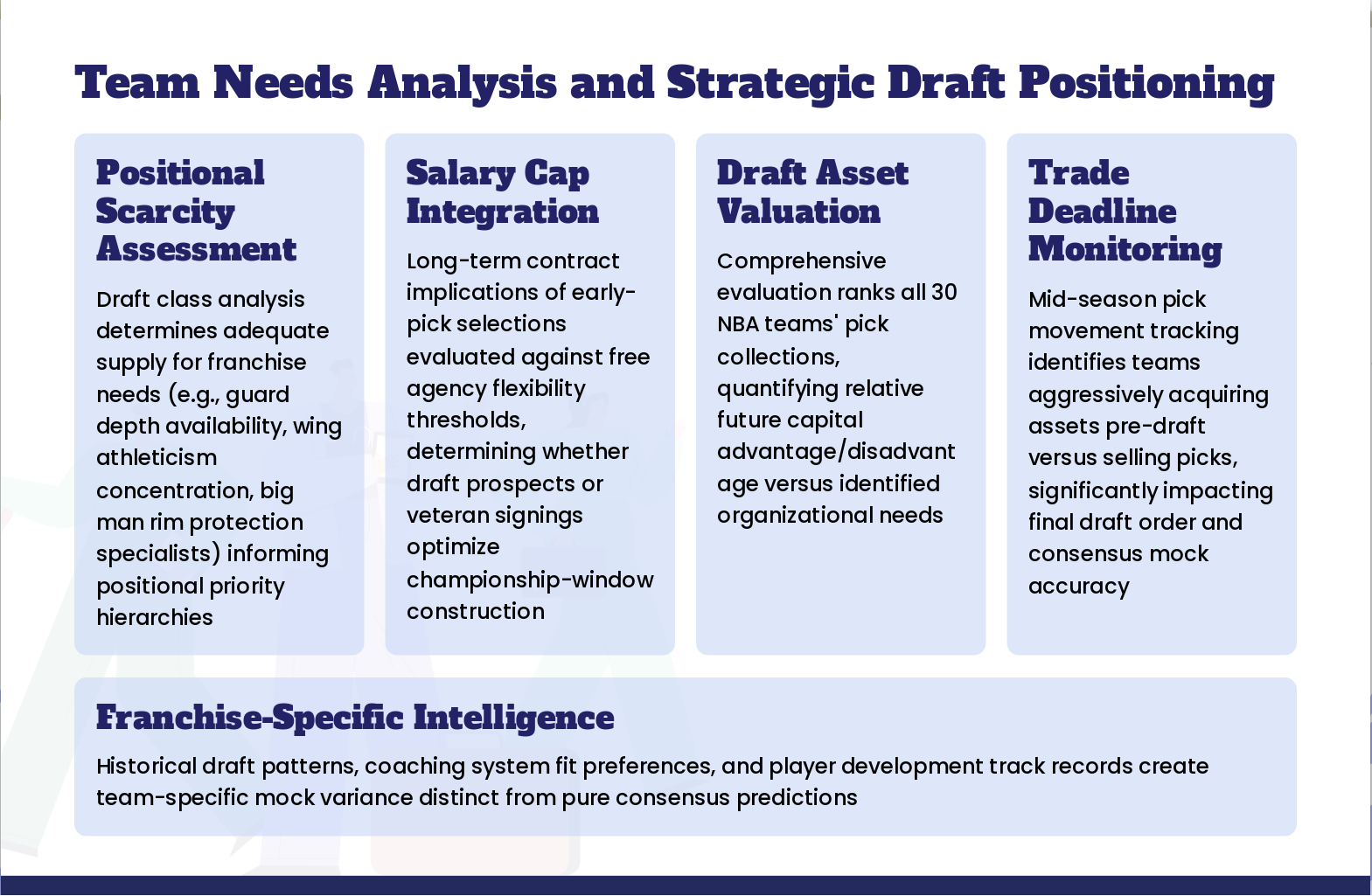
- Positional Scarcity Assessment: Draft class analysis determines adequate supply for franchise needs (e.g., guard depth availability, wing athleticism concentration, big man rim protection specialists) informing positional priority hierarchies
- Salary Cap Integration: Long-term contract implications of early-pick selections evaluated against free agency flexibility thresholds, determining whether draft prospects or veteran signings optimize championship-window construction
- Draft Asset Valuation: Comprehensive evaluation ranks all 30 NBA teams' pick collections, quantifying relative future capital advantage/disadvantage versus identified organizational needs
- Trade Deadline Monitoring: Mid-season pick movement tracking identifies teams aggressively acquiring assets pre-draft versus selling picks, significantly impacting final draft order and consensus mock accuracy
- Franchise-Specific Intelligence: Historical draft patterns, coaching system fit preferences, and player development track records create team-specific mock variance distinct from pure consensus predictions
Slide 23: Real-World Implications: Mock Drafts and Franchise Building Effectiveness
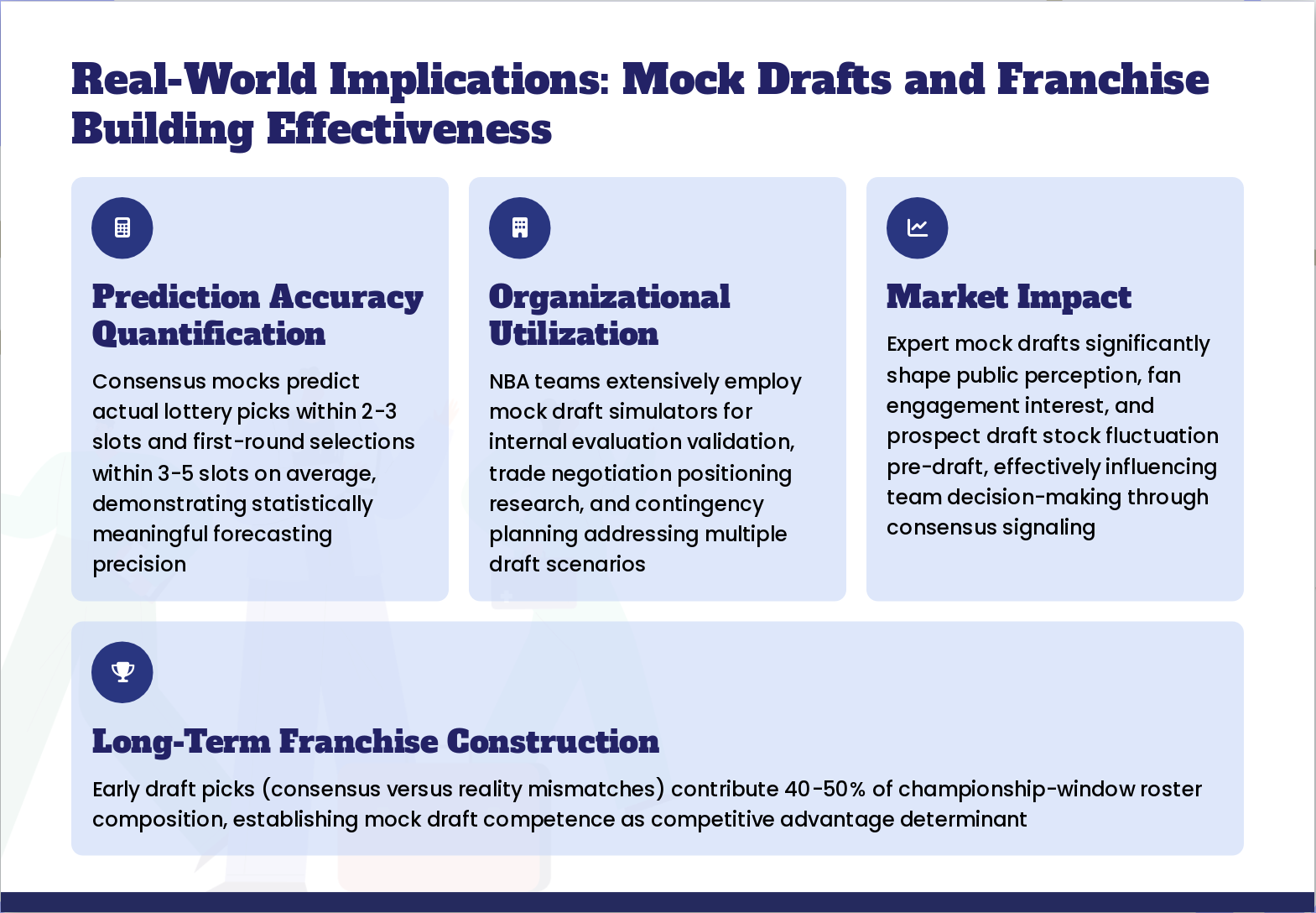
- Prediction Accuracy Quantification: Consensus mocks predict actual lottery picks within 2-3 slots and first-round selections within 3-5 slots on average, demonstrating statistically meaningful forecasting precision
- Organizational Utilization: NBA teams extensively employ mock draft simulators for internal evaluation validation, trade negotiation positioning research, and contingency planning addressing multiple draft scenarios
- Market Impact: Expert mock drafts significantly shape public perception, fan engagement interest, and prospect draft stock fluctuation pre-draft, effectively influencing team decision-making through consensus signaling
- Long-Term Franchise Construction: Early draft picks (consensus versus reality mismatches) contribute 40-50% of championship-window roster composition, establishing mock draft competence as competitive advantage determinant
Slide 24: Key Takeaways: The Future of NBA Draft Analytics and Predictive Intelligence
Key Takeaways: The Future of NBA Draft Analytics and Predictive Intelligence 1. Evolution of Mock Drafts: From speculative predictions to aggregated consensus forecasts utilizing sophisticated statistical methodologies (RCA, RBD metrics) 2. Extended Planning Horizons: Multi-year mock draft cycles (2...