
Presentation Summary
Master the first 90 minutes of your day with evidence-based strategies from high performers to build a morning routine that sets the tone for success.
Full Presentation Transcript
Slide 1: How to Build a Morning Routine for Success
Transform Your First 90 Minutes to Win the Day with Evidence-Based Strategies from High Performers
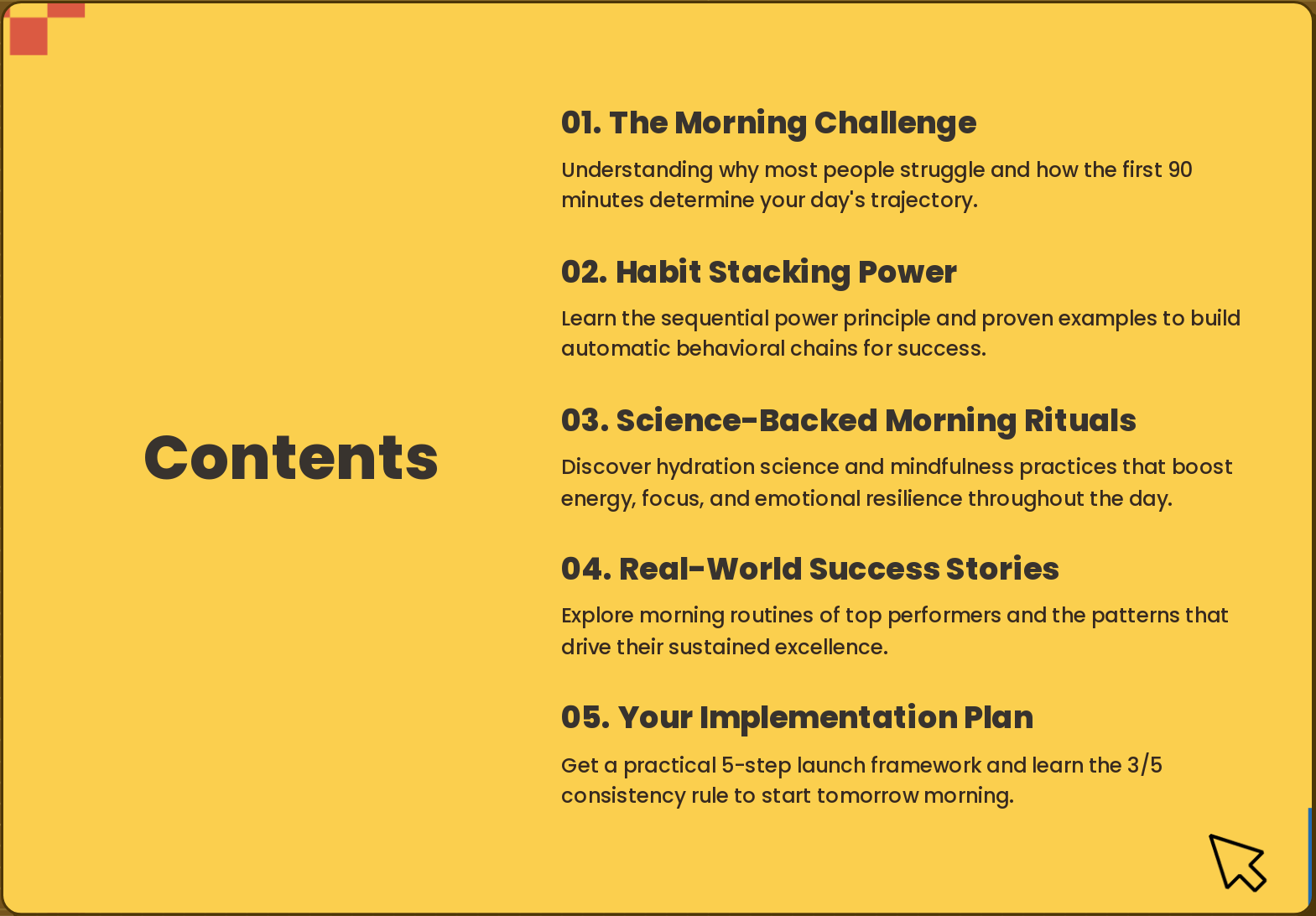
Slide 2: Contents
- The Morning Challenge: Understanding why most people struggle and how the first 90 minutes determine your day's trajectory.
- Habit Stacking Power: Learn the sequential power principle and proven examples to build automatic behavioral chains for success.
- Science-Backed Morning Rituals: Discover hydration science and mindfulness practices that boost energy, focus, and emotional resilience throughout the day.
- Real-World Success Stories: Explore morning routines of top performers and the patterns that drive their sustained excellence.
- Your Implementation Plan: Get a practical 5-step launch framework and learn the 3/5 consistency rule to start tomorrow morning.
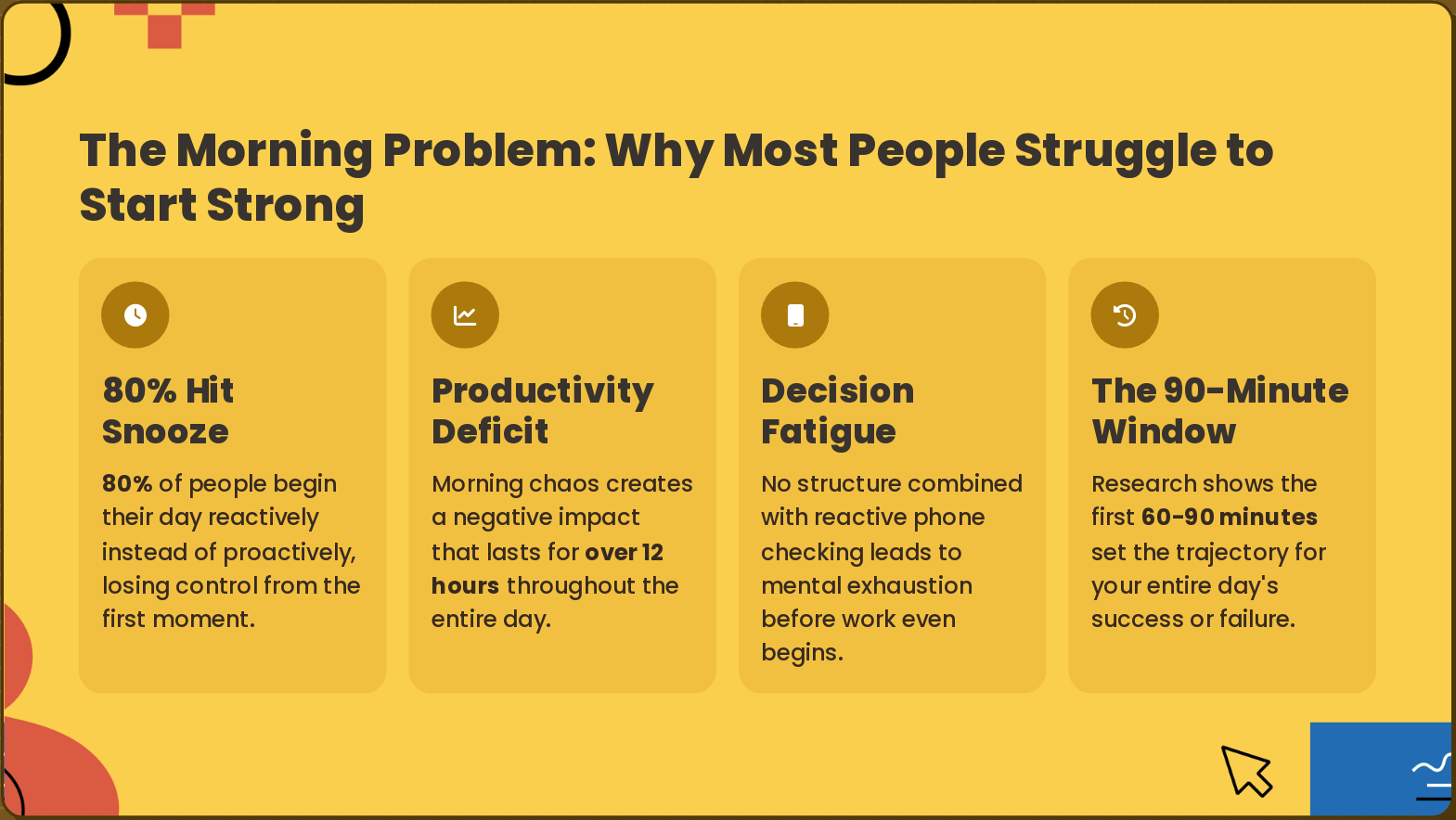
Slide 3: The Morning Problem: Why Most People Struggle to Start Strong
- 80% Hit Snooze: 80% of people begin their day reactively instead of proactively, losing control from the first moment.
- Productivity Deficit: Morning chaos creates a negative impact that lasts for over 12 hours throughout the entire day.
- Decision Fatigue: No structure combined with reactive phone checking leads to mental exhaustion before work even begins.
- The 90-Minute Window: Research shows the first 60-90 minutes set the trajectory for your entire day's success or failure.
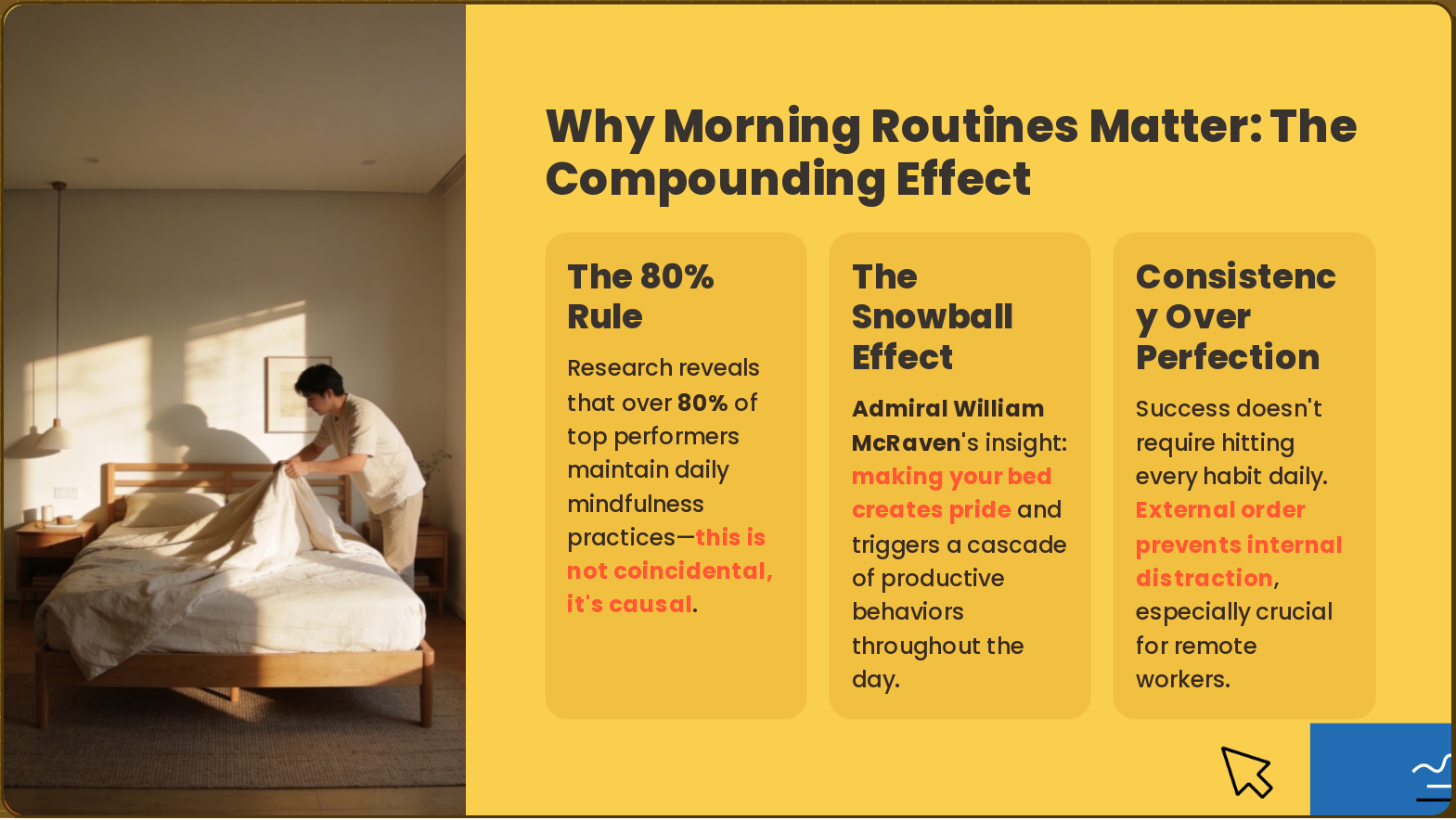
Slide 4: Why Morning Routines Matter: The Compounding Effect
- The 80% Rule: Research reveals that over 80% of top performers maintain daily mindfulness practices— this is not coincidental, it's causal .
- The Snowball Effect: Admiral William McRaven 's insight: making your bed creates pride and triggers a cascade of productive behaviors throughout the day.
- Consistency Over Perfection: Success doesn't require hitting every habit daily. External order prevents internal distraction , especially crucial for remote workers.
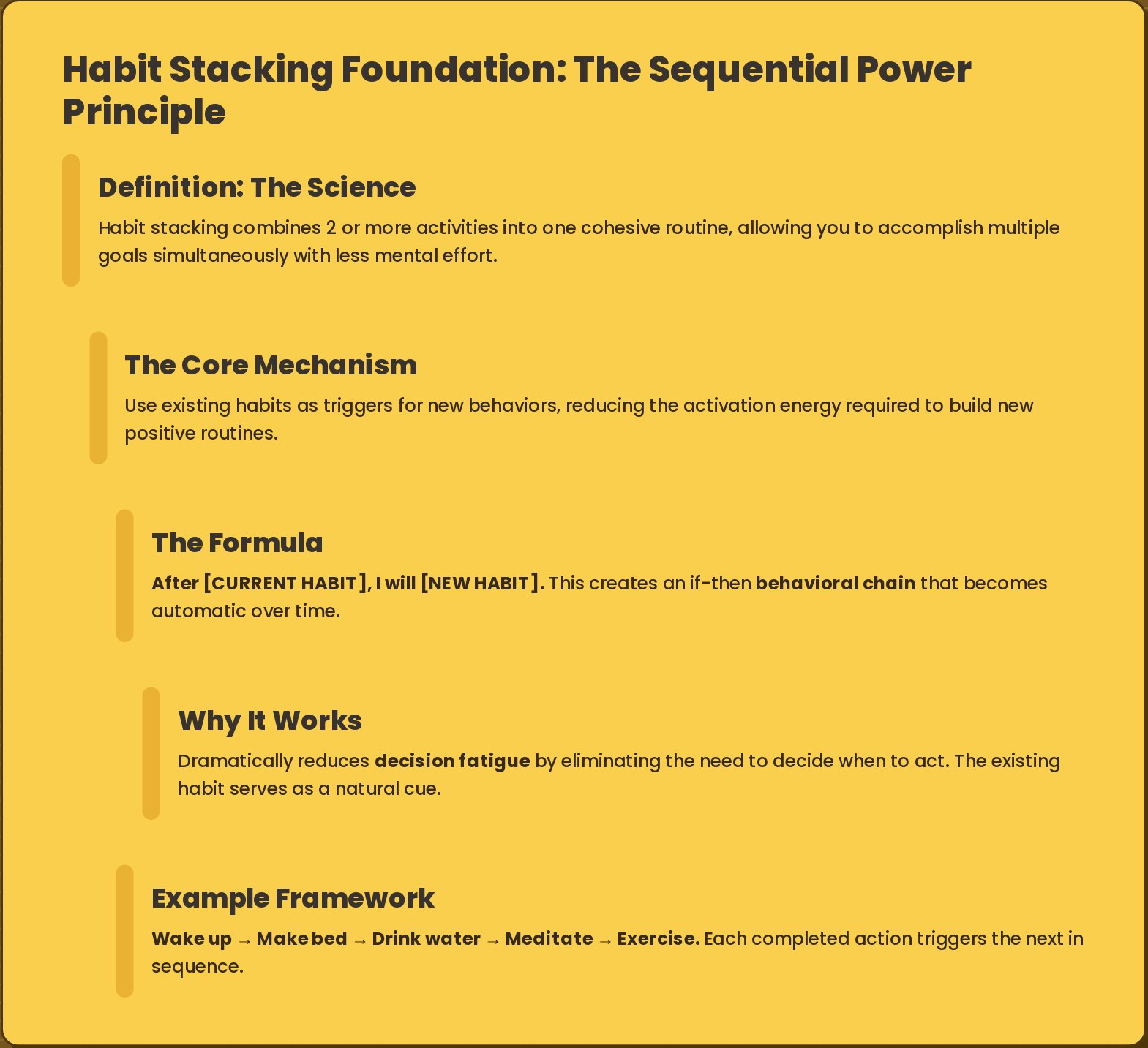
Slide 5: Habit Stacking Foundation: The Sequential Power Principle
- Definition: The Science: Habit stacking combines 2 or more activities into one cohesive routine, allowing you to accomplish multiple goals simultaneously with less mental effort.
- The Core Mechanism: Use existing habits as triggers for new behaviors, reducing the activation energy required to build new positive routines.
- The Formula: After [CURRENT HABIT], I will [NEW HABIT]. This creates an if-then behavioral chain that becomes automatic over time.
- Why It Works: Dramatically reduces decision fatigue by eliminating the need to decide when to act. The existing habit serves as a natural cue.
- Example Framework: Wake up → Make bed → Drink water → Meditate → Exercise. Each completed action triggers the next in sequence.
Slide 6: Proven Habit Stacking Examples: Build Your Custom Chain
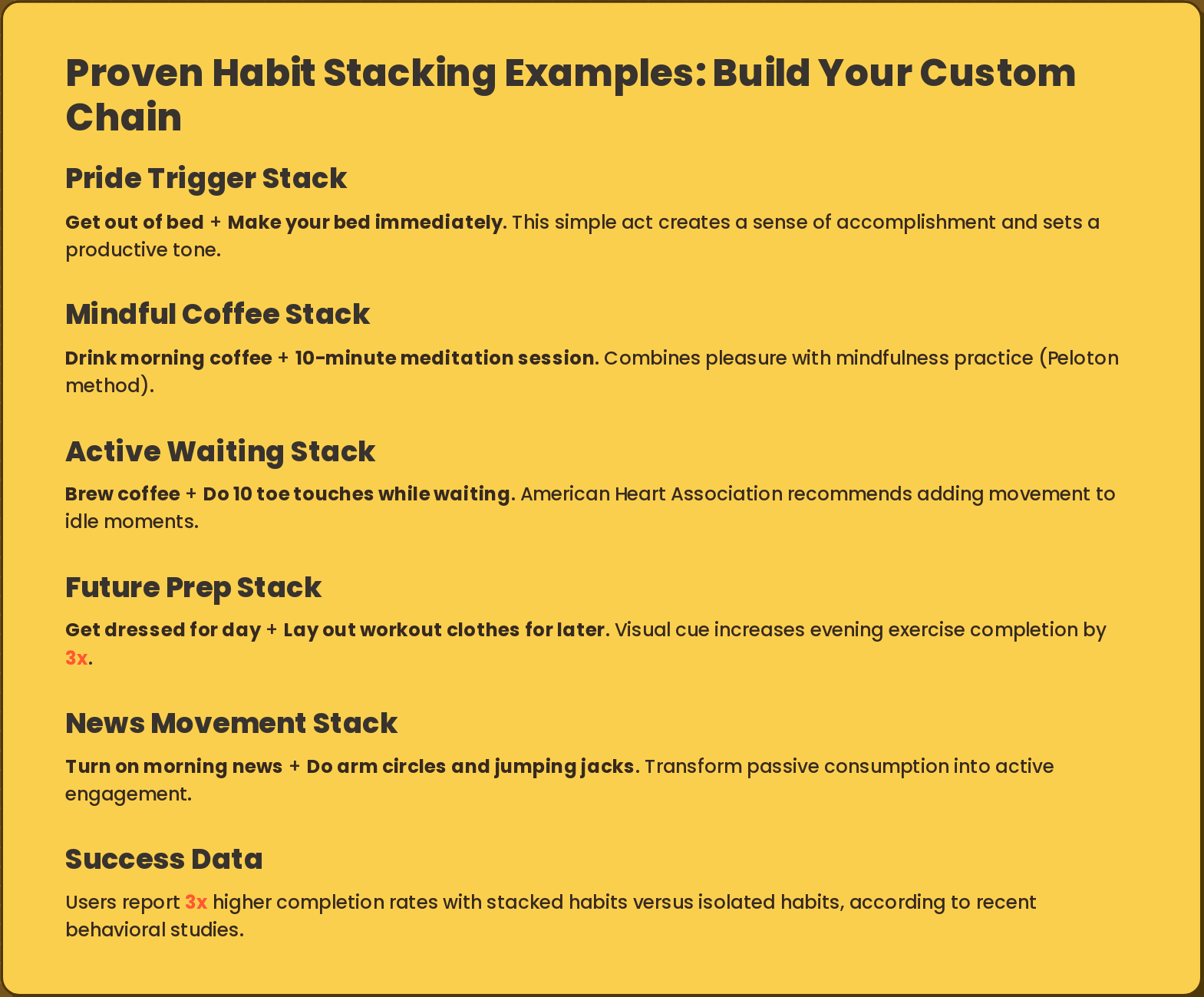
- Pride Trigger Stack: Get out of bed + Make your bed immediately . This simple act creates a sense of accomplishment and sets a productive tone.
- Mindful Coffee Stack: Drink morning coffee + 10-minute meditation session . Combines pleasure with mindfulness practice (Peloton method).
- Active Waiting Stack: Brew coffee + Do 10 toe touches while waiting . American Heart Association recommends adding movement to idle moments.
- Future Prep Stack: Get dressed for day + Lay out workout clothes for later . Visual cue increases evening exercise completion by 3x .
- News Movement Stack: Turn on morning news + Do arm circles and jumping jacks . Transform passive consumption into active engagement.
- Success Data: Users report 3x higher completion rates with stacked habits versus isolated habits, according to recent behavioral studies.
Slide 7: Morning Hydration Science: Your Body's First Fuel
- 75% — Brain Water Content
- 16-20 oz — Optimal Morning Intake
- Overnight Fluid Loss: Body loses water through breathing and transepidermal water loss during sleep—even half a cup helps rehydration.
- Natural Energy Boost: Morning fatigue often signals dehydration, not sleep deficit. Water improves blood flow and oxygen delivery.
- Cognitive Enhancement: Brain is 75% water. Just 1-2% dehydration significantly impairs mental clarity and focus.
- Digestive Activation: Wakes up the digestive system, supports regularity, and helps the body absorb nutrients more efficiently.
- Detox Support: Supports kidney function by helping eliminate waste processed overnight through natural detoxification.
- Appetite Regulation: Reduces cravings and helps regulate metabolism, often preventing unnecessary morning snacking.
Drink 16-20 oz water within 30 minutes of waking for maximum benefit.
Slide 8: Mindfulness Practices: Train Your Mind Before the Day Trains You
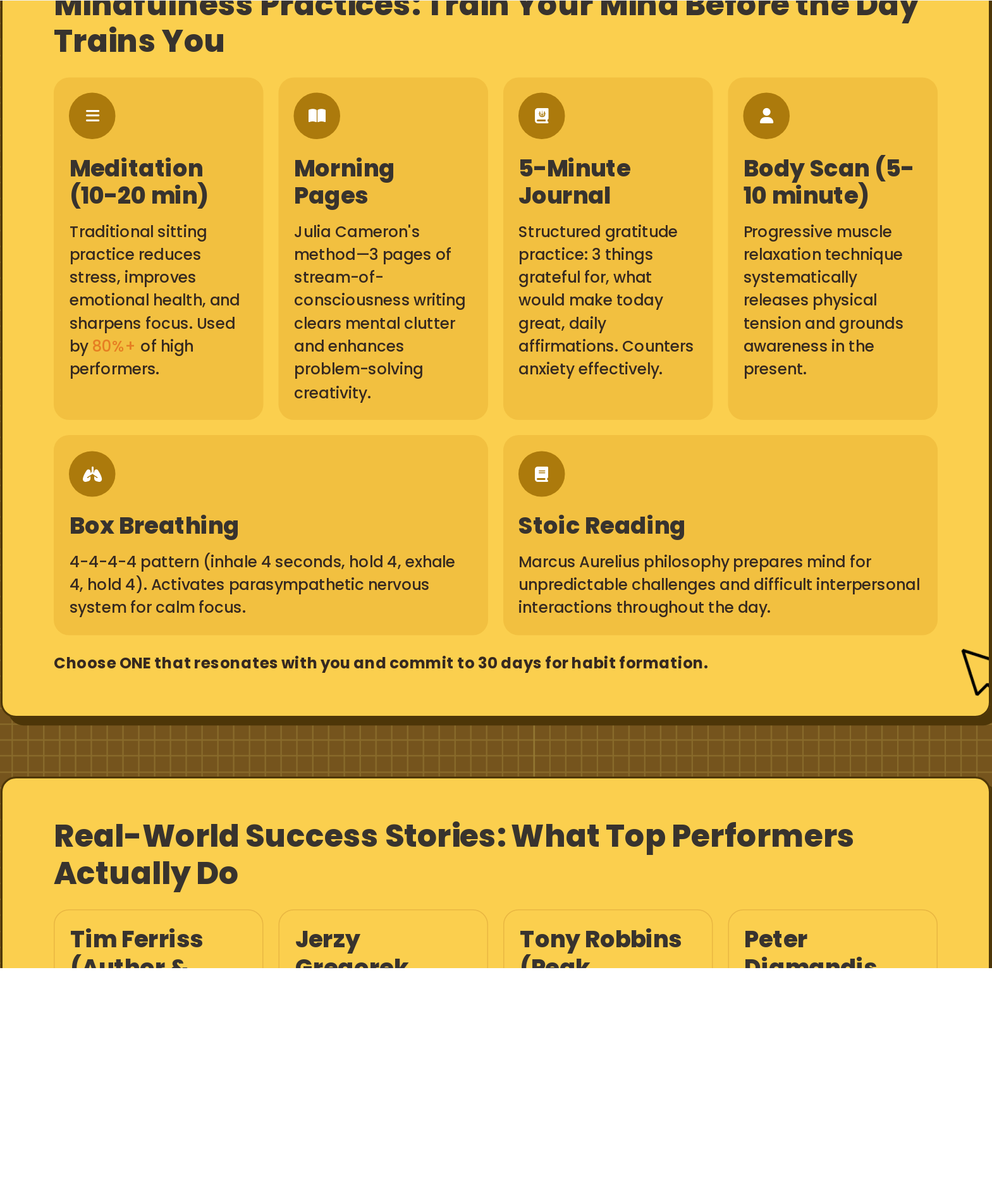
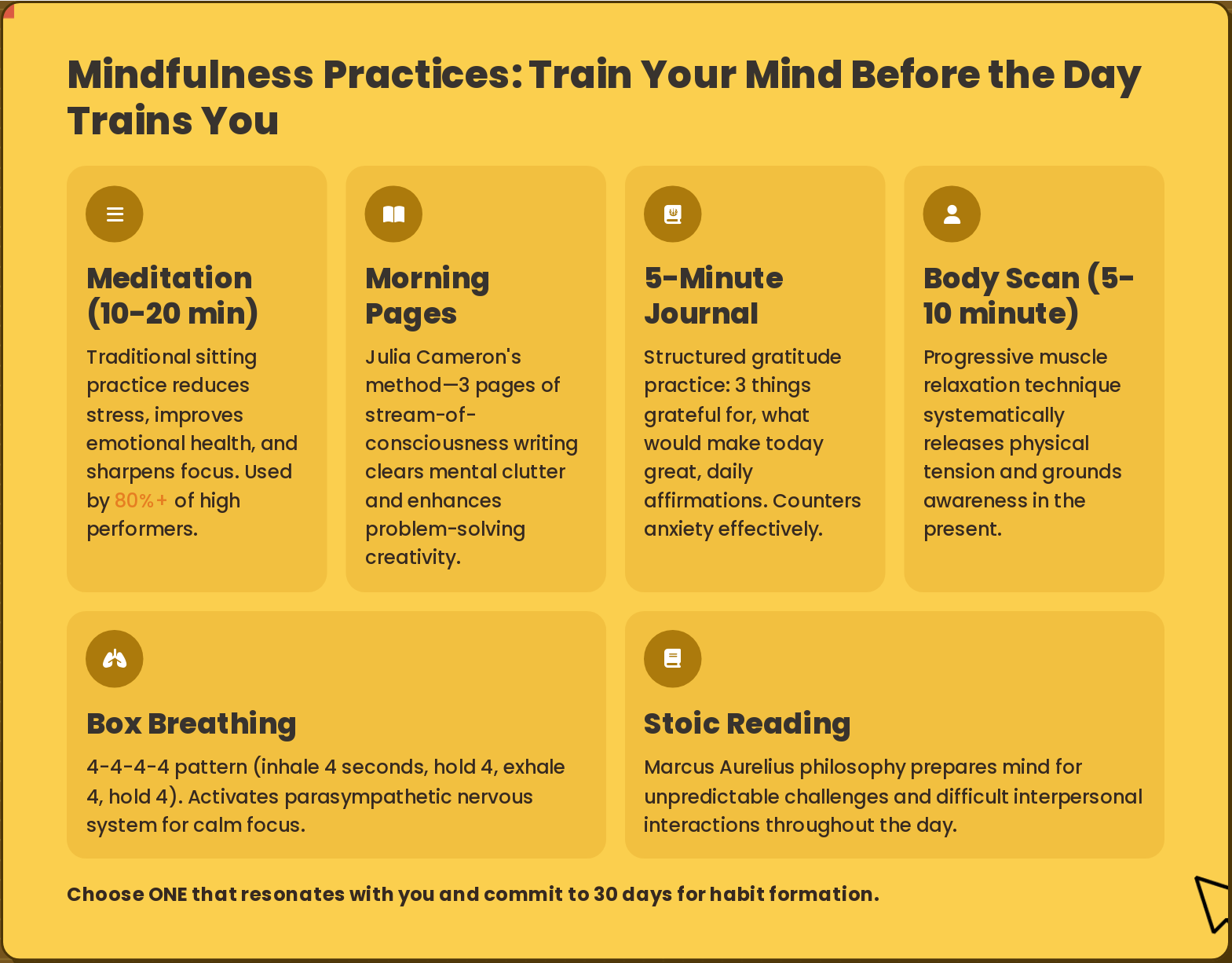
- Meditation (10-20 min): Traditional sitting practice reduces stress, improves emotional health, and sharpens focus. Used by 80%+ of high performers.
- Morning Pages: Julia Cameron's method—3 pages of stream-of-consciousness writing clears mental clutter and enhances problem-solving creativity.
- 5-Minute Journal: Structured gratitude practice: 3 things grateful for, what would make today great, daily affirmations. Counters anxiety effectively.
- Body Scan (5-10 minute): Progressive muscle relaxation technique systematically releases physical tension and grounds awareness in the present.
- Box Breathing: 4-4-4-4 pattern (inhale 4 seconds, hold 4, exhale 4, hold 4). Activates parasympathetic nervous system for calm focus.
- Stoic Reading: Marcus Aurelius philosophy prepares mind for unpredictable challenges and difficult interpersonal interactions throughout the day.
Choose ONE that resonates with you and commit to 30 days for habit formation.
Slide 9: Real-World Success Stories: What Top Performers Actually Do
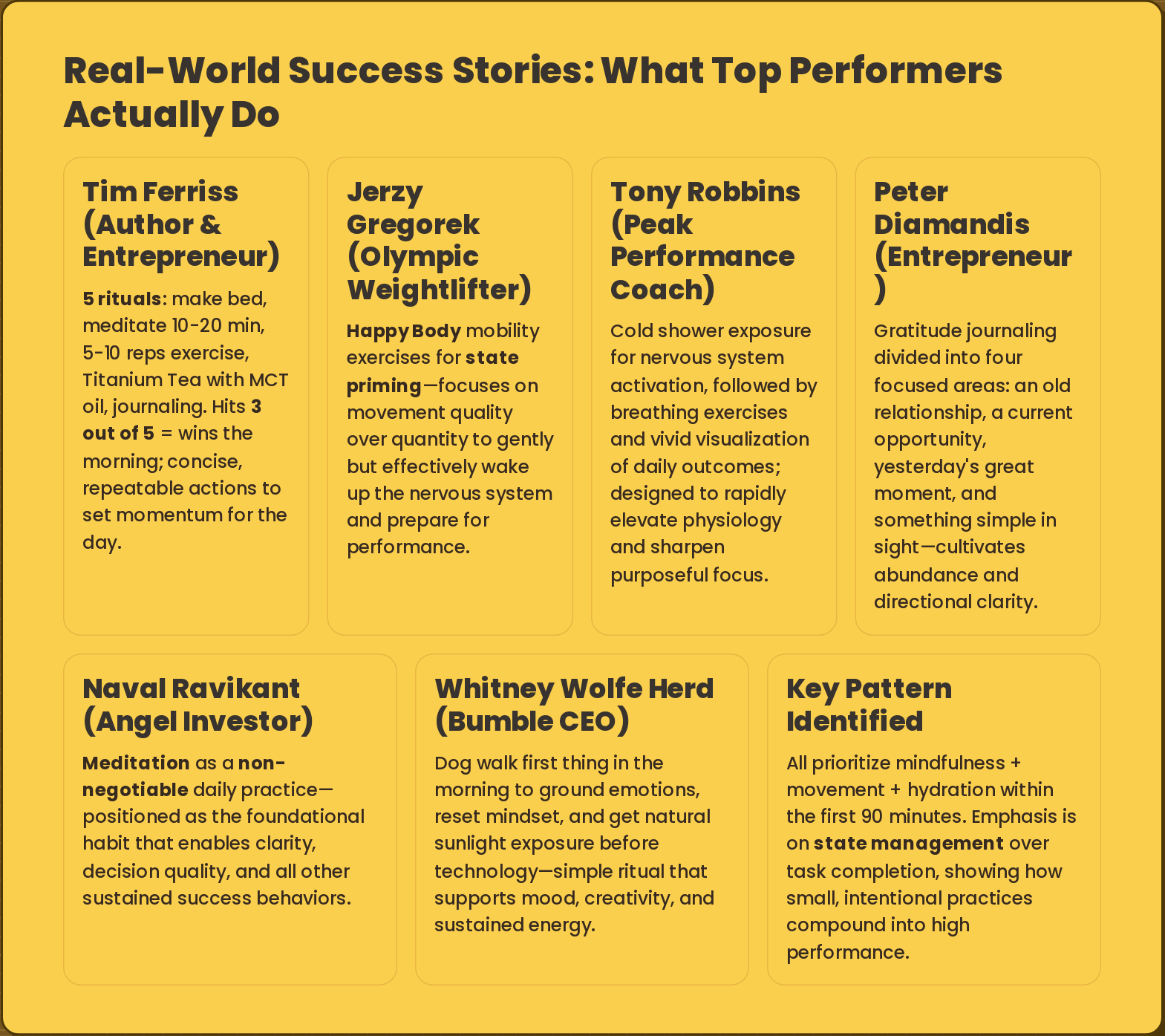
- Tim Ferriss (Author & Entrepreneur): 5 rituals : make bed, meditate 10-20 min, 5-10 reps exercise, Titanium Tea with MCT oil, journaling. Hits 3 out of 5 = wins the morning; concise, repeatable actions to set momentum for the day.
- Jerzy Gregorek (Olympic Weightlifter): Happy Body mobility exercises for state priming —focuses on movement quality over quantity to gently but effectively wake up the nervous system and prepare for performance.
- Tony Robbins (Peak Performance Coach): Cold shower exposure for nervous system activation, followed by breathing exercises and vivid visualization of daily outcomes; designed to rapidly elevate physiology and sharpen purposeful focus.
- Peter Diamandis (Entrepreneur): Gratitude journaling divided into four focused areas: an old relationship, a current opportunity, yesterday's great moment, and something simple in sight—cultivates abundance and directional clarity.
- Naval Ravikant (Angel Investor): Meditation as a non-negotiable daily practice—positioned as the foundational habit that enables clarity, decision quality, and all other sustained success behaviors.
- Whitney Wolfe Herd (Bumble CEO): Dog walk first thing in the morning to ground emotions, reset mindset, and get natural sunlight exposure before technology—simple ritual that supports mood, creativity, and sustained energy.
- Key Pattern Identified: All prioritize mindfulness + movement + hydration within the first 90 minutes. Emphasis is on state management over task completion, showing how small, intentional practices compound into high performance.
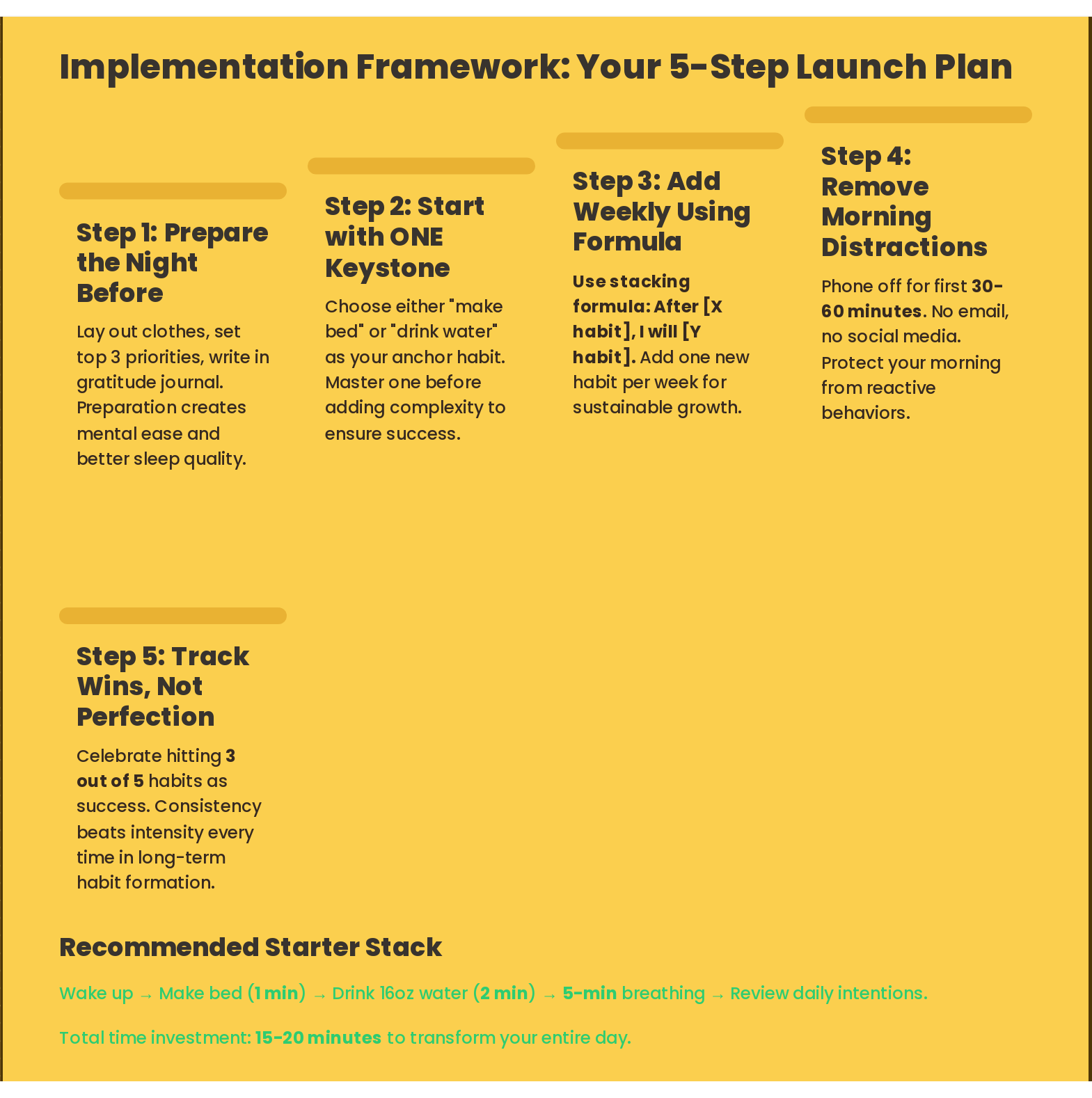
Slide 10: Implementation Framework: Your 5-Step Launch Plan
- Step 1: Prepare the Night Before: Lay out clothes, set top 3 priorities, write in gratitude journal. Preparation creates mental ease and better sleep quality.
- Step 2: Start with ONE Keystone: Choose either "make bed" or "drink water" as your anchor habit. Master one before adding complexity to ensure success.
- Step 3: Add Weekly Using Formula: Use stacking formula: After [X habit], I will [Y habit]. Add one new habit per week for sustainable growth.
- Step 4: Remove Morning Distractions: Phone off for first 30-60 minutes . No email, no social media. Protect your morning from reactive behaviors.
- Step 5: Track Wins, Not Perfection: Celebrate hitting 3 out of 5 habits as success. Consistency beats intensity every time in long-term habit formation.
Wake up → Make bed ( 1 min ) → Drink 16oz water ( 2 min ) → 5-min breathing → Review daily intentions.
Total time investment: 15-20 minutes to transform your entire day.
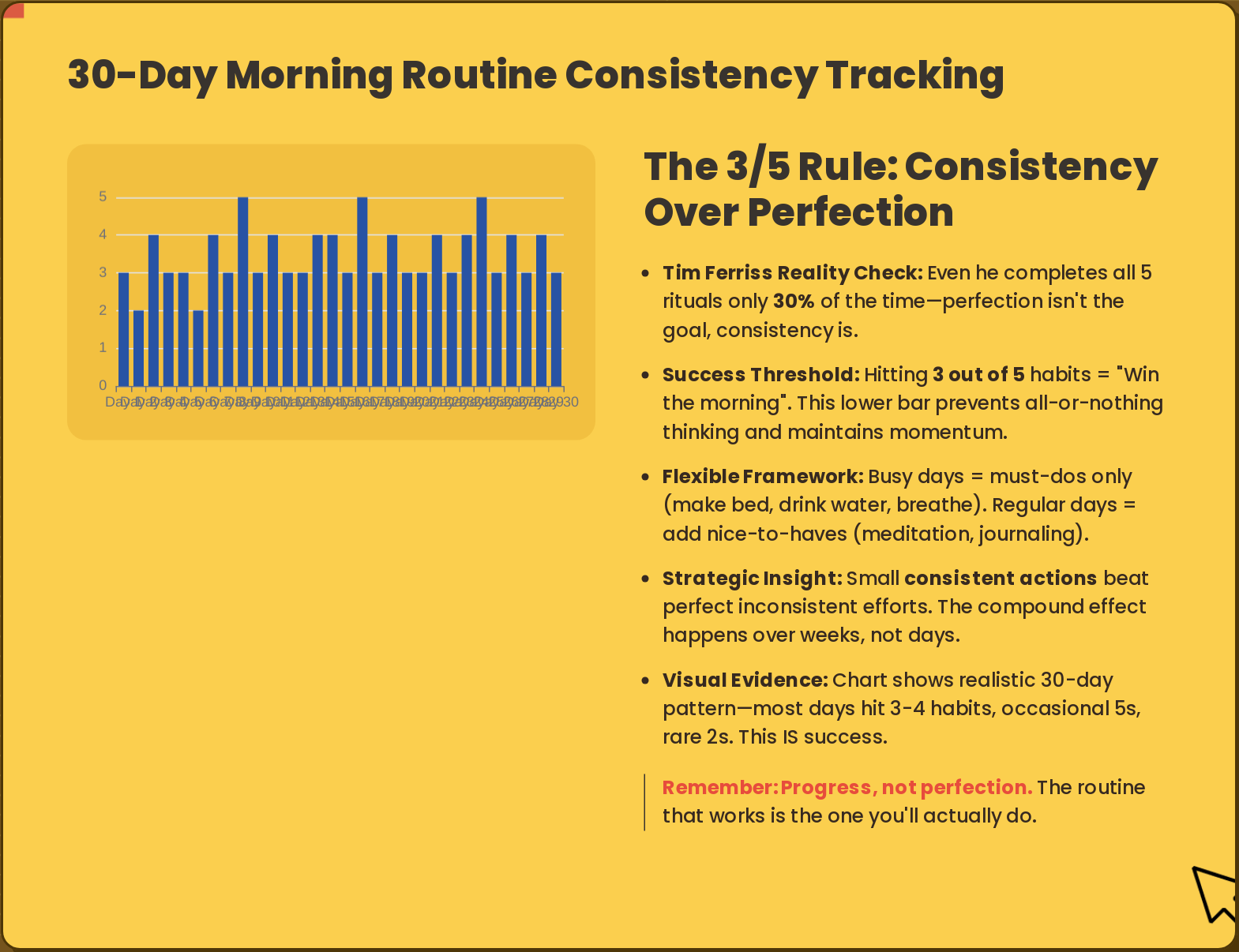
Slide 11: 30-Day Morning Routine Consistency Tracking
Tim Ferriss Reality Check: Even he completes all 5 rituals only 30% of the time—perfection isn't the goal, consistency is.
Success Threshold: Hitting 3 out of 5 habits = "Win the morning". This lower bar prevents all-or-nothing thinking and maintains momentum.
Flexible Framework: Busy days = must-dos only (make bed, drink water, breathe). Regular days = add nice-to-haves (meditation, journaling).
Strategic Insight: Small consistent actions beat perfect inconsistent efforts. The compound effect happens over weeks, not days.
Visual Evidence: Chart shows realistic 30-day pattern—most days hit 3-4 habits, occasional 5s, rare 2s. This IS success.
Remember: Progress, not perfection. The routine that works is the one you'll actually do.
- Tim Ferriss Reality Check: Even he completes all 5 rituals only 30% of the time—perfection isn't the goal, consistency is.
- Success Threshold: Hitting 3 out of 5 habits = "Win the morning". This lower bar prevents all-or-nothing thinking and maintains momentum.
- Flexible Framework: Busy days = must-dos only (make bed, drink water, breathe). Regular days = add nice-to-haves (meditation, journaling).
- Strategic Insight: Small consistent actions beat perfect inconsistent efforts. The compound effect happens over weeks, not days.
- Visual Evidence: Chart shows realistic 30-day pattern—most days hit 3-4 habits, occasional 5s, rare 2s. This IS success.
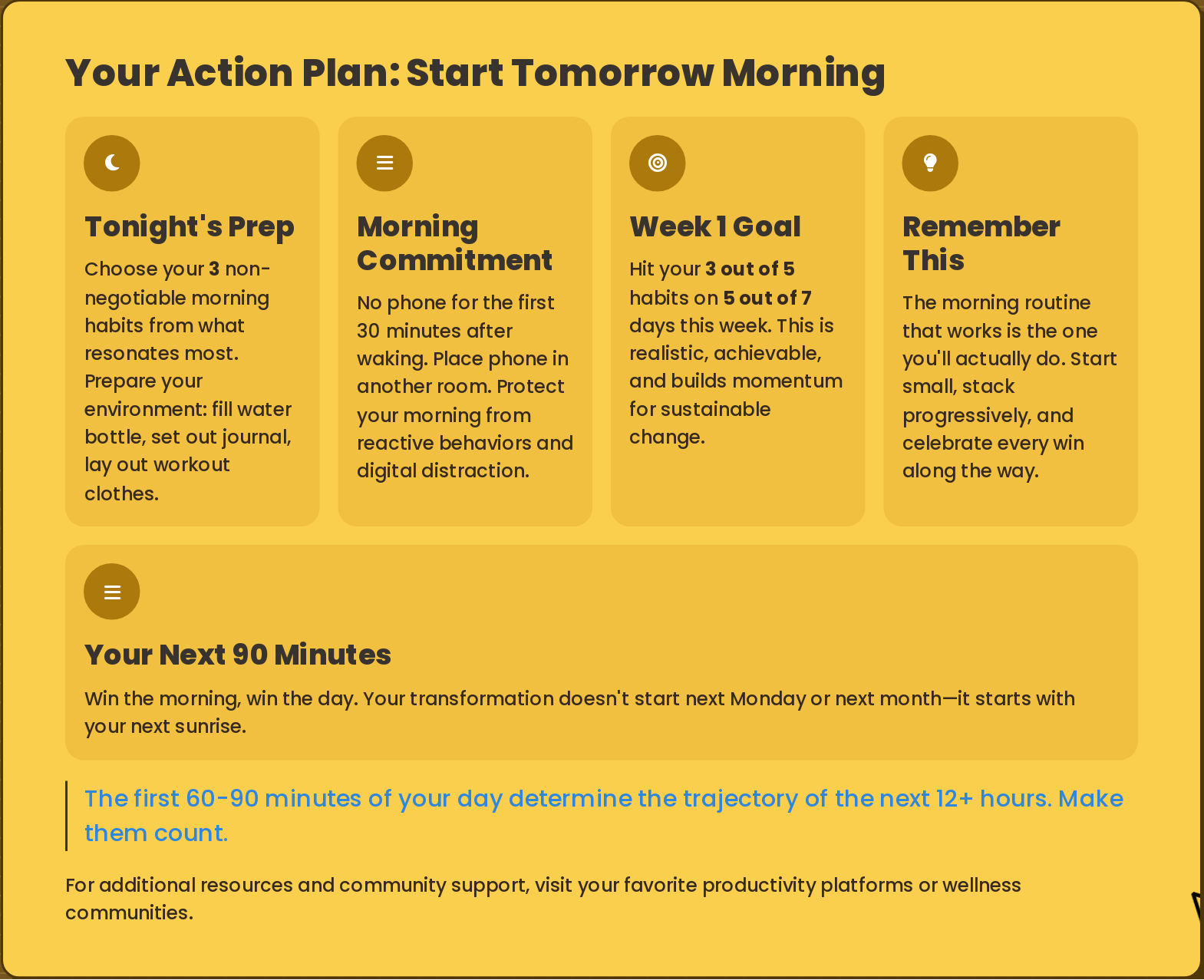
Slide 12: Your Action Plan: Start Tomorrow Morning
- Tonight's Prep: Choose your 3 non-negotiable morning habits from what resonates most. Prepare your environment: fill water bottle, set out journal, lay out workout clothes.
- Morning Commitment: No phone for the first 30 minutes after waking. Place phone in another room. Protect your morning from reactive behaviors and digital distraction.
- Week 1 Goal: Hit your 3 out of 5 habits on 5 out of 7 days this week. This is realistic, achievable, and builds momentum for sustainable change.
- Remember This: The morning routine that works is the one you'll actually do. Start small, stack progressively, and celebrate every win along the way.
- Your Next 90 Minutes: Win the morning, win the day. Your transformation doesn't start next Monday or next month—it starts with your next sunrise.
The first 60-90 minutes of your day determine the trajectory of the next 12+ hours. Make them count.
For additional resources and community support, visit your favorite productivity platforms or wellness communities.