


Presentation Summary
The Kano Model is a strategic framework for product managers to categorize features into Basic Needs, Performance Needs, and Excitement Needs, optimizing resource allocation and maximizing customer satisfaction.
Full Presentation Transcript
Slide 1: The Kano Model for Product Prioritization
A Strategic Framework for Feature Planning Maximizing Customer Satisfaction Through Scientific Feature Categorization
Slide 2: Contents
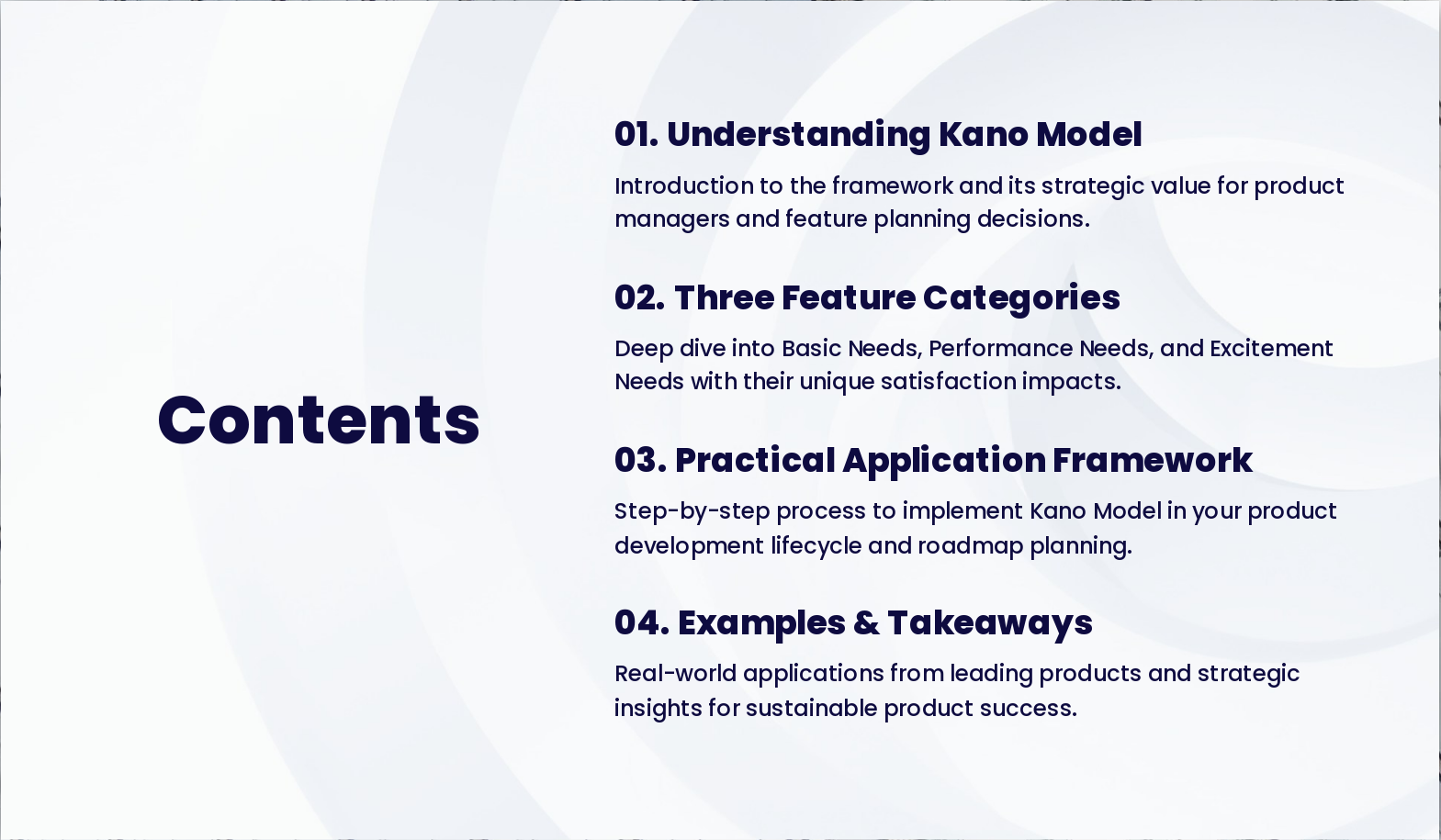
- Understanding Kano Model: Introduction to the framework and its strategic value for product managers and feature planning decisions.
- Three Feature Categories: Deep dive into Basic Needs, Performance Needs, and Excitement Needs with their unique satisfaction impacts.
- Practical Application Framework: Step-by-step process to implement Kano Model in your product development lifecycle and roadmap planning.
- Examples & Takeaways: Real-world applications from leading products and strategic insights for sustainable product success.
Slide 3: The Kano Model: Origin & Purpose
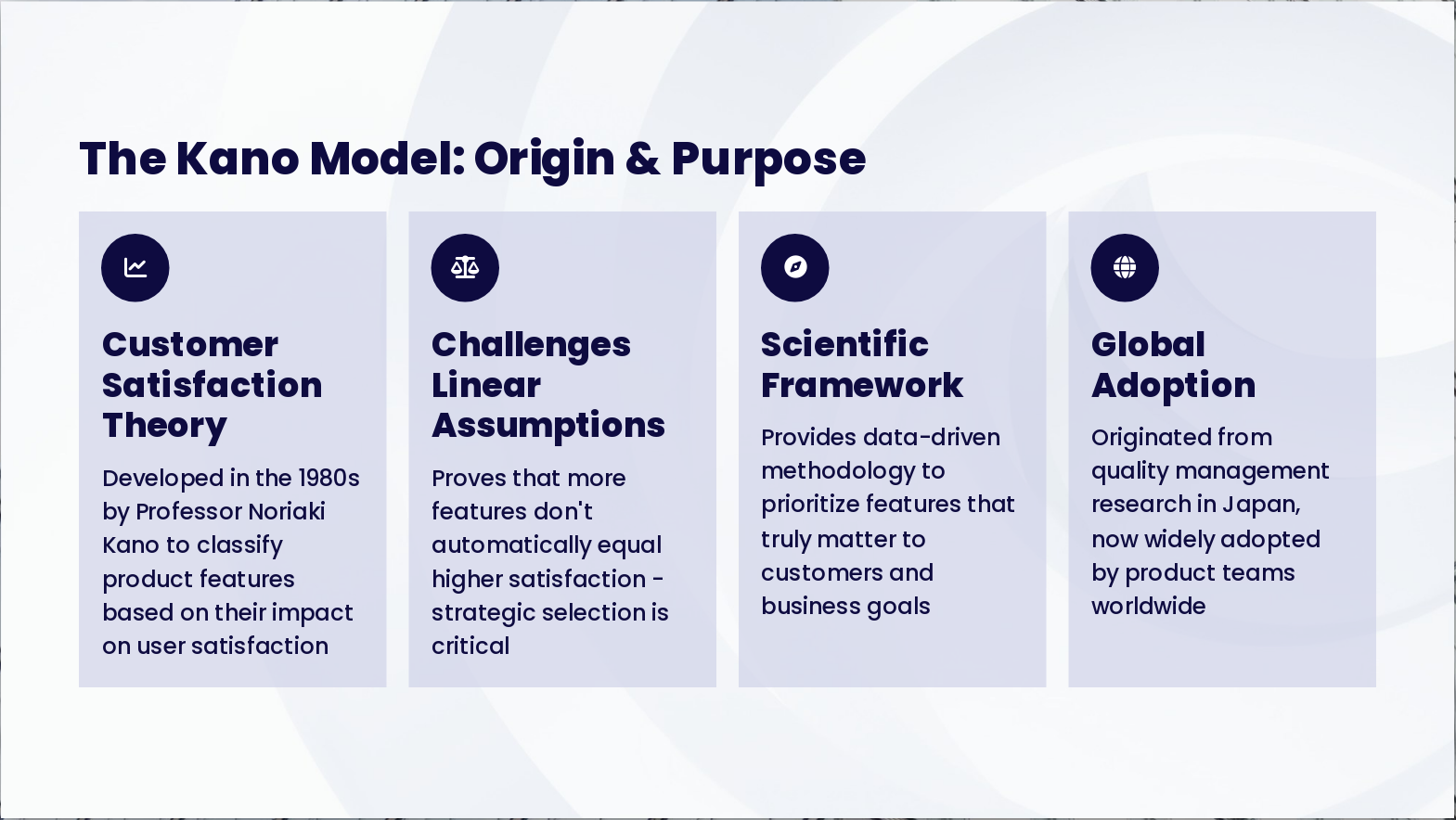
- Customer Satisfaction Theory: Developed in the 1980s by Professor Noriaki Kano to classify product features based on their impact on user satisfaction
- Challenges Linear Assumptions: Proves that more features don't automatically equal higher satisfaction - strategic selection is critical
- Scientific Framework: Provides data-driven methodology to prioritize features that truly matter to customers and business goals
- Global Adoption: Originated from quality management research in Japan, now widely adopted by product teams worldwide
Slide 4: Why Product Managers Need the Kano Model
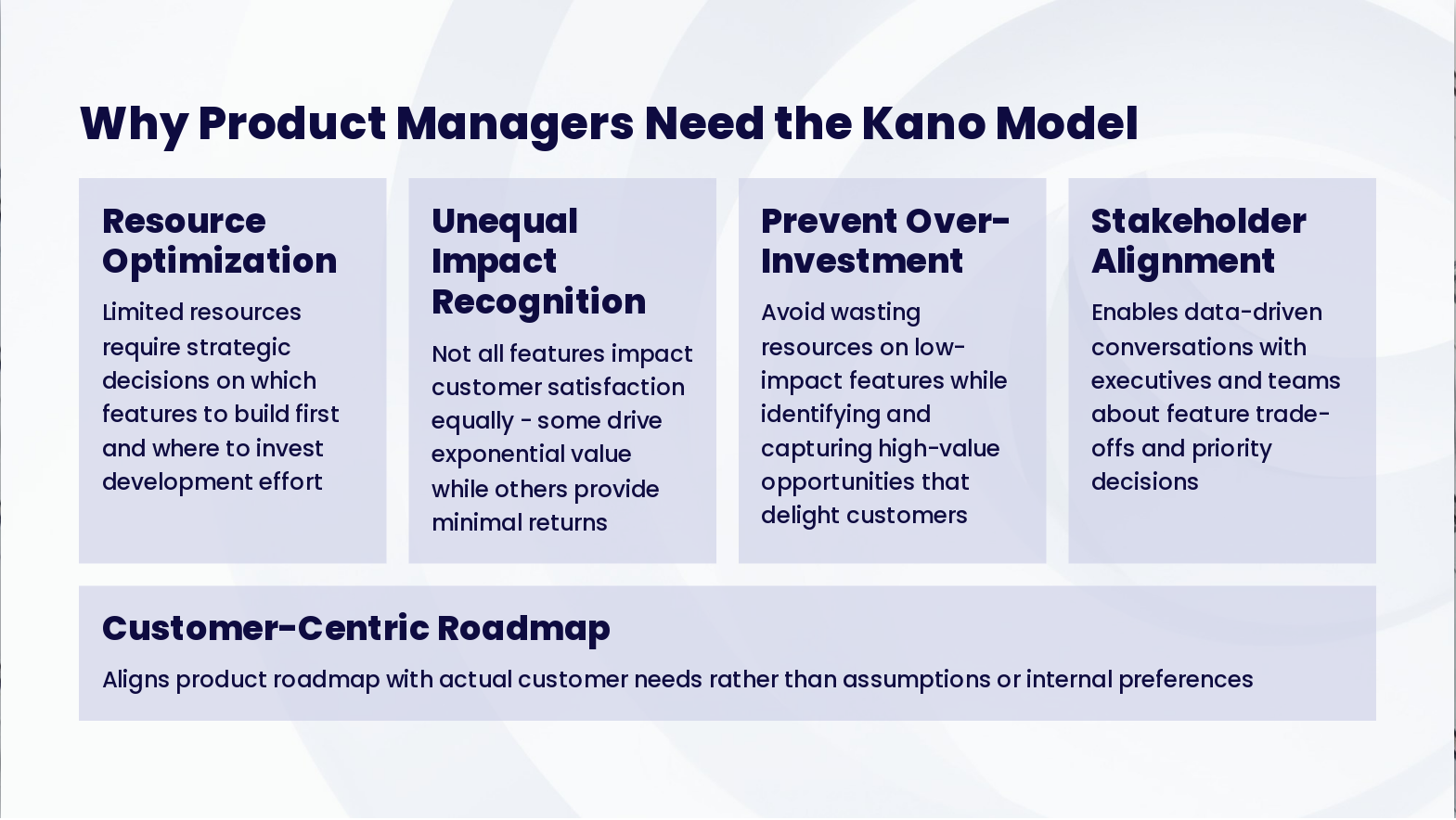
- Resource Optimization: Limited resources require strategic decisions on which features to build first and where to invest development effort
- Unequal Impact Recognition: Not all features impact customer satisfaction equally - some drive exponential value while others provide minimal returns
- Prevent Over-Investment: Avoid wasting resources on low-impact features while identifying and capturing high-value opportunities that delight customers
- Stakeholder Alignment: Enables data-driven conversations with executives and teams about feature trade-offs and priority decisions
- Customer-Centric Roadmap: Aligns product roadmap with actual customer needs rather than assumptions or internal preferences
Slide 5: Kano Framework: Five Feature Categories
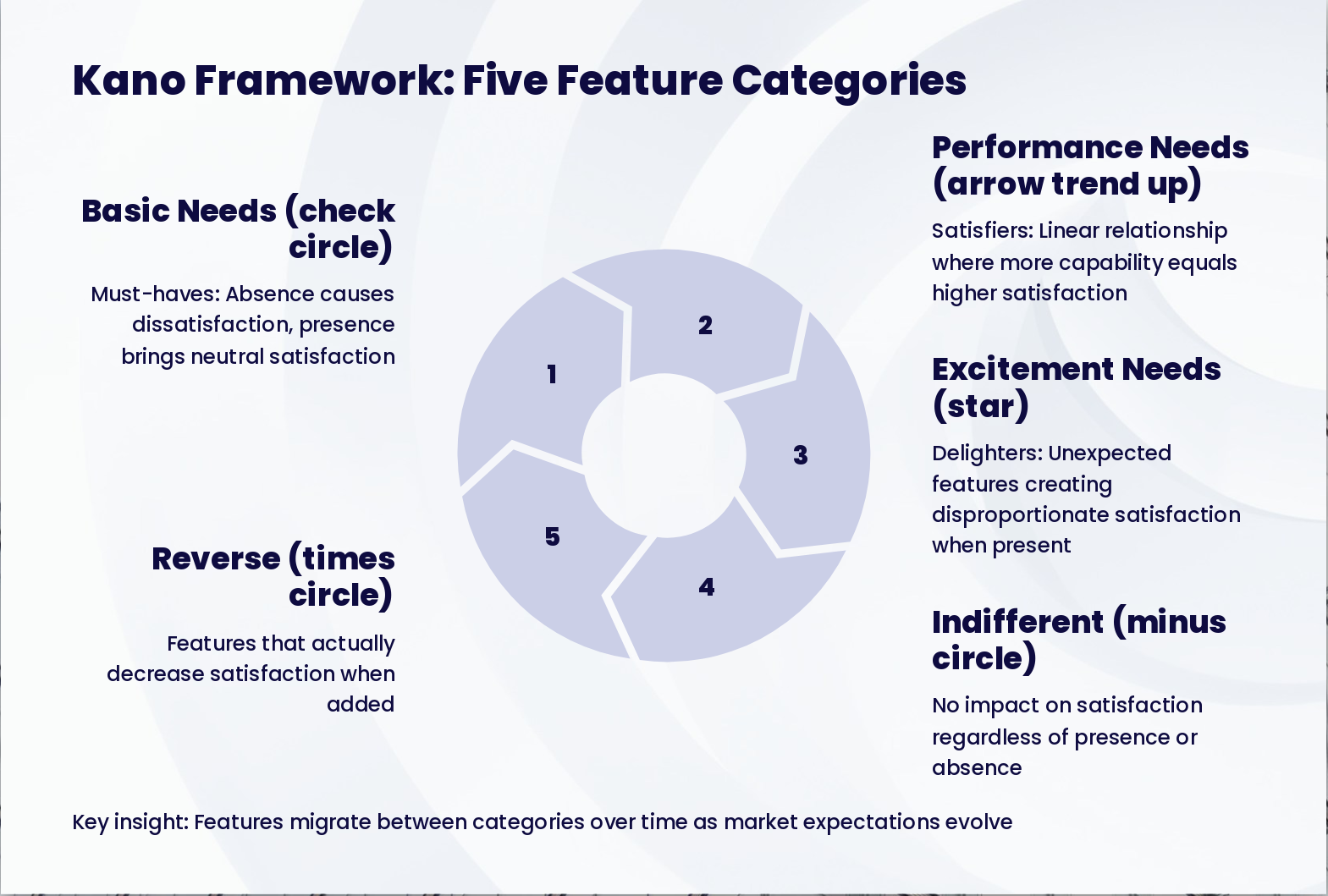
- Basic Needs (check circle): Must-haves: Absence causes dissatisfaction, presence brings neutral satisfaction
- Performance Needs (arrow trend up): Satisfiers: Linear relationship where more capability equals higher satisfaction
- Excitement Needs (star): Delighters: Unexpected features creating disproportionate satisfaction when present
- Indifferent (minus circle): No impact on satisfaction regardless of presence or absence
- Reverse (times circle): Features that actually decrease satisfaction when added
Key insight: Features migrate between categories over time as market expectations evolve
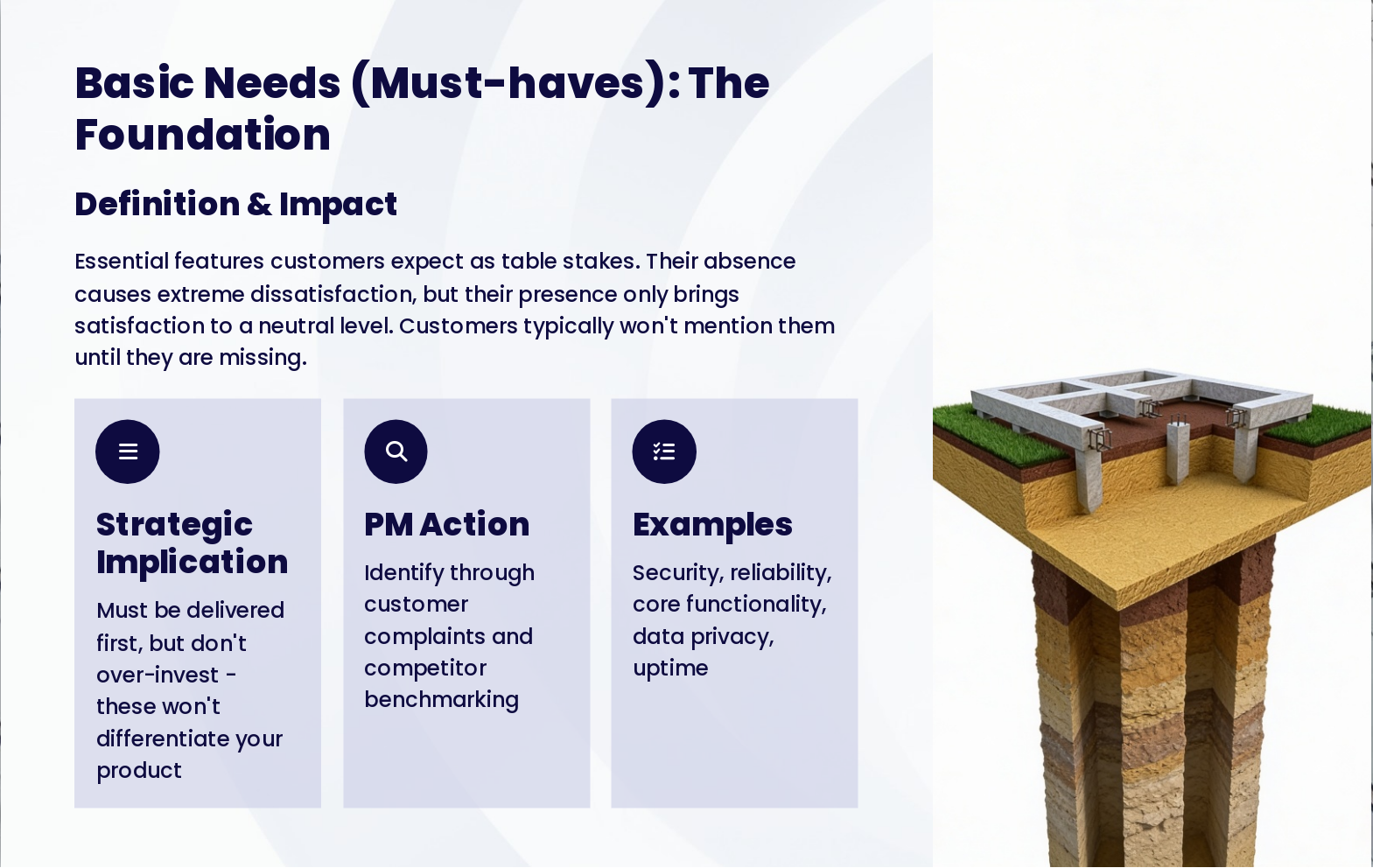
Slide 6: Basic Needs (Must-haves): The Foundation
- Strategic Implication: Must be delivered first, but don't over-invest - these won't differentiate your product
- PM Action: Identify through customer complaints and competitor benchmarking
- Examples: Security, reliability, core functionality, data privacy, uptime
Essential features customers expect as table stakes. Their absence causes extreme dissatisfaction, but their presence only brings satisfaction to a neutral level. Customers typically won't mention them until they are missing.
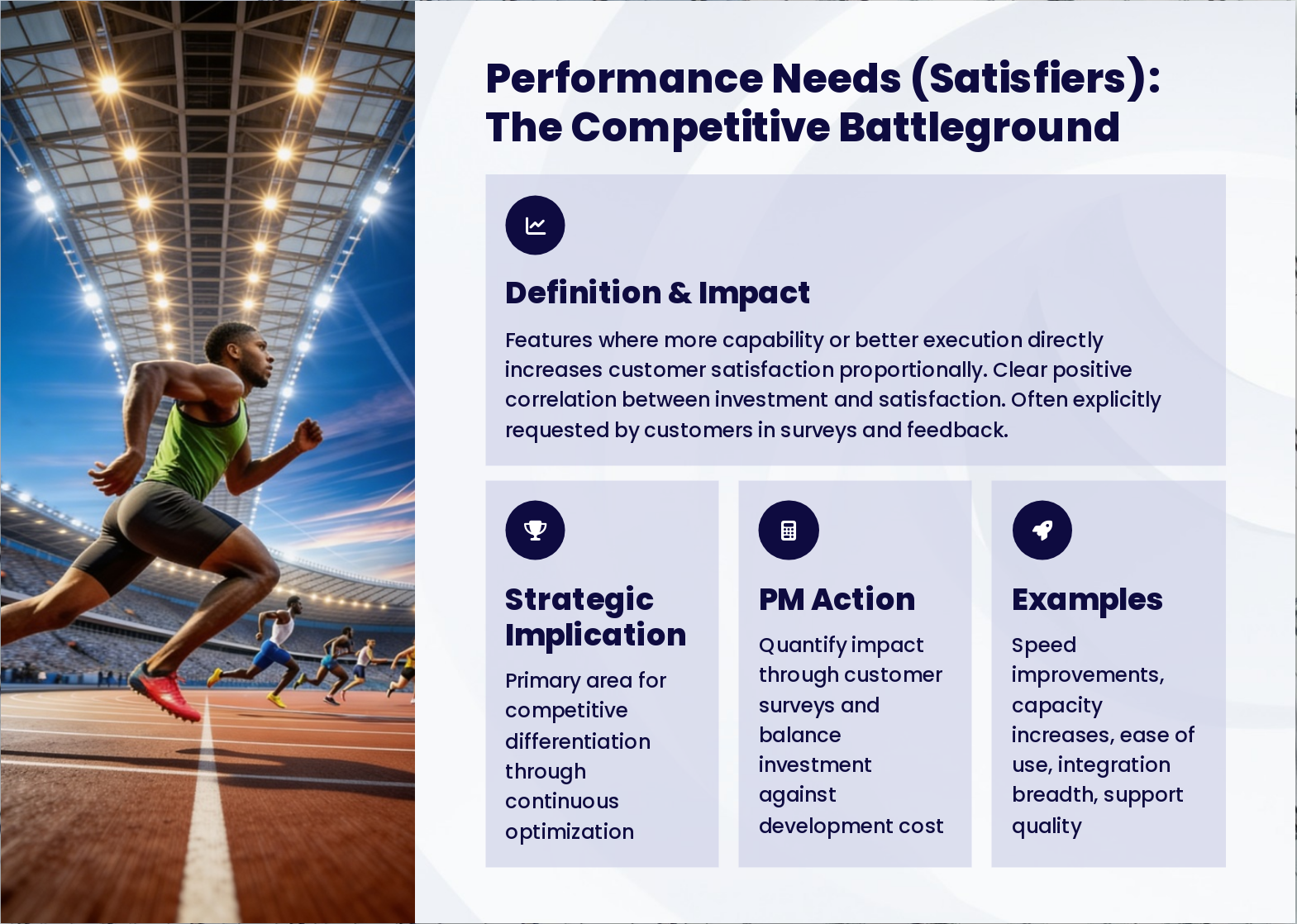
Slide 7: Performance Needs (Satisfiers): The Competitive Battleground
- Definition & Impact: Features where more capability or better execution directly increases customer satisfaction proportionally. Clear positive correlation between investment and satisfaction. Often explicitly requested by customers in surveys and feedback.
- Strategic Implication: Primary area for competitive differentiation through continuous optimization
- PM Action: Quantify impact through customer surveys and balance investment against development cost
- Examples: Speed improvements, capacity increases, ease of use, integration breadth, support quality
Slide 8: Excitement Needs (Delighters): The Game-Changer
- Strategic Implication: Source of breakthrough differentiation and competitive moat with highest risk-reward ratio
- PM Action: Identify through customer observation and pain point analysis beyond stated requirements
- Lifecycle Note: Today's delighters become tomorrow's basic needs as markets mature
Surprising features customers don't expect but create disproportionate delight when present. Absence doesn't cause dissatisfaction, but presence creates emotional connection and word-of-mouth promotion.
Netflix autoplay next episode
Spotify Discover Weekly
iPhone Face ID unlock
- Netflix autoplay next episode
- Spotify Discover Weekly
- iPhone Face ID unlock
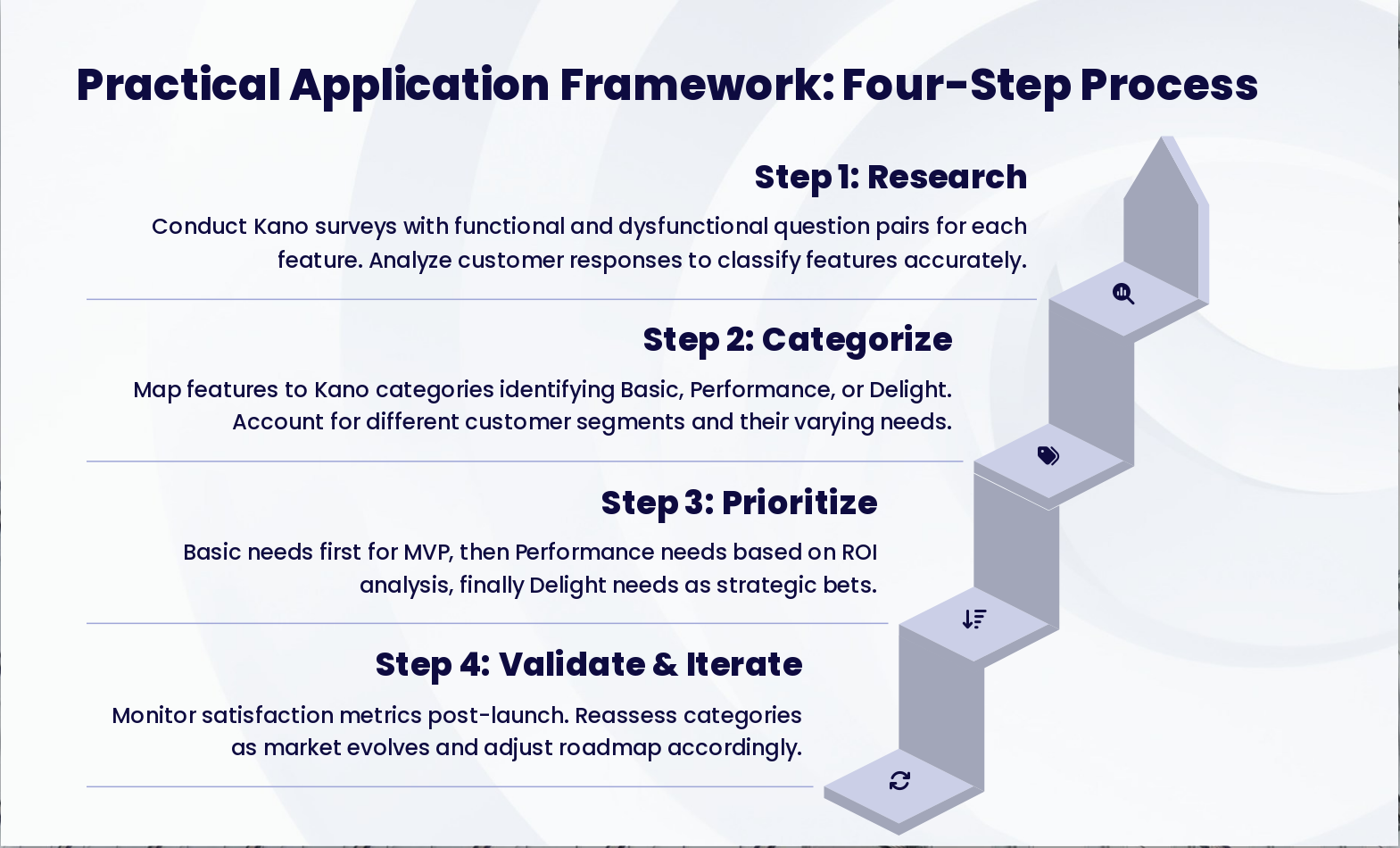
Slide 9: Practical Application Framework: Four-Step Process
- Step 1: Research: Conduct Kano surveys with functional and dysfunctional question pairs for each feature. Analyze customer responses to classify features accurately.
- Step 2: Categorize: Map features to Kano categories identifying Basic, Performance, or Delight. Account for different customer segments and their varying needs.
- Step 3: Prioritize: Basic needs first for MVP, then Performance needs based on ROI analysis, finally Delight needs as strategic bets.
- Step 4: Validate & Iterate: Monitor satisfaction metrics post-launch. Reassess categories as market evolves and adjust roadmap accordingly.
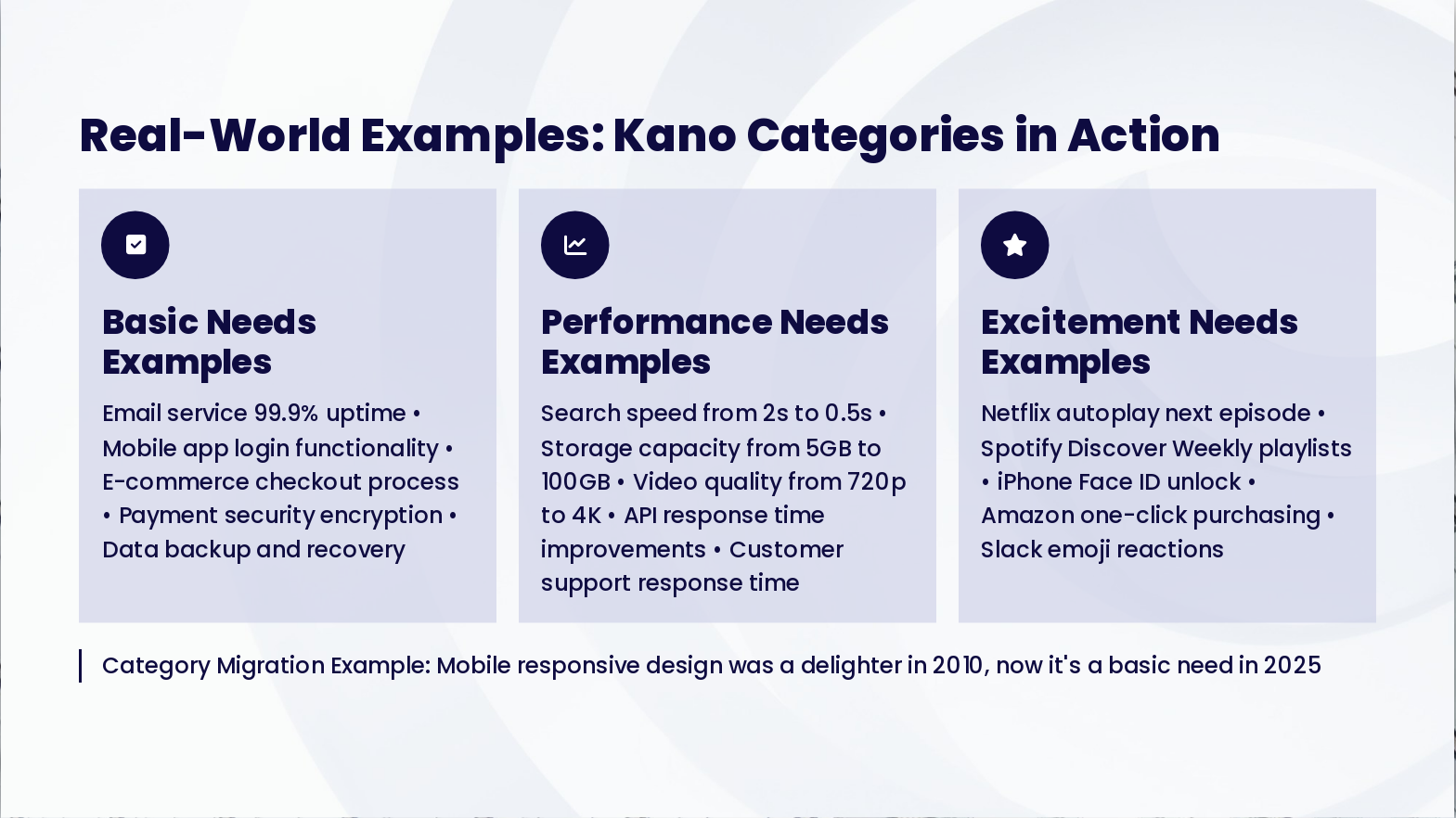
Slide 10: Real-World Examples: Kano Categories in Action
- Basic Needs Examples: Email service 99.9% uptime • Mobile app login functionality • E-commerce checkout process • Payment security encryption • Data backup and recovery
- Performance Needs Examples: Search speed from 2s to 0.5s • Storage capacity from 5GB to 100GB • Video quality from 720p to 4K • API response time improvements • Customer support response time
- Excitement Needs Examples: Netflix autoplay next episode • Spotify Discover Weekly playlists • iPhone Face ID unlock • Amazon one-click purchasing • Slack emoji reactions
Category Migration Example: Mobile responsive design was a delighter in 2010, now it's a basic need in 2025
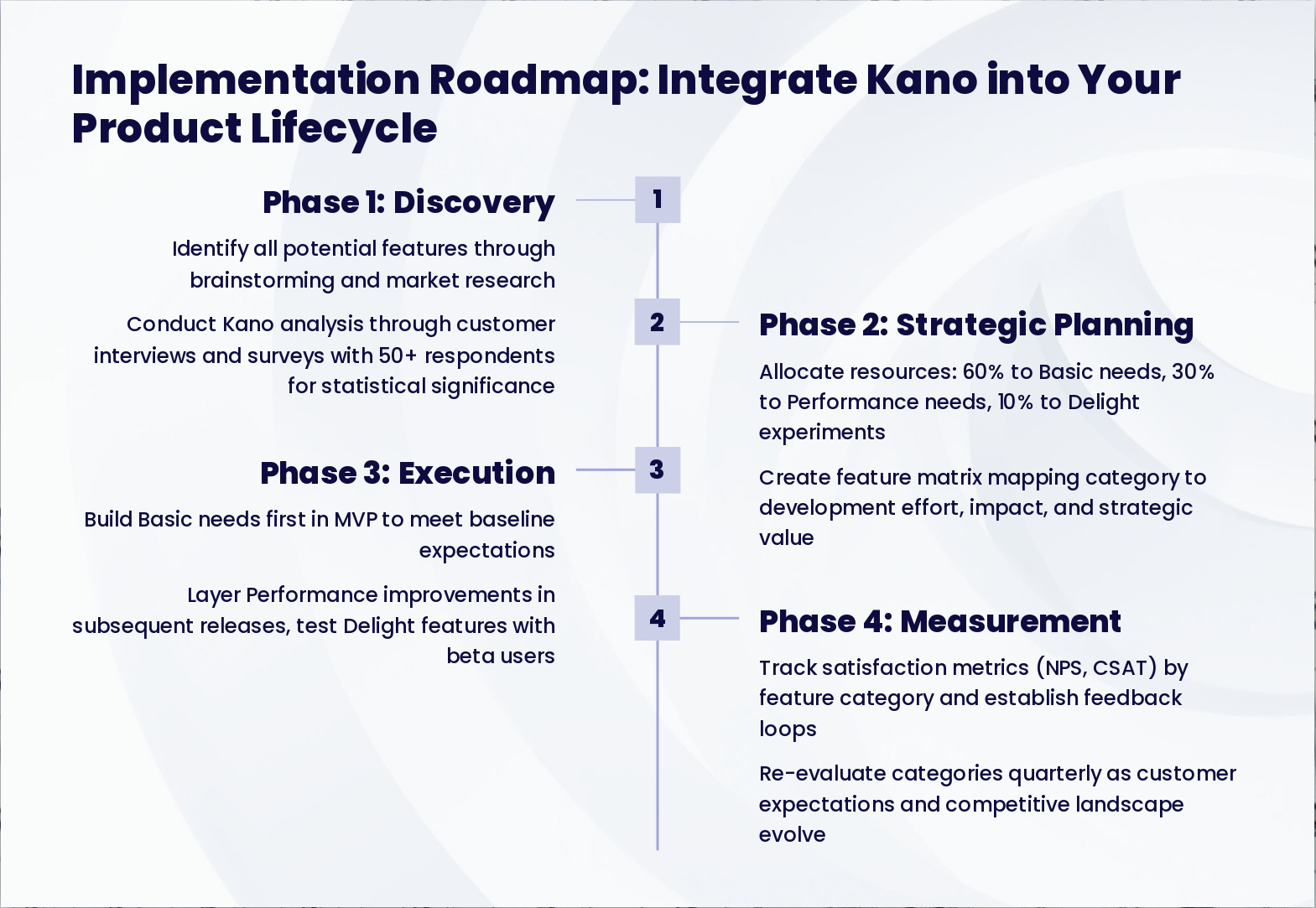
Slide 11: Implementation Roadmap: Integrate Kano into Your Product Lifecycle
- Phase 1: Discovery: Identify all potential features through brainstorming and market research
- Phase 2: Strategic Planning: Allocate resources: 60% to Basic needs, 30% to Performance needs, 10% to Delight experiments
- Phase 3: Execution: Build Basic needs first in MVP to meet baseline expectations
- Phase 4: Measurement: Track satisfaction metrics (NPS, CSAT) by feature category and establish feedback loops
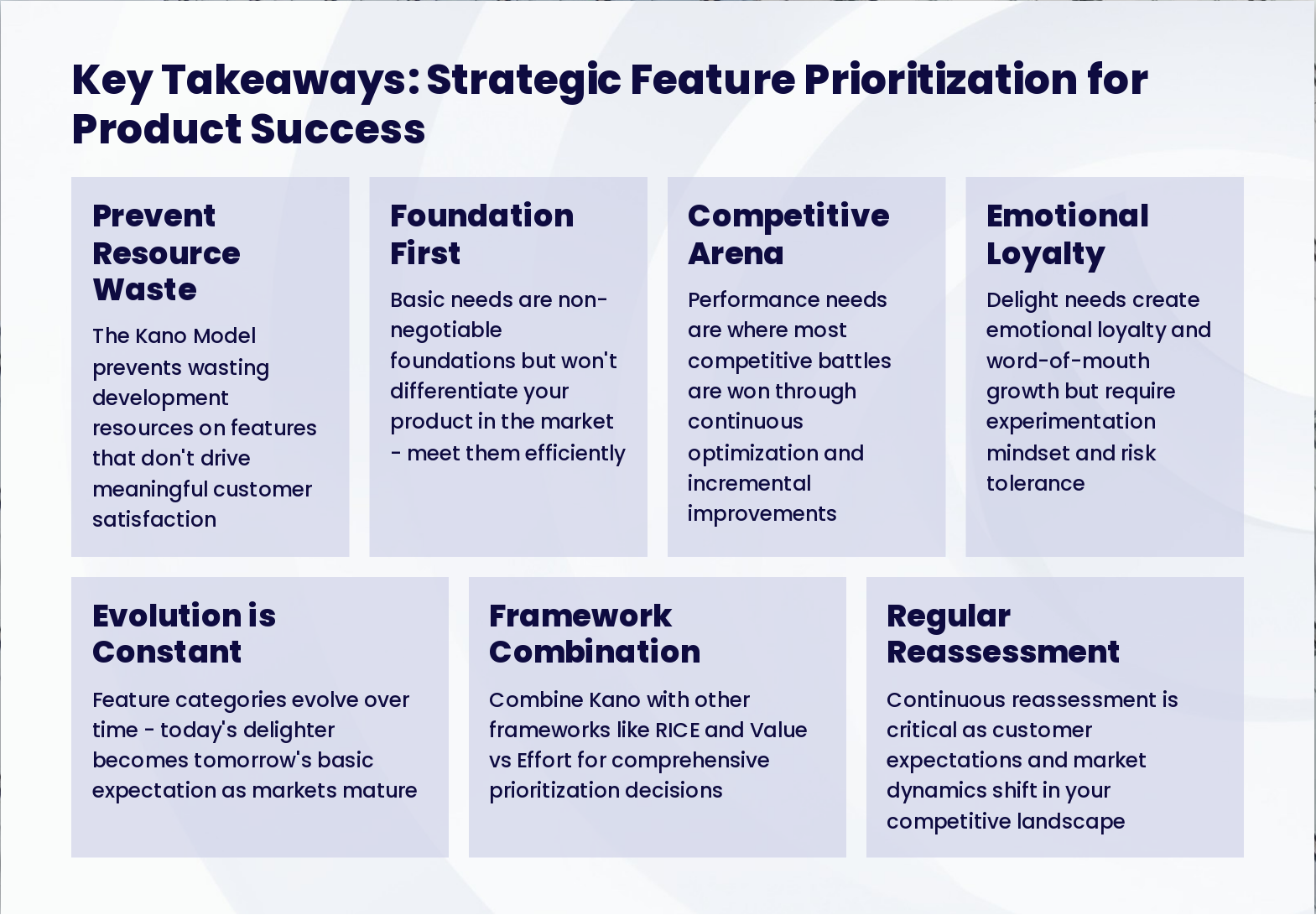
Slide 12: Key Takeaways: Strategic Feature Prioritization for Product Success
- Prevent Resource Waste: The Kano Model prevents wasting development resources on features that don't drive meaningful customer satisfaction
- Foundation First: Basic needs are non-negotiable foundations but won't differentiate your product in the market - meet them efficiently
- Competitive Arena: Performance needs are where most competitive battles are won through continuous optimization and incremental improvements
- Emotional Loyalty: Delight needs create emotional loyalty and word-of-mouth growth but require experimentation mindset and risk tolerance
- Evolution is Constant: Feature categories evolve over time - today's delighter becomes tomorrow's basic expectation as markets mature
- Framework Combination: Combine Kano with other frameworks like RICE and Value vs Effort for comprehensive prioritization decisions
- Regular Reassessment: Continuous reassessment is critical as customer expectations and market dynamics shift in your competitive landscape
Slide 13: Thank You
Thank You Start prioritizing features that truly matter to your customers and drive sustainable product success