Presentation Summary
Explore Jaden Ivey's journey from elite prospect to free agency, detailing his contract structure, trade implications, and future financial projections.
Full Presentation Transcript
Slide 1: The Jaden Ivey Contract Story: From Elite Prospect to Free Agency at 24
Comprehensive Analysis of Rookie Contract Structure, Trade Implications, Extension Scenarios, and Future Financial Projections
Slide 2: Agenda: Five-Part Framework
- Part 1 - Foundation: Who is Jaden Ivey and his draft context
- Part 2 - Initial Economics: Rookie contract structure and Spotrac salary details
- Part 3 - Extension Reality: Why a deal wasn't reached and market comparisons
- Part 4 - Trade Impact: February 2026 Bulls acquisition and implications
- Part 5 - Future Path: RFA timeline and predicted salary ranges
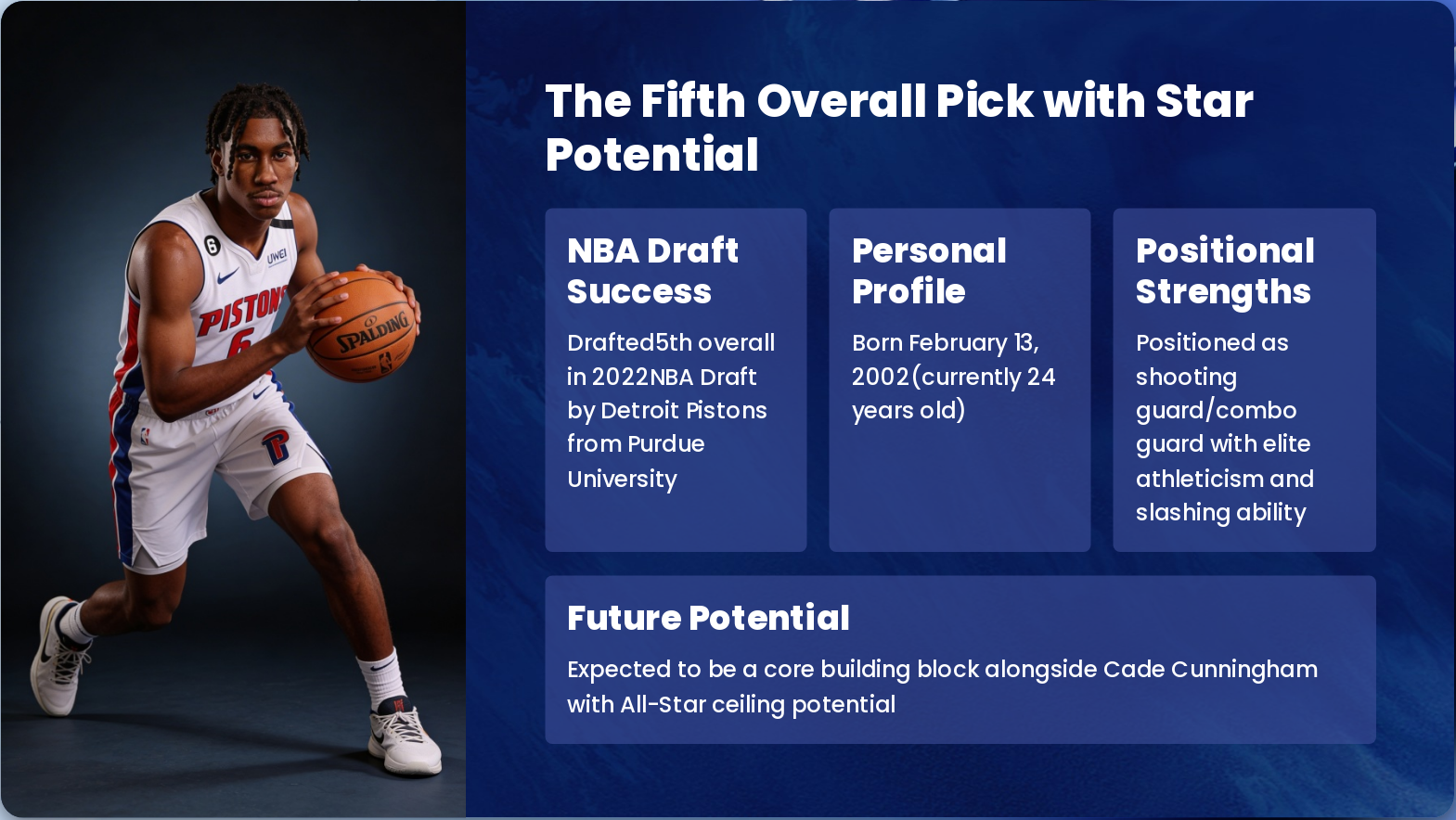
Slide 3: The Fifth Overall Pick with Star Potential
- NBA Draft Success: Drafted5th overall in 2022NBA Draft by Detroit Pistons from Purdue University
- Personal Profile: Born February 13, 2002(currently 24 years old)
- Positional Strengths: Positioned as shooting guard/combo guard with elite athleticism and slashing ability
- Future Potential: Expected to be a core building block alongside Cade Cunningham with All-Star ceiling potential
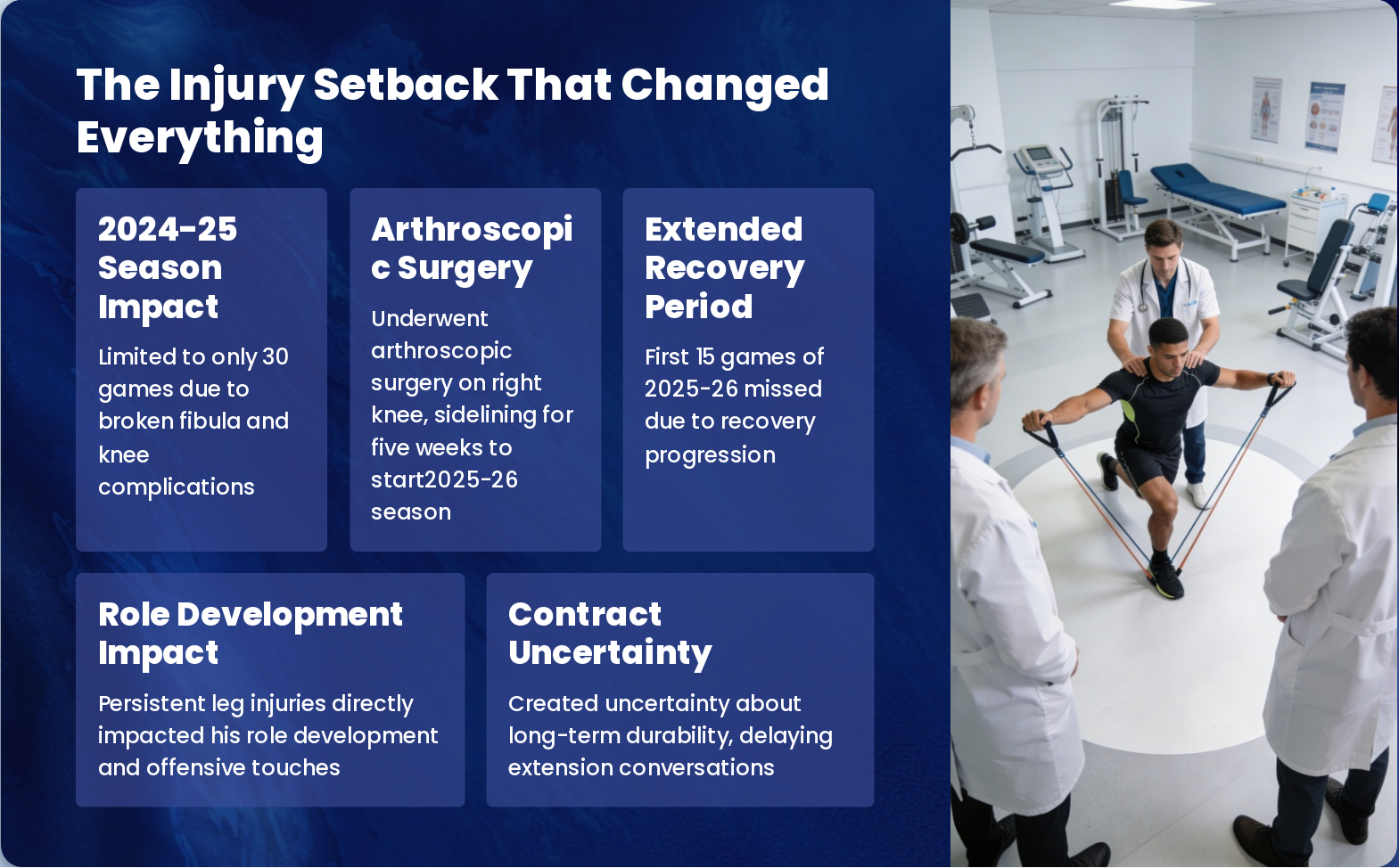
Slide 4: The Injury Setback That Changed Everything
- 2024-25 Season Impact: Limited to only 30 games due to broken fibula and knee complications
- Arthroscopic Surgery: Underwent arthroscopic surgery on right knee, sidelining for five weeks to start2025-26 season
- Extended Recovery Period: First 15 games of 2025-26 missed due to recovery progression
- Role Development Impact: Persistent leg injuries directly impacted his role development and offensive touches
- Contract Uncertainty: Created uncertainty about long-term durability, delaying extension conversations
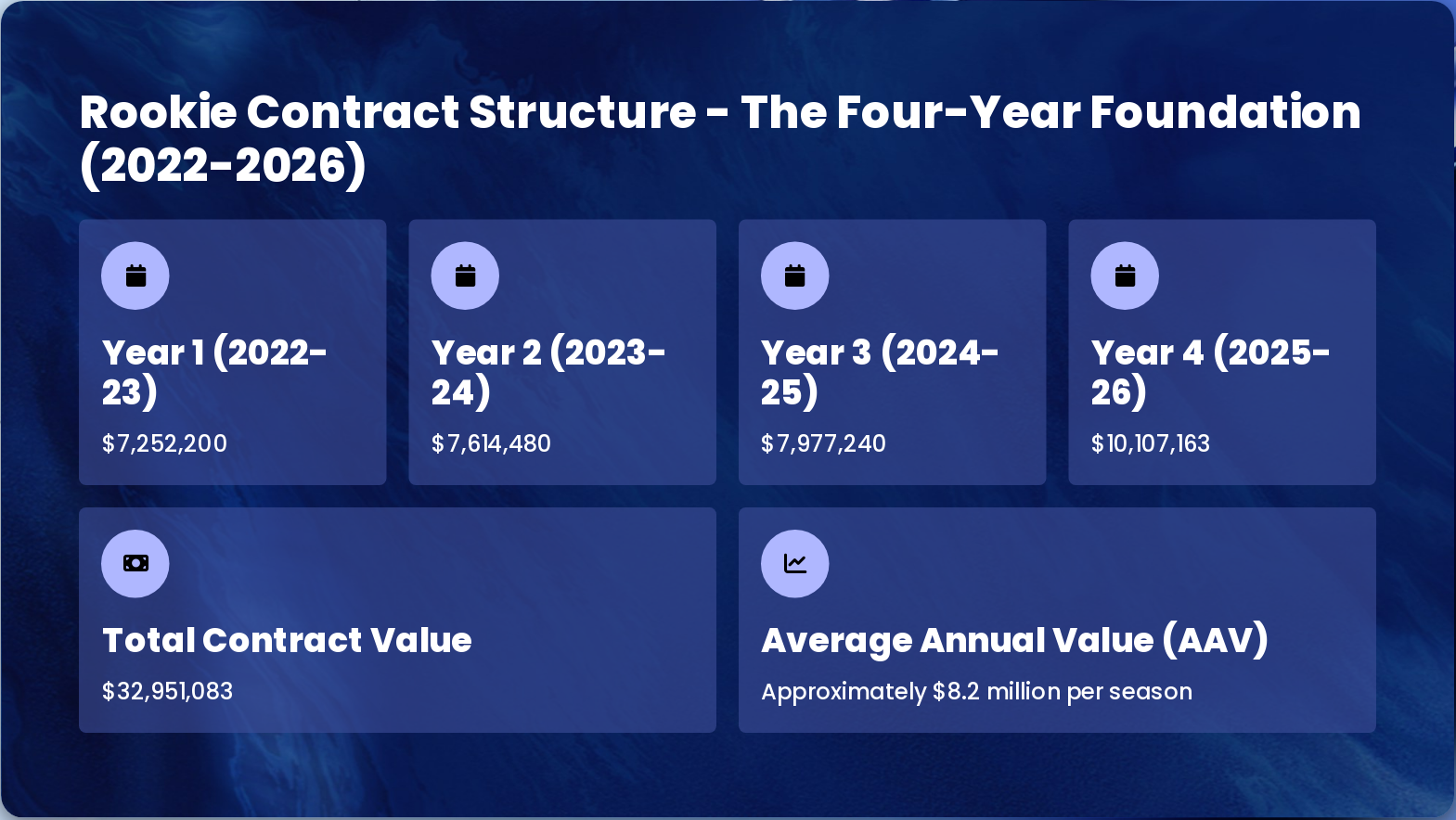
Slide 5: Rookie Contract Structure - The Four-Year Foundation (2022-2026)
- Year 1 (2022-23): $7,252,200
- Year 2 (2023-24): $7,614,480
- Year 3 (2024-25): $7,977,240
- Year 4 (2025-26): $10,107,163
- Total Contract Value: $32,951,083
- Average Annual Value (AAV): Approximately $8.2 million per season
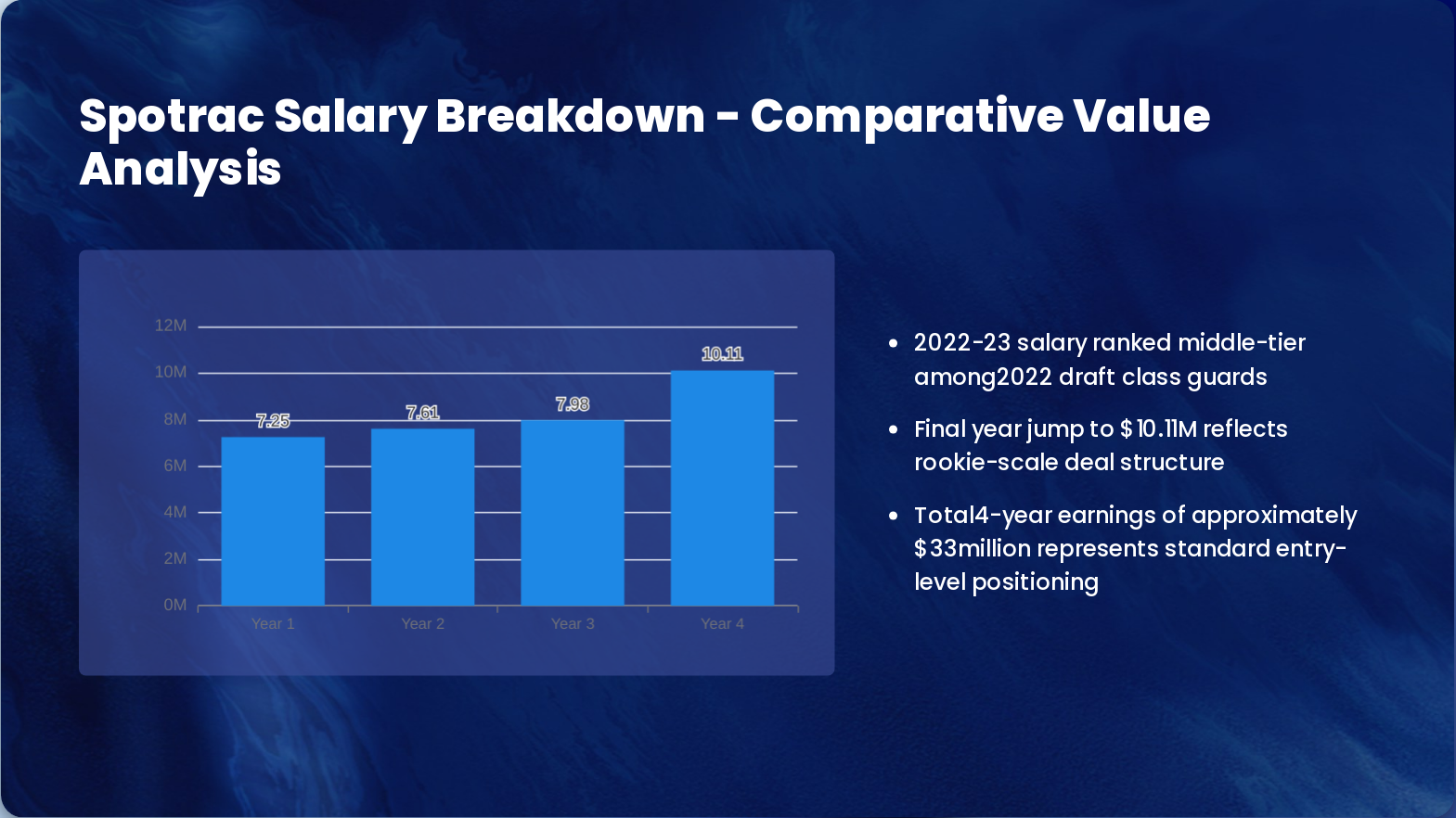
Slide 6: Spotrac Salary Breakdown - Comparative Value Analysis
2022-23 salary ranked middle-tier among2022 draft class guards
Final year jump to $10.11M reflects rookie-scale deal structure
Total4-year earnings of approximately $33million represents standard entry-level positioning
- 2022-23 salary ranked middle-tier among2022 draft class guards
- Final year jump to $10.11M reflects rookie-scale deal structure
- Total4-year earnings of approximately $33million represents standard entry-level positioning
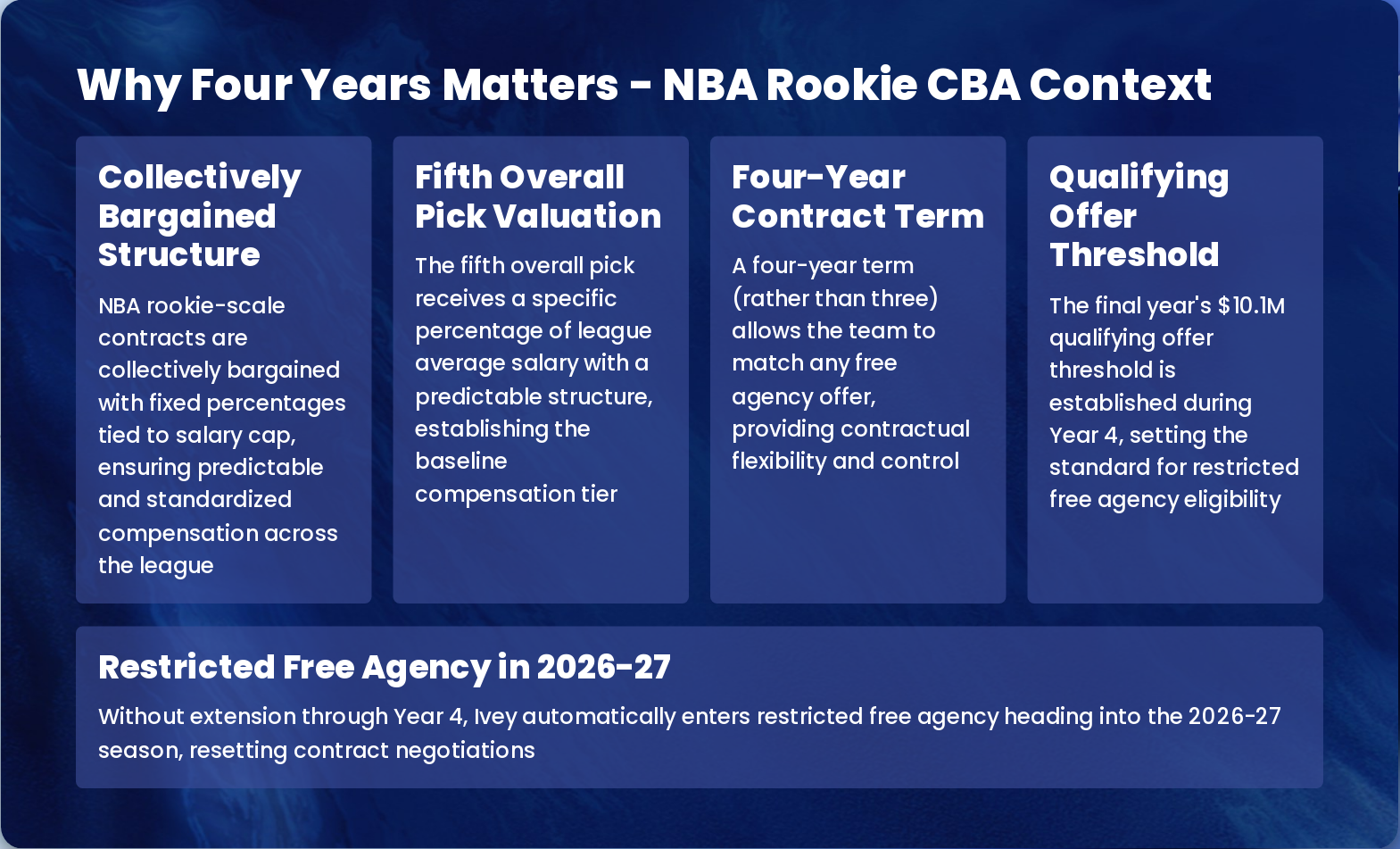
Slide 7: Why Four Years Matters - NBA Rookie CBA Context
- Collectively Bargained Structure: NBA rookie-scale contracts are collectively bargained with fixed percentages tied to salary cap, ensuring predictable and standardized compensation across the league
- Fifth Overall Pick Valuation: The fifth overall pick receives a specific percentage of league average salary with a predictable structure, establishing the baseline compensation tier
- Four-Year Contract Term: A four-year term (rather than three) allows the team to match any free agency offer, providing contractual flexibility and control
- Qualifying Offer Threshold: The final year's $10.1M qualifying offer threshold is established during Year 4, setting the standard for restricted free agency eligibility
- Restricted Free Agency in 2026-27: Without extension through Year 4, Ivey automatically enters restricted free agency heading into the 2026-27 season, resetting contract negotiations
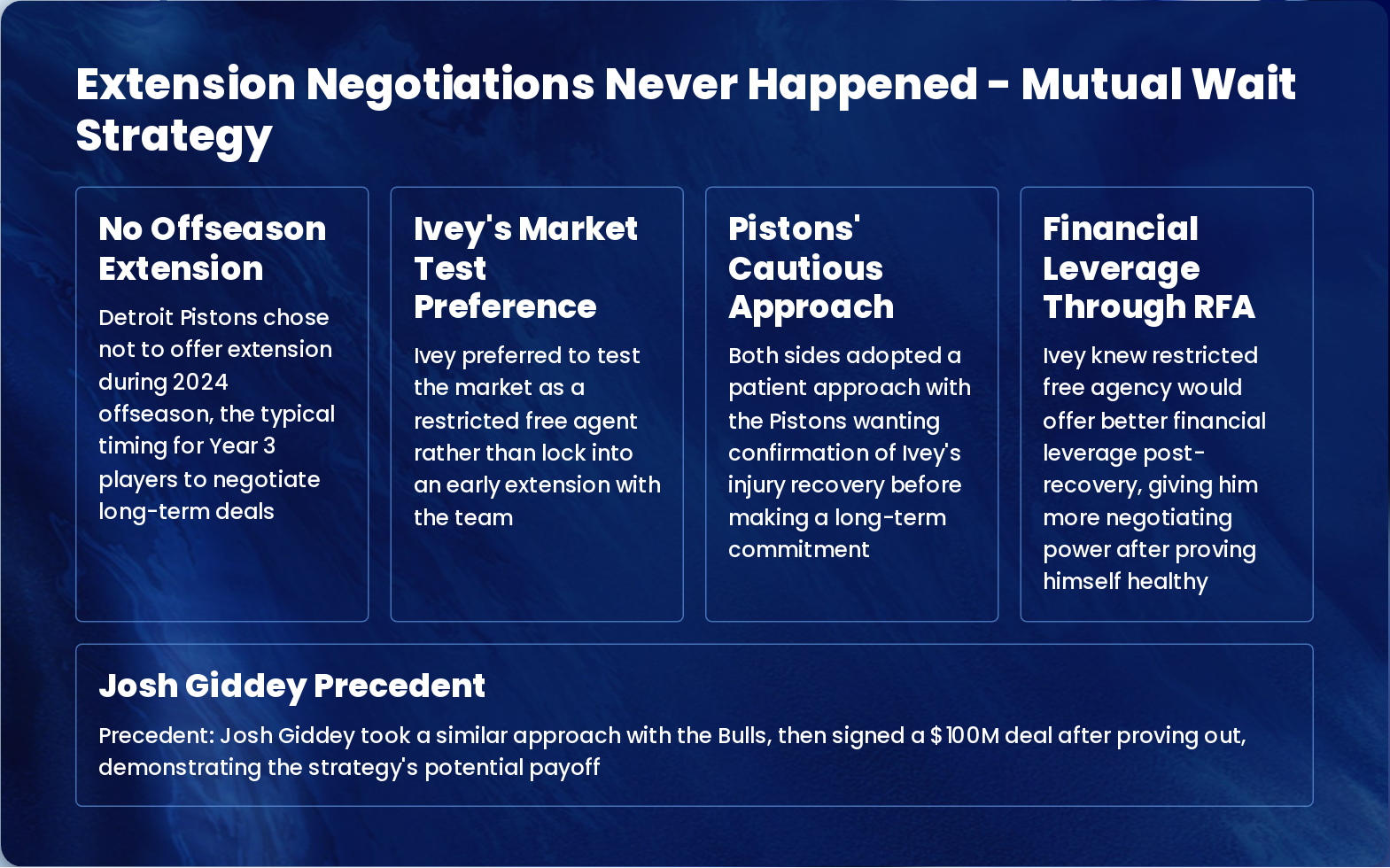
Slide 8: Extension Negotiations Never Happened - Mutual Wait Strategy
- No Offseason Extension: Detroit Pistons chose not to offer extension during 2024 offseason, the typical timing for Year 3 players to negotiate long-term deals
- Ivey's Market Test Preference: Ivey preferred to test the market as a restricted free agent rather than lock into an early extension with the team
- Pistons' Cautious Approach: Both sides adopted a patient approach with the Pistons wanting confirmation of Ivey's injury recovery before making a long-term commitment
- Financial Leverage Through RFA: Ivey knew restricted free agency would offer better financial leverage post-recovery, giving him more negotiating power after proving himself healthy
- Josh Giddey Precedent: Precedent: Josh Giddey took a similar approach with the Bulls, then signed a $100M deal after proving out, demonstrating the strategy's potential payoff
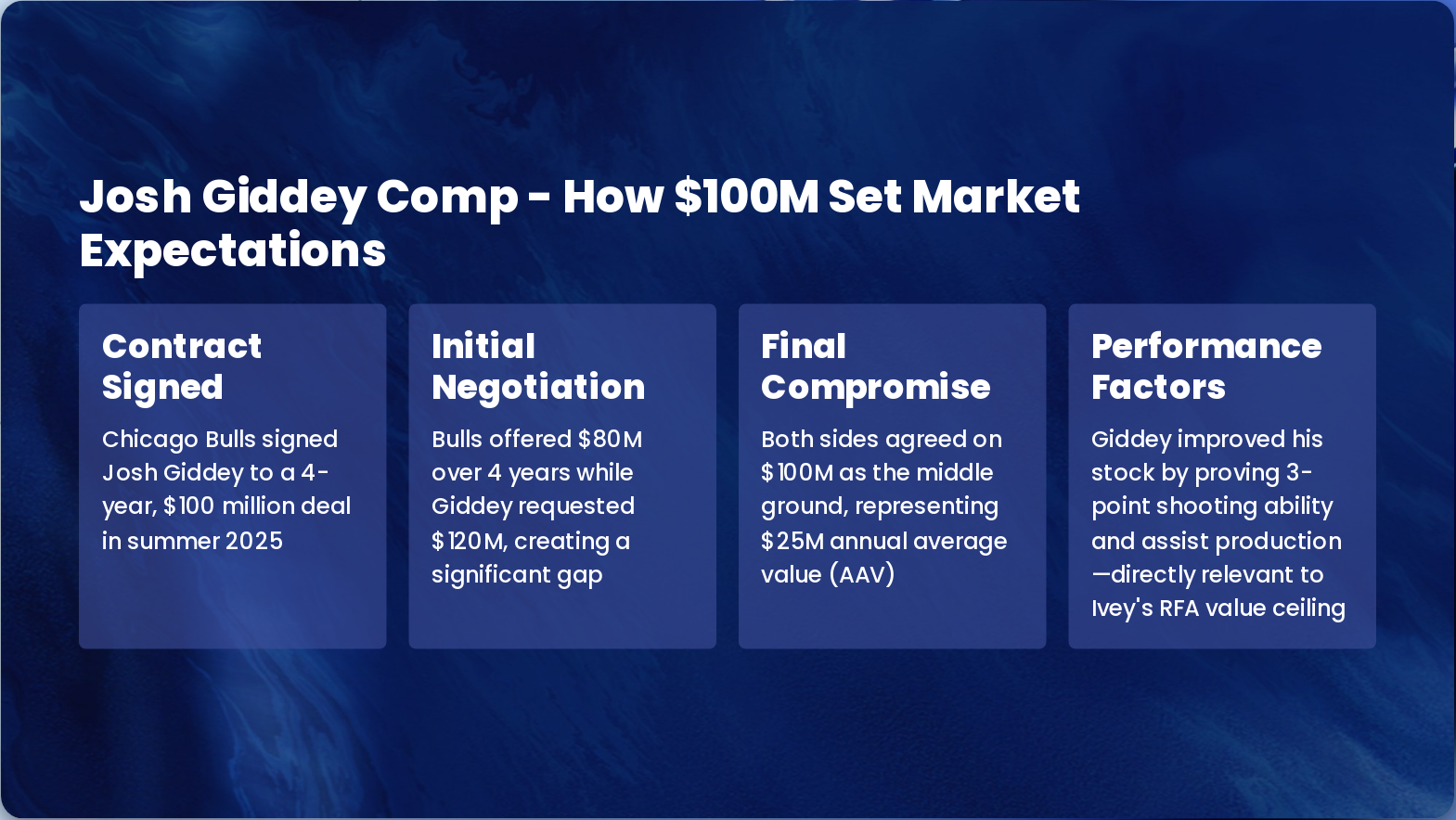
Slide 9: Josh Giddey Comp - How $100M Set Market Expectations
- Contract Signed: Chicago Bulls signed Josh Giddey to a 4-year, $100 million deal in summer 2025
- Initial Negotiation: Bulls offered $80M over 4 years while Giddey requested $120M, creating a significant gap
- Final Compromise: Both sides agreed on $100M as the middle ground, representing $25M annual average value (AAV)
- Performance Factors: Giddey improved his stock by proving 3-point shooting ability and assist production—directly relevant to Ivey's RFA value ceiling
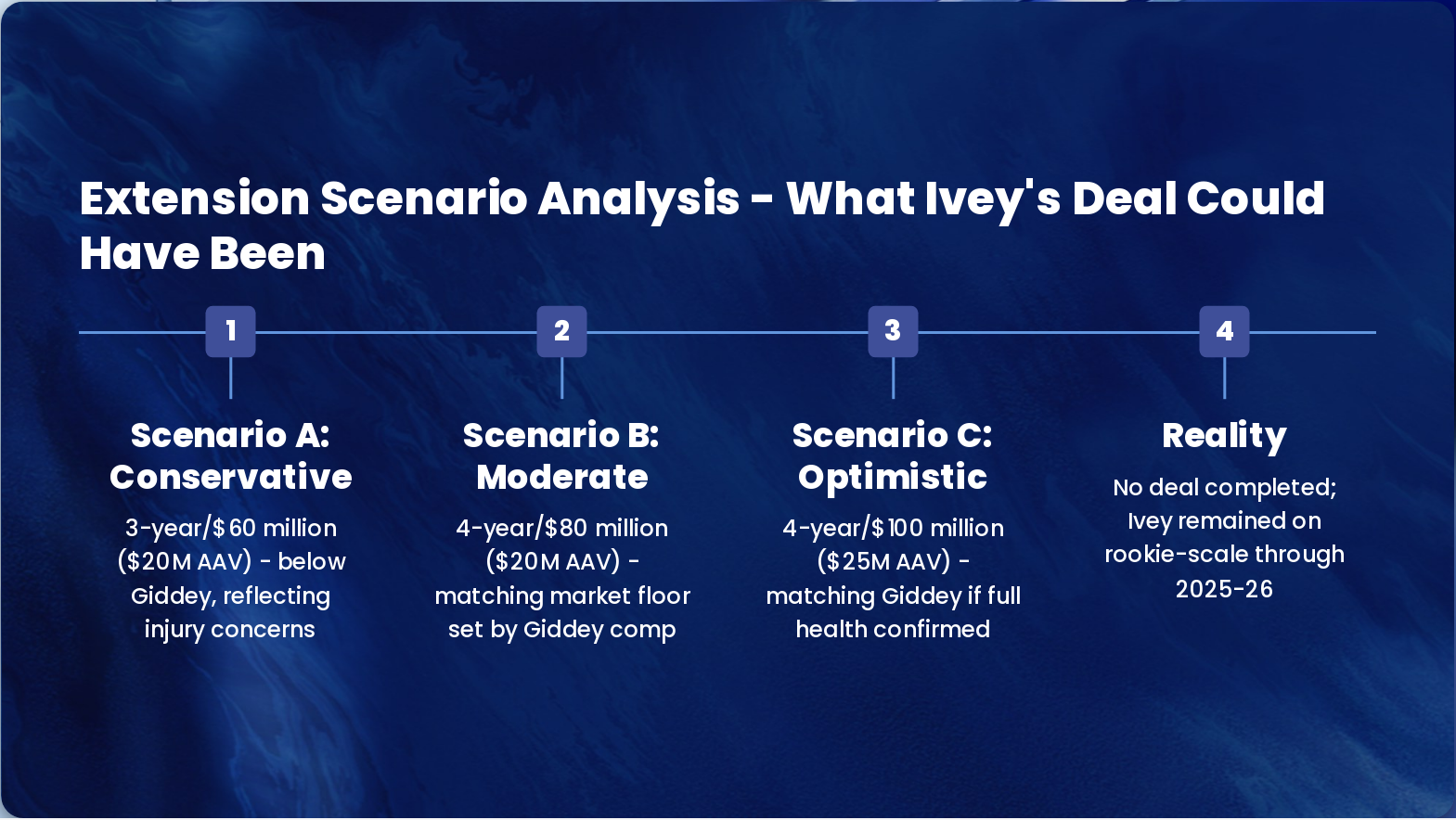
Slide 10: Extension Scenario Analysis - What Ivey's Deal Could Have Been
- Scenario A: Conservative: 3-year/$60 million ($20M AAV) - below Giddey, reflecting injury concerns
- Scenario B: Moderate: 4-year/$80 million ($20M AAV) - matching market floor set by Giddey comp
- Scenario C: Optimistic: 4-year/$100 million ($25M AAV) - matching Giddey if full health confirmed
- Reality: No deal completed; Ivey remained on rookie-scale through 2025-26
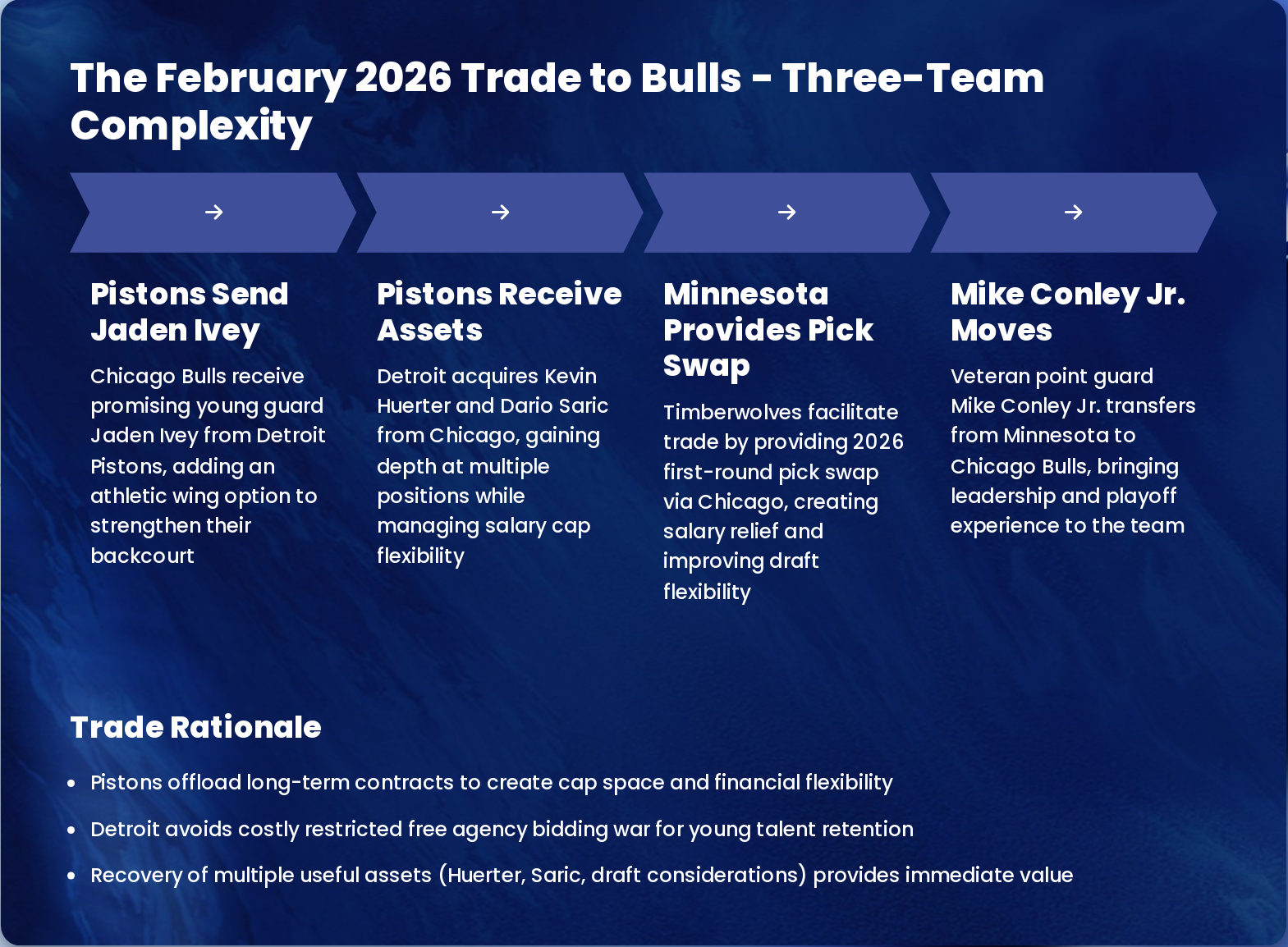
Slide 11: The February 2026 Trade to Bulls - Three-Team Complexity
- Pistons Send Jaden Ivey: Chicago Bulls receive promising young guard Jaden Ivey from Detroit Pistons, adding an athletic wing option to strengthen their backcourt
- Pistons Receive Assets: Detroit acquires Kevin Huerter and Dario Saric from Chicago, gaining depth at multiple positions while managing salary cap flexibility
- Minnesota Provides Pick Swap: Timberwolves facilitate trade by providing 2026 first-round pick swap via Chicago, creating salary relief and improving draft flexibility
- Mike Conley Jr. Moves: Veteran point guard Mike Conley Jr. transfers from Minnesota to Chicago Bulls, bringing leadership and playoff experience to the team
Pistons offload long-term contracts to create cap space and financial flexibility
Detroit avoids costly restricted free agency bidding war for young talent retention
Recovery of multiple useful assets (Huerter, Saric, draft considerations) provides immediate value
- Pistons offload long-term contracts to create cap space and financial flexibility
- Detroit avoids costly restricted free agency bidding war for young talent retention
- Recovery of multiple useful assets (Huerter, Saric, draft considerations) provides immediate value
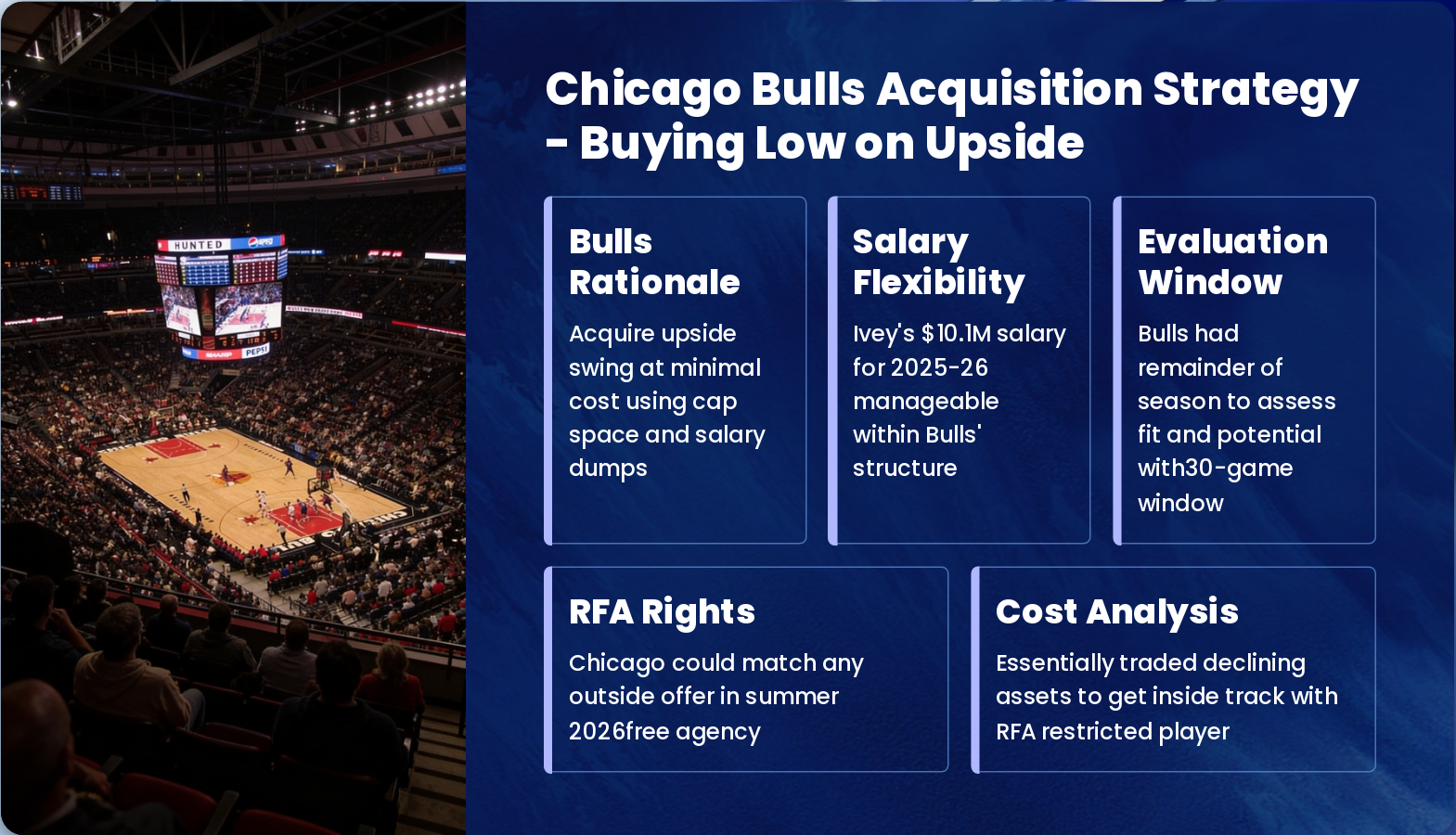
Slide 12: Chicago Bulls Acquisition Strategy - Buying Low on Upside
- Bulls Rationale: Acquire upside swing at minimal cost using cap space and salary dumps
- Salary Flexibility: Ivey's $10.1M salary for 2025-26 manageable within Bulls' structure
- Evaluation Window: Bulls had remainder of season to assess fit and potential with30-game window
- RFA Rights: Chicago could match any outside offer in summer 2026free agency
- Cost Analysis: Essentially traded declining assets to get inside track with RFA restricted player
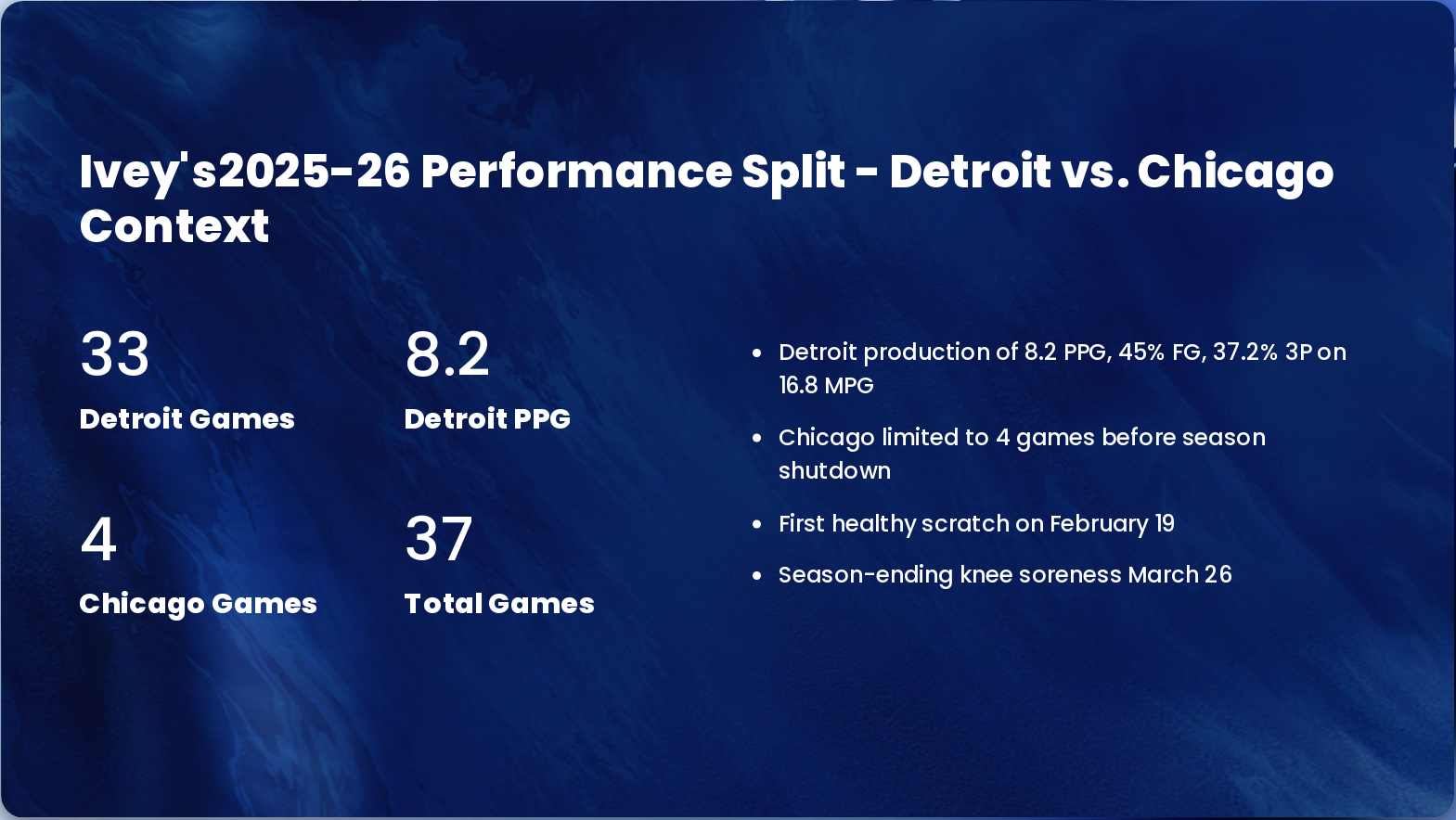
Slide 13: Ivey's2025-26 Performance Split - Detroit vs. Chicago Context
- 33 — Detroit Games
- 8.2 — Detroit PPG
- 4 — Chicago Games
- 37 — Total Games
Detroit production of 8.2 PPG, 45% FG, 37.2% 3P on 16.8 MPG
Chicago limited to 4 games before season shutdown
First healthy scratch on February 19
Season-ending knee soreness March 26
- Detroit production of 8.2 PPG, 45% FG, 37.2% 3P on 16.8 MPG
- Chicago limited to 4 games before season shutdown
- First healthy scratch on February 19
- Season-ending knee soreness March 26
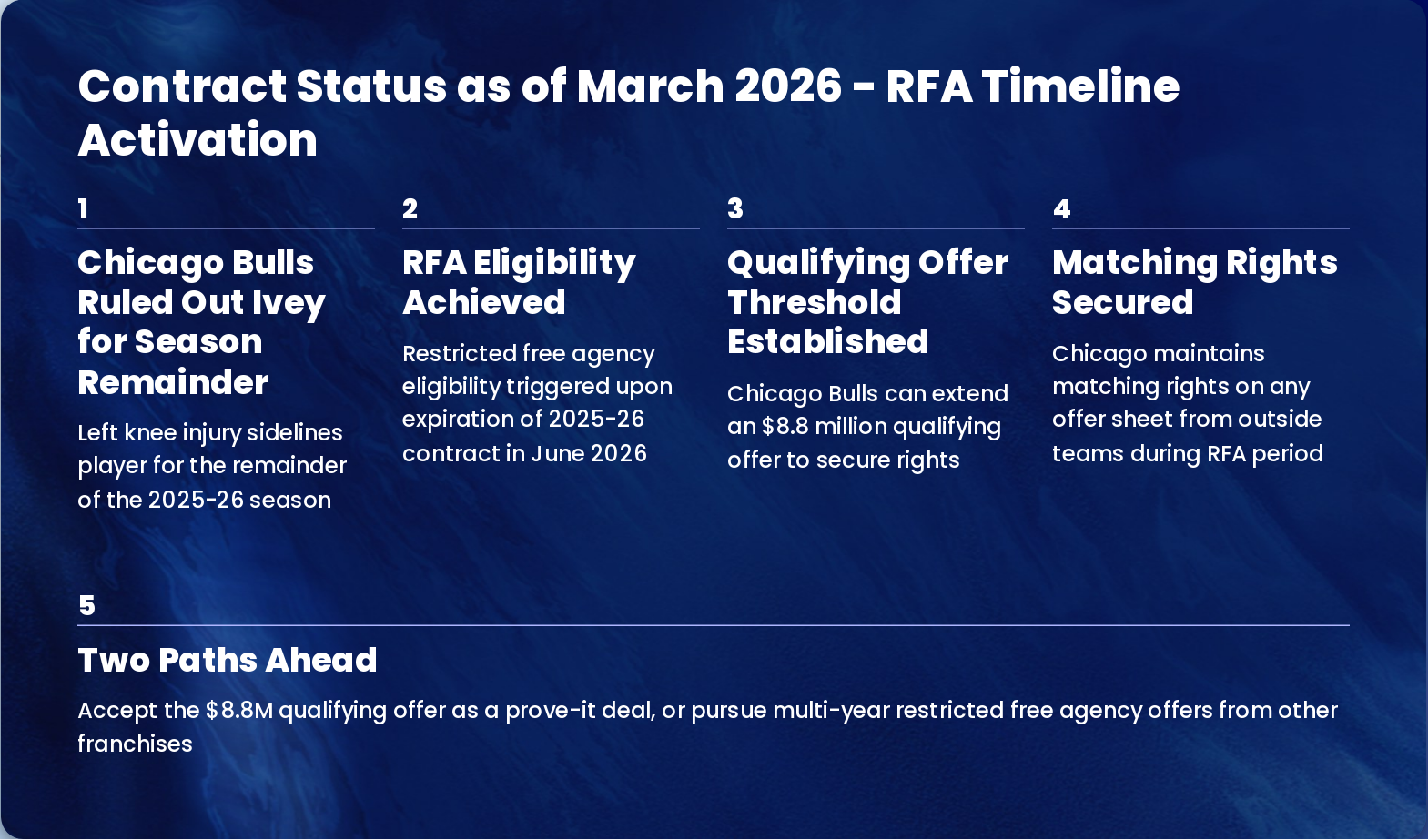
Slide 14: Contract Status as of March 2026 - RFA Timeline Activation
- Chicago Bulls Ruled Out Ivey for Season Remainder: Left knee injury sidelines player for the remainder of the 2025-26 season
- RFA Eligibility Achieved: Restricted free agency eligibility triggered upon expiration of 2025-26 contract in June 2026
- Qualifying Offer Threshold Established: Chicago Bulls can extend an $8.8 million qualifying offer to secure rights
- Matching Rights Secured: Chicago maintains matching rights on any offer sheet from outside teams during RFA period
- Two Paths Ahead: Accept the $8.8M qualifying offer as a prove-it deal, or pursue multi-year restricted free agency offers from other franchises
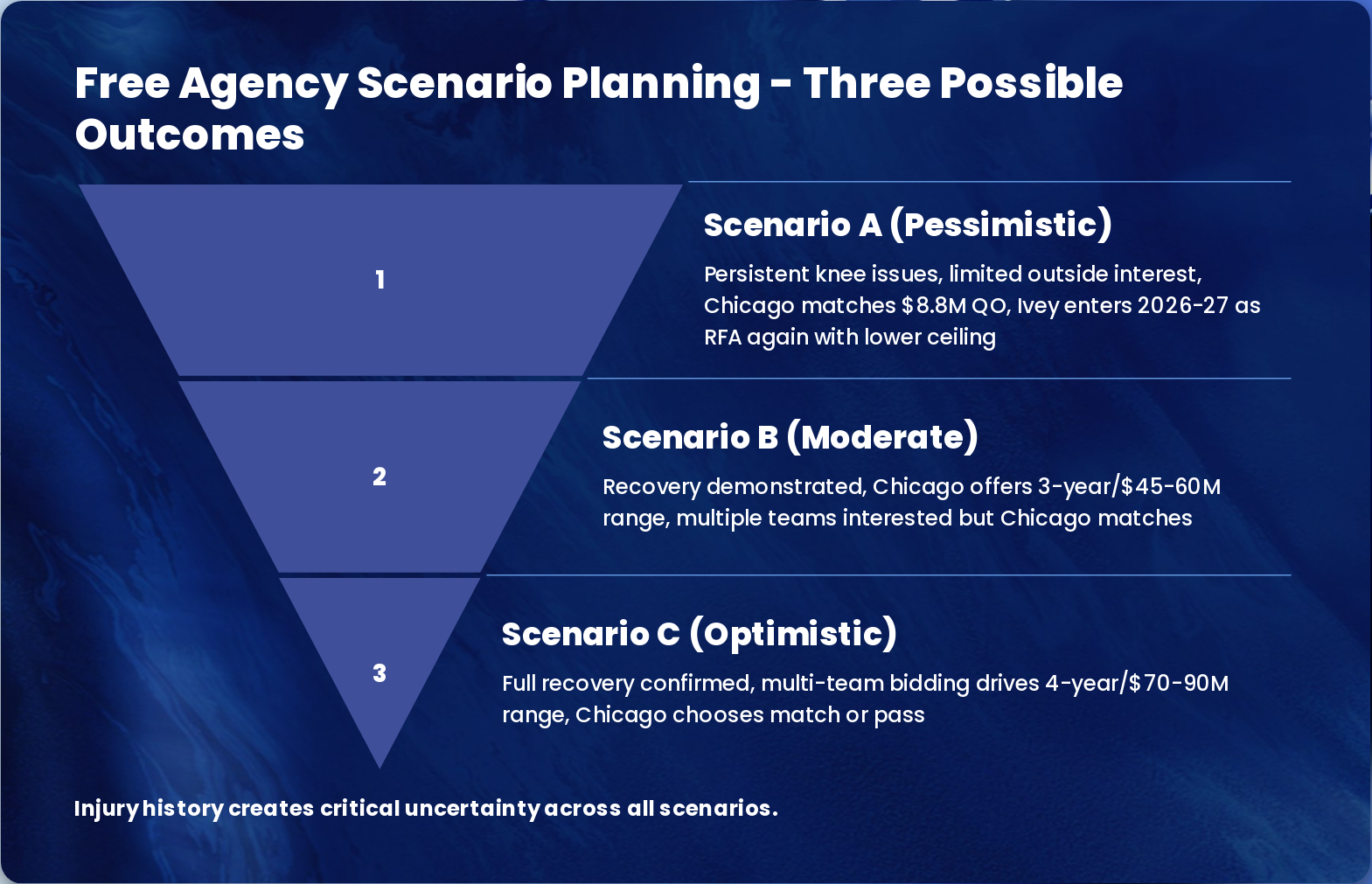
Slide 15: Free Agency Scenario Planning - Three Possible Outcomes
- Scenario A (Pessimistic): Persistent knee issues, limited outside interest, Chicago matches $8.8M QO, Ivey enters 2026-27 as RFA again with lower ceiling
- Scenario B (Moderate): Recovery demonstrated, Chicago offers 3-year/$45-60M range, multiple teams interested but Chicago matches
- Scenario C (Optimistic): Full recovery confirmed, multi-team bidding drives 4-year/$70-90M range, Chicago chooses match or pass
Injury history creates critical uncertainty across all scenarios.
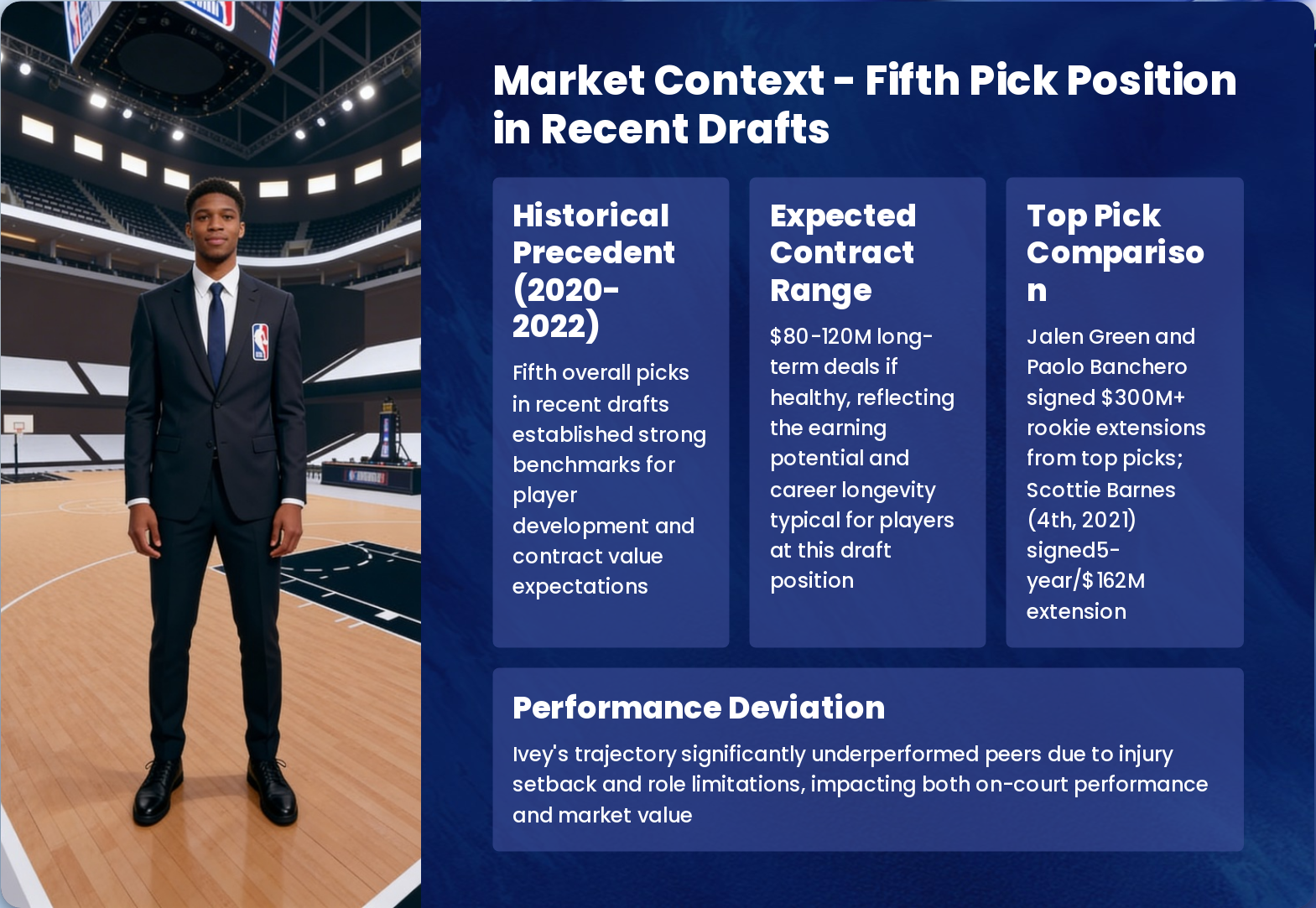
Slide 16: Market Context - Fifth Pick Position in Recent Drafts
- Historical Precedent (2020-2022): Fifth overall picks in recent drafts established strong benchmarks for player development and contract value expectations
- Expected Contract Range: $80-120M long-term deals if healthy, reflecting the earning potential and career longevity typical for players at this draft position
- Top Pick Comparison: Jalen Green and Paolo Banchero signed $300M+ rookie extensions from top picks; Scottie Barnes (4th, 2021) signed5-year/$162M extension
- Performance Deviation: Ivey's trajectory significantly underperformed peers due to injury setback and role limitations, impacting both on-court performance and market value
Slide 17: Injury Impact on Contract Value - Comparative Analysis
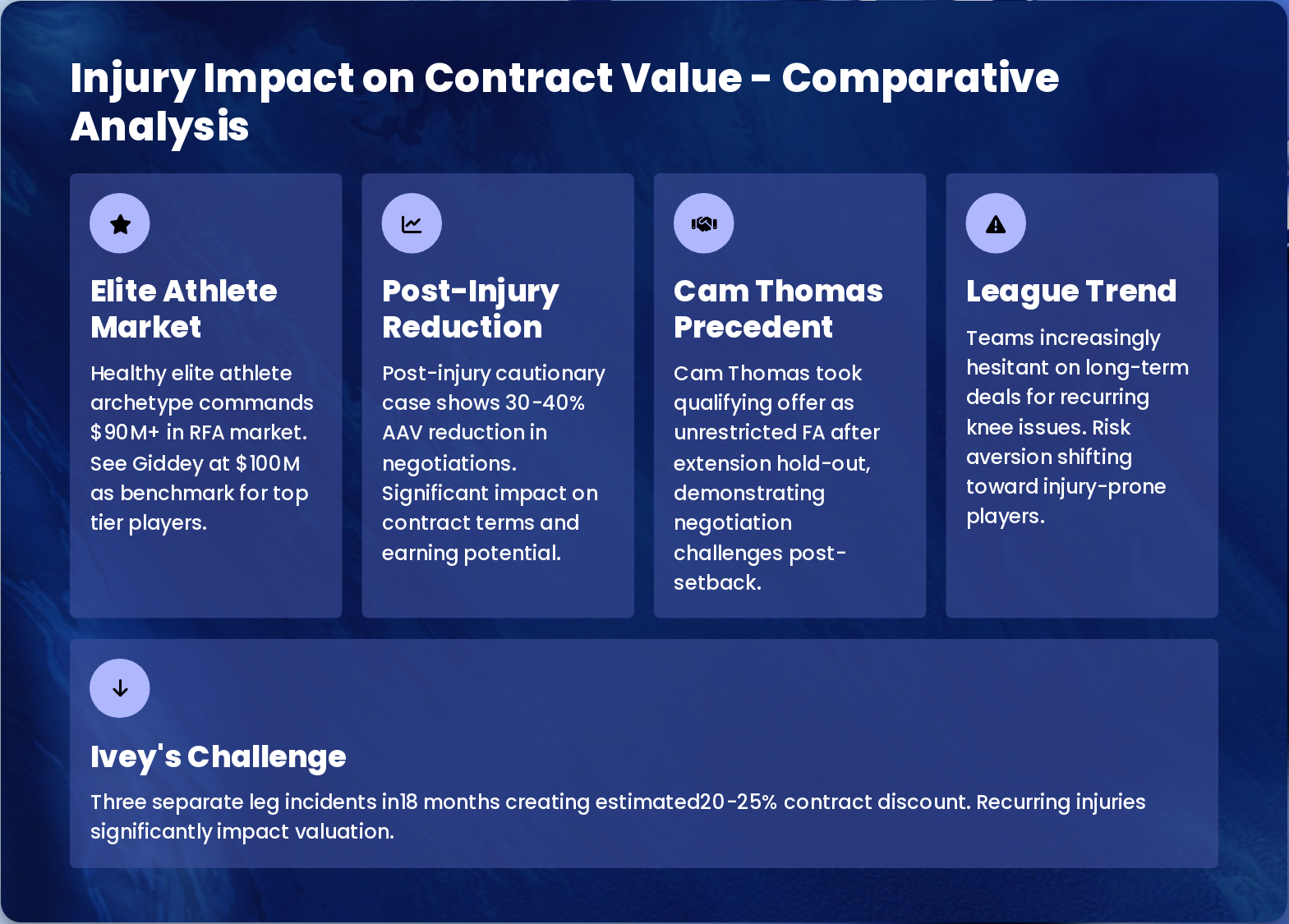
- Elite Athlete Market: Healthy elite athlete archetype commands $90M+ in RFA market. See Giddey at $100M as benchmark for top tier players.
- Post-Injury Reduction: Post-injury cautionary case shows 30-40% AAV reduction in negotiations. Significant impact on contract terms and earning potential.
- Cam Thomas Precedent: Cam Thomas took qualifying offer as unrestricted FA after extension hold-out, demonstrating negotiation challenges post-setback.
- League Trend: Teams increasingly hesitant on long-term deals for recurring knee issues. Risk aversion shifting toward injury-prone players.
- Ivey's Challenge: Three separate leg incidents in18 months creating estimated20-25% contract discount. Recurring injuries significantly impact valuation.
Slide 18: Future Deal Predictions - RFA Range Estimates
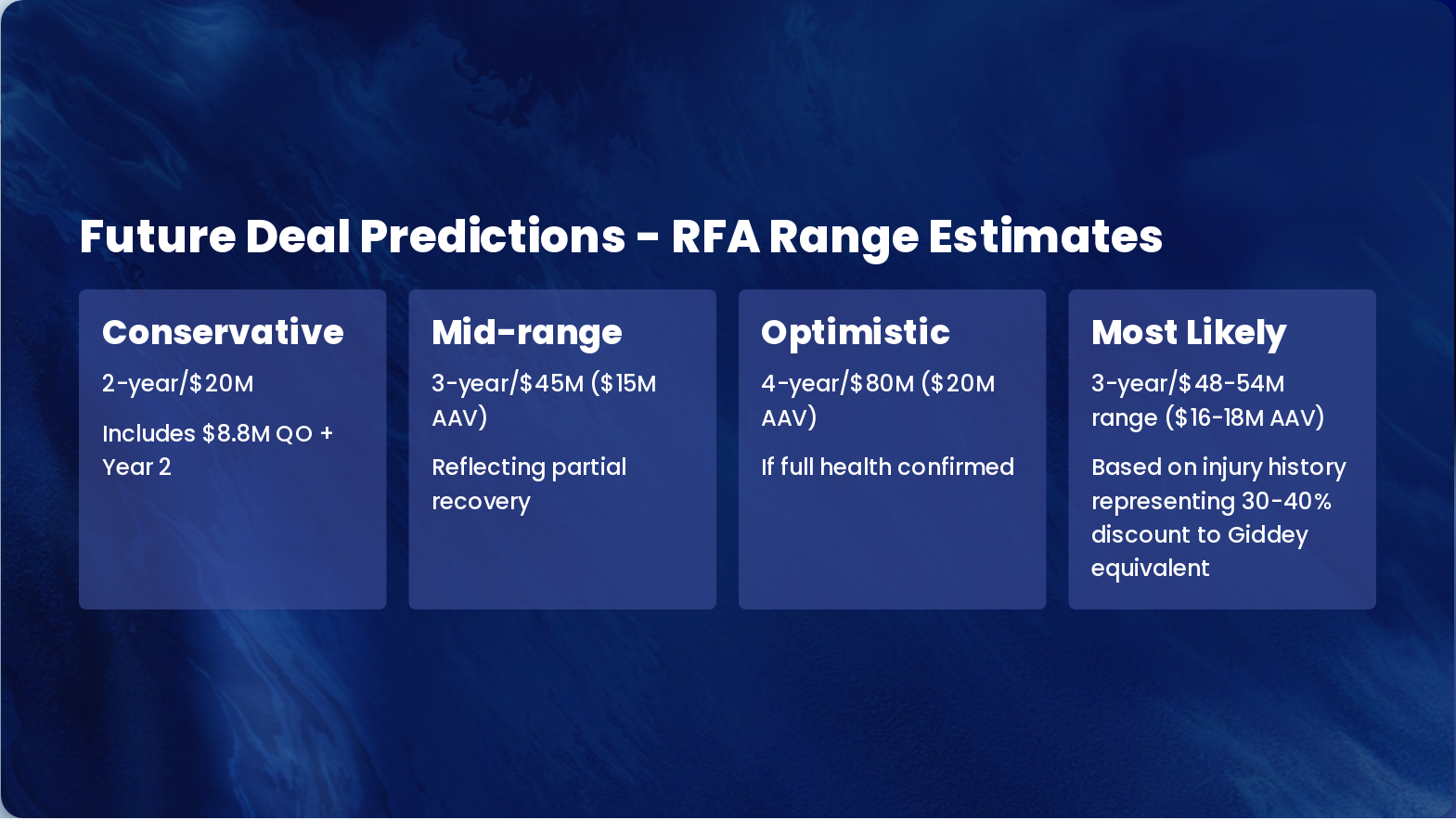
- Conservative: 2-year/$20M
- Mid-range: 3-year/$45M ($15M AAV)
- Optimistic: 4-year/$80M ($20M AAV)
- Most Likely: 3-year/$48-54M range ($16-18M AAV)
Slide 19: Contract Prediction Timeline - Key Decision Points Ahead
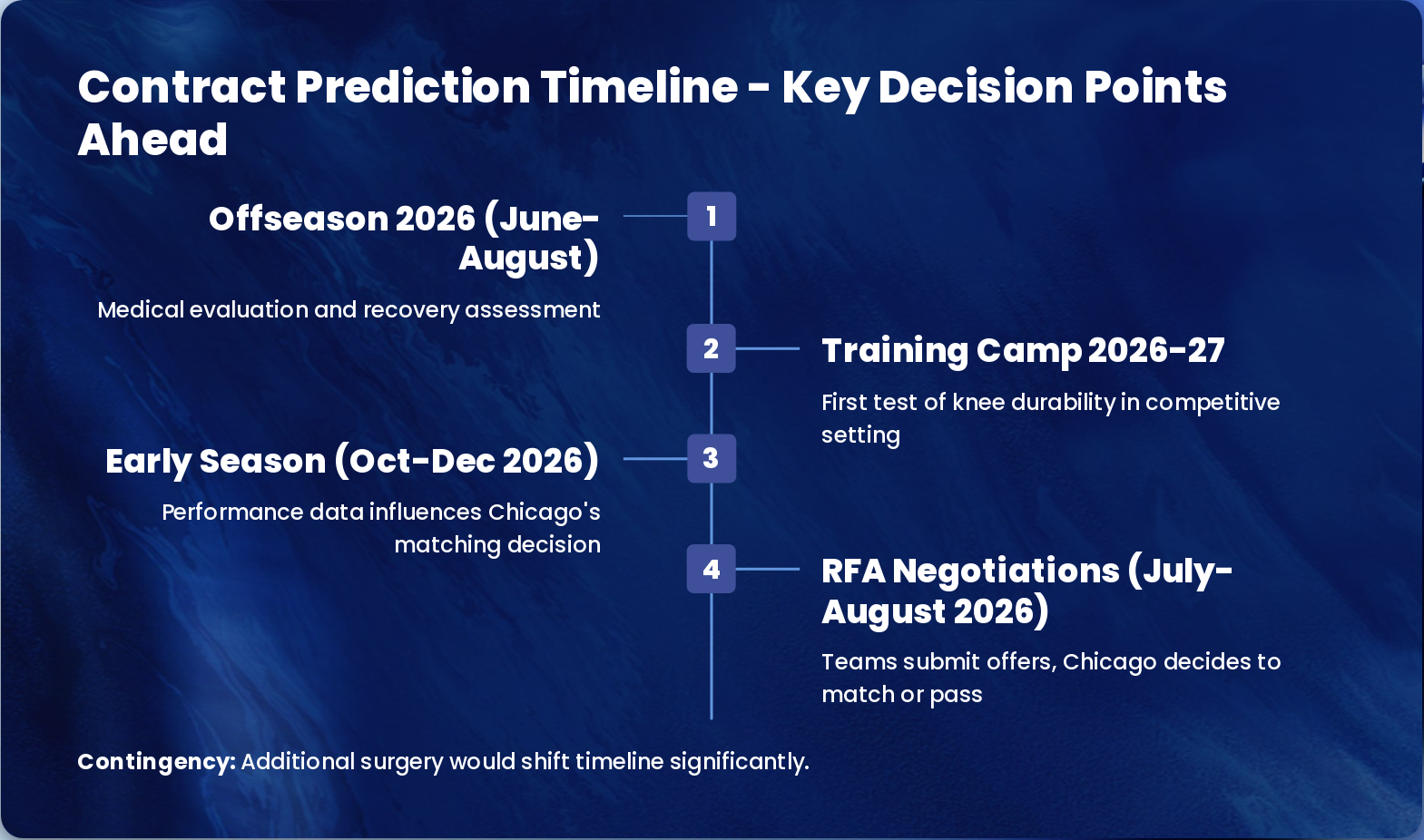
- Offseason 2026 (June-August): Medical evaluation and recovery assessment
- Training Camp 2026-27: First test of knee durability in competitive setting
- Early Season (Oct-Dec 2026): Performance data influences Chicago's matching decision
- RFA Negotiations (July-August 2026): Teams submit offers, Chicago decides to match or pass
Contingency: Additional surgery would shift timeline significantly.
Slide 20: Career Implications - From Star Prospect to Restricted Player
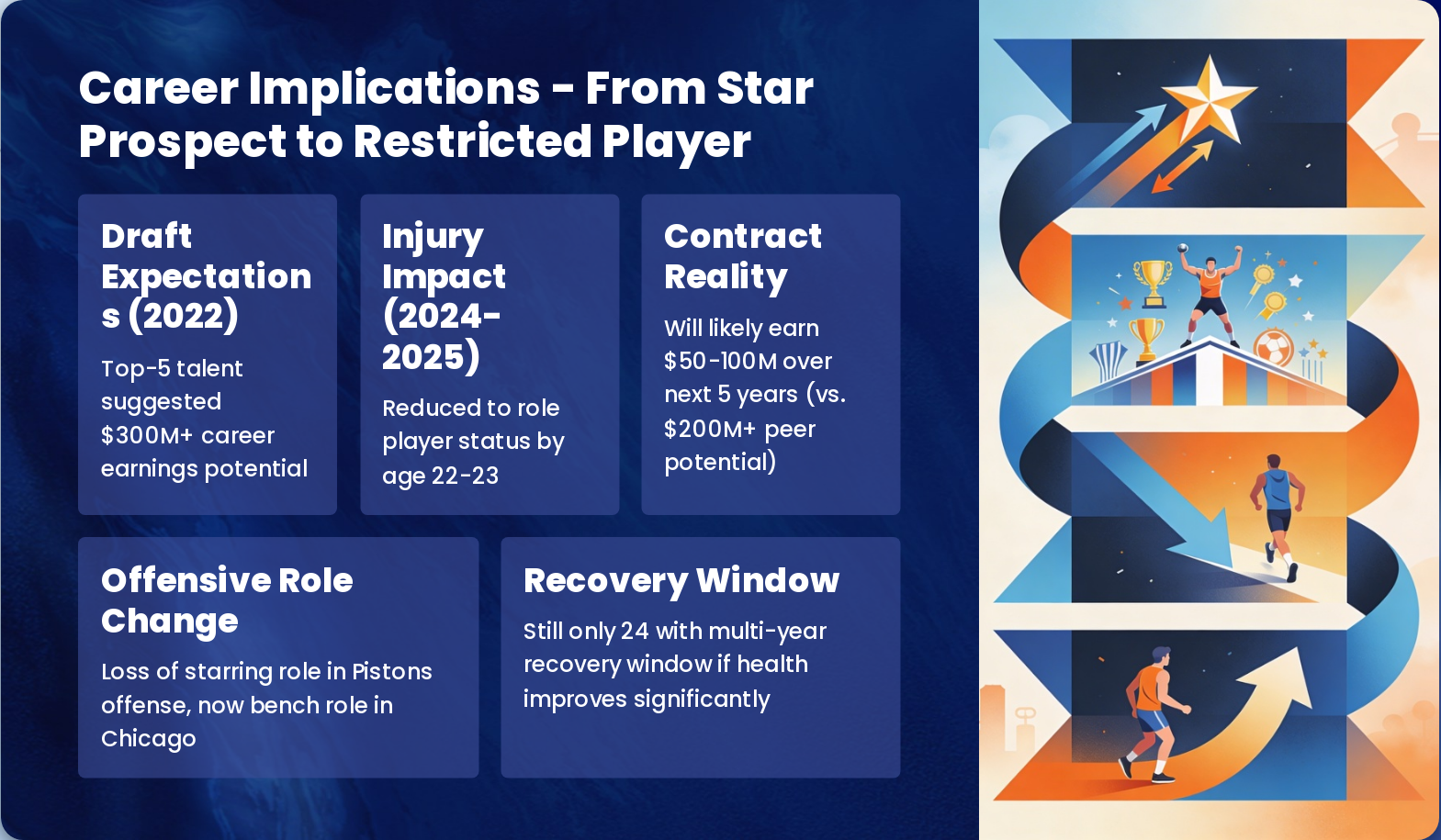
- Draft Expectations (2022): Top-5 talent suggested $300M+ career earnings potential
- Injury Impact (2024-2025): Reduced to role player status by age 22-23
- Contract Reality: Will likely earn $50-100M over next 5 years (vs. $200M+ peer potential)
- Offensive Role Change: Loss of starring role in Pistons offense, now bench role in Chicago
- Recovery Window: Still only 24 with multi-year recovery window if health improves significantly
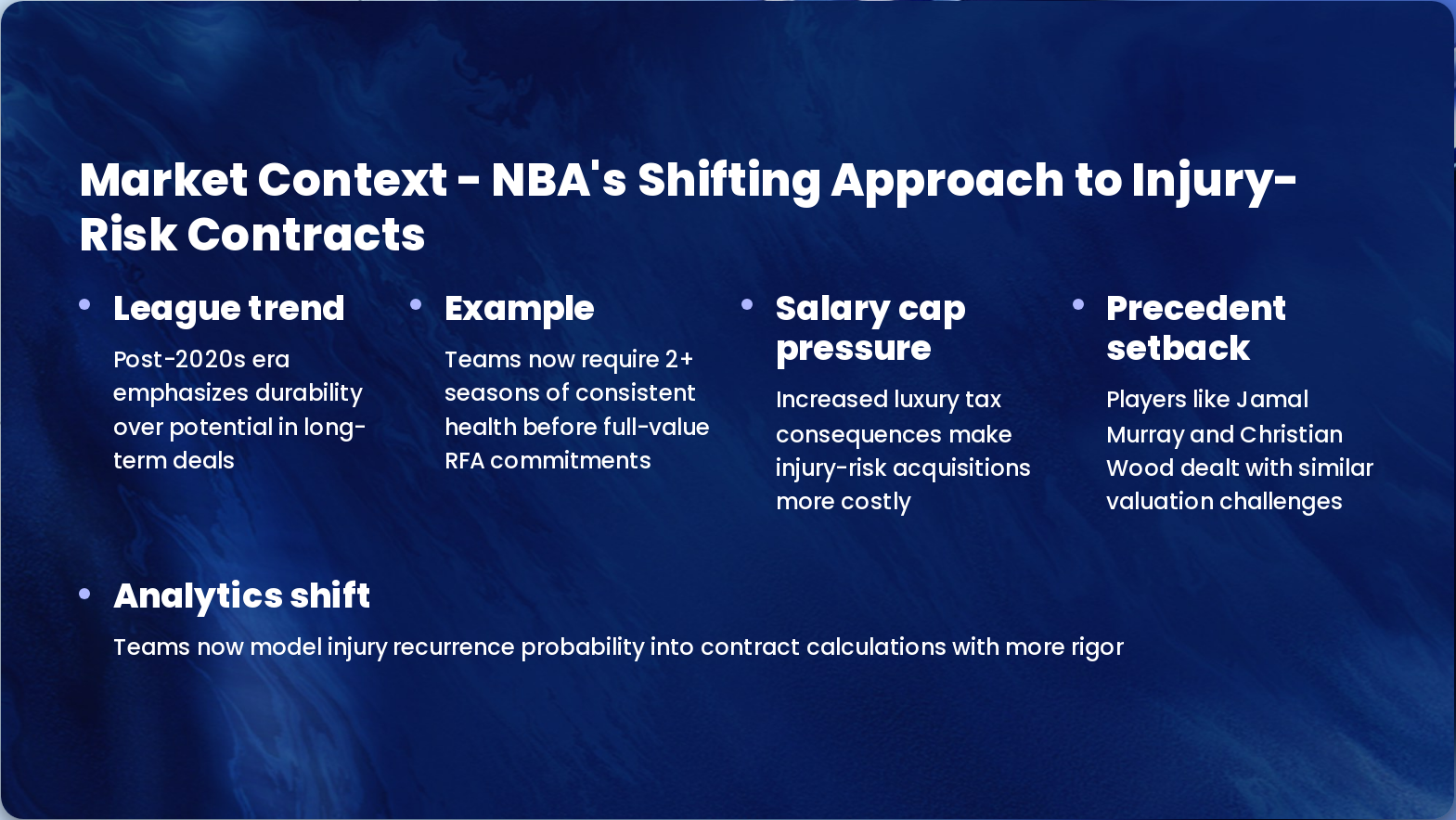
Slide 21: Market Context - NBA's Shifting Approach to Injury-Risk Contracts
- League trend: Post-2020s era emphasizes durability over potential in long-term deals
- Example: Teams now require 2+ seasons of consistent health before full-value RFA commitments
- Salary cap pressure: Increased luxury tax consequences make injury-risk acquisitions more costly
- Precedent setback: Players like Jamal Murray and Christian Wood dealt with similar valuation challenges
- Analytics shift: Teams now model injury recurrence probability into contract calculations with more rigor
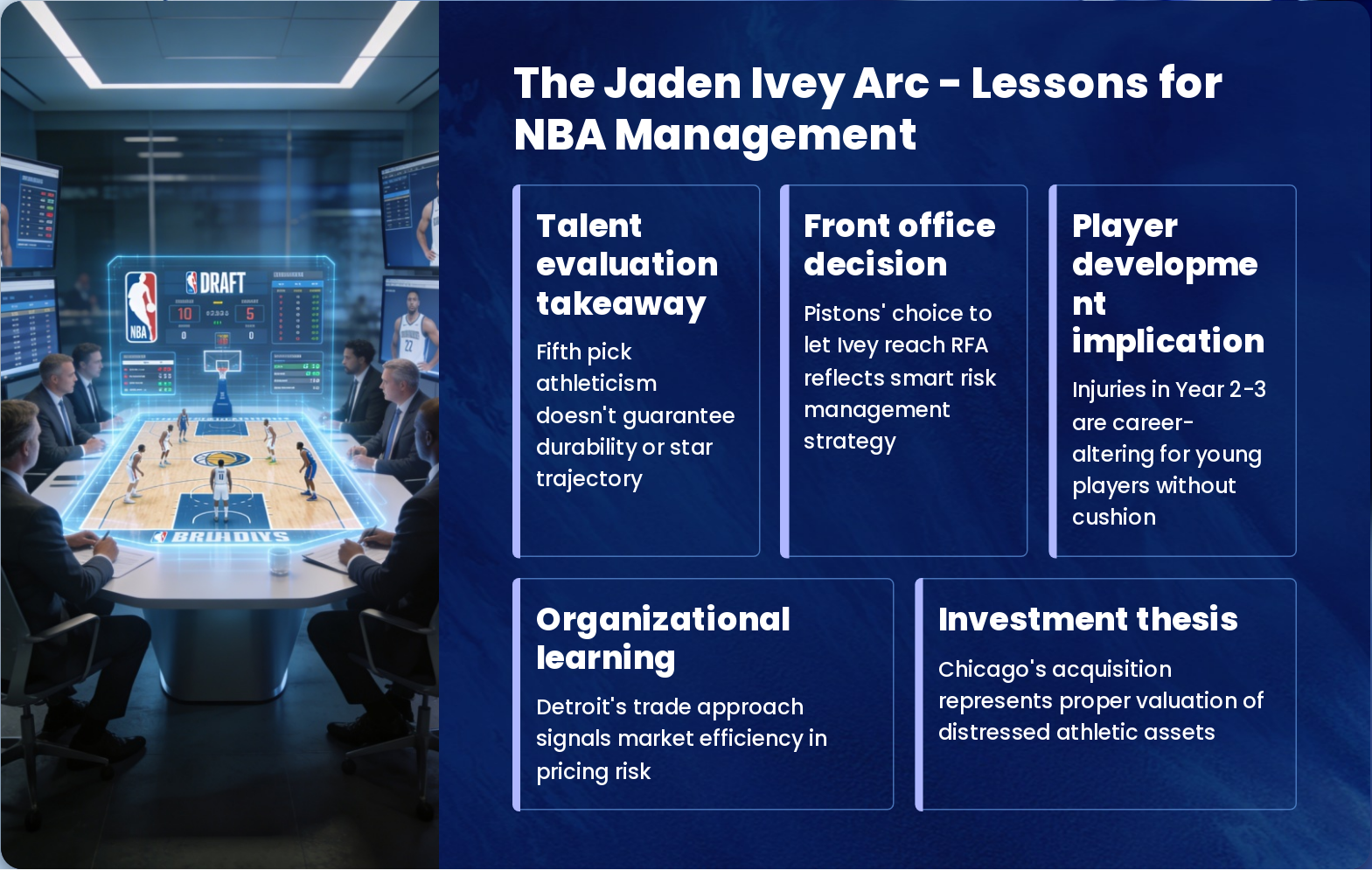
Slide 22: The Jaden Ivey Arc - Lessons for NBA Management
- Talent evaluation takeaway: Fifth pick athleticism doesn't guarantee durability or star trajectory
- Front office decision: Pistons' choice to let Ivey reach RFA reflects smart risk management strategy
- Player development implication: Injuries in Year 2-3 are career-altering for young players without cushion
- Organizational learning: Detroit's trade approach signals market efficiency in pricing risk
- Investment thesis: Chicago's acquisition represents proper valuation of distressed athletic assets
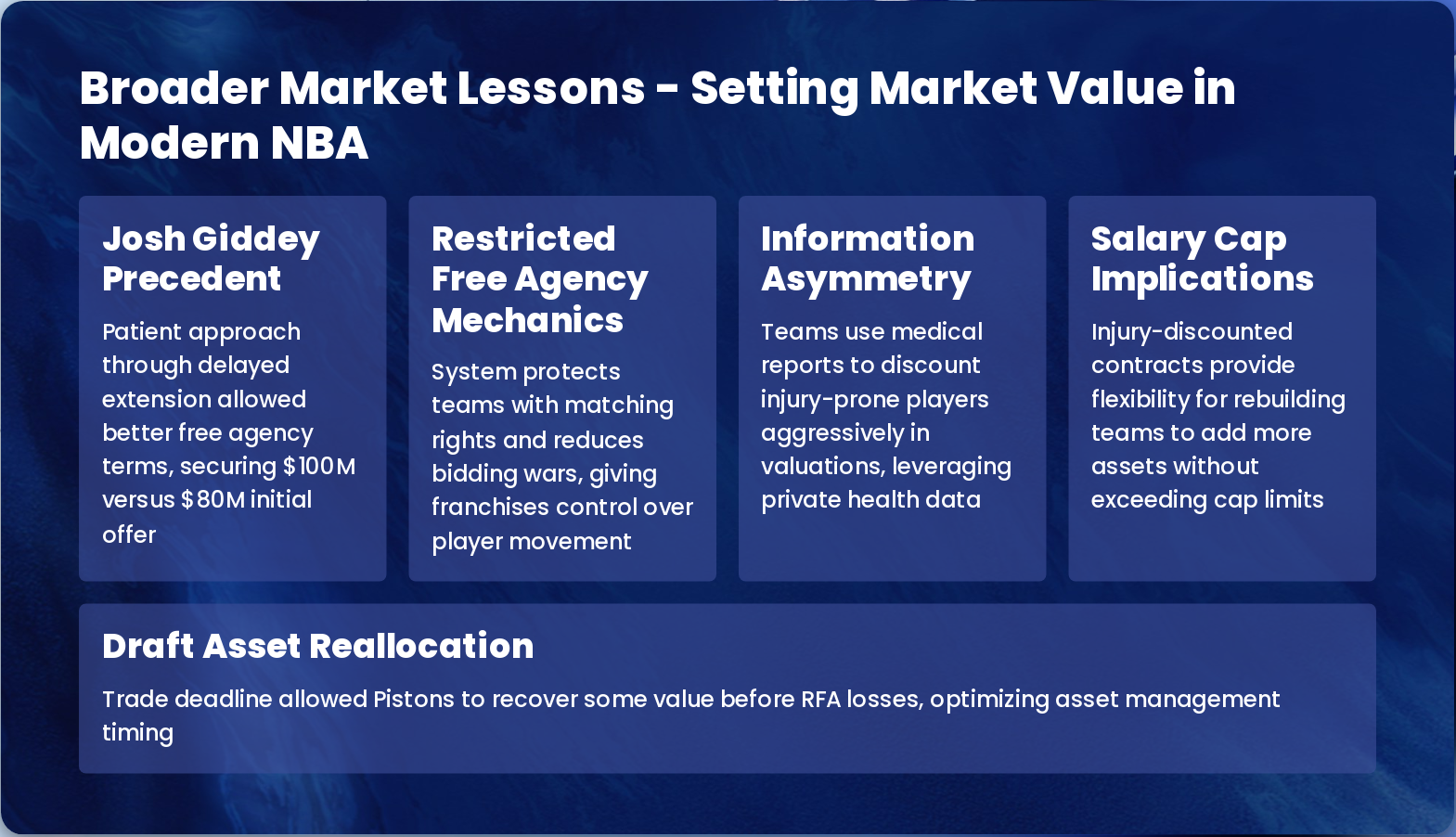
Slide 23: Broader Market Lessons - Setting Market Value in Modern NBA
- Josh Giddey Precedent: Patient approach through delayed extension allowed better free agency terms, securing $100M versus $80M initial offer
- Restricted Free Agency Mechanics: System protects teams with matching rights and reduces bidding wars, giving franchises control over player movement
- Information Asymmetry: Teams use medical reports to discount injury-prone players aggressively in valuations, leveraging private health data
- Salary Cap Implications: Injury-discounted contracts provide flexibility for rebuilding teams to add more assets without exceeding cap limits
- Draft Asset Reallocation: Trade deadline allowed Pistons to recover some value before RFA losses, optimizing asset management timing
Slide 24: Conclusion: Jaden Ivey's Contract Story Summary
Conclusion: Jaden Ivey's Contract Story Summary Elite athlete prospect (5th pick, $33M rookie deal) derailed by injury, now faces RFA at age 24 with uncertain ceiling. Financial reality: Estimated $16-18M AAV in 2026 RFA market (vs. $25M+ peer equivalents) reflecting 30-40% injury-risk discount. Dec...