Presentation Summary
Explore the fundamentals of machine learning, including supervised and unsupervised learning, neural networks, and key algorithms for regression, classification, and pattern discovery.
Full Presentation Transcript
Slide 1: Introduction to Machine Learning Algorithms
A Comprehensive Guide to Supervised Learning, Unsupervised Learning, and Neural Networks for Modern Data Science
Slide 2: Contents
- ML Fundamentals: Understanding how algorithms learn from data and the core components of machine learning systems.
- Supervised vs Unsupervised: Exploring the fundamental divide between labeled and unlabeled data approaches in machine learning.
- Regression & Classification: Deep dive into prediction algorithms for continuous values and categorical classification problems.
- Neural Networks: Understanding biological-inspired architectures and their revolutionary impact on modern AI applications.
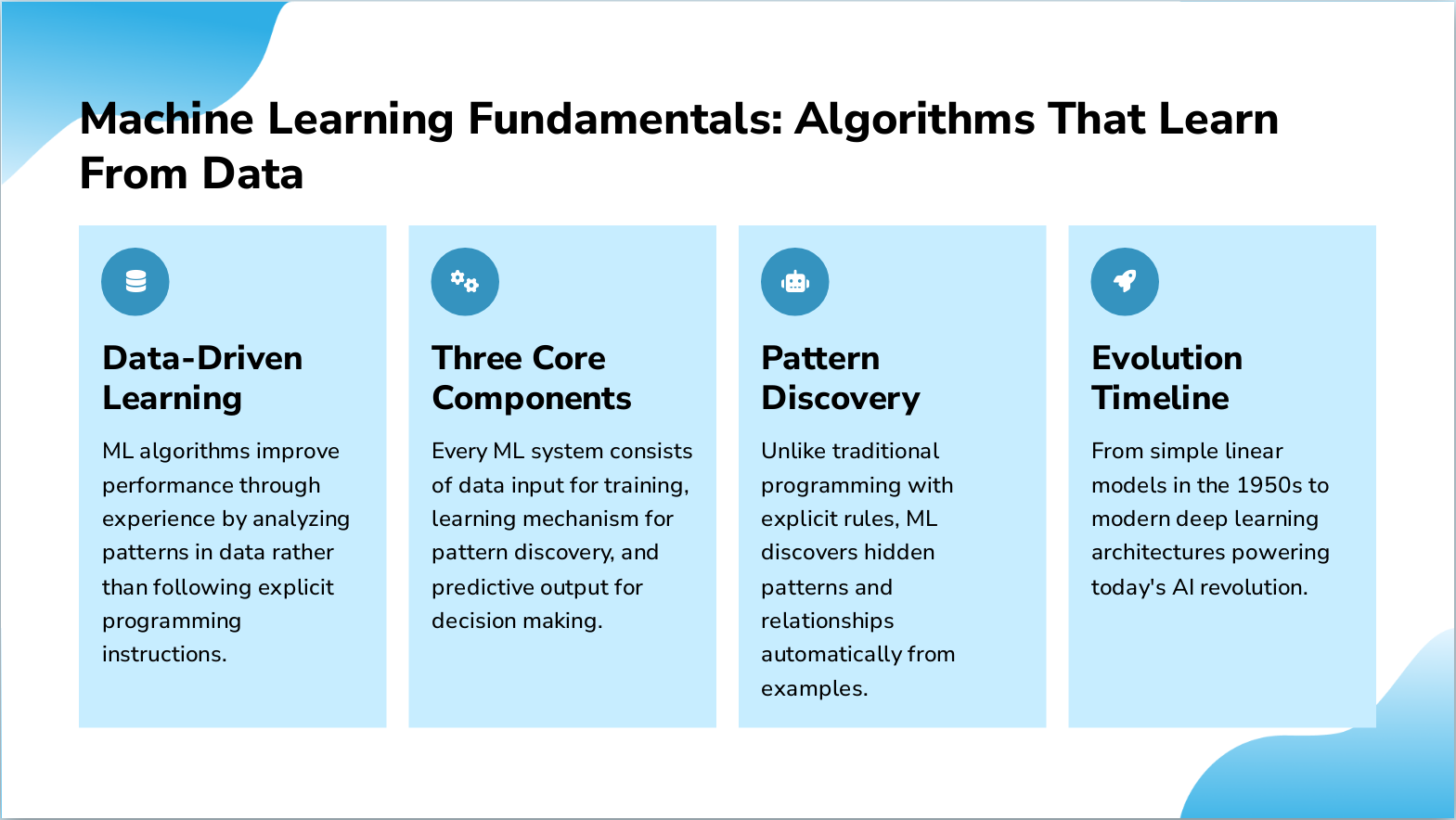
Slide 3: Machine Learning Fundamentals: Algorithms That Learn From Data
- Data-Driven Learning: ML algorithms improve performance through experience by analyzing patterns in data rather than following explicit programming instructions.
- Three Core Components: Every ML system consists of data input for training, learning mechanism for pattern discovery, and predictive output for decision making.
- Pattern Discovery: Unlike traditional programming with explicit rules, ML discovers hidden patterns and relationships automatically from examples.
- Evolution Timeline: From simple linear models in the 1950s to modern deep learning architectures powering today's AI revolution.
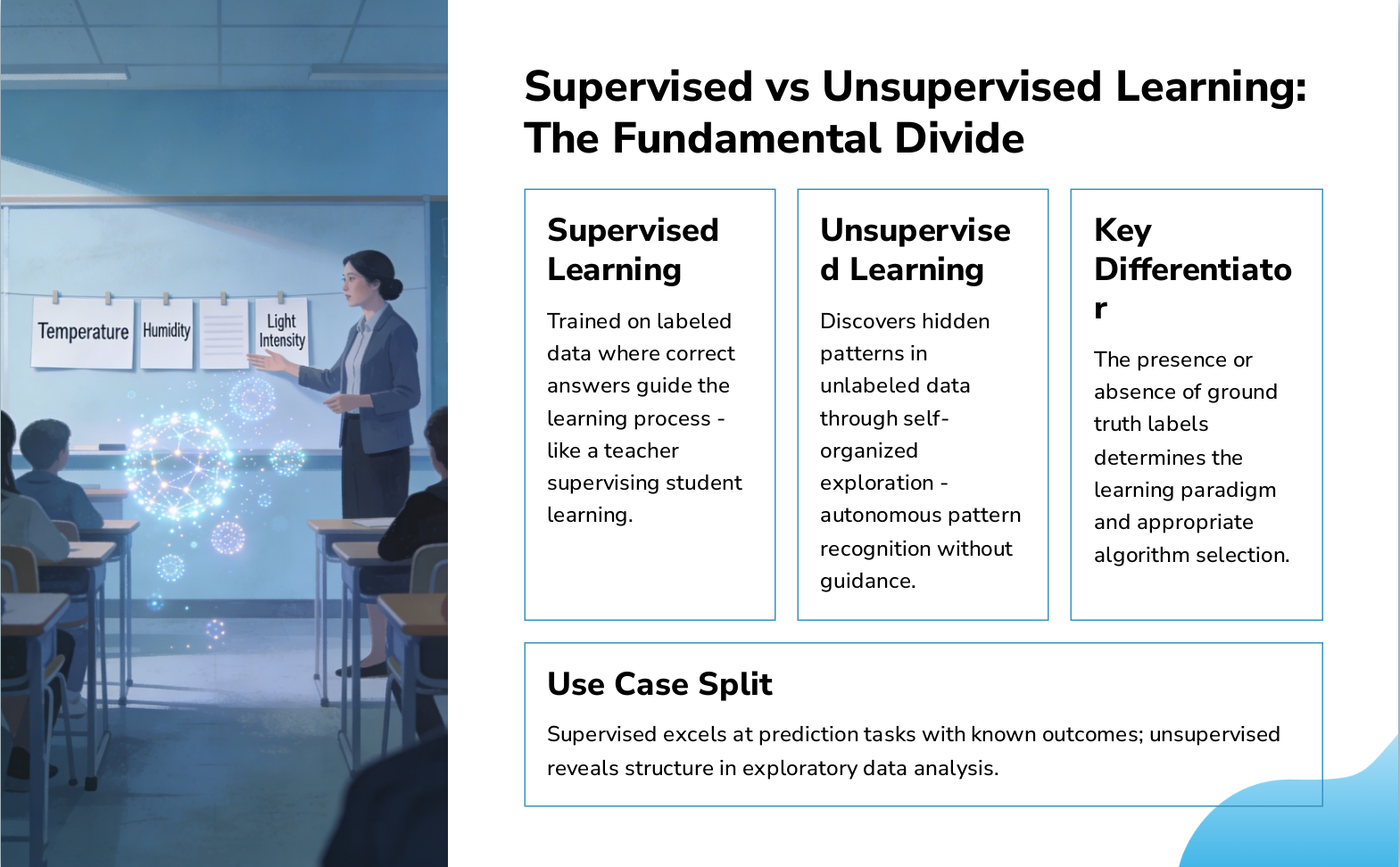
Slide 4: Supervised vs Unsupervised Learning: The Fundamental Divide
- Supervised Learning: Trained on labeled data where correct answers guide the learning process - like a teacher supervising student learning.
- Unsupervised Learning: Discovers hidden patterns in unlabeled data through self-organized exploration - autonomous pattern recognition without guidance.
- Key Differentiator: The presence or absence of ground truth labels determines the learning paradigm and appropriate algorithm selection.
- Use Case Split: Supervised excels at prediction tasks with known outcomes; unsupervised reveals structure in exploratory data analysis.
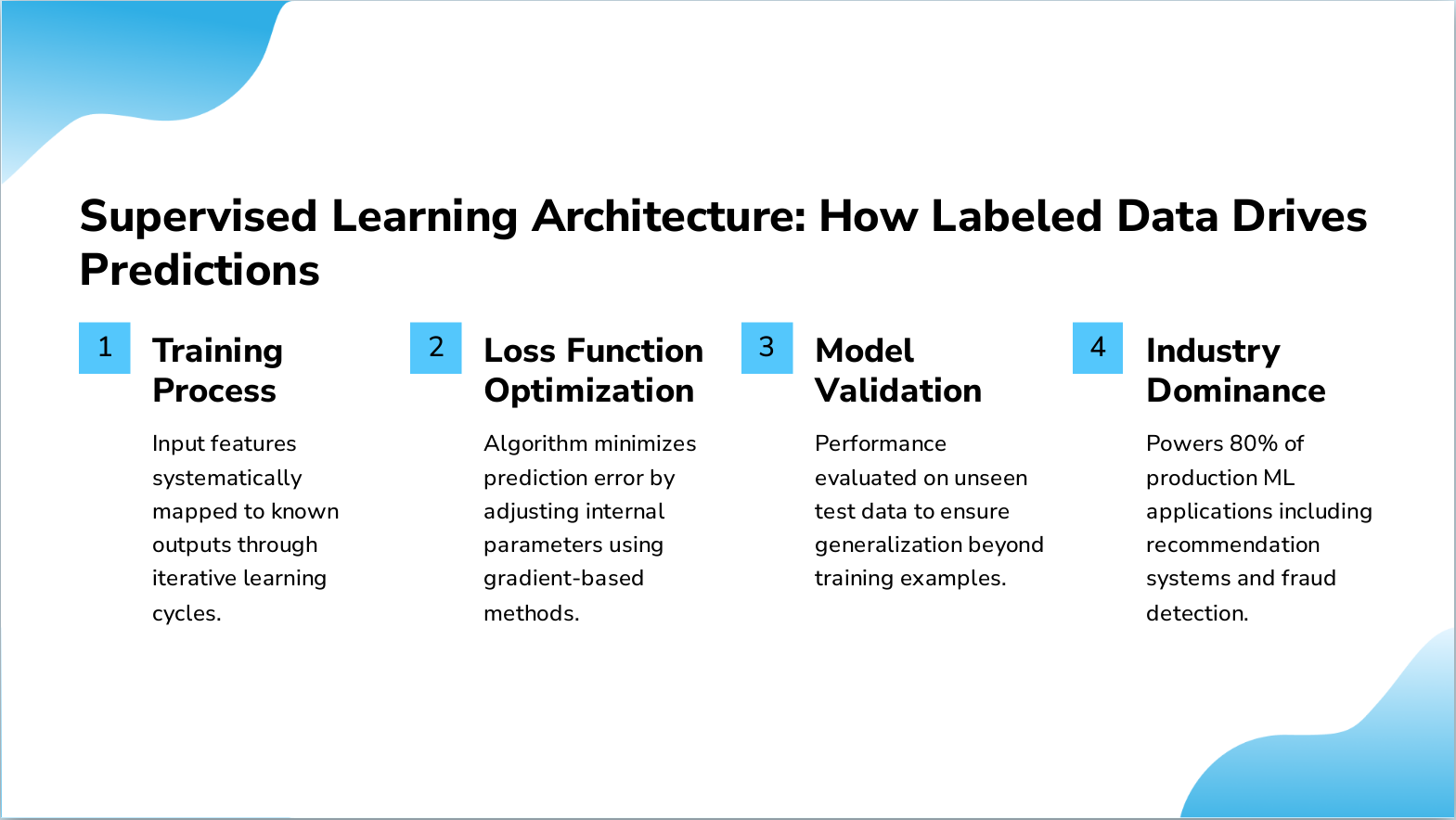
Slide 5: Supervised Learning Architecture: How Labeled Data Drives Predictions
- Training Process: Input features systematically mapped to known outputs through iterative learning cycles.
- Loss Function Optimization: Algorithm minimizes prediction error by adjusting internal parameters using gradient-based methods.
- Model Validation: Performance evaluated on unseen test data to ensure generalization beyond training examples.
- Industry Dominance: Powers 80% of production ML applications including recommendation systems and fraud detection.
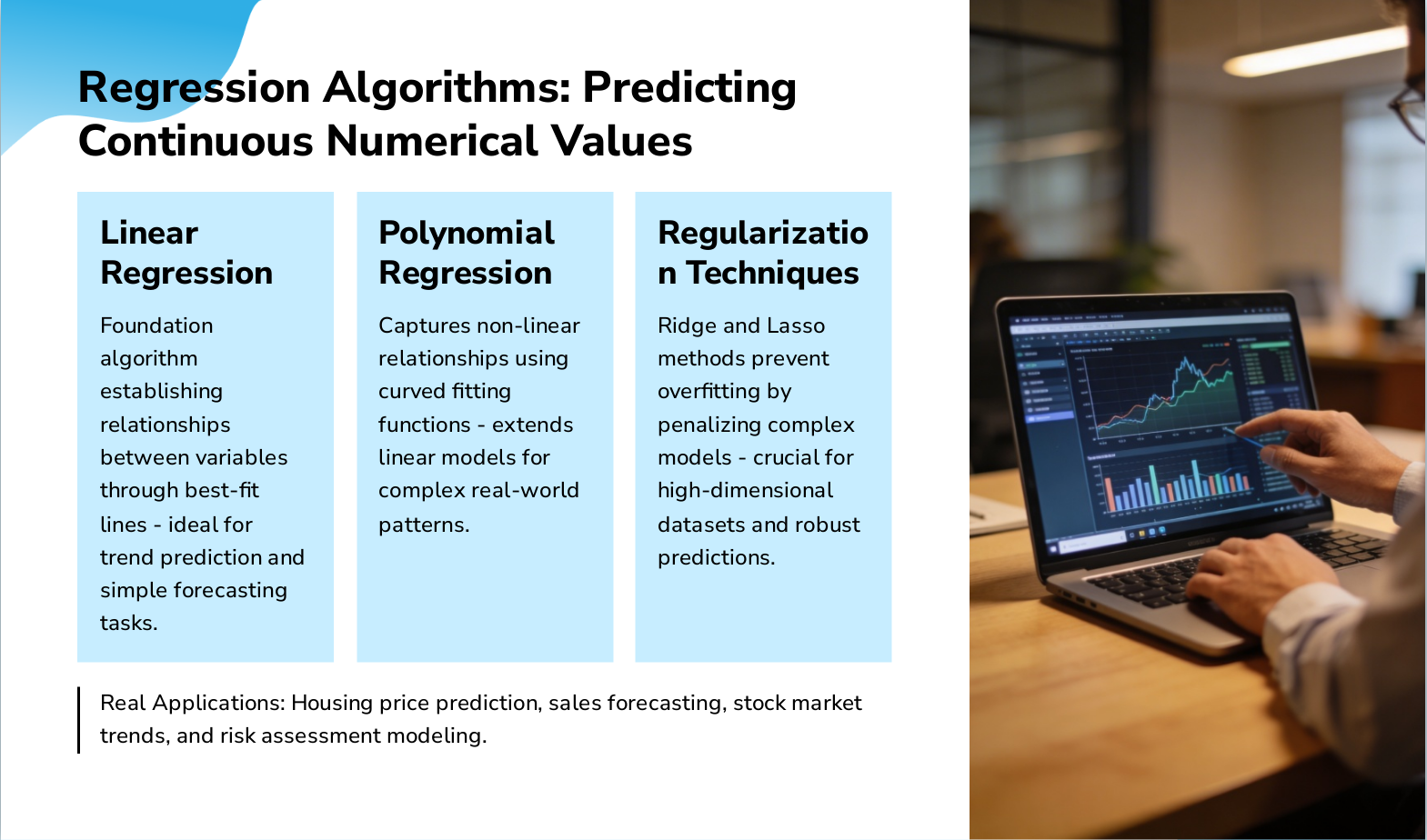
Slide 6: Regression Algorithms: Predicting Continuous Numerical Values
- Linear Regression: Foundation algorithm establishing relationships between variables through best-fit lines - ideal for trend prediction and simple forecasting tasks.
- Polynomial Regression: Captures non-linear relationships using curved fitting functions - extends linear models for complex real-world patterns.
- Regularization Techniques: Ridge and Lasso methods prevent overfitting by penalizing complex models - crucial for high-dimensional datasets and robust predictions.
Real Applications: Housing price prediction, sales forecasting, stock market trends, and risk assessment modeling.
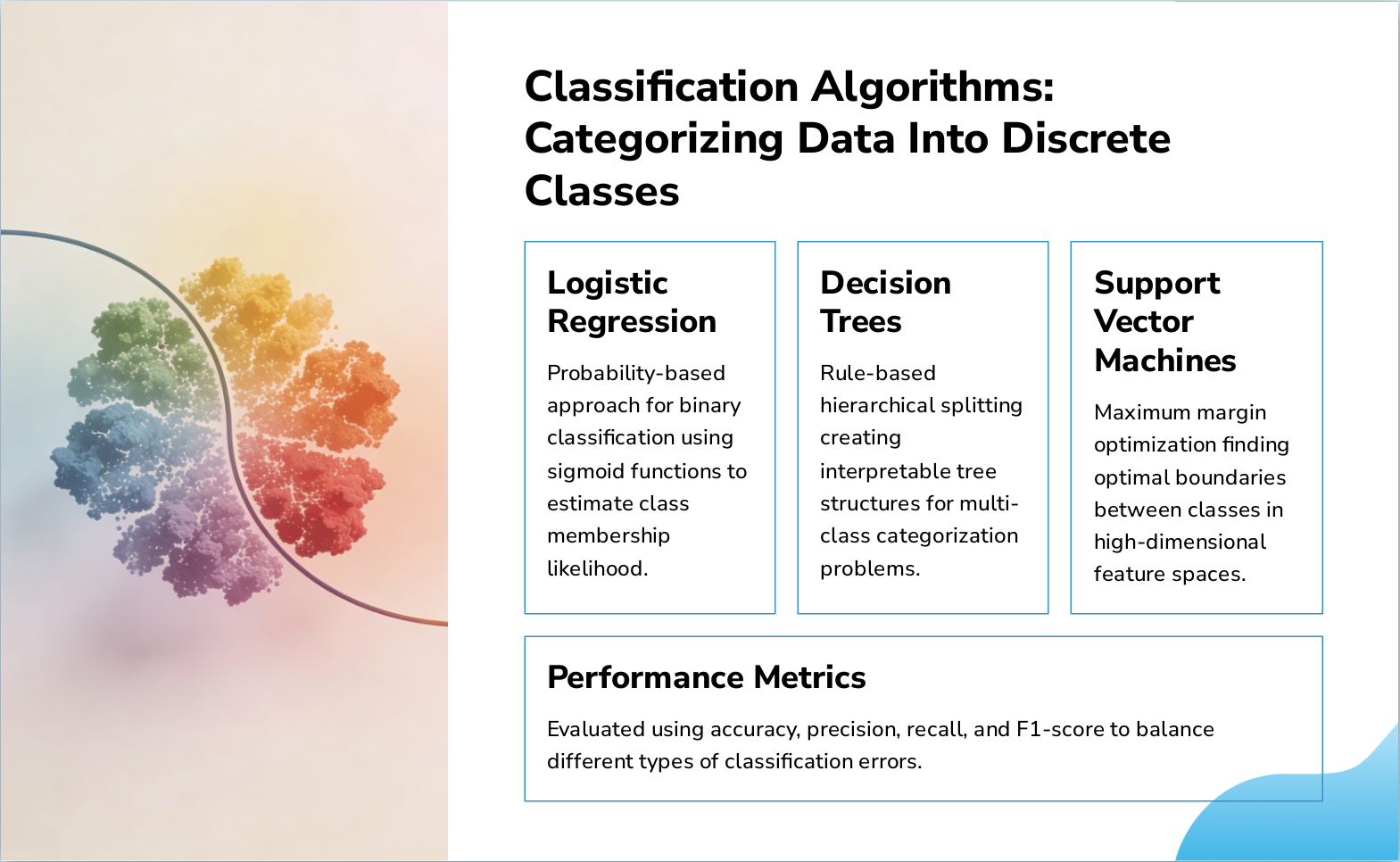
Slide 7: Classification Algorithms: Categorizing Data Into Discrete Classes
- Logistic Regression: Probability-based approach for binary classification using sigmoid functions to estimate class membership likelihood.
- Decision Trees: Rule-based hierarchical splitting creating interpretable tree structures for multi-class categorization problems.
- Support Vector Machines: Maximum margin optimization finding optimal boundaries between classes in high-dimensional feature spaces.
- Performance Metrics: Evaluated using accuracy, precision, recall, and F1-score to balance different types of classification errors.
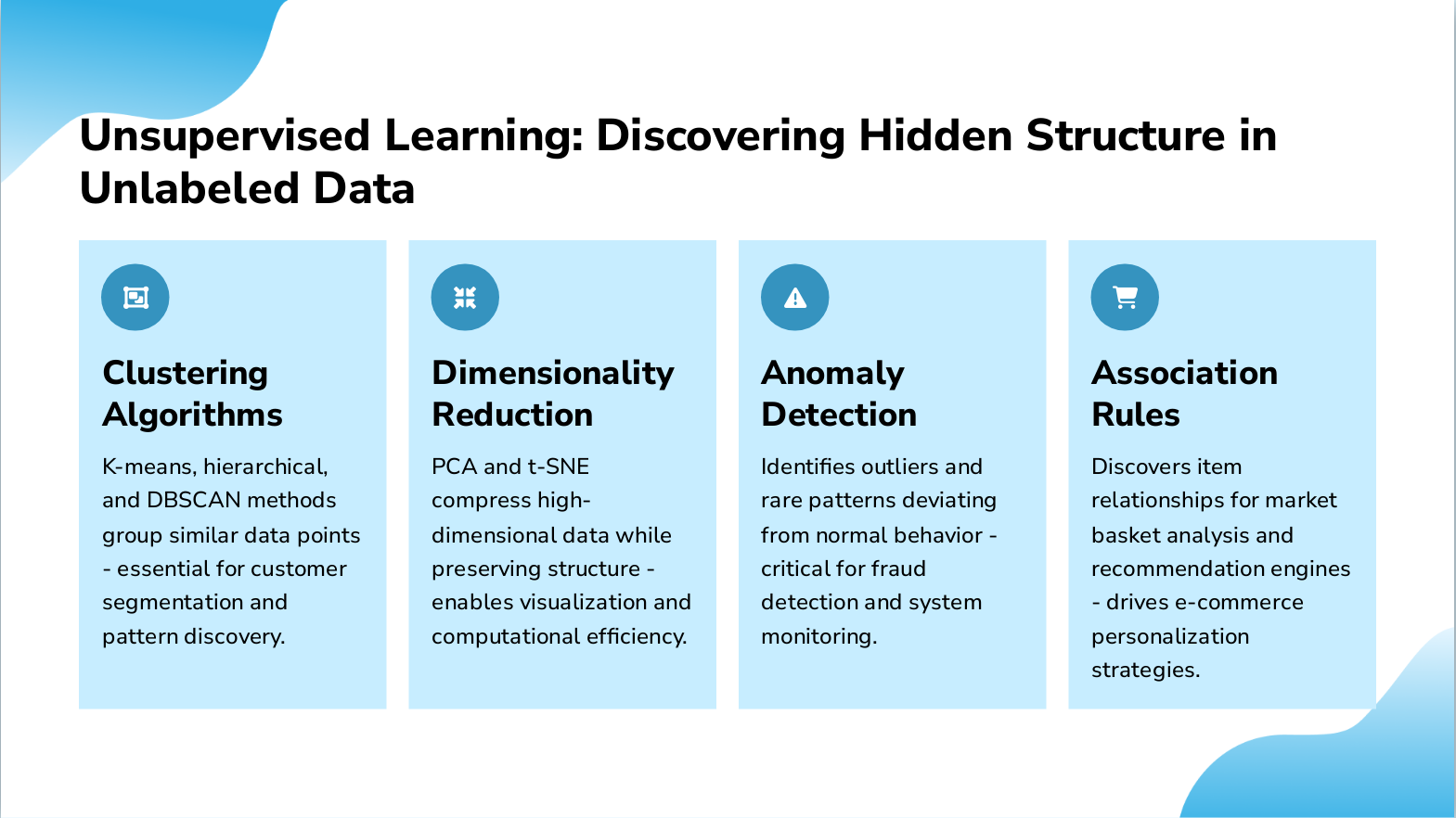
Slide 8: Unsupervised Learning: Discovering Hidden Structure in Unlabeled Data
- Clustering Algorithms: K-means, hierarchical, and DBSCAN methods group similar data points - essential for customer segmentation and pattern discovery.
- Dimensionality Reduction: PCA and t-SNE compress high-dimensional data while preserving structure - enables visualization and computational efficiency.
- Anomaly Detection: Identifies outliers and rare patterns deviating from normal behavior - critical for fraud detection and system monitoring.
- Association Rules: Discovers item relationships for market basket analysis and recommendation engines - drives e-commerce personalization strategies.
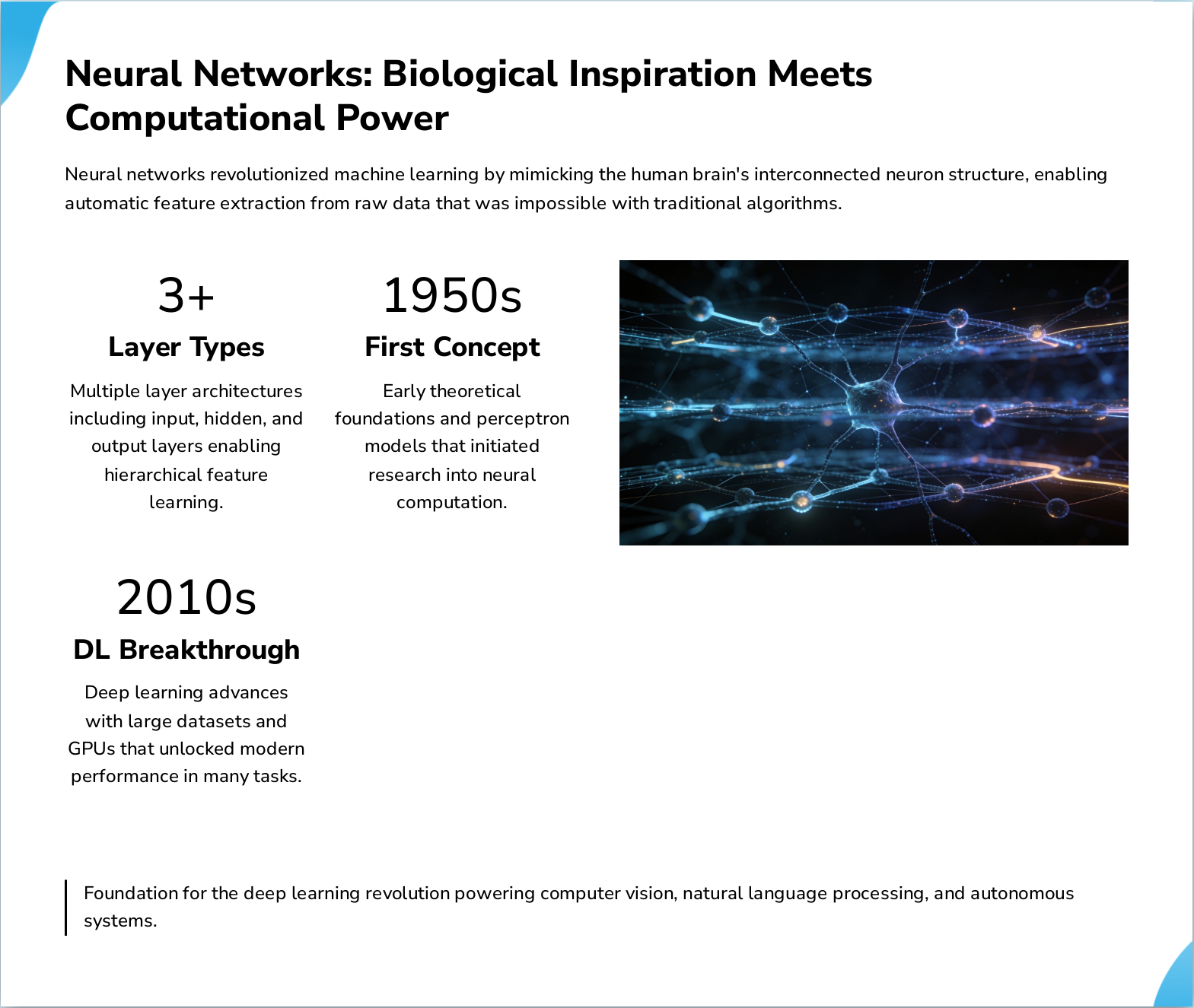
Slide 9: Neural Networks: Biological Inspiration Meets Computational Power
- 3+ — Layer Types
- 1950s — First Concept
- 2010s — DL Breakthrough
Neural networks revolutionized machine learning by mimicking the human brain's interconnected neuron structure, enabling automatic feature extraction from raw data that was impossible with traditional algorithms.
Foundation for the deep learning revolution powering computer vision, natural language processing, and autonomous systems.
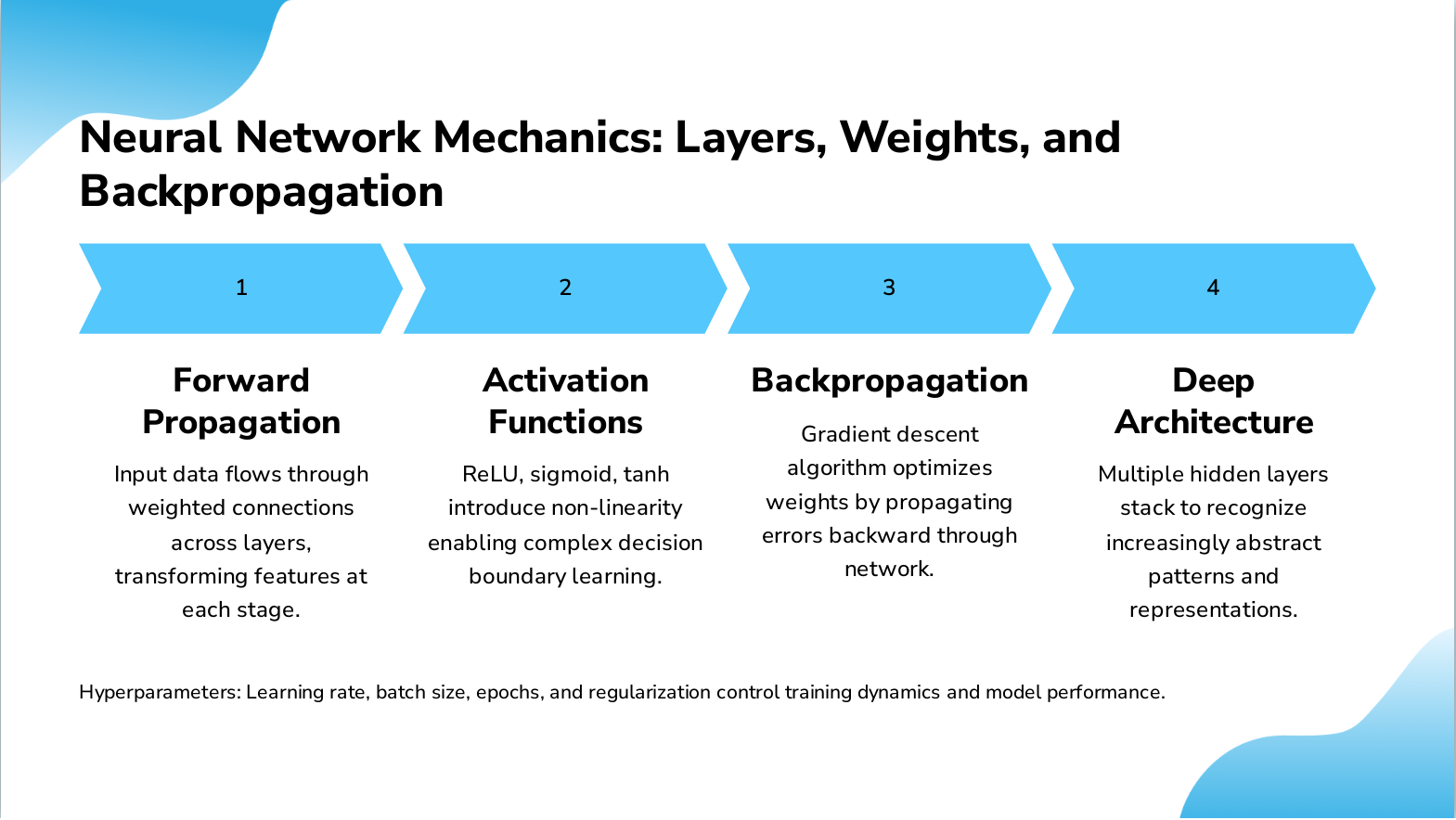
Slide 10: Neural Network Mechanics: Layers, Weights, and Backpropagation
- Forward Propagation: Input data flows through weighted connections across layers, transforming features at each stage.
- Activation Functions: ReLU, sigmoid, tanh introduce non-linearity enabling complex decision boundary learning.
- Backpropagation: Gradient descent algorithm optimizes weights by propagating errors backward through network.
- Deep Architecture: Multiple hidden layers stack to recognize increasingly abstract patterns and representations.
Hyperparameters: Learning rate, batch size, epochs, and regularization control training dynamics and model performance.
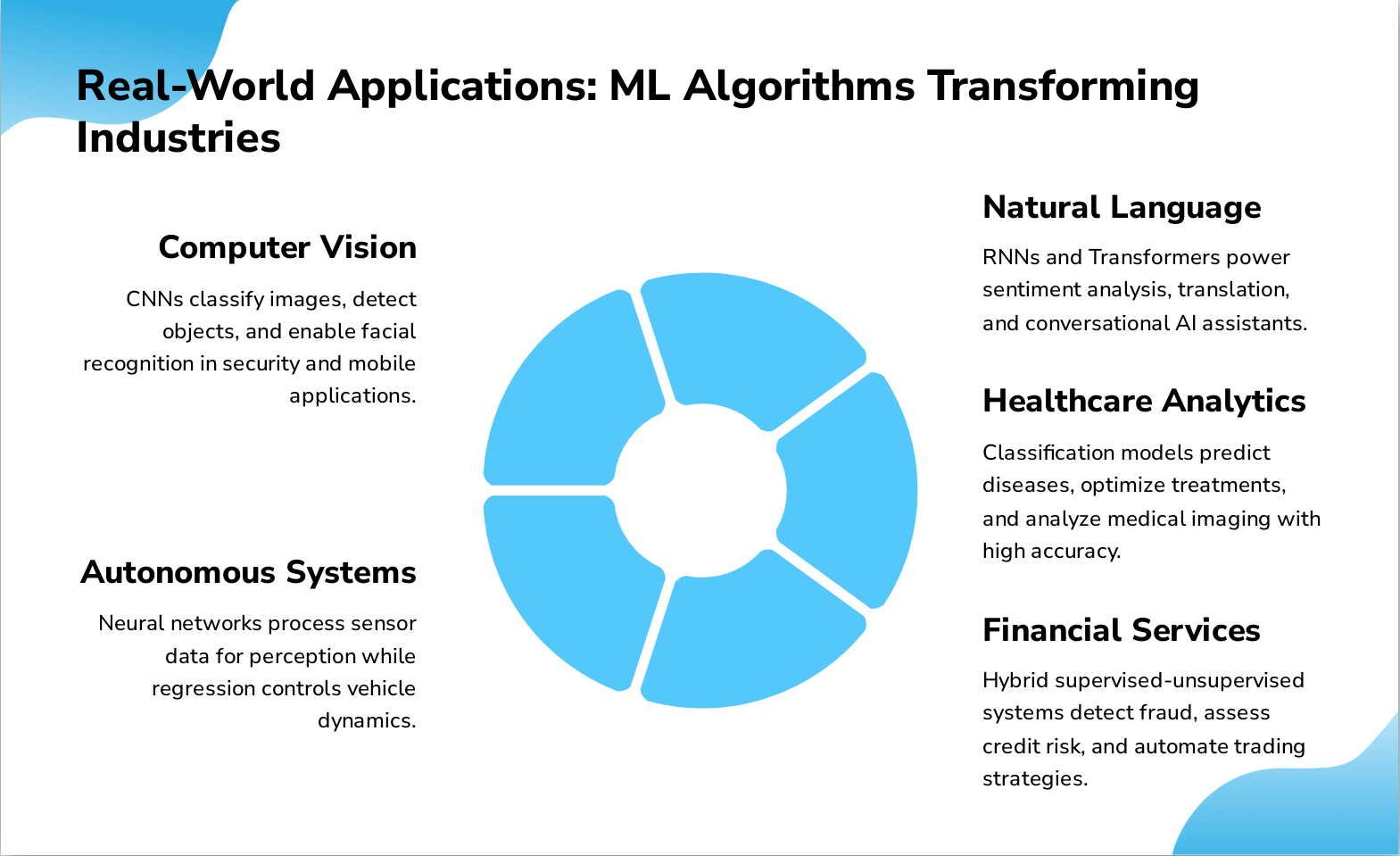
Slide 11: Real-World Applications: ML Algorithms Transforming Industries
- Computer Vision: CNNs classify images, detect objects, and enable facial recognition in security and mobile applications.
- Natural Language: RNNs and Transformers power sentiment analysis, translation, and conversational AI assistants.
- Healthcare Analytics: Classification models predict diseases, optimize treatments, and analyze medical imaging with high accuracy.
- Financial Services: Hybrid supervised-unsupervised systems detect fraud, assess credit risk, and automate trading strategies.
- Autonomous Systems: Neural networks process sensor data for perception while regression controls vehicle dynamics.
Slide 12: Thank You
Thank You Start building your ML toolkit - experiment, iterate, and keep learning as the field evolves!