Presentation Summary
Explore the rapidly growing IoT ecosystem, its four-layer technology stack, and the essential sensors and connectivity protocols that power smart home and industrial IoT applications.
Full Presentation Transcript
Slide 1: Introduction to Internet of Things
Tech and Business Trends Overview: Exploring Sensors, Connectivity, Applications, and Security Challenges
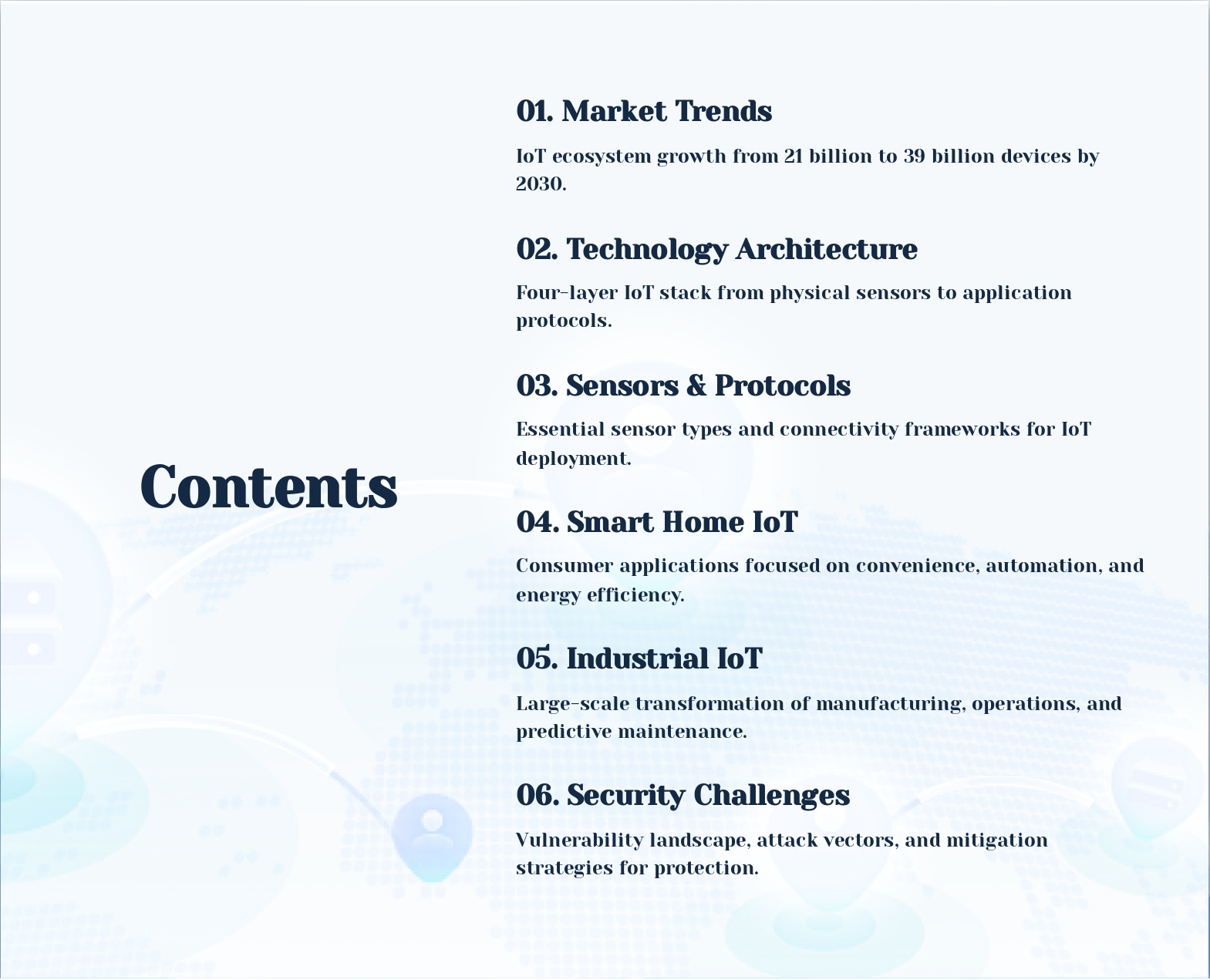
Slide 2: Contents
- Market Trends: IoT ecosystem growth from 21 billion to 39 billion devices by 2030.
- Technology Architecture: Four-layer IoT stack from physical sensors to application protocols.
- Sensors & Protocols: Essential sensor types and connectivity frameworks for IoT deployment.
- Smart Home IoT: Consumer applications focused on convenience, automation, and energy efficiency.
- Industrial IoT: Large-scale transformation of manufacturing, operations, and predictive maintenance.
- Security Challenges: Vulnerability landscape, attack vectors, and mitigation strategies for protection.
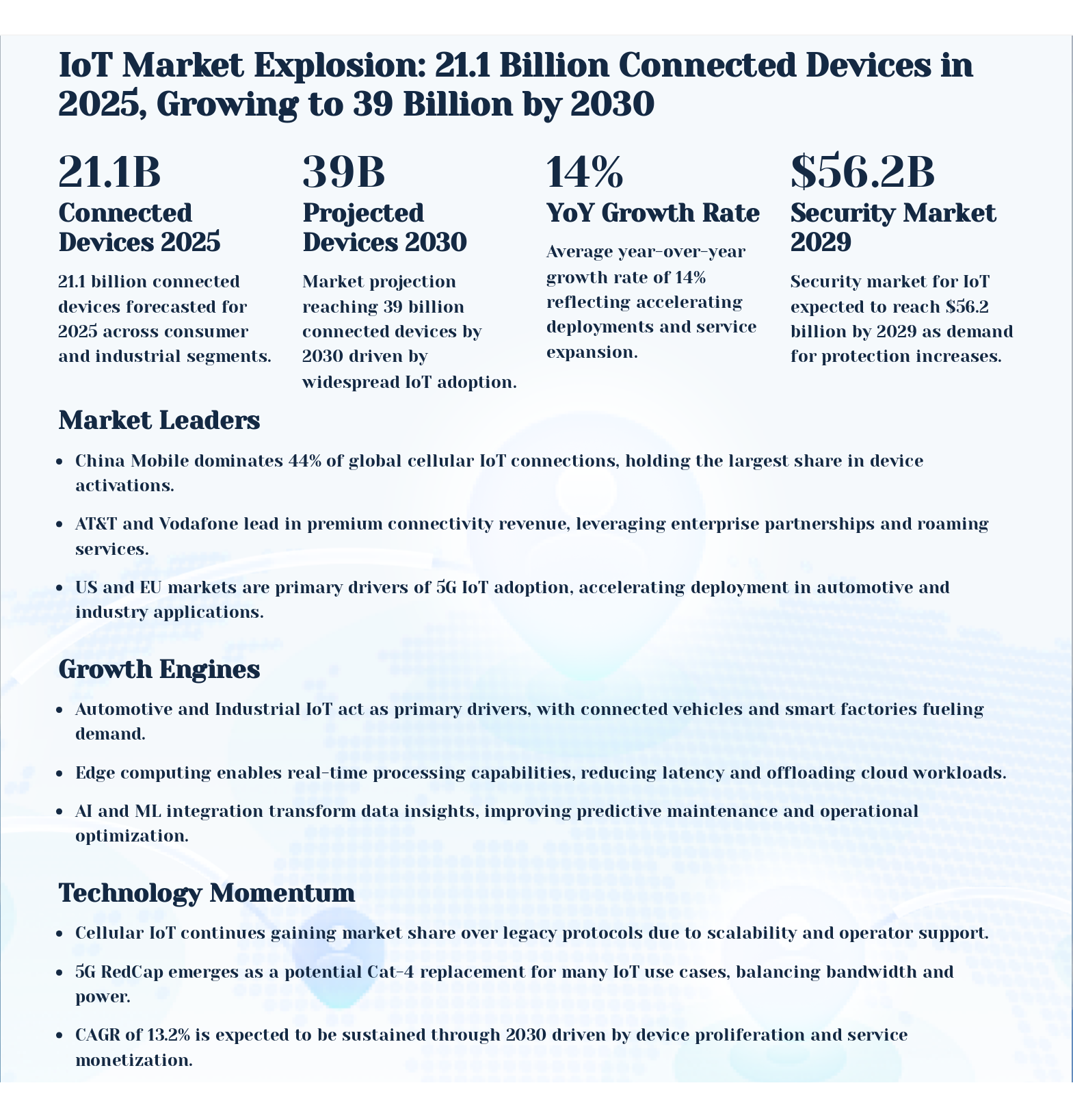
Slide 3: IoT Market Explosion: 21.1 Billion Connected Devices in 2025, Growing to 39 Billion by 2030
- 21.1B — Connected Devices 2025
- 39B — Projected Devices 2030
- 14% — YoY Growth Rate
- $56.2B — Security Market 2029
- Market Leaders: China Mobile dominates 44% of global cellular IoT connections, holding the largest share in device activations.
- Growth Engines: Automotive and Industrial IoT act as primary drivers, with connected vehicles and smart factories fueling demand.
- Technology Momentum: Cellular IoT continues gaining market share over legacy protocols due to scalability and operator support.
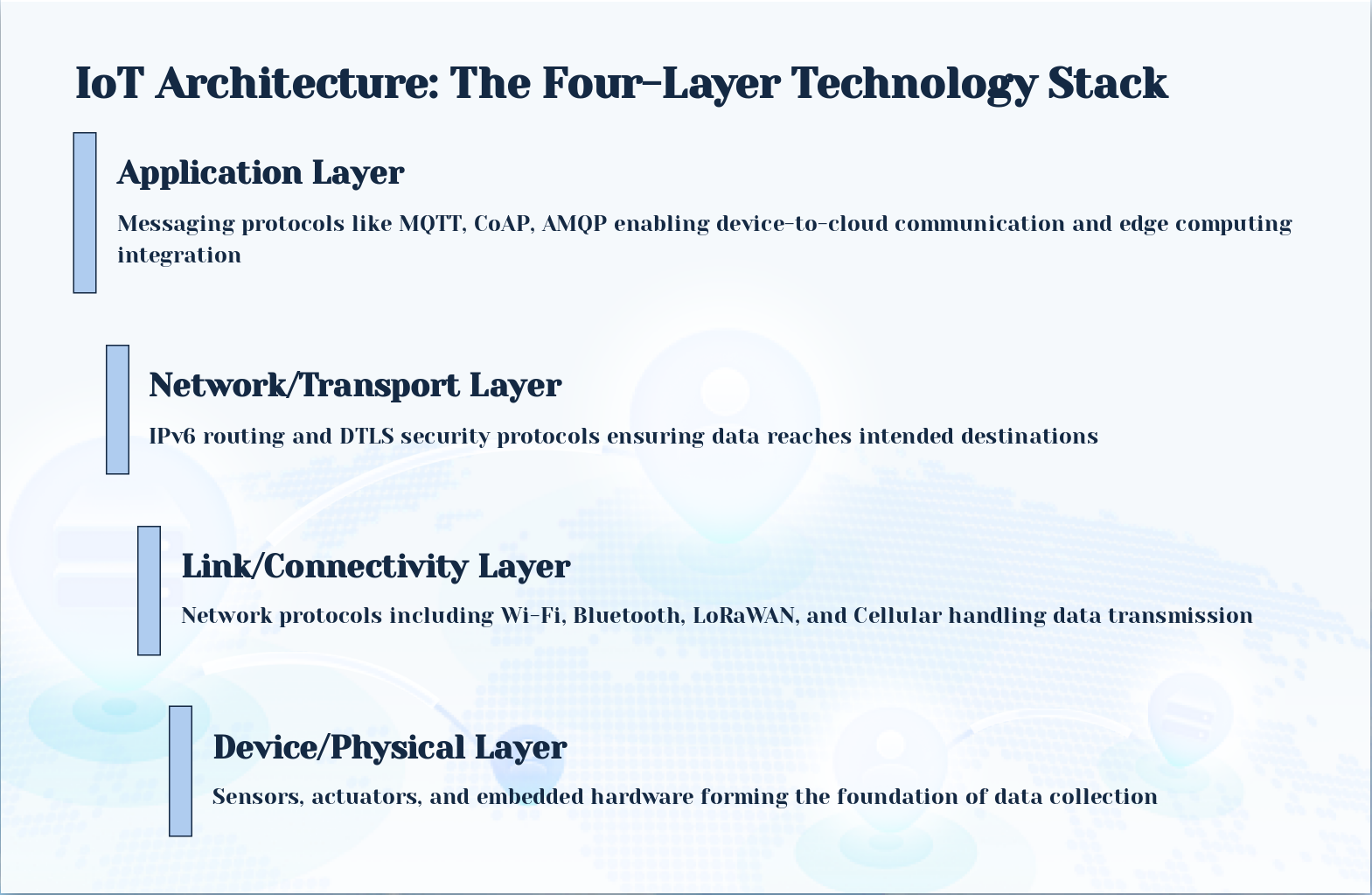
Slide 4: IoT Architecture: The Four-Layer Technology Stack
- Application Layer: Messaging protocols like MQTT, CoAP, AMQP enabling device-to-cloud communication and edge computing integration
- Network/Transport Layer: IPv6 routing and DTLS security protocols ensuring data reaches intended destinations
- Link/Connectivity Layer: Network protocols including Wi-Fi, Bluetooth, LoRaWAN, and Cellular handling data transmission
- Device/Physical Layer: Sensors, actuators, and embedded hardware forming the foundation of data collection
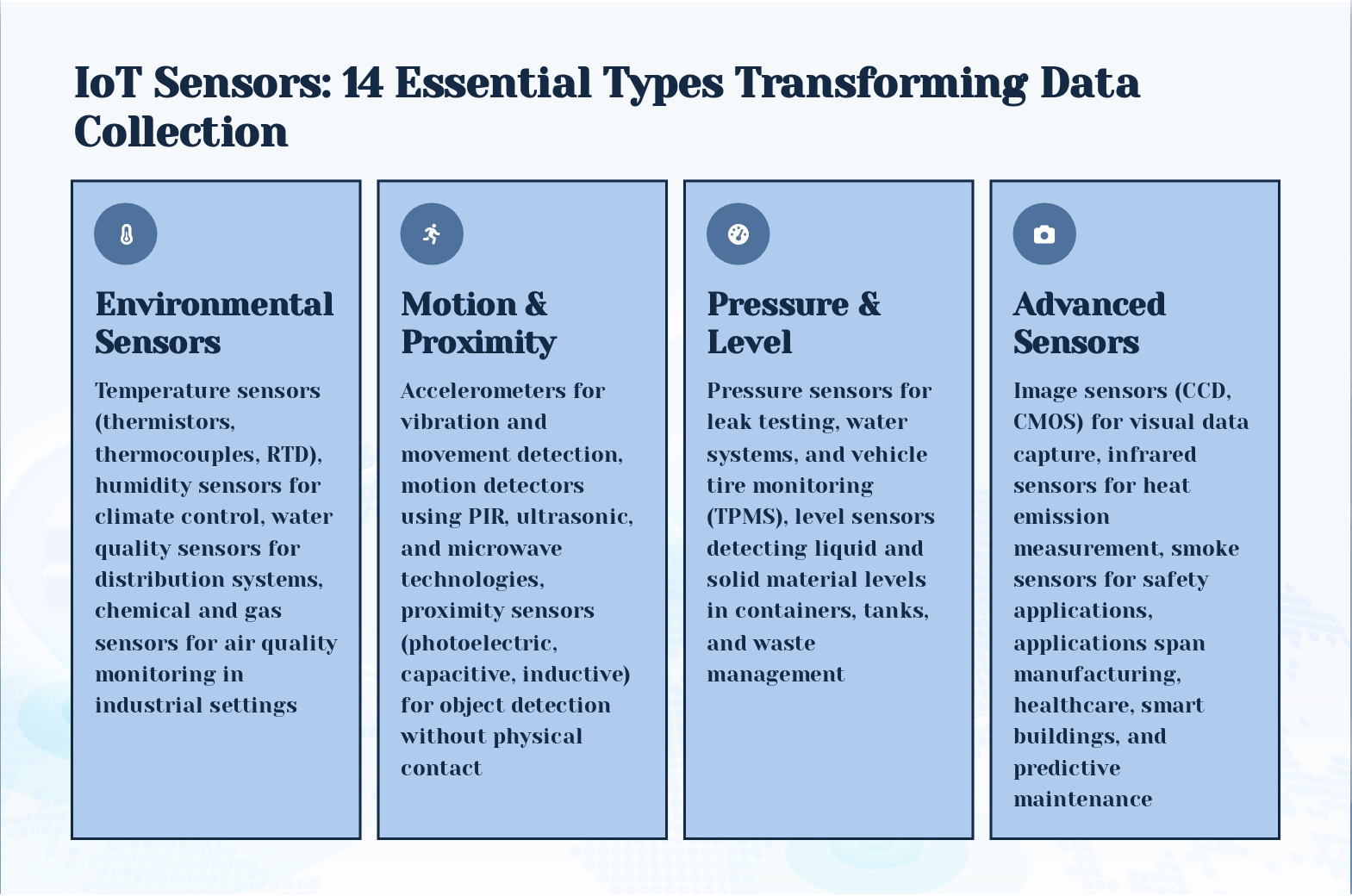
Slide 5: IoT Sensors: 14 Essential Types Transforming Data Collection
- Environmental Sensors: Temperature sensors (thermistors, thermocouples, RTD), humidity sensors for climate control, water quality sensors for distribution systems, chemical and gas sensors for air quality monitoring in industrial settings
- Motion & Proximity: Accelerometers for vibration and movement detection, motion detectors using PIR, ultrasonic, and microwave technologies, proximity sensors (photoelectric, capacitive, inductive) for object detection without physical contact
- Pressure & Level: Pressure sensors for leak testing, water systems, and vehicle tire monitoring (TPMS), level sensors detecting liquid and solid material levels in containers, tanks, and waste management
- Advanced Sensors: Image sensors (CCD, CMOS) for visual data capture, infrared sensors for heat emission measurement, smoke sensors for safety applications, applications span manufacturing, healthcare, smart buildings, and predictive maintenance
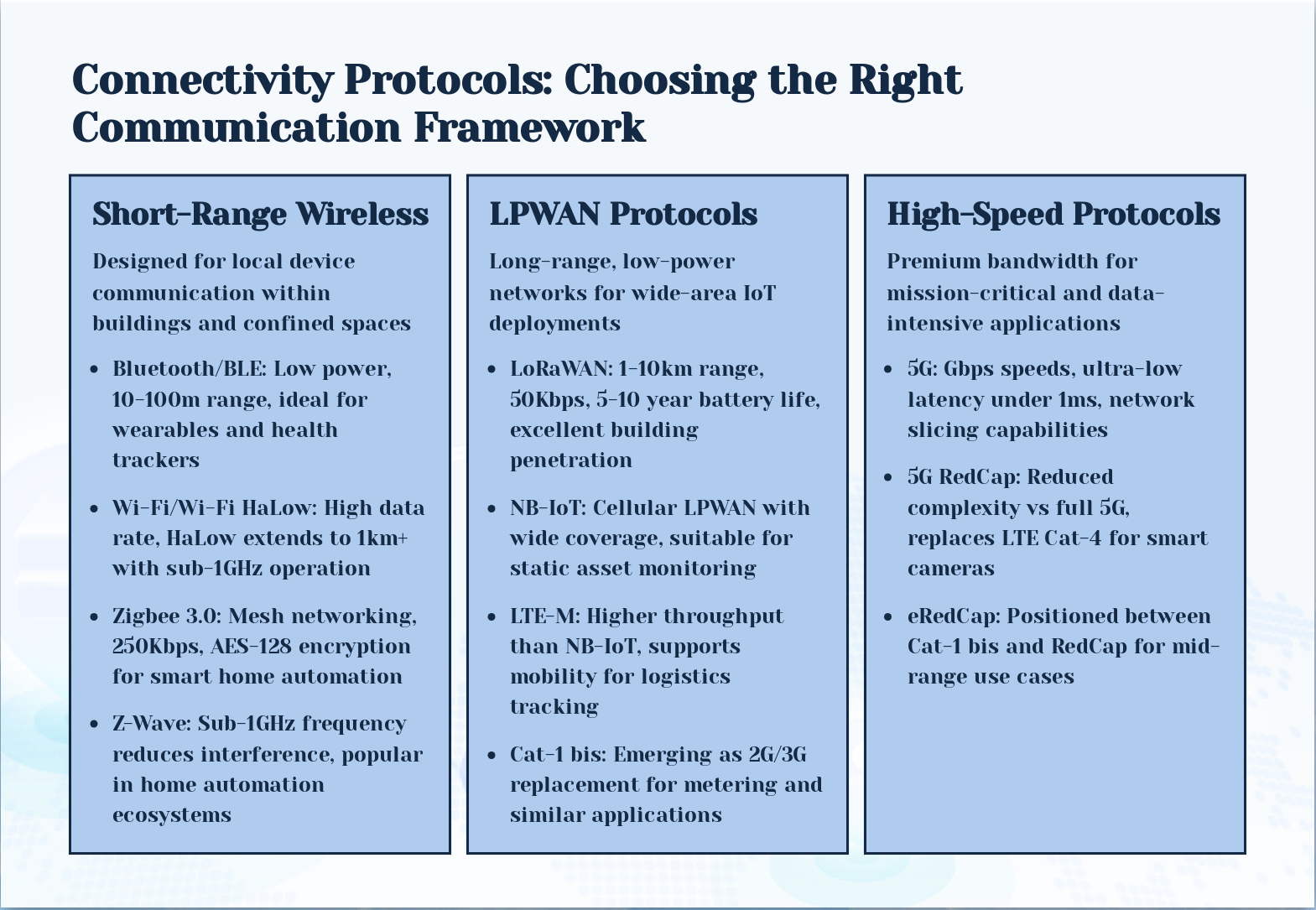
Slide 6: Connectivity Protocols: Choosing the Right Communication Framework
- Short-Range Wireless: Designed for local device communication within buildings and confined spaces
- LPWAN Protocols: Long-range, low-power networks for wide-area IoT deployments
- High-Speed Protocols: Premium bandwidth for mission-critical and data-intensive applications
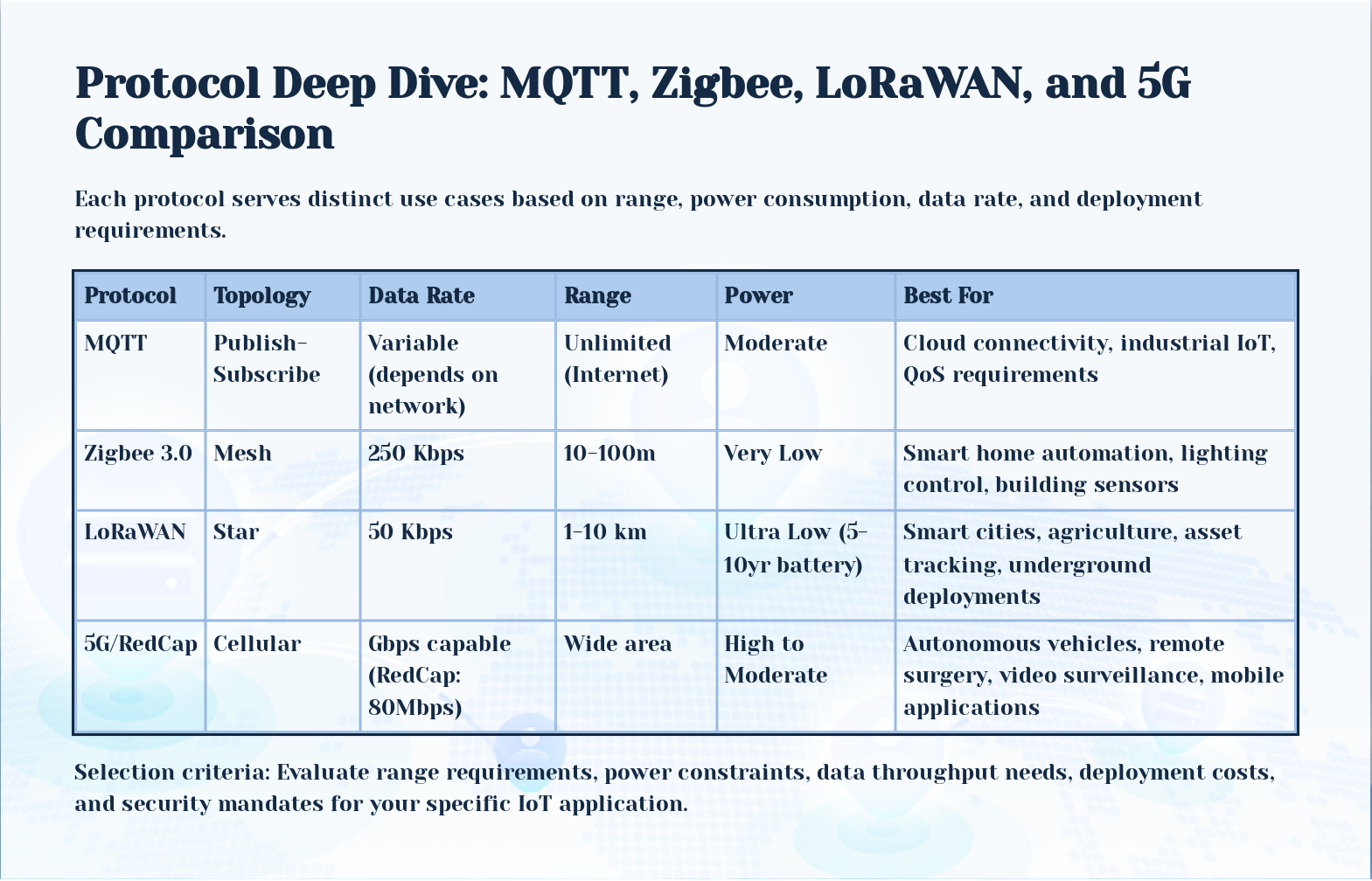
Slide 7: Protocol Deep Dive: MQTT, Zigbee, LoRaWAN, and 5G Comparison
Each protocol serves distinct use cases based on range, power consumption, data rate, and deployment requirements.
Selection criteria: Evaluate range requirements, power constraints, data throughput needs, deployment costs, and security mandates for your specific IoT application.
- Protocol: MQTT, Topology: Publish-Subscribe, Data Rate: Variable (depends on network), Range: Unlimited (Internet), Power: Moderate, Best For: Cloud connectivity, industrial IoT, QoS requirements
- Protocol: Zigbee 3.0, Topology: Mesh, Data Rate: 250 Kbps, Range: 10-100m, Power: Very Low, Best For: Smart home automation, lighting control, building sensors
- Protocol: LoRaWAN, Topology: Star, Data Rate: 50 Kbps, Range: 1-10 km, Power: Ultra Low (5-10yr battery), Best For: Smart cities, agriculture, asset tracking, underground deployments
- Protocol: 5G/RedCap, Topology: Cellular, Data Rate: Gbps capable (RedCap: 80Mbps), Range: Wide area, Power: High to Moderate, Best For: Autonomous vehicles, remote surgery, video surveillance, mobile applications
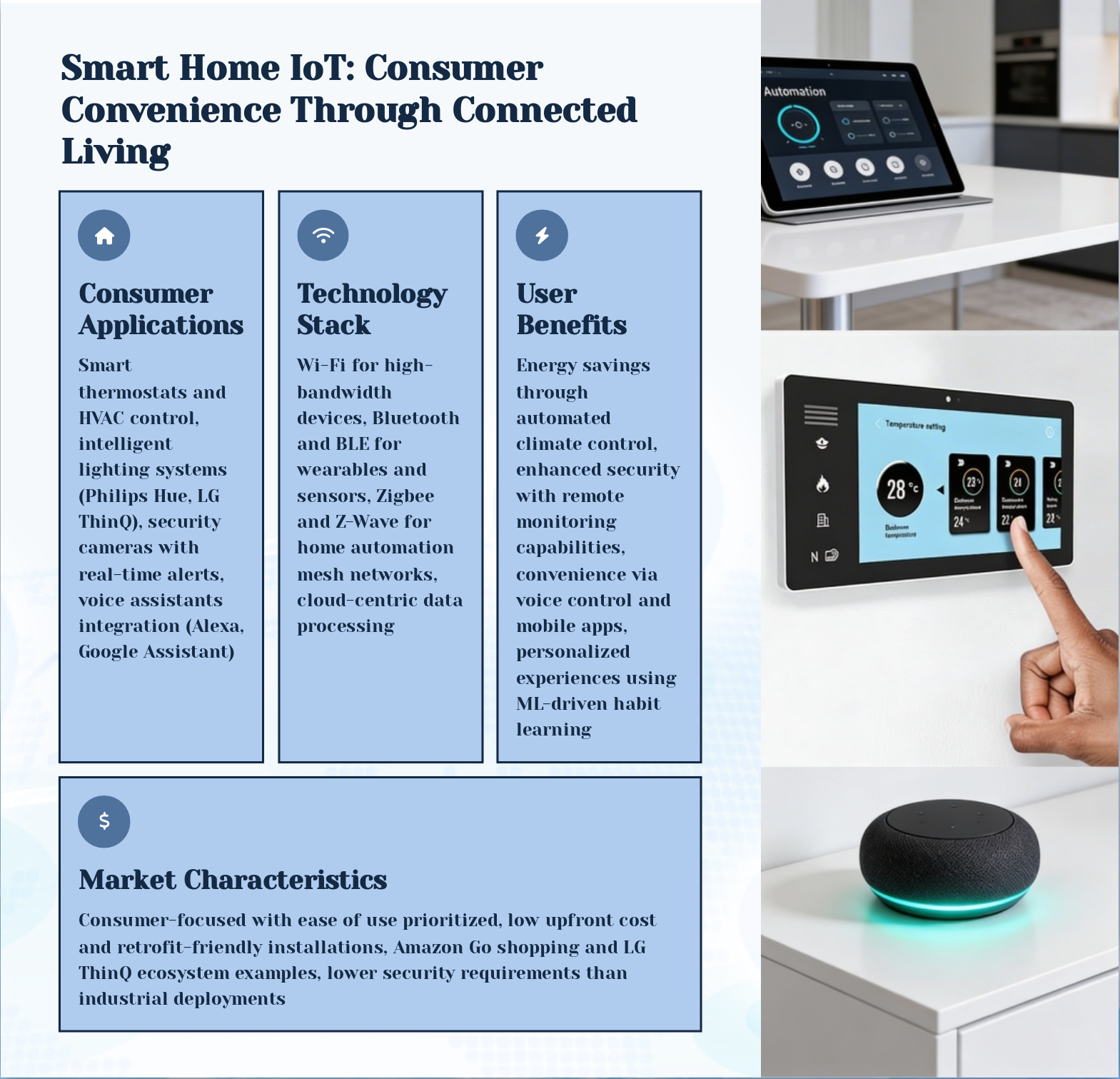
Slide 8: Smart Home IoT: Consumer Convenience Through Connected Living
- Consumer Applications: Smart thermostats and HVAC control, intelligent lighting systems (Philips Hue, LG ThinQ), security cameras with real-time alerts, voice assistants integration (Alexa, Google Assistant)
- Technology Stack: Wi-Fi for high-bandwidth devices, Bluetooth and BLE for wearables and sensors, Zigbee and Z-Wave for home automation mesh networks, cloud-centric data processing
- User Benefits: Energy savings through automated climate control, enhanced security with remote monitoring capabilities, convenience via voice control and mobile apps, personalized experiences using ML-driven habit learning
- Market Characteristics: Consumer-focused with ease of use prioritized, low upfront cost and retrofit-friendly installations, Amazon Go shopping and LG ThinQ ecosystem examples, lower security requirements than industrial deployments
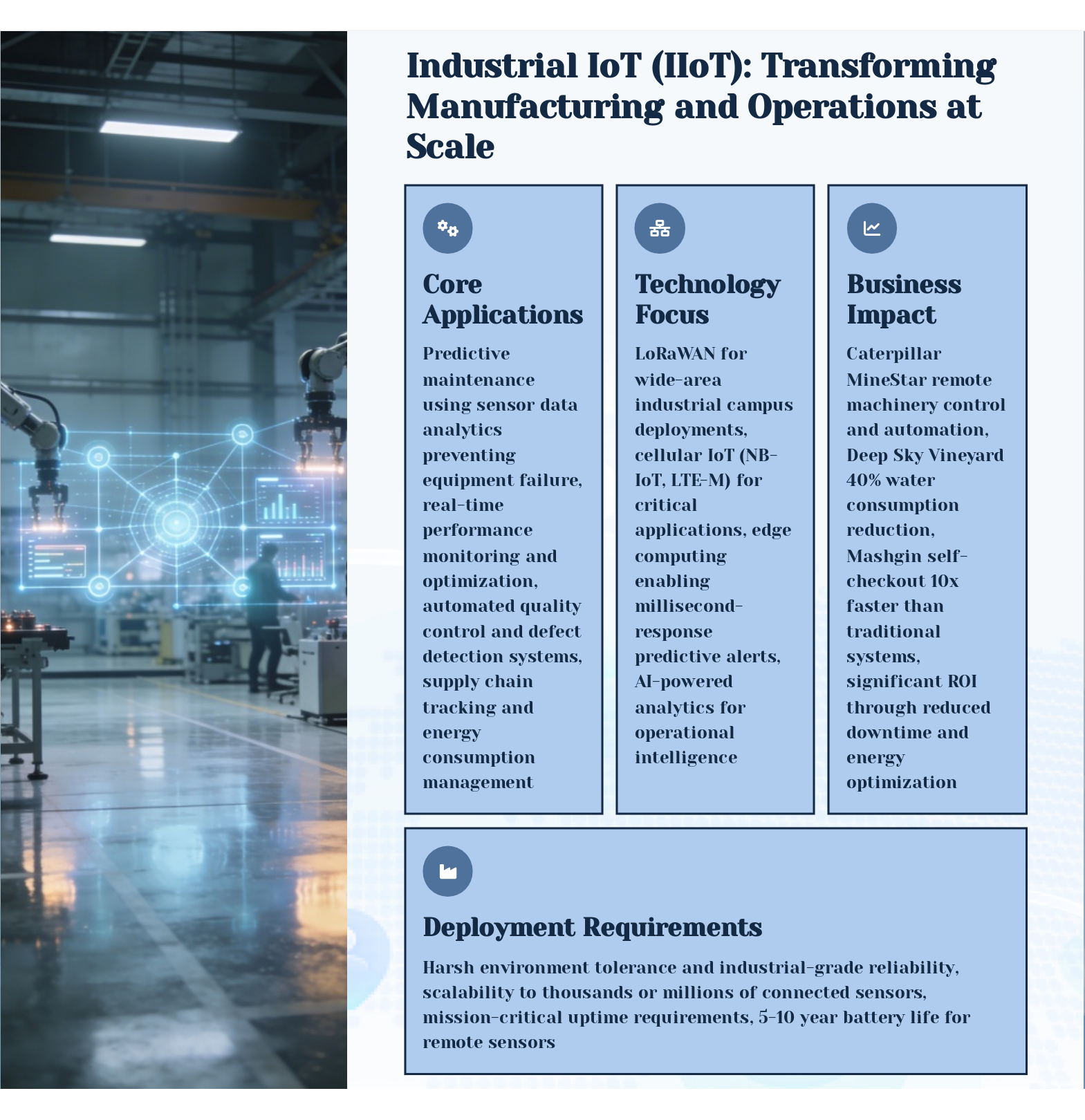
Slide 9: Industrial IoT (IIoT): Transforming Manufacturing and Operations at Scale
- Core Applications: Predictive maintenance using sensor data analytics preventing equipment failure, real-time performance monitoring and optimization, automated quality control and defect detection systems, supply chain tracking and energy consumption management
- Technology Focus: LoRaWAN for wide-area industrial campus deployments, cellular IoT (NB-IoT, LTE-M) for critical applications, edge computing enabling millisecond-response predictive alerts, AI-powered analytics for operational intelligence
- Business Impact: Caterpillar MineStar remote machinery control and automation, Deep Sky Vineyard 40% water consumption reduction, Mashgin self-checkout 10x faster than traditional systems, significant ROI through reduced downtime and energy optimization
- Deployment Requirements: Harsh environment tolerance and industrial-grade reliability, scalability to thousands or millions of connected sensors, mission-critical uptime requirements, 5-10 year battery life for remote sensors
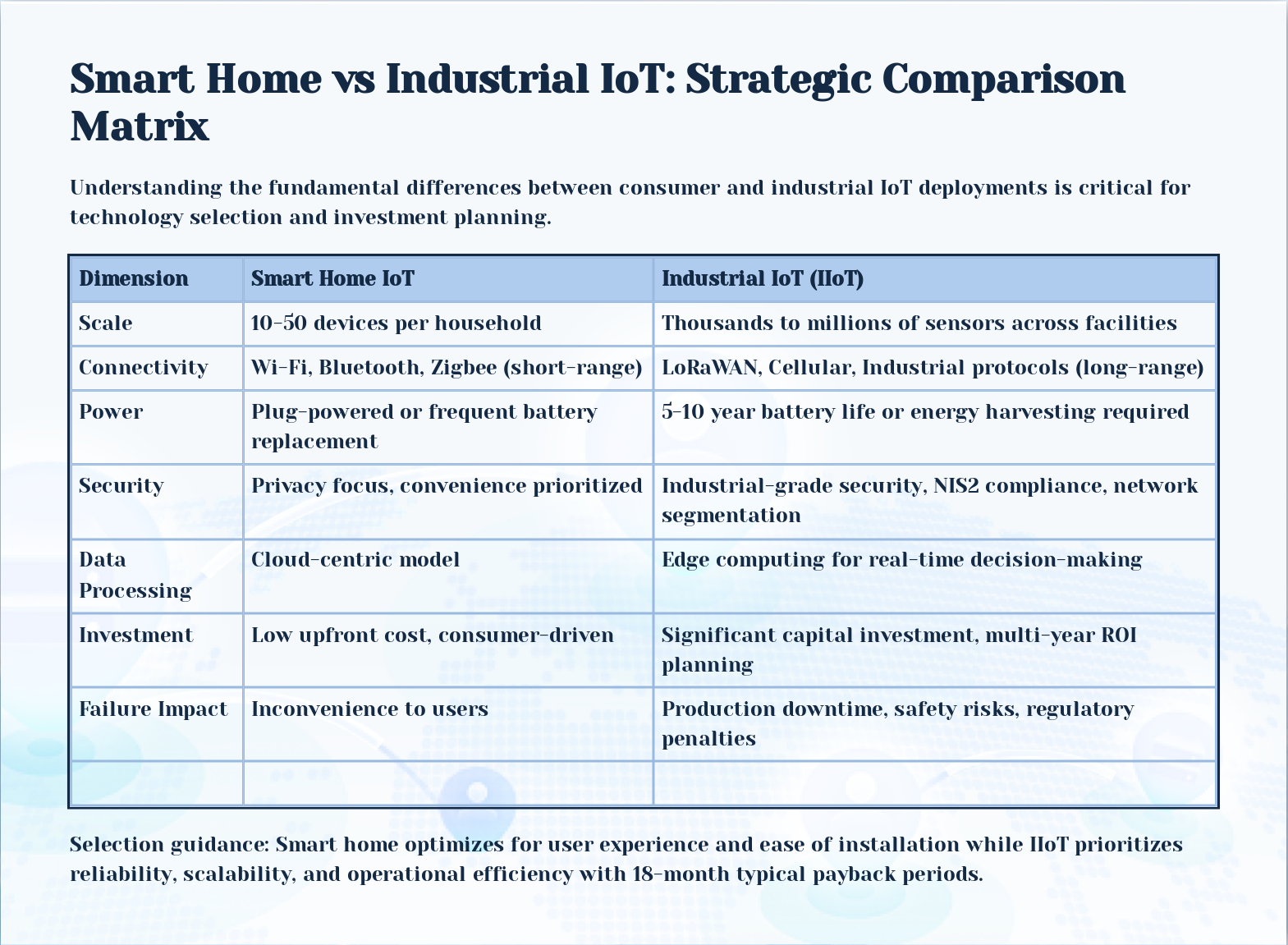
Slide 10: Smart Home vs Industrial IoT: Strategic Comparison Matrix
Understanding the fundamental differences between consumer and industrial IoT deployments is critical for technology selection and investment planning.
Selection guidance: Smart home optimizes for user experience and ease of installation while IIoT prioritizes reliability, scalability, and operational efficiency with 18-month typical payback periods.
- Dimension: Scale, Smart Home IoT: 10-50 devices per household, Industrial IoT (IIoT): Thousands to millions of sensors across facilities
- Dimension: Connectivity, Smart Home IoT: Wi-Fi, Bluetooth, Zigbee (short-range), Industrial IoT (IIoT): LoRaWAN, Cellular, Industrial protocols (long-range)
- Dimension: Power, Smart Home IoT: Plug-powered or frequent battery replacement, Industrial IoT (IIoT): 5-10 year battery life or energy harvesting required
- Dimension: Security, Smart Home IoT: Privacy focus, convenience prioritized, Industrial IoT (IIoT): Industrial-grade security, NIS2 compliance, network segmentation
- Dimension: Data Processing, Smart Home IoT: Cloud-centric model, Industrial IoT (IIoT): Edge computing for real-time decision-making
- Dimension: Investment, Smart Home IoT: Low upfront cost, consumer-driven, Industrial IoT (IIoT): Significant capital investment, multi-year ROI planning
- Dimension: Failure Impact, Smart Home IoT: Inconvenience to users, Industrial IoT (IIoT): Production downtime, safety risks, regulatory penalties
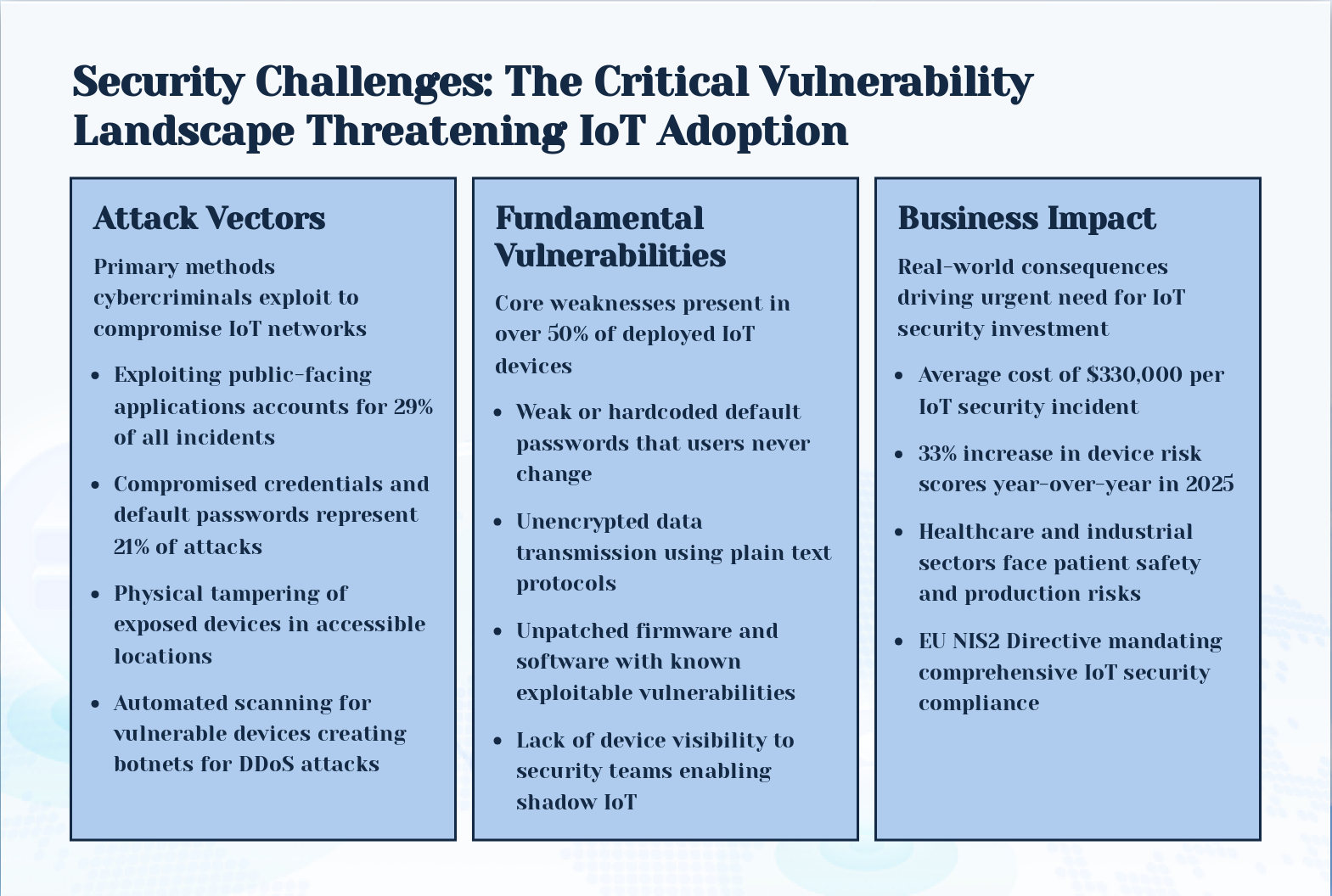
Slide 11: Security Challenges: The Critical Vulnerability Landscape Threatening IoT Adoption
- Attack Vectors: Primary methods cybercriminals exploit to compromise IoT networks
- Fundamental Vulnerabilities: Core weaknesses present in over 50% of deployed IoT devices
- Business Impact: Real-world consequences driving urgent need for IoT security investment
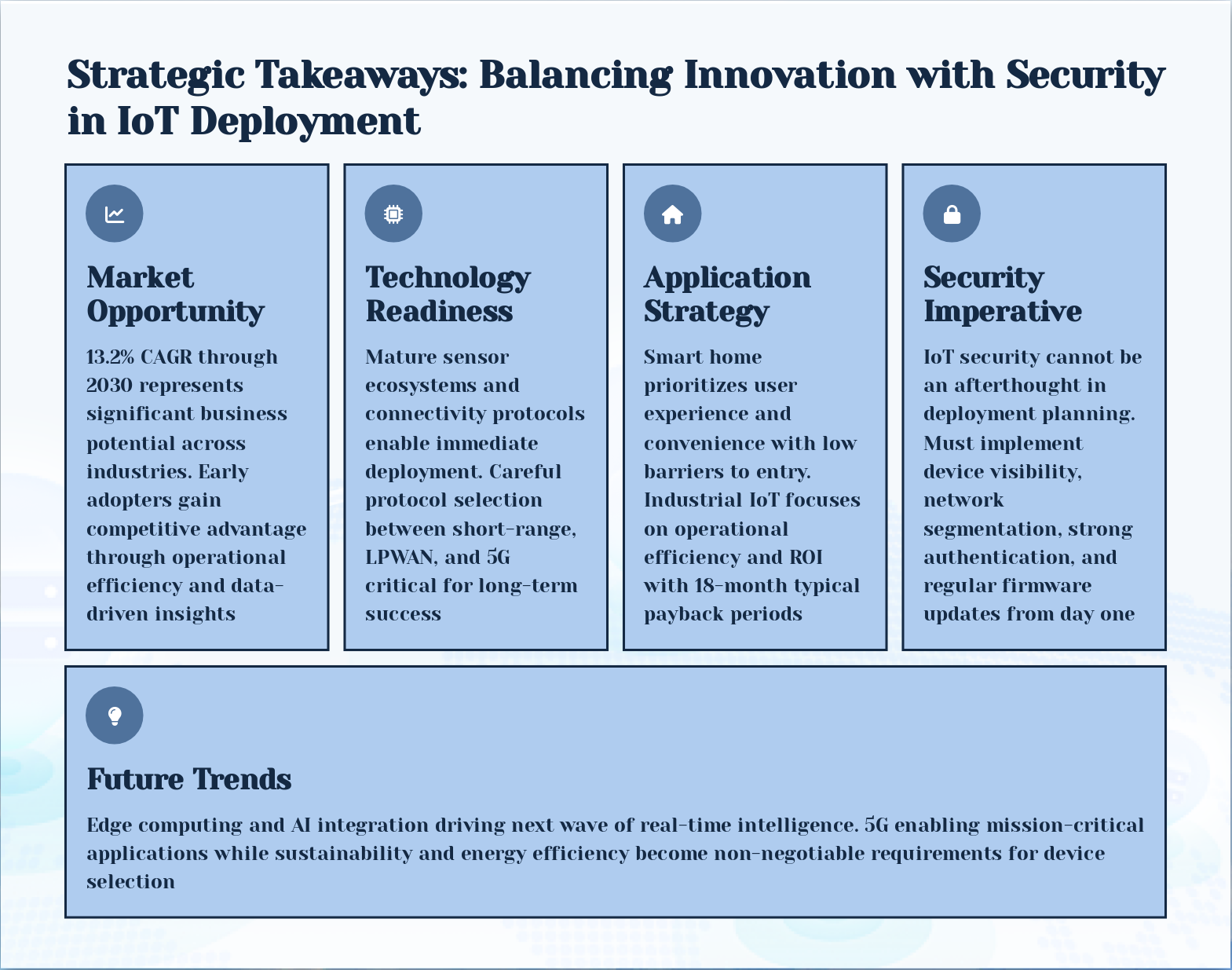
Slide 12: Strategic Takeaways: Balancing Innovation with Security in IoT Deployment
- Market Opportunity: 13.2% CAGR through 2030 represents significant business potential across industries. Early adopters gain competitive advantage through operational efficiency and data-driven insights
- Technology Readiness: Mature sensor ecosystems and connectivity protocols enable immediate deployment. Careful protocol selection between short-range, LPWAN, and 5G critical for long-term success
- Application Strategy: Smart home prioritizes user experience and convenience with low barriers to entry. Industrial IoT focuses on operational efficiency and ROI with 18-month typical payback periods
- Security Imperative: IoT security cannot be an afterthought in deployment planning. Must implement device visibility, network segmentation, strong authentication, and regular firmware updates from day one
- Future Trends: Edge computing and AI integration driving next wave of real-time intelligence. 5G enabling mission-critical applications while sustainability and energy efficiency become non-negotiable requirements for device selection