Presentation Summary
Mastering the Four Pillars of Engaging Gameplay for Aspiring Game Developers The heartbeat of player engagement - understanding repeating cycles that drive gameplay forward. Psychology behind what keeps players hooked - intrinsic and extrinsic motivation frameworks. Crafting interactive spaces that guide, engage, and tell stories without explicit instruction. Ensuring fairness, sustained challenge, and long-term player engagement through iterative tuning. Repeating cycle of actions that move the game forward: Do → Get → Upgrade → Repeat. Four essential elements: Actions (player verbs), Feedbac
Full Presentation Transcript
Slide 1: Introduction to Game Design Principles
Mastering the Four Pillars of Engaging Gameplay for Aspiring Game Developers
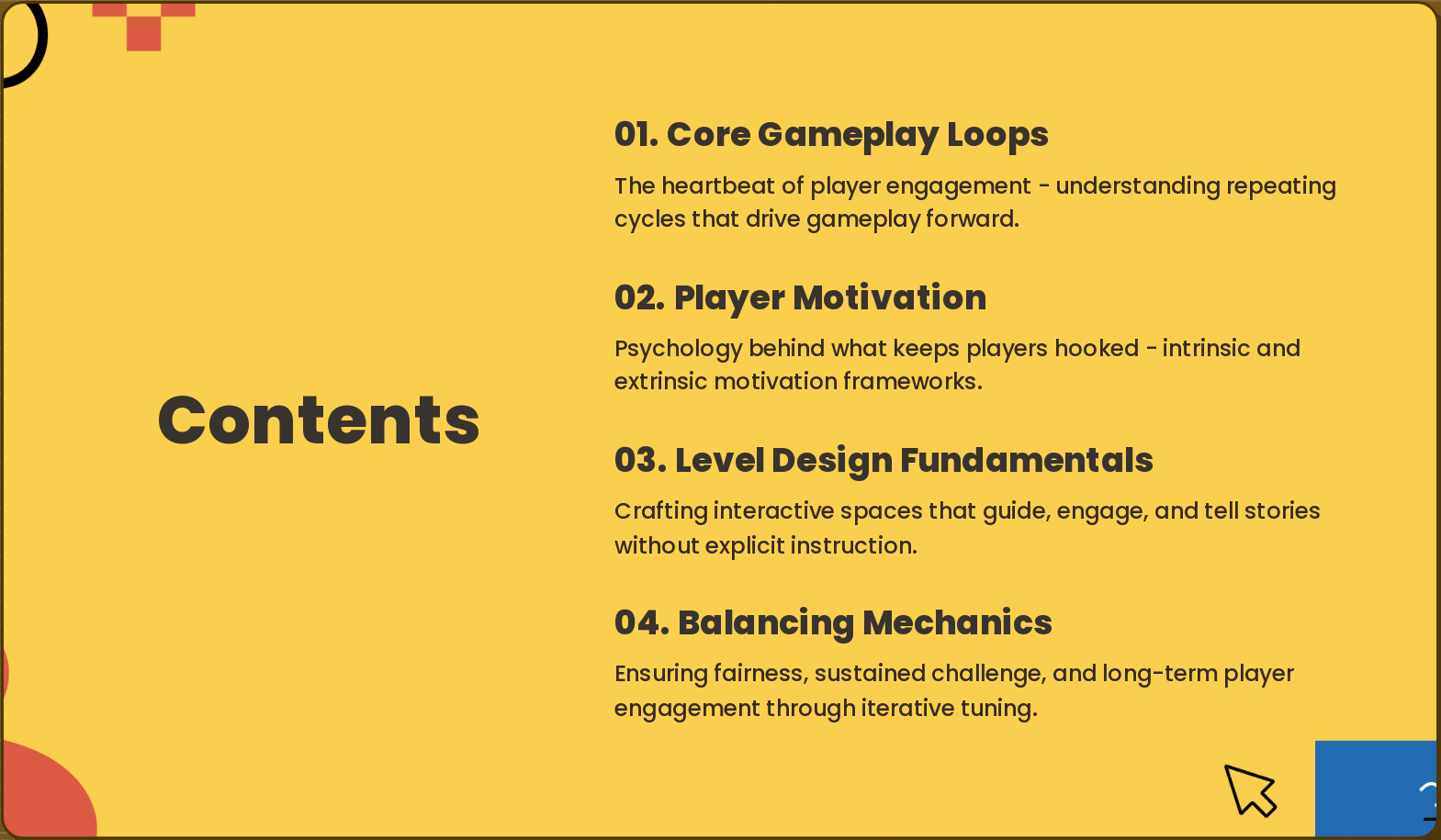
Slide 2: Contents
- Core Gameplay Loops: The heartbeat of player engagement - understanding repeating cycles that drive gameplay forward.
- Player Motivation: Psychology behind what keeps players hooked - intrinsic and extrinsic motivation frameworks.
- Level Design Fundamentals: Crafting interactive spaces that guide, engage, and tell stories without explicit instruction.
- Balancing Mechanics: Ensuring fairness, sustained challenge, and long-term player engagement through iterative tuning.
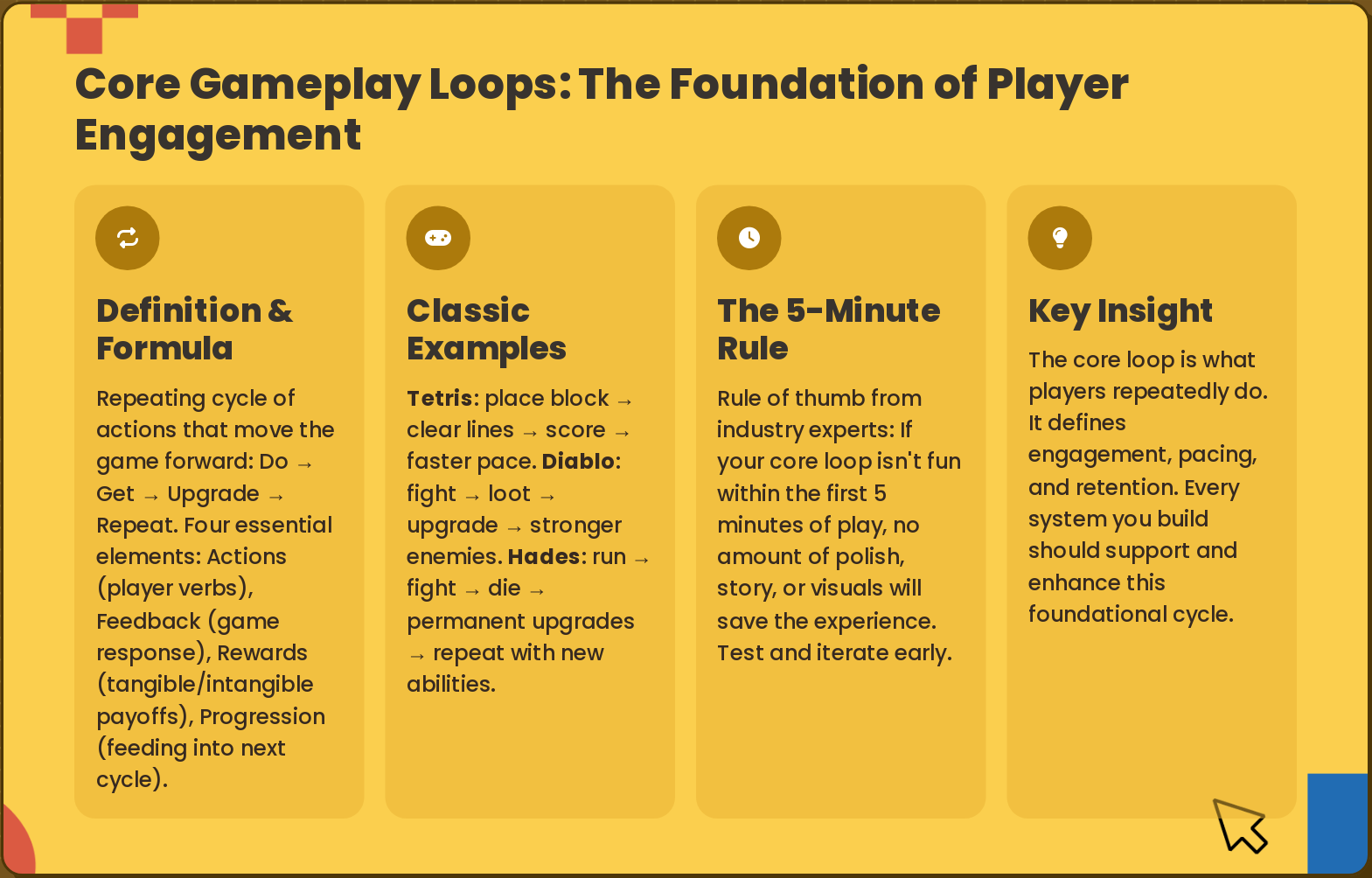
Slide 3: Core Gameplay Loops: The Foundation of Player Engagement
- Definition & Formula: Repeating cycle of actions that move the game forward: Do → Get → Upgrade → Repeat. Four essential elements: Actions (player verbs), Feedback (game response), Rewards (tangible/intangible payoffs), Progression (feeding into next cycle).
- Classic Examples: Tetris : place block → clear lines → score → faster pace. Diablo : fight → loot → upgrade → stronger enemies. Hades : run → fight → die → permanent upgrades → repeat with new abilities.
- The 5-Minute Rule: Rule of thumb from industry experts: If your core loop isn't fun within the first 5 minutes of play, no amount of polish, story, or visuals will save the experience. Test and iterate early.
- Key Insight: The core loop is what players repeatedly do. It defines engagement, pacing, and retention. Every system you build should support and enhance this foundational cycle.
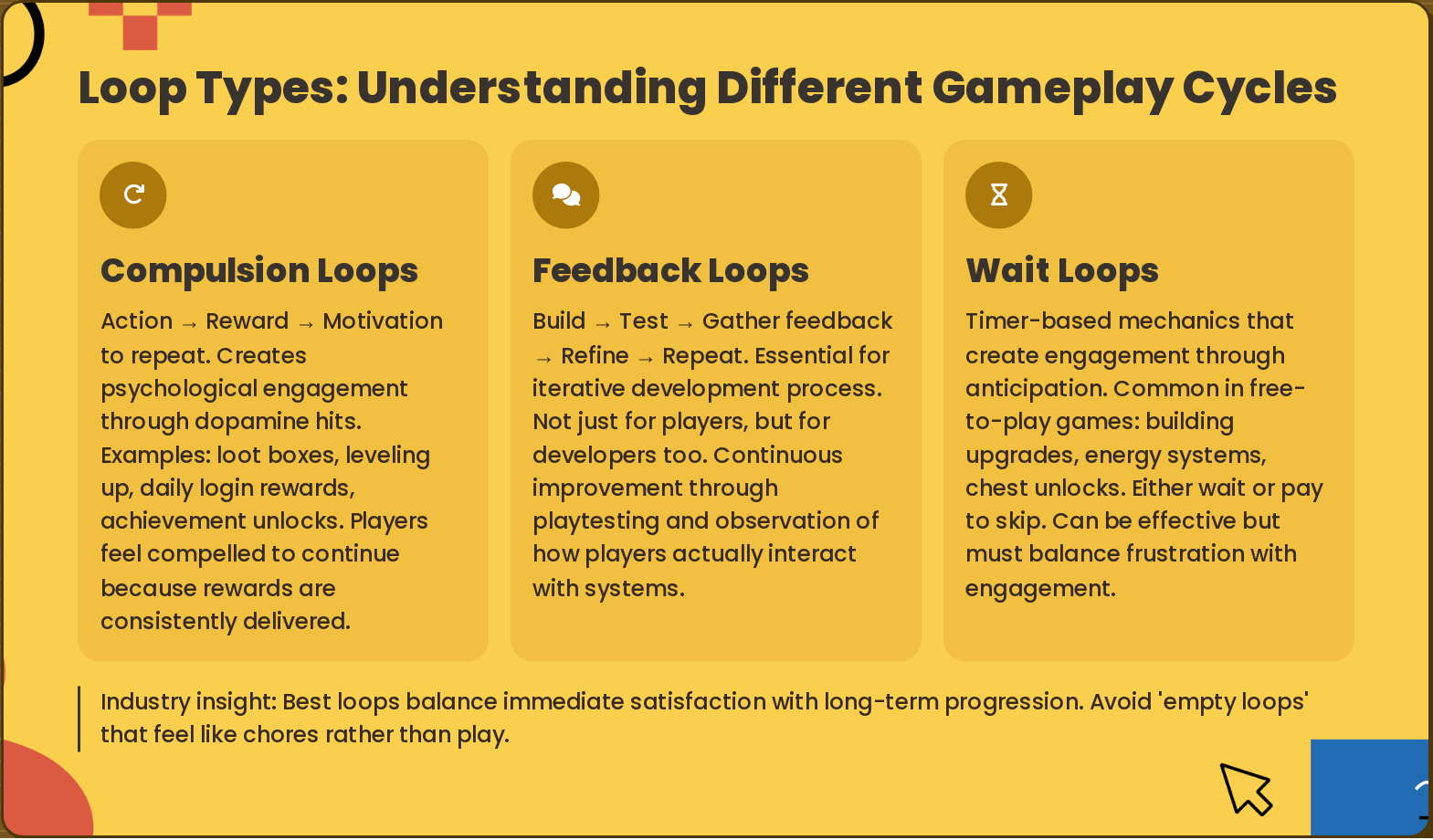
Slide 4: Loop Types: Understanding Different Gameplay Cycles
- Compulsion Loops: Action → Reward → Motivation to repeat. Creates psychological engagement through dopamine hits. Examples: loot boxes, leveling up, daily login rewards, achievement unlocks. Players feel compelled to continue because rewards are consistently delivered.
- Feedback Loops: Build → Test → Gather feedback → Refine → Repeat. Essential for iterative development process. Not just for players, but for developers too. Continuous improvement through playtesting and observation of how players actually interact with systems.
- Wait Loops: Timer-based mechanics that create engagement through anticipation. Common in free-to-play games: building upgrades, energy systems, chest unlocks. Either wait or pay to skip. Can be effective but must balance frustration with engagement.
Industry insight: Best loops balance immediate satisfaction with long-term progression. Avoid 'empty loops' that feel like chores rather than play.
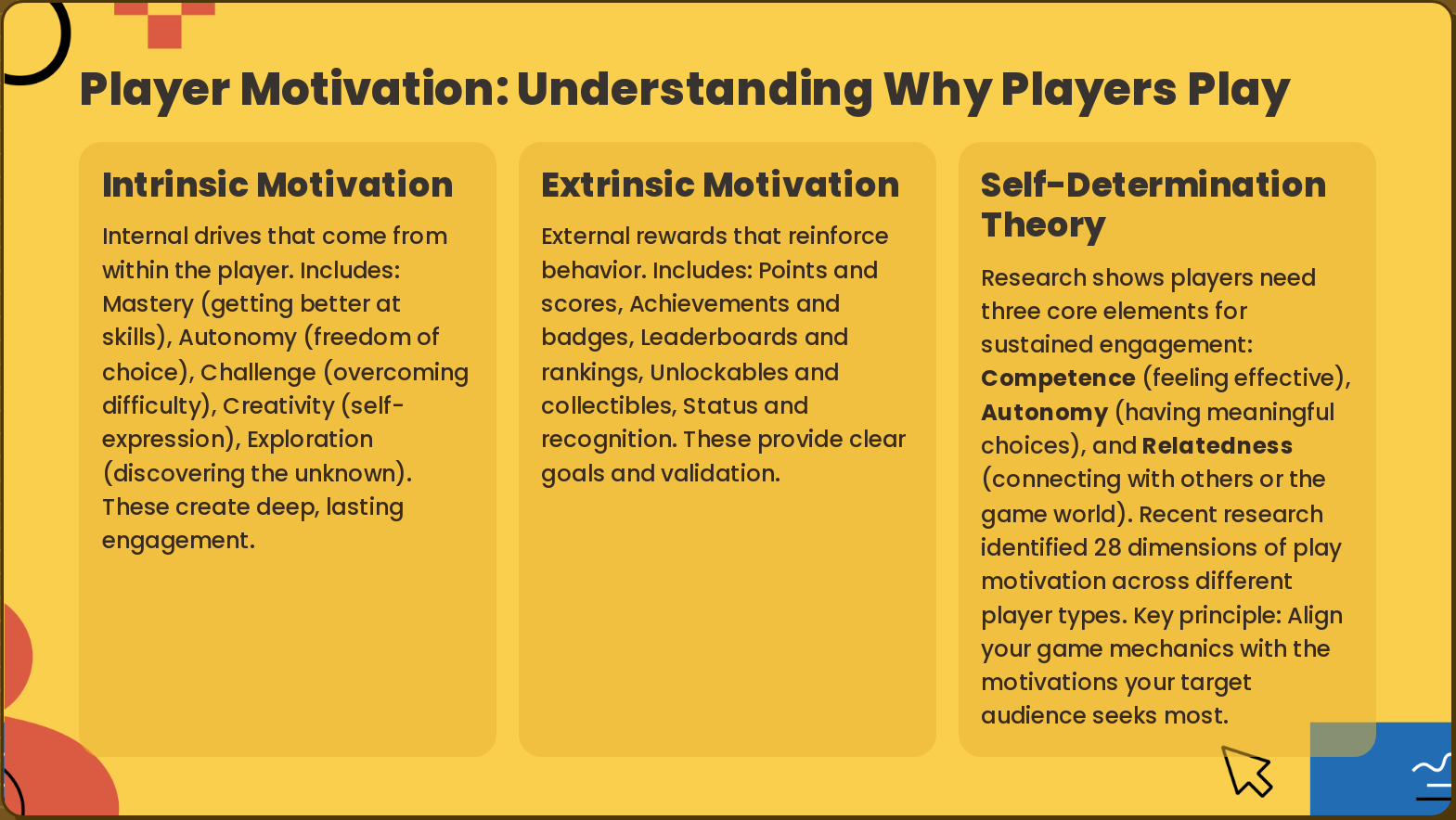
Slide 5: Player Motivation: Understanding Why Players Play
- Intrinsic Motivation: Internal drives that come from within the player. Includes: Mastery (getting better at skills), Autonomy (freedom of choice), Challenge (overcoming difficulty), Creativity (self-expression), Exploration (discovering the unknown). These create deep, lasting engagement.
- Extrinsic Motivation: External rewards that reinforce behavior. Includes: Points and scores, Achievements and badges, Leaderboards and rankings, Unlockables and collectibles, Status and recognition. These provide clear goals and validation.
- Self-Determination Theory: Research shows players need three core elements for sustained engagement: Competence (feeling effective), Autonomy (having meaningful choices), and Relatedness (connecting with others or the game world). Recent research identified 28 dimensions of play motivation across different player types. Key principle: Align your game mechanics with the motivations your target audience seeks most.
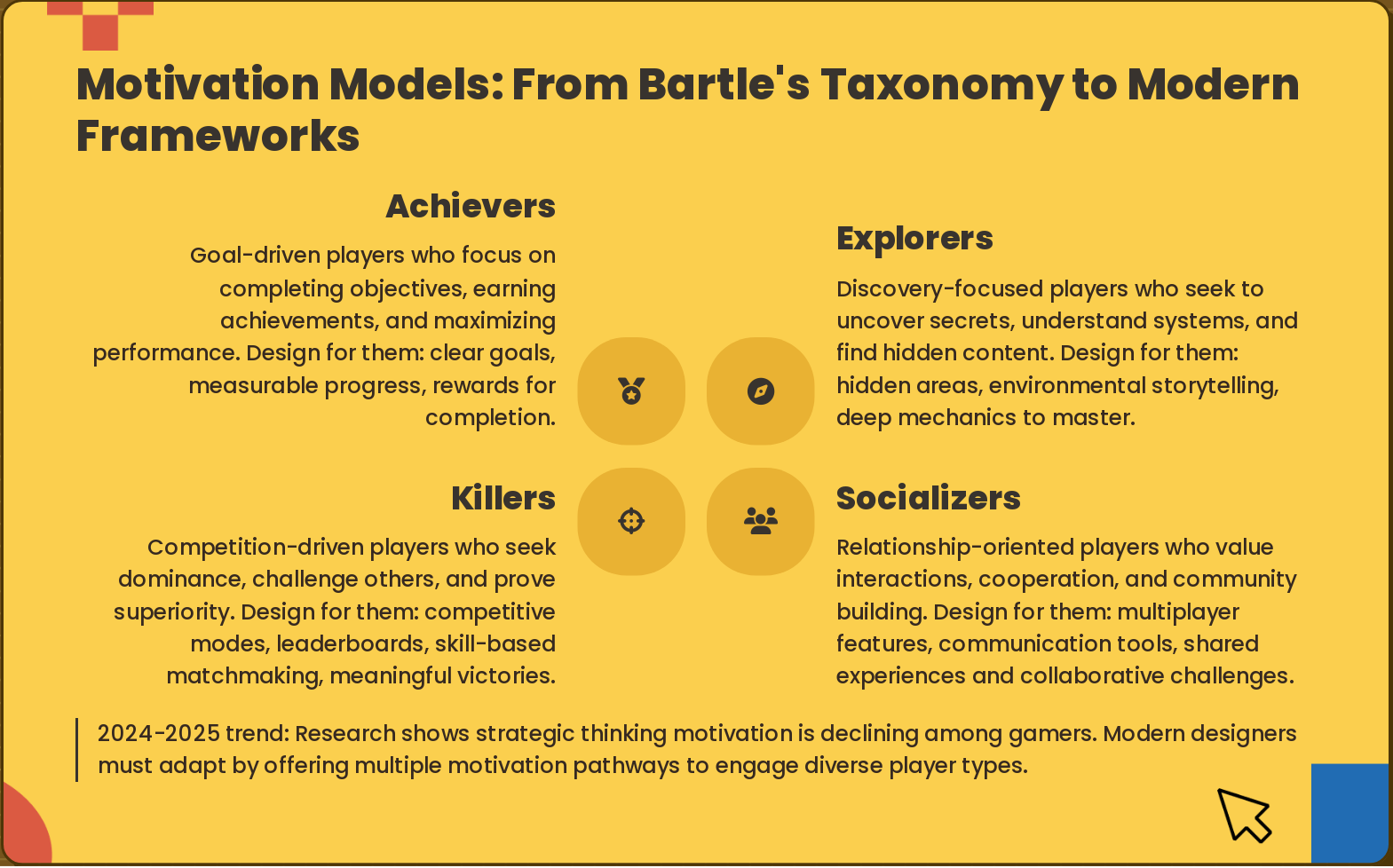
Slide 6: Motivation Models: From Bartle's Taxonomy to Modern Frameworks
- Achievers: Goal-driven players who focus on completing objectives, earning achievements, and maximizing performance. Design for them: clear goals, measurable progress, rewards for completion.
- Explorers: Discovery-focused players who seek to uncover secrets, understand systems, and find hidden content. Design for them: hidden areas, environmental storytelling, deep mechanics to master.
- Socializers: Relationship-oriented players who value interactions, cooperation, and community building. Design for them: multiplayer features, communication tools, shared experiences and collaborative challenges.
- Killers: Competition-driven players who seek dominance, challenge others, and prove superiority. Design for them: competitive modes, leaderboards, skill-based matchmaking, meaningful victories.
2024-2025 trend: Research shows strategic thinking motivation is declining among gamers. Modern designers must adapt by offering multiple motivation pathways to engage diverse player types.
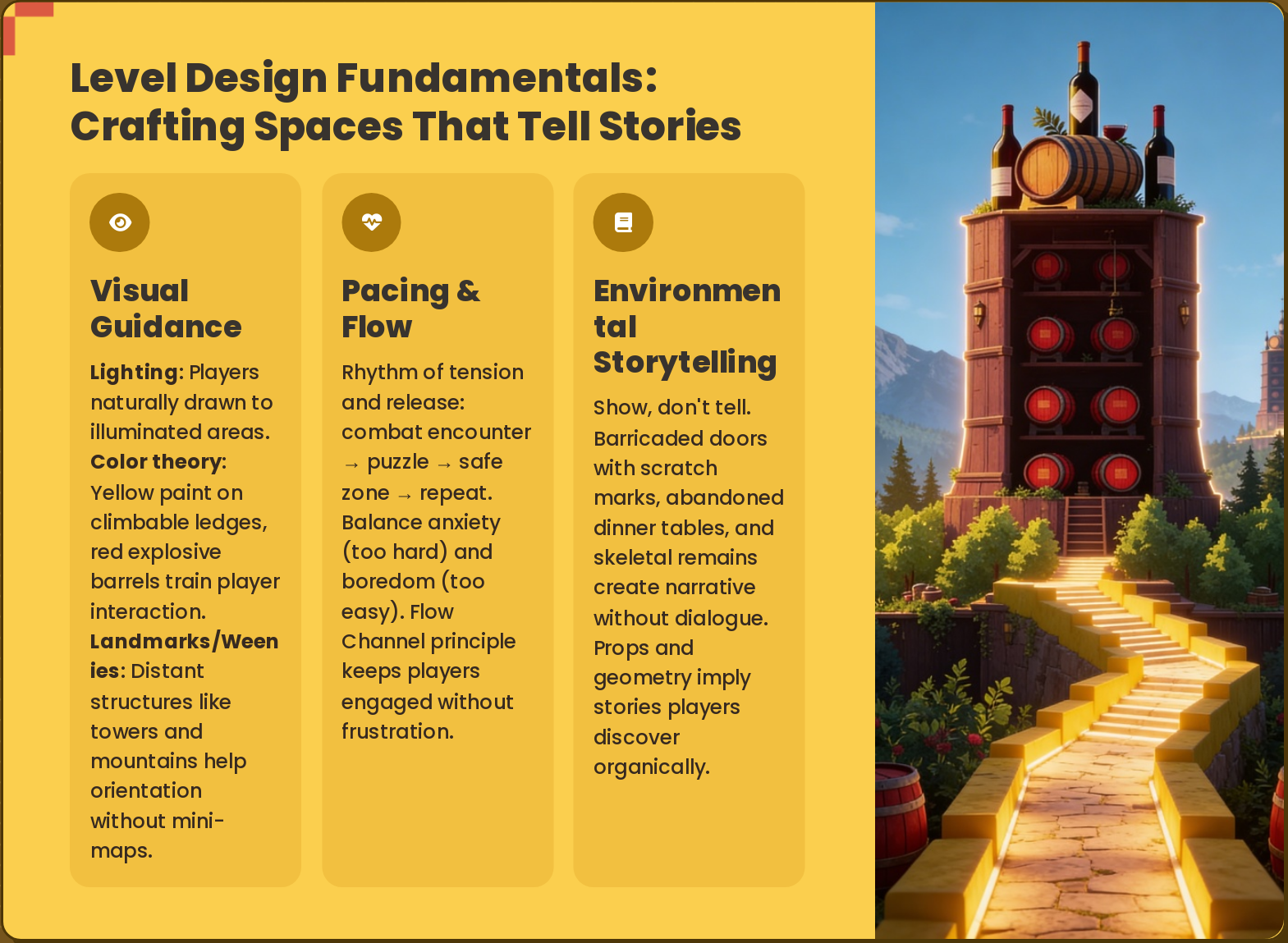
Slide 7: Level Design Fundamentals: Crafting Spaces That Tell Stories
- Visual Guidance: Lighting : Players naturally drawn to illuminated areas. Color theory : Yellow paint on climbable ledges, red explosive barrels train player interaction. Landmarks/Weenies : Distant structures like towers and mountains help orientation without mini-maps.
- Pacing & Flow: Rhythm of tension and release: combat encounter → puzzle → safe zone → repeat. Balance anxiety (too hard) and boredom (too easy). Flow Channel principle keeps players engaged without frustration.
- Environmental Storytelling: Show, don't tell. Barricaded doors with scratch marks, abandoned dinner tables, and skeletal remains create narrative without dialogue. Props and geometry imply stories players discover organically.
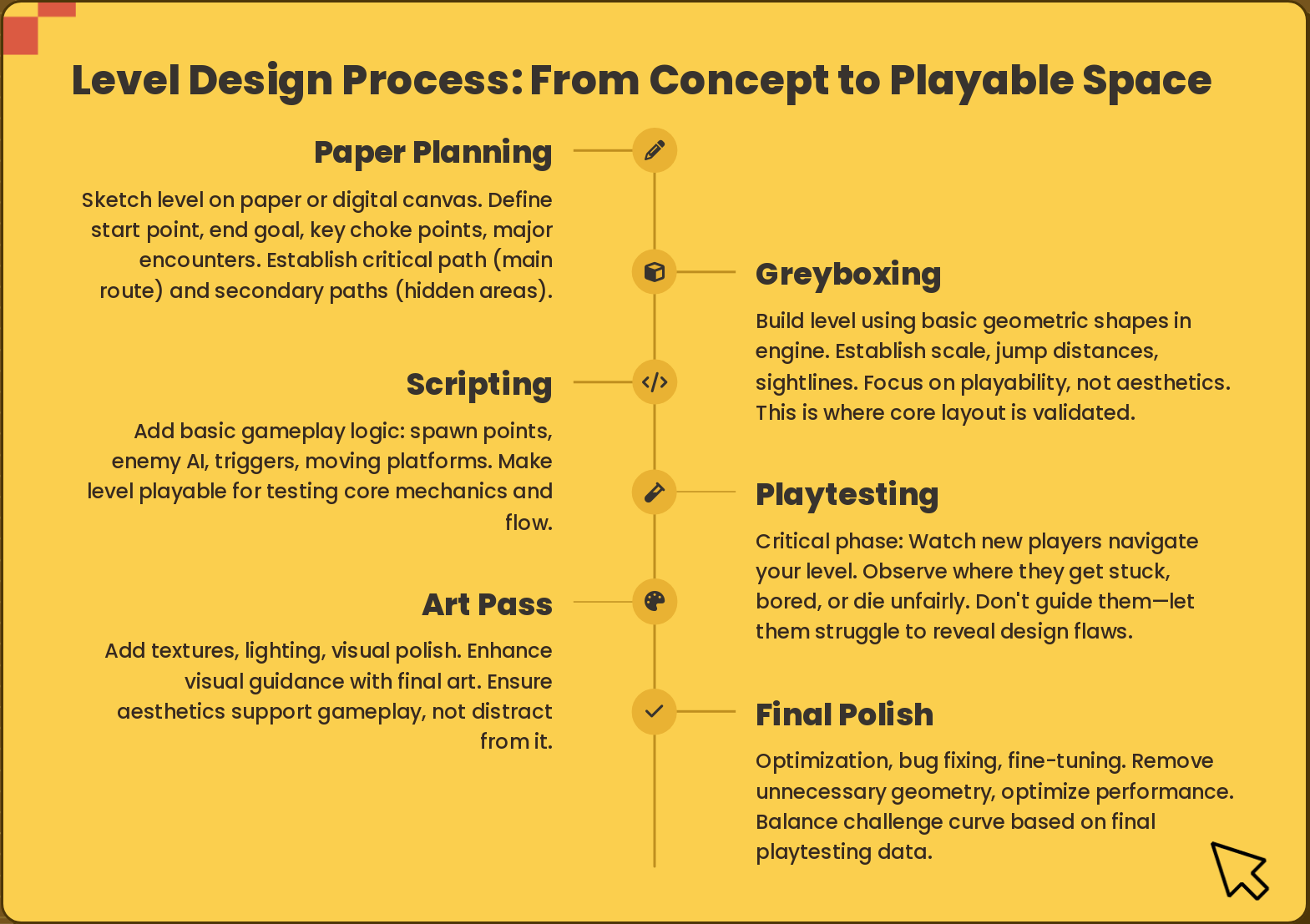
Slide 8: Level Design Process: From Concept to Playable Space
- Paper Planning: Sketch level on paper or digital canvas. Define start point, end goal, key choke points, major encounters. Establish critical path (main route) and secondary paths (hidden areas).
- Greyboxing: Build level using basic geometric shapes in engine. Establish scale, jump distances, sightlines. Focus on playability, not aesthetics. This is where core layout is validated.
- Scripting: Add basic gameplay logic: spawn points, enemy AI, triggers, moving platforms. Make level playable for testing core mechanics and flow.
- Playtesting: Critical phase: Watch new players navigate your level. Observe where they get stuck, bored, or die unfairly. Don't guide them—let them struggle to reveal design flaws.
- Art Pass: Add textures, lighting, visual polish. Enhance visual guidance with final art. Ensure aesthetics support gameplay, not distract from it.
- Final Polish: Optimization, bug fixing, fine-tuning. Remove unnecessary geometry, optimize performance. Balance challenge curve based on final playtesting data.
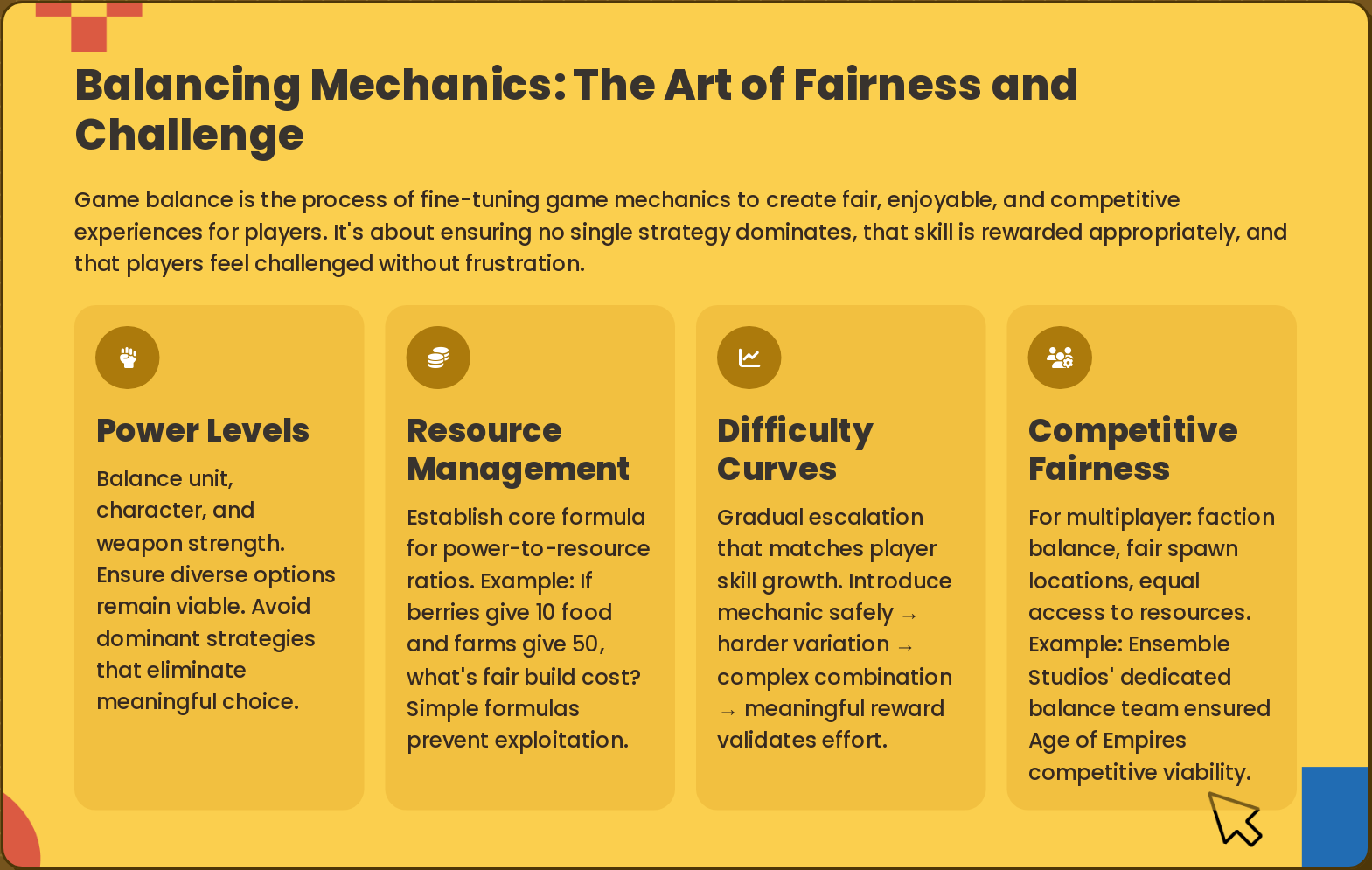
Slide 9: Balancing Mechanics: The Art of Fairness and Challenge
- Power Levels: Balance unit, character, and weapon strength. Ensure diverse options remain viable. Avoid dominant strategies that eliminate meaningful choice.
- Resource Management: Establish core formula for power-to-resource ratios. Example: If berries give 10 food and farms give 50, what's fair build cost? Simple formulas prevent exploitation.
- Difficulty Curves: Gradual escalation that matches player skill growth. Introduce mechanic safely → harder variation → complex combination → meaningful reward validates effort.
- Competitive Fairness: For multiplayer: faction balance, fair spawn locations, equal access to resources. Example: Ensemble Studios' dedicated balance team ensured Age of Empires competitive viability.
Game balance is the process of fine-tuning game mechanics to create fair, enjoyable, and competitive experiences for players. It's about ensuring no single strategy dominates, that skill is rewarded appropriately, and that players feel challenged without frustration.
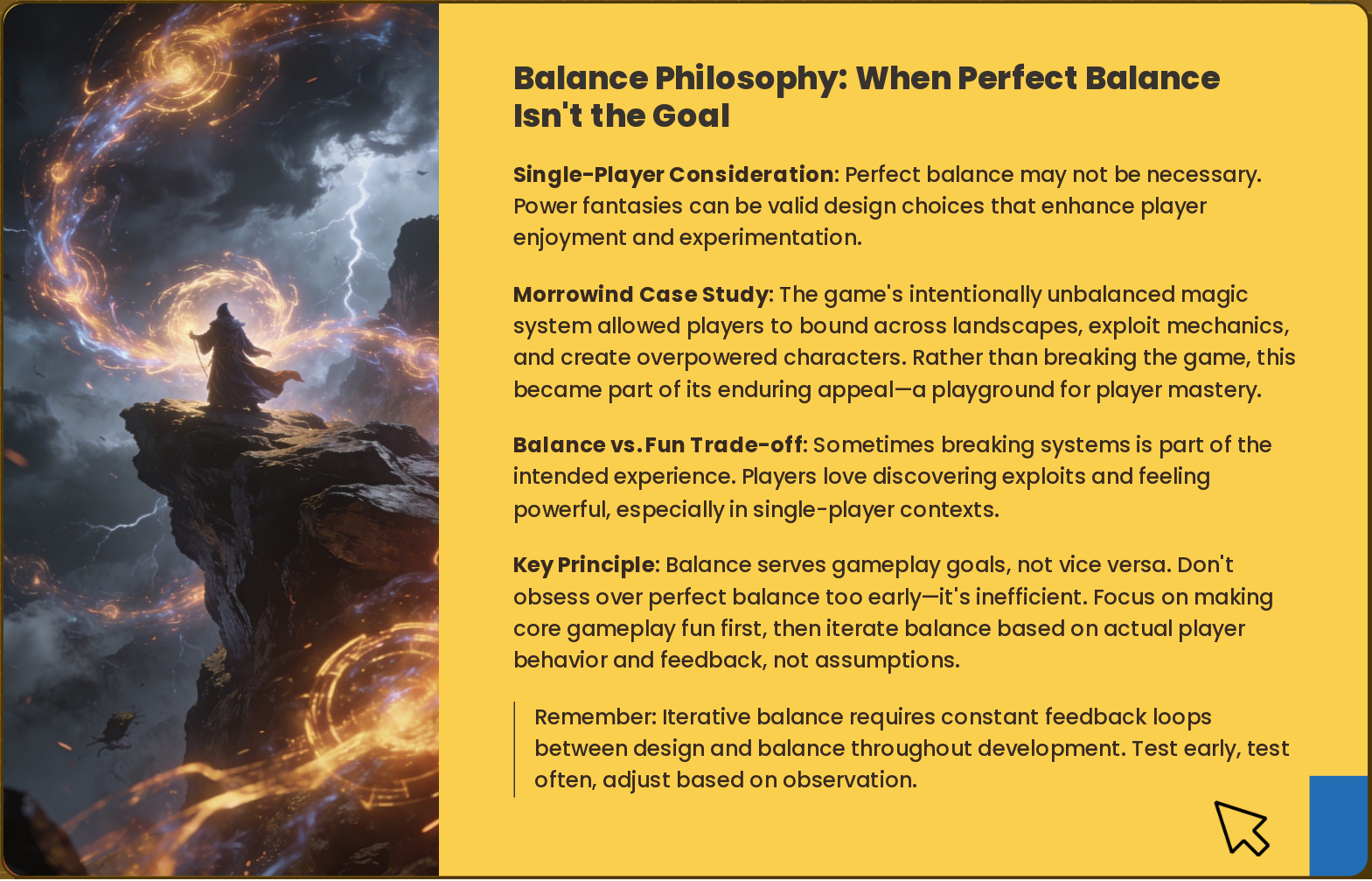
Slide 10: Balance Philosophy: When Perfect Balance Isn't the Goal
Single-Player Consideration : Perfect balance may not be necessary. Power fantasies can be valid design choices that enhance player enjoyment and experimentation.
Morrowind Case Study : The game's intentionally unbalanced magic system allowed players to bound across landscapes, exploit mechanics, and create overpowered characters. Rather than breaking the game, this became part of its enduring appeal—a playground for player mastery.
Balance vs. Fun Trade-off : Sometimes breaking systems is part of the intended experience. Players love discovering exploits and feeling powerful, especially in single-player contexts.
Key Principle : Balance serves gameplay goals, not vice versa. Don't obsess over perfect balance too early—it's inefficient. Focus on making core gameplay fun first, then iterate balance based on actual player behavior and feedback, not assumptions.
Remember: Iterative balance requires constant feedback loops between design and balance throughout development. Test early, test often, adjust based on observation.
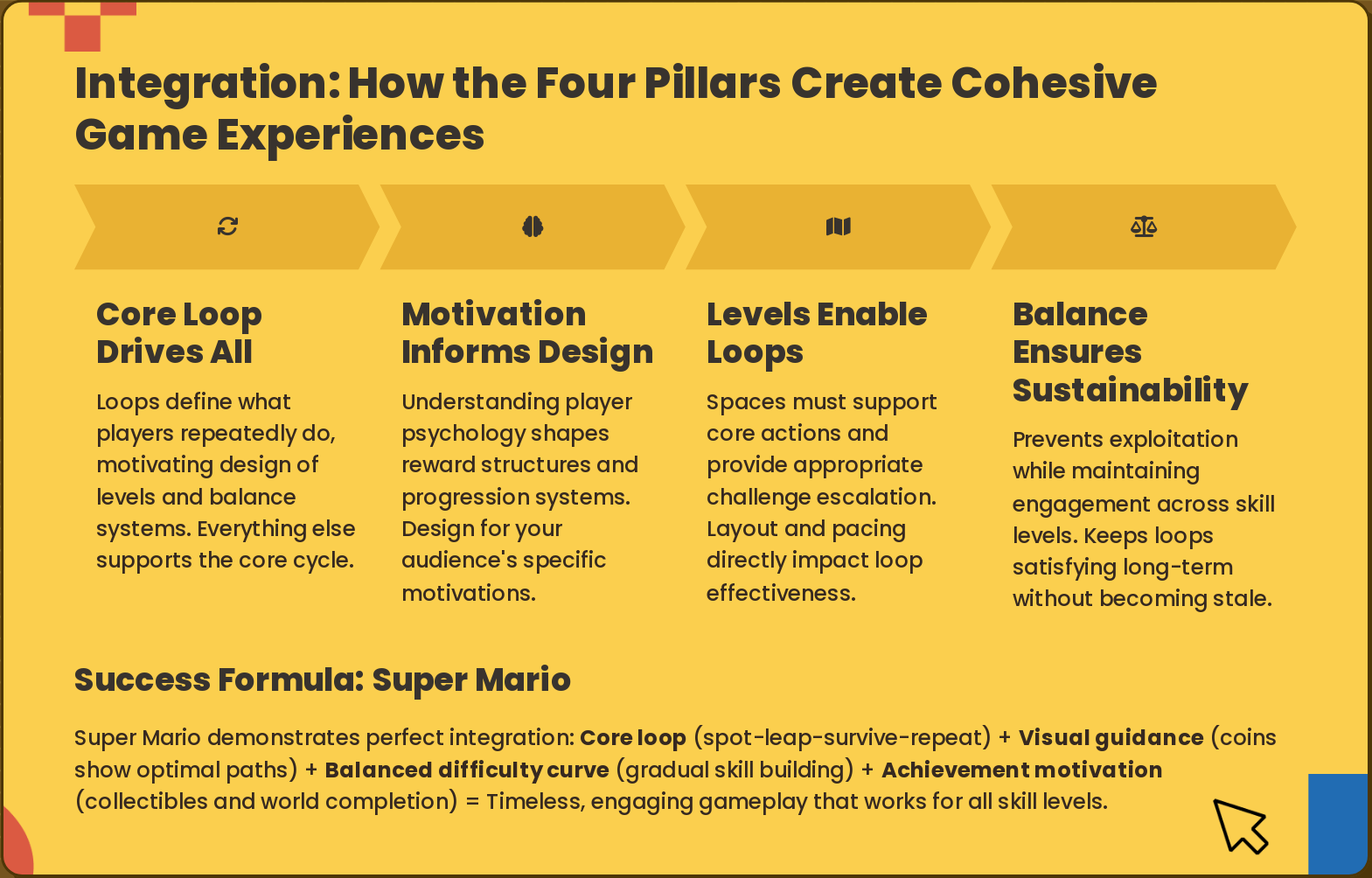
Slide 11: Integration: How the Four Pillars Create Cohesive Game Experiences
- Core Loop Drives All: Loops define what players repeatedly do, motivating design of levels and balance systems. Everything else supports the core cycle.
- Motivation Informs Design: Understanding player psychology shapes reward structures and progression systems. Design for your audience's specific motivations.
- Levels Enable Loops: Spaces must support core actions and provide appropriate challenge escalation. Layout and pacing directly impact loop effectiveness.
- Balance Ensures Sustainability: Prevents exploitation while maintaining engagement across skill levels. Keeps loops satisfying long-term without becoming stale.
Super Mario demonstrates perfect integration: Core loop (spot-leap-survive-repeat) + Visual guidance (coins show optimal paths) + Balanced difficulty curve (gradual skill building) + Achievement motivation (collectibles and world completion) = Timeless, engaging gameplay that works for all skill levels.
Slide 12: Thank You - Start Creating!
Thank You - Start Creating! Master the four pillars, prototype your loops, and build games that players love.