



Presentation Summary
A 200-Year Visual Journey - How Photography Evolved from Dark Rooms to Every Pocket Ancient optical discovery that laid the foundation for photography, from 5th century BC to Renaissance innovation. Louis Daguerre's 1839 breakthrough that created the first permanent photographic images on silver-plated copper. George Eastman democratized photography with simple roll film cameras, making image-making accessible to everyone. From digital sensors to billions of smartphone cameras, photography becomes universal human expression. First documented by Mozi (470-391 BC) observing light projection thro
Full Presentation Transcript
Slide 1: History of Photography: From Film to Digital
A 200-Year Visual Journey - How Photography Evolved from Dark Rooms to Every Pocket
Slide 2: Contents
- Camera Obscura Origins: Ancient optical discovery that laid the foundation for photography, from 5th century BC to Renaissance innovation.
- Daguerreotype Age: Louis Daguerre's 1839 breakthrough that created the first permanent photographic images on silver-plated copper.
- Kodak Revolution: George Eastman democratized photography with simple roll film cameras, making image-making accessible to everyone.
- Digital & Smartphone Era: From digital sensors to billions of smartphone cameras, photography becomes universal human expression.
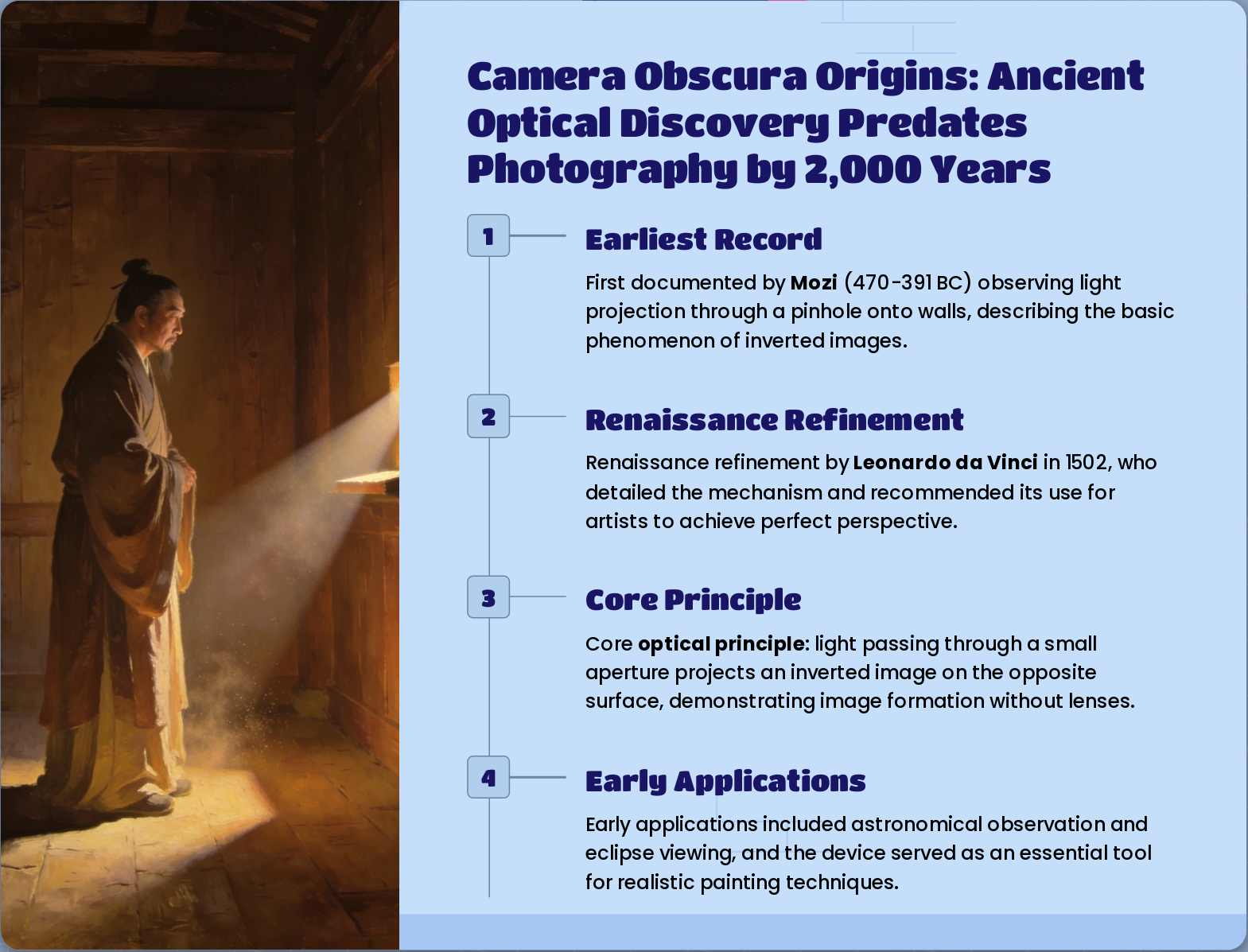
Slide 3: Camera Obscura Origins: Ancient Optical Discovery Predates Photography by 2,000 Years
- Earliest Record: First documented by Mozi (470-391 BC) observing light projection through a pinhole onto walls, describing the basic phenomenon of inverted images.
- Renaissance Refinement: Renaissance refinement by Leonardo da Vinci in 1502, who detailed the mechanism and recommended its use for artists to achieve perfect perspective.
- Core Principle: Core optical principle : light passing through a small aperture projects an inverted image on the opposite surface, demonstrating image formation without lenses.
- Early Applications: Early applications included astronomical observation and eclipse viewing, and the device served as an essential tool for realistic painting techniques.
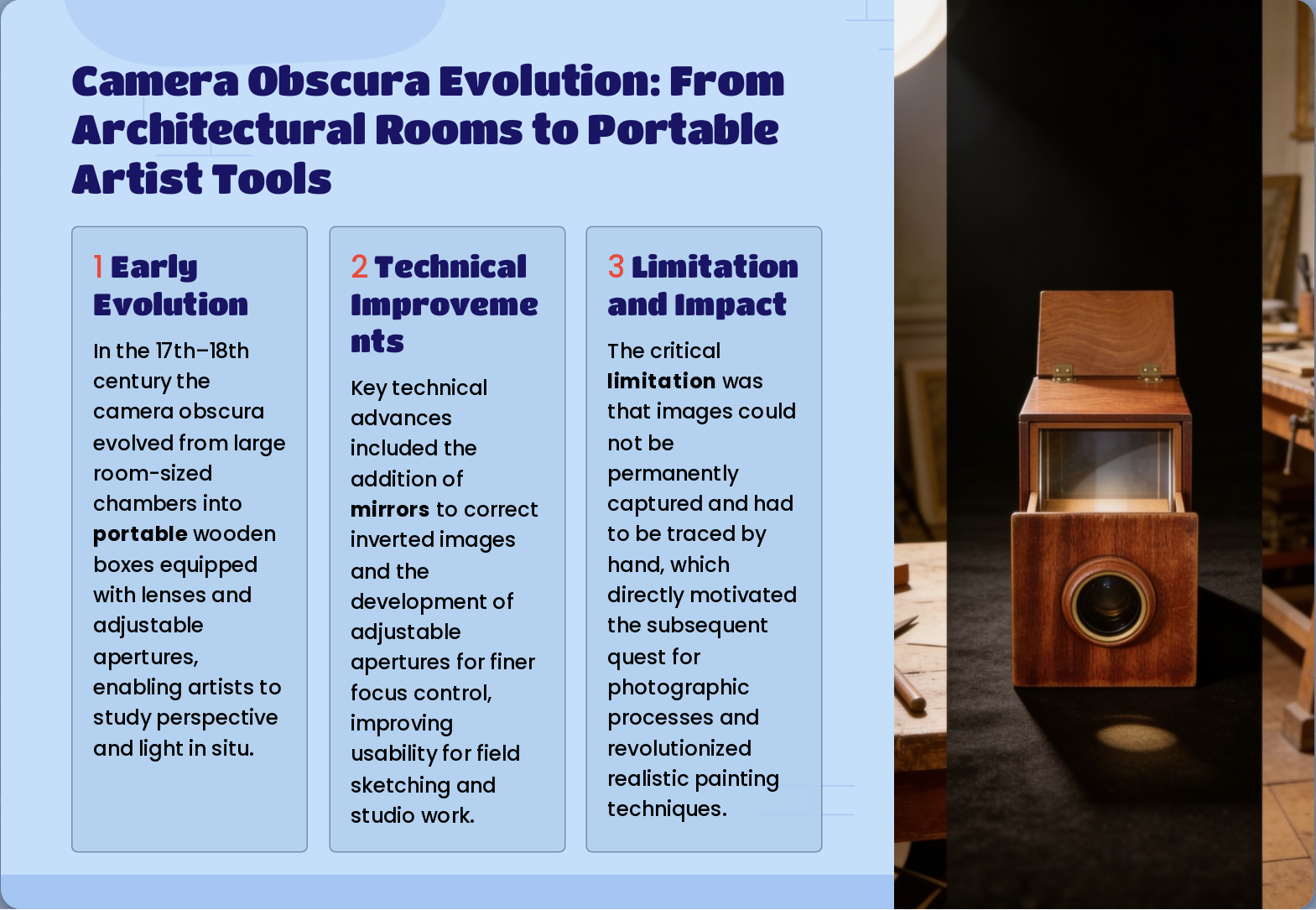
Slide 4: Camera Obscura Evolution: From Architectural Rooms to Portable Artist Tools
- 1 Early Evolution: In the 17th–18th century the camera obscura evolved from large room-sized chambers into portable wooden boxes equipped with lenses and adjustable apertures, enabling artists to study perspective and light in situ.
- 2 Technical Improvements: Key technical advances included the addition of mirrors to correct inverted images and the development of adjustable apertures for finer focus control, improving usability for field sketching and studio work.
- 3 Limitation and Impact: The critical limitation was that images could not be permanently captured and had to be traced by hand, which directly motivated the subsequent quest for photographic processes and revolutionized realistic painting techniques.
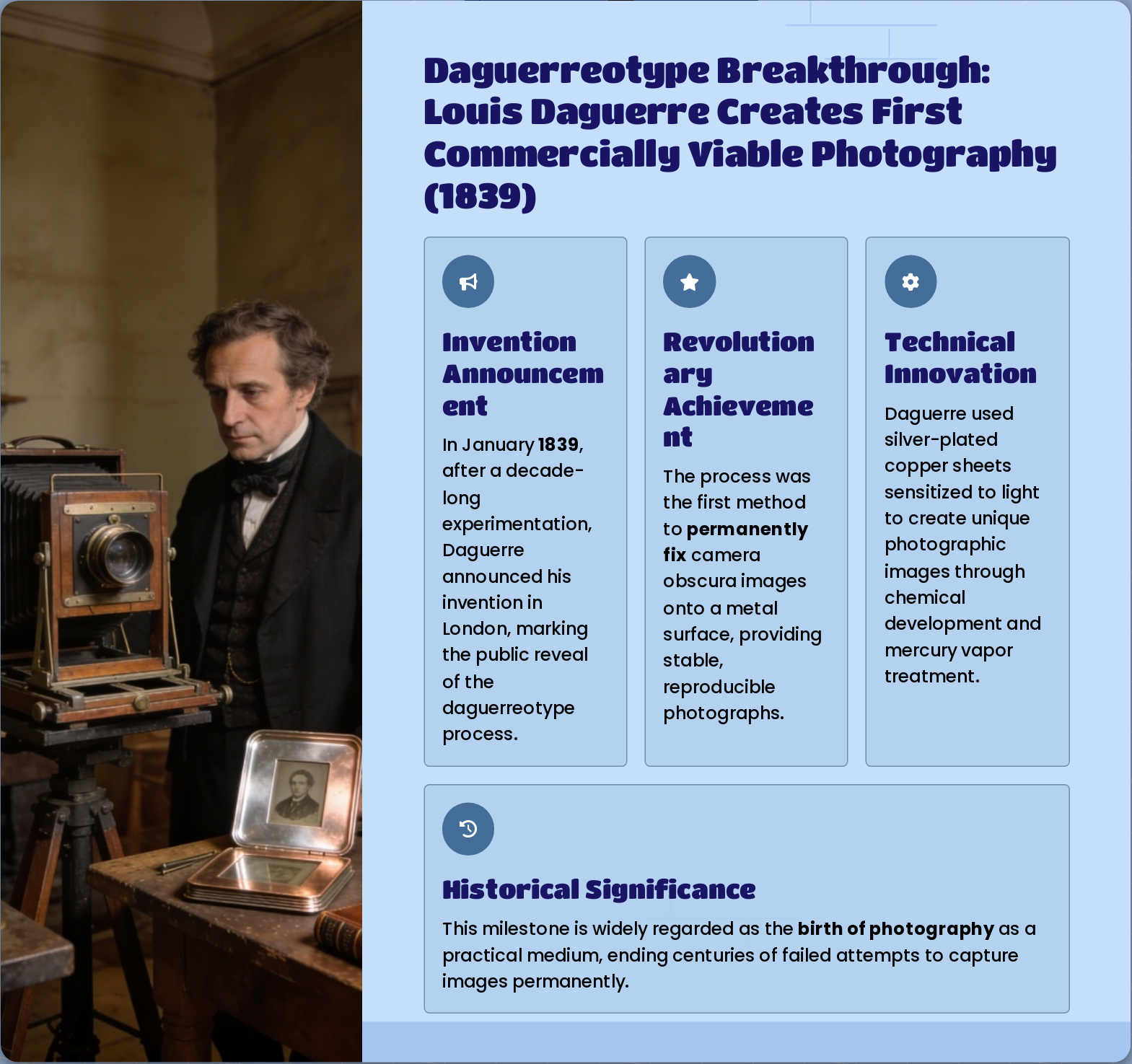
Slide 5: Daguerreotype Breakthrough: Louis Daguerre Creates First Commercially Viable Photography (1839)
- Invention Announcement: In January 1839 , after a decade-long experimentation, Daguerre announced his invention in London, marking the public reveal of the daguerreotype process.
- Revolutionary Achievement: The process was the first method to permanently fix camera obscura images onto a metal surface, providing stable, reproducible photographs.
- Technical Innovation: Daguerre used silver-plated copper sheets sensitized to light to create unique photographic images through chemical development and mercury vapor treatment.
- Historical Significance: This milestone is widely regarded as the birth of photography as a practical medium, ending centuries of failed attempts to capture images permanently.
Slide 6: Daguerreotype Process: Mirror-Like Images With Complex Technical Requirements
- 1 Polishing:: Laborious polishing of a copper plate to a mirror finish, requiring meticulous skill to achieve a flawless surface.
- 2 Sensitization:: Exposure to dangerous chemical vapors including mercury and iodine, a hazardous step demanding careful handling and ventilation.
- 3 Exposure:: Lengthy exposure times ranging from minutes to hours , depending on lighting and lens speed.
- 4 Image Result:: Remarkably detailed but fragile unique images with mirror-like quality, producing one-of-a-kind positives on metal.
- 5 Limitations:: Expensive process using hazardous chemicals, largely limited to wealthy patrons; dominated photography in the 1840s-1850s.
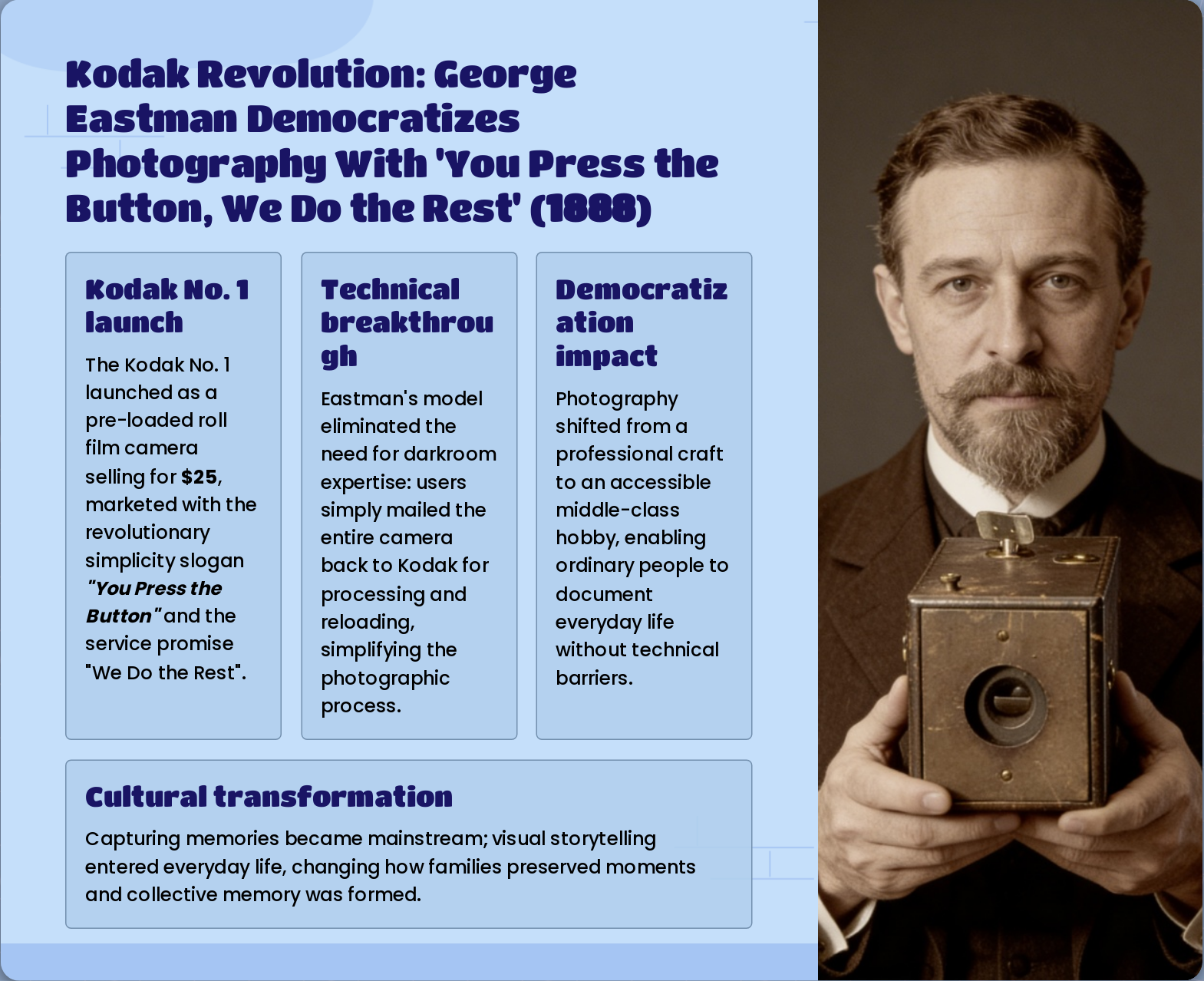
Slide 7: Kodak Revolution: George Eastman Democratizes Photography With 'You Press the Button, We Do the Rest' ( 1888 )
- Kodak No. 1 launch: The Kodak No. 1 launched as a pre-loaded roll film camera selling for $25 , marketed with the revolutionary simplicity slogan "You Press the Button" and the service promise "We Do the Rest".
- Technical breakthrough: Eastman's model eliminated the need for darkroom expertise: users simply mailed the entire camera back to Kodak for processing and reloading, simplifying the photographic process.
- Democratization impact: Photography shifted from a professional craft to an accessible middle-class hobby, enabling ordinary people to document everyday life without technical barriers.
- Cultural transformation: Capturing memories became mainstream; visual storytelling entered everyday life, changing how families preserved moments and collective memory was formed.
Slide 8: Kodak Film Era: Color Revolution and Mass-Market Photography Dominance (1935-1990s)
- 1935 - Kodachrome introduction: Kodachrome was the first commercially successful color film and transformed visual documentation, enabling vivid color photography for professionals and amateurs alike.
- 1900 - Brownie camera legacy: The ultra-affordable $1 Brownie cameras put photography into the hands of children and everyday consumers, democratizing image-making and popularizing snapshot culture.
- 1976 - Market dominance: Kodak controlled 90% of film sales and 85% of camera sales in the US, reflecting near-total market leadership in analog photography.
- Social impact: Family albums became a cultural norm; photography was essential to preserving personal and collective memory, shaping how everyday life and milestones were recorded.
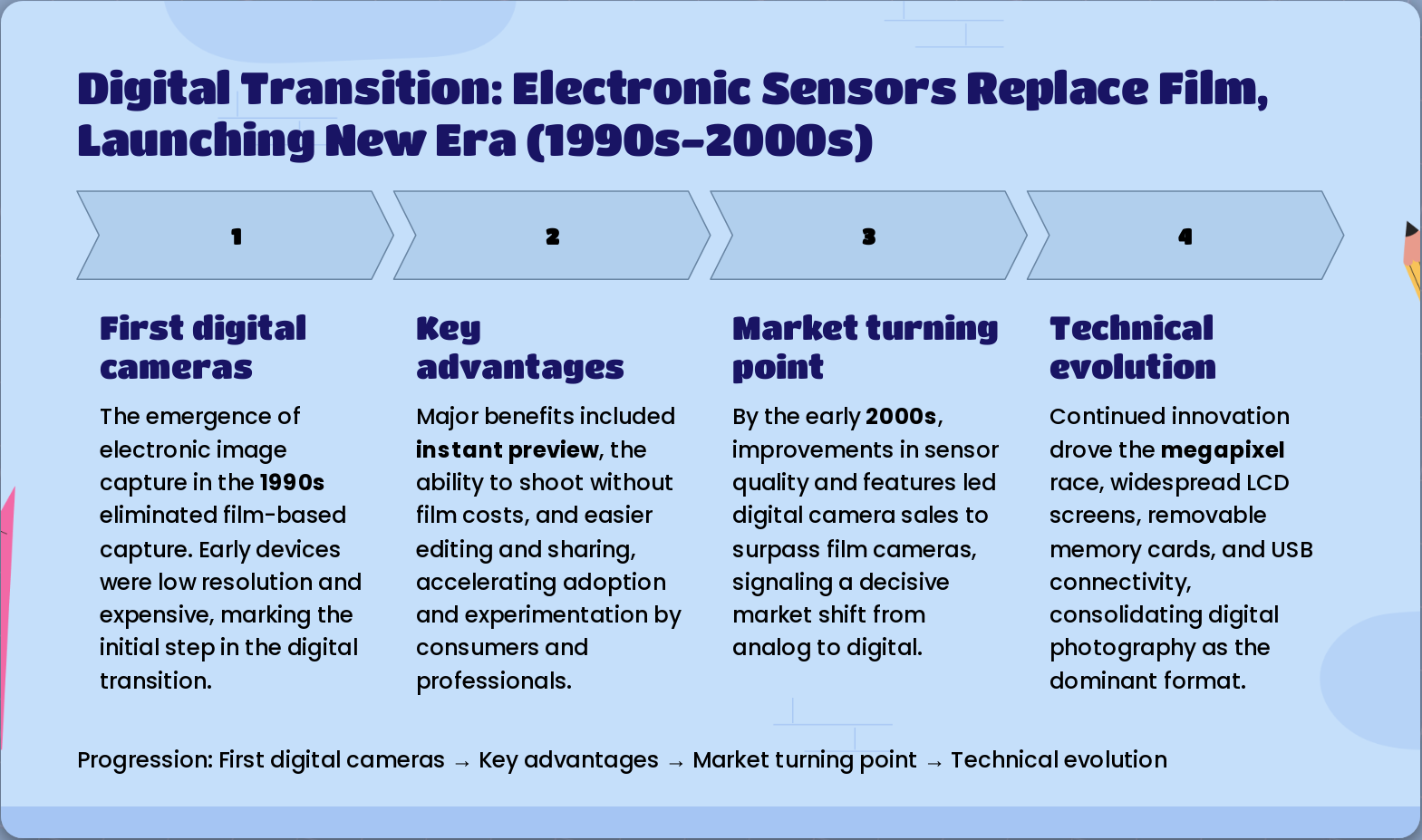
Slide 9: Digital Transition: Electronic Sensors Replace Film, Launching New Era (1990s-2000s)
- First digital cameras: The emergence of electronic image capture in the 1990s eliminated film-based capture. Early devices were low resolution and expensive, marking the initial step in the digital transition.
- Key advantages: Major benefits included instant preview , the ability to shoot without film costs, and easier editing and sharing, accelerating adoption and experimentation by consumers and professionals.
- Market turning point: By the early 2000s , improvements in sensor quality and features led digital camera sales to surpass film cameras, signaling a decisive market shift from analog to digital.
- Technical evolution: Continued innovation drove the megapixel race, widespread LCD screens, removable memory cards, and USB connectivity, consolidating digital photography as the dominant format.
Progression: First digital cameras → Key advantages → Market turning point → Technical evolution
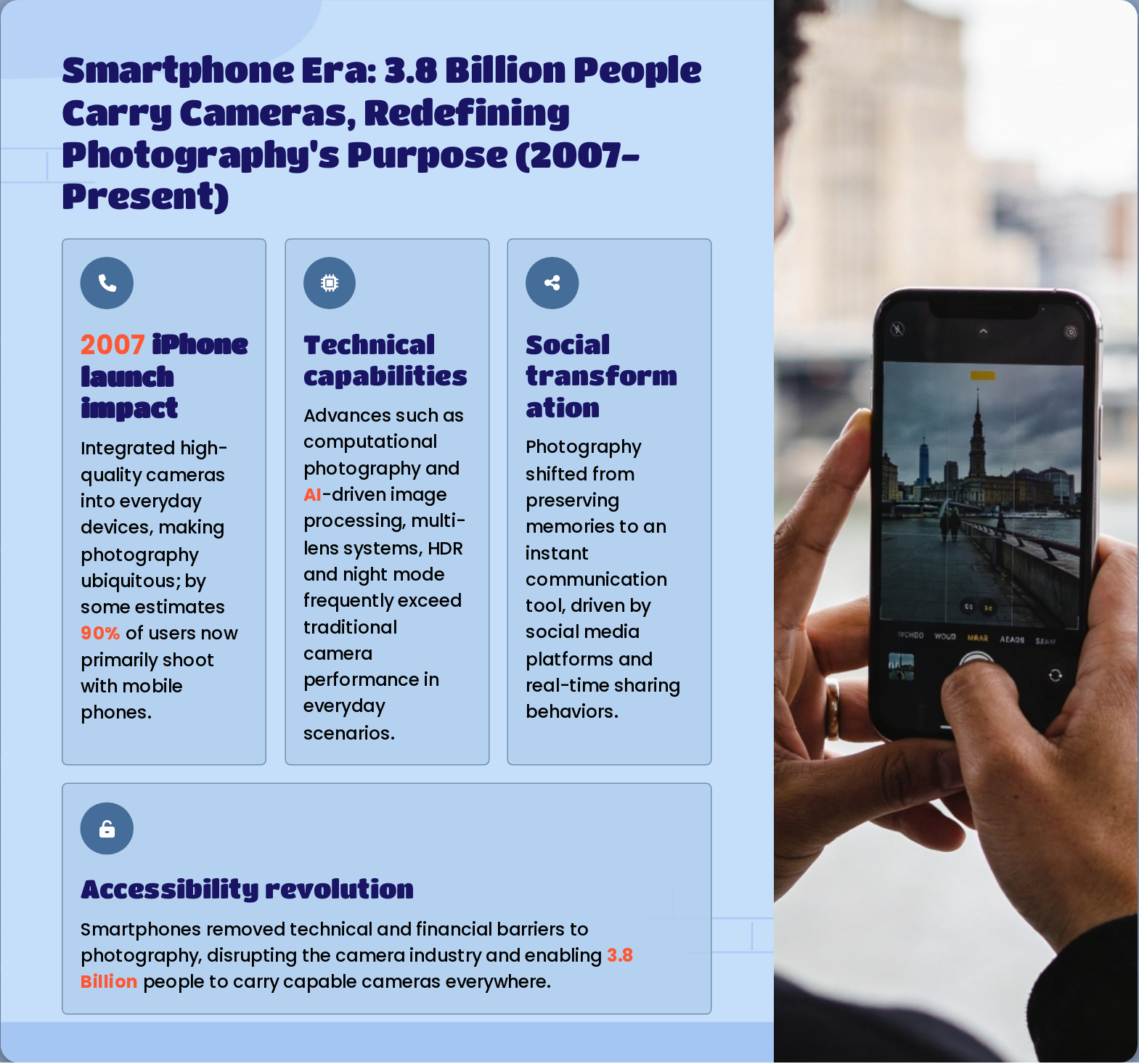
Slide 10: Smartphone Era: 3.8 Billion People Carry Cameras, Redefining Photography's Purpose (2007-Present)
- 2007 iPhone launch impact: Integrated high-quality cameras into everyday devices, making photography ubiquitous; by some estimates 90% of users now primarily shoot with mobile phones.
- Technical capabilities: Advances such as computational photography and AI -driven image processing, multi-lens systems, HDR and night mode frequently exceed traditional camera performance in everyday scenarios.
- Social transformation: Photography shifted from preserving memories to an instant communication tool, driven by social media platforms and real-time sharing behaviors.
- Accessibility revolution: Smartphones removed technical and financial barriers to photography, disrupting the camera industry and enabling 3.8 Billion people to carry capable cameras everywhere.
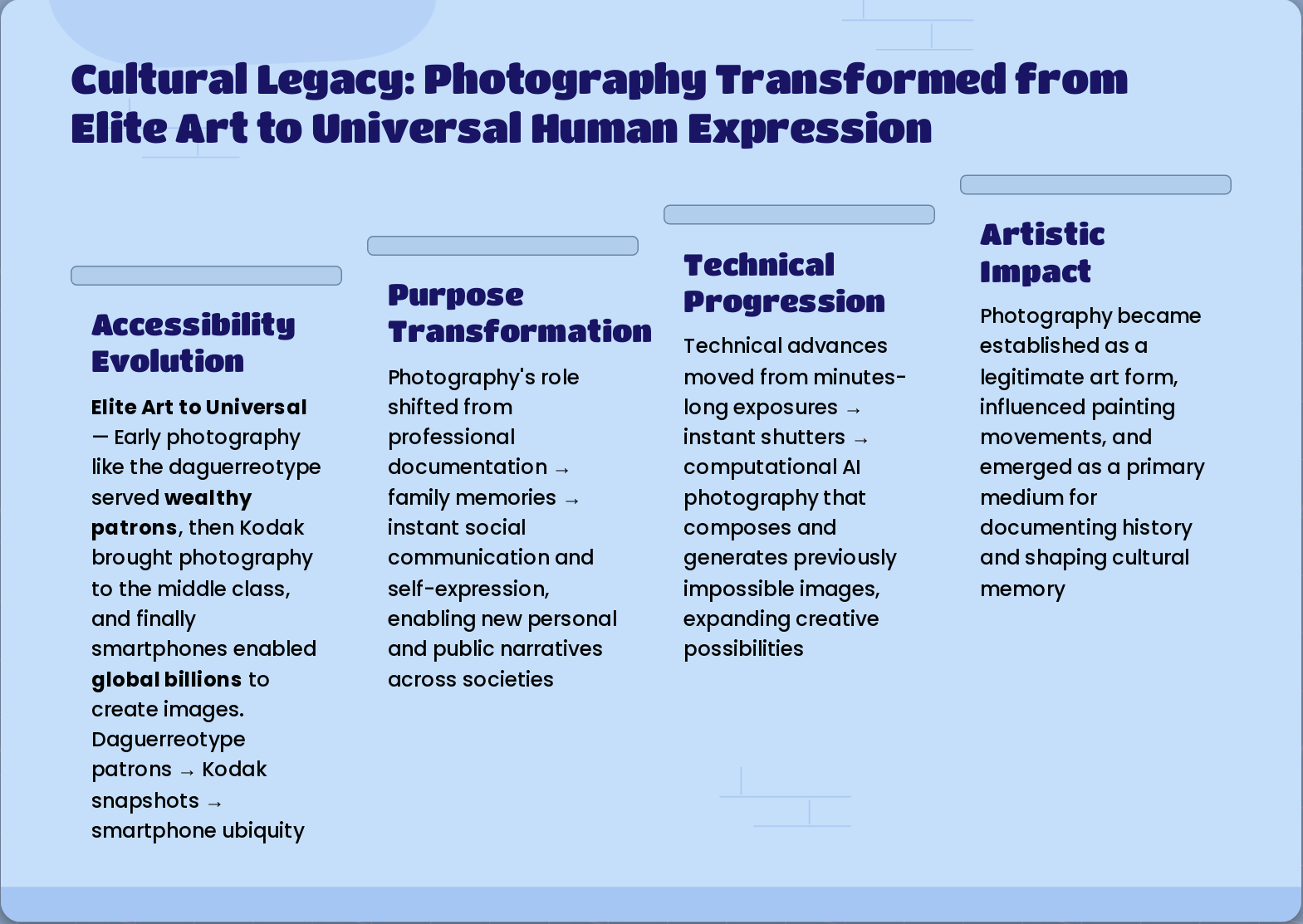
Slide 11: Cultural Legacy: Photography Transformed from Elite Art to Universal Human Expression
- Accessibility Evolution: Elite Art to Universal — Early photography like the daguerreotype served wealthy patrons , then Kodak brought photography to the middle class, and finally smartphones enabled global billions to create images. Daguerreotype patrons → Kodak snapshots → smartphone ubiquity
- Purpose Transformation: Photography's role shifted from professional documentation → family memories → instant social communication and self-expression, enabling new personal and public narratives across societies
- Technical Progression: Technical advances moved from minutes-long exposures → instant shutters → computational AI photography that composes and generates previously impossible images, expanding creative possibilities
- Artistic Impact: Photography became established as a legitimate art form, influenced painting movements, and emerged as a primary medium for documenting history and shaping cultural memory
Slide 12: Thank You For Your Time
Thank You For Your Time From Camera Obscura to smartphones - 200 years of innovation made photography history's most democratic art form