Presentation Summary
Dive into the future of cinema with an in-depth look at 2026's movie releases, trends, and the evolution of regional cinema culture, focusing on blockbusters, genre diversity, and the impact of streaming.
Full Presentation Transcript
Slide 1: The Global Cinema Landscape 2026 - An In-Depth Exploration of Movies, Trends, and Regional Cinema Culture
Comprehensive Analysis of Theatrical Releases, Genre Trends, and Johor Bahru Cinema Infrastructure
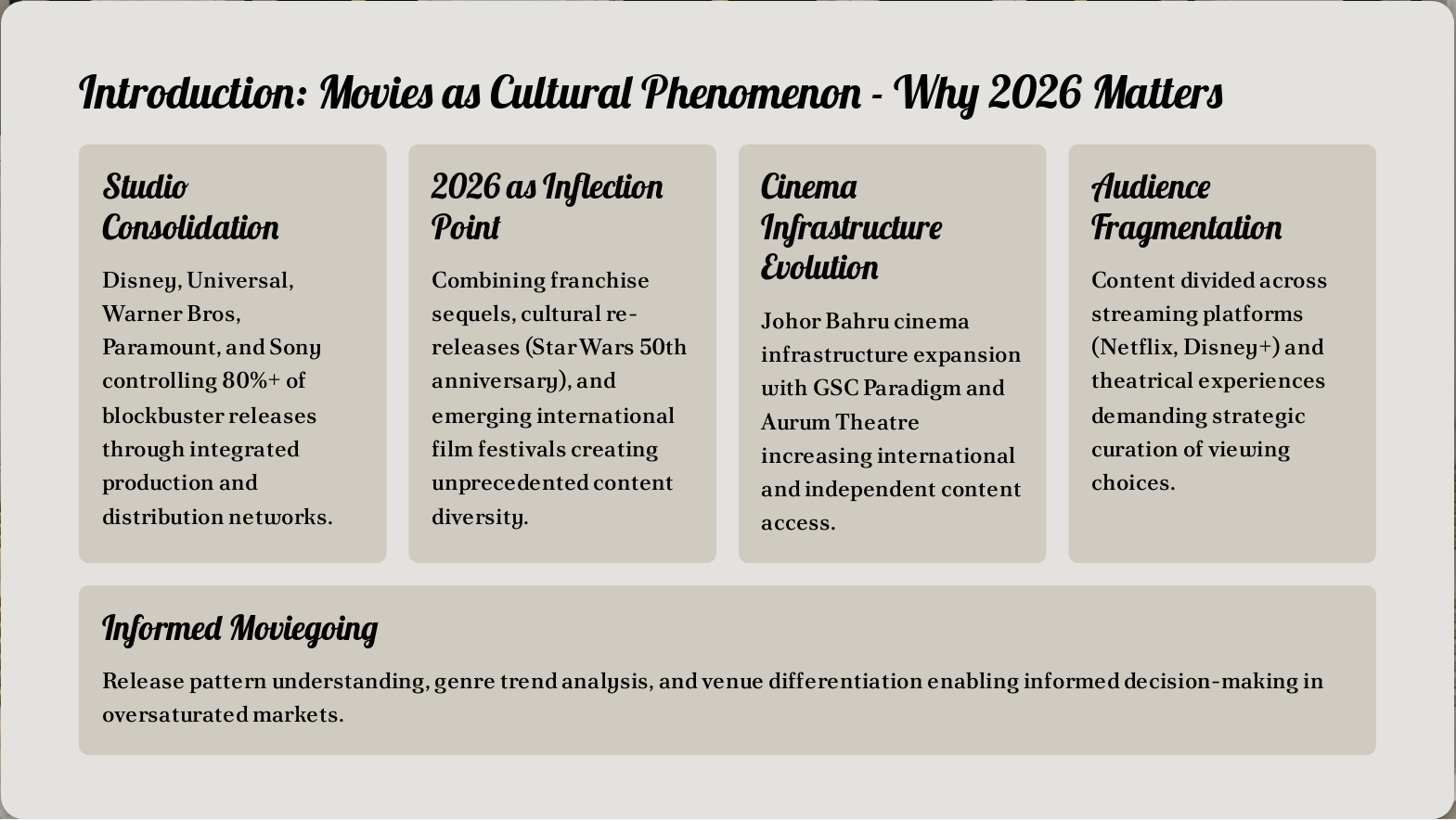
Slide 2: Introduction: Movies as Cultural Phenomenon - Why 2026 Matters
- Studio Consolidation: Disney, Universal, Warner Bros, Paramount, and Sony controlling 80%+ of blockbuster releases through integrated production and distribution networks.
- 2026 as Inflection Point: Combining franchise sequels, cultural re-releases (Star Wars 50th anniversary), and emerging international film festivals creating unprecedented content diversity.
- Cinema Infrastructure Evolution: Johor Bahru cinema infrastructure expansion with GSC Paradigm and Aurum Theatre increasing international and independent content access.
- Audience Fragmentation: Content divided across streaming platforms (Netflix, Disney+) and theatrical experiences demanding strategic curation of viewing choices.
- Informed Moviegoing: Release pattern understanding, genre trend analysis, and venue differentiation enabling informed decision-making in oversaturated markets.
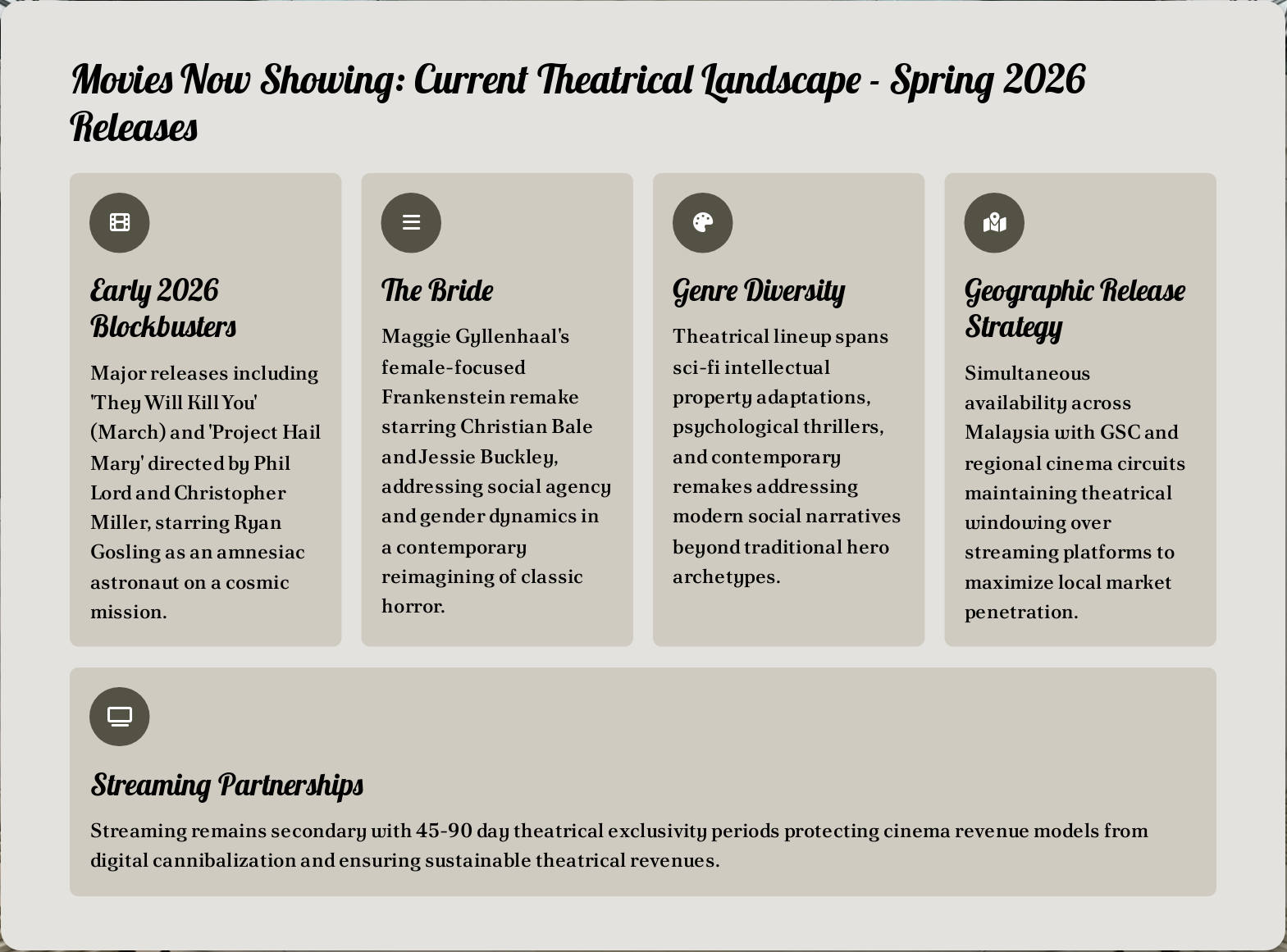
Slide 3: Movies Now Showing: Current Theatrical Landscape - Spring 2026 Releases
- Early 2026 Blockbusters: Major releases including 'They Will Kill You' (March) and 'Project Hail Mary' directed by Phil Lord and Christopher Miller, starring Ryan Gosling as an amnesiac astronaut on a cosmic mission.
- The Bride: Maggie Gyllenhaal's female-focused Frankenstein remake starring Christian Bale and Jessie Buckley, addressing social agency and gender dynamics in a contemporary reimagining of classic horror.
- Genre Diversity: Theatrical lineup spans sci-fi intellectual property adaptations, psychological thrillers, and contemporary remakes addressing modern social narratives beyond traditional hero archetypes.
- Geographic Release Strategy: Simultaneous availability across Malaysia with GSC and regional cinema circuits maintaining theatrical windowing over streaming platforms to maximize local market penetration.
- Streaming Partnerships: Streaming remains secondary with 45-90 day theatrical exclusivity periods protecting cinema revenue models from digital cannibalization and ensuring sustainable theatrical revenues.
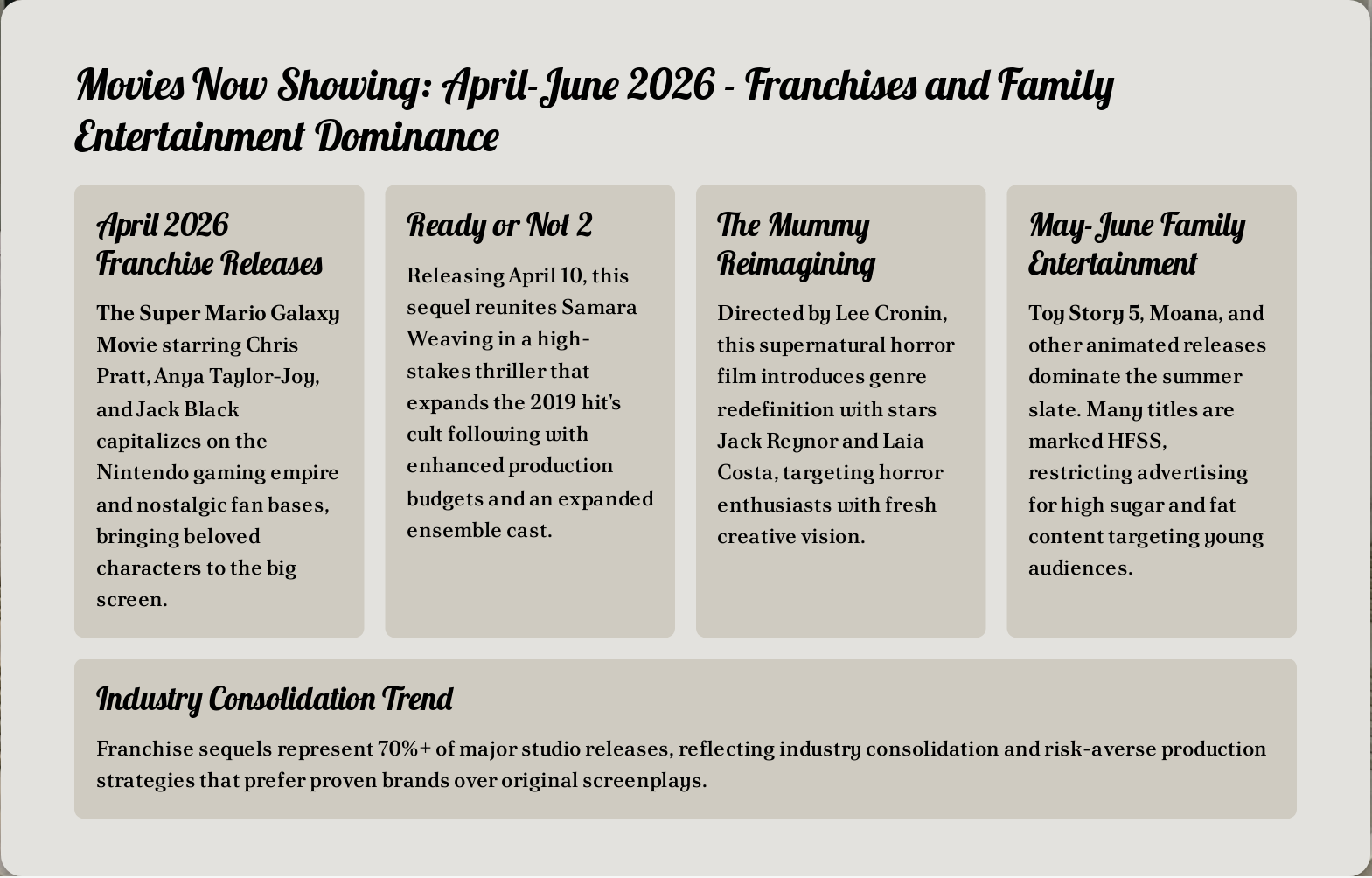
Slide 4: Movies Now Showing: April-June 2026 - Franchises and Family Entertainment Dominance
- April 2026 Franchise Releases: The Super Mario Galaxy Movie starring Chris Pratt, Anya Taylor-Joy, and Jack Black capitalizes on the Nintendo gaming empire and nostalgic fan bases, bringing beloved characters to the big screen.
- Ready or Not 2: Releasing April 10, this sequel reunites Samara Weaving in a high-stakes thriller that expands the 2019 hit's cult following with enhanced production budgets and an expanded ensemble cast.
- The Mummy Reimagining: Directed by Lee Cronin, this supernatural horror film introduces genre redefinition with stars Jack Reynor and Laia Costa, targeting horror enthusiasts with fresh creative vision.
- May-June Family Entertainment: Toy Story 5 , Moana , and other animated releases dominate the summer slate. Many titles are marked HFSS, restricting advertising for high sugar and fat content targeting young audiences.
- Industry Consolidation Trend: Franchise sequels represent 70%+ of major studio releases, reflecting industry consolidation and risk-averse production strategies that prefer proven brands over original screenplays.
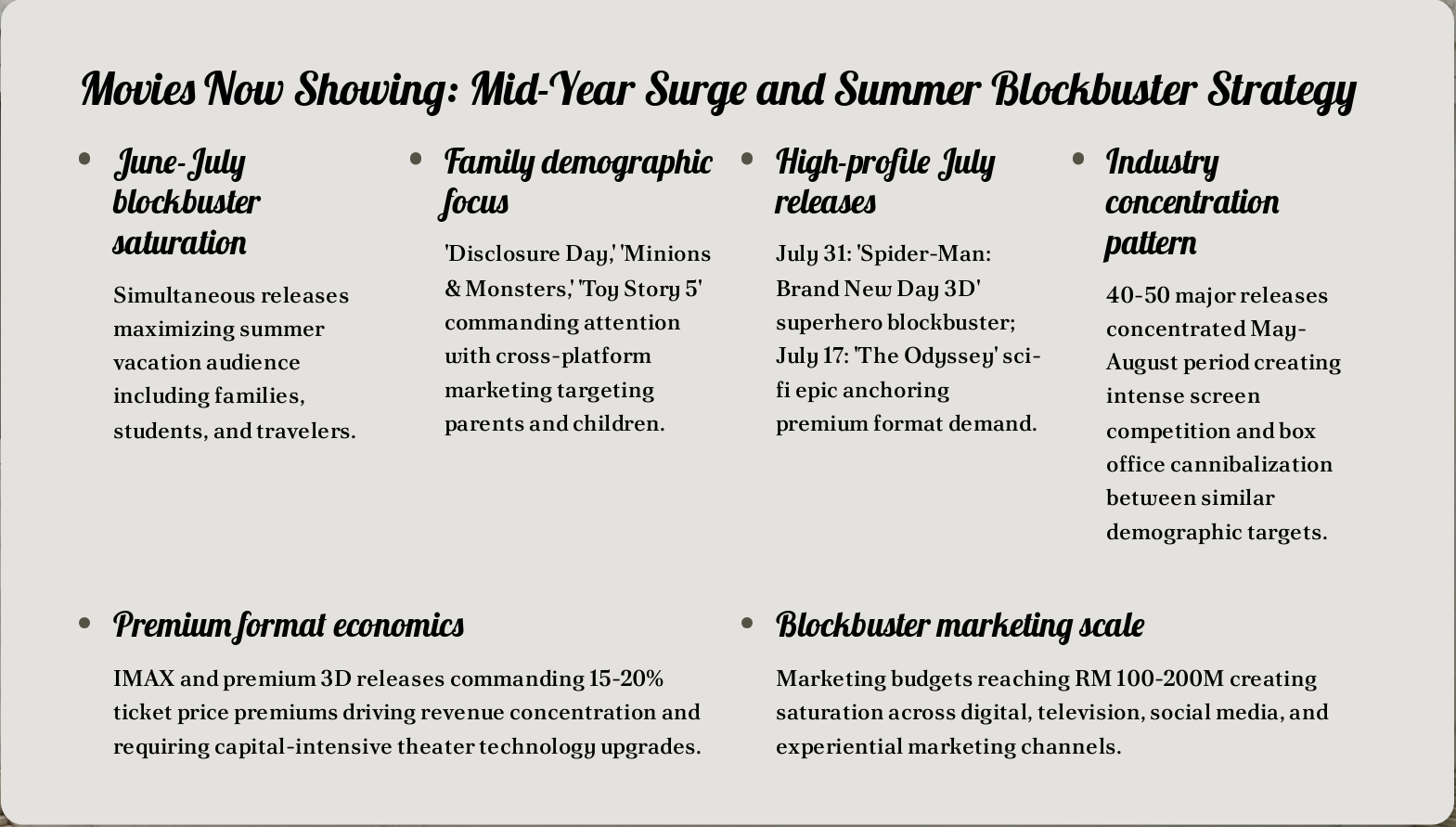
Slide 5: Movies Now Showing: Mid-Year Surge and Summer Blockbuster Strategy
- June-July blockbuster saturation: Simultaneous releases maximizing summer vacation audience including families, students, and travelers.
- Family demographic focus: 'Disclosure Day,' 'Minions & Monsters,' 'Toy Story 5' commanding attention with cross-platform marketing targeting parents and children.
- High-profile July releases: July 31: 'Spider-Man: Brand New Day 3D' superhero blockbuster; July 17: 'The Odyssey' sci-fi epic anchoring premium format demand.
- Industry concentration pattern: 40-50 major releases concentrated May-August period creating intense screen competition and box office cannibalization between similar demographic targets.
- Premium format economics: IMAX and premium 3D releases commanding 15-20% ticket price premiums driving revenue concentration and requiring capital-intensive theater technology upgrades.
- Blockbuster marketing scale: Marketing budgets reaching RM 100-200M creating saturation across digital, television, social media, and experiential marketing channels.
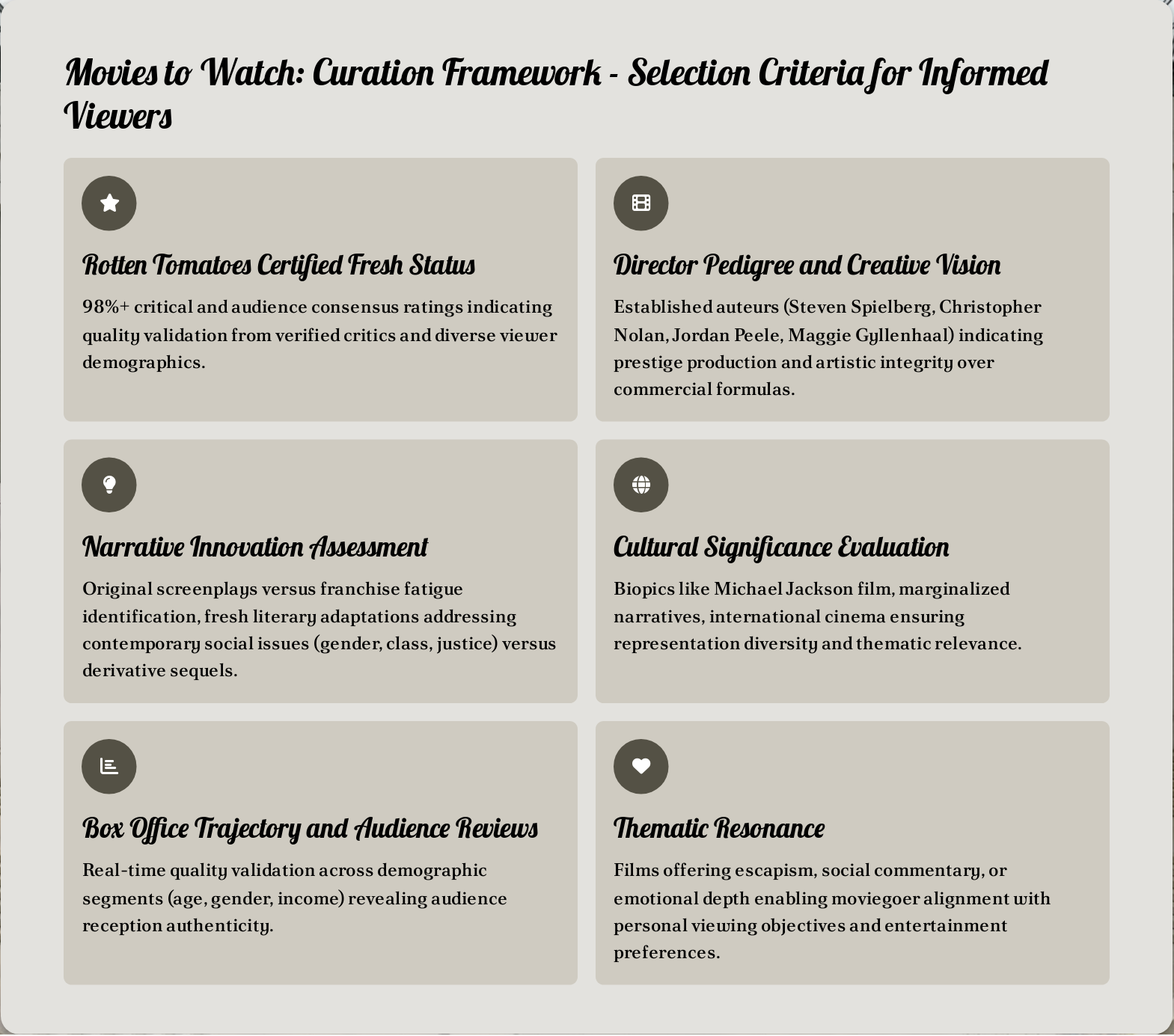
Slide 6: Movies to Watch: Curation Framework - Selection Criteria for Informed Viewers
- Rotten Tomatoes Certified Fresh Status: 98%+ critical and audience consensus ratings indicating quality validation from verified critics and diverse viewer demographics.
- Director Pedigree and Creative Vision: Established auteurs (Steven Spielberg, Christopher Nolan, Jordan Peele, Maggie Gyllenhaal) indicating prestige production and artistic integrity over commercial formulas.
- Narrative Innovation Assessment: Original screenplays versus franchise fatigue identification, fresh literary adaptations addressing contemporary social issues (gender, class, justice) versus derivative sequels.
- Cultural Significance Evaluation: Biopics like Michael Jackson film, marginalized narratives, international cinema ensuring representation diversity and thematic relevance.
- Box Office Trajectory and Audience Reviews: Real-time quality validation across demographic segments (age, gender, income) revealing audience reception authenticity.
- Thematic Resonance: Films offering escapism, social commentary, or emotional depth enabling moviegoer alignment with personal viewing objectives and entertainment preferences.
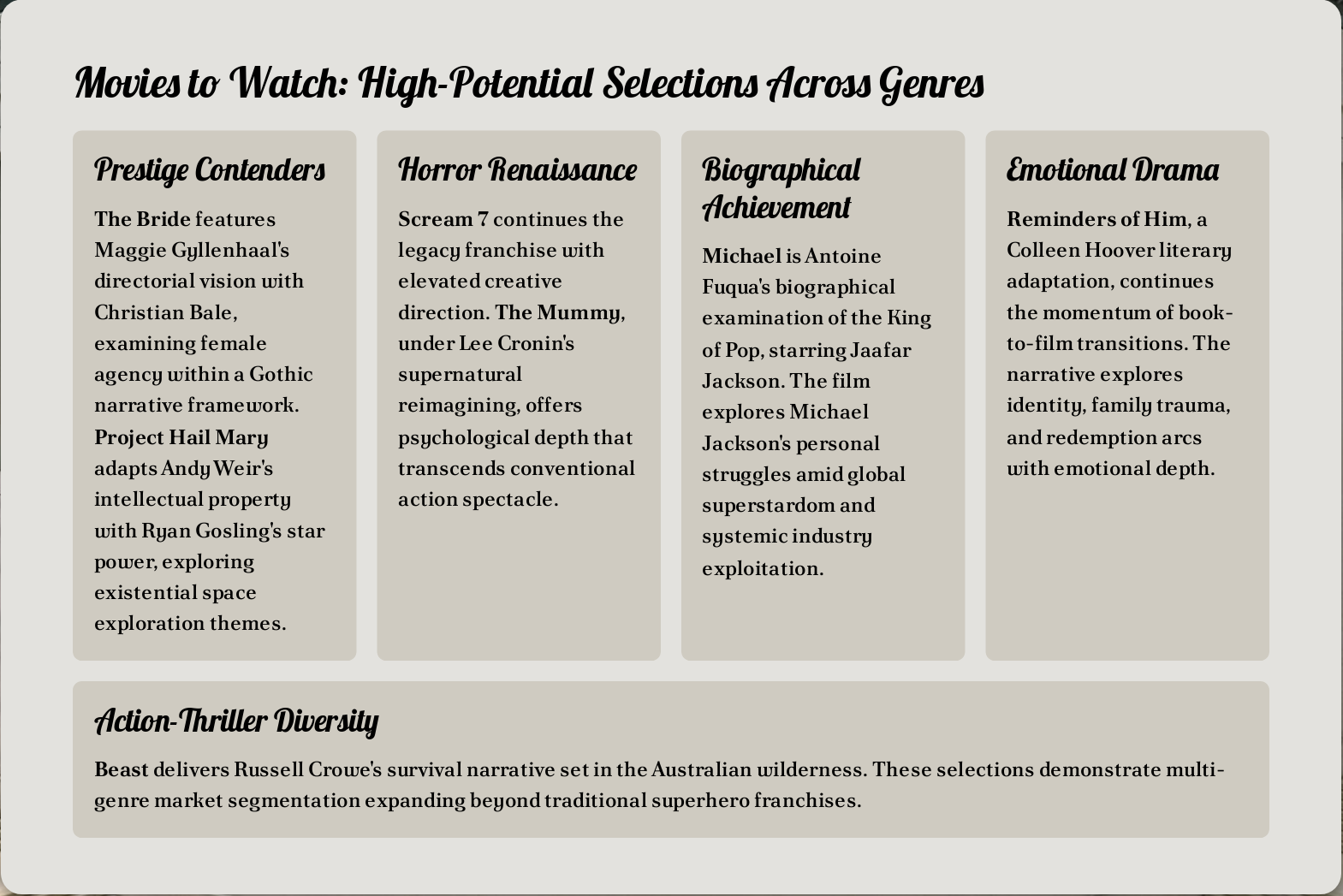
Slide 7: Movies to Watch: High-Potential Selections Across Genres
- Prestige Contenders: The Bride features Maggie Gyllenhaal's directorial vision with Christian Bale, examining female agency within a Gothic narrative framework. Project Hail Mary adapts Andy Weir's intellectual property with Ryan Gosling's star power, exploring existential space exploration themes.
- Horror Renaissance: Scream 7 continues the legacy franchise with elevated creative direction. The Mummy , under Lee Cronin's supernatural reimagining, offers psychological depth that transcends conventional action spectacle.
- Biographical Achievement: Michael is Antoine Fuqua's biographical examination of the King of Pop, starring Jaafar Jackson. The film explores Michael Jackson's personal struggles amid global superstardom and systemic industry exploitation.
- Emotional Drama: Reminders of Him , a Colleen Hoover literary adaptation, continues the momentum of book-to-film transitions. The narrative explores identity, family trauma, and redemption arcs with emotional depth.
- Action-Thriller Diversity: Beast delivers Russell Crowe's survival narrative set in the Australian wilderness. These selections demonstrate multi-genre market segmentation expanding beyond traditional superhero franchises.
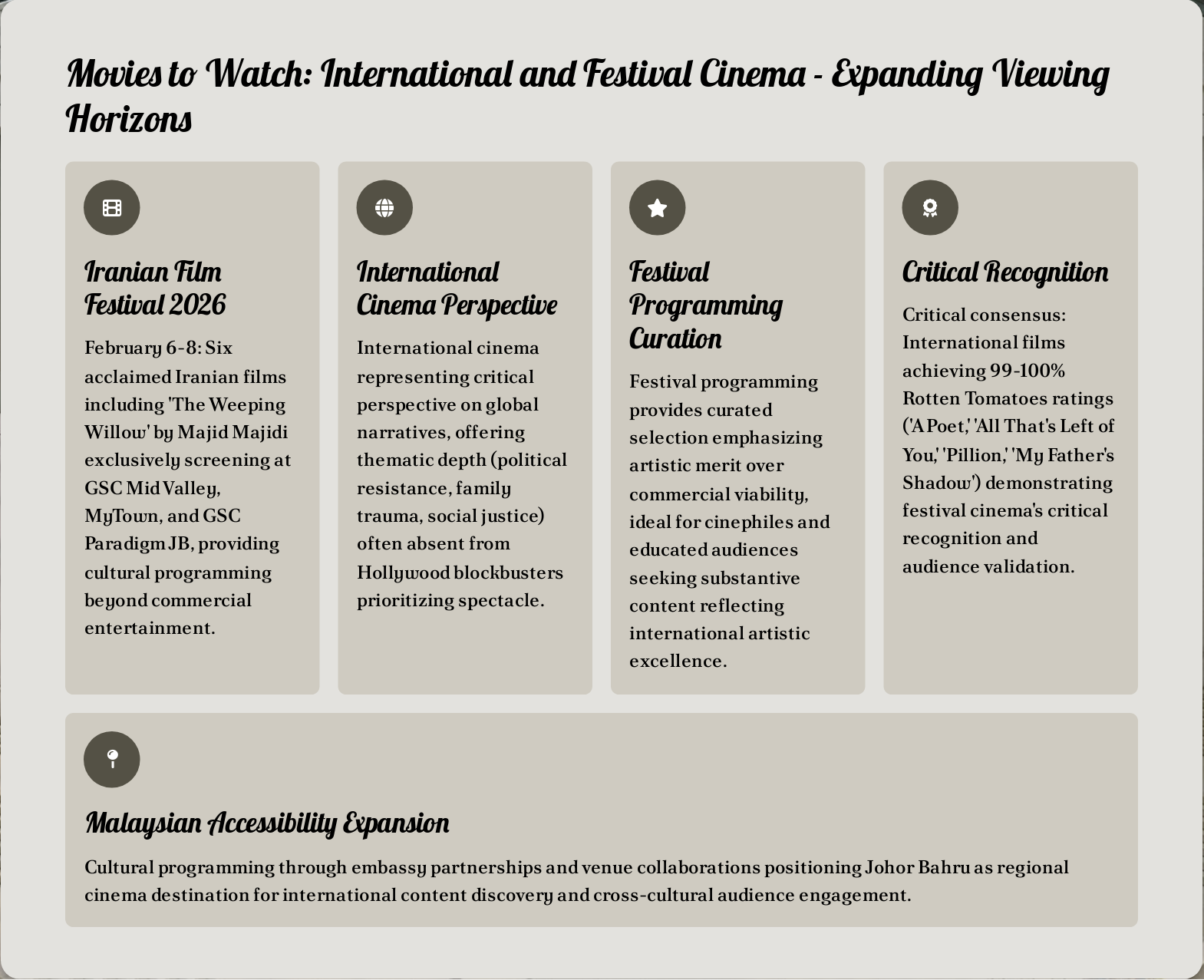
Slide 8: Movies to Watch: International and Festival Cinema - Expanding Viewing Horizons
- Iranian Film Festival 2026: February 6-8: Six acclaimed Iranian films including 'The Weeping Willow' by Majid Majidi exclusively screening at GSC Mid Valley, MyTown, and GSC Paradigm JB, providing cultural programming beyond commercial entertainment.
- International Cinema Perspective: International cinema representing critical perspective on global narratives, offering thematic depth (political resistance, family trauma, social justice) often absent from Hollywood blockbusters prioritizing spectacle.
- Festival Programming Curation: Festival programming provides curated selection emphasizing artistic merit over commercial viability, ideal for cinephiles and educated audiences seeking substantive content reflecting international artistic excellence.
- Critical Recognition: Critical consensus: International films achieving 99-100% Rotten Tomatoes ratings ('A Poet,' 'All That's Left of You,' 'Pillion,' 'My Father's Shadow') demonstrating festival cinema's critical recognition and audience validation.
- Malaysian Accessibility Expansion: Cultural programming through embassy partnerships and venue collaborations positioning Johor Bahru as regional cinema destination for international content discovery and cross-cultural audience engagement.
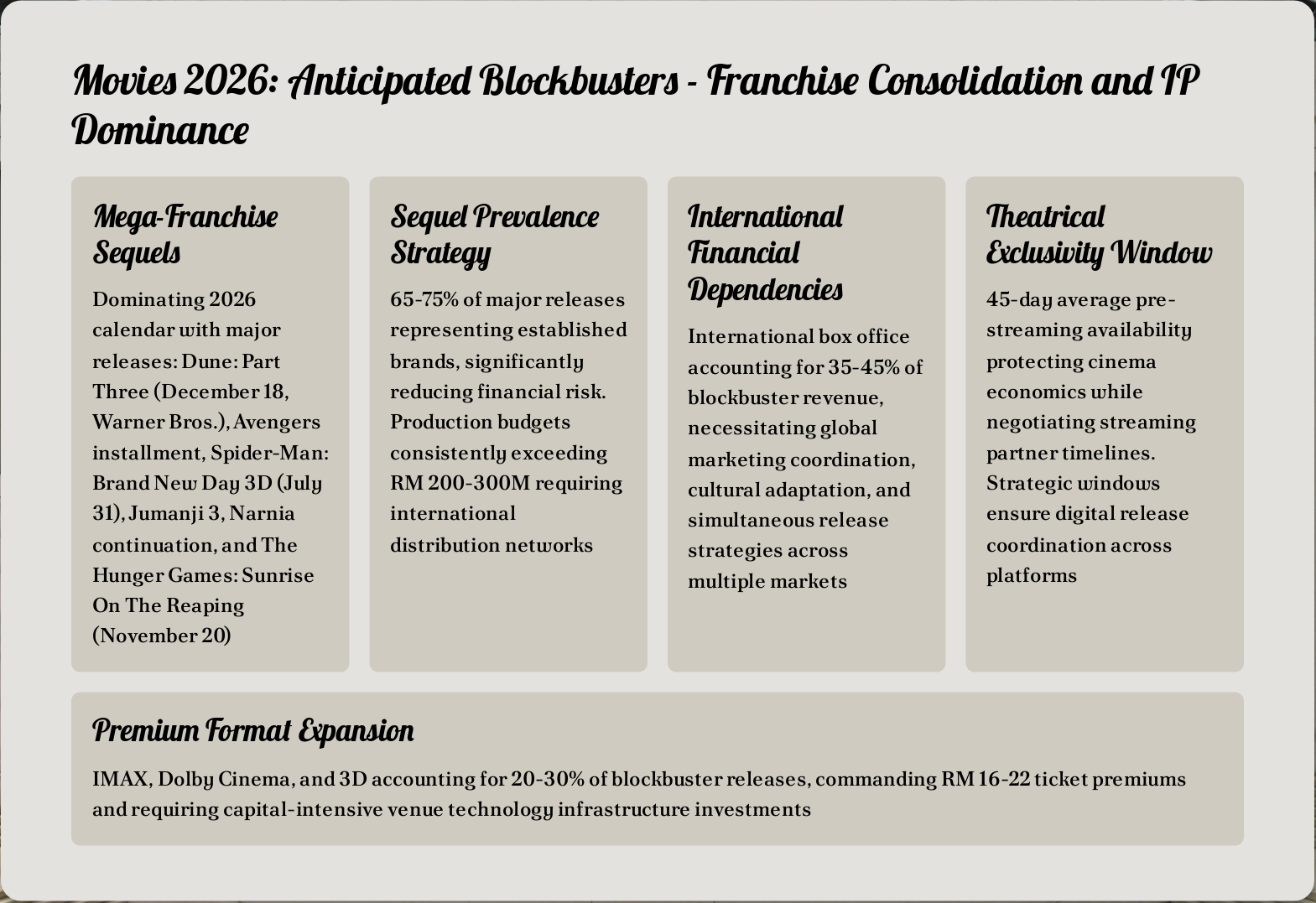
Slide 9: Movies 2026: Anticipated Blockbusters - Franchise Consolidation and IP Dominance
- Mega-Franchise Sequels: Dominating 2026 calendar with major releases: Dune: Part Three (December 18, Warner Bros.), Avengers installment, Spider-Man: Brand New Day 3D (July 31), Jumanji 3, Narnia continuation, and The Hunger Games: Sunrise On The Reaping (November 20)
- Sequel Prevalence Strategy: 65-75% of major releases representing established brands, significantly reducing financial risk. Production budgets consistently exceeding RM 200-300M requiring international distribution networks
- International Financial Dependencies: International box office accounting for 35-45% of blockbuster revenue, necessitating global marketing coordination, cultural adaptation, and simultaneous release strategies across multiple markets
- Theatrical Exclusivity Window: 45-day average pre-streaming availability protecting cinema economics while negotiating streaming partner timelines. Strategic windows ensure digital release coordination across platforms
- Premium Format Expansion: IMAX, Dolby Cinema, and 3D accounting for 20-30% of blockbuster releases, commanding RM 16-22 ticket premiums and requiring capital-intensive venue technology infrastructure investments
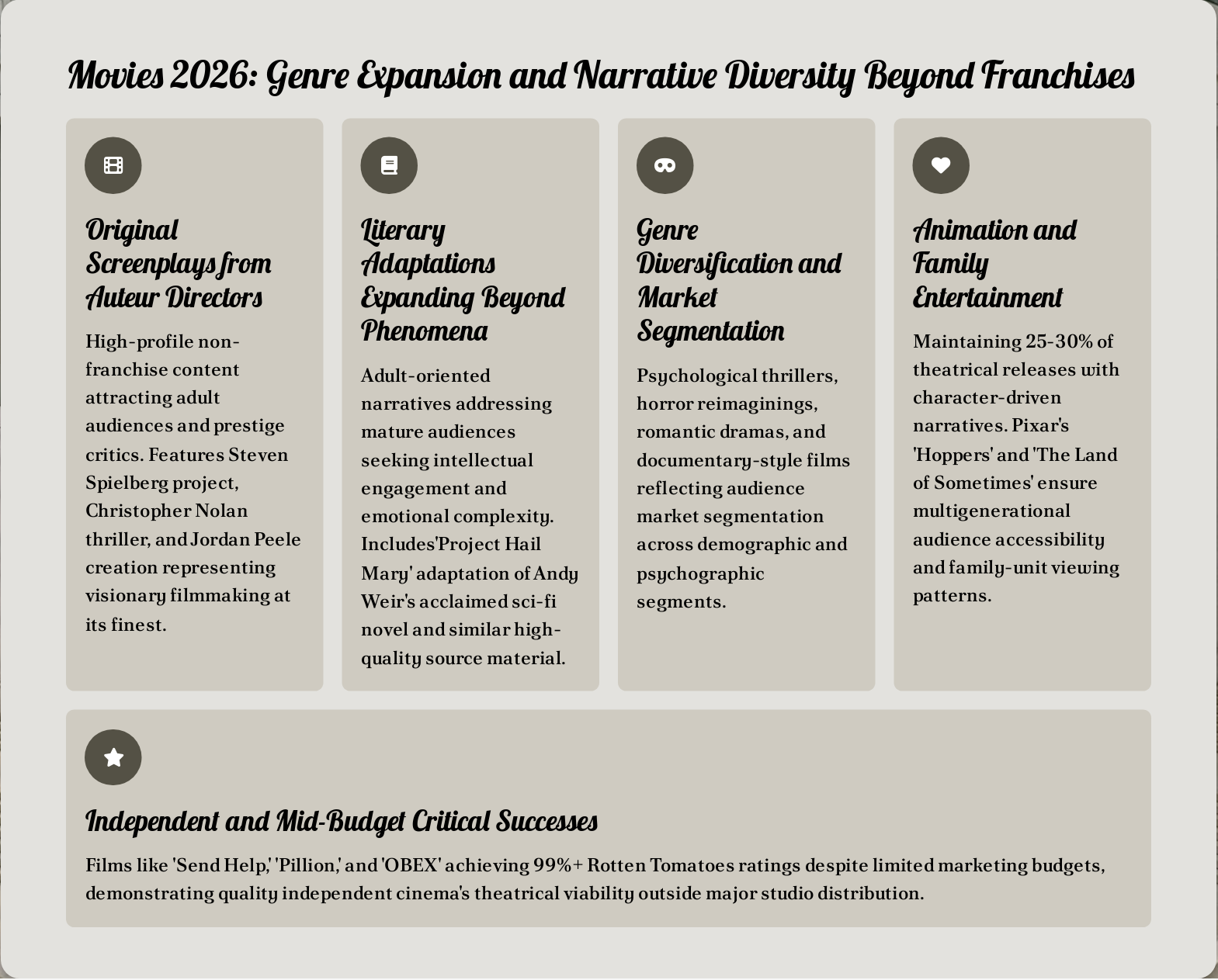
Slide 10: Movies 2026: Genre Expansion and Narrative Diversity Beyond Franchises
- Original Screenplays from Auteur Directors: High-profile non-franchise content attracting adult audiences and prestige critics. Features Steven Spielberg project, Christopher Nolan thriller, and Jordan Peele creation representing visionary filmmaking at its finest.
- Literary Adaptations Expanding Beyond Phenomena: Adult-oriented narratives addressing mature audiences seeking intellectual engagement and emotional complexity. Includes'Project Hail Mary' adaptation of Andy Weir's acclaimed sci-fi novel and similar high-quality source material.
- Genre Diversification and Market Segmentation: Psychological thrillers, horror reimaginings, romantic dramas, and documentary-style films reflecting audience market segmentation across demographic and psychographic segments.
- Animation and Family Entertainment: Maintaining 25-30% of theatrical releases with character-driven narratives. Pixar's 'Hoppers' and 'The Land of Sometimes' ensure multigenerational audience accessibility and family-unit viewing patterns.
- Independent and Mid-Budget Critical Successes: Films like 'Send Help,' 'Pillion,' and 'OBEX' achieving 99%+ Rotten Tomatoes ratings despite limited marketing budgets, demonstrating quality independent cinema's theatrical viability outside major studio distribution.
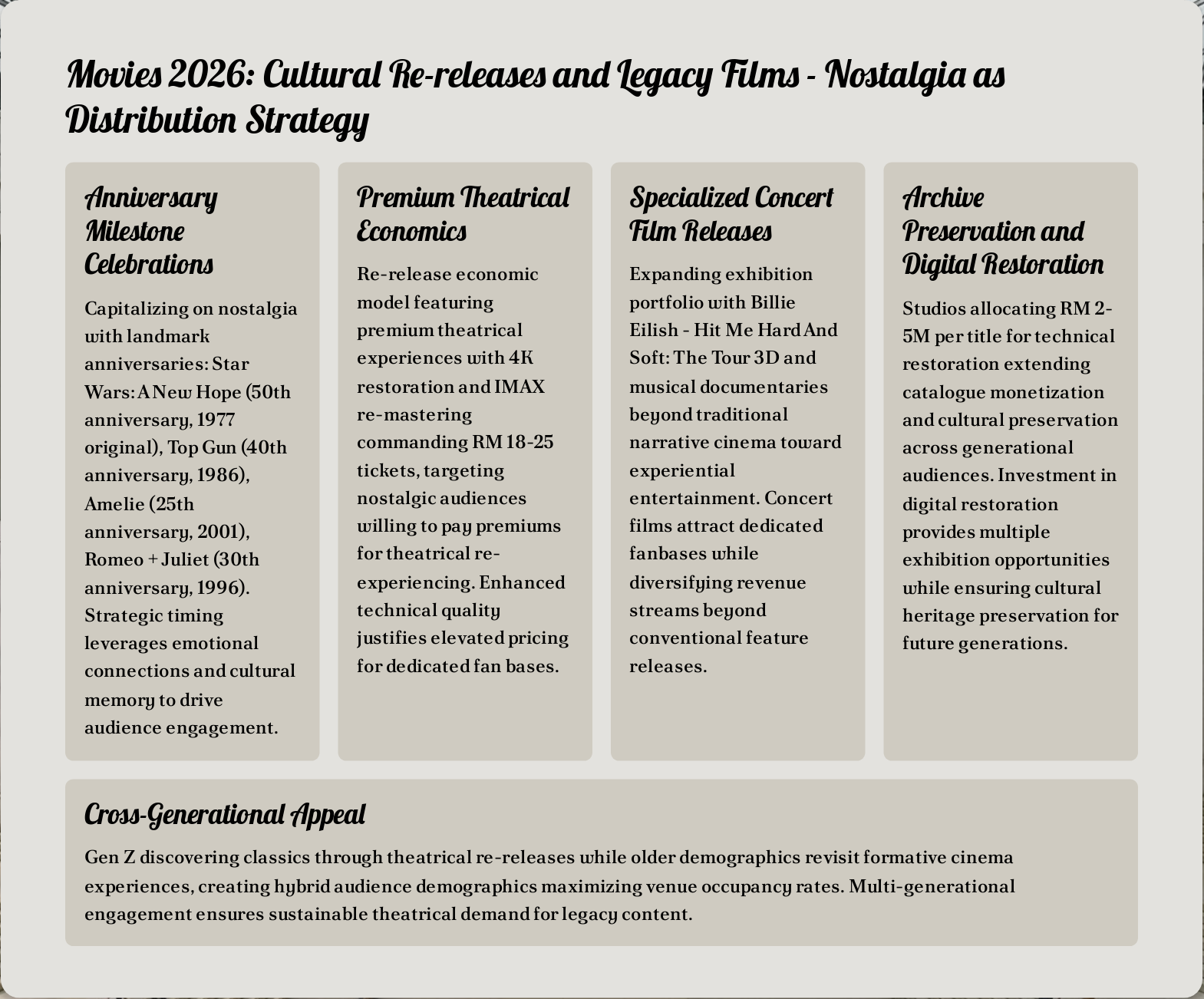
Slide 11: Movies 2026: Cultural Re-releases and Legacy Films - Nostalgia as Distribution Strategy
- Anniversary Milestone Celebrations: Capitalizing on nostalgia with landmark anniversaries: Star Wars: A New Hope (50th anniversary, 1977 original), Top Gun (40th anniversary, 1986), Amelie (25th anniversary, 2001), Romeo + Juliet (30th anniversary, 1996). Strategic timing leverages emotional connections and cultural memory to drive audience engagement.
- Premium Theatrical Economics: Re-release economic model featuring premium theatrical experiences with 4K restoration and IMAX re-mastering commanding RM 18-25 tickets, targeting nostalgic audiences willing to pay premiums for theatrical re-experiencing. Enhanced technical quality justifies elevated pricing for dedicated fan bases.
- Specialized Concert Film Releases: Expanding exhibition portfolio with Billie Eilish - Hit Me Hard And Soft: The Tour 3D and musical documentaries beyond traditional narrative cinema toward experiential entertainment. Concert films attract dedicated fanbases while diversifying revenue streams beyond conventional feature releases.
- Archive Preservation and Digital Restoration: Studios allocating RM 2-5M per title for technical restoration extending catalogue monetization and cultural preservation across generational audiences. Investment in digital restoration provides multiple exhibition opportunities while ensuring cultural heritage preservation for future generations.
- Cross-Generational Appeal: Gen Z discovering classics through theatrical re-releases while older demographics revisit formative cinema experiences, creating hybrid audience demographics maximizing venue occupancy rates. Multi-generational engagement ensures sustainable theatrical demand for legacy content.
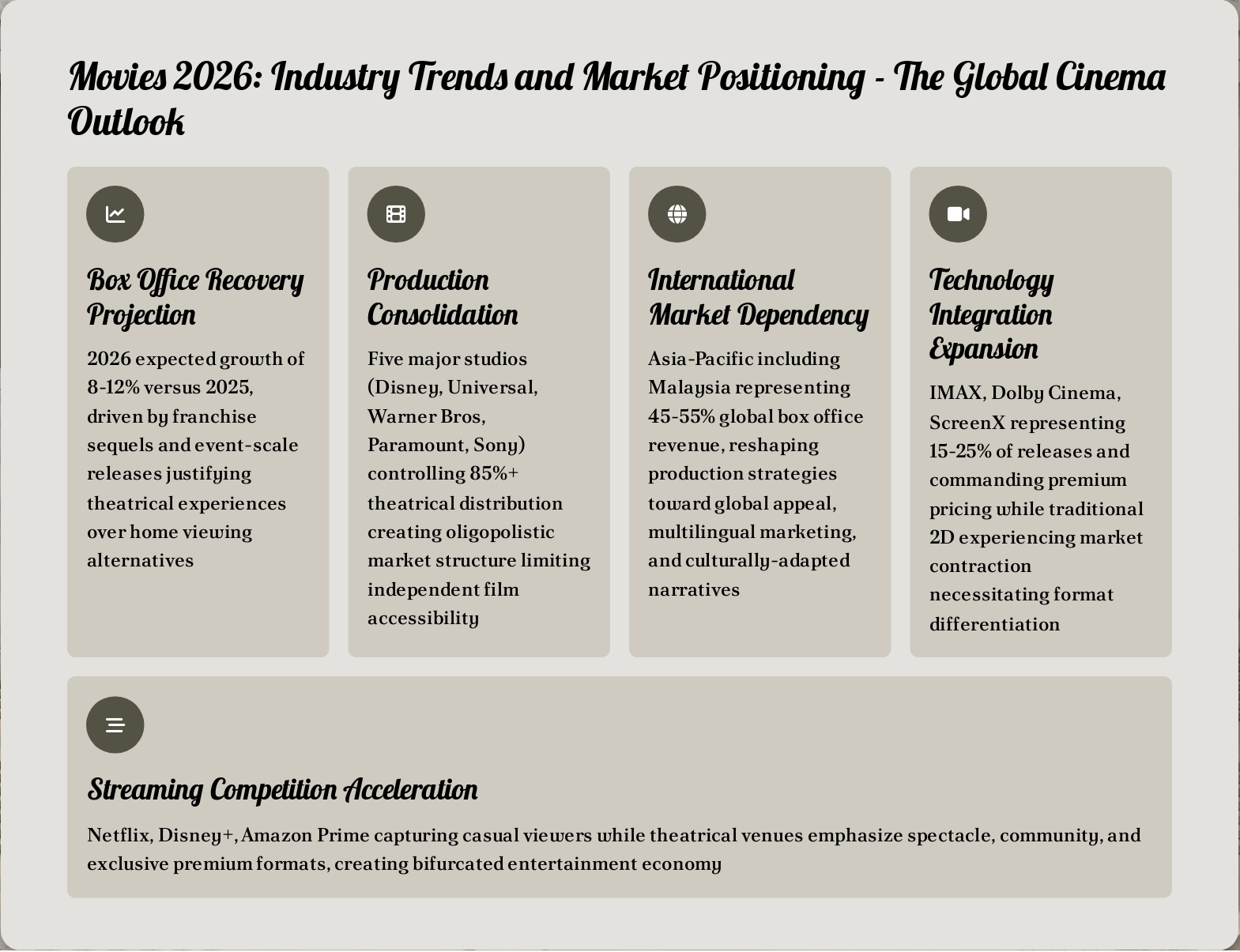
Slide 12: Movies 2026: Industry Trends and Market Positioning - The Global Cinema Outlook
- Box Office Recovery Projection: 2026 expected growth of 8-12% versus 2025, driven by franchise sequels and event-scale releases justifying theatrical experiences over home viewing alternatives
- Production Consolidation: Five major studios (Disney, Universal, Warner Bros, Paramount, Sony) controlling 85%+ theatrical distribution creating oligopolistic market structure limiting independent film accessibility
- International Market Dependency: Asia-Pacific including Malaysia representing 45-55% global box office revenue, reshaping production strategies toward global appeal, multilingual marketing, and culturally-adapted narratives
- Technology Integration Expansion: IMAX, Dolby Cinema, ScreenX representing 15-25% of releases and commanding premium pricing while traditional 2D experiencing market contraction necessitating format differentiation
- Streaming Competition Acceleration: Netflix, Disney+, Amazon Prime capturing casual viewers while theatrical venues emphasize spectacle, community, and exclusive premium formats, creating bifurcated entertainment economy
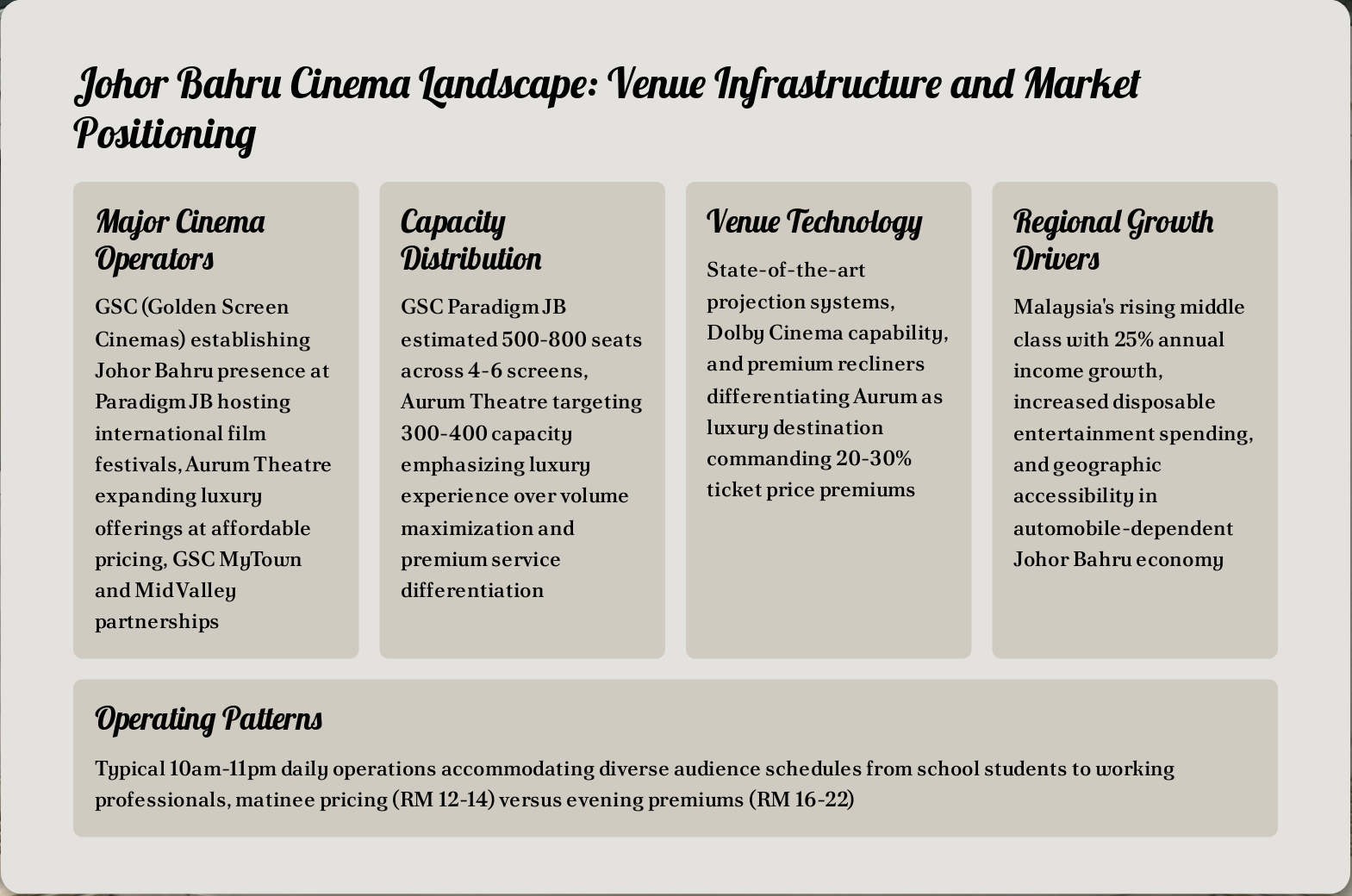
Slide 13: Johor Bahru Cinema Landscape: Venue Infrastructure and Market Positioning
- Major Cinema Operators: GSC (Golden Screen Cinemas) establishing Johor Bahru presence at Paradigm JB hosting international film festivals, Aurum Theatre expanding luxury offerings at affordable pricing, GSC MyTown and Mid Valley partnerships
- Capacity Distribution: GSC Paradigm JB estimated 500-800 seats across 4-6 screens, Aurum Theatre targeting 300-400 capacity emphasizing luxury experience over volume maximization and premium service differentiation
- Venue Technology: State-of-the-art projection systems, Dolby Cinema capability, and premium recliners differentiating Aurum as luxury destination commanding 20-30% ticket price premiums
- Regional Growth Drivers: Malaysia's rising middle class with 25% annual income growth, increased disposable entertainment spending, and geographic accessibility in automobile-dependent Johor Bahru economy
- Operating Patterns: Typical 10am-11pm daily operations accommodating diverse audience schedules from school students to working professionals, matinee pricing (RM 12-14) versus evening premiums (RM 16-22)
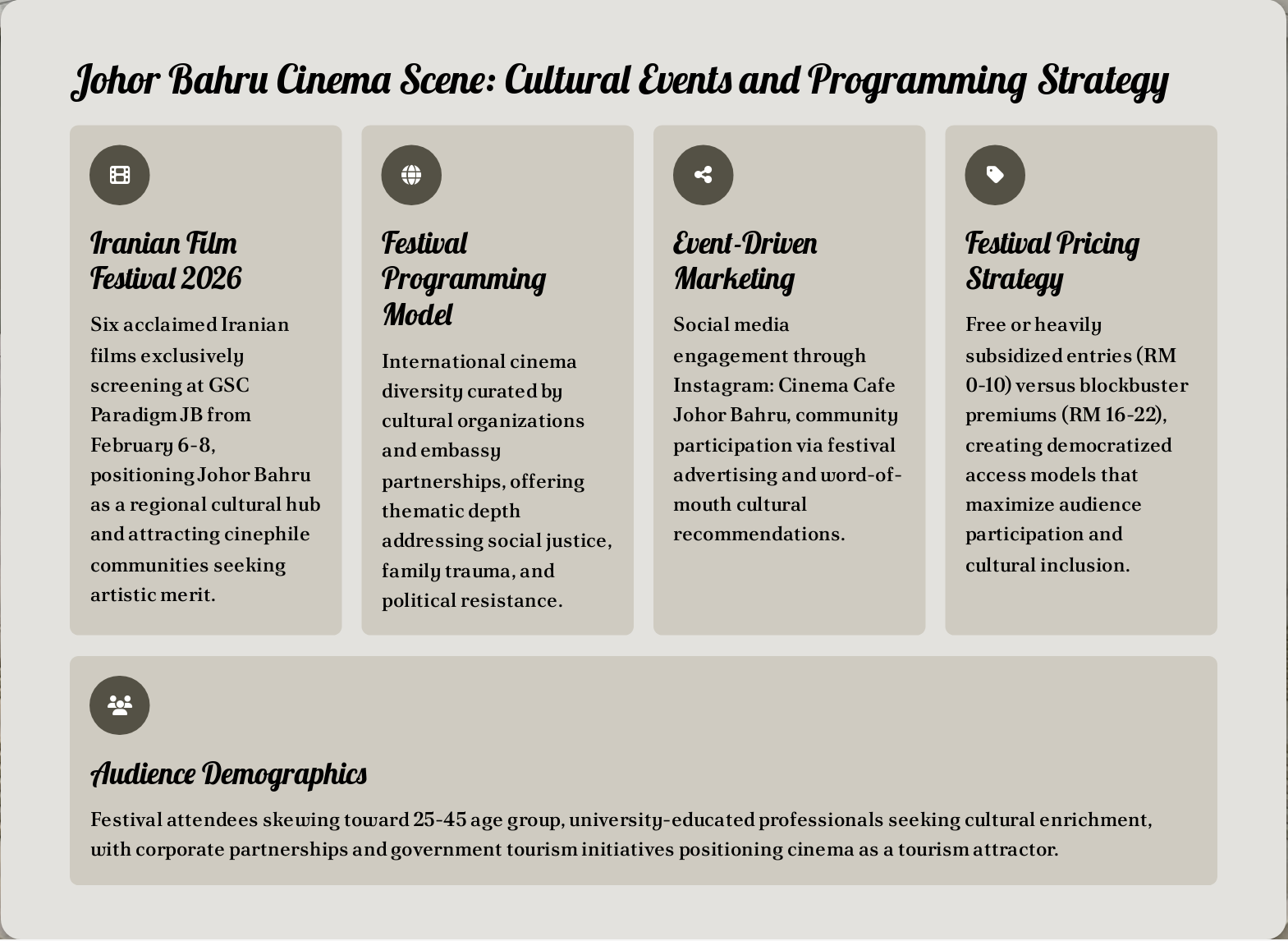
Slide 14: Johor Bahru Cinema Scene: Cultural Events and Programming Strategy
- Iranian Film Festival 2026: Six acclaimed Iranian films exclusively screening at GSC Paradigm JB from February 6-8, positioning Johor Bahru as a regional cultural hub and attracting cinephile communities seeking artistic merit.
- Festival Programming Model: International cinema diversity curated by cultural organizations and embassy partnerships, offering thematic depth addressing social justice, family trauma, and political resistance.
- Event-Driven Marketing: Social media engagement through Instagram: Cinema Cafe Johor Bahru, community participation via festival advertising and word-of-mouth cultural recommendations.
- Festival Pricing Strategy: Free or heavily subsidized entries (RM 0-10) versus blockbuster premiums (RM 16-22), creating democratized access models that maximize audience participation and cultural inclusion.
- Audience Demographics: Festival attendees skewing toward 25-45 age group, university-educated professionals seeking cultural enrichment, with corporate partnerships and government tourism initiatives positioning cinema as a tourism attractor.
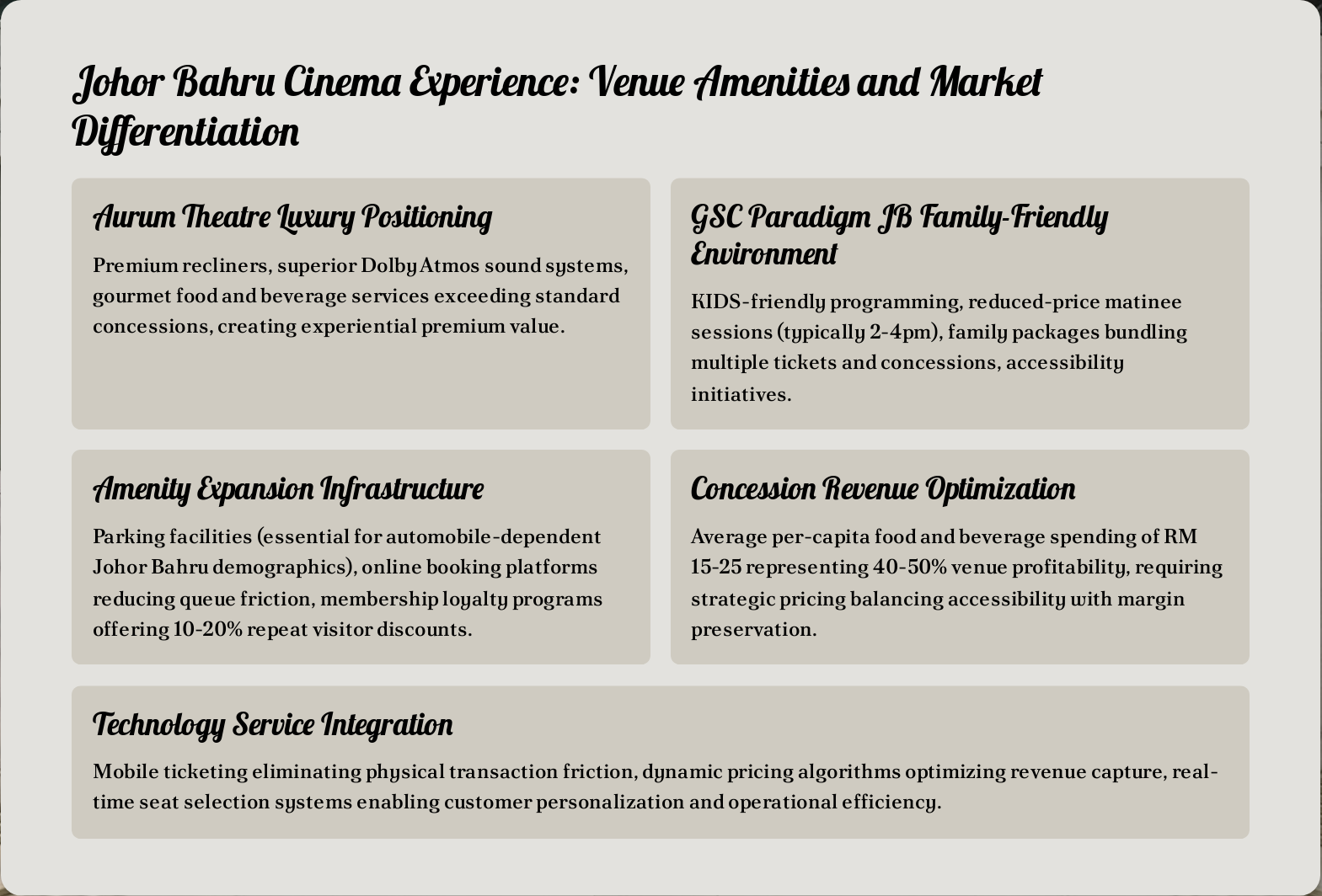
Slide 15: Johor Bahru Cinema Experience: Venue Amenities and Market Differentiation
- Aurum Theatre Luxury Positioning: Premium recliners, superior Dolby Atmos sound systems, gourmet food and beverage services exceeding standard concessions, creating experiential premium value.
- GSC Paradigm JB Family-Friendly Environment: KIDS-friendly programming, reduced-price matinee sessions (typically 2-4pm), family packages bundling multiple tickets and concessions, accessibility initiatives.
- Amenity Expansion Infrastructure: Parking facilities (essential for automobile-dependent Johor Bahru demographics), online booking platforms reducing queue friction, membership loyalty programs offering 10-20% repeat visitor discounts.
- Concession Revenue Optimization: Average per-capita food and beverage spending of RM 15-25 representing 40-50% venue profitability, requiring strategic pricing balancing accessibility with margin preservation.
- Technology Service Integration: Mobile ticketing eliminating physical transaction friction, dynamic pricing algorithms optimizing revenue capture, real-time seat selection systems enabling customer personalization and operational efficiency.
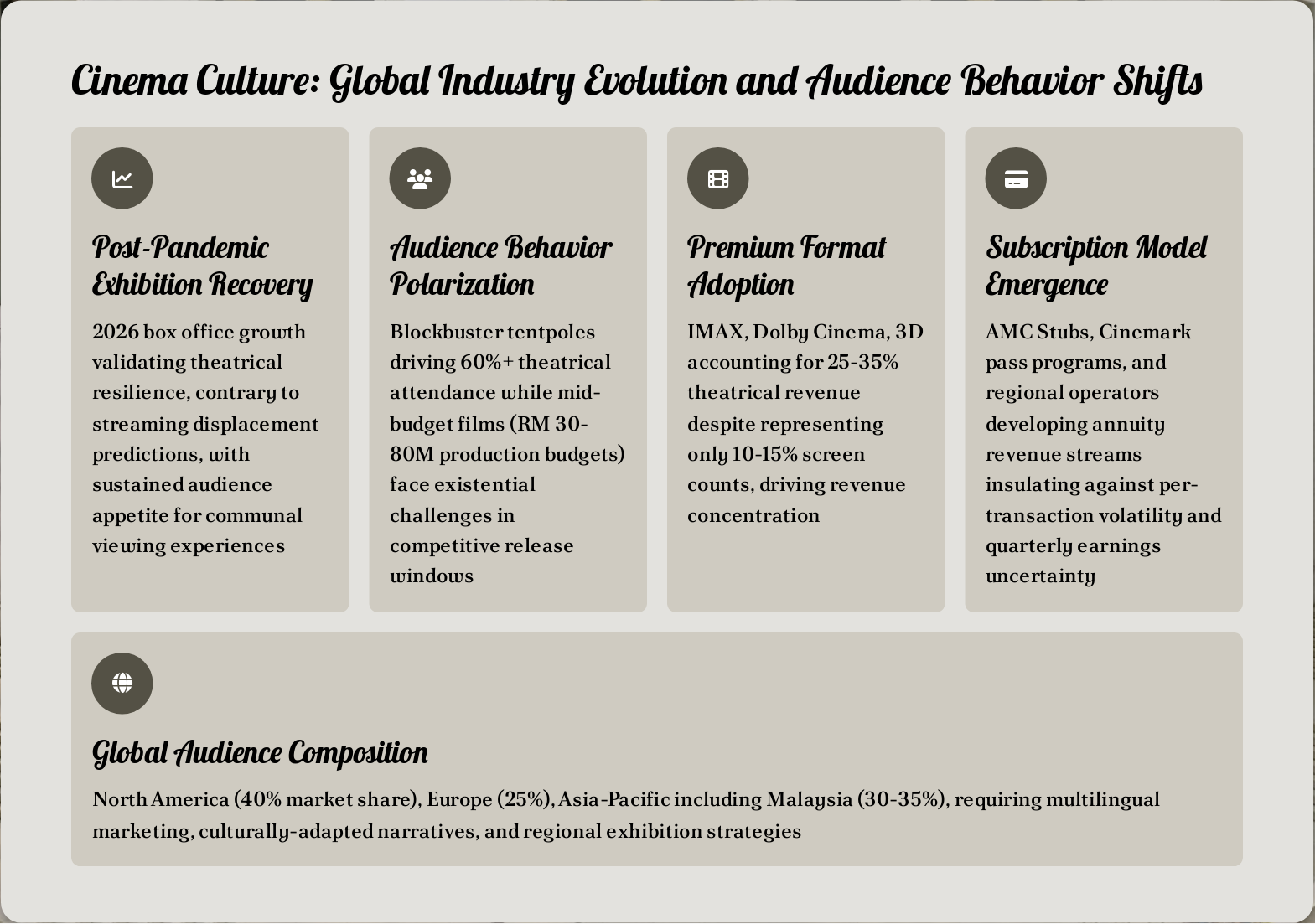
Slide 16: Cinema Culture: Global Industry Evolution and Audience Behavior Shifts
- Post-Pandemic Exhibition Recovery: 2026 box office growth validating theatrical resilience, contrary to streaming displacement predictions, with sustained audience appetite for communal viewing experiences
- Audience Behavior Polarization: Blockbuster tentpoles driving 60%+ theatrical attendance while mid-budget films (RM 30-80M production budgets) face existential challenges in competitive release windows
- Premium Format Adoption: IMAX, Dolby Cinema, 3D accounting for 25-35% theatrical revenue despite representing only 10-15% screen counts, driving revenue concentration
- Subscription Model Emergence: AMC Stubs, Cinemark pass programs, and regional operators developing annuity revenue streams insulating against per-transaction volatility and quarterly earnings uncertainty
- Global Audience Composition: North America (40% market share), Europe (25%), Asia-Pacific including Malaysia (30-35%), requiring multilingual marketing, culturally-adapted narratives, and regional exhibition strategies
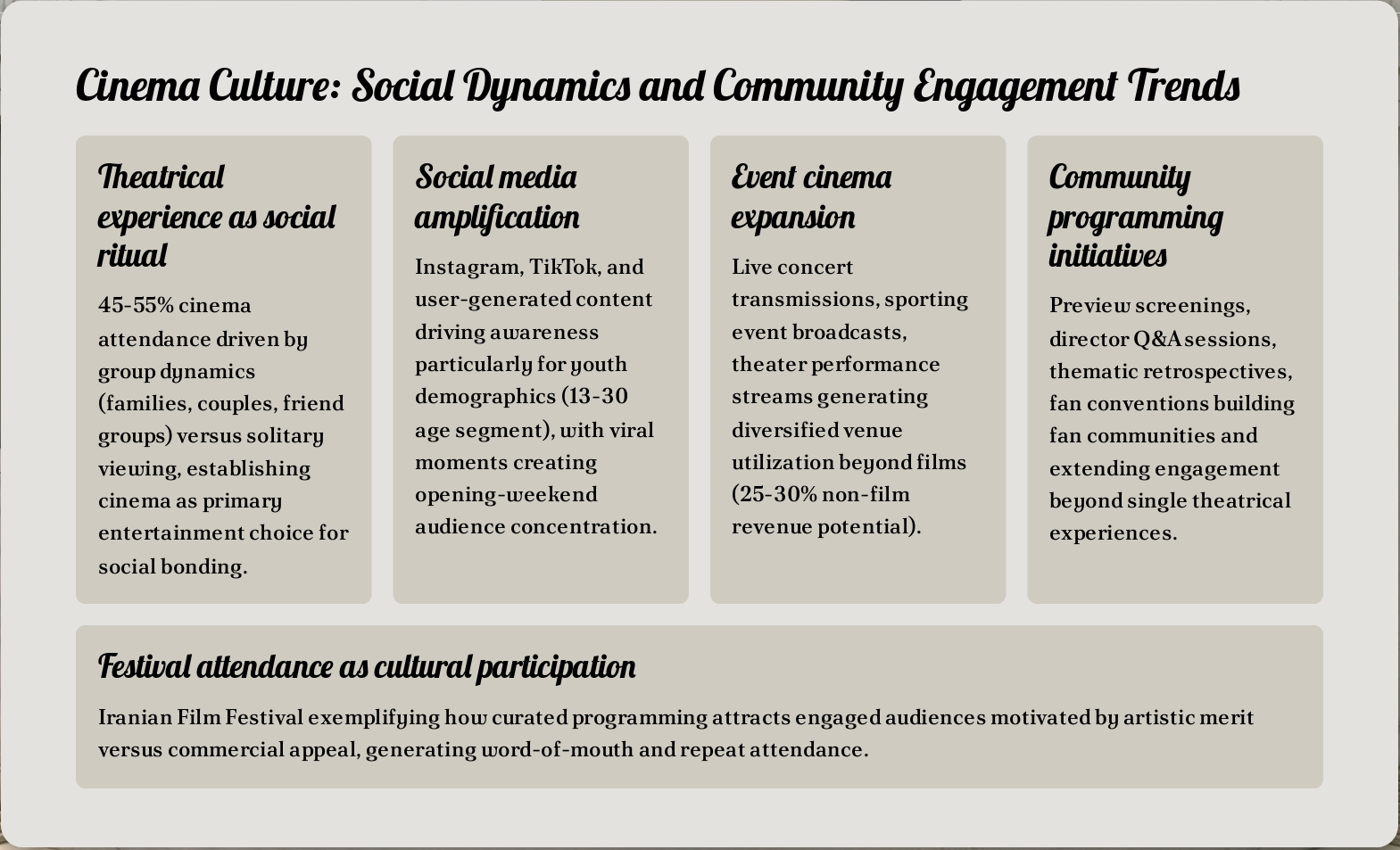
Slide 17: Cinema Culture: Social Dynamics and Community Engagement Trends
- Theatrical experience as social ritual: 45-55% cinema attendance driven by group dynamics (families, couples, friend groups) versus solitary viewing, establishing cinema as primary entertainment choice for social bonding.
- Social media amplification: Instagram, TikTok, and user-generated content driving awareness particularly for youth demographics (13-30 age segment), with viral moments creating opening-weekend audience concentration.
- Event cinema expansion: Live concert transmissions, sporting event broadcasts, theater performance streams generating diversified venue utilization beyond films (25-30% non-film revenue potential).
- Community programming initiatives: Preview screenings, director Q&A sessions, thematic retrospectives, fan conventions building fan communities and extending engagement beyond single theatrical experiences.
- Festival attendance as cultural participation: Iranian Film Festival exemplifying how curated programming attracts engaged audiences motivated by artistic merit versus commercial appeal, generating word-of-mouth and repeat attendance.
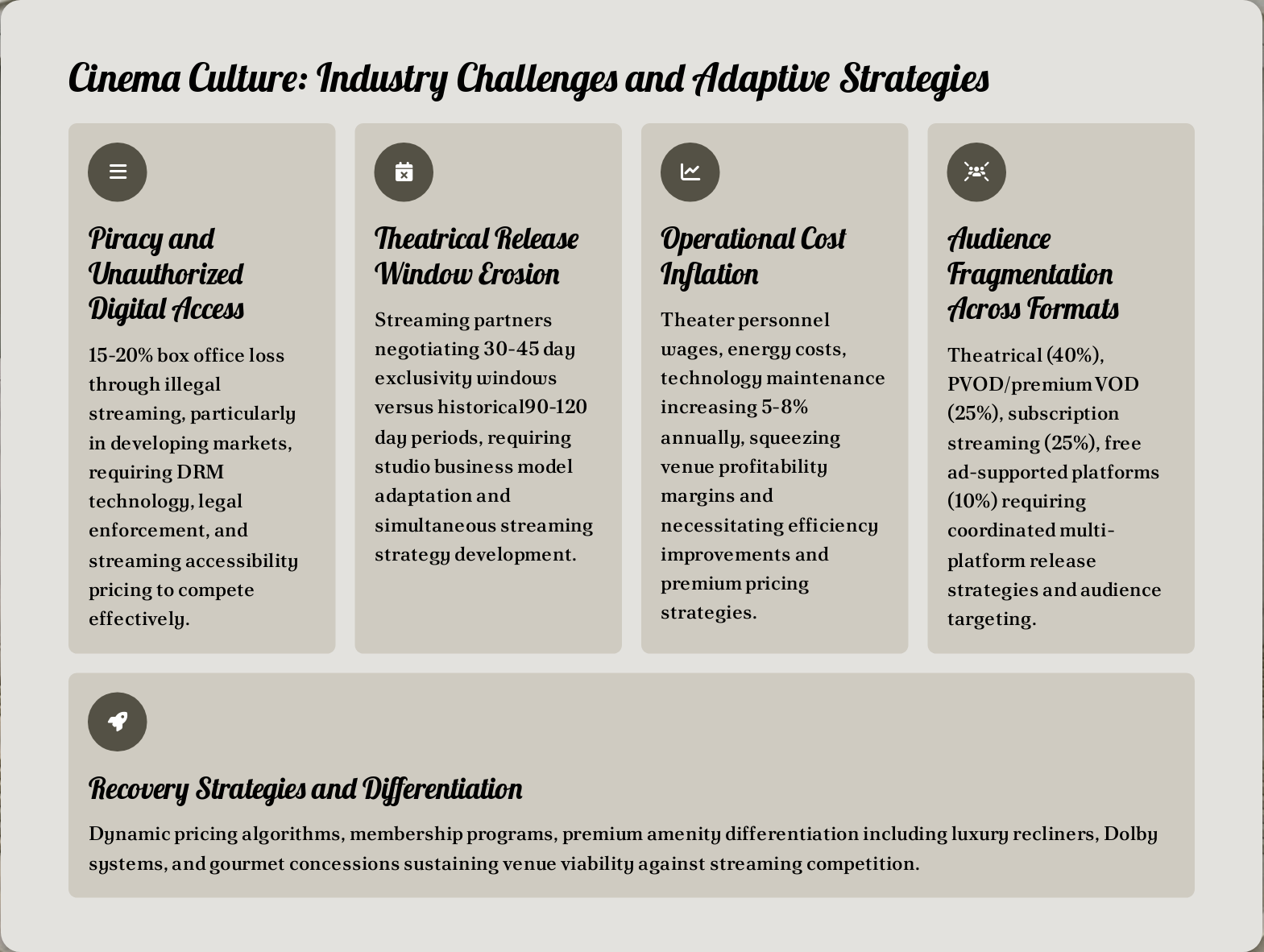
Slide 18: Cinema Culture: Industry Challenges and Adaptive Strategies
- Piracy and Unauthorized Digital Access: 15-20% box office loss through illegal streaming, particularly in developing markets, requiring DRM technology, legal enforcement, and streaming accessibility pricing to compete effectively.
- Theatrical Release Window Erosion: Streaming partners negotiating 30-45 day exclusivity windows versus historical90-120 day periods, requiring studio business model adaptation and simultaneous streaming strategy development.
- Operational Cost Inflation: Theater personnel wages, energy costs, technology maintenance increasing 5-8% annually, squeezing venue profitability margins and necessitating efficiency improvements and premium pricing strategies.
- Audience Fragmentation Across Formats: Theatrical (40%), PVOD/premium VOD (25%), subscription streaming (25%), free ad-supported platforms (10%) requiring coordinated multi-platform release strategies and audience targeting.
- Recovery Strategies and Differentiation: Dynamic pricing algorithms, membership programs, premium amenity differentiation including luxury recliners, Dolby systems, and gourmet concessions sustaining venue viability against streaming competition.
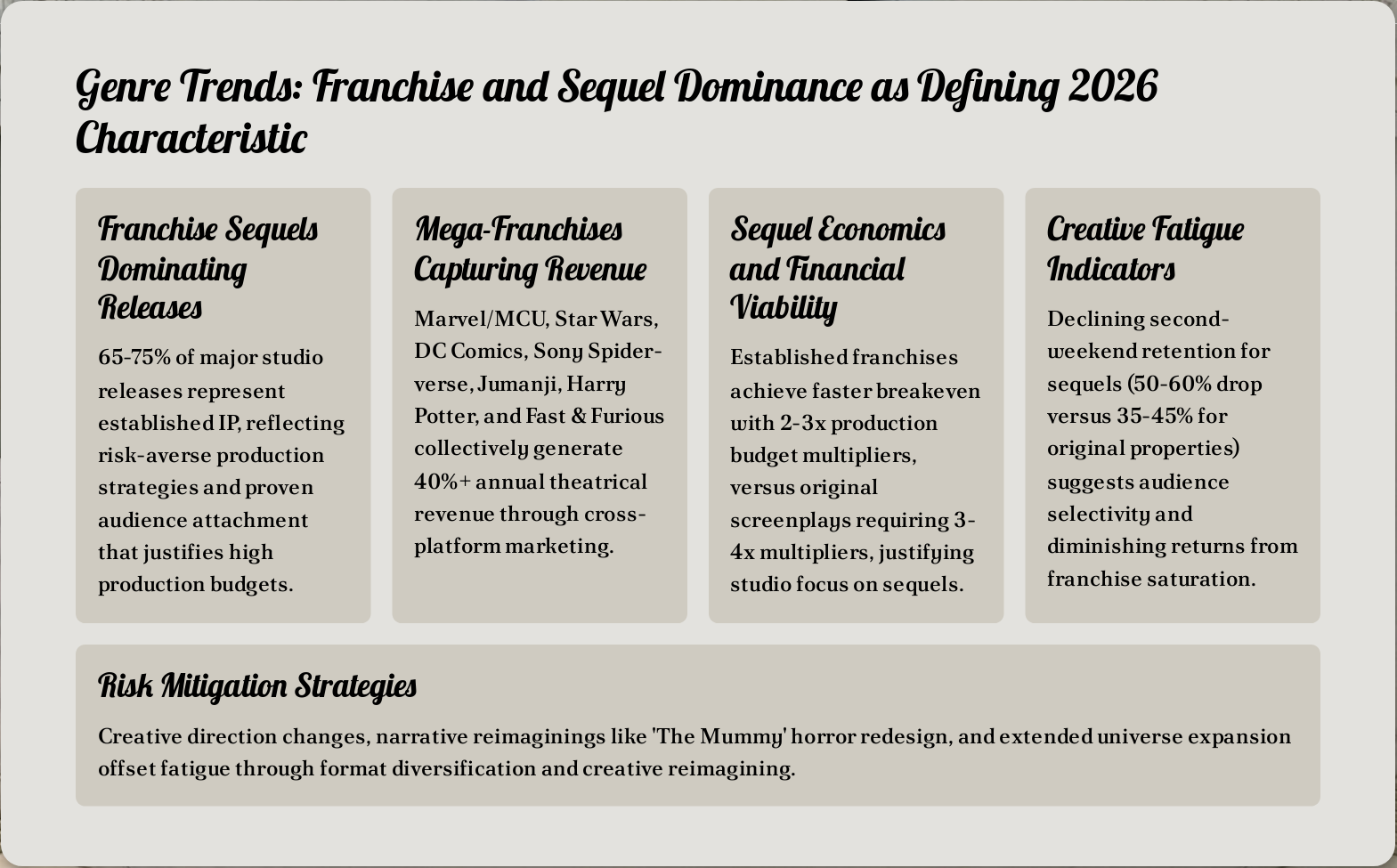
Slide 19: Genre Trends: Franchise and Sequel Dominance as Defining 2026 Characteristic
- Franchise Sequels Dominating Releases: 65-75% of major studio releases represent established IP, reflecting risk-averse production strategies and proven audience attachment that justifies high production budgets.
- Mega-Franchises Capturing Revenue: Marvel/MCU, Star Wars, DC Comics, Sony Spider-verse, Jumanji, Harry Potter, and Fast & Furious collectively generate 40%+ annual theatrical revenue through cross-platform marketing.
- Sequel Economics and Financial Viability: Established franchises achieve faster breakeven with 2-3x production budget multipliers, versus original screenplays requiring 3-4x multipliers, justifying studio focus on sequels.
- Creative Fatigue Indicators: Declining second-weekend retention for sequels (50-60% drop versus 35-45% for original properties) suggests audience selectivity and diminishing returns from franchise saturation.
- Risk Mitigation Strategies: Creative direction changes, narrative reimaginings like 'The Mummy' horror redesign, and extended universe expansion offset fatigue through format diversification and creative reimagining.
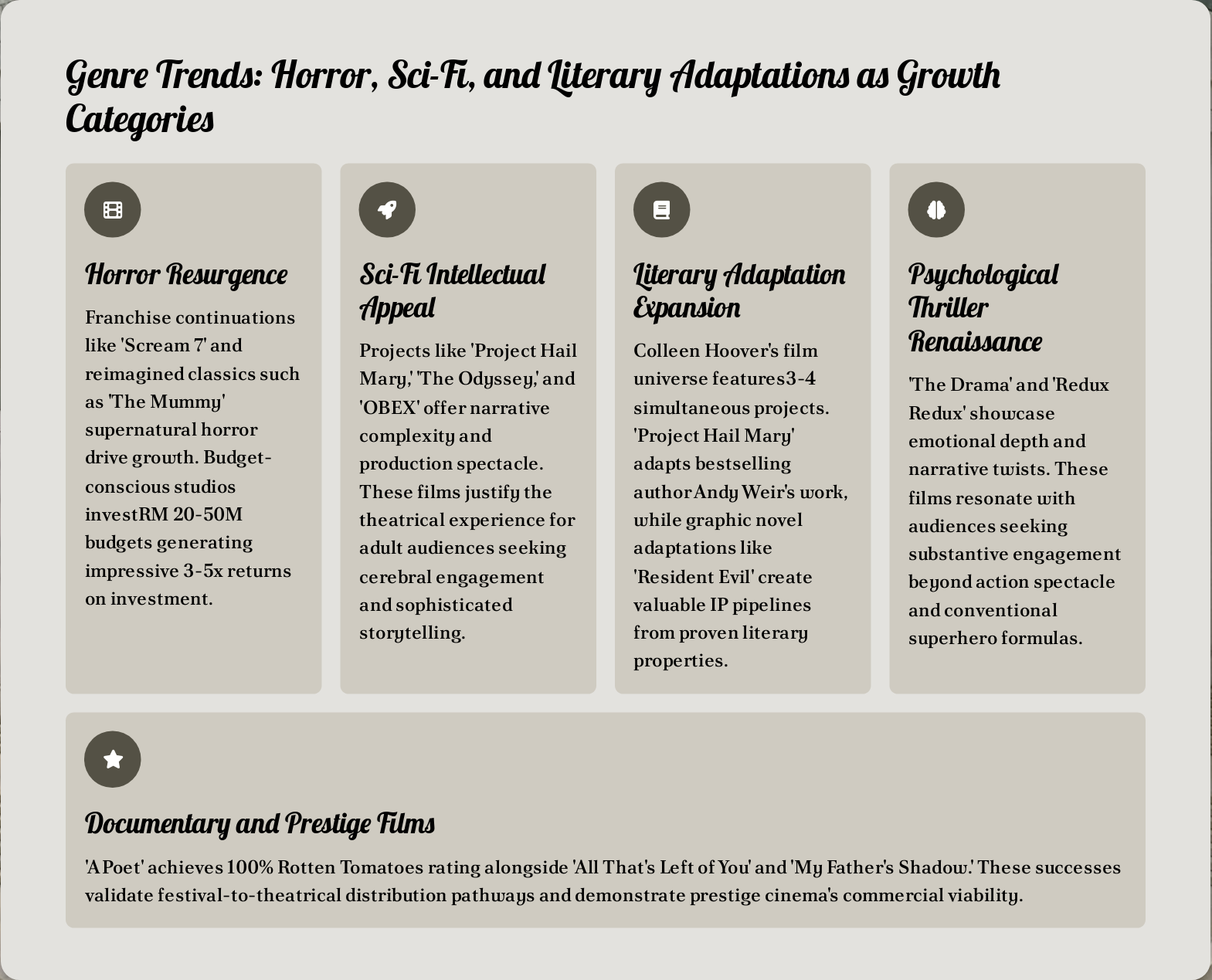
Slide 20: Genre Trends: Horror, Sci-Fi, and Literary Adaptations as Growth Categories
- Horror Resurgence: Franchise continuations like 'Scream 7' and reimagined classics such as 'The Mummy' supernatural horror drive growth. Budget-conscious studios investRM 20-50M budgets generating impressive 3-5x returns on investment.
- Sci-Fi Intellectual Appeal: Projects like 'Project Hail Mary,' 'The Odyssey,' and 'OBEX' offer narrative complexity and production spectacle. These films justify the theatrical experience for adult audiences seeking cerebral engagement and sophisticated storytelling.
- Literary Adaptation Expansion: Colleen Hoover's film universe features3-4 simultaneous projects. 'Project Hail Mary' adapts bestselling author Andy Weir's work, while graphic novel adaptations like 'Resident Evil' create valuable IP pipelines from proven literary properties.
- Psychological Thriller Renaissance: 'The Drama' and 'Redux Redux' showcase emotional depth and narrative twists. These films resonate with audiences seeking substantive engagement beyond action spectacle and conventional superhero formulas.
- Documentary and Prestige Films: 'A Poet' achieves 100% Rotten Tomatoes rating alongside 'All That's Left of You' and 'My Father's Shadow.' These successes validate festival-to-theatrical distribution pathways and demonstrate prestige cinema's commercial viability.
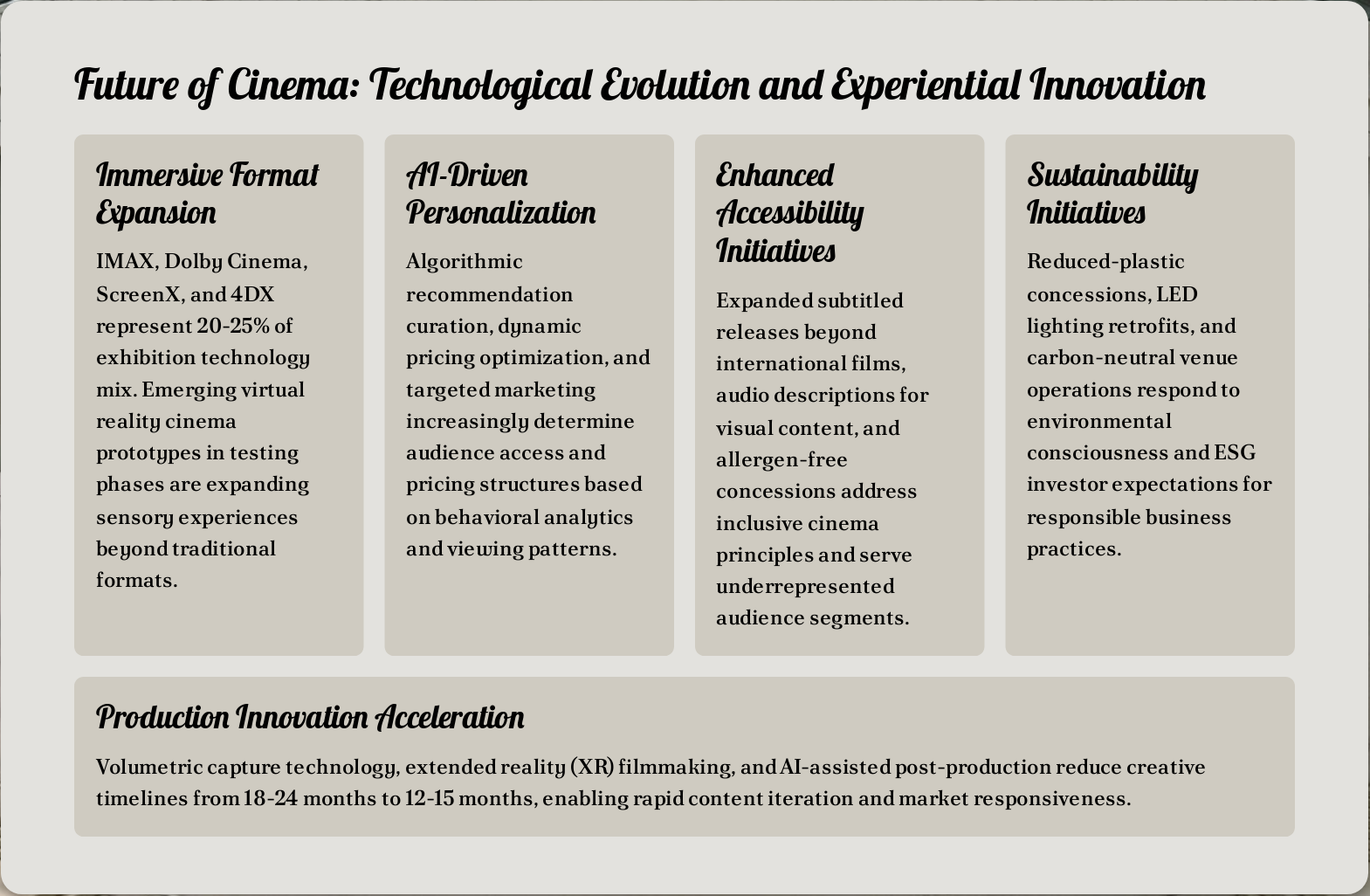
Slide 21: Future of Cinema: Technological Evolution and Experiential Innovation
- Immersive Format Expansion: IMAX, Dolby Cinema, ScreenX, and 4DX represent 20-25% of exhibition technology mix. Emerging virtual reality cinema prototypes in testing phases are expanding sensory experiences beyond traditional formats.
- AI-Driven Personalization: Algorithmic recommendation curation, dynamic pricing optimization, and targeted marketing increasingly determine audience access and pricing structures based on behavioral analytics and viewing patterns.
- Enhanced Accessibility Initiatives: Expanded subtitled releases beyond international films, audio descriptions for visual content, and allergen-free concessions address inclusive cinema principles and serve underrepresented audience segments.
- Sustainability Initiatives: Reduced-plastic concessions, LED lighting retrofits, and carbon-neutral venue operations respond to environmental consciousness and ESG investor expectations for responsible business practices.
- Production Innovation Acceleration: Volumetric capture technology, extended reality (XR) filmmaking, and AI-assisted post-production reduce creative timelines from 18-24 months to 12-15 months, enabling rapid content iteration and market responsiveness.
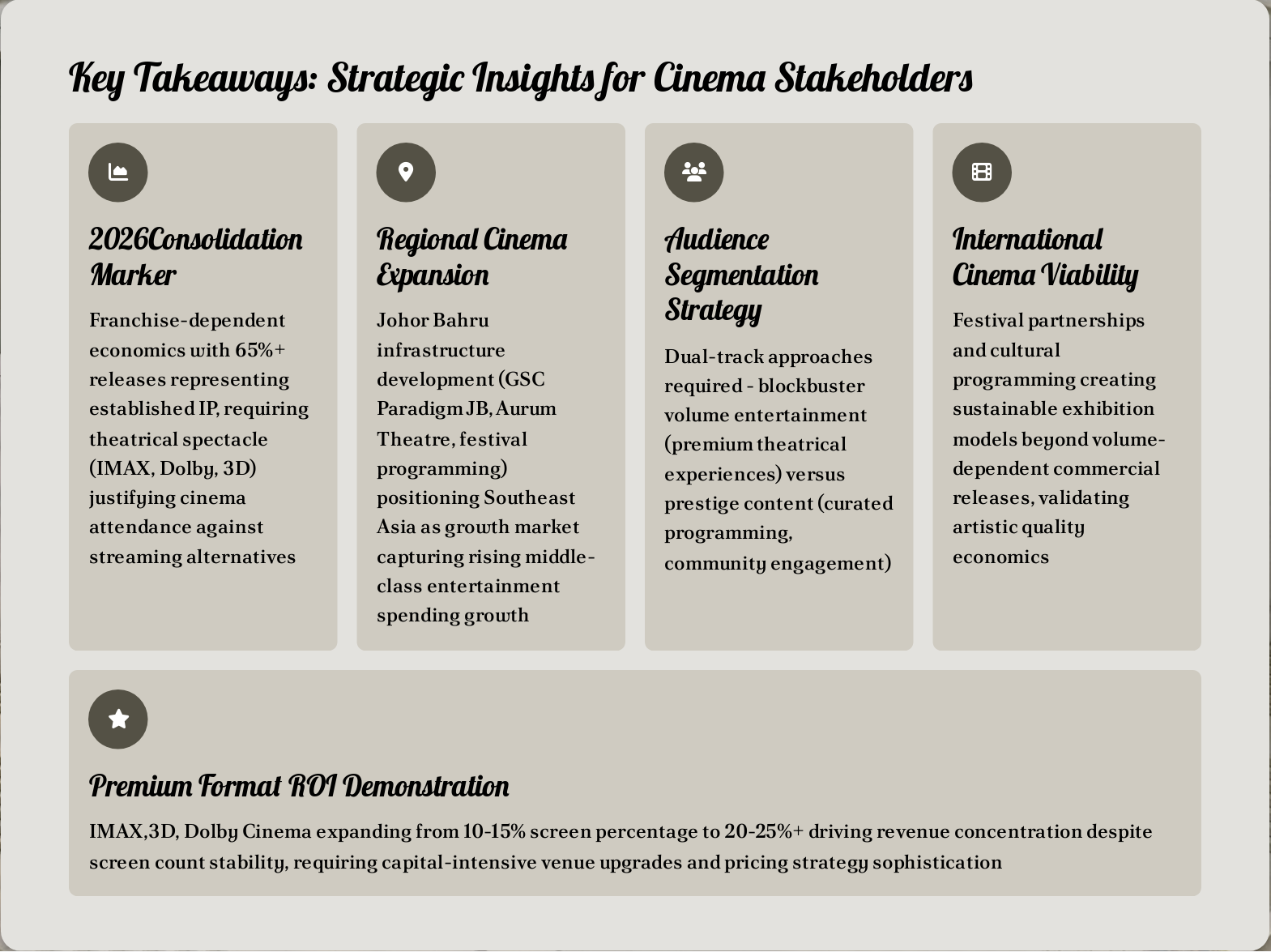
Slide 22: Key Takeaways: Strategic Insights for Cinema Stakeholders
- 2026Consolidation Marker: Franchise-dependent economics with 65%+ releases representing established IP, requiring theatrical spectacle (IMAX, Dolby, 3D) justifying cinema attendance against streaming alternatives
- Regional Cinema Expansion: Johor Bahru infrastructure development (GSC Paradigm JB, Aurum Theatre, festival programming) positioning Southeast Asia as growth market capturing rising middle-class entertainment spending growth
- Audience Segmentation Strategy: Dual-track approaches required - blockbuster volume entertainment (premium theatrical experiences) versus prestige content (curated programming, community engagement)
- International Cinema Viability: Festival partnerships and cultural programming creating sustainable exhibition models beyond volume-dependent commercial releases, validating artistic quality economics
- Premium Format ROI Demonstration: IMAX,3D, Dolby Cinema expanding from 10-15% screen percentage to 20-25%+ driving revenue concentration despite screen count stability, requiring capital-intensive venue upgrades and pricing strategy sophistication
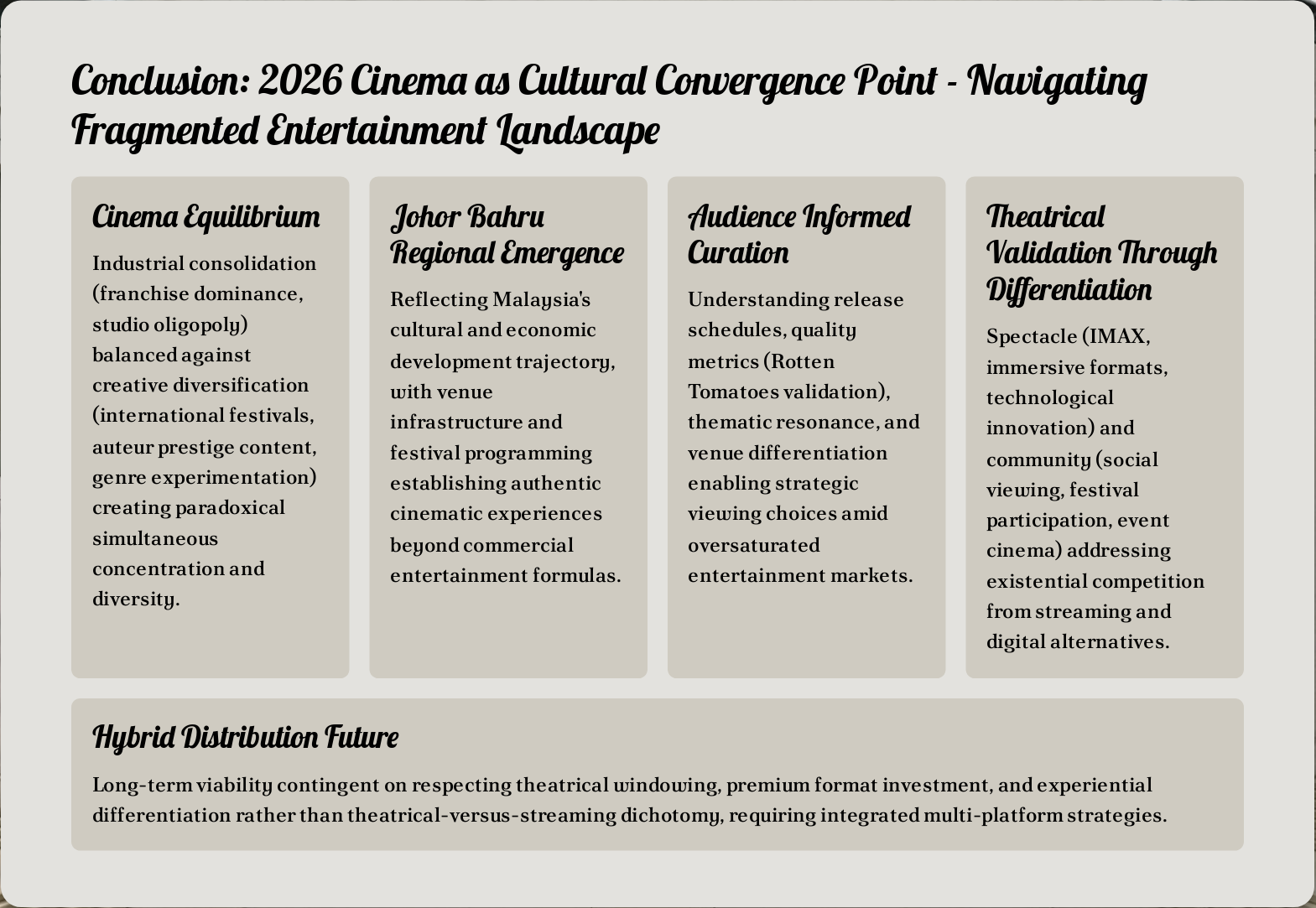
Slide 23: Conclusion: 2026 Cinema as Cultural Convergence Point - Navigating Fragmented Entertainment Landscape
- Cinema Equilibrium: Industrial consolidation (franchise dominance, studio oligopoly) balanced against creative diversification (international festivals, auteur prestige content, genre experimentation) creating paradoxical simultaneous concentration and diversity.
- Johor Bahru Regional Emergence: Reflecting Malaysia's cultural and economic development trajectory, with venue infrastructure and festival programming establishing authentic cinematic experiences beyond commercial entertainment formulas.
- Audience Informed Curation: Understanding release schedules, quality metrics (Rotten Tomatoes validation), thematic resonance, and venue differentiation enabling strategic viewing choices amid oversaturated entertainment markets.
- Theatrical Validation Through Differentiation: Spectacle (IMAX, immersive formats, technological innovation) and community (social viewing, festival participation, event cinema) addressing existential competition from streaming and digital alternatives.
- Hybrid Distribution Future: Long-term viability contingent on respecting theatrical windowing, premium format investment, and experiential differentiation rather than theatrical-versus-streaming dichotomy, requiring integrated multi-platform strategies.
Slide 24: Thank You for Exploring the Global Cinema Landscape
Thank You for Exploring the Global Cinema Landscape The Global Cinema Landscape 2026 - An In-Depth Exploration of Movies, Trends, and Regional Cinema Culture Strategic insights for informed moviegoers, industry professionals, and cinema stakeholders navigating the evolving theatrical and streaming e...