Presentation Summary
From Bauhaus to Minimalism: A Visual Journey Through Revolutionary Movements and Visionary Architects Breaking from ornate Victorian styles toward functional forms driven by industrialization and technological innovation. Unity of art, craft, and technology revolutionizing design through mass production and geometric simplicity. Honest expression through raw concrete, addressing postwar housing needs with monolithic structural forms. Less is more: clean lines, spatial clarity, and material honesty defining contemporary architectural excellence. Le Corbusier and Frank Lloyd Wright: pioneers res
Full Presentation Transcript
Slide 1: Evolution of Modern Architecture
From Bauhaus to Minimalism: A Visual Journey Through Revolutionary Movements and Visionary Architects
Slide 2: Contents
- Modern Architecture Foundation: Breaking from ornate Victorian styles toward functional forms driven by industrialization and technological innovation.
- Bauhaus Movement: Unity of art, craft, and technology revolutionizing design through mass production and geometric simplicity.
- Brutalism Era: Honest expression through raw concrete, addressing postwar housing needs with monolithic structural forms.
- Minimalism Philosophy: Less is more: clean lines, spatial clarity, and material honesty defining contemporary architectural excellence.
- Visionary Architects: Le Corbusier and Frank Lloyd Wright: pioneers reshaping modern architecture through revolutionary design philosophies.
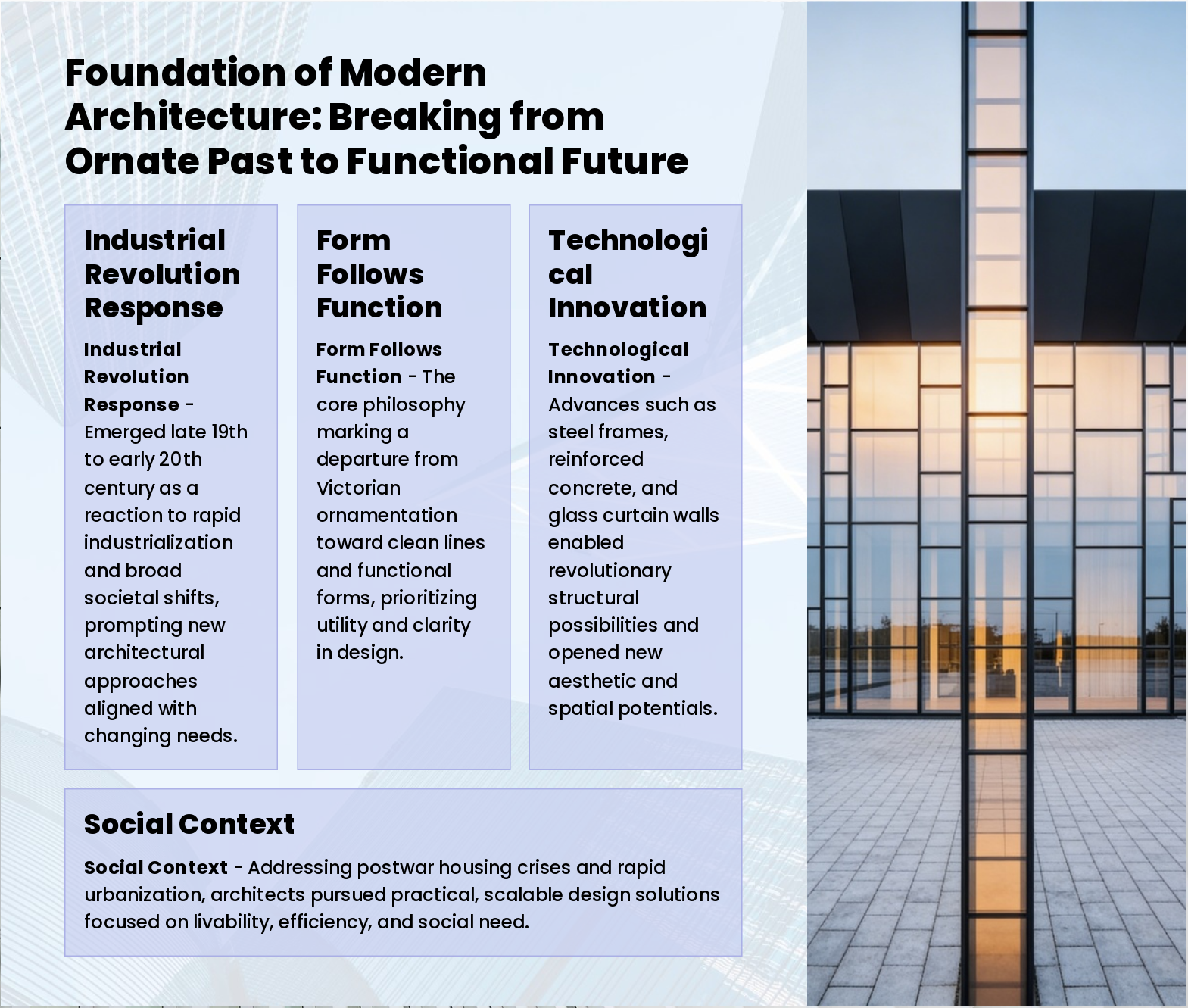
Slide 3: Foundation of Modern Architecture: Breaking from Ornate Past to Functional Future
- Industrial Revolution Response: Industrial Revolution Response - Emerged late 19th to early 20th century as a reaction to rapid industrialization and broad societal shifts, prompting new architectural approaches aligned with changing needs.
- Form Follows Function: Form Follows Function - The core philosophy marking a departure from Victorian ornamentation toward clean lines and functional forms, prioritizing utility and clarity in design.
- Technological Innovation: Technological Innovation - Advances such as steel frames, reinforced concrete, and glass curtain walls enabled revolutionary structural possibilities and opened new aesthetic and spatial potentials.
- Social Context: Social Context - Addressing postwar housing crises and rapid urbanization, architects pursued practical, scalable design solutions focused on livability, efficiency, and social need.
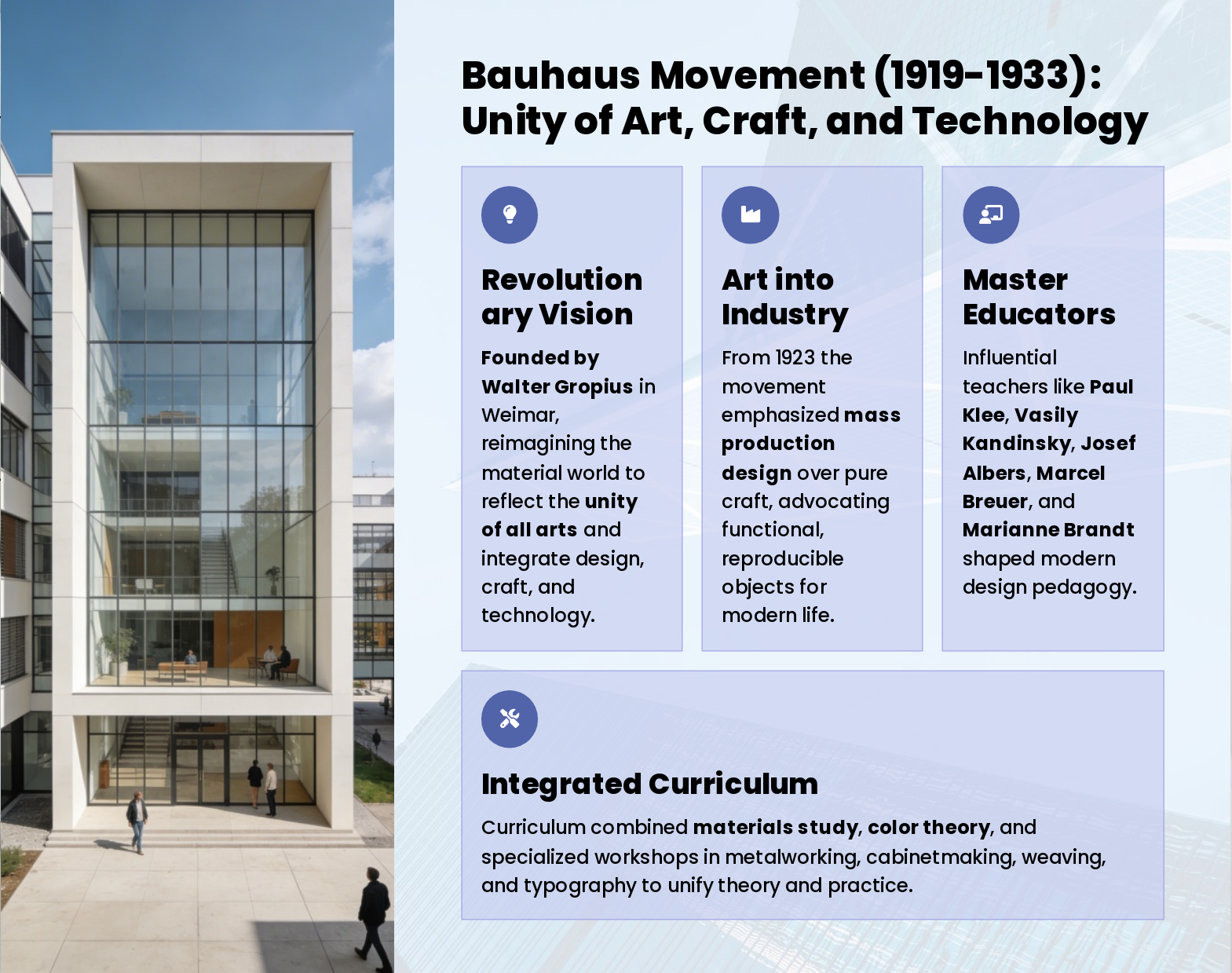
Slide 4: Bauhaus Movement (1919-1933): Unity of Art, Craft, and Technology
- Revolutionary Vision: Founded by Walter Gropius in Weimar, reimagining the material world to reflect the unity of all arts and integrate design, craft, and technology.
- Art into Industry: From 1923 the movement emphasized mass production design over pure craft, advocating functional, reproducible objects for modern life.
- Master Educators: Influential teachers like Paul Klee , Vasily Kandinsky , Josef Albers , Marcel Breuer , and Marianne Brandt shaped modern design pedagogy.
- Integrated Curriculum: Curriculum combined materials study , color theory , and specialized workshops in metalworking, cabinetmaking, weaving, and typography to unify theory and practice.
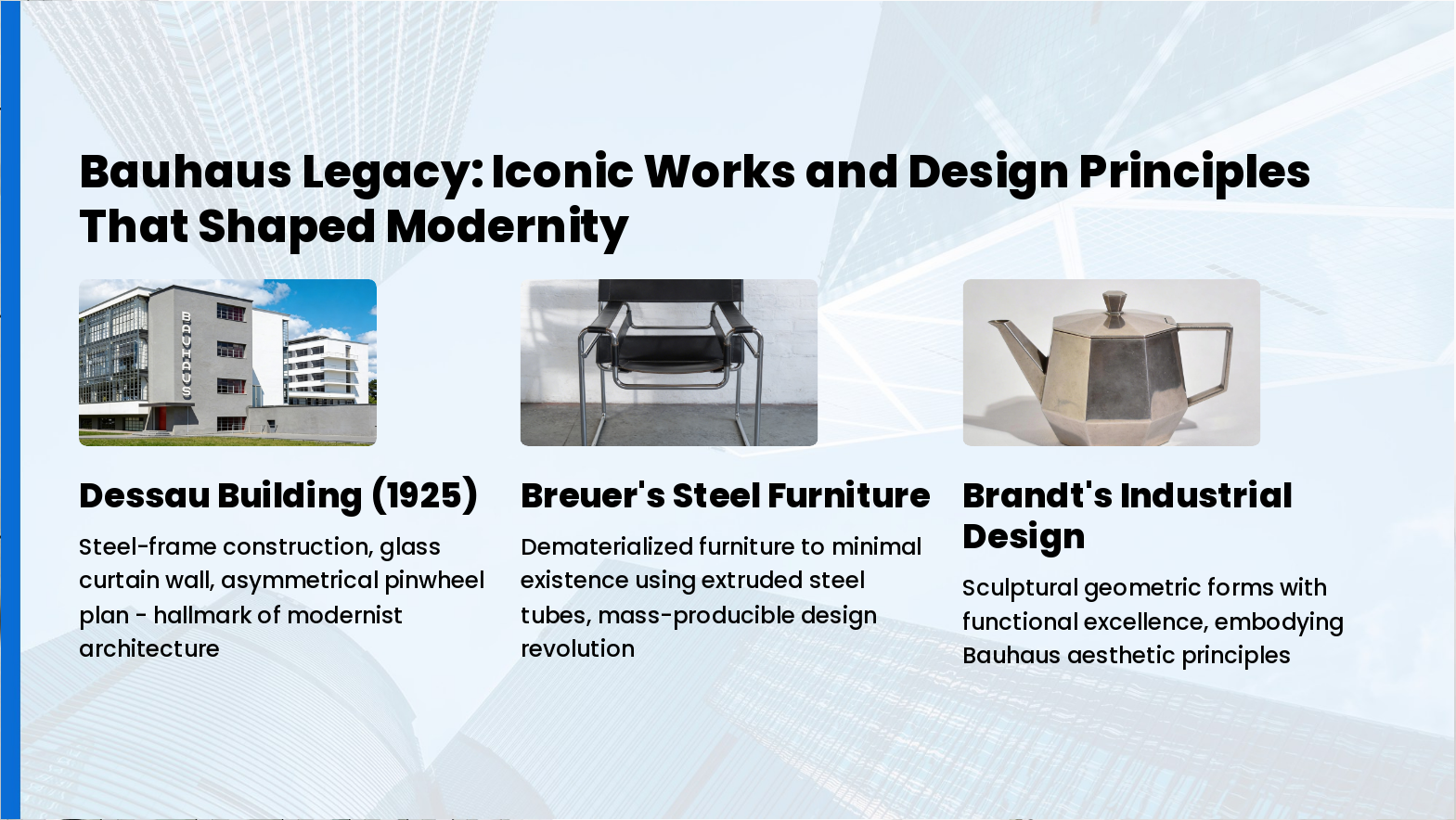
Slide 5: Bauhaus Legacy: Iconic Works and Design Principles That Shaped Modernity
- Dessau Building (1925): Steel-frame construction, glass curtain wall, asymmetrical pinwheel plan - hallmark of modernist architecture
- Breuer's Steel Furniture: Dematerialized furniture to minimal existence using extruded steel tubes, mass-producible design revolution
- Brandt's Industrial Design: Sculptural geometric forms with functional excellence, embodying Bauhaus aesthetic principles
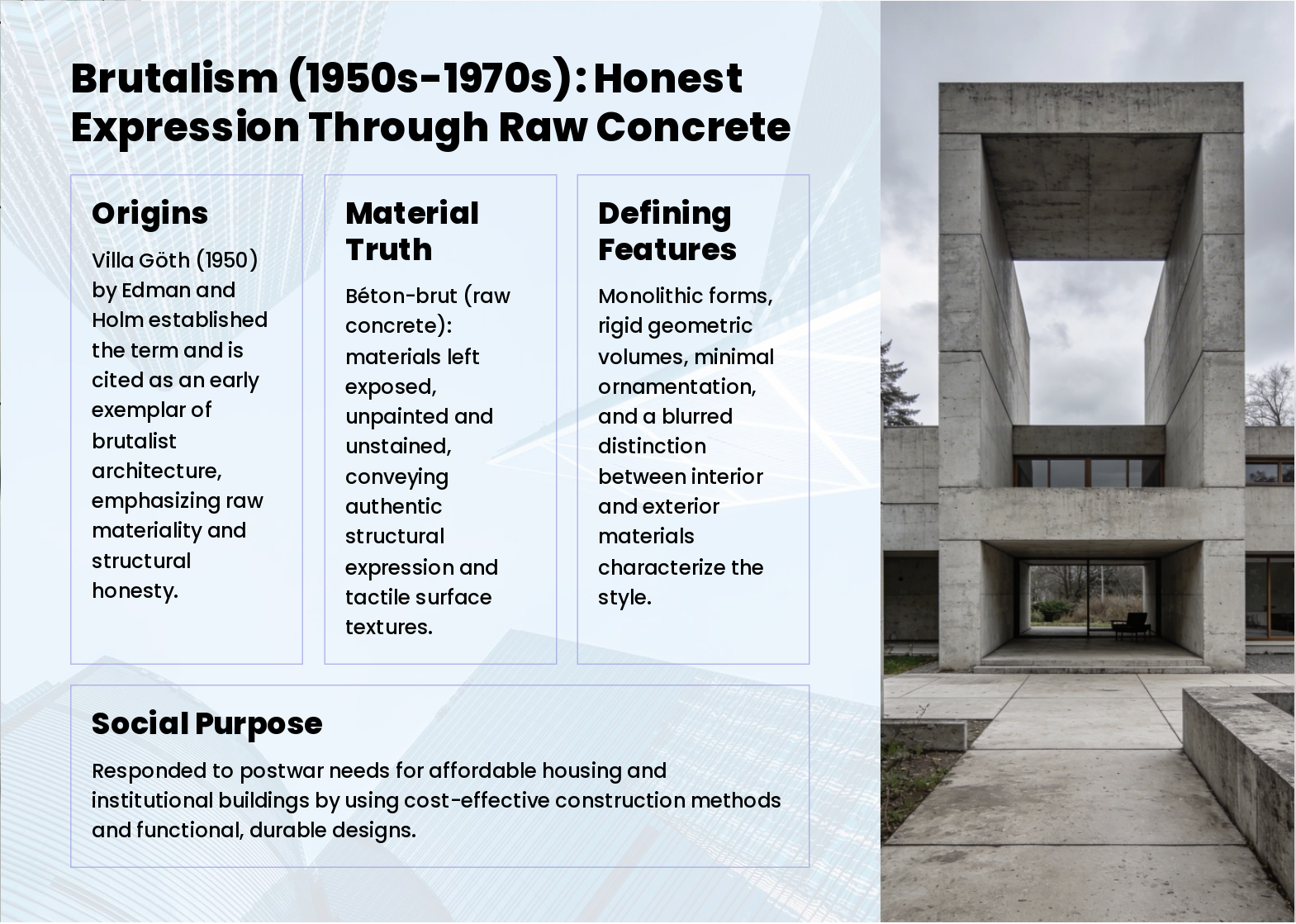
Slide 6: Brutalism (1950s-1970s): Honest Expression Through Raw Concrete
- Origins: Villa Göth (1950) by Edman and Holm established the term and is cited as an early exemplar of brutalist architecture, emphasizing raw materiality and structural honesty.
- Material Truth: Béton-brut (raw concrete): materials left exposed, unpainted and unstained, conveying authentic structural expression and tactile surface textures.
- Defining Features: Monolithic forms, rigid geometric volumes, minimal ornamentation, and a blurred distinction between interior and exterior materials characterize the style.
- Social Purpose: Responded to postwar needs for affordable housing and institutional buildings by using cost-effective construction methods and functional, durable designs.
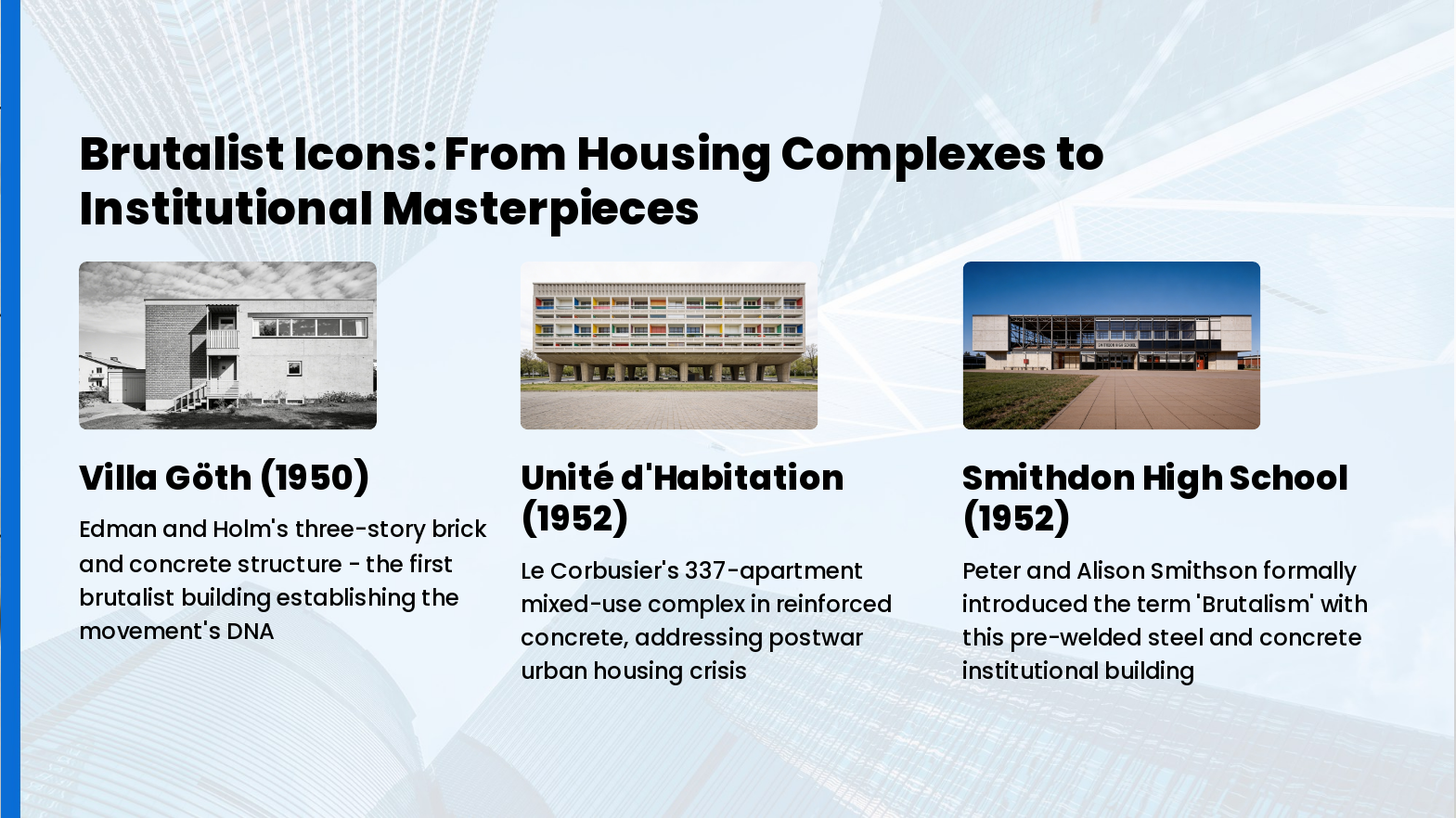
Slide 7: Brutalist Icons: From Housing Complexes to Institutional Masterpieces
- Villa Göth (1950): Edman and Holm's three-story brick and concrete structure - the first brutalist building establishing the movement's DNA
- Unité d'Habitation (1952): Le Corbusier's 337-apartment mixed-use complex in reinforced concrete, addressing postwar urban housing crisis
- Smithdon High School (1952): Peter and Alison Smithson formally introduced the term 'Brutalism' with this pre-welded steel and concrete institutional building
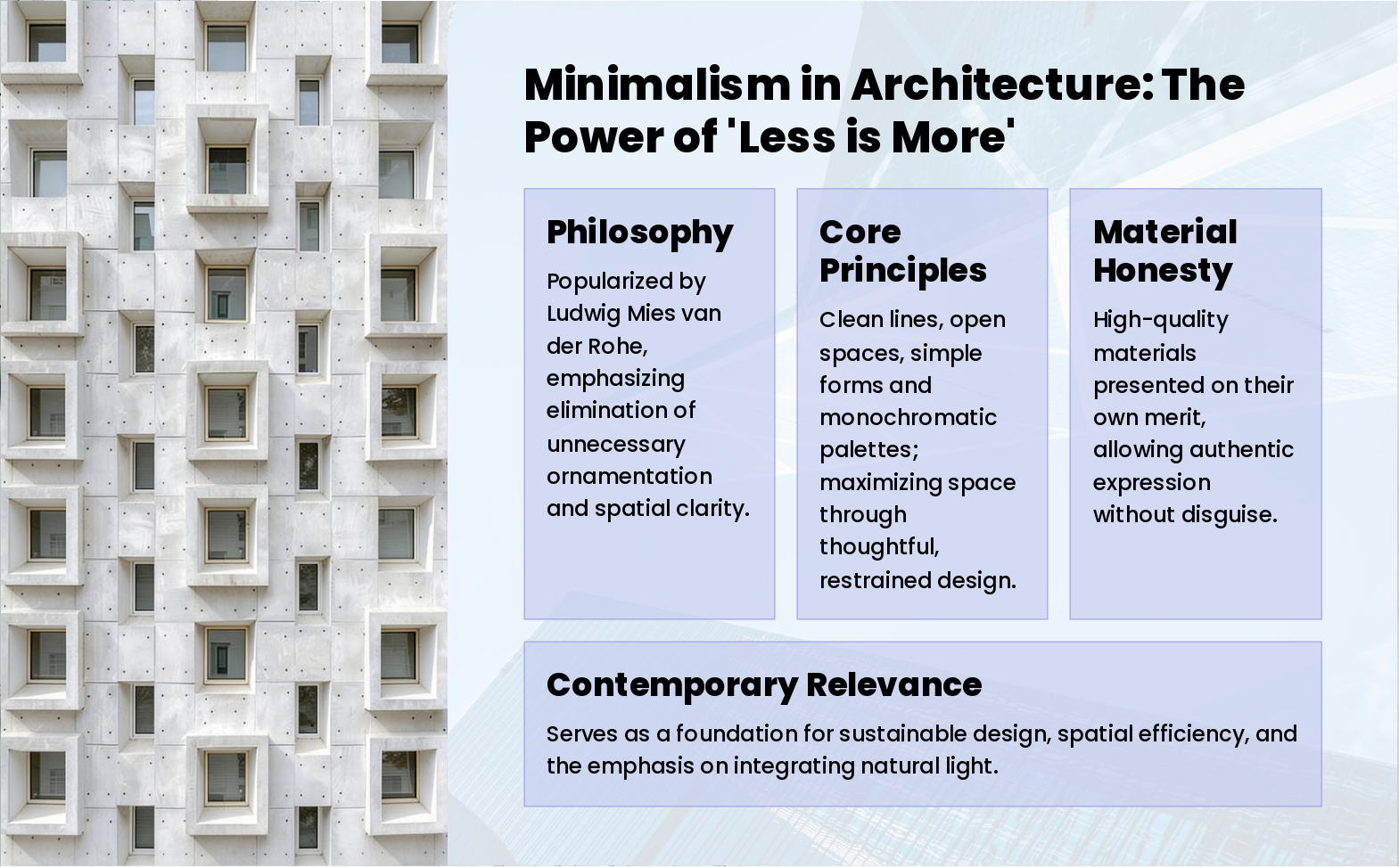
Slide 8: Minimalism in Architecture: The Power of 'Less is More'
- Philosophy: Popularized by Ludwig Mies van der Rohe, emphasizing elimination of unnecessary ornamentation and spatial clarity.
- Core Principles: Clean lines, open spaces, simple forms and monochromatic palettes; maximizing space through thoughtful, restrained design.
- Material Honesty: High-quality materials presented on their own merit, allowing authentic expression without disguise.
- Contemporary Relevance: Serves as a foundation for sustainable design, spatial efficiency, and the emphasis on integrating natural light.
Slide 9: Le Corbusier (1887-1965): Pioneer of Modern Architecture and Urban Planning
- Pilotis: Reinforced concrete pillars elevating buildings
- Free Façade: Non-load bearing exterior walls enabling design freedom
- Open Floor Plan: Flexible interior spaces without structural constraints
- Horizontal Windows: Ribbon windows providing panoramic light
- Roof Gardens: Compensating land occupation with green spaces
Swiss-French architect revolutionized 20th century design, authoring 50+ influential books including 'Vers une architecture'. Co-founded Purism movement and marked birth of Brutalism and sculptural architecture. Multiple works inscribed as UNESCO World Heritage Sites.
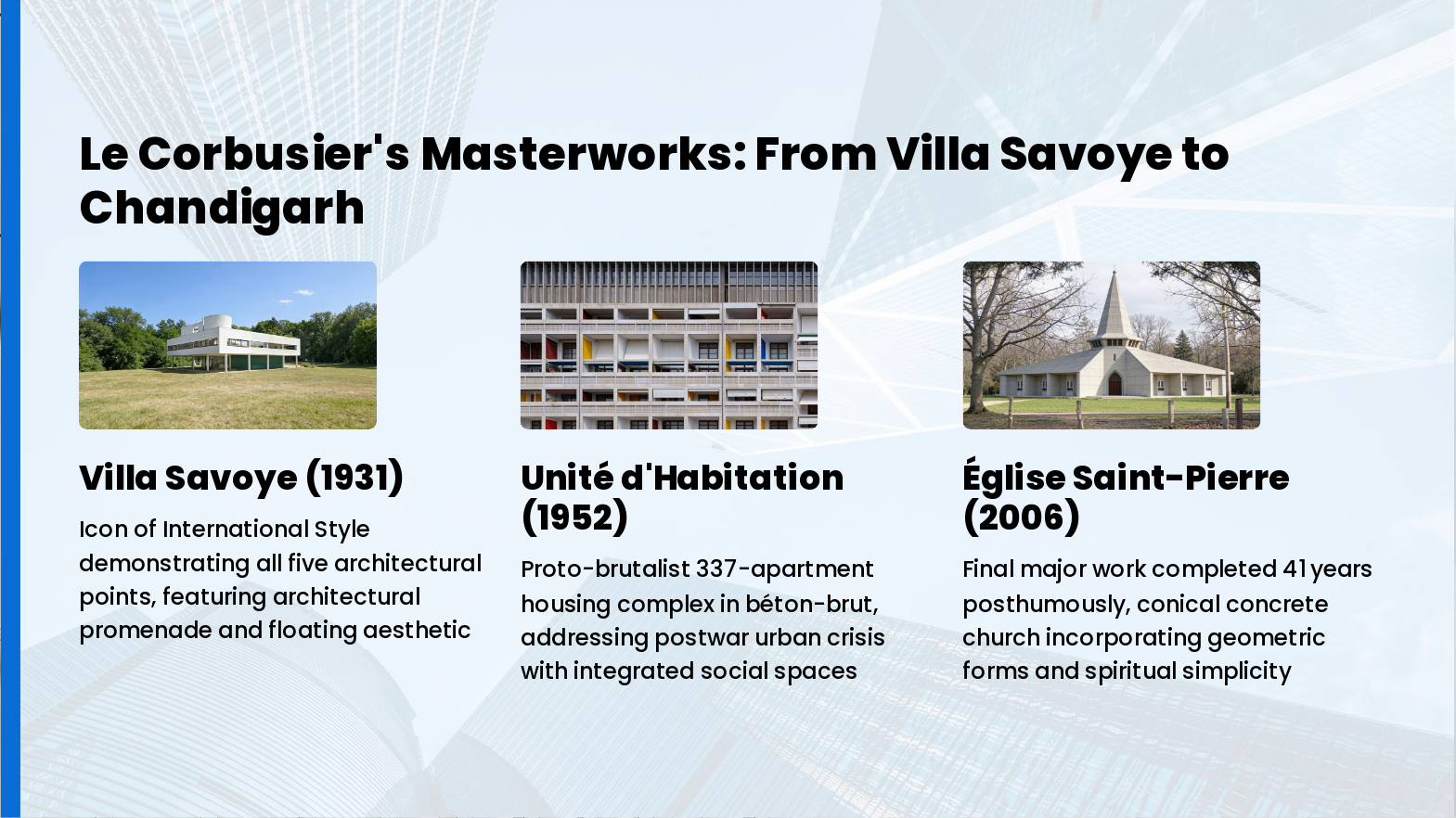
Slide 10: Le Corbusier's Masterworks: From Villa Savoye to Chandigarh
- Villa Savoye (1931): Icon of International Style demonstrating all five architectural points, featuring architectural promenade and floating aesthetic
- Unité d'Habitation (1952): Proto-brutalist 337-apartment housing complex in béton-brut, addressing postwar urban crisis with integrated social spaces
- Église Saint-Pierre (2006): Final major work completed 41 years posthumously, conical concrete church incorporating geometric forms and spiritual simplicity
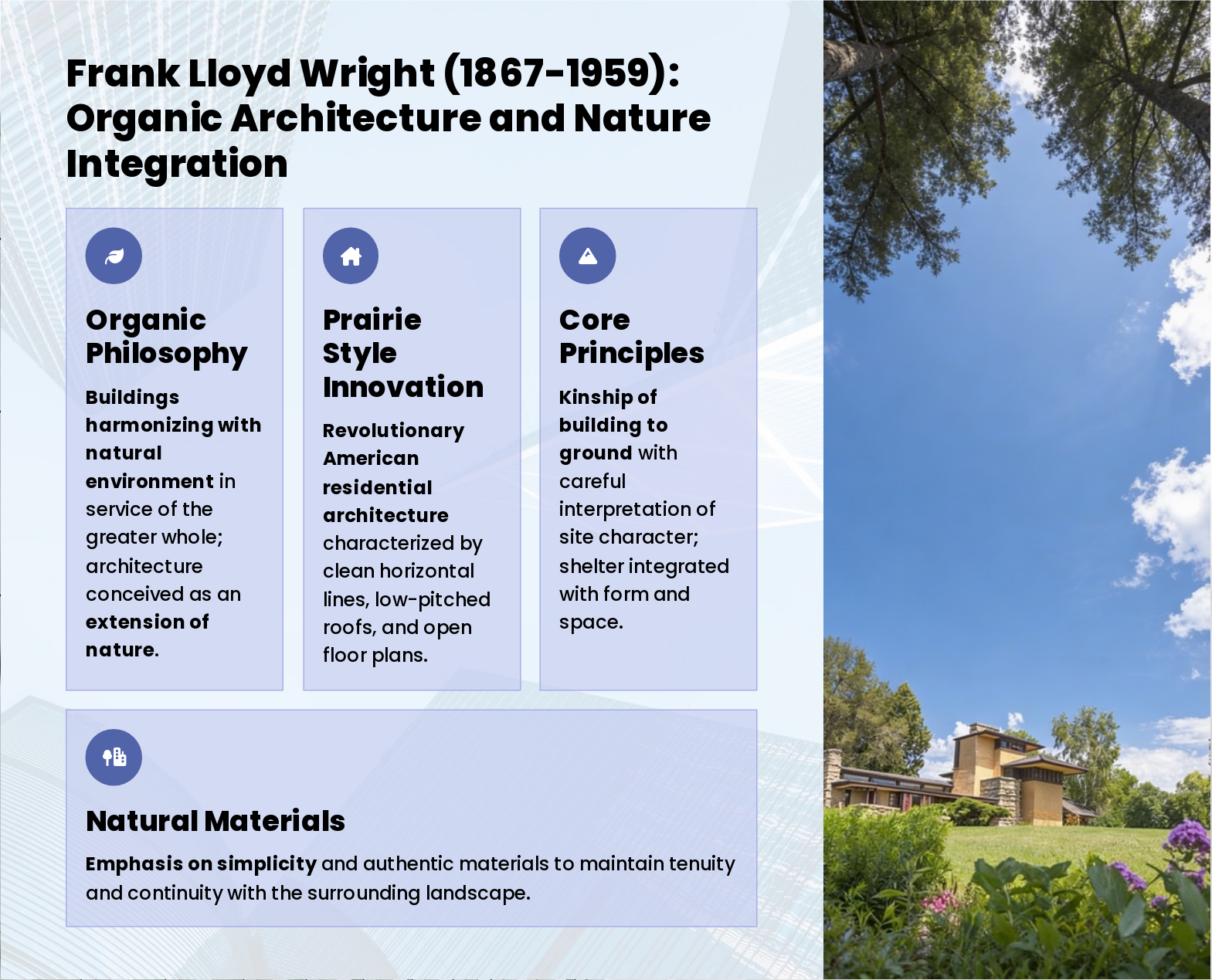
Slide 11: Frank Lloyd Wright (1867-1959): Organic Architecture and Nature Integration
- Organic Philosophy: Buildings harmonizing with natural environment in service of the greater whole; architecture conceived as an extension of nature .
- Prairie Style Innovation: Revolutionary American residential architecture characterized by clean horizontal lines, low-pitched roofs, and open floor plans.
- Core Principles: Kinship of building to ground with careful interpretation of site character; shelter integrated with form and space.
- Natural Materials: Emphasis on simplicity and authentic materials to maintain tenuity and continuity with the surrounding landscape.
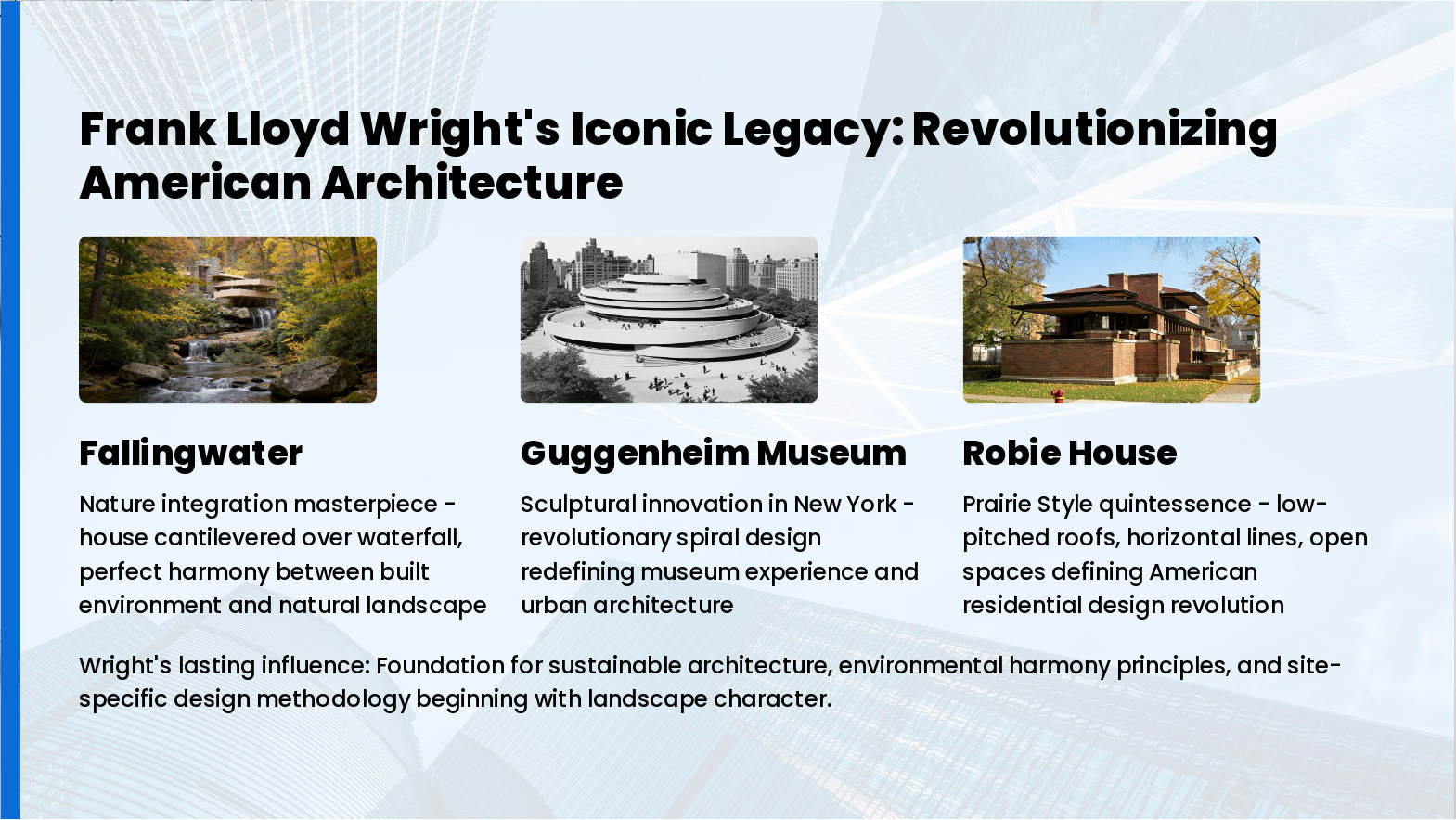
Slide 12: Frank Lloyd Wright's Iconic Legacy: Revolutionizing American Architecture
- Fallingwater: Nature integration masterpiece - house cantilevered over waterfall, perfect harmony between built environment and natural landscape
- Guggenheim Museum: Sculptural innovation in New York - revolutionary spiral design redefining museum experience and urban architecture
- Robie House: Prairie Style quintessence - low-pitched roofs, horizontal lines, open spaces defining American residential design revolution
Wright's lasting influence: Foundation for sustainable architecture, environmental harmony principles, and site-specific design methodology beginning with landscape character.
Slide 13: Thank You
Thank You Evolution of Modern Architecture - A Journey Through Design Innovation