Presentation Summary
Delve into the ancient traditions and symbolic meanings behind Easter eggs, exploring their evolution from pre-Christian roots to modern celebrations, including the upcoming Easter Eggstravaganza 2026.
Full Presentation Transcript
Slide 1: Easter Eggs: A Journey Through History, Culture, and Celebration
Exploring Ancient Traditions, Symbolic Meanings, and Modern Easter Eggstravaganza Events 2026
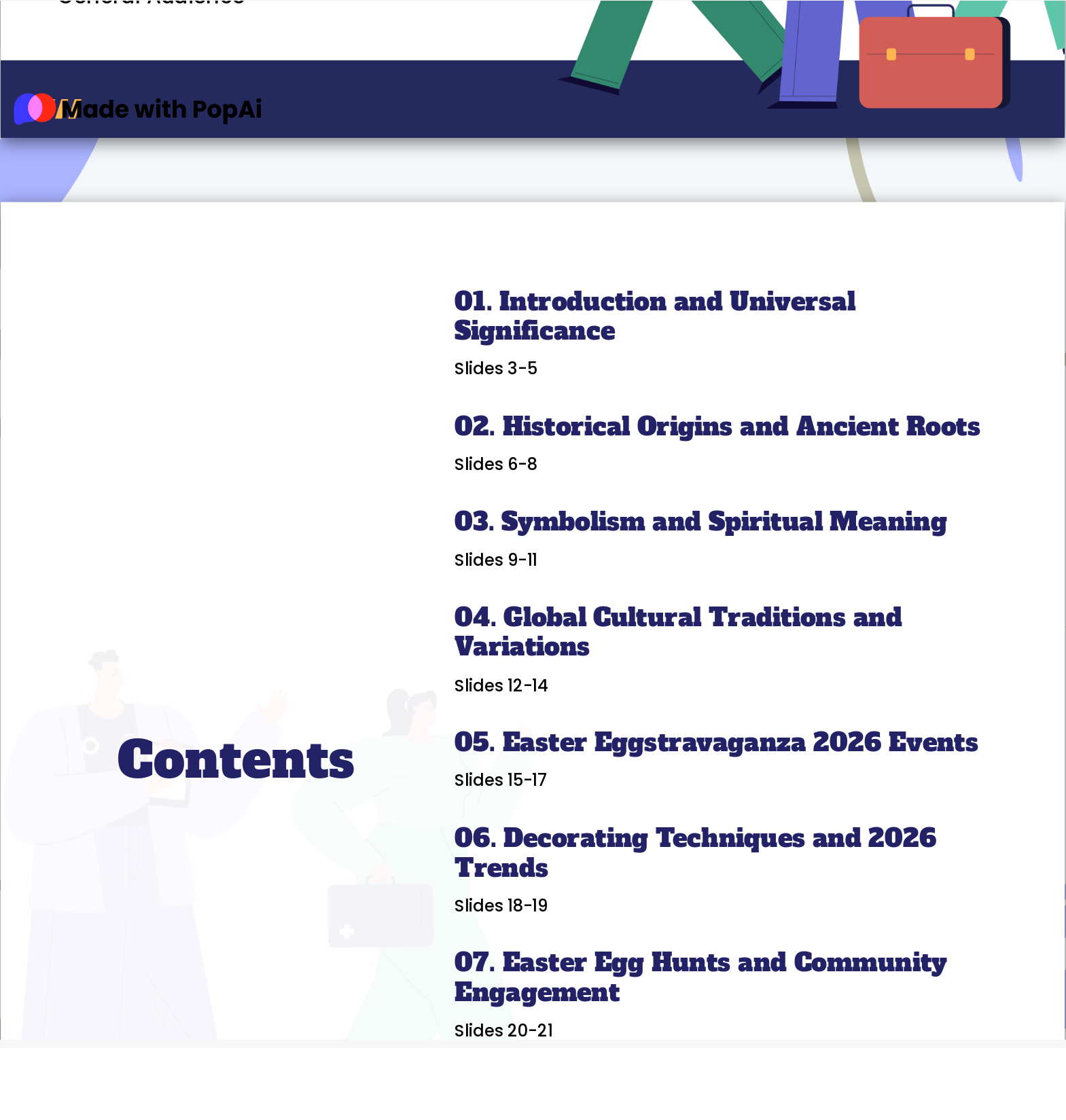
Slide 2: Contents
- Introduction and Universal Significance: Slides 3-5
- Historical Origins and Ancient Roots: Slides 6-8
- Symbolism and Spiritual Meaning: Slides 9-11
- Global Cultural Traditions and Variations: Slides 12-14
- Easter Eggstravaganza 2026 Events: Slides 15-17
- Decorating Techniques and 2026 Trends: Slides 18-19
- Easter Egg Hunts and Community Engagement: Slides 20-21
- Modern Commercial Evolution: Slides 22-23
- Conclusion and Key Takeaways: Slide 24
Slide 3: Introduction: Easter Eggs as Universal Symbol Across Millennia
- Ancient Origins: Easter eggs represent one of humanity's oldest and most widespread traditions spanning multiple civilizations. The egg serves as a universal symbol appearing in ancient Egyptian, Persian, Phoenician, and Hindu cultures.
- Religious and Secular Blend: Modern Easter celebrations blend pre-Christian pagan spring festivals with Christian resurrection symbolism, creating a unique fusion of multiple belief systems.
- Global Diversity: Easter egg customs exist in diverse forms across Europe, Americas, Australia, and Asia with regional variations that reflect local traditions and cultural identities.
- Cultural Continuity: The tradition demonstrates remarkable cultural continuity from ancient times through medieval period to contemporary practices, showing the resilience of symbolic meaning.
- Multidimensional Significance: Understanding Easter eggs requires examining religious, secular, and commercial dimensions simultaneously to appreciate its full cultural importance.
- Universal Symbolism: The egg transcends geographical and temporal boundaries, serving as one of humanity's most enduring and universally recognized symbols of renewal and hope.
Slide 4: Overview: The Dual Nature of Easter Egg Traditions
- Religious and Secular Duality: Easter eggs function simultaneously as religious symbols representing Christian resurrection and secular celebrations of spring renewal
- Evolution from Prohibition to Celebration: The practice evolved from forbidden Lenten food to decorated celebratory items marking the end of fasting periods
- Economic Powerhouse: Modern Easter has become the second best-selling candy holiday in America after Halloween generating billions in economic impact
- Jelly Bean Production: Over 16 billion jelly beans are manufactured annually in the United States specifically for Easter celebrations alone
- Record-Breaking Creation: The largest Easter egg ever created measured over 25 feet high and weighed over 8,000 pounds constructed from chocolate and marshmallow
- Cultural Synthesis: Contemporary Easter traditions combine ancient symbolism with modern commercialization creating multi-layered cultural phenomenon
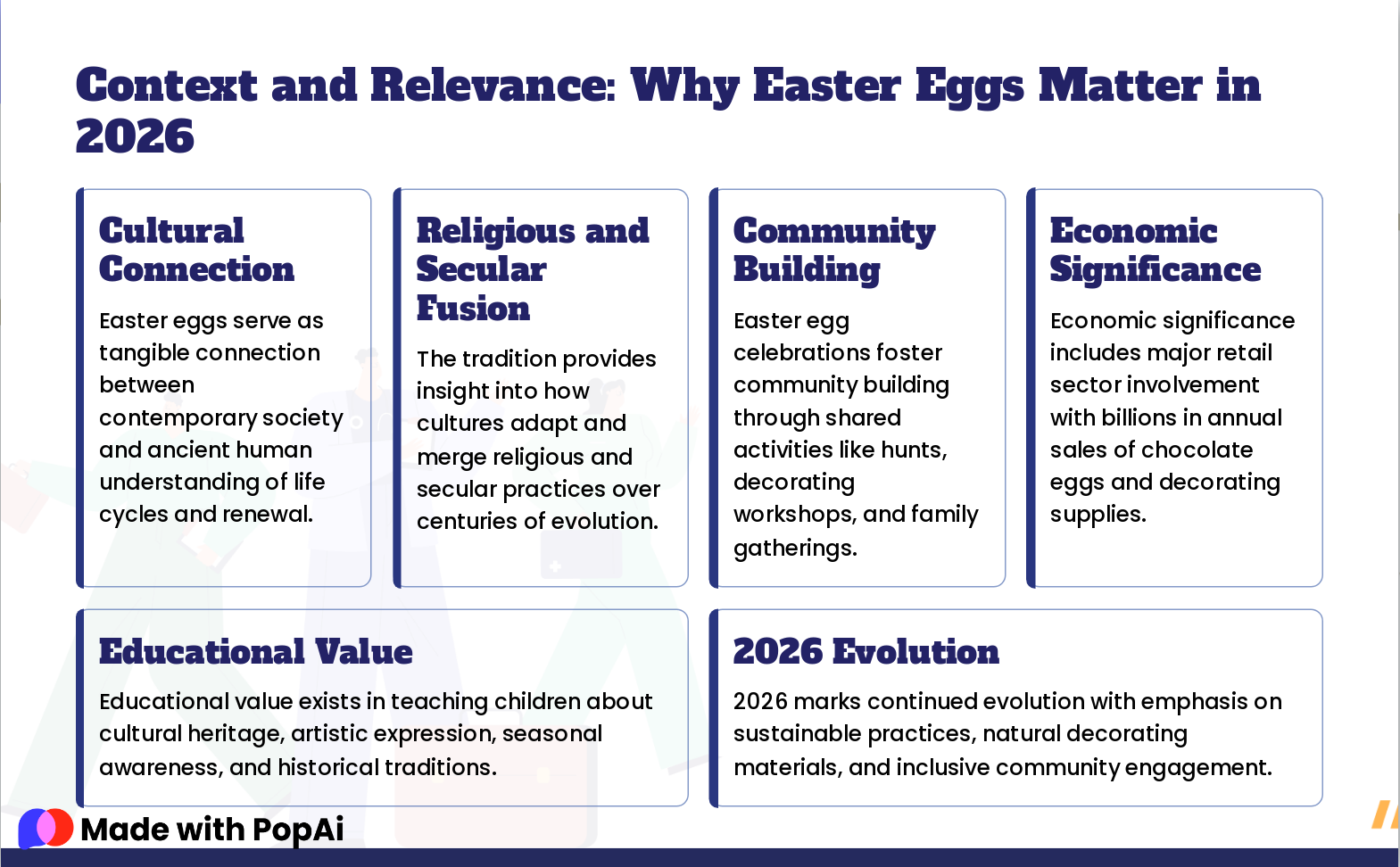
Slide 5: Context and Relevance: Why Easter Eggs Matter in 2026
- Cultural Connection: Easter eggs serve as tangible connection between contemporary society and ancient human understanding of life cycles and renewal.
- Religious and Secular Fusion: The tradition provides insight into how cultures adapt and merge religious and secular practices over centuries of evolution.
- Community Building: Easter egg celebrations foster community building through shared activities like hunts, decorating workshops, and family gatherings.
- Economic Significance: Economic significance includes major retail sector involvement with billions in annual sales of chocolate eggs and decorating supplies.
- Educational Value: Educational value exists in teaching children about cultural heritage, artistic expression, seasonal awareness, and historical traditions.
- 2026 Evolution: 2026 marks continued evolution with emphasis on sustainable practices, natural decorating materials, and inclusive community engagement.
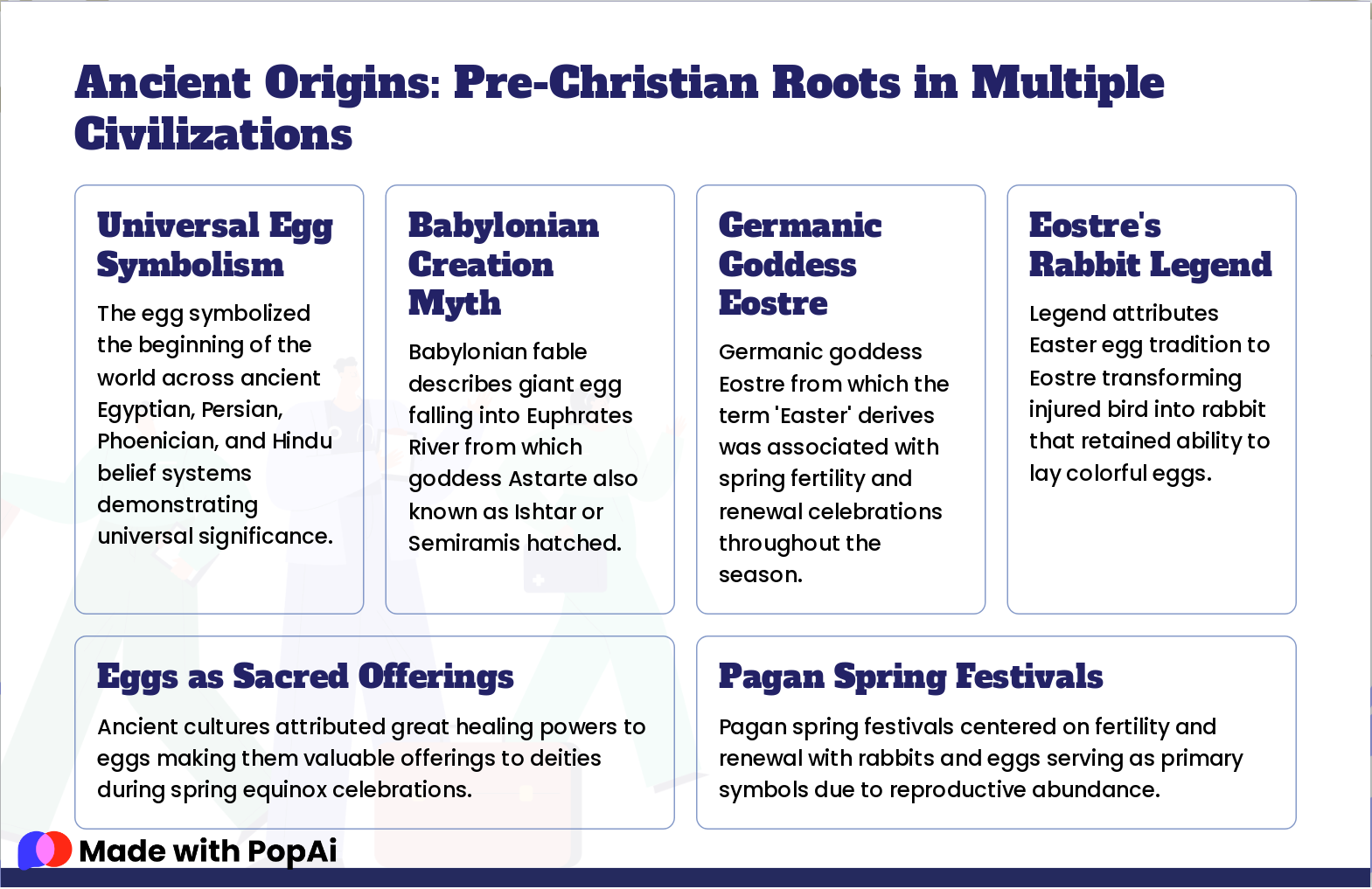
Slide 6: Ancient Origins: Pre-Christian Roots in Multiple Civilizations
- Universal Egg Symbolism: The egg symbolized the beginning of the world across ancient Egyptian, Persian, Phoenician, and Hindu belief systems demonstrating universal significance.
- Babylonian Creation Myth: Babylonian fable describes giant egg falling into Euphrates River from which goddess Astarte also known as Ishtar or Semiramis hatched.
- Germanic Goddess Eostre: Germanic goddess Eostre from which the term 'Easter' derives was associated with spring fertility and renewal celebrations throughout the season.
- Eostre's Rabbit Legend: Legend attributes Easter egg tradition to Eostre transforming injured bird into rabbit that retained ability to lay colorful eggs.
- Eggs as Sacred Offerings: Ancient cultures attributed great healing powers to eggs making them valuable offerings to deities during spring equinox celebrations.
- Pagan Spring Festivals: Pagan spring festivals centered on fertility and renewal with rabbits and eggs serving as primary symbols due to reproductive abundance.
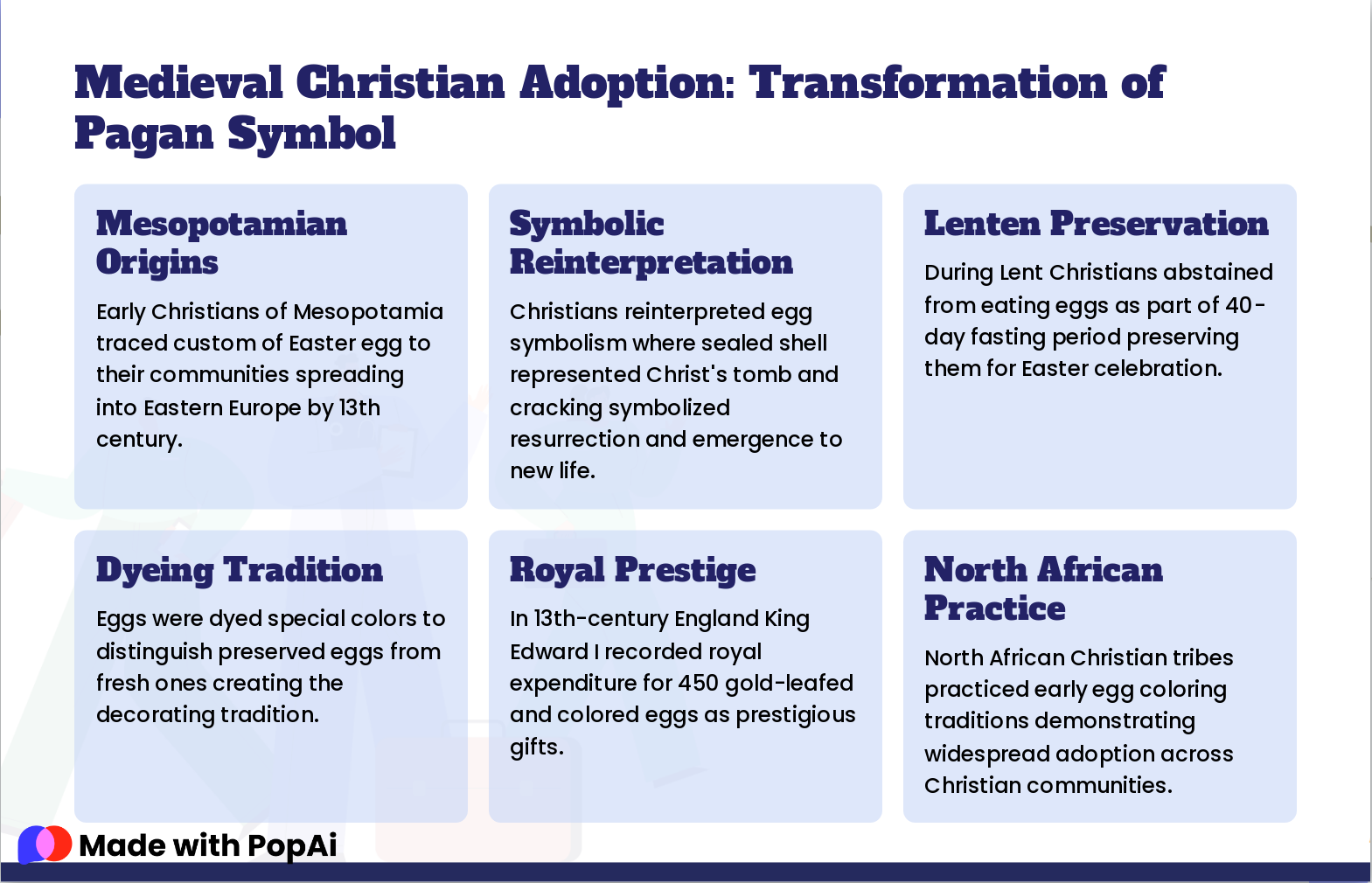
Slide 7: Medieval Christian Adoption: Transformation of Pagan Symbol
- Mesopotamian Origins: Early Christians of Mesopotamia traced custom of Easter egg to their communities spreading into Eastern Europe by 13th century.
- Symbolic Reinterpretation: Christians reinterpreted egg symbolism where sealed shell represented Christ's tomb and cracking symbolized resurrection and emergence to new life.
- Lenten Preservation: During Lent Christians abstained from eating eggs as part of 40-day fasting period preserving them for Easter celebration.
- Dyeing Tradition: Eggs were dyed special colors to distinguish preserved eggs from fresh ones creating the decorating tradition.
- Royal Prestige: In 13th-century England King Edward I recorded royal expenditure for 450 gold-leafed and colored eggs as prestigious gifts.
- North African Practice: North African Christian tribes practiced early egg coloring traditions demonstrating widespread adoption across Christian communities.
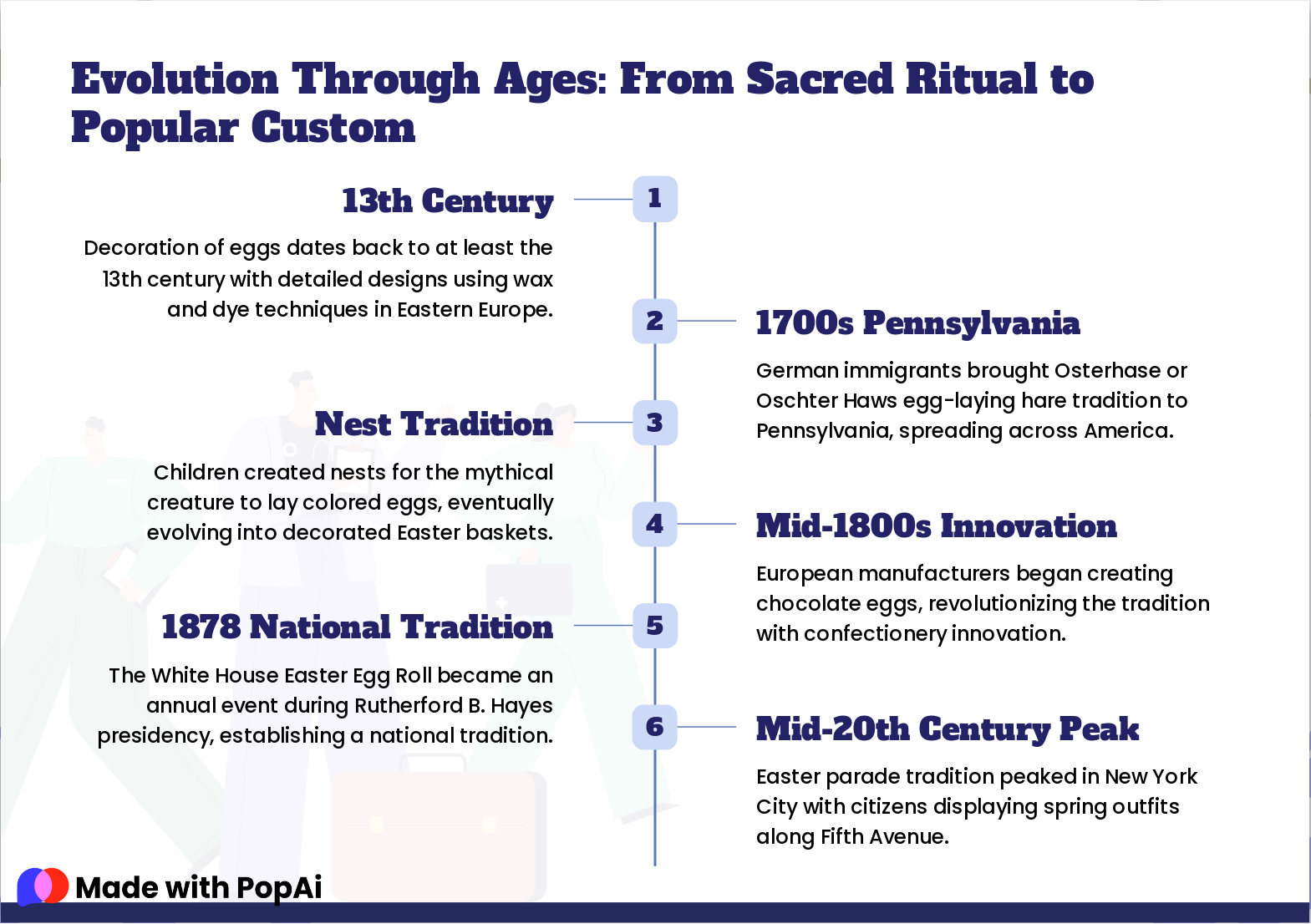
Slide 8: Evolution Through Ages: From Sacred Ritual to Popular Custom
- 13th Century: Decoration of eggs dates back to at least the 13th century with detailed designs using wax and dye techniques in Eastern Europe.
- 1700s Pennsylvania: German immigrants brought Osterhase or Oschter Haws egg-laying hare tradition to Pennsylvania, spreading across America.
- Nest Tradition: Children created nests for the mythical creature to lay colored eggs, eventually evolving into decorated Easter baskets.
- Mid-1800s Innovation: European manufacturers began creating chocolate eggs, revolutionizing the tradition with confectionery innovation.
- 1878 National Tradition: The White House Easter Egg Roll became an annual event during Rutherford B. Hayes presidency, establishing a national tradition.
- Mid-20th Century Peak: Easter parade tradition peaked in New York City with citizens displaying spring outfits along Fifth Avenue.
Slide 9: Christian Symbolism: The Resurrection Connection
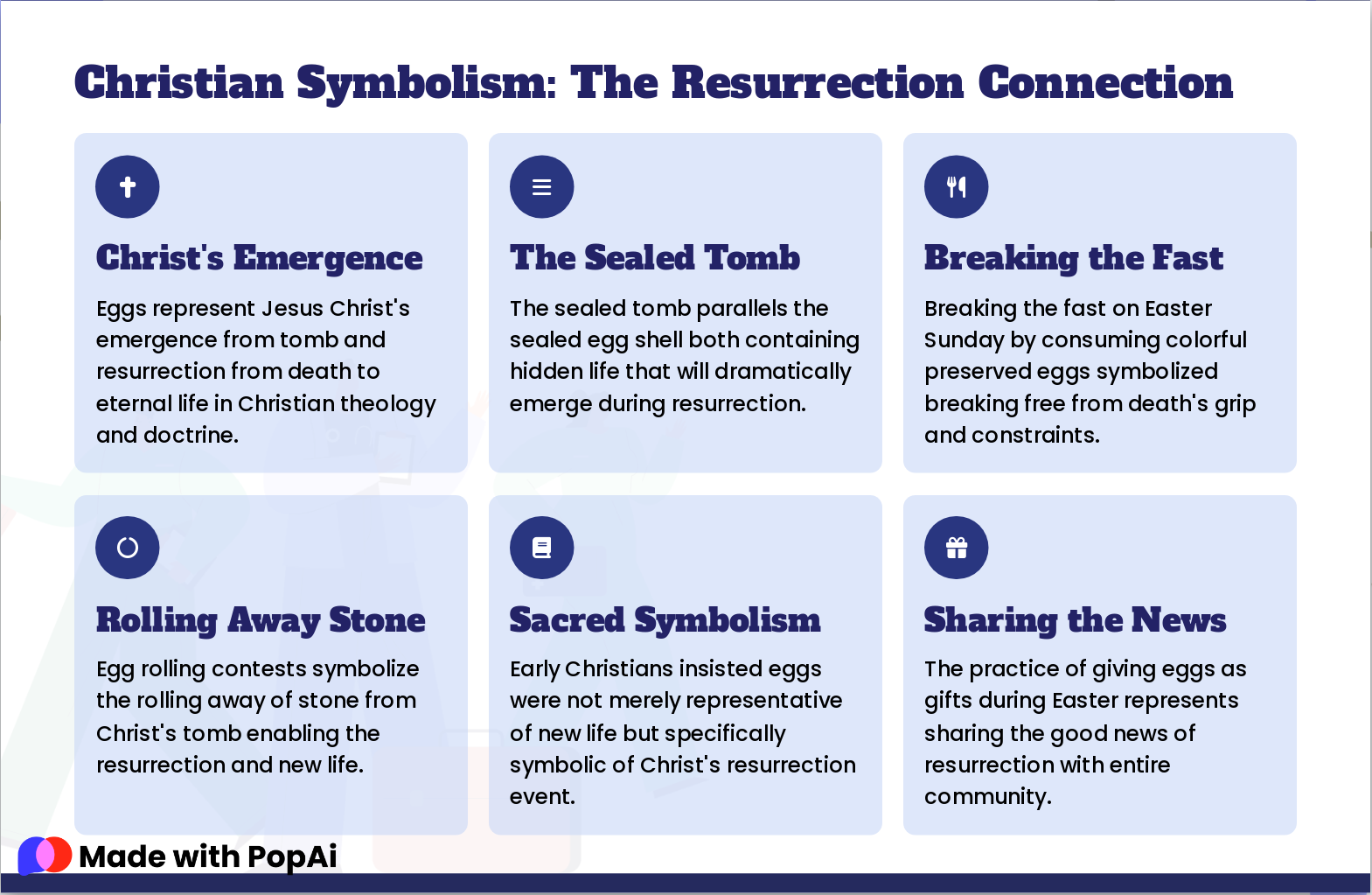
- Christ's Emergence: Eggs represent Jesus Christ's emergence from tomb and resurrection from death to eternal life in Christian theology and doctrine.
- The Sealed Tomb: The sealed tomb parallels the sealed egg shell both containing hidden life that will dramatically emerge during resurrection.
- Breaking the Fast: Breaking the fast on Easter Sunday by consuming colorful preserved eggs symbolized breaking free from death's grip and constraints.
- Rolling Away Stone: Egg rolling contests symbolize the rolling away of stone from Christ's tomb enabling the resurrection and new life.
- Sacred Symbolism: Early Christians insisted eggs were not merely representative of new life but specifically symbolic of Christ's resurrection event.
- Sharing the News: The practice of giving eggs as gifts during Easter represents sharing the good news of resurrection with entire community.
Slide 10: Pagan and Secular Meanings: Fertility and Renewal Symbolism
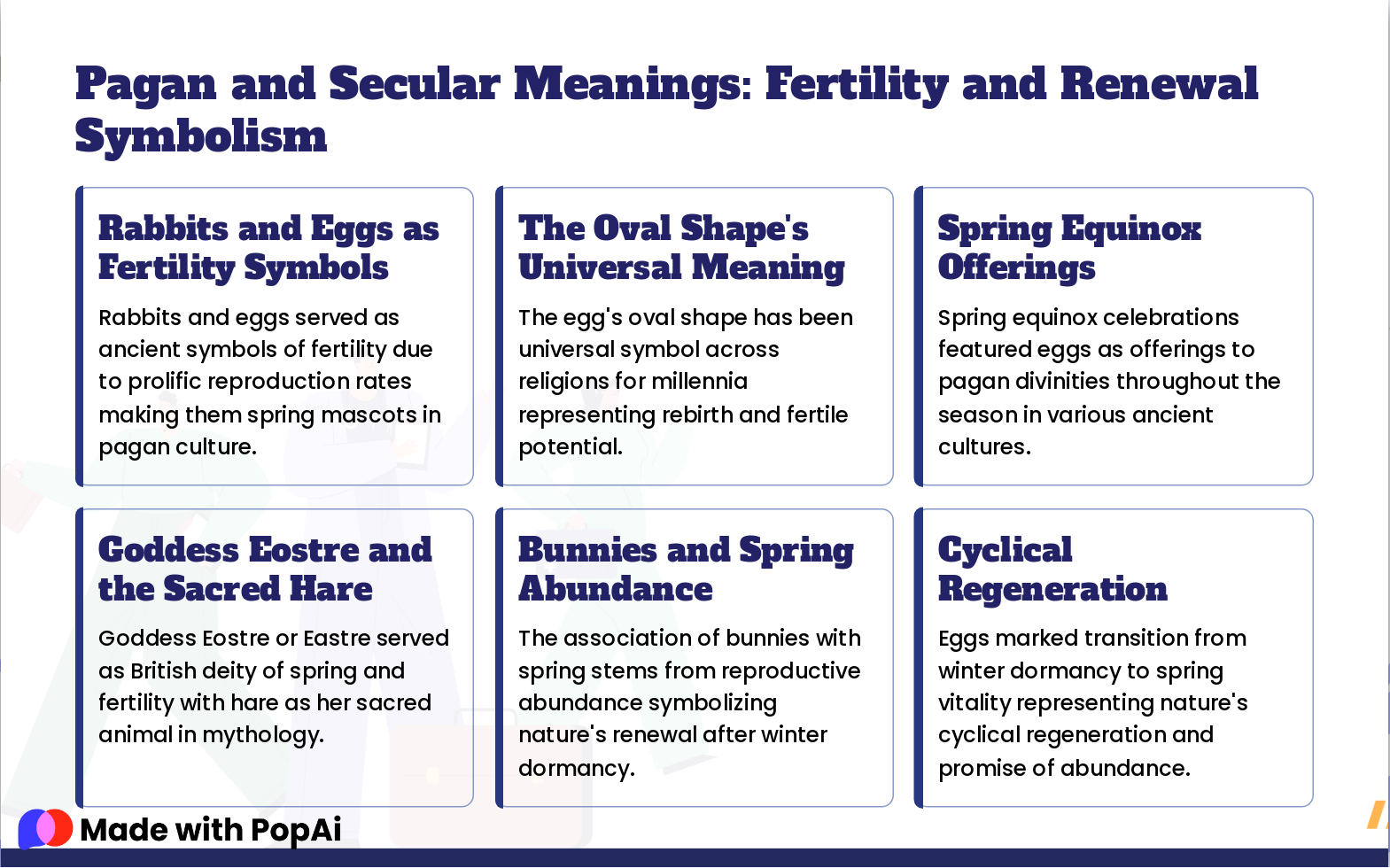
- Rabbits and Eggs as Fertility Symbols: Rabbits and eggs served as ancient symbols of fertility due to prolific reproduction rates making them spring mascots in pagan culture.
- The Oval Shape's Universal Meaning: The egg's oval shape has been universal symbol across religions for millennia representing rebirth and fertile potential.
- Spring Equinox Offerings: Spring equinox celebrations featured eggs as offerings to pagan divinities throughout the season in various ancient cultures.
- Goddess Eostre and the Sacred Hare: Goddess Eostre or Eastre served as British deity of spring and fertility with hare as her sacred animal in mythology.
- Bunnies and Spring Abundance: The association of bunnies with spring stems from reproductive abundance symbolizing nature's renewal after winter dormancy.
- Cyclical Regeneration: Eggs marked transition from winter dormancy to spring vitality representing nature's cyclical regeneration and promise of abundance.
Slide 11: Dual Symbolism: Religious and Secular Coexistence
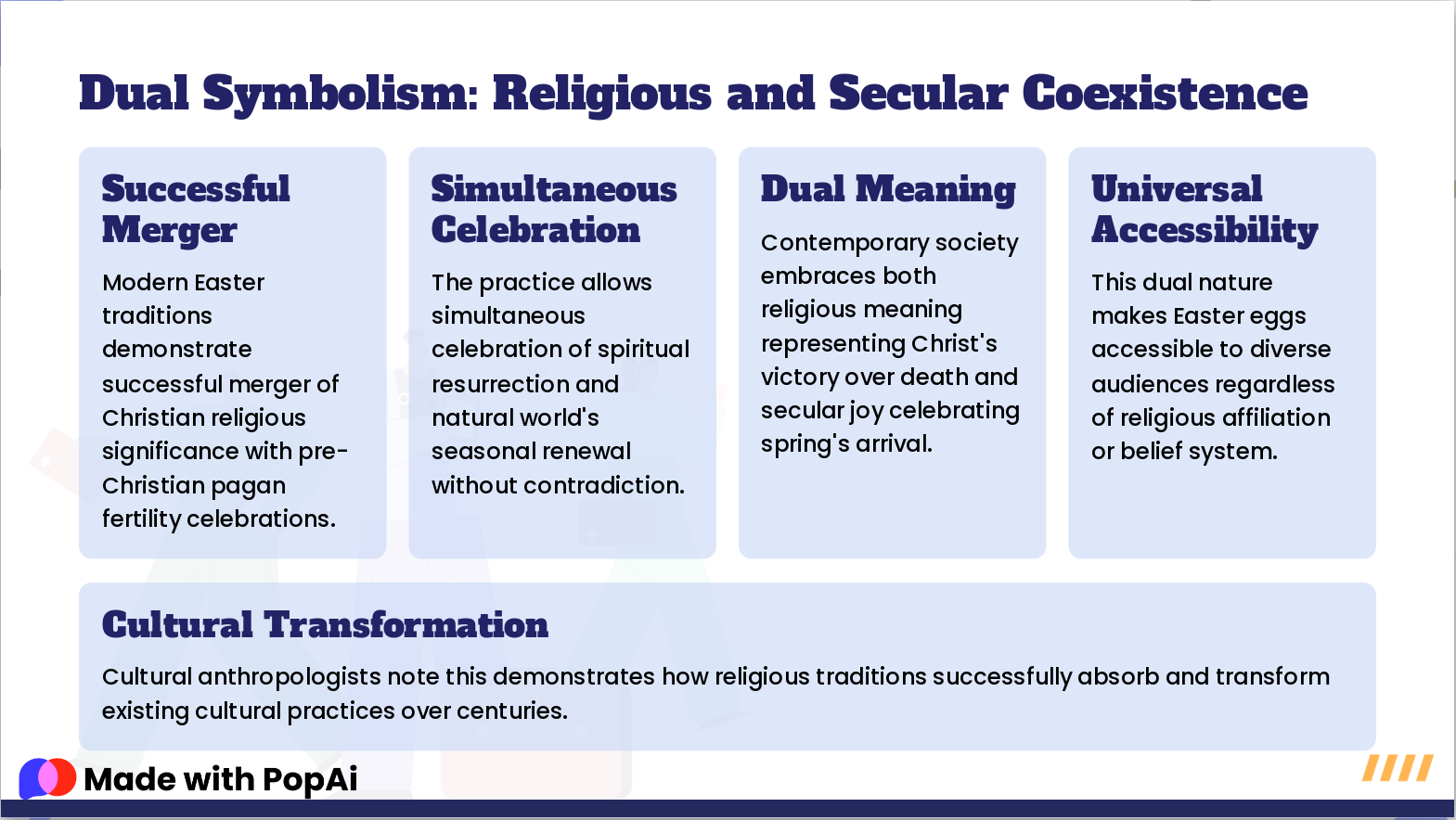
- Successful Merger: Modern Easter traditions demonstrate successful merger of Christian religious significance with pre-Christian pagan fertility celebrations.
- Simultaneous Celebration: The practice allows simultaneous celebration of spiritual resurrection and natural world's seasonal renewal without contradiction.
- Dual Meaning: Contemporary society embraces both religious meaning representing Christ's victory over death and secular joy celebrating spring's arrival.
- Universal Accessibility: This dual nature makes Easter eggs accessible to diverse audiences regardless of religious affiliation or belief system.
- Cultural Transformation: Cultural anthropologists note this demonstrates how religious traditions successfully absorb and transform existing cultural practices over centuries.
Slide 12: European Traditions: Regional Variations Across the Continent
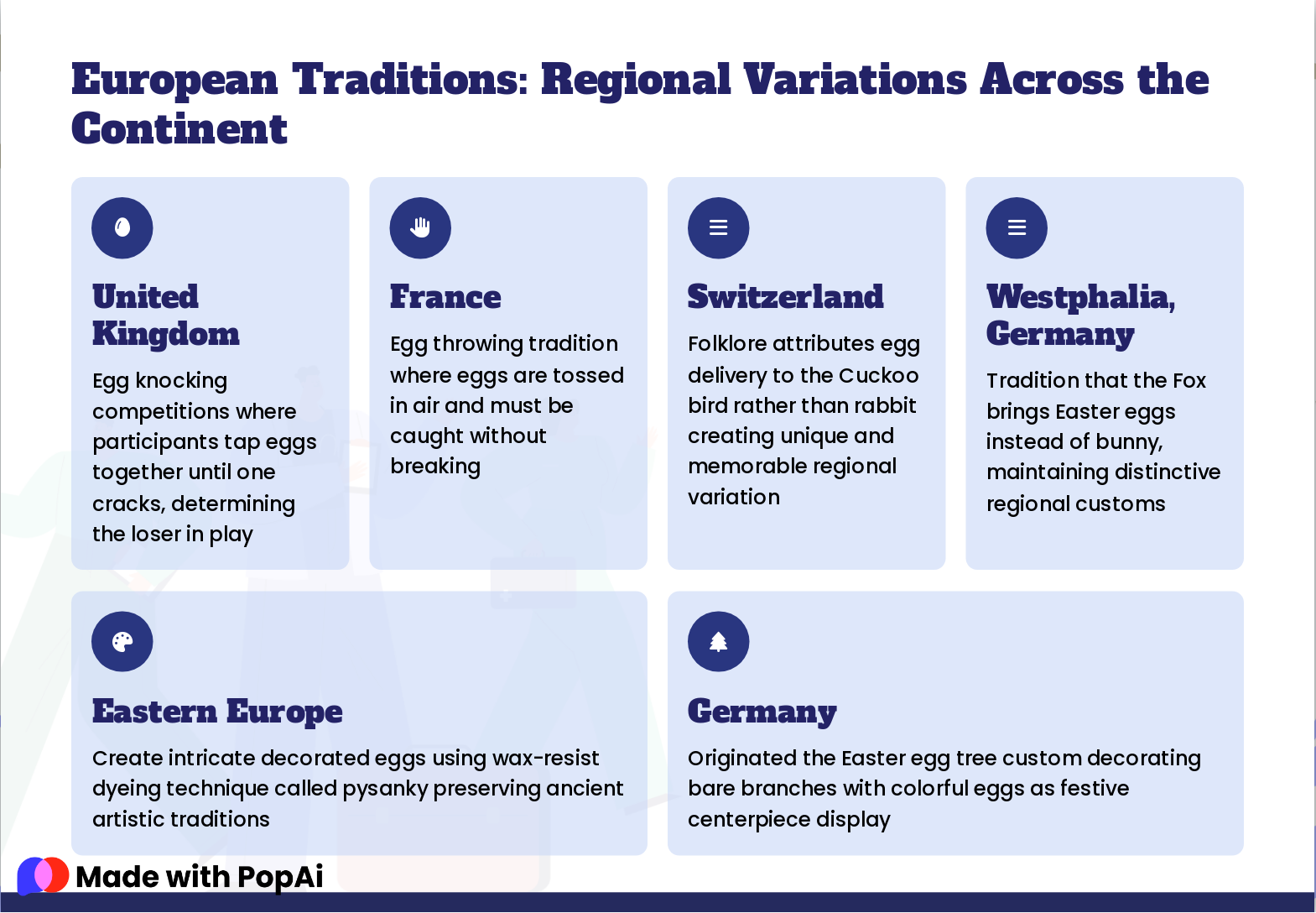
- United Kingdom: Egg knocking competitions where participants tap eggs together until one cracks, determining the loser in play
- France: Egg throwing tradition where eggs are tossed in air and must be caught without breaking
- Switzerland: Folklore attributes egg delivery to the Cuckoo bird rather than rabbit creating unique and memorable regional variation
- Westphalia, Germany: Tradition that the Fox brings Easter eggs instead of bunny, maintaining distinctive regional customs
- Eastern Europe: Create intricate decorated eggs using wax-resist dyeing technique called pysanky preserving ancient artistic traditions
- Germany: Originated the Easter egg tree custom decorating bare branches with colorful eggs as festive centerpiece display
Slide 13: Global Practices: Easter Traditions Beyond Europe
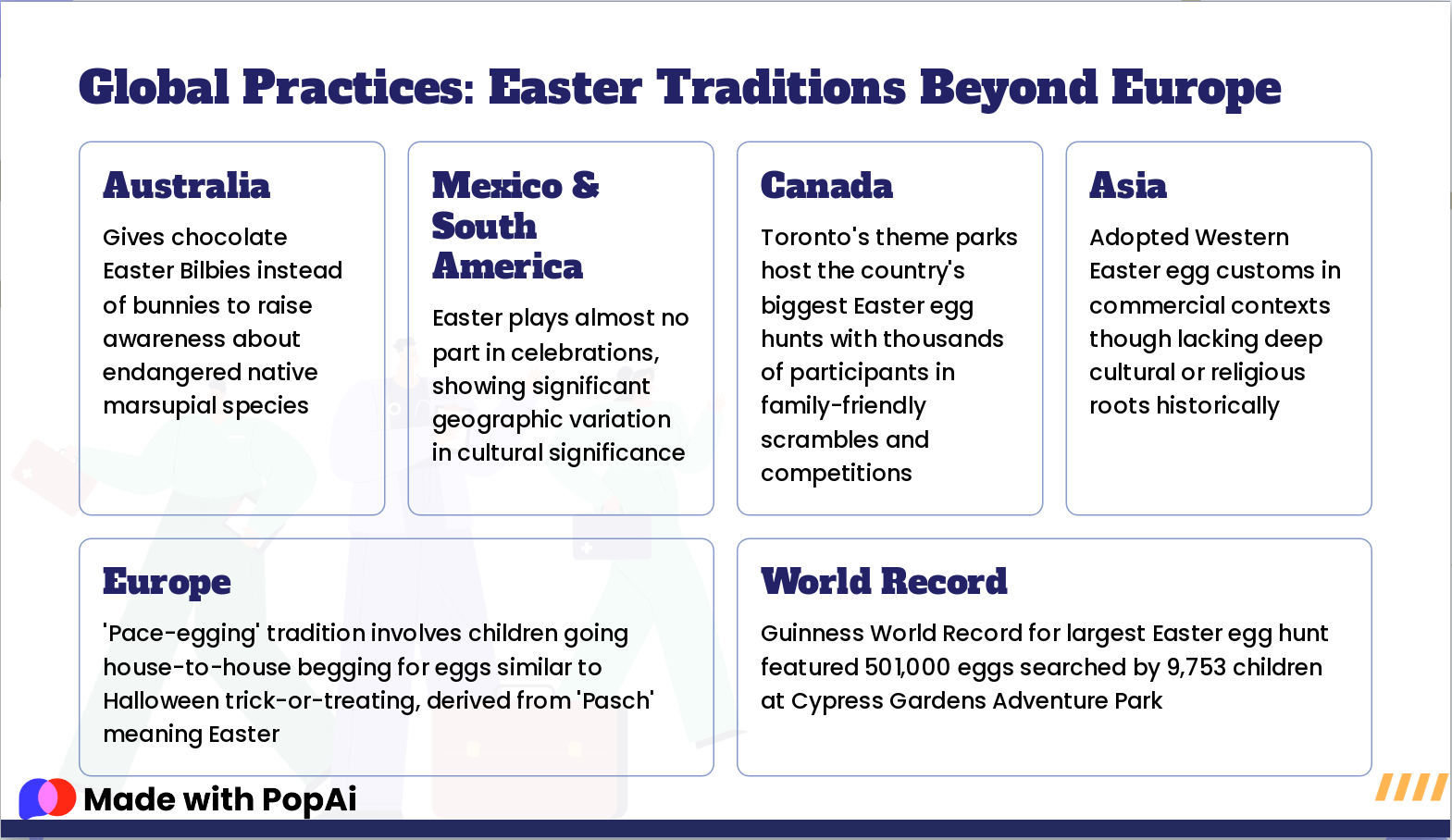
- Australia: Gives chocolate Easter Bilbies instead of bunnies to raise awareness about endangered native marsupial species
- Mexico & South America: Easter plays almost no part in celebrations, showing significant geographic variation in cultural significance
- Canada: Toronto's theme parks host the country's biggest Easter egg hunts with thousands of participants in family-friendly scrambles and competitions
- Asia: Adopted Western Easter egg customs in commercial contexts though lacking deep cultural or religious roots historically
- Europe: 'Pace-egging' tradition involves children going house-to-house begging for eggs similar to Halloween trick-or-treating, derived from 'Pasch' meaning Easter
- World Record: Guinness World Record for largest Easter egg hunt featured 501,000 eggs searched by 9,753 children at Cypress Gardens Adventure Park
Slide 14: Cultural Significance: Community Building Through Shared Traditions
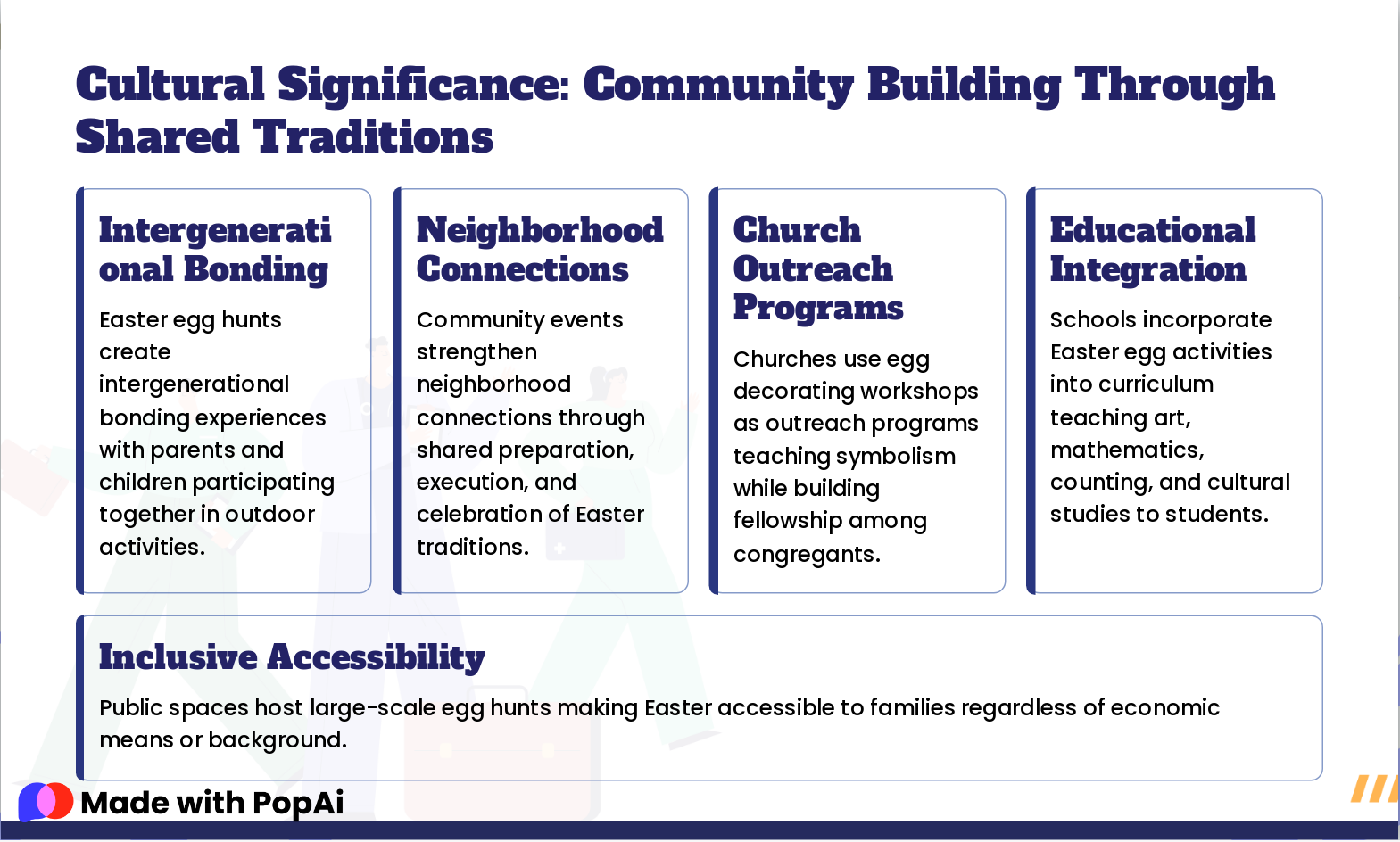
- Intergenerational Bonding: Easter egg hunts create intergenerational bonding experiences with parents and children participating together in outdoor activities.
- Neighborhood Connections: Community events strengthen neighborhood connections through shared preparation, execution, and celebration of Easter traditions.
- Church Outreach Programs: Churches use egg decorating workshops as outreach programs teaching symbolism while building fellowship among congregants.
- Educational Integration: Schools incorporate Easter egg activities into curriculum teaching art, mathematics, counting, and cultural studies to students.
- Inclusive Accessibility: Public spaces host large-scale egg hunts making Easter accessible to families regardless of economic means or background.
Slide 15: Easter Eggstravaganza 2026: Major Events Across America
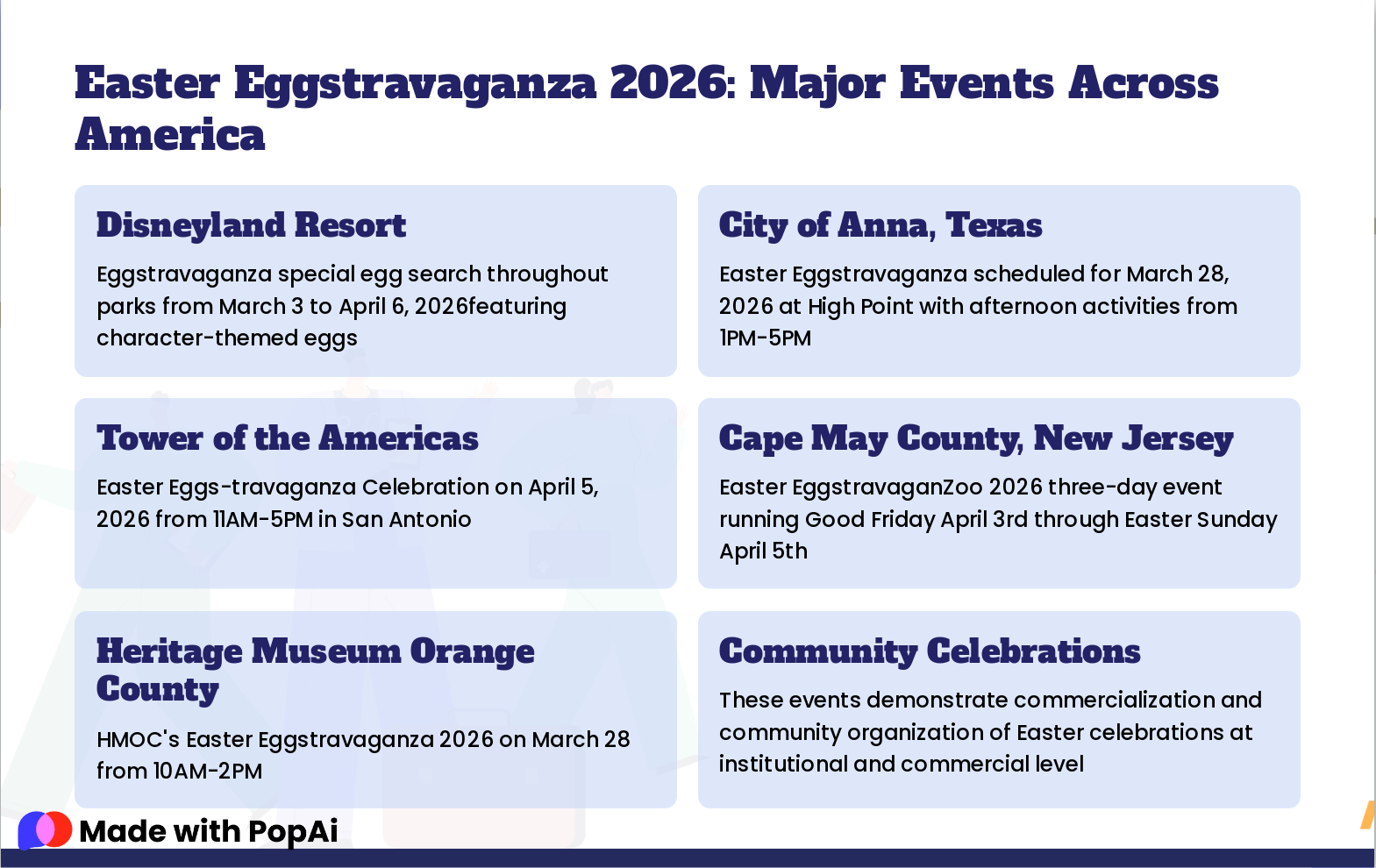
- Disneyland Resort: Eggstravaganza special egg search throughout parks from March 3 to April 6, 2026featuring character-themed eggs
- City of Anna, Texas: Easter Eggstravaganza scheduled for March 28, 2026 at High Point with afternoon activities from 1PM-5PM
- Tower of the Americas: Easter Eggs-travaganza Celebration on April 5, 2026 from 11AM-5PM in San Antonio
- Cape May County, New Jersey: Easter EggstravaganZoo 2026 three-day event running Good Friday April 3rd through Easter Sunday April 5th
- Heritage Museum Orange County: HMOC's Easter Eggstravaganza 2026 on March 28 from 10AM-2PM
- Community Celebrations: These events demonstrate commercialization and community organization of Easter celebrations at institutional and commercial level
Slide 16: 2026Event Features: What Makes Modern Eggstravaganzas Special
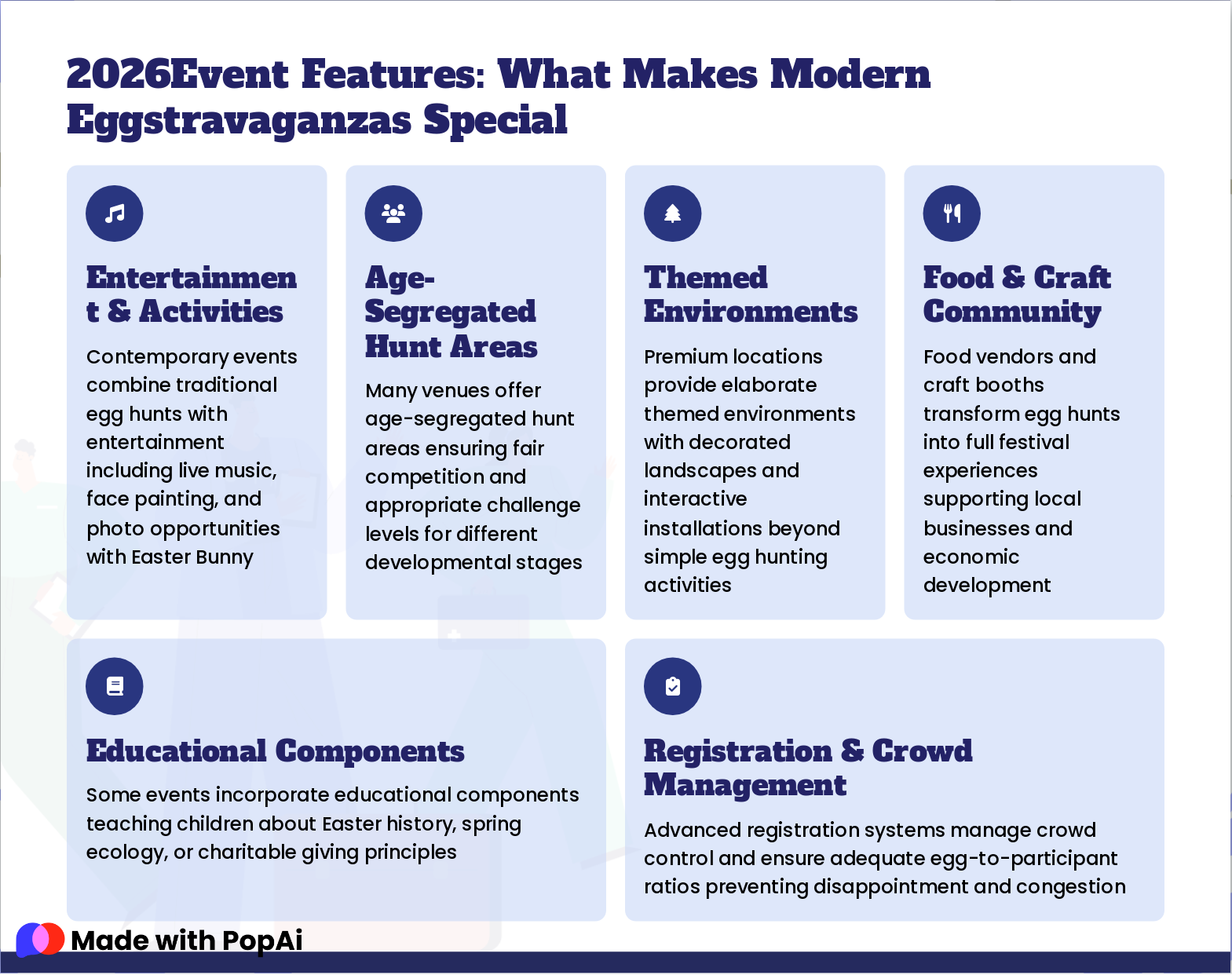
- Entertainment & Activities: Contemporary events combine traditional egg hunts with entertainment including live music, face painting, and photo opportunities with Easter Bunny
- Age-Segregated Hunt Areas: Many venues offer age-segregated hunt areas ensuring fair competition and appropriate challenge levels for different developmental stages
- Themed Environments: Premium locations provide elaborate themed environments with decorated landscapes and interactive installations beyond simple egg hunting activities
- Food & Craft Community: Food vendors and craft booths transform egg hunts into full festival experiences supporting local businesses and economic development
- Educational Components: Some events incorporate educational components teaching children about Easter history, spring ecology, or charitable giving principles
- Registration & Crowd Management: Advanced registration systems manage crowd control and ensure adequate egg-to-participant ratios preventing disappointment and congestion
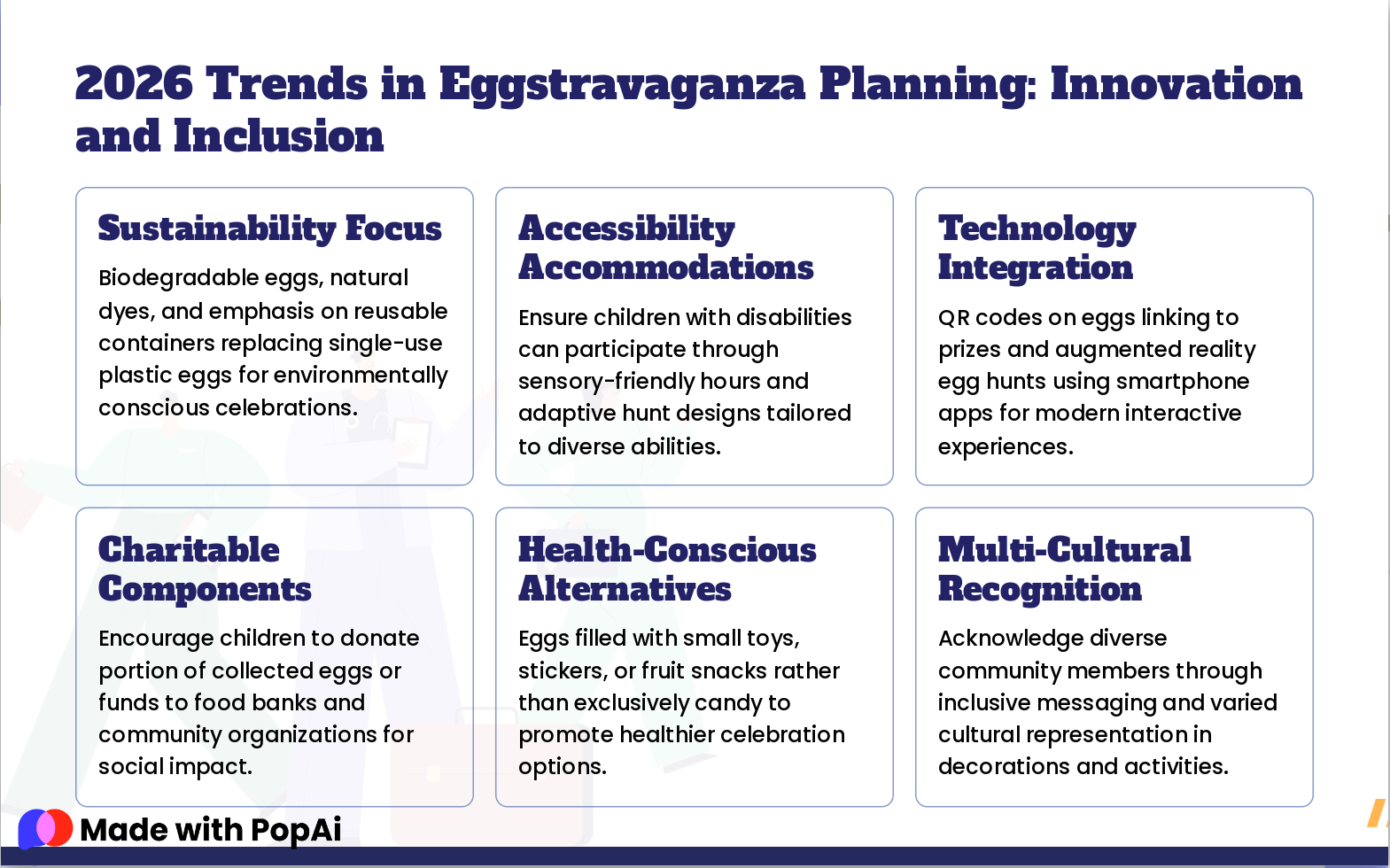
Slide 17: 2026 Trends in Eggstravaganza Planning: Innovation and Inclusion
- Sustainability Focus: Biodegradable eggs, natural dyes, and emphasis on reusable containers replacing single-use plastic eggs for environmentally conscious celebrations.
- Accessibility Accommodations: Ensure children with disabilities can participate through sensory-friendly hours and adaptive hunt designs tailored to diverse abilities.
- Technology Integration: QR codes on eggs linking to prizes and augmented reality egg hunts using smartphone apps for modern interactive experiences.
- Charitable Components: Encourage children to donate portion of collected eggs or funds to food banks and community organizations for social impact.
- Health-Conscious Alternatives: Eggs filled with small toys, stickers, or fruit snacks rather than exclusively candy to promote healthier celebration options.
- Multi-Cultural Recognition: Acknowledge diverse community members through inclusive messaging and varied cultural representation in decorations and activities.
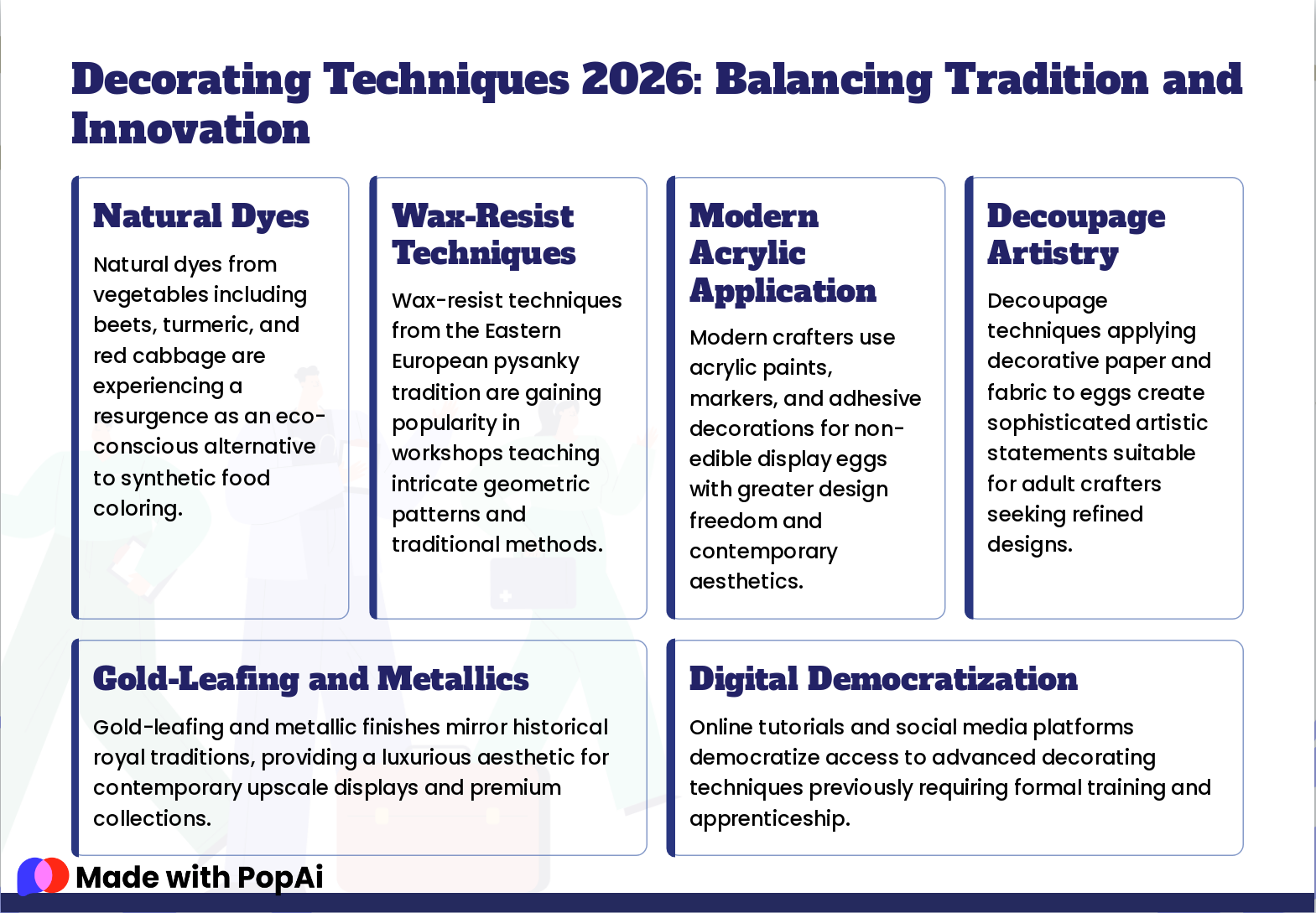
Slide 18: Decorating Techniques 2026: Balancing Tradition and Innovation
- Natural Dyes: Natural dyes from vegetables including beets, turmeric, and red cabbage are experiencing a resurgence as an eco-conscious alternative to synthetic food coloring.
- Wax-Resist Techniques: Wax-resist techniques from the Eastern European pysanky tradition are gaining popularity in workshops teaching intricate geometric patterns and traditional methods.
- Modern Acrylic Application: Modern crafters use acrylic paints, markers, and adhesive decorations for non-edible display eggs with greater design freedom and contemporary aesthetics.
- Decoupage Artistry: Decoupage techniques applying decorative paper and fabric to eggs create sophisticated artistic statements suitable for adult crafters seeking refined designs.
- Gold-Leafing and Metallics: Gold-leafing and metallic finishes mirror historical royal traditions, providing a luxurious aesthetic for contemporary upscale displays and premium collections.
- Digital Democratization: Online tutorials and social media platforms democratize access to advanced decorating techniques previously requiring formal training and apprenticeship.
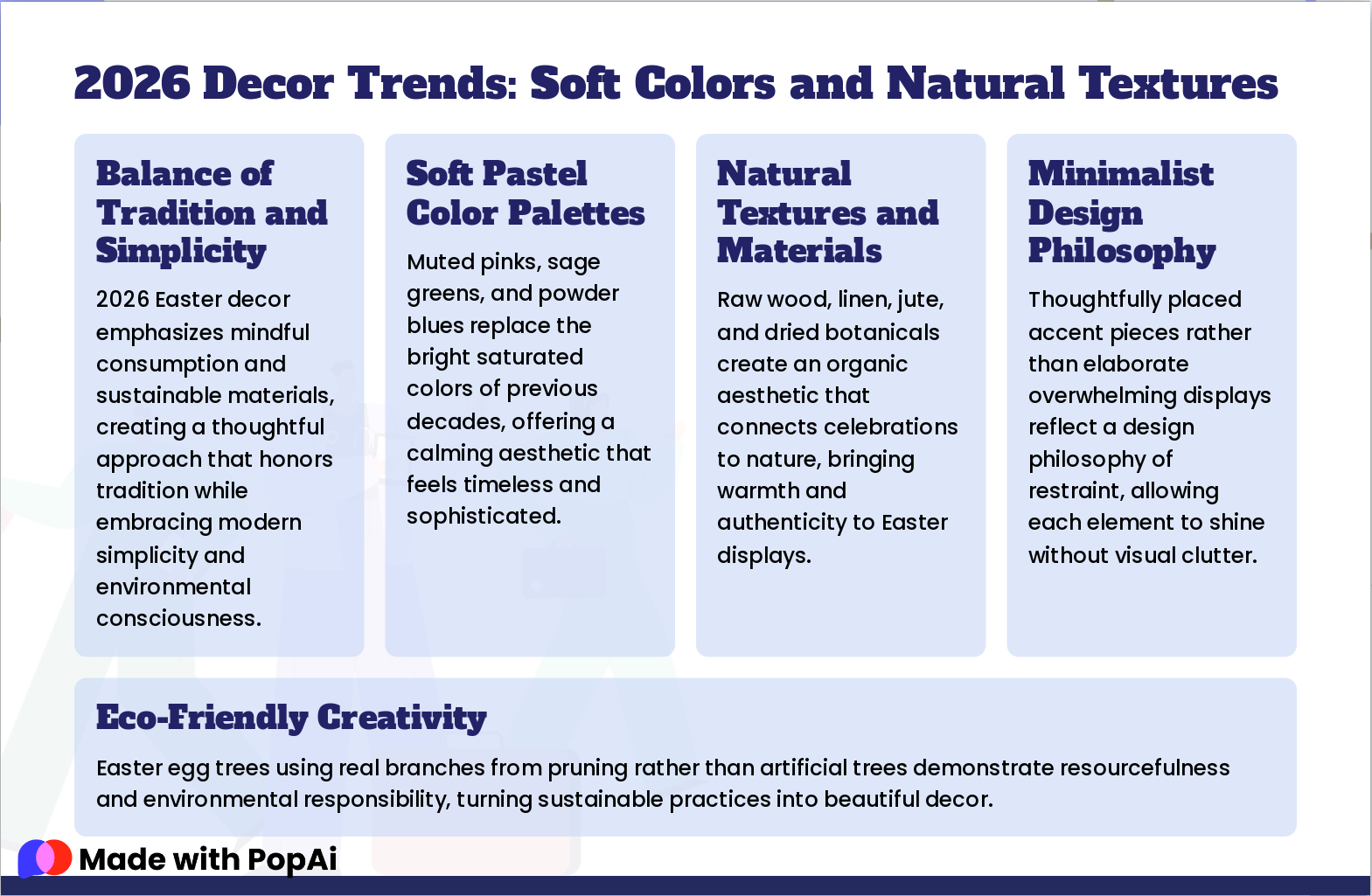
Slide 19: 2026 Decor Trends: Soft Colors and Natural Textures
- Balance of Tradition and Simplicity: 2026 Easter decor emphasizes mindful consumption and sustainable materials, creating a thoughtful approach that honors tradition while embracing modern simplicity and environmental consciousness.
- Soft Pastel Color Palettes: Muted pinks, sage greens, and powder blues replace the bright saturated colors of previous decades, offering a calming aesthetic that feels timeless and sophisticated.
- Natural Textures and Materials: Raw wood, linen, jute, and dried botanicals create an organic aesthetic that connects celebrations to nature, bringing warmth and authenticity to Easter displays.
- Minimalist Design Philosophy: Thoughtfully placed accent pieces rather than elaborate overwhelming displays reflect a design philosophy of restraint, allowing each element to shine without visual clutter.
- Eco-Friendly Creativity: Easter egg trees using real branches from pruning rather than artificial trees demonstrate resourcefulness and environmental responsibility, turning sustainable practices into beautiful decor.
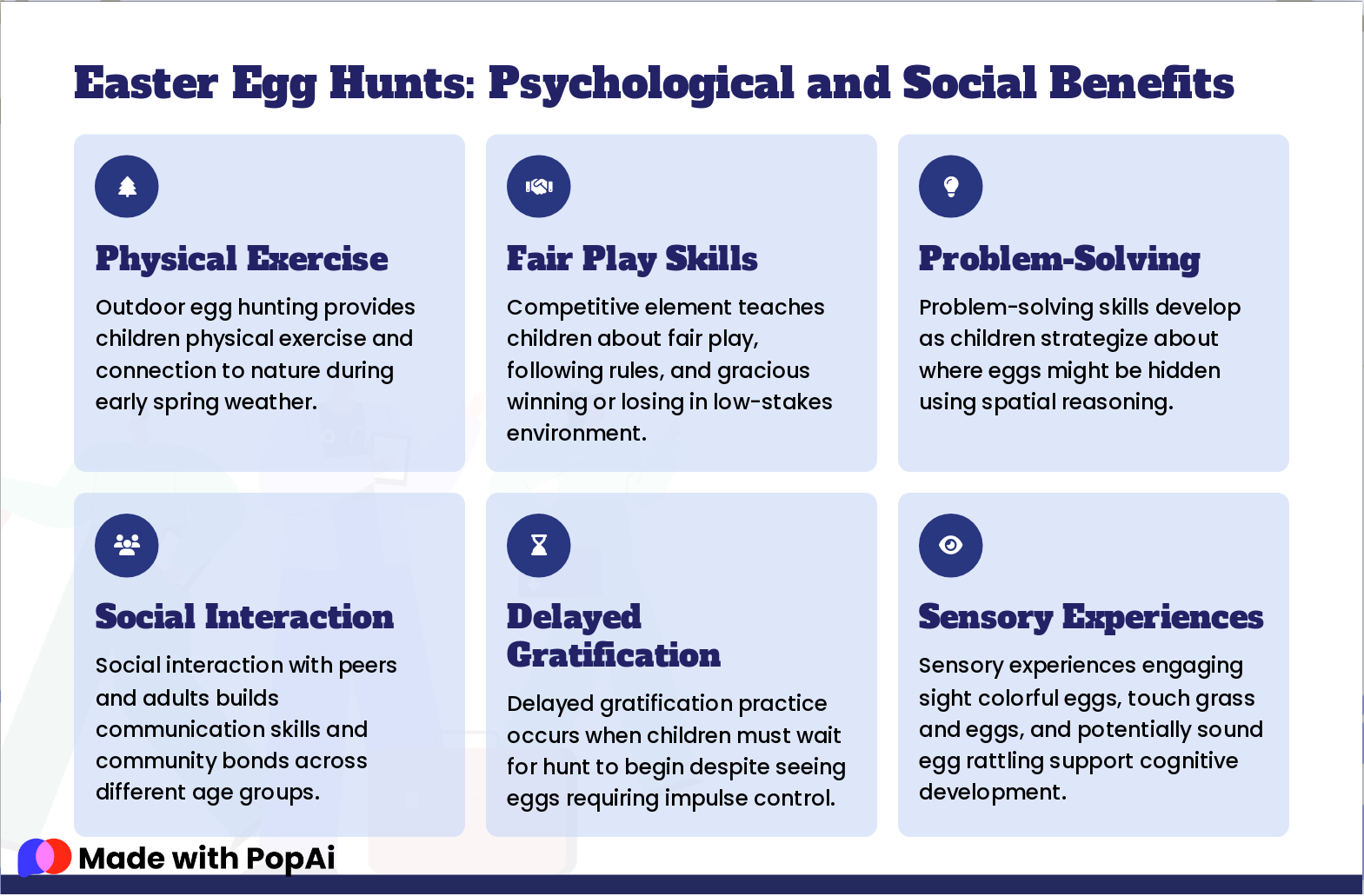
Slide 20: Easter Egg Hunts: Psychological and Social Benefits
- Physical Exercise: Outdoor egg hunting provides children physical exercise and connection to nature during early spring weather.
- Fair Play Skills: Competitive element teaches children about fair play, following rules, and gracious winning or losing in low-stakes environment.
- Problem-Solving: Problem-solving skills develop as children strategize about where eggs might be hidden using spatial reasoning.
- Social Interaction: Social interaction with peers and adults builds communication skills and community bonds across different age groups.
- Delayed Gratification: Delayed gratification practice occurs when children must wait for hunt to begin despite seeing eggs requiring impulse control.
- Sensory Experiences: Sensory experiences engaging sight colorful eggs, touch grass and eggs, and potentially sound egg rattling support cognitive development.
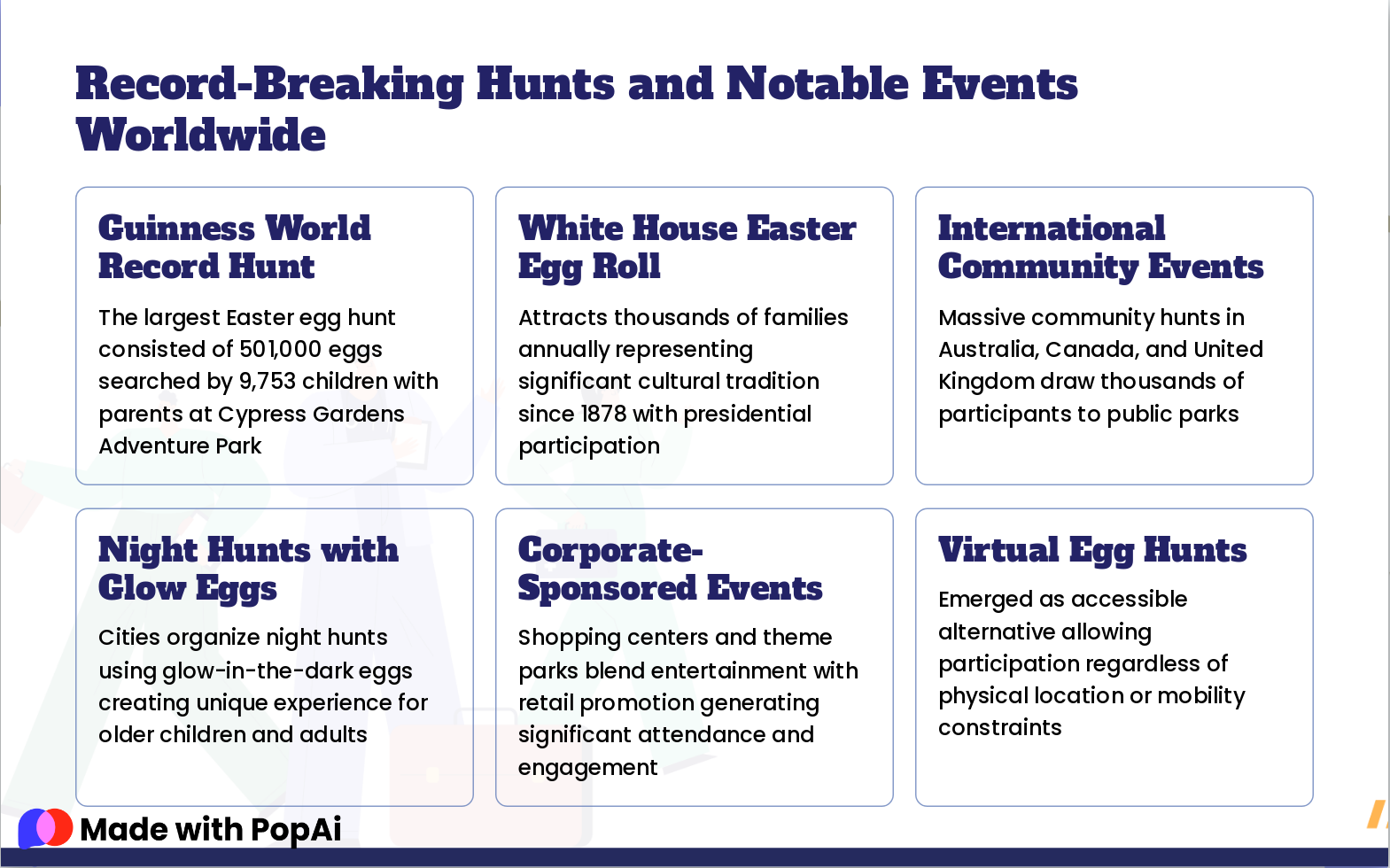
Slide 21: Record-Breaking Hunts and Notable Events Worldwide
- Guinness World Record Hunt: The largest Easter egg hunt consisted of 501,000 eggs searched by 9,753 children with parents at Cypress Gardens Adventure Park
- White House Easter Egg Roll: Attracts thousands of families annually representing significant cultural tradition since 1878 with presidential participation
- International Community Events: Massive community hunts in Australia, Canada, and United Kingdom draw thousands of participants to public parks
- Night Hunts with Glow Eggs: Cities organize night hunts using glow-in-the-dark eggs creating unique experience for older children and adults
- Corporate-Sponsored Events: Shopping centers and theme parks blend entertainment with retail promotion generating significant attendance and engagement
- Virtual Egg Hunts: Emerged as accessible alternative allowing participation regardless of physical location or mobility constraints
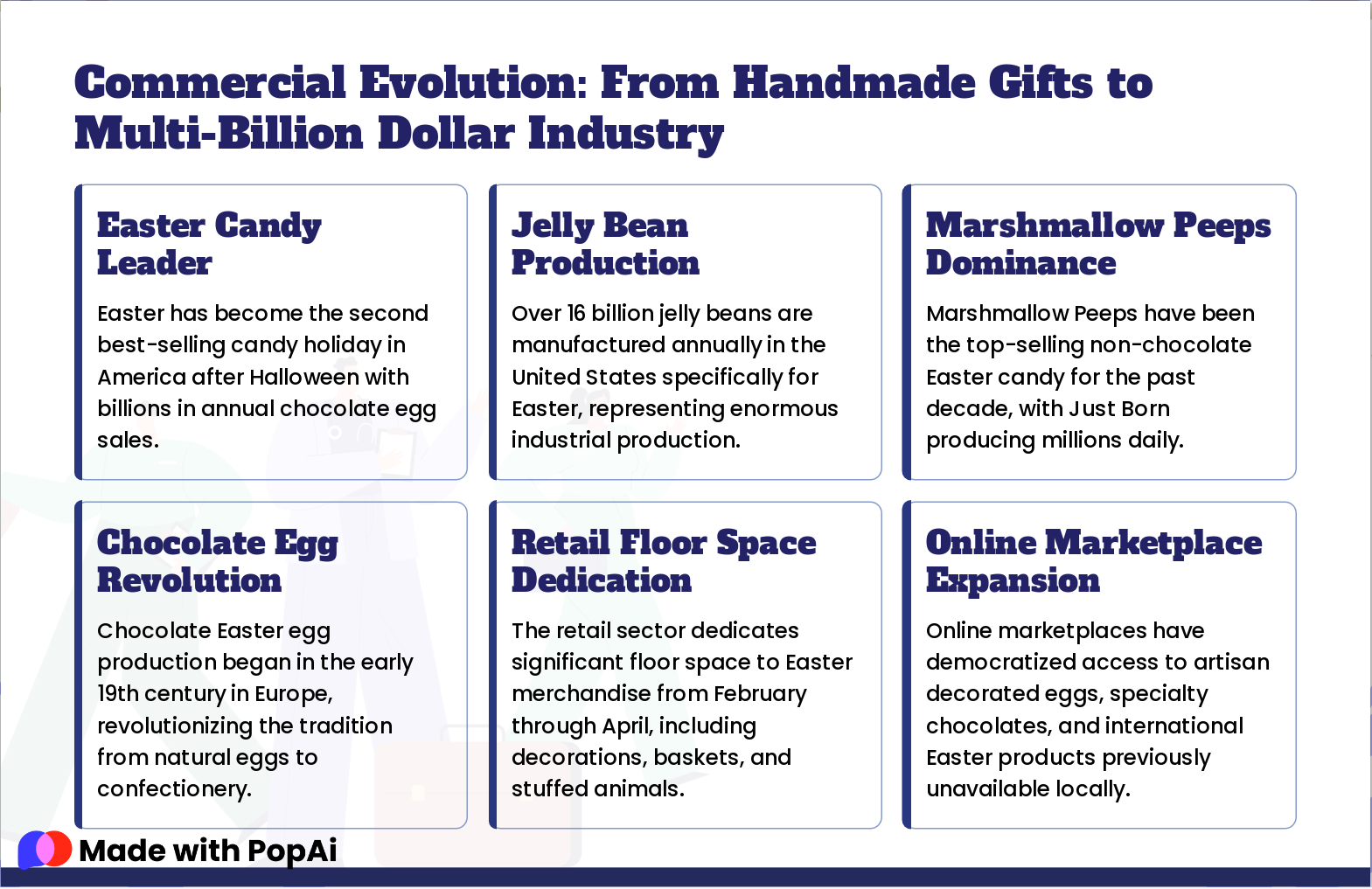
Slide 22: Commercial Evolution: From Handmade Gifts to Multi-Billion Dollar Industry
- Easter Candy Leader: Easter has become the second best-selling candy holiday in America after Halloween with billions in annual chocolate egg sales.
- Jelly Bean Production: Over 16 billion jelly beans are manufactured annually in the United States specifically for Easter, representing enormous industrial production.
- Marshmallow Peeps Dominance: Marshmallow Peeps have been the top-selling non-chocolate Easter candy for the past decade, with Just Born producing millions daily.
- Chocolate Egg Revolution: Chocolate Easter egg production began in the early 19th century in Europe, revolutionizing the tradition from natural eggs to confectionery.
- Retail Floor Space Dedication: The retail sector dedicates significant floor space to Easter merchandise from February through April, including decorations, baskets, and stuffed animals.
- Online Marketplace Expansion: Online marketplaces have democratized access to artisan decorated eggs, specialty chocolates, and international Easter products previously unavailable locally.
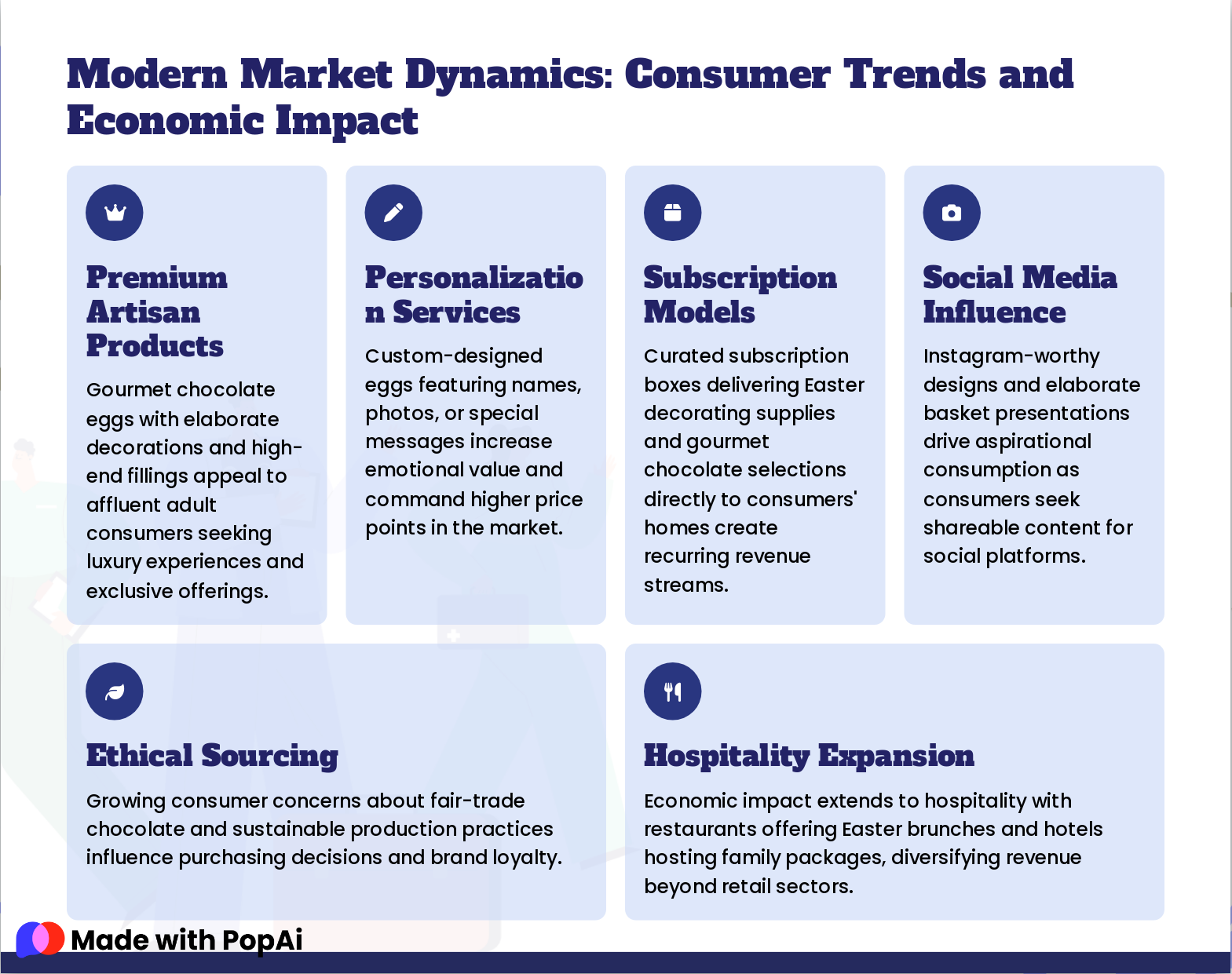
Slide 23: Modern Market Dynamics: Consumer Trends and Economic Impact
- Premium Artisan Products: Gourmet chocolate eggs with elaborate decorations and high-end fillings appeal to affluent adult consumers seeking luxury experiences and exclusive offerings.
- Personalization Services: Custom-designed eggs featuring names, photos, or special messages increase emotional value and command higher price points in the market.
- Subscription Models: Curated subscription boxes delivering Easter decorating supplies and gourmet chocolate selections directly to consumers' homes create recurring revenue streams.
- Social Media Influence: Instagram-worthy designs and elaborate basket presentations drive aspirational consumption as consumers seek shareable content for social platforms.
- Ethical Sourcing: Growing consumer concerns about fair-trade chocolate and sustainable production practices influence purchasing decisions and brand loyalty.
- Hospitality Expansion: Economic impact extends to hospitality with restaurants offering Easter brunches and hotels hosting family packages, diversifying revenue beyond retail sectors.
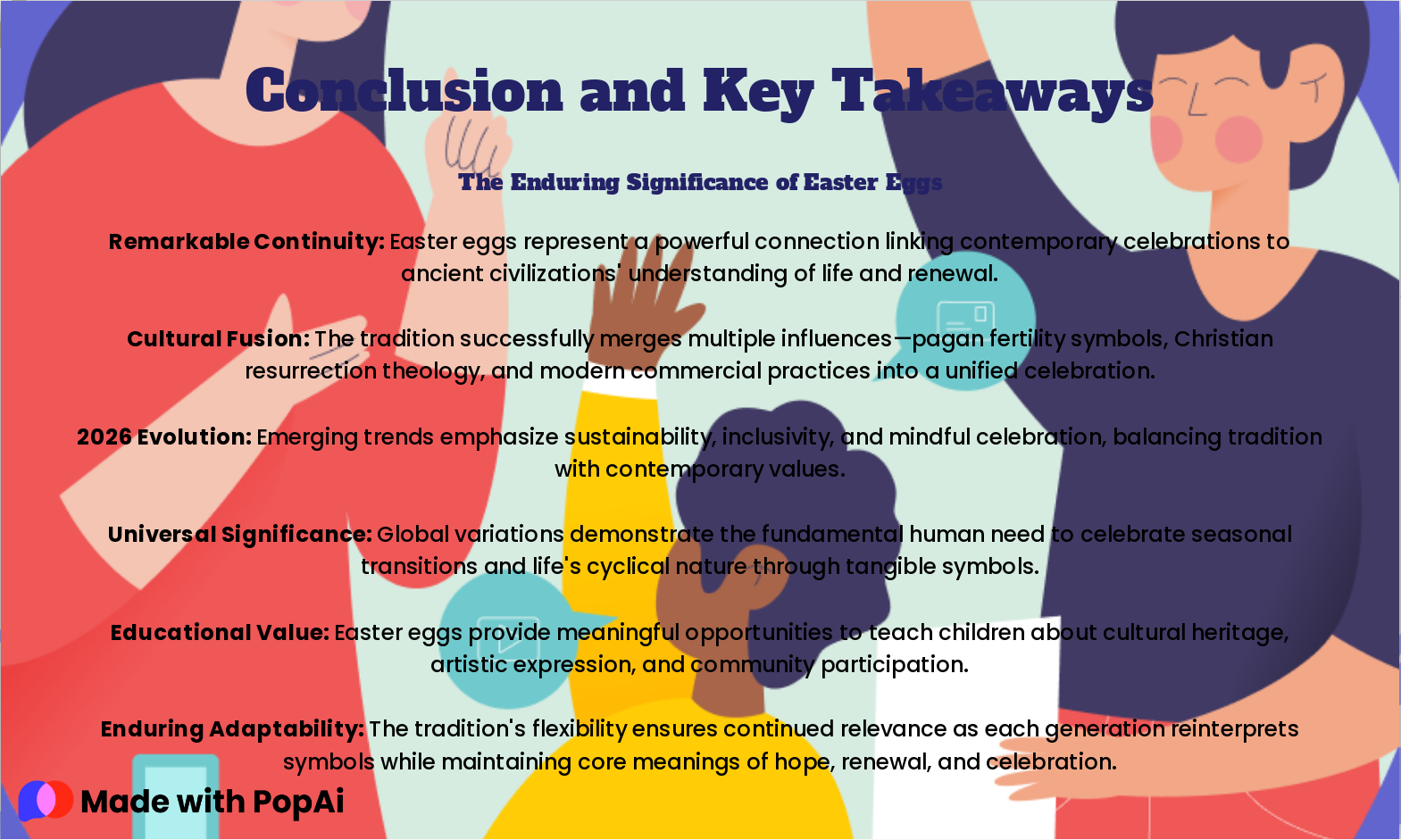
Slide 24: Conclusion and Key Takeaways
Remarkable Continuity: Easter eggs represent a powerful connection linking contemporary celebrations to ancient civilizations' understanding of life and renewal. Cultural Fusion: The tradition successfully merges multiple influences—pagan fertility symbols, Christian resurrection theology, and modern commercial practices into a unified celebration. 2026 Evolution: Emerging trends emphasize sustainability, inclusivity, and mindful celebration, balancing tradition with contemporary values. Universal Significance: Global variations demonstrate the fundamental human need to celebrate seasonal transitions and life's cyclical nature through tangible symbols. Educational Value: Easter eggs provide meaningful opportunities to teach children about cultural heritage, artistic expression, and community participation. Enduring Adaptability: The tradition's flexibility ensures continued relevance as each generation reinterprets symbols while maintaining core meanings of hope, renewal, and celebration.