Presentation Summary
Discover the human-centered innovation framework by IDEO that transforms complex problems into user-centric solutions through empathy, experimentation, and iteration.
Full Presentation Transcript
Slide 1: Design Thinking by IDEO
A Human-Centered Innovation Framework for Transforming Complex Problems into User-Centric Solutions
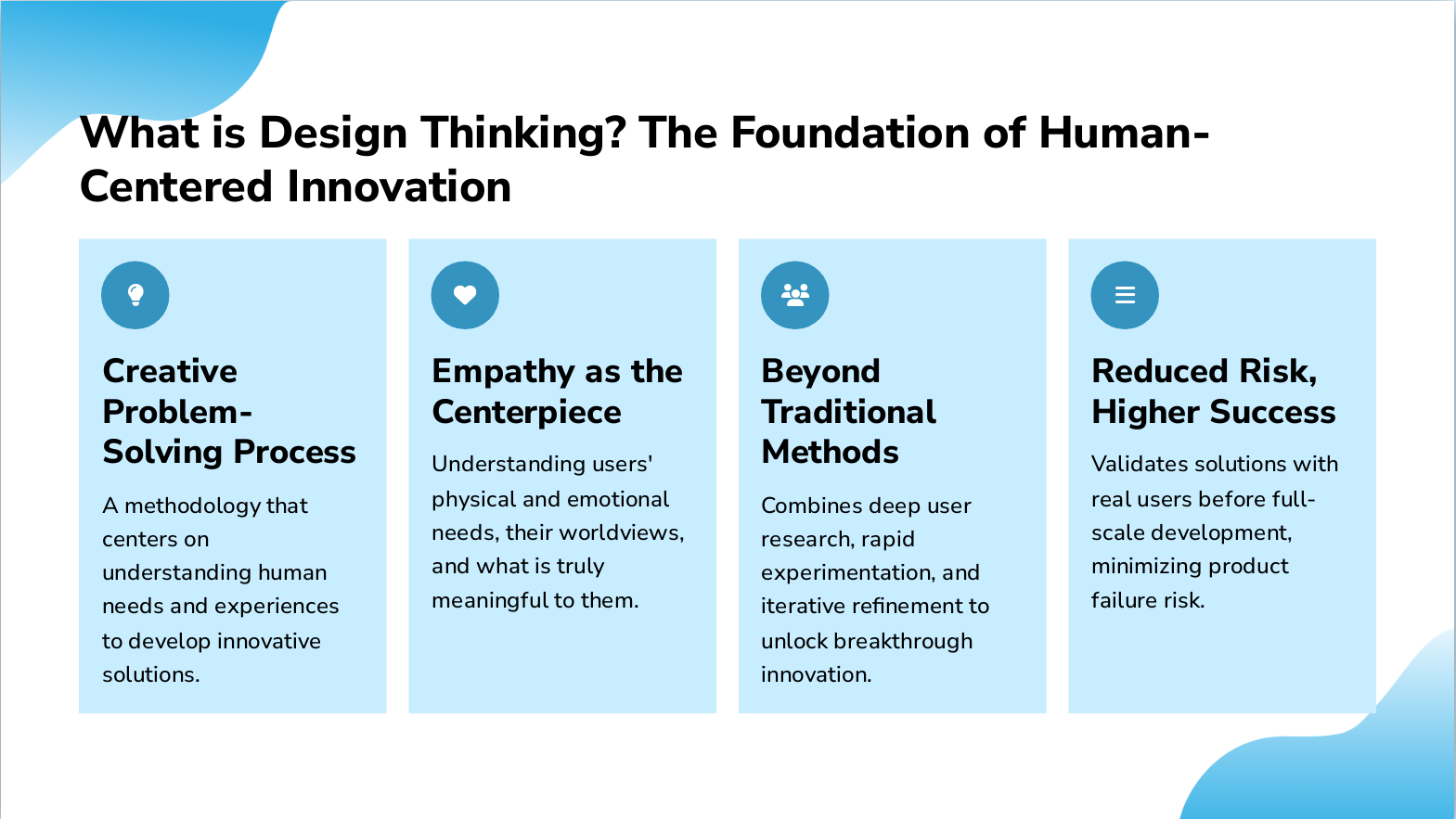
Slide 2: What is Design Thinking? The Foundation of Human-Centered Innovation
- Creative Problem-Solving Process: A methodology that centers on understanding human needs and experiences to develop innovative solutions.
- Empathy as the Centerpiece: Understanding users' physical and emotional needs, their worldviews, and what is truly meaningful to them.
- Beyond Traditional Methods: Combines deep user research, rapid experimentation, and iterative refinement to unlock breakthrough innovation.
- Reduced Risk, Higher Success: Validates solutions with real users before full-scale development, minimizing product failure risk.
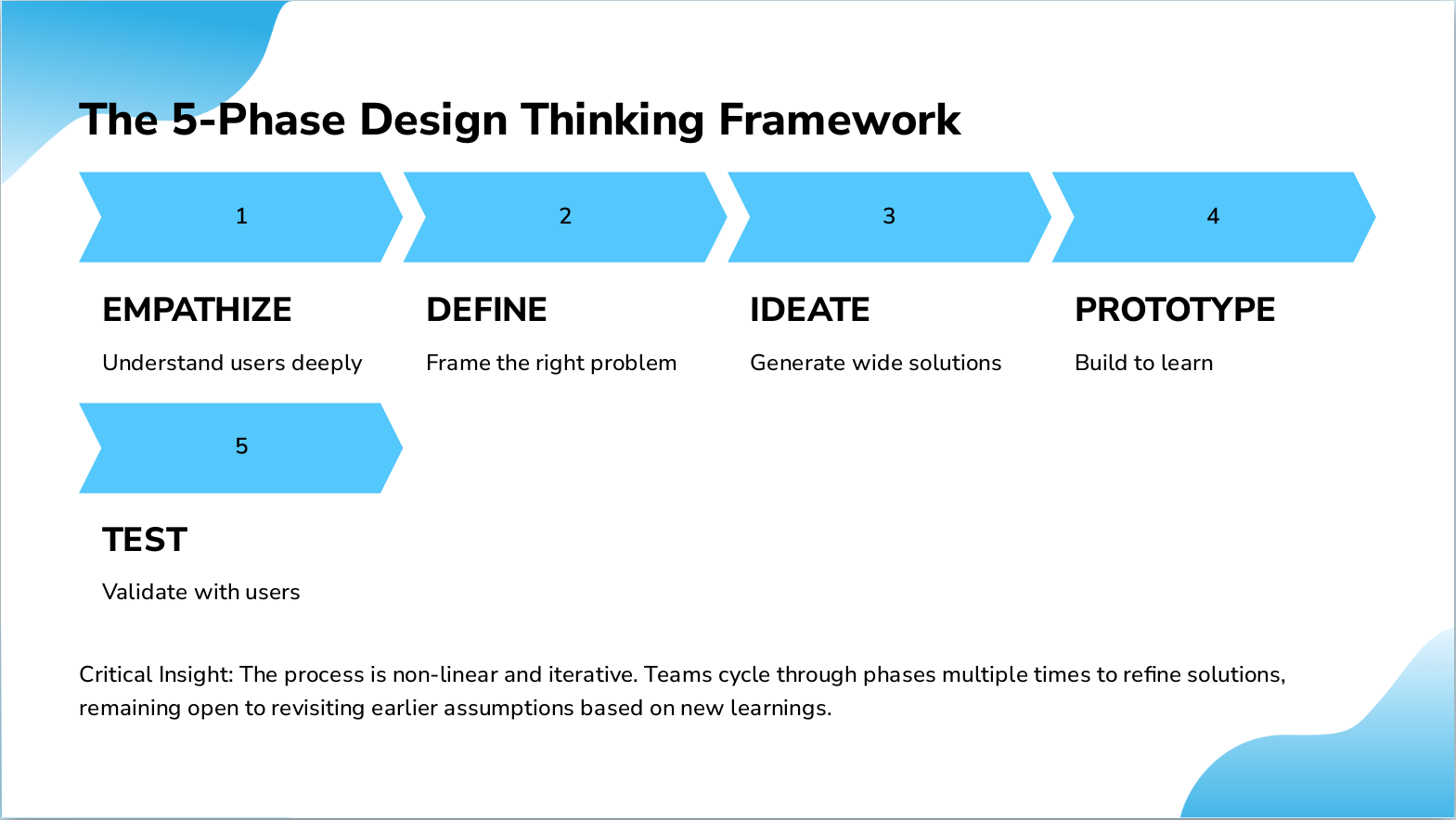
Slide 3: The 5-Phase Design Thinking Framework
- EMPATHIZE: Understand users deeply
- DEFINE: Frame the right problem
- IDEATE: Generate wide solutions
- PROTOTYPE: Build to learn
- TEST: Validate with users
Critical Insight: The process is non-linear and iterative. Teams cycle through phases multiple times to refine solutions, remaining open to revisiting earlier assumptions based on new learnings.
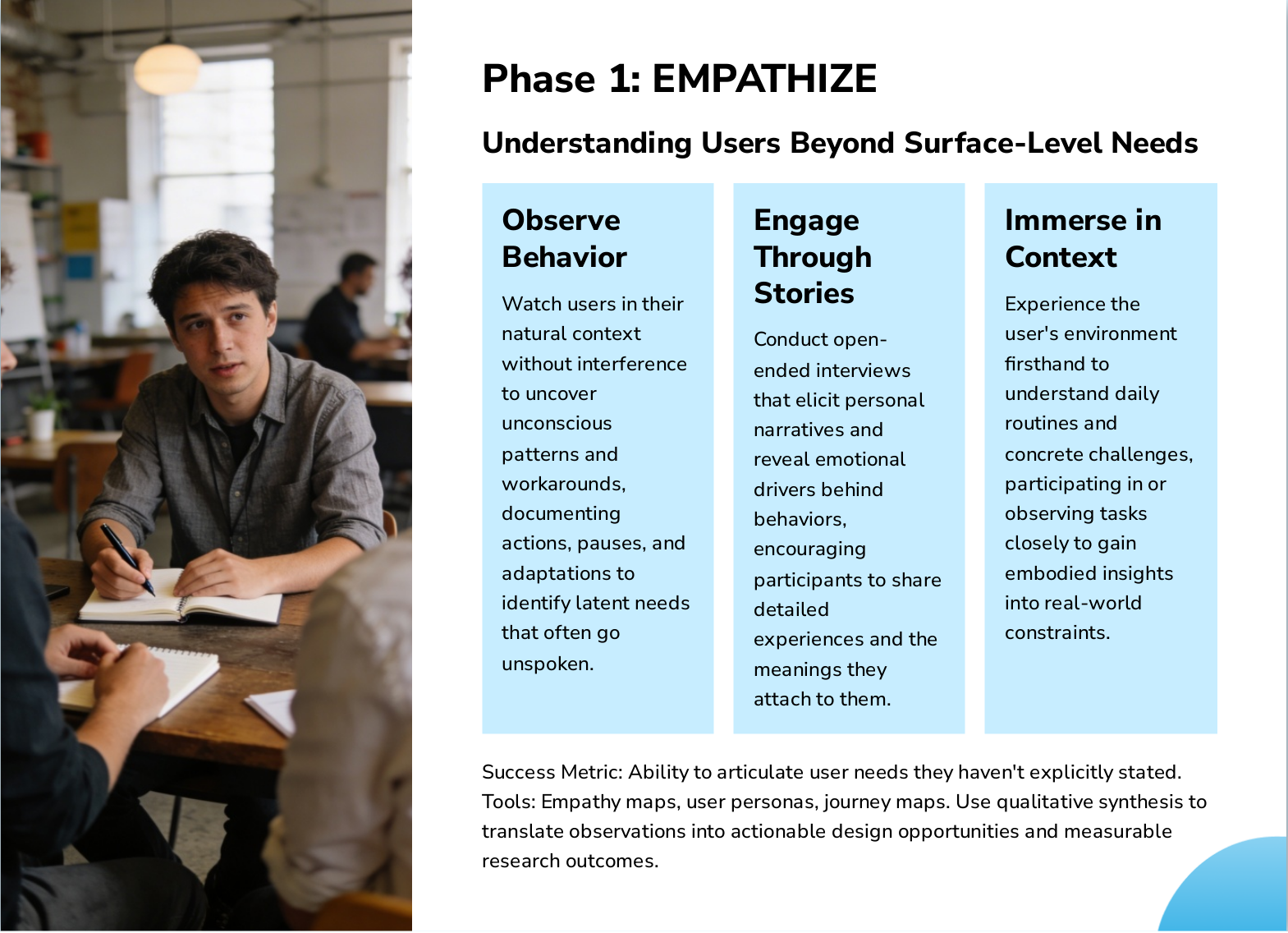
Slide 4: Phase 1: EMPATHIZE
- Observe Behavior: Watch users in their natural context without interference to uncover unconscious patterns and workarounds, documenting actions, pauses, and adaptations to identify latent needs that often go unspoken.
- Engage Through Stories: Conduct open-ended interviews that elicit personal narratives and reveal emotional drivers behind behaviors, encouraging participants to share detailed experiences and the meanings they attach to them.
- Immerse in Context: Experience the user's environment firsthand to understand daily routines and concrete challenges, participating in or observing tasks closely to gain embodied insights into real-world constraints.
Success Metric: Ability to articulate user needs they haven't explicitly stated. Tools: Empathy maps, user personas, journey maps. Use qualitative synthesis to translate observations into actionable design opportunities and measurable research outcomes.
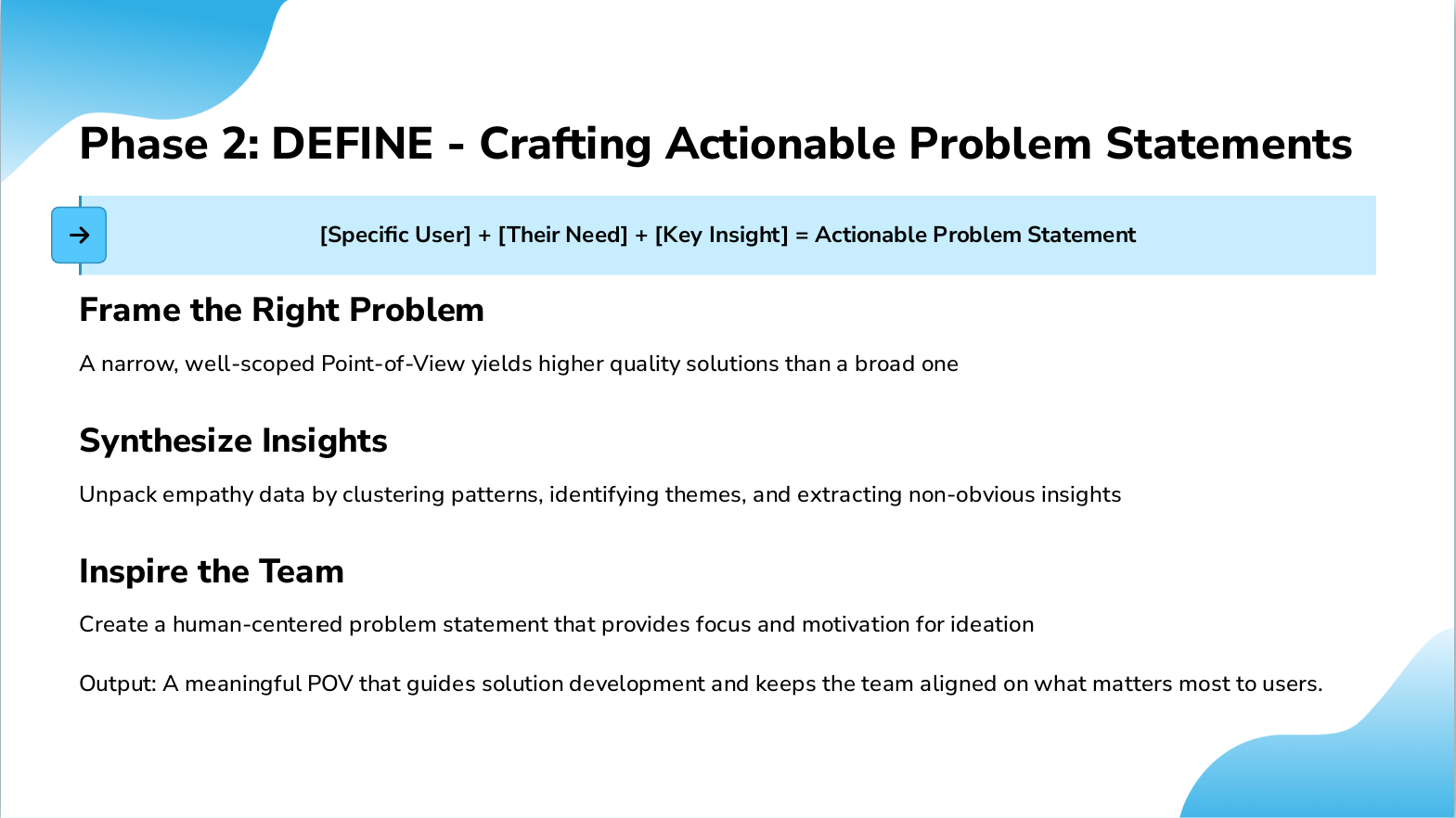
Slide 5: Phase 2: DEFINE - Crafting Actionable Problem Statements
- Frame the Right Problem: A narrow, well-scoped Point-of-View yields higher quality solutions than a broad one
- Synthesize Insights: Unpack empathy data by clustering patterns, identifying themes, and extracting non-obvious insights
- Inspire the Team: Create a human-centered problem statement that provides focus and motivation for ideation
Output: A meaningful POV that guides solution development and keeps the team aligned on what matters most to users.
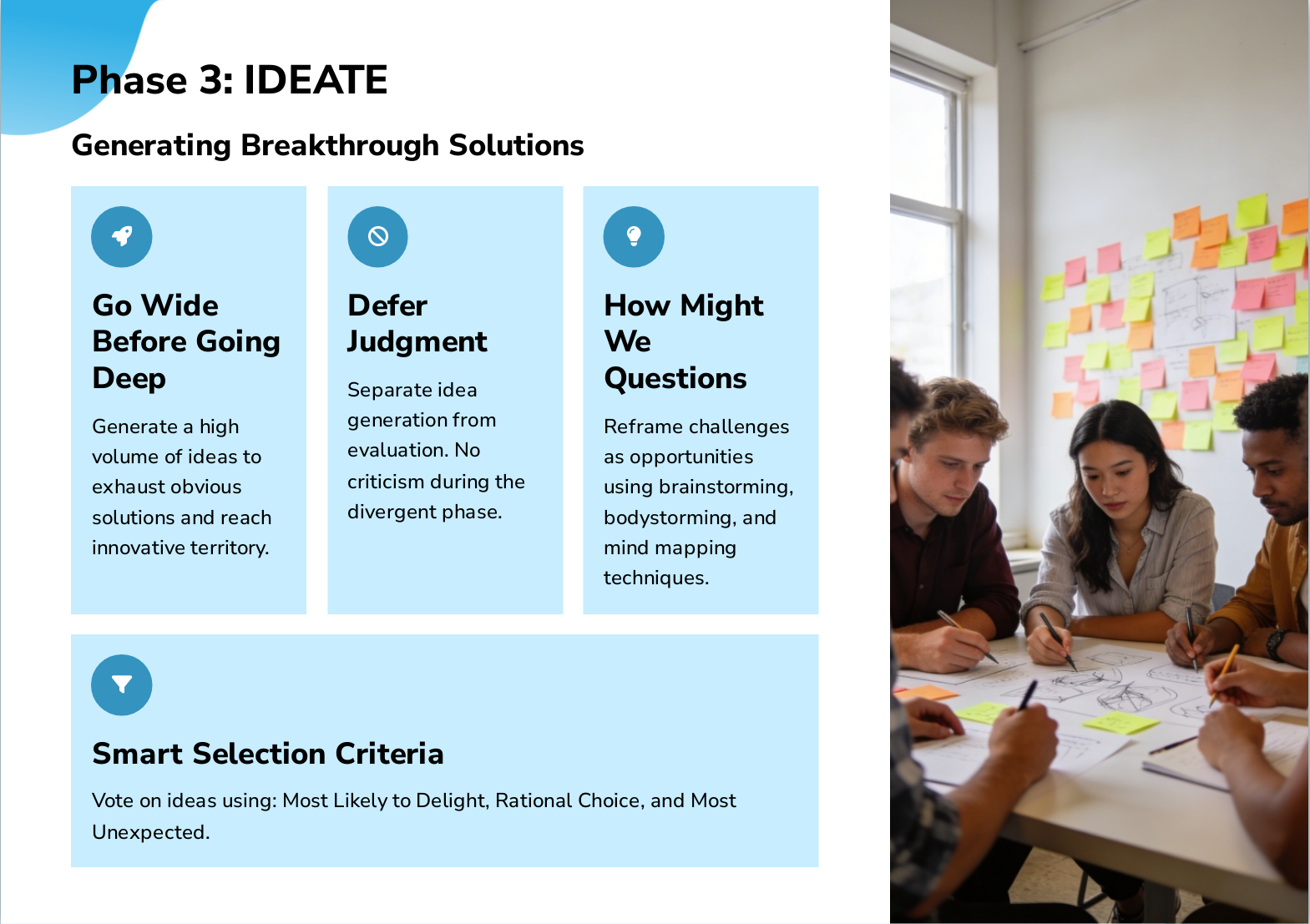
Slide 6: Phase 3: IDEATE
- Go Wide Before Going Deep: Generate a high volume of ideas to exhaust obvious solutions and reach innovative territory.
- Defer Judgment: Separate idea generation from evaluation. No criticism during the divergent phase.
- How Might We Questions: Reframe challenges as opportunities using brainstorming, bodystorming, and mind mapping techniques.
- Smart Selection Criteria: Vote on ideas using: Most Likely to Delight, Rational Choice, and Most Unexpected.
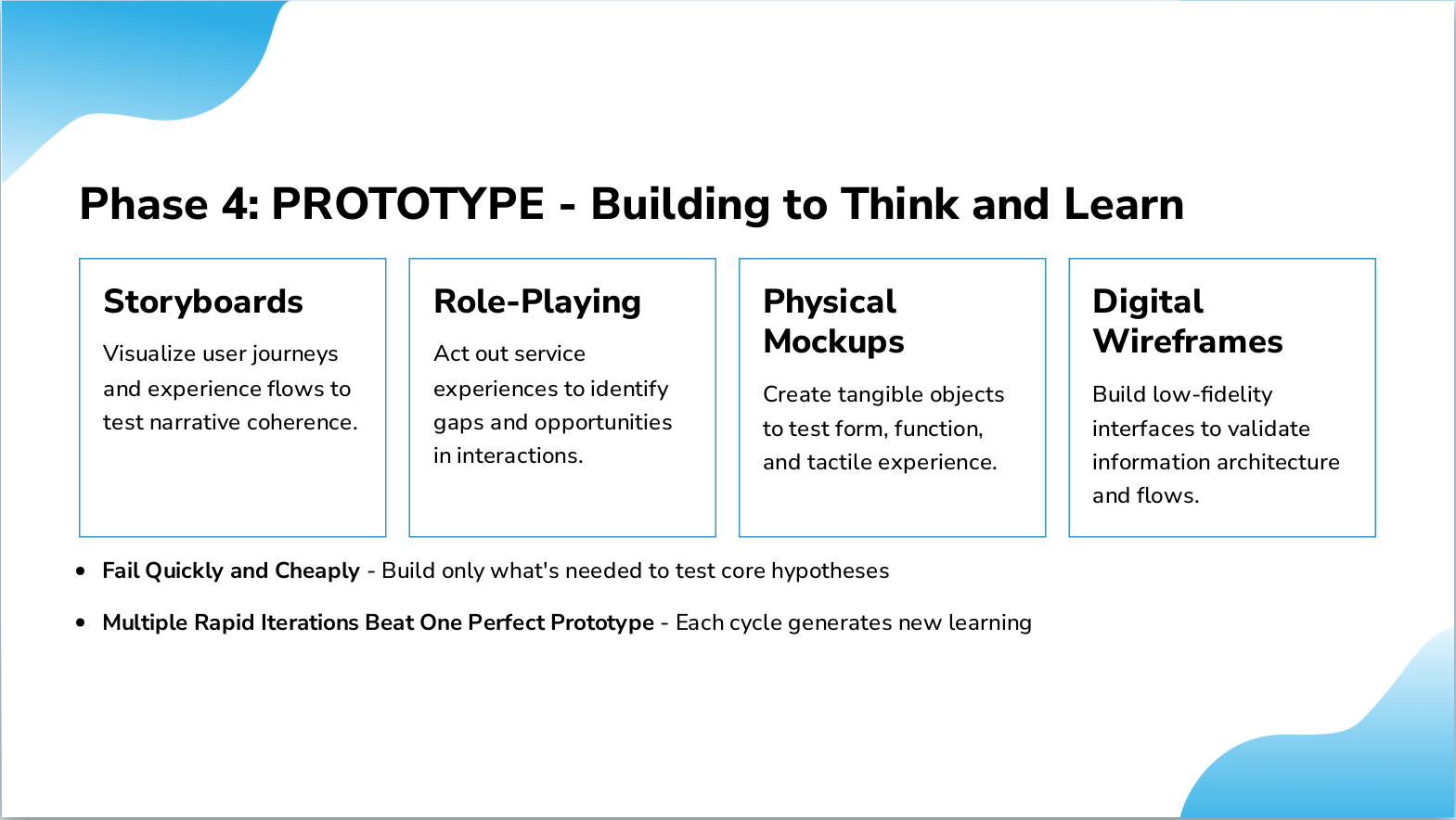
Slide 7: Phase 4: PROTOTYPE - Building to Think and Learn
- Storyboards: Visualize user journeys and experience flows to test narrative coherence.
- Role-Playing: Act out service experiences to identify gaps and opportunities in interactions.
- Physical Mockups: Create tangible objects to test form, function, and tactile experience.
- Digital Wireframes: Build low-fidelity interfaces to validate information architecture and flows.
Fail Quickly and Cheaply - Build only what's needed to test core hypotheses
Multiple Rapid Iterations Beat One Perfect Prototype - Each cycle generates new learning
- Fail Quickly and Cheaply - Build only what's needed to test core hypotheses
- Multiple Rapid Iterations Beat One Perfect Prototype - Each cycle generates new learning
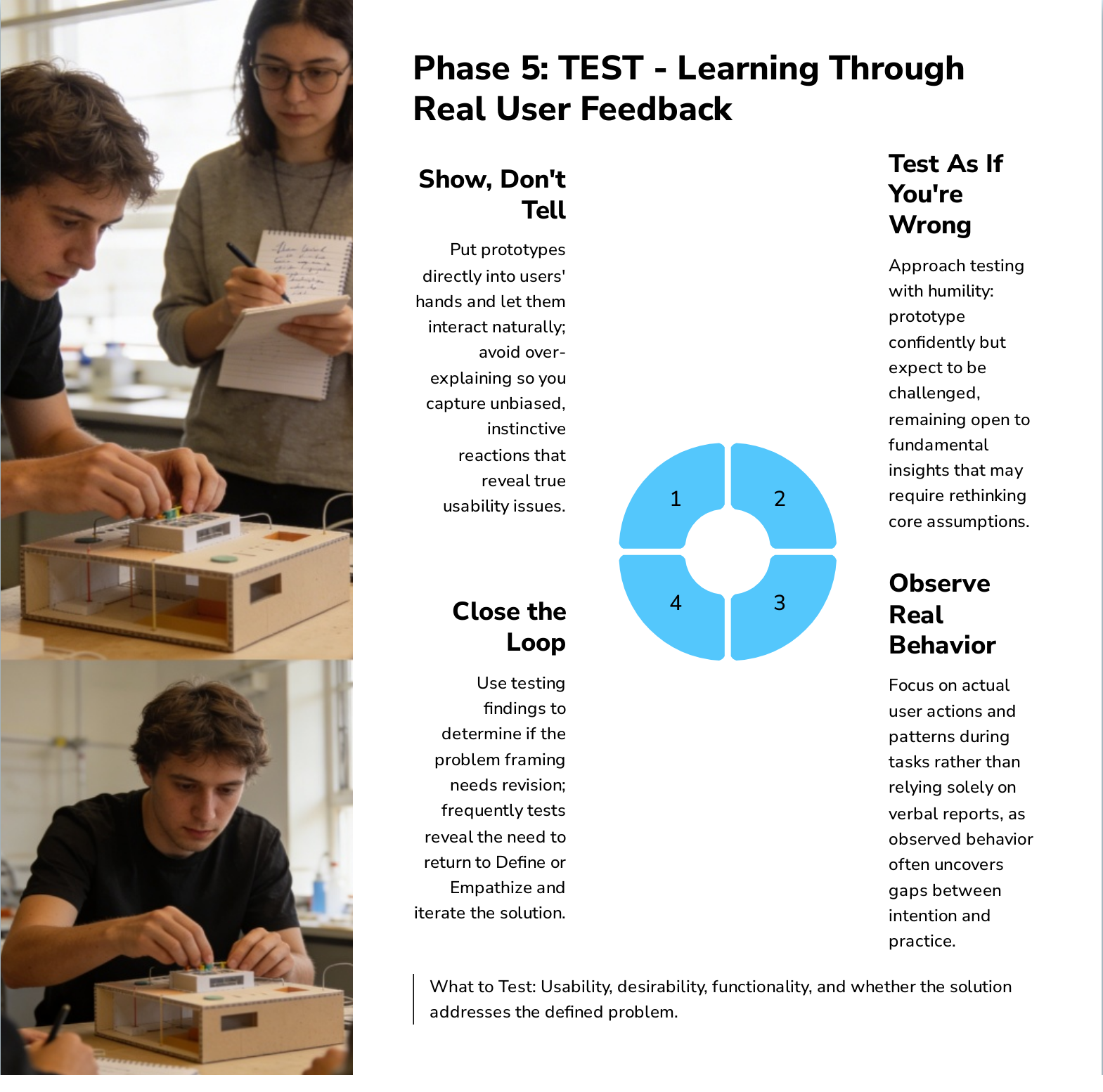
Slide 8: Phase 5: TEST - Learning Through Real User Feedback
- Show, Don't Tell: Put prototypes directly into users' hands and let them interact naturally; avoid over-explaining so you capture unbiased, instinctive reactions that reveal true usability issues.
- Test As If You're Wrong: Approach testing with humility: prototype confidently but expect to be challenged, remaining open to fundamental insights that may require rethinking core assumptions.
- Observe Real Behavior: Focus on actual user actions and patterns during tasks rather than relying solely on verbal reports, as observed behavior often uncovers gaps between intention and practice.
- Close the Loop: Use testing findings to determine if the problem framing needs revision; frequently tests reveal the need to return to Define or Empathize and iterate the solution.
What to Test: Usability, desirability, functionality, and whether the solution addresses the defined problem.
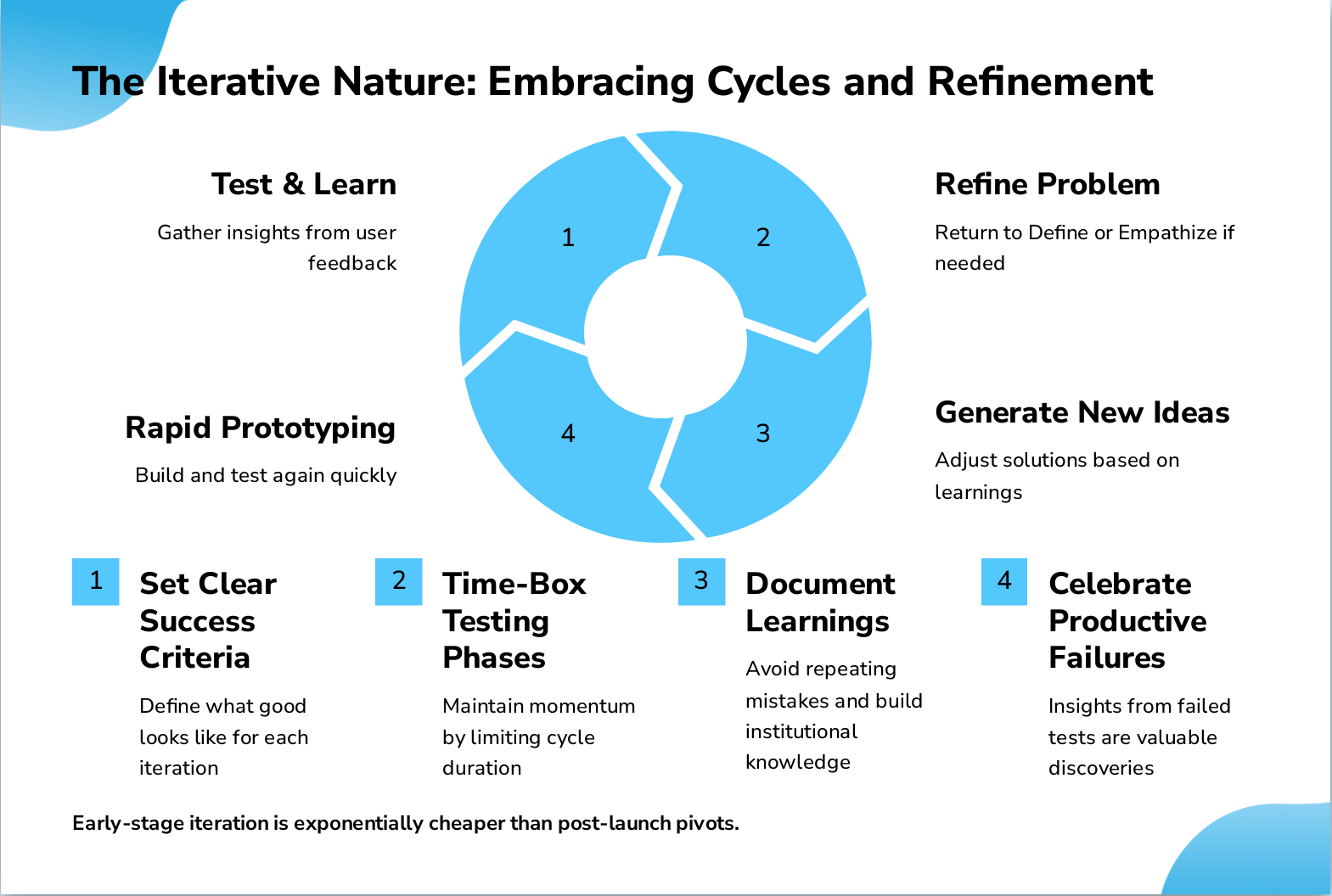
Slide 9: The Iterative Nature: Embracing Cycles and Refinement
- Test & Learn: Gather insights from user feedback
- Refine Problem: Return to Define or Empathize if needed
- Generate New Ideas: Adjust solutions based on learnings
- Rapid Prototyping: Build and test again quickly
- Set Clear Success Criteria: Define what good looks like for each iteration
- Time-Box Testing Phases: Maintain momentum by limiting cycle duration
- Document Learnings: Avoid repeating mistakes and build institutional knowledge
- Celebrate Productive Failures: Insights from failed tests are valuable discoveries
Early-stage iteration is exponentially cheaper than post-launch pivots.
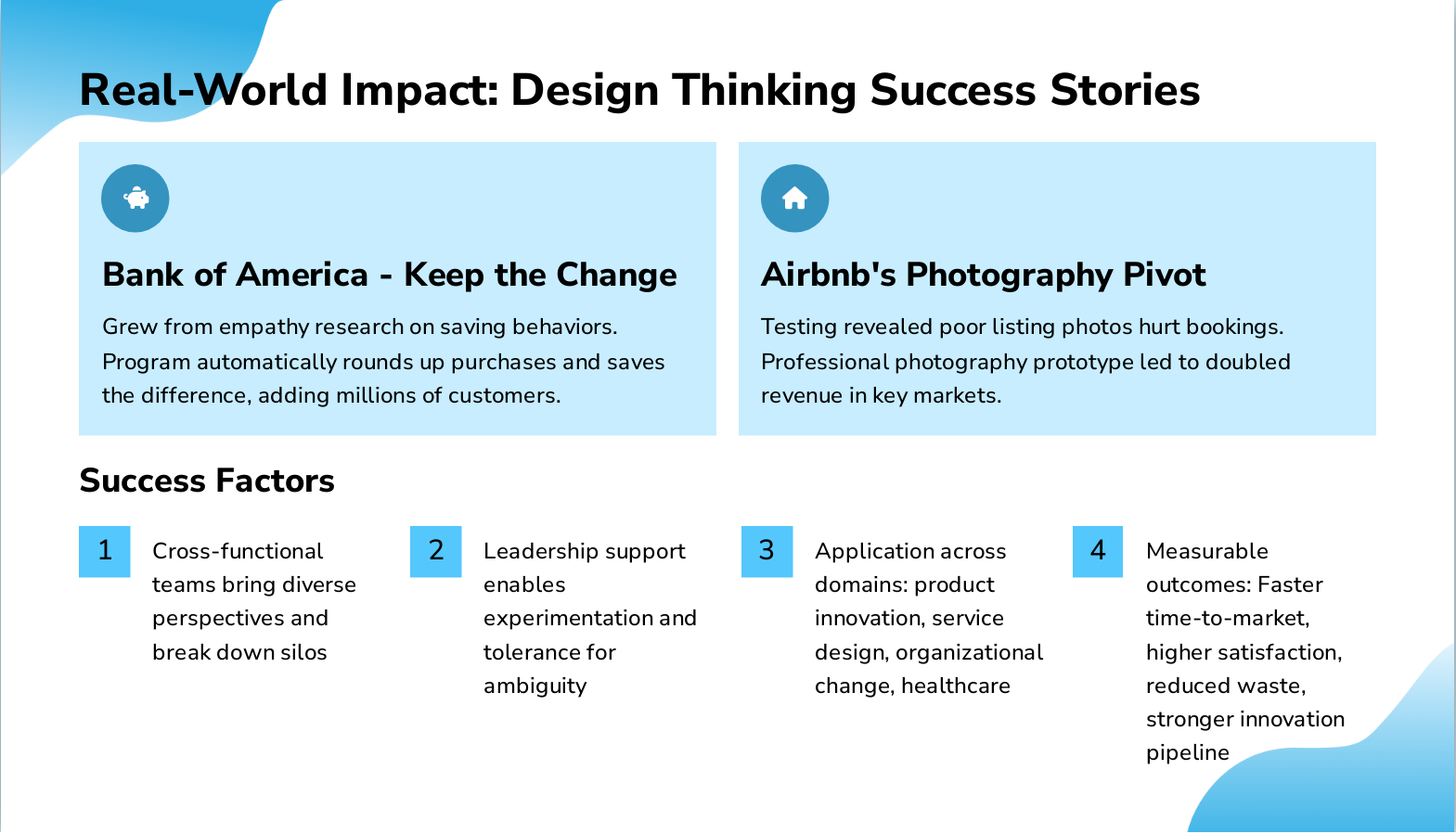
Slide 10: Real-World Impact: Design Thinking Success Stories
- Bank of America - Keep the Change: Grew from empathy research on saving behaviors. Program automatically rounds up purchases and saves the difference, adding millions of customers.
- Airbnb's Photography Pivot: Testing revealed poor listing photos hurt bookings. Professional photography prototype led to doubled revenue in key markets.
Slide 11: Thank You
Thank You Start your Design Thinking journey today. Empathize, Define, Ideate, Prototype, and Test your way to breakthrough innovation.