Presentation Summary
Essential Design Principles for Designers and Students: Mastering Visual Communication Through Strategic Color Application Understanding why color is the most powerful visual communication tool in digital interfaces. Master primary, secondary, and tertiary colors plus the RGB additive model for screen design. Learn how colors trigger emotions, influence behavior, and vary across cultural contexts globally. Implement contrast ratio standards to ensure inclusive design for all users including visually impaired. Color communicates meaning 60,000 times faster than text alone
Full Presentation Transcript
Slide 1: Color Theory in UI/UX Design
Essential Design Principles for Designers and Students: Mastering Visual Communication Through Strategic Color Application
Slide 2: Contents
- Color in Design: Understanding why color is the most powerful visual communication tool in digital interfaces.
- Color Wheel Fundamentals: Master primary, secondary, and tertiary colors plus the RGB additive model for screen design.
- Color Psychology: Learn how colors trigger emotions, influence behavior, and vary across cultural contexts globally.
- WCAG Accessibility: Implement contrast ratio standards to ensure inclusive design for all users including visually impaired.
Slide 3: Why Color Matters in Digital Design
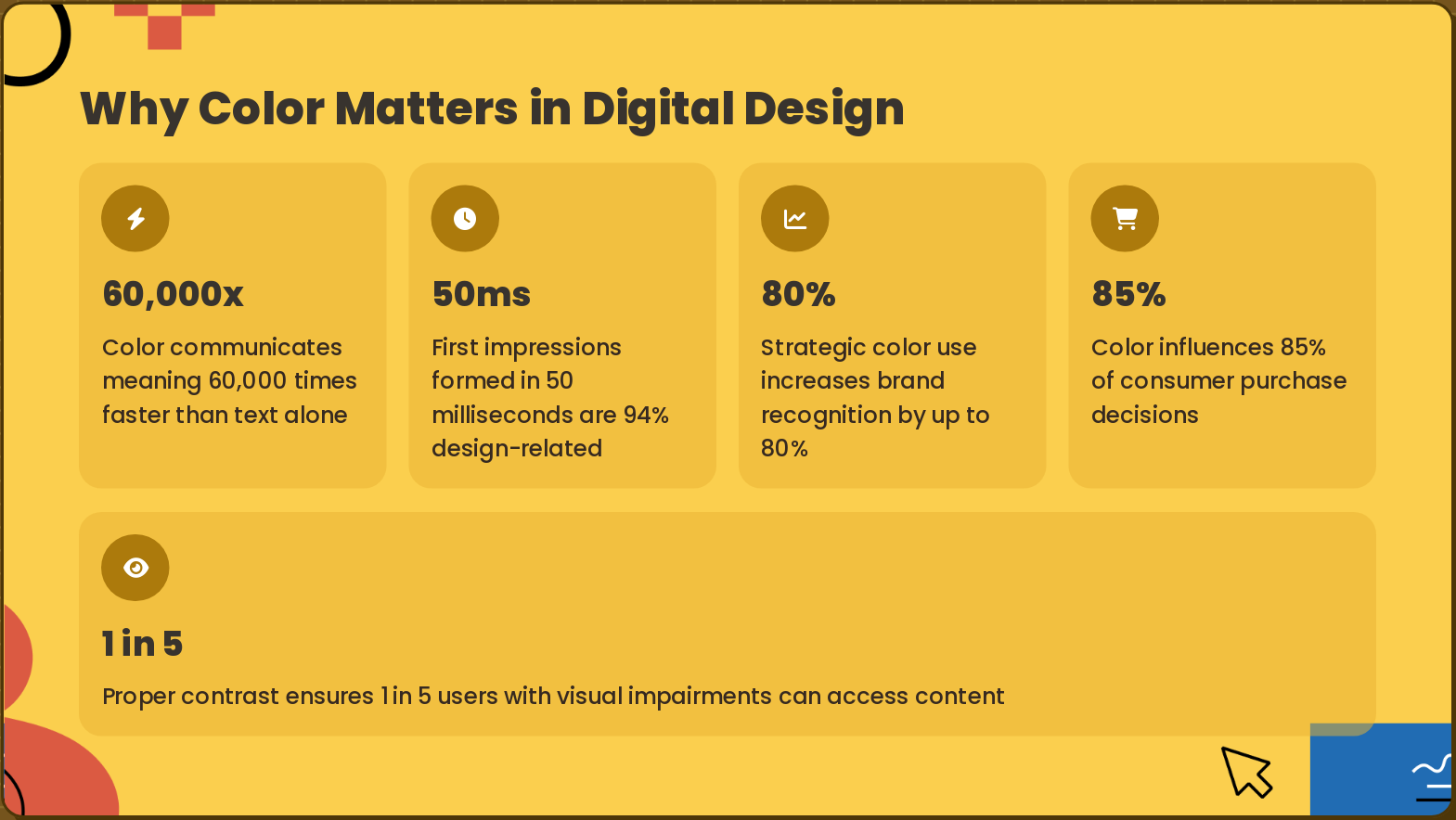
- 60,000x: Color communicates meaning 60,000 times faster than text alone
- 50ms: First impressions formed in 50 milliseconds are 94% design-related
- 80%: Strategic color use increases brand recognition by up to 80%
- 85%: Color influences 85% of consumer purchase decisions
- 1 in 5: Proper contrast ensures 1 in 5 users with visual impairments can access content
Slide 4: Color Wheel Fundamentals
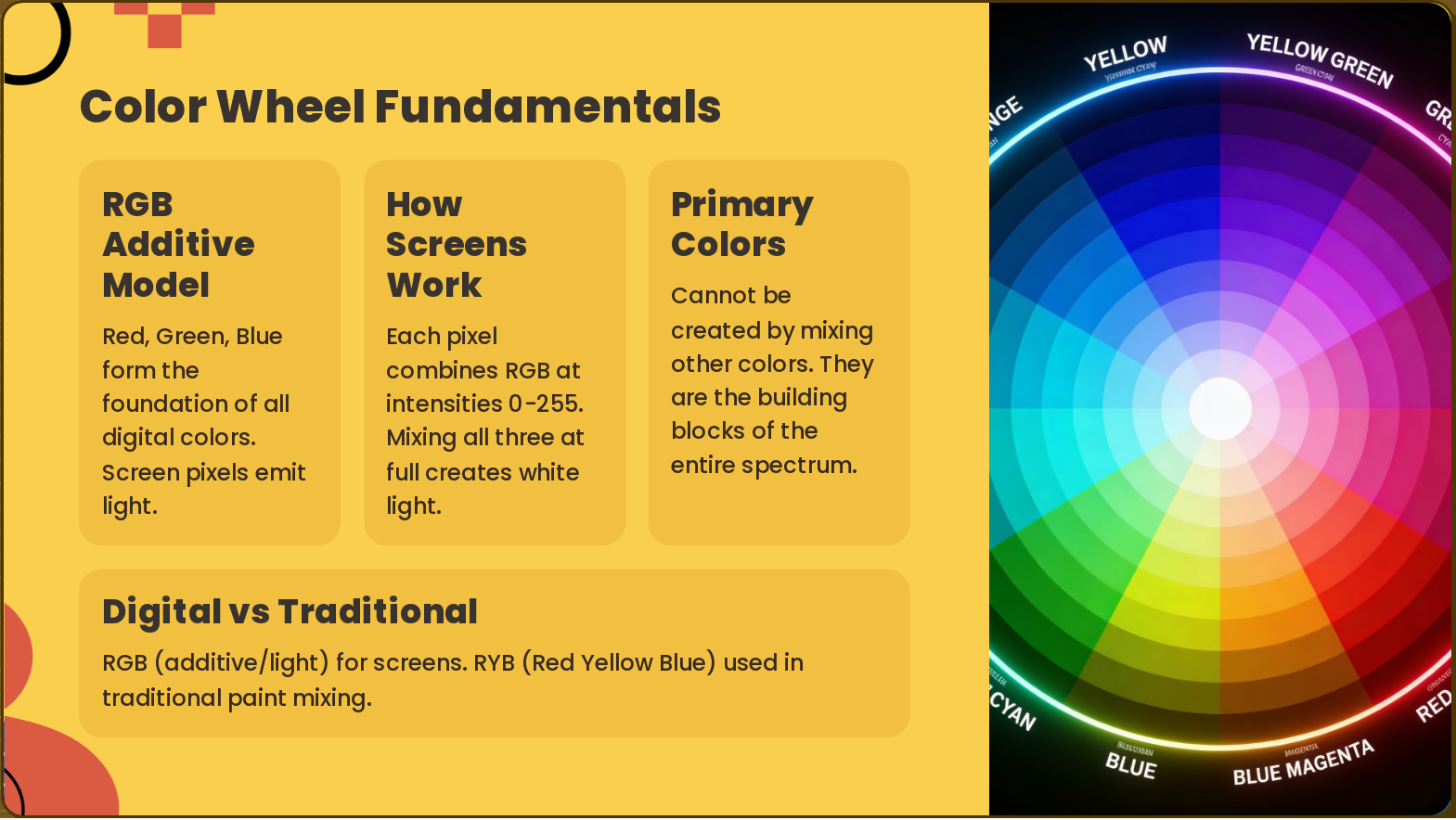
- RGB Additive Model: Red, Green, Blue form the foundation of all digital colors. Screen pixels emit light.
- How Screens Work: Each pixel combines RGB at intensities 0-255. Mixing all three at full creates white light.
- Primary Colors: Cannot be created by mixing other colors. They are the building blocks of the entire spectrum.
- Digital vs Traditional: RGB (additive/light) for screens. RYB (Red Yellow Blue) used in traditional paint mixing.
Slide 5: Color Wheel Overview
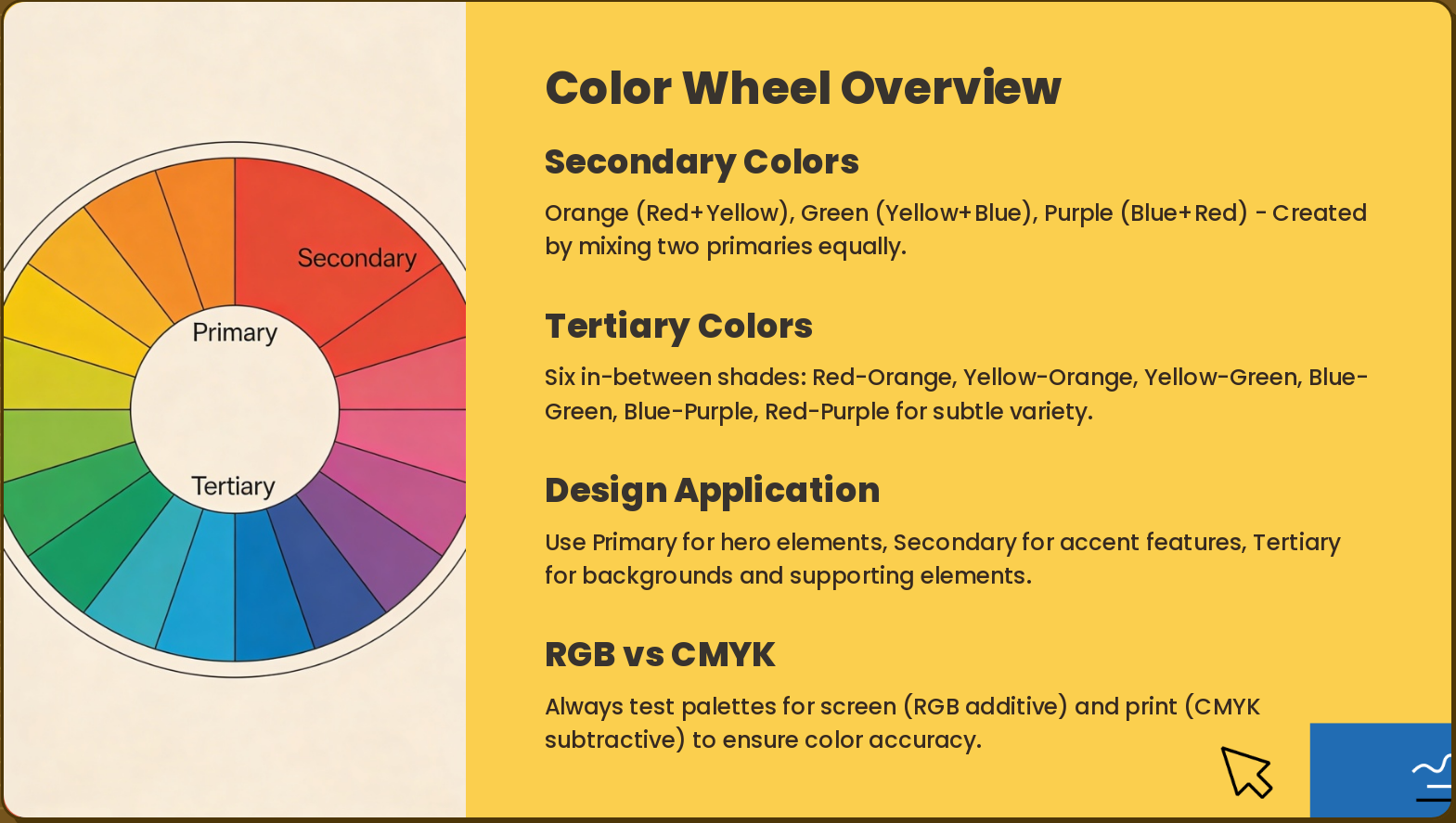
- Secondary Colors: Orange (Red+Yellow), Green (Yellow+Blue), Purple (Blue+Red) - Created by mixing two primaries equally.
- Tertiary Colors: Six in-between shades: Red-Orange, Yellow-Orange, Yellow-Green, Blue-Green, Blue-Purple, Red-Purple for subtle variety.
- Design Application: Use Primary for hero elements, Secondary for accent features, Tertiary for backgrounds and supporting elements.
- RGB vs CMYK: Always test palettes for screen (RGB additive) and print (CMYK subtractive) to ensure color accuracy.
Slide 6: Color Harmony Schemes: Strategic Combinations for Intentional Design
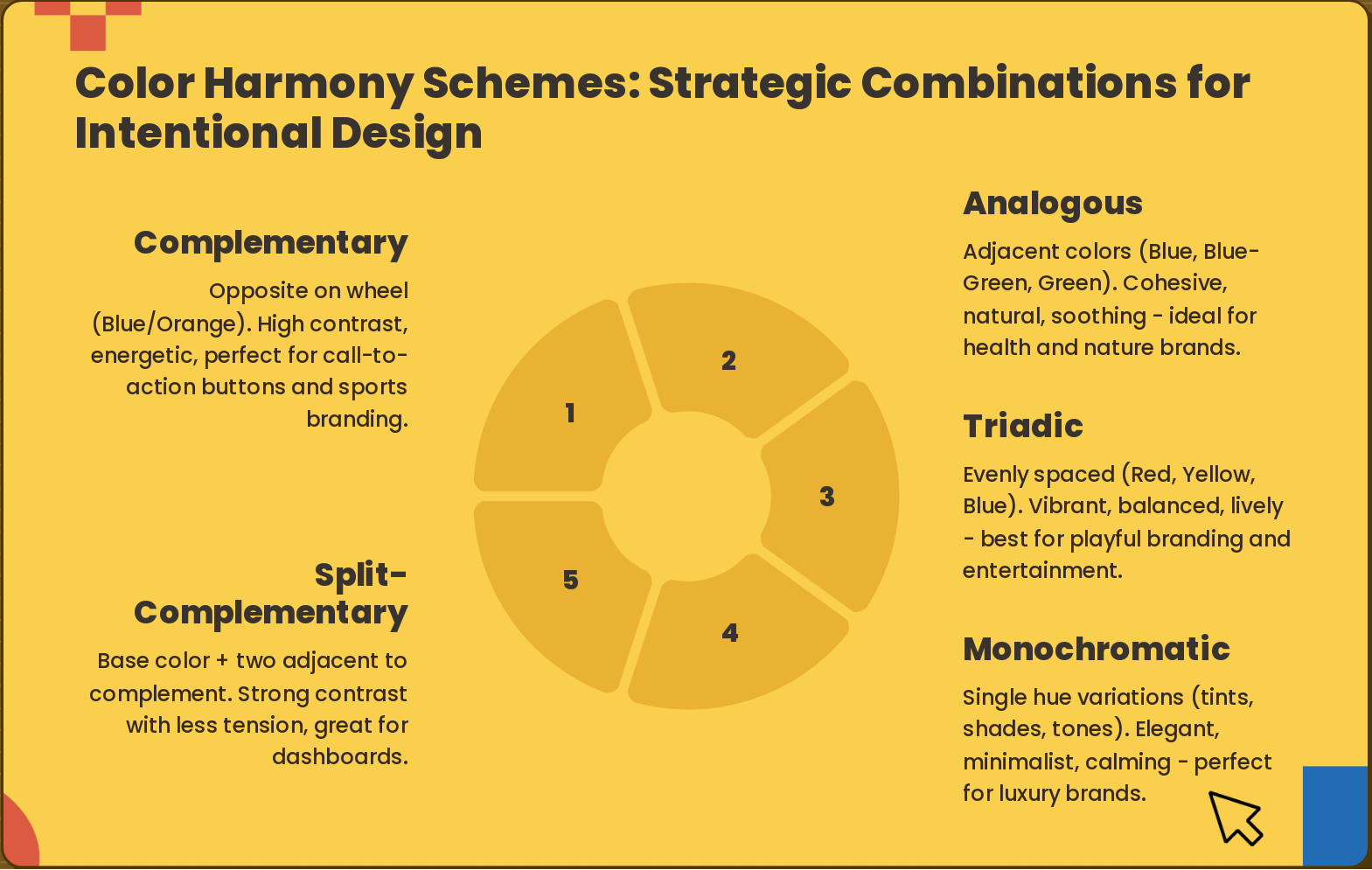
- Complementary: Opposite on wheel (Blue/Orange). High contrast, energetic, perfect for call-to-action buttons and sports branding.
- Analogous: Adjacent colors (Blue, Blue-Green, Green). Cohesive, natural, soothing - ideal for health and nature brands.
- Triadic: Evenly spaced (Red, Yellow, Blue). Vibrant, balanced, lively - best for playful branding and entertainment.
- Monochromatic: Single hue variations (tints, shades, tones). Elegant, minimalist, calming - perfect for luxury brands.
- Split-Complementary: Base color + two adjacent to complement. Strong contrast with less tension, great for dashboards.
Slide 7: Color Psychology: Emotions and Behaviors Triggered by Specific Hues
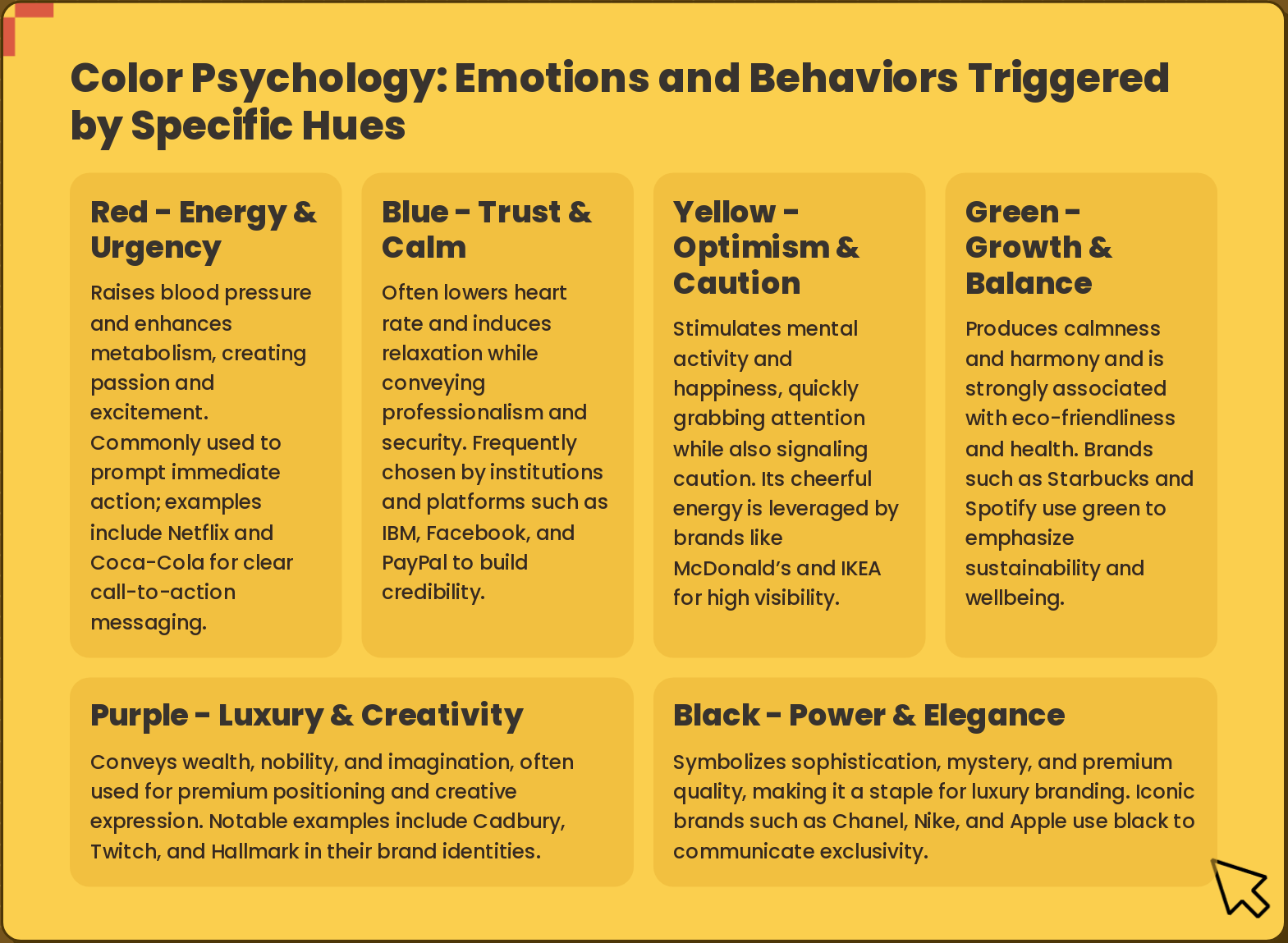
- Red - Energy & Urgency: Raises blood pressure and enhances metabolism, creating passion and excitement. Commonly used to prompt immediate action; examples include Netflix and Coca-Cola for clear call-to-action messaging.
- Blue - Trust & Calm: Often lowers heart rate and induces relaxation while conveying professionalism and security. Frequently chosen by institutions and platforms such as IBM, Facebook, and PayPal to build credibility.
- Yellow - Optimism & Caution: Stimulates mental activity and happiness, quickly grabbing attention while also signaling caution. Its cheerful energy is leveraged by brands like McDonald’s and IKEA for high visibility.
- Green - Growth & Balance: Produces calmness and harmony and is strongly associated with eco-friendliness and health. Brands such as Starbucks and Spotify use green to emphasize sustainability and wellbeing.
- Purple - Luxury & Creativity: Conveys wealth, nobility, and imagination, often used for premium positioning and creative expression. Notable examples include Cadbury, Twitch, and Hallmark in their brand identities.
- Black - Power & Elegance: Symbolizes sophistication, mystery, and premium quality, making it a staple for luxury branding. Iconic brands such as Chanel, Nike, and Apple use black to communicate exclusivity.
Slide 8: Cultural Context: Color Meanings Across Global Markets
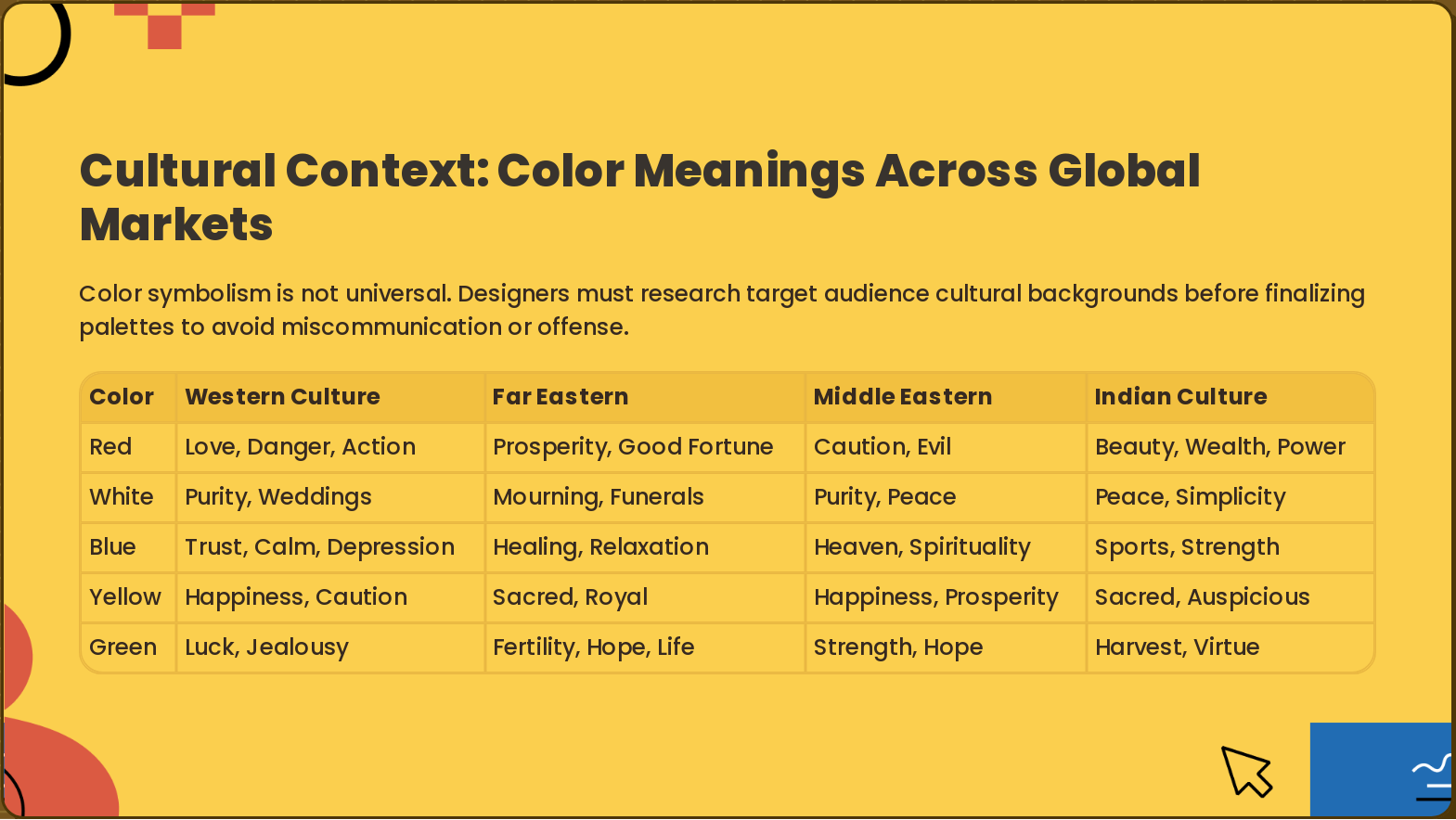
Color symbolism is not universal. Designers must research target audience cultural backgrounds before finalizing palettes to avoid miscommunication or offense.
- Color: Red, Western Culture: Love, Danger, Action, Far Eastern: Prosperity, Good Fortune, Middle Eastern: Caution, Evil, Indian Culture: Beauty, Wealth, Power
- Color: White, Western Culture: Purity, Weddings, Far Eastern: Mourning, Funerals, Middle Eastern: Purity, Peace, Indian Culture: Peace, Simplicity
- Color: Blue, Western Culture: Trust, Calm, Depression, Far Eastern: Healing, Relaxation, Middle Eastern: Heaven, Spirituality, Indian Culture: Sports, Strength
- Color: Yellow, Western Culture: Happiness, Caution, Far Eastern: Sacred, Royal, Middle Eastern: Happiness, Prosperity, Indian Culture: Sacred, Auspicious
- Color: Green, Western Culture: Luck, Jealousy, Far Eastern: Fertility, Hope, Life, Middle Eastern: Strength, Hope, Indian Culture: Harvest, Virtue
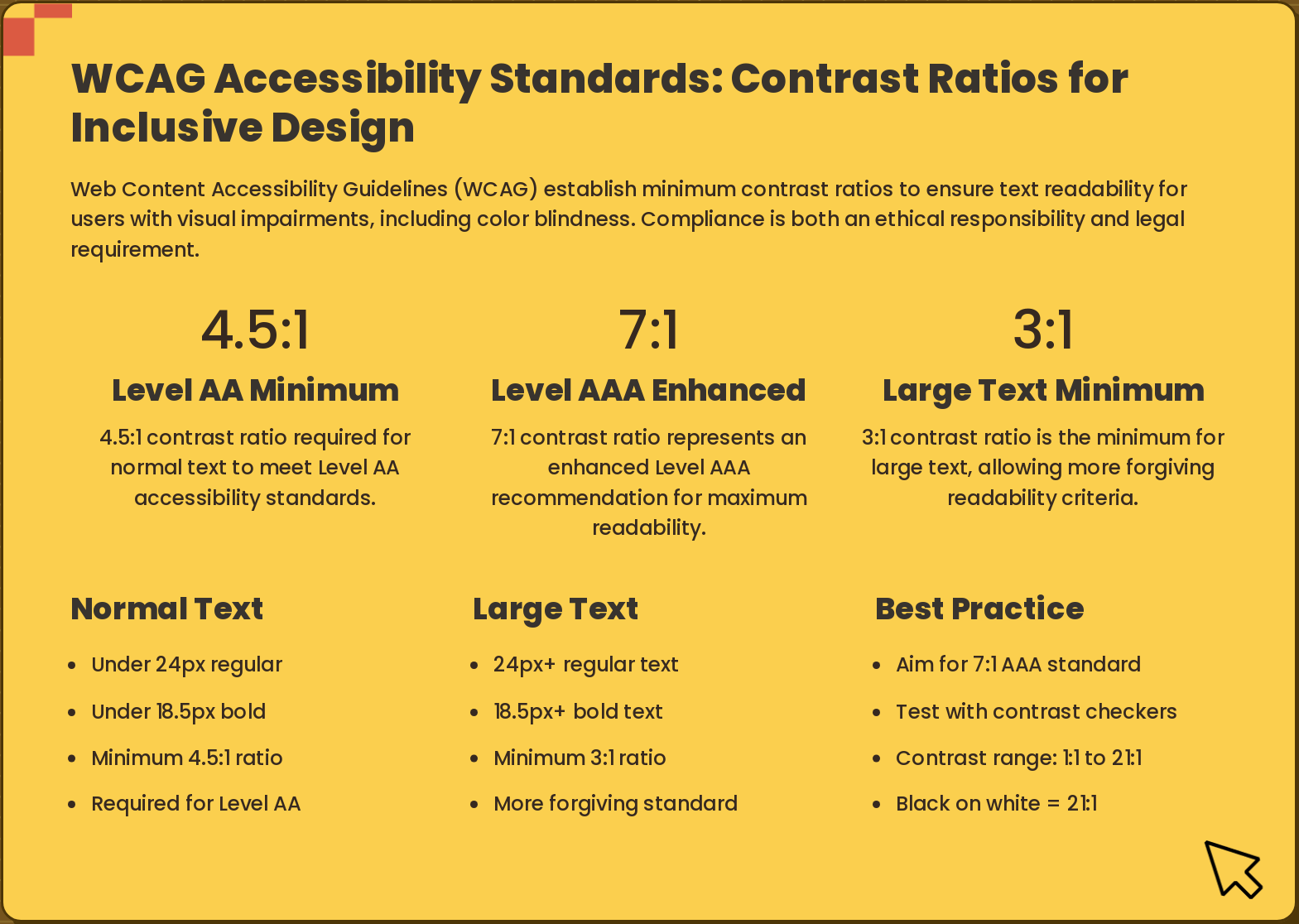
Slide 9: WCAG Accessibility Standards: Contrast Ratios for Inclusive Design
- 4.5:1 — Level AA Minimum
- 7:1 — Level AAA Enhanced
- 3:1 — Large Text Minimum
Web Content Accessibility Guidelines (WCAG) establish minimum contrast ratios to ensure text readability for users with visual impairments, including color blindness. Compliance is both an ethical responsibility and legal requirement.
Under 24px regular
Under 18.5px bold
Minimum 4.5:1 ratio
Required for Level AA
24px+ regular text
18.5px+ bold text
Minimum 3:1 ratio
More forgiving standard
Aim for 7:1 AAA standard
Test with contrast checkers
Contrast range: 1:1 to 21:1
Black on white = 21:1
- Under 24px regular
- Under 18.5px bold
- Minimum 4.5:1 ratio
- Required for Level AA
- 24px+ regular text
- 18.5px+ bold text
- Minimum 3:1 ratio
- More forgiving standard
- Aim for 7:1 AAA standard
- Test with contrast checkers
- Contrast range: 1:1 to 21:1
- Black on white = 21:1
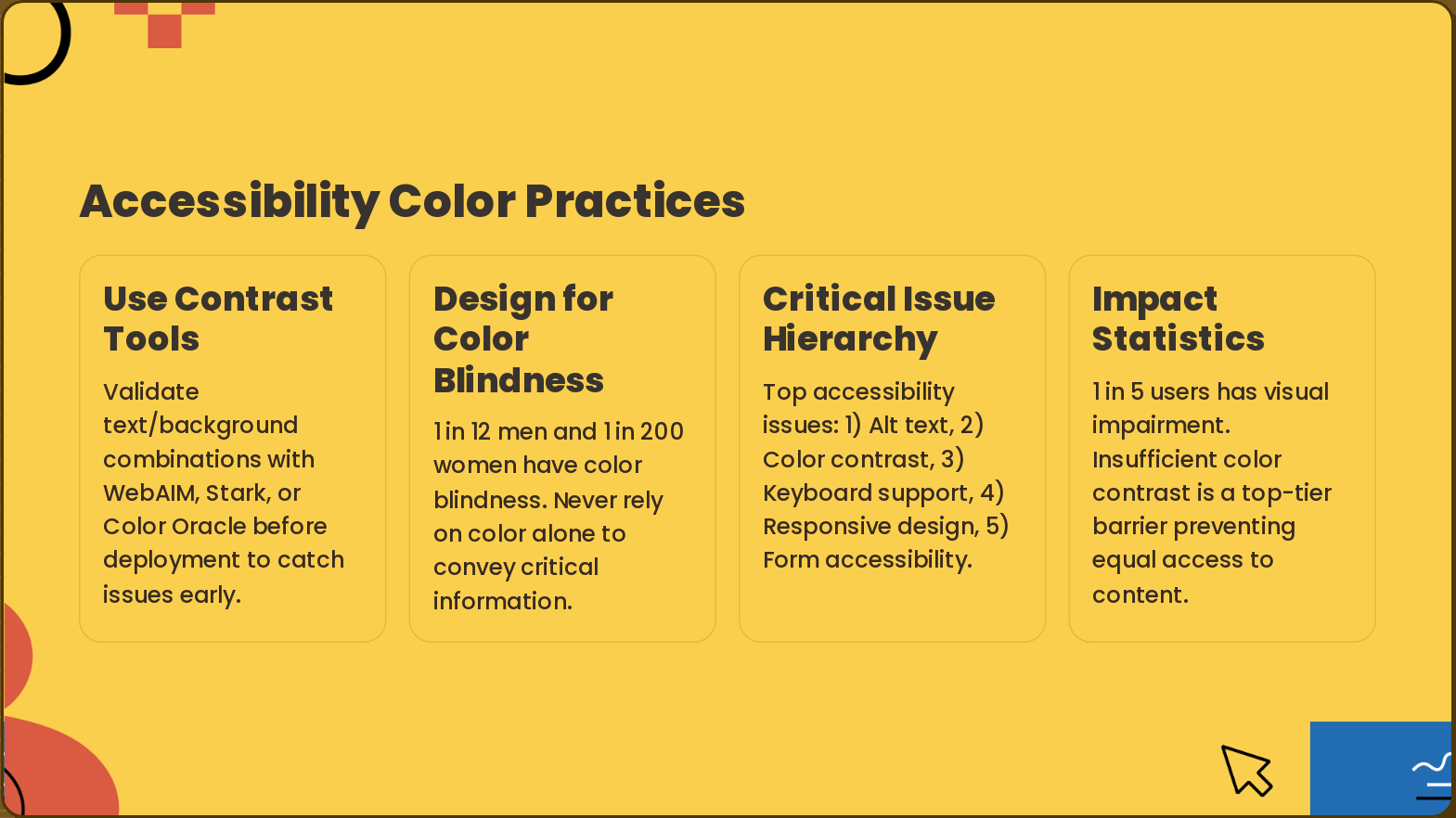
Slide 10: Accessibility Color Practices
- Use Contrast Tools: Validate text/background combinations with WebAIM, Stark, or Color Oracle before deployment to catch issues early.
- Design for Color Blindness: 1 in 12 men and 1 in 200 women have color blindness. Never rely on color alone to convey critical information.
- Critical Issue Hierarchy: Top accessibility issues: 1) Alt text, 2) Color contrast, 3) Keyboard support, 4) Responsive design, 5) Form accessibility.
- Impact Statistics: 1 in 5 users has visual impairment. Insufficient color contrast is a top-tier barrier preventing equal access to content.
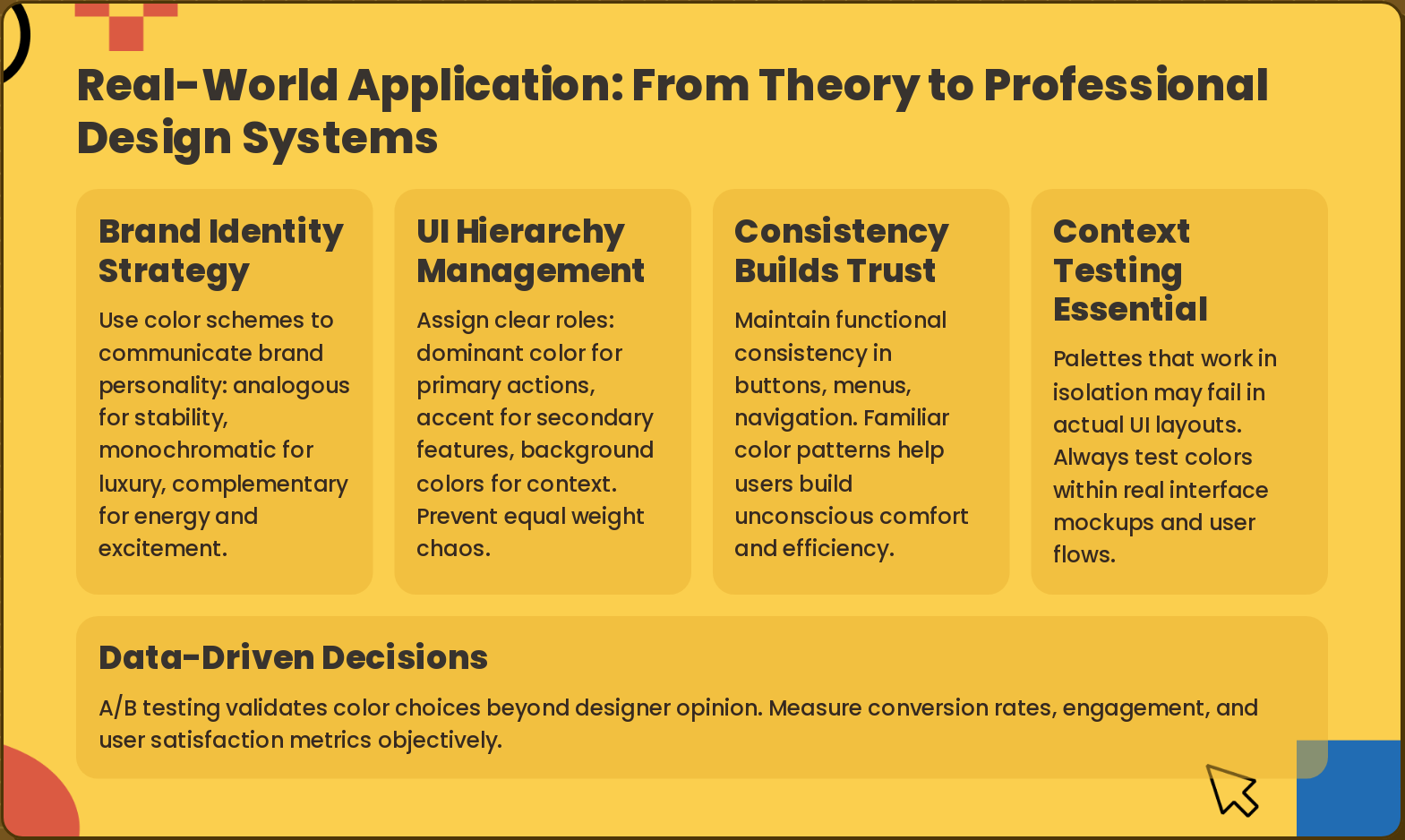
Slide 11: Real-World Application: From Theory to Professional Design Systems
- Brand Identity Strategy: Use color schemes to communicate brand personality: analogous for stability, monochromatic for luxury, complementary for energy and excitement.
- UI Hierarchy Management: Assign clear roles: dominant color for primary actions, accent for secondary features, background colors for context. Prevent equal weight chaos.
- Consistency Builds Trust: Maintain functional consistency in buttons, menus, navigation. Familiar color patterns help users build unconscious comfort and efficiency.
- Context Testing Essential: Palettes that work in isolation may fail in actual UI layouts. Always test colors within real interface mockups and user flows.
- Data-Driven Decisions: A/B testing validates color choices beyond designer opinion. Measure conversion rates, engagement, and user satisfaction metrics objectively.
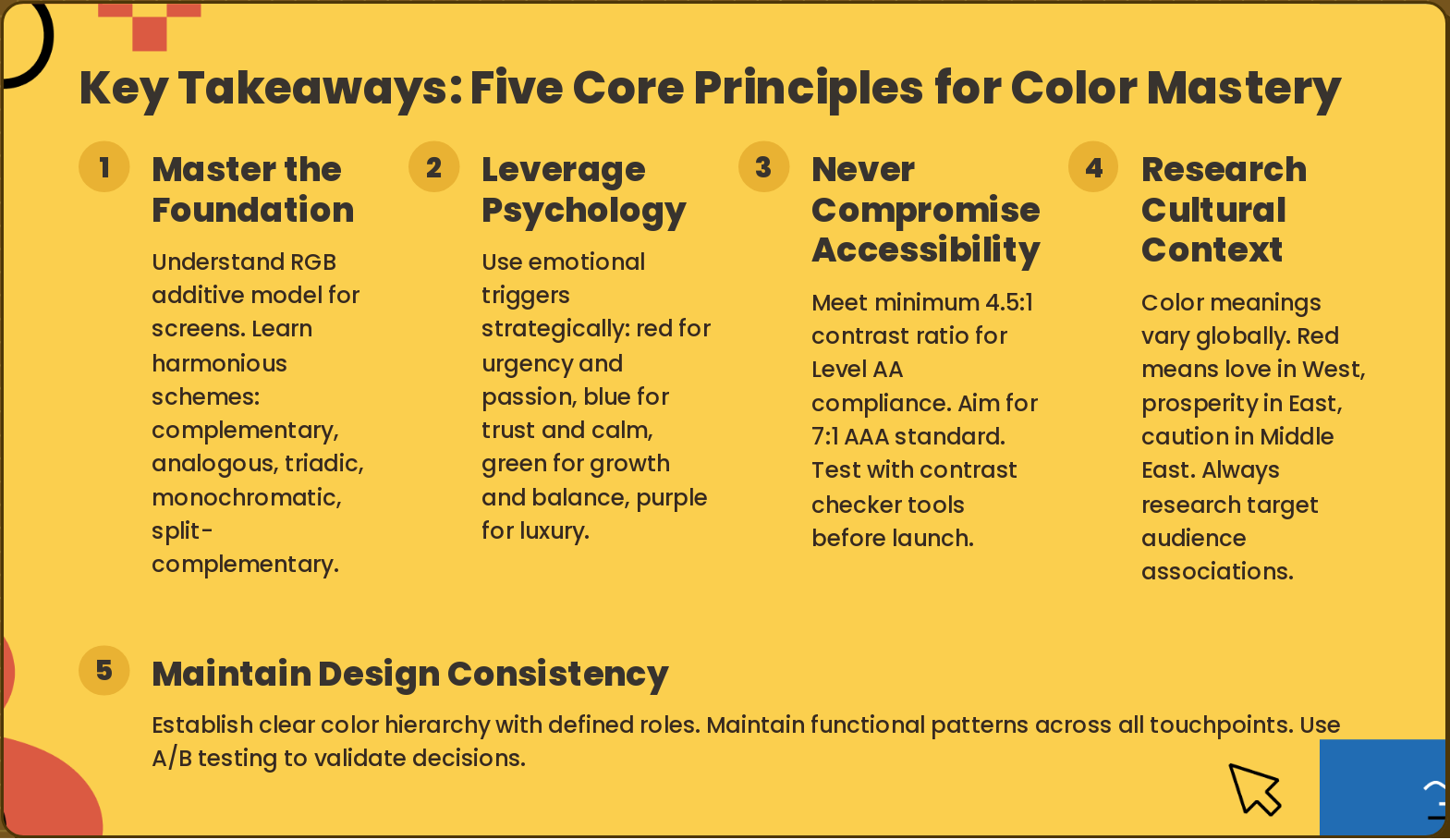
Slide 12: Key Takeaways: Five Core Principles for Color Mastery
- Master the Foundation: Understand RGB additive model for screens. Learn harmonious schemes: complementary, analogous, triadic, monochromatic, split-complementary.
- Leverage Psychology: Use emotional triggers strategically: red for urgency and passion, blue for trust and calm, green for growth and balance, purple for luxury.
- Never Compromise Accessibility: Meet minimum 4.5:1 contrast ratio for Level AA compliance. Aim for 7:1 AAA standard. Test with contrast checker tools before launch.
- Research Cultural Context: Color meanings vary globally. Red means love in West, prosperity in East, caution in Middle East. Always research target audience associations.
- Maintain Design Consistency: Establish clear color hierarchy with defined roles. Maintain functional patterns across all touchpoints. Use A/B testing to validate decisions.