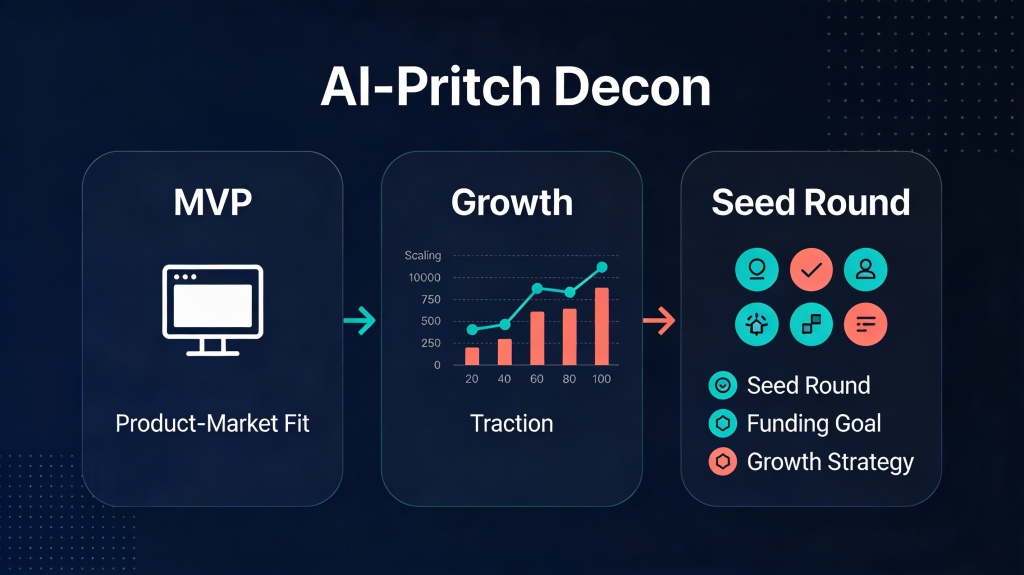
How to Present to Investors: AI Slide Wording Checklist
June 23, 2026
AI can create a pitch deck fast, but investors still judge the wording: what you claim, what you prove, what you avoid, and how quickly they can understand the opportunity. A polished design cannot rescue vague claims like "huge market" or "disruptive platform" if the slide does not answer the investor’s real question.
This checklist is for founders using AI-generated or AI-assisted decks who need investor-ready wording. Each slide should answer one investor question, make one main claim, and support that claim with a concrete signal where possible: a customer quote you can verify, a usage pattern, a revenue model, a pilot, a waitlist, a defensible market segment, or a clear operational milestone.
PopAi AI Presentation can help you move from rough startup notes, a one-line idea, or a business document into an editable pitch deck structure. The founder’s job is then to verify every number, remove inflated language, sharpen the story, and adapt the wording for either an emailed deck or a live investor meeting.
When you are ready to turn the workflow into slides, PopAi AI Presentation can help transform rough notes, documents, or prompts into an editable deck structure.
Quick Answer: Investor Slide Wording Should Be Clear, Specific, and Evidence-Led
Use this core rule before editing any AI-generated investor slide.
The simplest test for investor slide wording is this: can a busy investor understand the point of the slide in five seconds, and can you defend the claim in a follow-up conversation? If the answer is no, the wording needs another pass.
AI tools are helpful at the blank-page stage because they can organize a startup story into a recognizable deck sequence. They can draft headlines, compress long notes into slide bullets, and suggest investor-facing language. But AI will often sound too broad unless you give it specific context and review every claim.
- One slide should answer one investor question, such as "Who has this problem?" or "How will this company make money?"
- One slide should make one main claim, not three competing claims.
- The body copy should support the headline with evidence, explanation, or a clear next step.
- Numbers should appear only when they are sourced, calculated, or otherwise defensible.
- Qualitative wording is acceptable when the company is early, but it should be honest: use "early customer interest" instead of pretending to have proven demand.
- Superlatives should be removed unless you can support them with credible evidence.
A credible pitch deck does not need to sound timid. It needs to sound precise.
For example, an AI draft might say, "We are transforming the future of healthcare with an innovative AI platform." That sounds ambitious, but it gives an investor little to evaluate. A more useful version would say, "Our software helps small clinics reduce manual intake work by converting patient forms into structured visit notes for staff review." The second version names the customer, the workflow, and the value.
Before polishing design, read only the slide headlines in order. If the headlines do not tell a coherent investor story, revise the wording before changing colors, icons, or layouts.
The Investor Slide Checklist: What Each Slide Needs to Say
Each common pitch deck slide has a wording job and an investor question it must answer.
A pitch deck is not a brochure. Investors are reading for risk, evidence, speed of learning, and potential return. The wording should help them decide whether the opportunity is worth a meeting, a second meeting, or a deeper diligence process.
- Title slide: answer "What is this company and why should I keep reading?" Use a short company description, not a slogan alone. Example: "Workflow software for independent dental clinics" is clearer than "The future of dental operations."
- Problem slide: answer "Who feels the pain and how often?" Name a specific customer and a specific pain. Avoid broad social trends unless they directly create the purchasing need.
- Solution slide: answer "What do you do about that pain?" Use plain language. Explain the outcome before listing features.
- Product slide: answer "How does it work in practice?" Show the workflow, screenshot, demo steps, or user journey. Use labels that explain the user action.
- Market slide: answer "How large is the reachable opportunity?" Define the target segment first. Do not lead with a giant market number if you cannot defend how your company reaches it.
- Business model slide: answer "Who pays, how much, and why?" State the pricing logic, buyer, and purchasing trigger.
- Traction slide: answer "What proof exists?" Use verified signals: revenue, pilots, usage, retention, letters of intent, waitlist quality, repeat customers, or qualified pipeline.
- Go-to-market slide: answer "How will you acquire customers efficiently?" Describe a channel with a reason it fits your buyer. Avoid "social media and partnerships" unless you can explain the mechanism.
- Competition slide: answer "Why can you win despite alternatives?" Compare against the way customers solve the problem today, not only direct startups.
- Team slide: answer "Why this team?" Tie founder experience to the customer, product, distribution, or technical challenge.
- Financials or roadmap slide: answer "What must happen next?" Use realistic milestones, assumptions, and sequencing. Early-stage financials should show logic, not false precision.
- Ask slide: answer "What are you raising and what will it accomplish?" State the amount, use of funds, runway or milestone target if appropriate, and what progress the round is designed to unlock.
Some slides should be headline-led. The title, problem, solution, traction, and ask slides need crisp headlines because investors often skim these first. Other slides can carry slightly more explanation, especially in a send-ahead deck where you are not present to provide context.
The problem slide is where AI often becomes too abstract. A weak AI-generated slide might say, "Businesses struggle with inefficiency and outdated processes." A stronger version says, "Independent clinics spend staff hours re-entering intake information because patient forms, scheduling tools, and visit notes do not connect." The second version creates a clearer picture of the pain and buyer.
- Use concise headlines for: problem, solution, traction, team fit, and ask.
- Use supporting bullets for: product workflow, business model, go-to-market, and roadmap.
- Use numbers on: traction, market, pricing, financials, and use of funds only when you can explain the source or calculation.
- Use qualitative proof on: customer discovery, early pilots, product feedback, and expert validation when the company is pre-revenue.
- Remove unsupported phrases such as "massive opportunity," "seamless experience," "revolutionary platform," and "game-changing solution" unless the sentence also explains what is true and verifiable.
If a slide could apply to hundreds of startups after changing the logo, it is not specific enough for investors.
How to Use AI to Draft the Deck Without Losing Investor Credibility
A strong AI workflow uses automation for structure and speed, then human review for truth, strategy, and investor judgment.
A useful AI deck workflow starts with context, not a blank prompt. Give the tool your product description, customer notes, market hypothesis, team background, early traction, and fundraising goal. The more specific the input, the less generic the first draft.
- Collect your source material: product notes, customer discovery summaries, pricing assumptions, screenshots, founder bios, early traction, and fundraising goal.
- Start in PopAi AI Presentation from a prompt or upload a source document that explains the startup.
- Ask for a 10 to 12 slide investor pitch deck with one investor question per slide.
- Review the generated outline before editing visual design. Confirm the sequence matches your story.
- Revise slide headlines so each one makes one clear claim.
- Replace generic bullets with company-specific evidence, customer language, product details, or honest qualitative signals.
- Flag every market number, traction claim, forecast, and customer statement for verification.
- Export or continue polishing the deck after the wording is credible.
Here is a realistic PopAi workflow example. Context: a B2B SaaS founder has a rough idea, five customer interview notes, a screenshot of the MVP, and a deadline to send a deck to an angel investor by Friday. Action: the founder pastes the notes into PopAi AI Presentation and asks for a 12-slide seed-stage deck. The first draft creates a logical sequence: problem, solution, product, market, business model, traction, go-to-market, competition, team, roadmap, ask. Result: the founder has an editable deck in minutes instead of staring at a blank page, but still needs to tighten claims and verify numbers.
A second workflow looks different. Context: a healthcare researcher is turning a grant-supported prototype into a startup pitch and has a technical document, clinical workflow notes, and early conversations with two pilot sites. Action: she uploads the document into PopAi AI Presentation and asks for investor-facing wording in plain language, with technical terms explained and regulatory claims flagged for review. Result: the draft translates the research into a product story, but the founder must remove any unsupported clinical performance claims and replace them with careful wording about development stage, pilot interest, and next validation steps.
- Prompt for structure: "Create a 10-slide investor pitch deck for an early-stage company. Each slide should answer one investor question and make one main claim."
- Prompt for tone: "Use plain investor language. Avoid unsupported superlatives, buzzwords, and promotional phrasing."
- Prompt for evidence: "Flag any claim that needs a source, customer proof, financial calculation, or founder verification."
- Prompt for concision: "Rewrite each slide headline in fewer than 12 words and each bullet in fewer than 18 words where possible."
- Prompt for send-ahead use: "Add enough context for an investor to understand the deck without a live presentation, but keep slides scannable."
- Prompt for live use: "Create shorter slide text and separate speaker notes so I do not read from the slide."
Use AI to get to a reviewable draft faster. Do not use it to outsource your judgment about the business.
The human review loop is where credibility is built. Verify every number. Replace broad phrases with customer-specific details. Change "users love our product" to a real signal you can defend, such as "six beta users completed onboarding and three requested team access" if that is true. If you do not have the metric, use careful qualitative language.
Ask AI to generate a separate list called "claims to verify." That list often reveals which slides are too dependent on assumptions.
Slide-by-Slide Wording Examples Founders Can Reuse
These fictional examples show wording patterns, not performance claims, so adapt them to your real business evidence.
The examples below are intentionally generic enough to adapt but specific enough to show the difference between weak AI wording and investor-ready wording. Do not copy the metrics or claims unless they are true for your company.
- Problem slide weak wording: "The education system is broken and teachers need better tools." Why it fails: too broad, emotionally loaded, and not tied to a buyer or workflow.
- Problem slide stronger wording: "Middle school science teachers spend evenings adapting lessons for mixed reading levels because district materials are not differentiated." Why it works: it names a user, task, pain, and context.
- Solution slide weak wording: "Our AI platform makes learning seamless and personalized for everyone." Why it fails: buzzwords without a concrete workflow.
- Solution slide stronger wording: "Teachers upload a lesson objective and receive three reading-level versions, a short quiz, and discussion prompts they can edit." Why it works: it explains what the user does and receives.
- Traction slide weak wording: "We have strong market validation and growing demand." Why it fails: no evidence.
- Traction slide stronger wording if metrics exist: "Pilot teachers used the lesson generator across four consecutive weekly units and requested export to Google Classroom." Why it works: it describes behavior rather than hype.
- Traction slide stronger wording if metrics do not exist yet: "Early discovery calls point to recurring demand for faster differentiated lesson prep; next step is a structured classroom pilot." Why it works: it is honest about stage and next validation.
The market slide needs special care because AI often creates inflated language. A weak market slide might say, "We are targeting a multi-billion-dollar global education market." That may be true in a broad sense, but it does not explain your reachable customer. A stronger wording pattern is: "Initial market: U.S. middle school science departments using digital curriculum tools, reached through district pilots and teacher-led adoption." This narrows the segment and makes the go-to-market logic easier to evaluate.
- Business model weak wording: "We will monetize through subscriptions and partnerships." Why it fails: it does not say who pays.
- Business model stronger wording: "Schools pay an annual subscription per teacher seat after a department pilot; pricing will be tested against curriculum budget cycles." Why it works: it names buyer, unit, and purchasing context.
- Competition weak wording: "We have no direct competitors." Why it fails: investors know customers already solve the problem somehow.
- Competition stronger wording: "Teachers currently use manual lesson adaptation, generic AI chat tools, and curriculum add-ons; our focus is editable standards-aligned variants inside the teacher workflow." Why it works: it respects alternatives and clarifies differentiation.
- Fundraising ask weak wording: "We are raising funds to scale and dominate the market." Why it fails: vague use of funds and inflated tone.
- Fundraising ask stronger wording: "Raising $X to complete classroom pilots, ship district admin features, and hire the first customer success lead." Why it works: it connects the round to milestones. Replace $X only with your real target.
For SaaS, the strongest wording usually connects the pain to a workflow, budget owner, and measurable business outcome. For healthcare, wording must be more cautious about clinical, regulatory, and patient outcome claims. For consumer products, the deck should show who buys, why now, evidence of demand, and repeat purchase logic. For B2B services, investors will look for repeatability beyond founder-led delivery.
- SaaS adaptation: emphasize workflow pain, buyer, integration, retention signal, and expansion path.
- Education technology adaptation: emphasize classroom workflow, budget cycle, teacher adoption, student privacy, and implementation burden.
- Healthcare adaptation: emphasize user workflow, validation stage, compliance considerations, and careful claims about outcomes.
- Consumer product adaptation: emphasize customer segment, purchase trigger, channel, margin logic, and repeat behavior.
- B2B services adaptation: emphasize packaged offering, sales process, delivery system, customer proof, and path to scalable margins.
The best early-stage wording is sometimes qualitative. A truthful sentence about customer discovery is stronger than an invented metric.
What to Cut From an AI Pitch Deck Before Investors See It
Most weak AI-assisted decks fail because they keep language that sounds polished but proves nothing.
AI drafts often include filler because the tool is trying to be helpful with limited context. Your job is to remove anything that does not help an investor understand the business, risk, timing, or evidence.
- Cut generic market claims such as "massive opportunity" unless you define the customer segment and purchasing trigger.
- Cut buzzwords such as "seamless," "next-generation," "cutting-edge," and "innovative" when they replace a real explanation.
- Cut inflated TAM language if you cannot explain how the number was calculated and what portion is reachable.
- Cut vague traction such as "strong interest" unless you specify the source, quality, or next step of that interest.
- Cut overstuffed bullets that combine product, market, traction, and vision in one paragraph.
- Cut repetitive phrasing where every slide starts with "Our platform enables..."
- Cut decorative slides that do not answer an investor question.
- Cut unsupported rankings, invented customer quotes, unverified competitor claims, and precise projections that cannot be defended.
Each of these problems hurts confidence in a different way. Generic market claims make the founder look unfocused. Buzzwords hide the actual product. Inflated TAM language suggests weak investor judgment. Vague traction makes investors wonder whether the founder is overstating progress. Overstuffed bullets make the deck hard to read and harder to remember.
- Replace "huge market opportunity" with "initial target: operations teams at multi-location dental groups that still process intake forms manually."
- Replace "AI-powered automation platform" with "software that extracts customer requests from support emails and drafts categorized replies for human review."
- Replace "customers love us" with a verifiable signal, such as usage, renewal, pilot request, referral, or a real quote you have permission to use.
- Replace "no competitors" with "customers currently solve this with spreadsheets, agencies, or generic tools; our wedge is faster setup for this workflow."
- Replace "we project rapid growth" with the assumptions behind growth: number of salespeople, conversion rate, deal size, onboarding capacity, or channel partner activity.
Slide headlines deserve their own edit. A headline is not a label like "Problem" or "Market." It should state the point of the slide. Instead of "Problem," write "Small clinics lose staff time to disconnected intake workflows." Instead of "Traction," write "Pilot users are returning weekly to complete core workflows" if that is true.
- Can the investor understand the headline in five seconds?
- Does the headline make one claim rather than three?
- Does the body copy support the headline?
- Is the claim specific to your company and customer?
- Would you be comfortable defending this slide in live Q&A?
- If a number appears, can you explain the source, date, and calculation?
- If a quote appears, is it real, approved, and accurately represented?
Remove any AI-generated claim you would not say out loud to a skeptical investor.
Prepare the Live Investor Presentation From the Same AI Deck
The same deck structure can support email review and live presentation, but the wording should change by format.
A send-ahead deck must stand on its own. It needs enough context for an investor to understand the problem, product, evidence, and ask without you in the room. A live deck should be cleaner because you can explain nuance verbally. If you use the same dense send-ahead slides in a live meeting, the investor may read ahead instead of listening.
- Send-ahead deck: slightly fuller headlines, clearer labels, short explanatory bullets, and fewer assumptions left unstated.
- Live deck: shorter headlines, fewer bullets, stronger visuals, and speaker notes for details.
- Send-ahead traction slide: include context for what the metric or signal means.
- Live traction slide: show the strongest proof visually and explain the interpretation verbally.
- Send-ahead ask slide: include amount, use of funds, and milestone target.
- Live ask slide: keep the ask clear, then discuss details in conversation.
Do not read slides word for word. Turn bullets into speaker notes by expanding the reasoning behind each claim. If the slide says, "Initial wedge: independent clinics with manual intake," your speaker note might explain how you discovered the pain, why that segment buys faster, and what must be true to expand to larger groups.
- Present the AI-generated draft once without stopping, as if the investor were on the call.
- Mark every slide where you hesitated, over-explained, or felt exposed.
- Shorten headlines that are labels rather than claims.
- Add proof points where the slide currently depends on assertion.
- Prepare answers for likely investor questions tied to each slide.
- Create a shorter live version if the current deck was written for email review.
- Practice the opening two minutes until the problem, customer, and product are clear without sounding memorized.
- Problem slide likely question: "How often does this pain occur, and who has budget to solve it?"
- Solution slide likely question: "Why is your approach meaningfully better than current alternatives?"
- Business model likely question: "What are the margin assumptions and what costs scale with customers?"
- Go-to-market likely question: "What will customer acquisition cost, and what evidence supports that channel?"
- Competition likely question: "What prevents a larger company or generic AI tool from solving this?"
- Healthcare or regulated product likely question: "What regulatory, compliance, or adoption risks could slow deployment?"
- Ask slide likely question: "How will this funding change the company’s risk profile by the next round?"
AI can help you prepare for objections. After drafting in PopAi AI Presentation, copy the slide outline into an AI prompt and ask for skeptical investor questions by slide. Then answer only from verified business facts. If the AI suggests an answer that sounds confident but is not true, delete it.
If you need a full paragraph on a slide to make the point, the point probably belongs in your speaker notes.
Final Pre-Send Checklist for AI Investor Deck Wording
Use this final review to decide whether the deck is ready to send or needs another editing pass.
The final check should be slow even if the first draft was fast. Investors do not know which words came from AI and which came from you. They will attribute the judgment, precision, and exaggeration level to the founder.
- Clarity: every slide has one job, one main claim, and a headline that states the point.
- Clarity: technical terms are explained in investor-friendly language.
- Clarity: the problem, customer, product, and business model are understandable without a demo.
- Evidence: every number is verified, sourced, or removed.
- Evidence: every customer claim is real and represented accurately.
- Evidence: traction is separated from future intent, so investors can see what has already happened.
- Investor logic: the market slide defines a reachable segment, not only a large category.
- Investor logic: the go-to-market slide explains why the channel fits the buyer.
- Investor logic: the team slide explains why this team can execute this specific plan.
- Tone: claims are confident but not inflated.
- Tone: unsupported superlatives have been removed.
- Presentation readiness: the deck works as either a send-ahead document or a live presentation, not an awkward mix of both.
- Send it if the deck can be understood without you.
- Send it if the ask is clear and tied to specific milestones.
- Send it if the story flows from problem to proof to plan.
- Send it if your strongest proof appears early enough to keep attention.
- Send it if you can defend every claim in live Q&A.
- Revise it if the deck depends on hype rather than evidence.
- Revise it if the market slide is vague or starts with an unsupported giant number.
- Revise it if traction sounds stronger than the facts support.
- Revise it if the team slide lists resumes but does not explain founder-market fit.
- Revise it if investors would need a long explanation to understand what the company actually does.
- Revise it if AI-generated phrases make the company sound like every other startup in the category.
A practical next step is to generate or import your draft in PopAi AI Presentation, review the slide sequence, and then apply this checklist slide by slide. Treat the AI draft as the starting point, not the final investor artifact.
Read the deck once as a founder, once as a skeptical investor, and once as someone who has never heard of the company. Each read will reveal different wording problems.
FAQ
Can AI write an investor pitch deck for me?
AI can create a strong first draft, outline, and wording options, especially when you provide detailed source material. It should not be treated as the final author of your investor story. You still need to verify facts, sharpen the strategy, add real customer evidence, and personalize the deck to the investor audience.
What is the biggest wording mistake in AI-generated pitch decks?
The biggest mistake is using vague, inflated claims that sound impressive but prove little. Replace broad language with a specific customer, a clear problem, a concrete solution, defensible proof, and a business model the investor can understand.
How many words should be on an investor pitch slide?
Use as few words as needed for the slide to be understood quickly. Live presentation slides should be cleaner, often with short headlines and a few bullets. Send-ahead decks can include slightly more context, but each slide should still be scannable and focused on one main point.
Should I include market size numbers if I am not sure they are accurate?
Do not include unsupported market size numbers. Use a clearly sourced, defensible estimate or frame the market qualitatively while defining the target customer segment, purchasing trigger, and expansion path. Investors will often ask how the number was calculated.
How do I make an AI pitch deck sound less generic?
Add founder-specific details, customer language, product screenshots, real validation signals, and sharper prompts. Ask the AI to use plain investor language, avoid buzzwords, make one claim per slide, and flag any claim that needs evidence.
Create your presentation with one click now
Turn your rough startup notes into an editable investor deck, then refine every slide with a clearer, more credible wording checklist.
Try PopAi AI Presentation